Quotulatiousness

July 8, 2025

The dangers of whiplash when “the narrative” suddenly changes

Filed under: Government, Law, Media, Politics, USA — Tags: , , , , , — Nicholas @ 04:00

I’ve never been to Los Angeles, although I did spend a couple of weeks working in the San Francisco area a few decades back, so I’m inclined to think Chris Bray is reporting closer to the objective reality than most of the mainstream media are doing:

Federal agents raided MacArthur Park in Los Angeles today, and that’s shocking! It’s HORRIBLE! Why on earth would they do that?!?!?!? (MY GOD, THEY WERE EVEN ARMED!)

Also, here’s local NPR station KCRW, a very few months ago:

Opening paragraphs:

    For more than a century, MacArthur Park, just west of Downtown Los Angeles, has been an urban oasis for residents of the surrounding Westlake District and the wider city. But in recent years, MacArthur Park has also become synonymous with fentanyl, the synthetic opioid that can be 50 times more powerful than heroin. Open fentanyl abuse is now so common, the drug might as well be an unofficial symbol of the park.

    Scenes of fentanyl abuse, and what it does to the body and mind, are everywhere, with people passed out or staring dead-eyed as they clutch drug pipes and small containers of fentanyl residue.

More recently, the Los Angeles County DA’s office announced a bunch of felony indictments for an aggressive retail theft ring that used MacArthur Park to recruit and organize its army of professional thieves:

    LOS ANGELES — Los Angeles County District Attorney Nathan J. Hochman announced today that Blanca Escobar has been charged with receiving over $350,000 in stolen merchandise from retailers including Target, Macy’s, TJ Maxx, CVS, and Walgreens at her business near MacArthur Park.

    “This case is an important step toward cleaning up MacArthur Park, a community that has long struggled with crime and safety concerns,” District Attorney Hochman said. “Combating organized retail theft in close partnership with LAPD and other law enforcement is a priority for my administration. My office will vigorously prosecute this case and send an unmistakable message to criminals: Retail theft will not be tolerated under my watch.”

Note that the DA called the indictments “an important step toward cleaning up MacArthur Park”. Why? Why did prosecutors think MacArthur Park needs cleaning up?

“One of the problems with being a writer is that all of your idiocies are still in print somewhere”

Filed under: Books, Economics, Humour, Liberty, Media, Politics, USA — Tags: , , , , , — Nicholas @ 03:00

At the Foundation for Economic Education, Itxu Díaz considers the work of P.J. O’Rourke:

Though P.J. O’Rourke passed away three years ago, his sharp wit and defense of freedom continue to resonate in a world still tempted by interventionist solutions. Reclaiming his work is more vital now than ever. What he told us through laughs and jabs in recent decades has proven to be one of the sharpest diagnoses of the dangers of postmodern left-wing ideology — and one of the most inspired reflections on why we must root our societies in individual liberty, private property, the free market, and the Judeo-Christian values that shaped the West for centuries.

Progressives want bigger government, and often conservatives don’t want it as small as we ought to like. O’Rourke knew all too well that the larger the state grows, the smaller individuals become. He devoted much of his work to explaining this in a way anyone could understand — even those not particularly interested in politics. His words resonate today in a new light, and fortunately, they remain easy to access: the Internet is full of O’Rourke’s articles, and all his books are still in print. The ideas, the jokes — the profound, the outdated, and even the ones that haven’t aged all that well — are still out there, waiting to be discovered by any digital wanderer with a sense of humor and a thirst for sharp thinking. It’s almost frightening to realize that some of O’Rourke’s tech-related jokes would go completely over a Millennial or Zoomer’s head today. And it’s even more pitiful to think that some of his old comments would be cancelled in today’s dull, hypersensitive postmodern world. Perhaps it’s because, as he once said, “One of the problems with being a writer is that all of your idiocies are still in print somewhere”. Incidentally, that’s where O’Rourke found his only point of agreement with environmentalists: “I strongly support paper recycling”.

The hippie student he was in the ’60s lost his enthusiasm for leftist ideas the following decade, as soon as he got his first paycheck from National Lampoon: a $300 check that filled him with joy — until he was told $140 would be deducted for taxes, health insurance, and Social Security. That day, he got mad at the government, and the grudge never faded. Before that, while still sporting what he called “a bad haircut” — think John Lennon’s worst style — he’d decided to tell his Republican grandmother he’d become a communist. Her response threw him off: “Well, at least you’re not a Democrat”.

O’Rourke was never one to romanticize his drug-fueled college days. “Oh God, the ’60s are back,” he wrote. “Good thing I’ve got a double-barreled 12-gauge with a chamber for three-inch magnum shells. And speaking strictly as a retired hippie and former beatnik, if the ’60s come my way, they won’t make it past the porch steps. They’ll be history. Which, for God’s sake, is what they’re supposed to be.”

From his time as editor-in-chief of National Lampoon in the ’70s, we got his account in The Hollywood Reporter, “How I Killed National Lampoon“. The job was a blast, but the environment was hell: “Having a bunch of humorists in one place is like having a bunch of cats in a sack”. As a satirical war correspondent covering every late-century conflict, O’Rourke filled countless pages describing the struggle to find a damn glass of whiskey in the burning countries at the “end of history”. His last dangerous assignment was in Iraq. “I’d been writing about overseas troubles of one kind or another for twenty-one years, in forty-some countries, none of them the nice ones. I had a happy marriage and cute kids. There wasn’t much happy or cute about Iraq,” he wrote in Holidays in Heck.

Paul’s Drawer Tour | Paul Sellers

Filed under: Tools, Woodworking — Tags: , , , — Nicholas @ 02:00

Paul Sellers
Published 21 Feb 2025

What’s the question? Why did Paul put the drawer in such a dumb place, or what does Paul use the drawer in his bench apron for?

Well, this drawer is pretty much my catchall for all of the small tools and bits of equipment that would definitely go astray in quick-time if I didn’t have it.

The hundred and more pieces and fifty types cannot be housed in any kind of order without my becoming obsessive and compelled. It gives me efficiency and economic ability minute by minute, and to say it’s opened a hundred times in a given day would not be an exaggeration.

Those odd moments of inconvenience when something in my vise stops its use are so well worth it. I love this drawer exactly where it is.
(more…)

QotD: Sixty years of intelligence service operations going sideways

Taking a wild-ass guess (because that’s the best I can do), I imagine any Intelligence Service is going to bat below the Mendoza Line, because the Enemy gets a vote, too — when his best and brightest are doing their best to fool your guys, it’s certain your guys are going to get fooled a lot.

There’s also another version of the Historian’s Fallacy in play with Intelligence work:

    The historian’s fallacy is an informal fallacy that occurs when one assumes that decision makers of the past viewed events from the same perspective and having the same information as those subsequently analyzing the decision. It is not to be confused with presentism, a similar but distinct mode of historical analysis in which present-day ideas (such as moral standards) are projected into the past. The idea was first articulated by British literary critic Matthew Arnold in 1880 and later named and defined by American historian David Hackett Fischer in 1970.

Things that seem obvious in retrospect weren’t at the time. That’s the “formal” Historian’s Fallacy, if you like. But there’s another one, that we could call the “Narrative Fallacy” or the “Assumed Rationality Fallacy” or something (I stink at titles). Historians are, or at least should be, acutely sensitive to the danger of seeing patterns that aren’t really there (in a very real sense, “conspiracy theorists” e.g. McGowan are just Historians manqué. Coincidences are coincidental, and without training and practice and — crucially — an experienced hand to smack you upside the head for going farther than the available sources allow, it’s easy to run wild with them. So-and-So knew Joe Blow … yes, but that does not automatically mean that So-and-So conspired with Joe Blow).

Compounding it further: It’s indeed rational to assume rationality on your enemies’ part, so some catastrophic intelligence “failures” have come because analysts were unwilling to acknowledge that the enemy was, in fact, making a mistake. It’s a bit pricey, but I highly recommend James Wirtz’s The Tet Offensive: Intelligence Failure in War (here’s a preview page of a review at JSTOR, which points to a trade journal, American Intelligence Journal. Wirtz is a professor at the Naval Postgraduate School; I bet his book rattled a lot of cages that needed rattling). Breaking it out a bit further, and these categories are mine, not Wirtz’s:

In the case of Tet, there was top-level structural “failure” that hardly deserves the term “failure” — the NVA’s intelligence boys were no fools; they were bright guys doing their damnedest to put one over on the American intelligence crew, and they had some success at it. That’s only “failure” in the sense that in binary system, a win for them is a loss for you — you “failed” to win the game against a highly skilled, highly motivated opponent. The Americans didn’t fail to recognize that The Enemy Gets a Vote; they just didn’t realize how he’d voted.

But there was what I’ll call “Narrative” failure, and that’s all on the Americans. They seem to have decided that the North Vietnamese were not only losing the war, but knew themselves to be losing the war. So what the North Vietnamese saw as merely “the next phase of the plan”, the Americans saw as “increasing desperation”. Which led to other Narrative Failures. I might be misremembering the details, so check me on this, but I believe that the Americans were correct despite themselves about the attack on the big Marine base at Khe Sanh — it was indeed a diversion. But the Americans somehow concluded that it was a diversionary attack, specifically a “spoiling attack”, on something the NVA shouldn’t have known about in the first place — a top secret operation called “Muscle Shoals” (in Wiki under Operation Igloo White).

In reality, the Khe Sanh attack was a diversion against the main Tet operation, and it worked so well that it took a week or more, IIRC, for Westmoreland to come around. He insisted on interpreting the Tet “uprising” as yet a further diversion — a diversion in support of what he assumed was the main NVA operation, the attack on Khe Sanh!

Those are Narrative Failures. Twitter didn’t exist then, but we could nowadays profitably call them “Twitter Failures”. Whatcha gonna believe, your own lying eyes or the blue checkmarks in the Pocket Moloch?

All of which was aided and abetted by the third kind of failure, that “Assumed Rationality” failure. One CIA analyst, Joseph Hovey, not only predicted the Tet Offensive, but got large parts of it exactly right. But Hovey had a hard time believing his own analysis, because its central assumption was that the North Vietnamese were, in fact, making a mistake. The North Vietnamese did not, in fact, have the forces in place to do what they wanted to do. They were suffering a catastrophic Narrative Failure of their own, one endemic (it seems reasonable to say) to Communist regimes — since political officers are highly encouraged to submit exaggerated reports of unit strength and morale (and often lethally discouraged from reporting the opposite), the NVA thought they had far more, and far better prepared, forces than they actually did.

In an Alanis-level irony, US military intelligence had a better idea of the NVA’s strength than the boys in Hanoi did. (They confirmed this, in fact, when they nabbed a high-level NVA defector, who only “rallied” because the formation he was sent south to lead didn’t actually exist!). When faced with the possible conclusion that the Enemy is about to make a big mistake, it’s only rational to assume that something else is going on. Hovey knew that, of course, and that’s one of the main reasons his analysis went nowhere — being a conscientious professional, he noted at the outset that his analysis was premised on the NVA setting up to make a big mistake, which seemed extremely unlikely.

Given all that, if I had to guess, I’d bet that the KGB had a similar record, if the truth is ever known, because they had similar problems. They had a different, more systematic kind of Narrative Failure, I’d imagine — “Marxism-Leninism” vs. “bow-tied Ivy Leaguers running around cosplaying Lawrence of Indochina” — but it probably all washed out in the end. It’d be extremely interesting to hear about the Vietnam War from the KGB’s side …

Severian, “Friday Mailbag”, Founding Questions, 2023-04-15.

July 7, 2025

Consumers don’t want AI in everything, but you’ll be forced to take your AI, peasants!

Filed under: Business, Media, Technology — Tags: , , , — Nicholas @ 05:00

Ted Gioia — like about 92% of consumers at last count — doesn’t want to have artificial intelligence “enhancing” the software he uses every day, but software companies don’t want him — or you — to have that choice:

A few months ago, I needed to send an email. But when I opened Microsoft Outlook, something had changed.

Microsoft asked me to use Copilot to write my email. Copilot is my AI companion. (That’s the cute word they use.)

Hey I don’t want a companion — especially not a fake AI buddy. I never asked for this.

And what about the people receiving my emails? They don’t want this either. They want to hear from me, not a bot.

How do I turn my companion off?

After some trial-and-error, I found a way to disable Copilot. Phew!

But a few days later, Microsoft surprised me again. It wouldn’t let me save an Excel file until I had agreed to new terms for my software account.

Guess what? AI is now bundled into all of my Microsoft software.

Even worse, Microsoft recently raised the price of its subscriptions by $3 per month to cover the additional AI benefits. I get to use my AI companion 60 times per month as part of the deal.

But I don’t want to use it. I want to kill it.

As you can see, I’ve never used this service. I still have all 60 credits unused. But I’m paying for it — because it’s now embedded into Microsoft Word, Excel, etc.

This is how AI gets introduced to the marketplace — by force-feeding the public. And they’re doing this for a very good reason.

Most people won’t pay for AI voluntarily — just 8% according to a recent survey. So they need to bundle it with some other essential product.

You never get to decide.

Before proceeding let me ask a simple question: Has there ever been a major innovation that helped society, but only 8% of the public would pay for it?

That’s never happened before in human history. Everybody wanted electricity in their homes. Everybody wanted a radio. Everybody wanted a phone. Everybody wanted a refrigerator. Everybody wanted a TV set. Everybody wanted the Internet.

They wanted it. They paid for it. They enjoyed it.

AI isn’t like that. People distrust it or even hate it — and more so with each passing month. So the purveyors must bundle it into current offerings, and force usage that way.

Why the Cold War Gave Us LEGO, Credit Cards, and Video Games – W2W 35

Filed under: Economics, Gaming, History, Technology, USA — Tags: , , , , , — Nicholas @ 04:00

TimeGhost History
Published 6 Jul 2025

Think the 1950s were all poodle skirts and jukeboxes? Think again! From the first credit cards and modems to LEGO bricks, video games, and even skateboards, discover the surprisingly futuristic side of the Cold War era.

In this episode of War to War by TimeGhost, Sparty dives into the forgotten innovations of the 1950s that still shape our daily lives in 2025.

Topics covered:
• The first commercial credit card (Diners Club)
• The birth of the computer modem
• The first microchip and the rise of computing
• “Tennis for Two” – the 1950s’ video game
• LEGO and the System of Play
• Skateboards before Marty McFly

The 50s were WAY more high-tech than you think!

#1950s #coldwar #inventions #historyyoudidntknow #SkateboardHistory #lego #timeghost #techhistory #Modem #microchips #creditcard #videogames
(more…)

The federal government’s EV mandate cannot stand

Following its established pattern, the Canadian government will seek any possible path other than economic reality, especially when it comes to things like mandating that all vehicles sold in Canada must be EVs by 2035:

Nissan Leaf electric vehicle charging.
Photo by Nissan UK

It’s not always the unexpected that gets governments in trouble — often enough it’s their own bad judgement, poor timing or general clumsiness that gets in the way. But the unanticipated does happen a lot.

Parties and politicians put time and effort into concocting a set of policies aimed at winning votes by proposing remedies to problems identified as occupying top rungs of current voter concern. If they’re lucky they get elected, presumably intending to put those policies into effect at the earliest opportunity. Then the world shifts and pulls the rug from under them.

Former prime minister Justin Trudeau was a big fan of the attention-getting promise. Especially if it was a pledge timed well into the future when he was unlikely to still be around to be held responsible. Carbon reductions too ambitious to be realistic. Budget targets too unlikely to be believed. Statist planning projects that tended increasingly to the surreal.

Mark Carney is left with the detritus and the problem of what to do about it. As prime minister he’s already acted on a few of the problematic leftovers, ditching the carbon tax even though he’d previously supported it as a good idea; scrapping an increased tax on capital gains although the Treasury could certainly use the money; “caving,” as the Trump administration so tastefully put it, on a digital services tax that was a bad idea to begin with but pushed through by the Trudeau government anyway.

There’s an argument to be made, and not a bad one, that each retreat was the right move for the moment. And if there are mistakes that need abandoning, the early days of a new government is proverbially the best time to do it.

But righting wrongs has confronted Carney with a new predicament, in that there are so many Trudeau-era wrongs that need righting. Washington was still in the midst of its victory dance over its digital tax triumph when Canada’s auto industry came along to plead for similar treatment from Ottawa, insisting automakers couldn’t possibly meet previously-set electric vehicle targets and urging the new Liberal government to backtrack post haste.

Carney hosted the session with Canada’s chief executives for Ford, Stellantis and General Motors. Brian Kingston, chief executive of the Canadian Vehicle Manufacturers Association, was blunt in identifying the targets set for electric vehicle (EV) production as the main topic.

“The EV mandate itself is not sustainable. The targets that have been established cannot be met,” he said on arriving for the meeting. Afterwards he told Politico‘s online news site, “At a time when the industry is under immense pressure, the damaging and redundant ZEV mandate must be urgently removed”.

Augustus: Visionary Statesman or Destroyer Of The Republic?

Filed under: Books, Europe, History — Tags: , , , , , — Nicholas @ 02:00

The Rest Is History
Published 27 Jan 2025

The Roman historian Suetonius’ The Lives of the Caesars, written during the early imperial period of the Roman Empire, is a seminal biography covering the biographies of the early emperors of Rome, during two spectacular centuries of Roman history. Delving deep into the personal lives of the Caesars and sparing no detail, no matter how prurient, pungent, explicit or salacious, it vividly captures Rome at the peak of her power, and those colourful individuals at the heart of everything. It is an unsettling yet fascinating portrait of the alien and the intimate, that sees some of history’s most famous characters revealed as almost modern men, plotting a delicate line between private and public, respectability and suspicion. From the showmanship of Augustus, the first Caesar, and his convoluted family melodramas, to Tiberius, a monster in the historical record famed for his sexual misdeeds, to Caligula, who delighted in voyeuristic moral degeneracy, and the looming shadow of Nero; all will be revealed …

00:00 A humble plug from Tom
02:55 The most spectacular two centuries in Roman history
05:25 The value of Suetonius as a biographer
08:43 Suetonius’ interest in the love lives of the Caesars
12:58 Suetonius’ influence on popular culture
16:15 Augustus: Rome’s greatest actor
21:25 Roman politics as spectacle
21:55 Augustus as the model of a good emperor
24:30 What kind of monarchy was this?
28:00 The life of Suetonius
35:52 How did Roman histories work?
39:04 Why Romans had no idea of privacy
40:05 Did Roman emperors sexual misdemeanours matter
42:08 How we see sexual relations different to the Romans
(more…)

QotD: The mythological “perfect market” and “perfect competition”

In modern neoclassical economics, the benchmark of analysis from which real-world markets are judged is the model of perfect competition, in which a homogenous good is bought and sold by a large group of buyers and sellers, respectively, none of whom have an influence on the price. Moreover, under such conditions, there exists free entry and exit of sellers in the marketplace, defined by perfect information.

The narrative that is constructed and logically follows from this model is that observed deviations from perfect competition in the marketplace are indicative of imperfections, also known as “market failures”, associated with the existence of monopoly power, pervasive externalities, the provision of public goods, and macroeconomic instability. According to this narrative, government intervention is the deus ex machina that saves the market from its own “imperfections” through regulations, taxes, subsides, and other public policy measures. Why? To use a quote from Frank Knight often used by James Buchanan, “to call a situation hopeless is to call it ideal”. The narrative that is constructed is one in which, outside the conditions of the ideal of perfect competition, there is no hope but for government intervention to save the market from itself. Anyone who has taken an economics course is well aware of what I’ve stated thus far, and therefore this should not be surprising.

But what is the implicit meaning of the word “imperfect” that is baked into the narrative, which is constructed into the model of perfect competition? What is implied when we postulate that markets are “imperfect” in comparison to the benchmark of perfect competition is that markets are flawed, non-ideal, or otherwise sub-optimal, and therefore in need of correction through government intervention. Who could dispute the logic of this narrative?

However, if we simply reinterpret our understanding of the word “imperfect”, not only will it reframe the narrative being told about the marketplace, but also the public policy implications that flow from this narrative. If we analyze the etymology of the word imperfect, breaking it down from its Latin origins, you will learn that “im” expresses the negation, “per” comes from the Latin word meaning “thoroughly” and “fect” comes from the Latin verb “facere“, meaning “to do”. Thus, rather than saying that something, or some state of affairs, is flawed, suboptimal, or non-ideal, another way to interpret the meaning of “imperfect” is an act or process that is not thoroughly done, or incomplete. In fact, from a quick perusal of the Merriam Webster’s Dictionary, you will find a similar definition of the word imperfect: “constituting a verb tense used to designate a continuing state or an incomplete action” (emphasis added).

Rather than regarding the market as a flawed or sub-optimal state of affairs, a better understanding of an “imperfect market” reveals that the market is a process of continuous tendency towards perfection, or completion, where are all the gains from trade are exhausted and all plans between buyers and sellers are perfectly coordinated. As Ludwig von Mises states in his magnum opus, Human Action, the “market process is the adjustment of the individual actions of the various members of the market society to the requirements of mutual cooperation” (1949 [2007]: 258).

Thus, markets will always be imperfect, but that is precisely why markets exist in the first place! Markets never conform to the “ideal” of perfect competition, but this is completely irrelevant, since under such state of affairs, markets are unnecessary and redundant, since all resources are already perfectly allocated to their most valued uses. Market processes exist precisely because to generate the information necessary to better coordinate the plans and purposes of individuals in a peaceful and productive manner. The entrepreneurial lure for profit and the discipline of loss is what guides such imperfect processes in a tendency towards the creation of more complete information between buyers and sellers.

Rosolino Candela, “Are Markets Imperfect? Of Course, But That’s The Point!”, Econlib.org, 2020-05-18.

July 6, 2025

Day Six – Breakout – Ten Days in Sedan

Filed under: Britain, France, Germany, History, Military, WW2 — Tags: , , , — Nicholas @ 04:00

World War Two
Published 5 Jul 2025

May 15 1940 — Ten Days in Sedan, continues as our WW2 Blitzkrieg documentary follows Germany’s drive through France. Today French 2nd Army chief Charles Huntziger faces a pivotal choice: try and contain the German bridgeheads at Sedan, where Heinz Guderian is trying desperately to breakout, or pivot south to shield the Maginot forts he still trusts. His choice may just decide the fate of France.
(more…)

The purpose of primary and secondary schools in the west

Filed under: Education, USA — Tags: , , , — Nicholas @ 03:00

About a week ago, I linked to a parent’s review of “Alpha School” at Astral Codex Ten. Perhaps as an unintended counter-point, here’s another anonymous essay discussing existing public school systems in the West:

    Democracy is the worst form of Government except for all those other forms that have been tried from time to time.Winston Churchill

    There exists in such a case a certain institution or law; let us say, for the sake of simplicity, a fence or gate erected across a road. The more modern type of reformer goes gaily up to it and says, “I don’t see the use of this; let us clear it away.” To which the more intelligent type of reformer will do well to answer: “If you don’t see the use of it, I certainly won’t let you clear it away. Go away and think. Then, when you can come back and tell me that you do see the use of it, I may allow you to destroy it.G.K. Chesterton

What Do Schools Do?

Imagine for a moment that you visit 100 random classrooms in 100 random schools across the country. You’ll be impressed by some teachers; you won’t think much of others. You will see a handful of substitute teachers struggling to manage their classrooms. You’ll see some schools where the energy is positive and students seem excited to learn, and others where it feels like pulling teeth. Two commonalities you might notice are that first, in the vast majority of classrooms, the students are grouped by age and taught the same content. And second, you might notice that the learning isn’t particularly efficient. Many students already know what is being taught. Others are struggling and would benefit from a much slower pace. You will see plenty of sitting around waiting for the next thing to happen, or activities that seem designed to take up time and not to maximize learning.

What do schools do? Your first thought might be that schools exist to maximize learning. Observing 100 random classrooms may disabuse you of that notion. It sure doesn’t seem like school is doing a good job of maximizing learning. So what are schools doing?

Context

This essay is a review of school as an institution. It is an attempt to write something that is true and insightful about how school is designed and why the structure of school has proven so durable. In particular, I’m trying to describe why those two commonalities – age-graded classrooms and inefficient learning – are so widespread. I’m not trying to provide solutions. Everyone seems to have a pet idea for how schools could be better. I do think that most people who think they have the prescription for schools’ problems don’t understand those problems as well as they should. For context, I am a teacher. I have taught in public, private, and charter schools for 13 years. I have also had the chance to visit and observe at a few dozen schools of all types. I’m writing based on my experience teaching and observing, and also drawing on some education history and research. My experience and knowledge are mostly limited to the United States, so that’s what I’ll focus on and where I think my argument generalizes. I’ll leave it as an exercise to the reader to think about how these ideas apply to other countries.

Thesis

Here’s the thesis, the point of this essay. School isn’t designed to maximize learning. School is designed to maximize motivation.

This might seem like a silly thing to say. During those 100 classroom visits you might have seen a lot of classrooms with a lot of students who don’t look very motivated. The core design of our schools – age-graded classrooms where all students are expected to learn more or less the same curriculum – are the worst form of motivation we could invent … except for all the others. While school is not particularly effective at motivating students, every other approach we’ve tried manages to be worse. School is a giant bundle of compromises, and many things that you might intuitively think would work better simply don’t.

The important thing to remember is that, when I talk about school, I’m talking about tens of millions of students and a few million teachers in the US. You might say to yourself, “I wasn’t very motivated in school”. Sure, I believe you. The goal isn’t to motivate you, it’s to motivate as many students as possible, and to do it at scale. If you have a boutique solution that works for your kid in your living room, that’s nice, but that isn’t likely to scale to the size at which we ask our education system to operate.

Motivation for What?

So school is designed to motivate kids. But motivate them to do what? Do kids learn anything in school?

There are plenty of depressing statistics out there about what people don’t learn in school, but they do learn things. You can look at longitudinal studies where on average students make academic progress. For a broader sample size, the NWEA assessment is given at thousands of schools across the country each year. You can see from the average scores they publish that the average student does improve at math and reading – especially through the end of middle school. We also had a natural experiment a few years ago. The pandemic closed schools across the country, shifting to online or part-time learning for anywhere from three months to a year and a half. The result is now well-known as “learning loss”. The nationally-sampled NAEP assessment is the most objective measure, though learning loss shows up across various assessments. There’s some variability between states, subjects, and ages. For one example, 8th grade math scores declined by about 0.2 standard deviations. This is a relatively small but significant decline. It’s a good example of the broader principle: students learn less in school than we would like, but students do learn things.

It’s useful to pick a few specific examples. Do you know the meaning of the word “relevant?” Do you know what photosynthesis is? Where do you think you learned those facts? I’m sure some readers learned them by being avid readers and curious humans, outside of the school curriculum. But many kids learn stuff like that in school. If you’re skeptical, stop by a middle school classroom when they’re learning photosynthesis, or when they’re working on identifying relevant evidence in their writing. You’ll see plenty of kids who already know both, but plenty more who know neither. A lot of learning is this kind of gradual, incidental knowledge that we often take for granted.

So students can read and do arithmetic and maybe they learn about photosynthesis, but isn’t that all learned in elementary school? A number of studies suggest that additional years of education lead to IQ gains of 1-5 IQ points per year of schooling. These studies often use a change in compulsory education laws or age discontinuities as quasi-experiments. In particular, changes in compulsory education laws are typically at upper middle school or high school levels. Those are the places where we might be most skeptical of the value of education. Sure, schools teach kids how to read, but once students know how to read do schools really add any value? Kids don’t remember how to factor quadratics, yet they gain IQ points from the time they spent in school not learning how to factor quadratics, at least on average.

That gain in IQ points is worth lingering on. This might seem hard to believe for people who are skeptical of the value of school. And to be clear, the fact that school raises IQ doesn’t mean that school is designed optimally. Maybe there’s a better way to design school that would raise IQ even more? But I think that, if we all imagine a world where we give up on education and the average person had a significantly lower IQ, is that a world you want to live in? We don’t have good experiments on IQ, but higher IQs are correlated with all sorts of things that we might want – lower probability of committing crime, higher career earnings, and better physical and mental health. It’s tough to pin down exactly what students learn in school that sticks, particularly for the higher grades. During those visits to 100 classrooms you would’ve seen a lot of classrooms where not much learning was happening. Yet despite all those bad optics, school still raises IQ. Before we tear down the fence, we should think carefully about the purpose this particular fence serves.

I don’t want to overstate the case here. We should be skeptical of school learning. Kids don’t learn as much as we might hope. They forget all sorts of stuff you would think they’d remember if school was operating well. But at a basic level, most students learn to read and do arithmetic, some learn much more than that, and on average school seems to add to IQ. Revisiting Chesterton’s fence, those are the benefits of school we need to understand before we tear anything apart.

Steyr-Solothurn S2-200: the Austrian MG30 and Hungarian 31M

Forgotten Weapons
Published 23 Sept 2024

The S2-200 was developed by Louis Stange at the Rheinmetall company in Germany in the late 1920s. Because Germany was not allowed to be doing this sort of arms development at the time, Rheinmetall bought a controlling stake in the Swiss firm Solothurn AG, to make the product deniably Swiss. The gun itself is recoil operated, with a rotating locking collar connecting the bolt and barrel, rather like the Hotchkiss Portative. It was a design that had some early influence on the German MG34, although the German military declined to adopt it. Instead, it was taken into service in 8x56mm by both Austria (as the MG30) and Hungary (as the 31M). A third purchaser was El Salvador, which purchased 47 examples in 7x57mm caliber.

After the anschluss in 1938, the Austrian guns were integrated into the Wehrmacht, where they were primarily used by mountain troops. Hungary did later make a version in 7.92x57mm, designated the 43M.
(more…)

QotD: After the Bronze Age Collapse

Filed under: Europe, History, Quotations — Tags: , , , , , , — Nicholas @ 01:00

The collapse itself has a certain drama — the tumbled ruins of monumental architecture, the skeletons and arrowheads amidst the rubble, the panicked requests for aid preserved in the archives of a society that lasted a few decades longer — but any sufficiently thorough collapse will leave few archaeological or historical traces of its aftermath. Civilization is in some sense defined as “stuff that leaves records”: monumental architecture, literacy, large-scale trade, specialist craft production, and so on. It’s much harder for us to know what was going on during an era when people are building with wood (instead of stone), or making pots at home out of lousy local clay (instead of in centralized and semi-industrial production centers), or relying on the oral tradition (instead of carving dynastic propaganda into the living cliff-face in friezes a thousand feet high). When we call these periods “Dark Ages”, we mean you can’t see anything when you look in.

But what surprised me most about After 1177 B.C. is how short this era was. In some places, anyway.

We have a vague picture of what happens after a civilizational collapse, but it’s been disproportionately influenced by two particularly dramatic examples: sub-Roman Britain and the Greek Dark Ages. This was perfectly sensible coming from the Anglo historians and archaeologists who have dominated the public conception of the field — after all, the only thing more interesting than the history of your own island is that of the classical world you’ve been studying since you got your first Latin grammar at age six — but it turns out that neither of these are the general rule. Foggy, faraway Britain, so reliant on imported goods and troops, was far more seriously impacted by the withdrawal of Rome than was most of the Empire and saw a longer and more significant reduction in cultural complexity, standards of living, average stature, and of course population. (Imagine what would happen to a Mars colony if the connections to the home planet stopped working.)

Greece after the fall of the Mycenaeans suffered an even more striking decline. As Austrian archaeologist Sigrid Deger-Jalkotzy summarizes:

    The impressive palatial structures were not rebuilt, and very little of the representational arts and crafts of the palaces seems to have survived. The complex forms of political, social, and economic organization fell into oblivion. Palaces, kings, and royal families became matter for Greek myths. The art of writing was lost for centuries. In short, Greek civilization was reduced to the level of a prehistoric society.

The Greeks of the classical era had little conception that the Mycenaeans had even existed, let alone that they were their own ancestors: they retained a vague mythological tradition of past kings, but they attributed the few surviving Mycenaean structures to the work of cyclopes. In fact, the disconnect between the civilization of the Late Bronze Age and the later classical world was so great that until Michael Ventris deciphered Linear B, it was an open question whether the people responsible for the Lion Gate and the Treasury of Atreus were even Greeks at all. (The answer, in case you’re wondering, is yes: Linear B turns out to be a syllabic script for the most ancient attested form of Greek. It features a number of uniquely Greek words and deity names even in the limited surviving corpus. More recently, ancient DNA has confirmed the linguistic evidence: the classical Greeks were the descendants of the Mycenaeans.)1

But the more you look at the archaeological record, the more you can pick out signs of cultural continuity. Agricultural practices don’t seem to have changed much, nor did Mycenaean pottery styles, and the names and attributes of the gods preserved in Linear B are close if not identical to their forms as codified in Homer and Hesiod. Even the cyclopean architecture continued to provide shelter: the Mycenaean palace at Pylos was almost completely destroyed in the Collapse, but the few rooms that survived intact show signs of having been inhabited by squatters over the next century or two.

Homer too is chock full of details that turn out to be distant memories of the Mycenaean world, somehow preserved in the oral tradition until writing was reintroduced to Greece.2 For instance, he describes a kind of boar’s tusk helmet that, by his time, no one had worn for centuries, but which archaeologists have since regularly discovered in Mycenaean shaft graves throughout the Aegean. But my favorite example, which is of course linguistic, is the word for “king”: Homer describes Menelaus, Agamemnon, Odysseus and others with the word anax, which is recognizably the Linear B word 𐀷𐀙𐀏, wa-na-ka, used in the Bronze Age to describe the supreme rulers of the Mycenaean palatial societies. (The w sound was lost with the tragic death of the digamma.) By the classical era, however, anax had fallen out of use in preference for basileus (Linear B 𐀣𐀯𐀩𐀄, qa-si-re-u), which in the Mycenaean period had referred to a much lower-level chieftain.

This all paints an evocative picture of a post-apocalyptic world. You can imagine it transplanted to an American context, with the scattered survivors of some great cataclysm huddled around fires built in the corners of a crumbling Lincoln Memorial. You can picture them passing on stories of the great men of the past with their tall tube-shaped hats and the shiny black stones they carried in their pockets. And by the time this remnant rebuilt, they might well have forgotten the word “President” except as an archaism; after centuries of as a small-scale society, “Mayor” might become so deeply engrained as the highest title that two thousand years later they would still use it to refer to their emperor.

Jane Psmith, “REVIEW: After 1177 B.C., by Eric H. Cline”, Mr. and Mrs. Psmith’s Bookshelf, 2024-07-08.


    1. It’s slightly more complicated than that, because of course it is; see here for more detail from Razib Khan.

    2. A reasonable ballpark guess is that the poems traditionally attributed to Homer were composed in something like their current forms around 750 BC and written down for the first time shortly before 525 BC, although like the dating of Beowulf there’s a great deal of argument.

July 5, 2025

“This is what happens when a major label morphs into a copyright and IP management business”

Filed under: Business, History, Media, USA — Tags: , , , — Nicholas @ 04:00

Ted Gioia reads the tea leaves of the big music labels and says that the future does not look good. At all:

I follow music industry news the way other people read obituaries.

Those two kinds of articles have a lot in common — both death notices and music biz news deal mostly with the past. The only new thing in the story is that something was living, and now it ain’t.

Here’s an example from yesterday:

This sounds like a happy story, no? These smart people are investing in music.

But it isn’t a happy story. They are investing in the rights to old music. They won’t spend any of that money on new music.

If you have any doubts about Warner’s priorities, here’s another headline — also from yesterday.

If you’re looking for a clear signal from a major record label, it won’t get any clearer than this.

This is exactly what a record label does when it no longer views music as a vital creative force in the current day. This is what happens when a major label morphs into a copyright and IP management business — which can be run by a small team of lawyers and accountants.

Yes, you can make money living off the past — but not for long.

I keep waiting to read a news story about a major label investing a billion dollars in developing new artists. But I never see that story.

I’ve written in the past about fans who prefer old music. But big record labels are even more obsessed with vintage and retro songs.

And it’s not just Warner Music. Universal Music is doing the same thing. So is Sony and Concord and other big labels.

That’s disturbing.

These are the same companies who should be creating the future of music. They should be convincing the public to listen to new songs and new artists. After all, if record labels don’t invest in the future of music, who will?

Maybe nobody.

A few years ago, investment firms started viewing old songs as investments. That didn’t work out very well. The most prominent song investment fund crashed and burned — as I predicted long in advance.

At that point, the smart money headed for the exits.

In the aftermath, the only enthusiastic buyers of old songs were the big record labels. They are the buyers of last resort.

NYC selects its own Justin Trudeau clone

Filed under: Media, Politics, USA — Tags: , , , , , — Nicholas @ 03:00

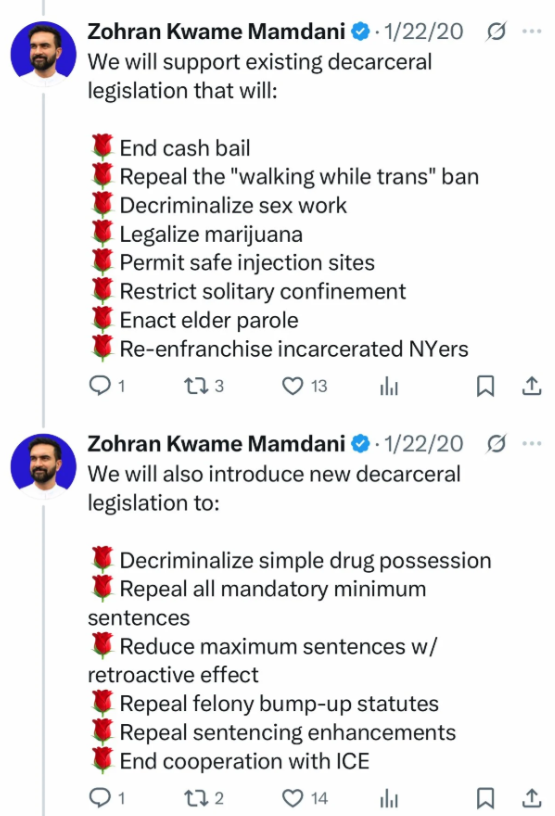
The winner of the Democratic primary is almost always subsequently elected as the mayor of New York City, so it’s fair to assume that Zohran Mamdani is going to be NYC’s next mayor. And he’s an American version of ultra-progressive former Prime Minister Justin Trudeau:

New York State Assemblymember Zohran Mamdani photographed in Assembly District 36, 10 February 2024.
Photo by Kara McCurdy via Wikimedia Commons.

American politics often seem to balance themselves out in the worst possible way. Even as the GOP sheds its last vestiges of affection for limited government and free markets, the opposition Democrats openly embrace bigotry and crazy economic nostrums. Case in point: the rise in New York City of Zohran Mamdani, an avowed socialist who flirts with antisemitism, to represent the Democratic Party in this year’s mayoral election.

The primary race in New York was a snapshot of the Democratic Party’s woes. Despite the presence of other candidates seeking the mayoral nomination, the race ultimately came down to two candidates: Mamdani and Andrew Cuomo, the disgraced former governor of New York.

Before resigning over allegations of sexual harassment, Cuomo, the 67-year-old son of another former governor, was best known for a “controversial directive that told nursing homes they couldn’t deny patients coming from hospitals admission based on a COVID-19 diagnosis”, according to StatNews. He then covered up the large number of ensuing deaths. He was the favoured candidate of the Democratic establishment and the early front-runner for the nomination.

Standing out from the pack of political hopefuls facing Cuomo was Zohran Mamdani, the 34-year-old son of an Oscar-nominated filmmaker and a Columbia University political science professor. Before being elected to the state legislature as a Democrat and a socialist, Mamdani tried his hand as a government employee and a rapper. His musical output included the song “Salaam”, which, as The Independent put it, “praised the ‘Holy Land Five’ — five men convicted in 2008 of donating over $12 million to Hamas”.

To say that New Yorkers are tired of Cuomo is a wild understatement. Like most Americans, New Yorkers are deeply sick of the old party establishment that rallied around Cuomo as well as the man himself. Yet, he was expected to walk away with the nomination and then cruise to victory in a largely one-party city.

But Mamdani sweetened the pot in the expensive metropolis with promises to freeze rent, make buses free, offer no-cost childcare, lower grocery prices with city-owned grocery stores, and use “public dollars” to build 200,000 apartments. He swears that he “knows exactly how to pay for it, too” with higher taxes on those making more than $1 million per year. Not explicitly part of his campaign, but on the record as his intention, is “the end goal of seizing the means of production”.

In the 2021 recording in which he advocated seizing the means of production, Mamdani endorsed BDS as an issue “that we firmly believe in”. The BDS movement — shorthand for “Boycott, Divestment, and Sanctions” — aims to economically pressure Israel into withdrawing from so-called “occupied territories” and allowing Palestinians to settle throughout Israel. At its extremes, BDS seeks to eliminate the world’s only Jewish-majority state. It’s inspired by the movement against South Africa’s old apartheid regime.

« Newer PostsOlder Posts »

Powered by WordPress