
Published on 26 May 2017
The 73 Anniversary of D-Day is nearly upon us so let us talk about the Luftwaffe‘s involvement in the Battle of Normandy!
June 6, 2017
Where was the Luftwaffe on D-Day? – German Response to Operation Overlord, Normandy
Comments Off on Where was the Luftwaffe on D-Day? – German Response to Operation Overlord, Normandy
June 4, 2017
The Battle of Midway, 4-7 June 1942
Last month, Victor Davis Hanson recounted the American side of the Battle of Midway, which many historians see as the turning point of the Pacific War:
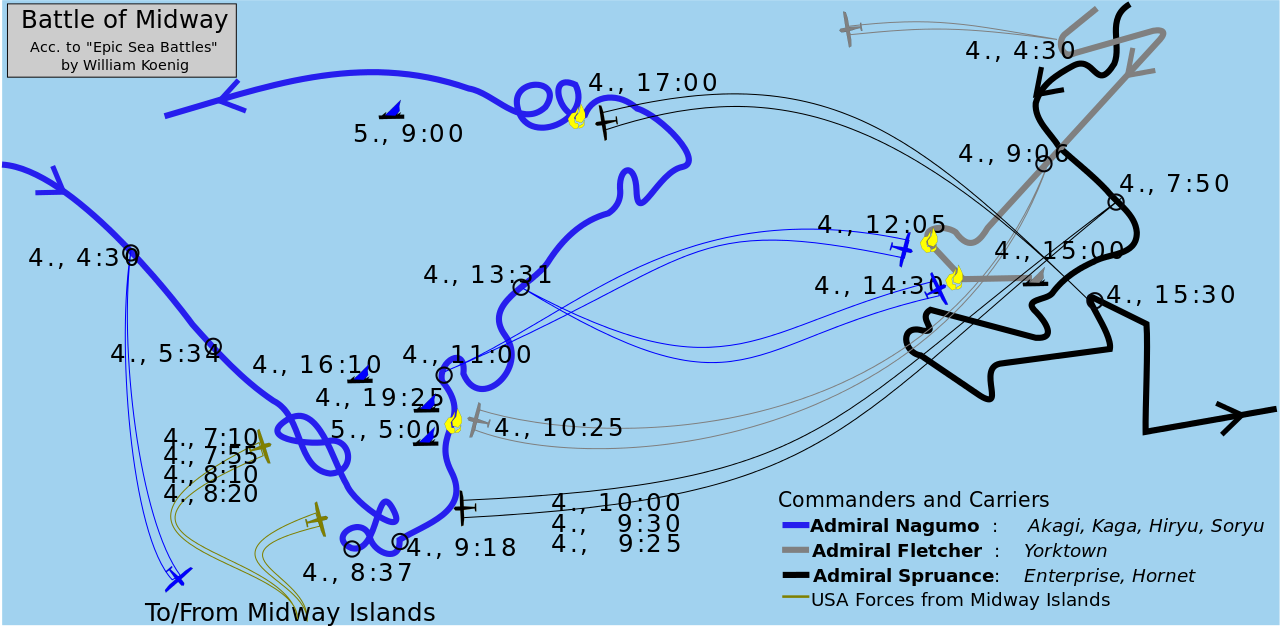
Battle of Midway deployment map, according to Seeschlachten der Weltgeschichte by William Koenig (German version of Epic Sea Battles) via Wikimedia
Seventy-five years ago (June 4-7, 1942), the astonishing American victory at the Battle of Midway changed the course of the Pacific War.
Just six months after the catastrophic Japanese surprise attack on Pearl Harbor, the U.S. crushed the Imperial Japanese Navy off Midway Island (about 1,300 miles northwest of Honolulu), sinking four of its aircraft carriers.
“Midway” referred to the small atoll roughly halfway between North America and Asia. But to Americans, “Midway” became a barometer of military progress. Just half a year after being surprised at Pearl Harbor, the U.S. Navy had already destroyed almost half of Japan’s existing carrier strength (after achieving a standoff at the Battle of the Coral Sea a month earlier).
The odds at the June 1942 battle favored the Japanese. The imperial fleet had four carriers to the Americans’ three, backed up by scores of battleships, cruisers and light carriers as part of the largest armada that had ever steamed from Japan.
No military had ever won more territory in six months than had Japan. Its Pacific Empire ranged from the Indian Ocean to the coast of the Aleutian Islands, and from the Russian-Manchurian border to Wake Island in the Pacific.
Yet the Japanese Navy was roundly defeated by an outnumbered and inexperienced American fleet at Midway. Why and how?
Comments Off on The Battle of Midway, 4-7 June 1942
May 31, 2017
“JFK before the speechwriters got to him is far more interesting”
Mark Steyn celebrates what would have been JFK’s 100th birthday by looking at the pre-Camelot JFK’s life:
Jack’s early life was certainly privileged but not idyllic. The family patriarch, Joe, is an easy target: an enthusiastic adulterer at home, and abroad, as US Ambassador to the Court of St James’s, an equally enthusiastic appeaser. His wife, Rose, reacted to his infidelities by retreating into her social life. The distance she put between her and her husband also left her nine children (four of whom she would outlive) beached on the other side of the divide. She regarded them, as one biographer put it, as “a management exercise”, and she believed in mostly hands-off management. Jack was a sickly child who spent months in hospital, but his mother was too far away to visit. Maternal affection was confined to a postcard from Paris, a ship-to-shore telegram from the Queen Mary. For the rest of his life, Kennedy disliked being touched or hugged even in the course of his many fleeting, transient sexual encounters.
Sex was fine. Anything more he found awkward and difficult. He showered up to five times a day. You can do your own analysis; everybody else does. “If he were my son,” declared a master at Choate, “I should take him to a gland specialist.” “He has never eaten enough vegetables,” decided Rose.
Duty is more easily borne when the the world’s eminences are your dinner companions. You meet the seigneurs, and you get to enjoy a little of their droit de, too. A former lover of Prince George, Duke of Kent introduced herself to young Jack as “a member of the British Royal Family by injection”. The line seemed fresh to him, as it might not have a quarter-century later were random showgirls and mob molls running around Vegas and Malibu introducing themselves as members of the Kennedy family by injection. He signed his letters from Harvard, “Stout-hearted Kennedy, despoiler of women.”
On the other hand, not many 24-year-olds get to shoot the breeze with Lord Halifax, British Ambassador in Washington, at the height of the Second World War about where the man he served as prime minister had gone wrong. “Halifax believed,” wrote young Kennedy after their conversation, “that Chamberlain was misled and defeated by his phrases, which he did not really believe in, such as ‘Peace in our time’.” By the time Kennedy got into the phrase-making business, he left it to the professionals to craft all that sing-songy seesawing jingles people seem to think meets the definition of powerful rhetoric: Ask not what your country can do for you, ask what you can do for your country. Mankind must put an end to war or war will put an end to mankind. Let us never negotiate out of fear, but let us never fear to negotiate. Mankind must put an end to cheap applause lines, but let us never fear to invert them formulaically yet portentously.
The JFK before the speechwriters got to him is far more interesting. “We are at a great disadvantage,” Kennedy the gunboat skipper writes from the Pacific. “The Russians could see their country invaded, the Chinese the same. The British were bombed, but we are fighting on some islands belonging to the Lever Company, a British concern making soap… I suppose if we were stockholders we would perhaps be doing better, but to see that by dying at Munda you are helping to ensure peace in our time takes a larger imagination than most men possess.”
Comments Off on “JFK before the speechwriters got to him is far more interesting”
May 18, 2017
World of Warships – HMS Hood
Published on 17 May 2017
Look up in the sky! Is it a bird? Is it a plane? No don’t be silly, it’s HMS Hood. Bugger off with your Superman jokes, Jingles.
Comments Off on World of Warships – HMS Hood
May 16, 2017
The Virtual Lorenz machine
At The Register, Gareth Corfield discusses the new virtual coding device simulating the WW2 German Lorenz cipher machine:
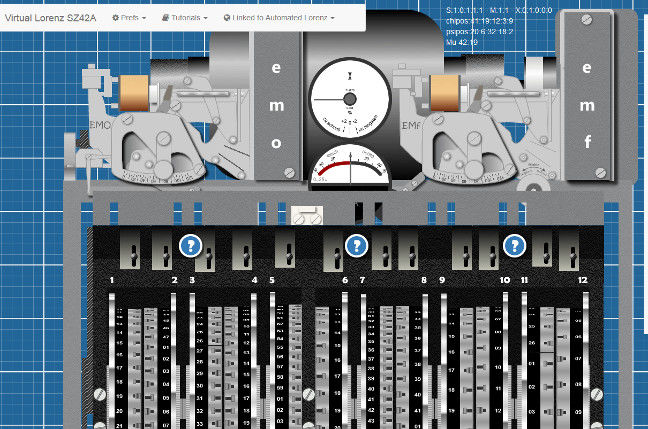
The National Museum of Computing has put an emulation of an “unbreakable” Second World War German cipher machine online for world+dog to admire.
The Virtual Lorenz machine has been launched in honour of WW2 codebreaker Bill Tutte, the man who broke the crypto used in the twelve-rotor cipher machine.
As The National Museum of Computing (TNMOC) puts it, Tutte’s work “shortened the conflict” – even though he had never even seen the cipher machine or its crypto scheme, the breaking of which the museum added was “the greatest intellectual feat of the war”.
TNMOC unveiled the Virtual Lorenz today to celebrate Tutte’s 100th birthday. Built by computing chap Martin Gillow, the simulation accurately reproduces the whirring of the cipher wheels (you might want to turn it down as the “background whirr” is a little too realistic).
The BBC profiled the “gifted mathematician” a few years ago, highlighting how the Lorenz machine whose secrets Tutte cracked was “several degrees more advanced than Enigma”, the cipher famously cracked by Tutte’s colleague Alan Turing. Tutte cracked the Lorenz in about six months, reverse-engineering its workings by reading intercepted Lorenz messages. When the Allies wanted to fool Hitler into believing the D-Day landings would take place in a false location, our ability to read Lorenz was critical for confirming that the ruse had worked – saving thousands of soldiers, sailors and airmen’s lives.
[…]
The Virtual Lorenz can be found here. Word to the wise – it’s not on an HTTPS site, so if you’re hoping to use it to thwart GCHQ, you might want to think again.
Comments Off on The Virtual Lorenz machine
May 9, 2017
Historical ingratitude
In the latest Libertarian Enterprise, D.J. Webb asks what Europe — individual European nations, not the EU — owe to Britain:
I do believe that historical perspective is important, and that we should deal with other nations on the basis of historical memory. For example, we recall in our dealings with Greece and Italy that these countries have been of vital importance to the historical development of civilization in Europe, and at a long remove, we should be cognizant of the cultural and economic advantages bestowed on the Roman province of Britannia by the Romans. At a minimum, they evoke in us a residual affection. Of course, as history recedes, the ability of these countries to demand a special status owing to their illustrious history has to decline too. But some recognition of the achievements of the most glorious nations and what they have done for all of European civilization is in order.
Britain is a special country — we are told in the media and in the schools today that this is not the case — but a cursory reading of history shows that we are of vital importance to Europe. Economically, we gave the world the industrial revolution and capitalism. Politically, democracy and human rights (even where absurdly misinterpreted) are among our gifts to the world. Culturally, literature, drama and film are among the arts to which we have made great contributions that remain to this day part of the canon of world literature. Scientifically, Europe looks to us for having provided electricity, railways, automobiles, planes, computers, the telephone, television and the Internet. It is not an exaggeration to state that the prosperity of the whole of Europe, and indeed of every country in the world, comes on the back our our ancestors’ — and not their ancestors’ — achievements. English children should grow up with a knowledge of and pride in this.
Geopolitically, we have always sought to prevent combinations on the Continent, and stood against the Habsburgs and Imperial Spain, Napoleonic France, the Kaiser’s Germany and Nazi Germany. We also made an outsized contribution in the Cold War. Numerous European countries owe their freedom to us. I do not deny that historical memory works both ways. Maybe — I say this for the purpose of discussion — the prominence of Polish airmen in the Battle of Britain provides us with good reason to take, if possible and where facilitated by Poland’s own foreign policy, a pro-Polish view of modern international affairs, and if we need immigrants going forward, we could well consider prioritising Poland, as well as Czechs, Belgians, Frenchmen, Canadians, Australians and New Zealanders, all represented in the Battle of Britain. However, there is no other European country that can lay claim to being the author of European freedom. True, Russian blood was expended to an immense degree in the defeat of Germany, but many European countries will be mindful that Russia was ultimately engaged in its own war of imperial conquest of Eastern Europe.
We are special, and do deserve recognition in Europe. Yet we get none. Or less than none, as all 27 EU countries have agreed to try to punish Britain for asserting its sovereignty. Would Luxembourg be free today without Britain? Jean-Claude Junker’s treatment of Britain is disgusting from a Luxembourgeois national. Does he not know that Luxemburgers huddled round the wireless in the 1940s listening to the World Service, hoping or praying that Britain or America would come to their salvation? I cannot abide the continental Europeans who refuse to acknowledge this. They will end up making an enemy of Britain, with long-term consequences.
It’s time to realise that the European nations we liberated were not worth it. They turned out to be ingrates. We need to face up to this. We wasted the lives of our servicemen for nothing. Who would wage war to liberate Belgium now?
May 2, 2017
Tank Chats #8 Renault FT-17
Published on 4 Aug 2015
The eight in a series of short films about some of the vehicles in our collection presented by The Tank Museum’s historian David Fletcher MBE.
Conceived by General Jean-Baptiste Estienne and manufactured under the control of the Renault Company this was the world’s first mass-produced tank, 3800 being built in all.
They went into action for the first time on 31 May 1918 near Ploissy-Chazelle and proved very successful when they were used in numbers. British forces used a few Renaults as liaison vehicles while the United States Army used them in combat and copied the design.
Comments Off on Tank Chats #8 Renault FT-17
April 16, 2017
QotD: The fascination of Hitler and Nazi Germany
This morning I read Marina Fontaine’s review of Downfall (http://marinafontaine.blogspot.com/2017/03/netflix-review-downfall.html), yes, including mention of that scene, the one that’s been recaptioned several gazillion times, some with more humor than others. In the review, she asks why the fascination? What is it with the Nazis and Hitler?
I have a theory. It is purely mine, based on reading a metric crap-ton about all manner of things (and don’t ask me for cites because this stuff has stewed so long in the back of my head I no longer remember where I originally read whatever triggered any particular piece. You can get most of the raw facts off Wikipedia). It is also a very broad generalization. Coming years will determine whether or not it is correct in the big picture. I’m not optimistic (I hope I’ve got this horribly wrong. I fear I haven’t).
Okay. So.
The ongoing fascination with Hitler and Nazi Germany.
Simply put, it’s the most well-documented and acknowledged demonstration of the allure of evil and how easy it is for a more or less civilized people to descend into utter brutality. As such, it holds an unclean fascination not helped by uniforms that were designed to look good as well as be practical (or by the simple fact that evil, when done effectively, is sexy. Because it is invariably power, and untrammeled power at that. We’re human. Power attracts and corrupts us. The wiser among us acknowledge this so we can fight the effect).
The various Communist regimes can be dismissed as “not counting” because to the minds of those who do the dismissing, Russia, China, North Korea, and Eastern Europe “weren’t civilized”, and so Communism/Socialism would work just fine implemented by civilized people (they usually point to one of the Nordic nations when they do this). These same people are a big part of why the wrong lesson keeps being drawn from Nazi Germany.
The problem was not nationalism. It was not even the disgusting racial laws. Those laws could never have been passed, much less enforced, without the one big thing Socialism, Communism, and yes, Nazism have in common.
The supremacy of the state.
[…]
That bare listing of facts accounts for the rise of Hitler, but not the continuing notion that the Nazis were conservative (only if you define ‘conservative’ as ‘nationalist’). That one comes from two sources. One was Soviet propaganda aimed at making Communist and Nazi ideologies seem much more distinct than they actually were. The other was Allied propaganda aimed at much the same thing. It wouldn’t do, after all, to have people realize they were allied with a dictator every bit as vile as Hitler.
So in American and British media, the evil of the Nazis was played up, while the evil of the Communists was minimized where it couldn’t be silenced altogether. The Communist plants and fellow-travelers in both nations helped.
They were – and are – almost the same. Both demand an all-powerful state. The state determines who is deserving and provides for the deserving. The state dehumanizes the undeserving prior to eliminating them. The state determines the direction of industry (in the case of the Nazis, by requiring business owners to support the regime where the Communists took over the businesses). The state cares for you – but if you’re no use to the state, your care will be an unmarked grave in a prison camp/work camp/concentration camp/gulag. All hail the state.
Kate Paulk, “The Ease of Evil”, guest-posting at According to Hoyt, 2017-03-21.
Comments Off on QotD: The fascination of Hitler and Nazi Germany
April 15, 2017
Tank Chats #6 Vickers Light MKVI B
Published on 5 Jun 2015
The first mass-produced British tank.
Being, in terms of numbers, the most significant British tank at the outbreak of war, the Mark VIB saw service with the British Expeditionary Force in France, the Eighth Army in North Africa and in various subsidiary theatres. As a reconnaissance vehicle it was satisfactory, as a fighting tank quite useless since armour protection was minimal and the armament ineffective against enemy tanks.
Comments Off on Tank Chats #6 Vickers Light MKVI B
April 9, 2017
Tank Chats #5 Lanchester Armoured Car
Published on 7 May 2015
Lanchester Armoured Cars were produced by the The Lanchester Company at the request of the War Office, during late 1920’s and 30’s.
The long chassis was fitted with a large armoured body that mounted two machine guns in a turret as well as a third, optional, hull mounted gun. The Lanchesters turned out to be much too big for reconnaissance duties and were almost impossible to turn around on the narrow roads found in Britain at that time. Only 39 cars were issued.
Comments Off on Tank Chats #5 Lanchester Armoured Car
April 6, 2017
American “isolationism” between the wars
Reason‘s Jesse Walker linked to this article by Andrew Bacevich which helps to debunk the routine description of US foreign policy between the first and second world wars as “isolationism”:
… McCain is worried about the direction of world events, with Russian provocations offering but one concern among many. Patterson shares McCain’s apprehensions, compounded by what he sees as a revival of “the isolationism in Europe and America that precipitated World War II.”
Now as an explanation for the origins of the war of 1939-1945, American “isolationism” is as familiar as the sweet-and-sour pork featured at your local Chinese takeout joint. Its authenticity is equally dubious. Yet Patterson’s assertion has this virtue: It captures in less than a sentence a prime obstacle to instituting a realistic, fact-based approach to foreign policy.
In truth, isolationism is to history what fake news is to journalism. The oft-repeated claim that in the 1920s and 1930s the United States raised the drawbridges, stuck its head in the sand, and turned its back on the world is not only misleading, but also unhelpful. Citing a penchant for isolationism as a defect afflicting the American character is like suggesting that members of Congress suffer from a lack of self-esteem. The charge just doesn’t square with the facts, no matter how often repeated.
Here, by way of illustrating some of those relevant facts, is a partial list of places beyond the boundaries of North America, where the United States stationed military forces during the interval between the two world wars: China, the Philippines, Guam, Hawaii, Panama, Cuba, and Puerto Rico. That’s not counting the U.S. Marine occupations of Nicaragua, Haiti, and the Dominican Republic during a portion of this period. Choose whatever term you like to describe the U.S military posture during this era — incoherent comes to mind — but isolationism doesn’t fill the bill.
As for Patterson’s suggestion that the behavior of the United States “precipitated” World War II, the claim is simply laughable. World War I precipitated World War II, or more specifically the European malaise resulting from the bloodletting of 1914-1918, compounded by the Bolshevik Revolution and the spread of fascism, and further exacerbated by profoundly shortsighted policies pursued by Great Britain and France. Throw into the mix the Great Depression, Japanese imperial ambitions, and the diabolical plotting of Adolf Hitler and his henchmen, and you have the makings of a catastrophe. Some few observers foresaw that catastrophe, but preventing it lay well beyond the ability of the United States, even if U.S. leaders had been clairvoyant.
Comments Off on American “isolationism” between the wars
March 30, 2017
How Germany’s Victories weakened the Japanese in World War 2
Published on 24 Mar 2017
This video gives you a short glimpse on how the war in Europe had a detrimental effect on the Japanese Economy.
Military History Visualized provides a series of short narrative and visual presentations like documentaries based on academic literature or sometimes primary sources. Videos are intended as introduction to military history, but also contain a lot of details for history buffs. Since the aim is to keep the episodes short and comprehensive some details are often cut.
Comments Off on How Germany’s Victories weakened the Japanese in World War 2
March 24, 2017
David Fletcher’s Tank Chats #2: The Carden Loyd Carrier
Published on 27 Feb 2015
The second in a series of short films about some of the vehicles in our collection presented by The Tank Museum’s historian David Fletcher MBE.
The Carden Loyd Carrier or tankette: Designed by Sir John Carden and Captain Vivian Loyd this was a low cost, two-man Machine-Gun Carrier for infantry use. The company was taken over by Vickers-Armstrong in 1927 and the vehicle was mass-produced for the British Army in addition to a thriving export trade. Unpopular with the infantry, they were used mostly by the Royal Tank Corps as embryonic light tanks in the reconnaissance role.
Comments Off on David Fletcher’s Tank Chats #2: The Carden Loyd Carrier
March 6, 2017
David Fletcher’s Tank Chats #1: The A13 Cruiser
Published on 13 Feb 2015
The first in a series of short films about some of the vehicles in our collection presented by The Tank Museum’s historian David Fletcher MBE.
The A13 was the first British tank to have Christie Suspension. With a top speed of 40 miles per hour, it was much faster than the German Panzers, and had one of the best guns of its time. Despite this, many were lost in the battle for France in 1940. They fared better in the desert when their speed enabled them to cut off and defeat a huge Italian Army at Beda Fomm in Libya.
Comments Off on David Fletcher’s Tank Chats #1: The A13 Cruiser
February 11, 2017
QotD: The Nazi Final Solution in Denmark and Bulgaria
… most nations of Central and Eastern Europe were occupied by or allied with Germany during this period. The Nazis made it clear that deporting their Jews to the concentration camps in Nazi territory was a condition for continued good relations; a serious threat, when bad relations could turn a protectorate-type situation into an outright invasion and occupation.
Pride of place goes to Denmark and Bulgaria, both of which resisted all Nazi demands despite the Germans having almost complete power over them. Most people have heard the legend of how, when the Germans ordered that all Jews must wear gold stars, the King of Denmark said he would wear one too. These kinds of actions weren’t just symbolic; without cooperation from the Gentile population and common knowledge of who was or wasn’t Jewish, the Nazis had no good way to round people up for concentration camps. Nothing happened until 1943, when Himmler became so annoyed that he sent his personal agent Rolf Gunther to clean things up. Gunther tried hard but found the going impossible. Danish police refused to go door-to-door rounding up Jews, and when Gunther imported police from Germany, the Danes told them that they couldn’t break into apartments or else they would arrest them for breaking and entering. Then the Danish police tipped off Danish Jews not to open their doors to knocks since those might be German police. When it became clear that the Nazis weren’t going to accept any more delays, Danish fishermen offered to ferry Jews to neutral Sweden for free. In the end the Nazis only got a few hundred Danish Jews, and the Danish government made such a “fuss” (Arendt’s word) about them that the Nazis agreed to send them all to Theresienstadt, their less-murderous-than-usual camp, and let Red Cross observers in to make sure they were treated well. In the end, only 48 Danish Jews died in the entire Holocaust.
Bulgaria’s resistance was less immediately heroic, and looked less like the king proudly proclaiming his identity with oppressed people everywhere than with the whole government just dragging their feet so long that nothing got done. Eichmann sent an agent named Theodor Dannecker to get them moving, but as per Arendt:
not until about six months later did they take the first step in the direction of “radical” measures – the introduction of the Jewish badge. For the Nazis, even this turned out to be a great disappointment. In the first place, as they dutifully reported, the badge was only a “very little star”; second, most Jews simply did not wear it; and, third, those who did wear it received “so many manifestations of sympathy from the misled population that they actually are proud of their sign” – as Walter Schellenberg, Chief of Counterintelligence in the R.S.H.A., wrote in an S.D. report transmitted to the Foreign Office in November, 1942. Whereupon the Bulgarian government revoked the decree. Under great German pressure, the Bulgarian government finally decided to expel all Jews from Sofia to rural areas, but this measure was definitely not what the Germans demanded, since it dispersed the Jews instead of concentrating them.
The Bulgarians continued their policy of vaguely agreeing in principle to Nazi demands and then doing nothing, all the way until the Russians invaded and the time of danger was over. The result was that not a single Bulgarian Jew died in the Holocaust.
Scott Alexander, “Book review: Eichmann in Jerusalem”, Slate Star Codex, 2017-01-30.
Comments Off on QotD: The Nazi Final Solution in Denmark and Bulgaria


