
World War Two
Published on 16 Mar 2019The Winter War is over. The Allies tried to stall the Finns for as long as possible to justify their invasion of Norway, but the Finns have had it and don’t trust the British and French to come to their aid. This week, the Finns sign a peace agreement with the Soviet in Moscow.
Join us on Patreon: https://www.patreon.com/TimeGhostHistory
Or join The TimeGhost Army directly at: https://timeghost.tvFollow WW2 day by day on Instagram @World_war_two_realtime https://www.instagram.com/world_war_t…
Between 2 Wars: https://www.youtube.com/playlist?list…
Source list: http://bit.ly/WW2sourcesWritten and Hosted by: Indy Neidell
Produced and Directed by: Spartacus Olsson and Astrid Deinhard
Executive Producers: Bodo Rittenauer, Astrid Deinhard, Indy Neidell, Spartacus Olsson
Creative Producer: Joram Appel
Research by: Indy Neidell
Edited by: Iryna Dulka
Map animations: EastoryPhotos of the Winter War are mostly from the Finnish Wartime Photograph Archive (SA-Kuva).
Eastory’s channel: https://www.youtube.com/channel/UCEly…
Archive by Screenocean/Reuters https://www.screenocean.comA TimeGhost chronological documentary produced by OnLion Entertainment GmbH.
March 17, 2019
The Soviets Finish a Costly Winter War – WW2 – 029 – March 16 1940
Book Review: FN Browning Pistols by Anthony Vanderlinden
Forgotten Weapons
Published on 17 Feb 2019Get your copy here:
https://www.wetdogstore.com/NEW-FN-BR…Anthony Vanderlinden is a noted FN collector and author of a book on FN Mauser rifles as well as this volume on FN’s Browning pistols. Both are excellent reference works, with a remarkable amount of contextual information in addition to the very specific detail that appeal to the collector. This work begins with about 70 pages on the history of the FN company, detailing its work in firearms, automobiles, and other products through the Great War, the Great Depression, World War Two, and other events. It then spends a period discussing unique and interesting FN pistols, like the presentation guns made for FN’s celebration of producing a million Browning pistols and the guns used by Gavrilo Princip and his cohorts in the assassination of the Archduke Franz Ferdinand. There are then sections on FN’s association with John Browning and on Browning himself, and on the markings and proofs used by FN throughout its history.
The remaining bulk of the book is broken up into chapters covering the development, production, and use of each model of Browning pistol produced by FN (namely the 1899/1900, 1903, 1905, 1910, 1922, Baby Browning, and High Power). These chapters do an excellent job of providing information on the early development of the guns as well as the commercial and military production, often broken down by the different contracts for each model. For instance, the 1922 chapter includes sections on Yugoslav, Dutch, Mexican, Greek, Turkish, French, Romanian, Danish, Finnish, and German procurement of those pistols. For the historian, the context presented does an excellent job of explaining each gun’s significance in larger events. For the collector, the attention to the details of differences in marking and production between each different variant is thorough and very useful.
My only real complaint would be that the book is entirely in black and white. While that does not really hinder the purpose of the photographs in showing variations and such, color photographs would make it nicer to look at. The book was first printed in 2009, with a revised and expanded second edition printed in 2013. That second edition is available direct from Wet Dog Publications for $67.95 plus shipping, and also from Amazon.
http://www.patreon.com/ForgottenWeapons
Cool Forgotten Weapons merch! http://shop.bbtv.com/collections/forg…
Contact:
Forgotten Weapons
PO Box 87647
Tucson, AZ 85754
March 15, 2019
Charles De Gaulle
Colby Cosh linked to an interesting Peter Hitchens review of a recent biography of Charles De Gaulle (De Gaulle by Julian Jackson):
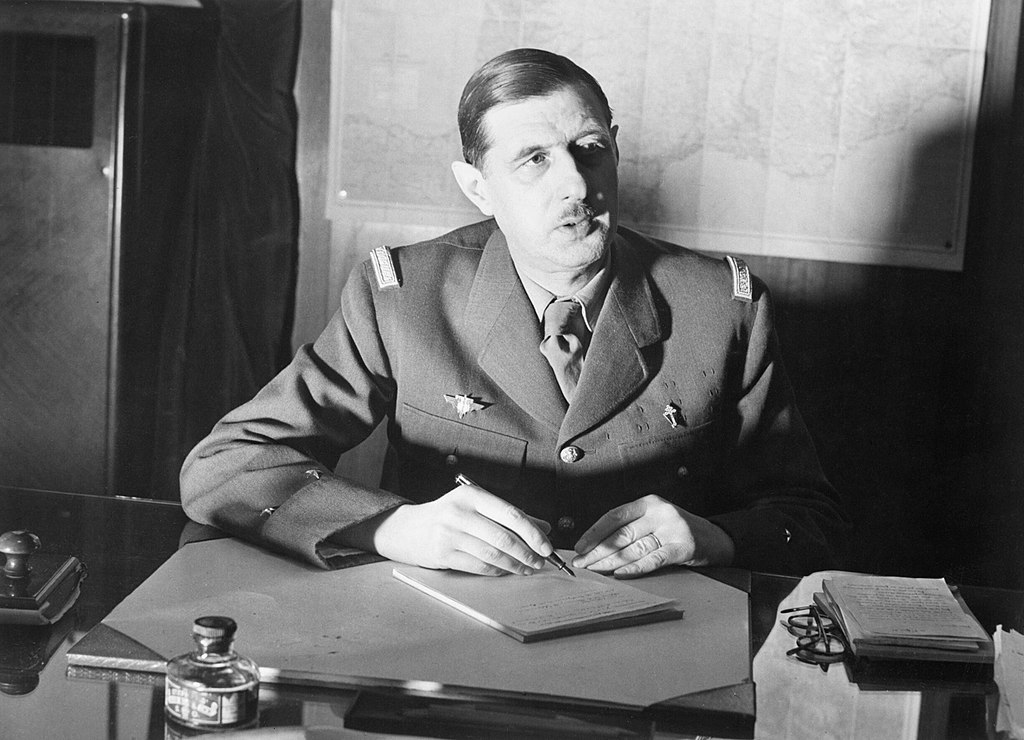
General Charles de Gaulle, Commander of Free French Forces, seated at his desk in London during the Second World War.
Photo via Wikimedia Commons.
When it came to what de Gaulle thought was the pivotal moment in his life, when he could become virtual monarch of France under conditions chosen wholly by himself, he was as ruthless as Lenin. He had, it is often said, a “certain idea of France.” But the ultra-conservative lawyer, Jacques Isorni, whose clients included the collaborationist Vichy leader Marshal Philippe Pétain and de Gaulle’s would-be assassin, Jean-Marie Bastien-Thiry, concluded that it was “an abstract idea of France, indifferent to the sufferings of the French people.” There is something to this. De Gaulle represented the steely warlike France, summoned up by Bonaparte and again a century later at Verdun, for which the French were required to die and mourn uncomplainingly. For him, Paris was well worth a lie or a betrayal, because his supremacy was so essential for the country he loved.
The costs of de Gaulle’s idea of France were high. As the general himself once mused, “There is no action in which the devil has no part.” The two massacres, and the charnel-house stench which clings to them, are evidence of the reliable rule that even — often especially — the greatest and best of men have terrible flaws and can do terrible things; and also of the other rule that power tends to corrupt. I have begun with them because they are a necessary antidote to the feelings of admiration and liking which any reader of this thrilling, witty, ceaselessly moving, beautifully written account of a truly great man is bound to feel.
Charles de Gaulle’s life would perhaps have been better lived in the seventeenth or eighteenth century, in times when personal courage, mystical imagination, chivalry, and religious fervor were more welcome than they are now. In this world of the United Nations, risk assessment, lawyers, Geneva Conventions, television and superpowers, there is not really enough room for such a man to swing his sword, just as there is no room for old-fashioned great powers in the shadow of superpowers. Had he not been so magnificent, he would have been ridiculous. He looked, more than anything else, like a camel, not least because of the superior expression on his face suggesting that he alone knew the secret One Hundredth Name of God, which camels are supposed to know.
He was filled with shining, old-fashioned beliefs about honor, courage, shame and humiliation, glory and infamy. And as those who conversed with him found, he was perhaps the last great man to make it his business to know those things that it is proper for a king to know. He could talk fluently with philosophers and literary novelists. He had a minute knowledge of history: not just that of France, but of Europe and the world. After many, many conversations with Winston Churchill, a large number of them furious quarrels, he concluded that England’s savior was not in fact very intelligent. He believed wartime, with its austerity and tests of manhood, was more virtuous than peacetime. He believed nothing important could be achieved without recklessness. He stood up to people with considerable courage, even when he was a powerless and lonely figure without soldiers, money, or supporters. He once justified his bloody-minded awkwardness by pointing out that if he were not so difficult, he would himself have been a collaborator. He said “If I were easy to work with, I would be on Marshal Petain’s staff.” He had no time for people like himself. He confessed, “I only esteem those who stand up to me but unfortunately I cannot stand them.”
De Gaulle possessed that great chivalrous virtue of being ready to walk unbowed and defiant in front of the powerful, while being gentle and even submissive to the defenseless and weak. He once became so angry with Churchill that he smashed a chair in his presence to emphasize his rage. Likewise, he defied Franklin Roosevelt over and over again. But he would go home after these battles to sing tender love songs to his daughter Anne, who suffered from Down syndrome. The tiny glimpses we have of this part of his life, obtained from the accidental observations of others, tear at the heart. His concern for Anne was entirely private and not at all feigned. After any long absence from home his first act was to rush up to her room. She died, aged twenty, in his arms. At her funeral, he comforted his wife Yvonne with the words, “Maintenant, elle est comme les autres” (“Now she is like the others”), which must be one of the most moving things said in the whole twentieth century.
“Talvisota” – The Winter War – Sabaton History 006
Sabaton History
Published on 14 Mar 2019This war is modern version of David versus Goliath. The Sabaton song “Talvisota” (from The Art of War album) is about the Winter War that took place in late 1939 till the early spring of 1940 between Finland and the Soviet union. Against all odds, and overwhelming numbers of Red Army soldiers, the Finnish army manage to hold off the Soviet advance for longer than anyone could have foreseen.
Support Sabaton History on Patreon: https://www.patreon.com/sabatonhistory
Hosted by: Indy Neidell
Written by: Markus Linke and Indy Neidell
Directed by: Astrid Deinhard and Wieke Kapteijns
Produced by: Pär Sundström, Astrid Deinhard and Spartacus Olsson
Creative Producer: Joram Appel
Executive Producers: Pär Sundström, Joakim Broden, Tomas Sunmo, Indy Neidell, Astrid Deinhard, and Spartacus Olsson
Maps by: Eastory
Edited by: Wieke Kapteijns
Sound Editing by: Marek KaminskiEastory YouTube Channel: https://www.youtube.com/channel/UCEly…
Archive by: Reuters/Screenocean https://www.screenocean.com
Music by Sabaton.An OnLion Entertainment GmbH and Raging Beaver Publishing AB co-Production.
© Raging Beaver Publishing AB, 2019 – all rights reserved.
March 10, 2019
Finnish Winter is Almost Over – WW2 – 028 – March 9 1940
World War Two
Published on 9 Mar 2019The French promise to send troops to aid Finland, though the majority is planned to go to Norway or Sweden. In return, the Finns postpone their peace talks with the Soviets. It is at that moment that the Finns realise that the French are playing tricks and the Soviets are not to be messed with. It’s deal or no deal, and they need to decide quick.
Thumbnail depicts an unnamed Red Army PoW towards the end of the Winter War – colorisation by Jared Enos
Join us on Patreon: https://www.patreon.com/TimeGhostHistory
Or join The TimeGhost Army directly at: https://timeghost.tvFollow WW2 day by day on Instagram @World_war_two_realtime https://www.instagram.com/world_war_t…
Between 2 Wars: https://www.youtube.com/playlist?list…
Source list: http://bit.ly/WW2sourcesWritten and Hosted by: Indy Neidell
Produced and Directed by: Spartacus Olsson and Astrid Deinhard
Executive Producers: Bodo Rittenauer, Astrid Deinhard, Indy Neidell, Spartacus Olsson
Creative Producer: Joram Appel
Research by: Indy Neidell
Edited by: Iryna Dulka
Map animations: EastoryThumbnail and portrait colorizations by Norman Stewart.
Photos of the Winter War are mostly from the Finnish Wartime Photograph Archive (SA-Kuva).
Eastory’s channel: https://www.youtube.com/channel/UCEly…
Archive by Screenocean/Reuters https://www.screenocean.comA TimeGhost chronological documentary produced by OnLion Entertainment GmbH.
From the comments:
World War Two
2 days ago
It doesn’t look too good for the Finns this week. Peace talks are more and more becoming their only way out of this war. The Soviets are looking to gain as much leverage to benefit their position in the talks. Meanwhile, the Finnish try to do the same, and focus their defence on diplomatic key points instead of long term defensive strategies.Note that we have launched our first episode of the War Against Humanity this week, in which we will discuss the war crimes committed by all sides. The first episode covers the first six months of the war up until March 5 1940, the day on which Joseph Stalin and Beria order the Katyn Massacre. You can find that episode right here: https://www.youtube.com/watch?v=gd5YhhNcC44&
March 7, 2019
Outbreak of the War Against Humanity – WW2 – WaH 001 – 5 March 1940
World War Two
Published on 6 Mar 2019When the Second World War breaks out, it is at first largely a war between one side of totalitarian aggressors against a portion of the democratic countries of the world defending other totalitarian states. From the first day of the war in Poland, as it already is in China, this will be a war against humanity.
Join us on Patreon: https://www.patreon.com/TimeGhostHistory
Or join The TimeGhost Army directly at: https://timeghost.tvFollow WW2 day by day on Instagram @World_war_two_realtime https://www.instagram.com/world_war_t…
Between 2 Wars: https://www.youtube.com/playlist?list…
Source list: http://bit.ly/WW2sourcesWritten and Hosted by: Spartacus Olsson
Produced and Directed by: Astrid Deinhard
Executive Producers: Bodo Rittenauer, Astrid Deinhard, Indy Neidell, Spartacus Olsson
Creative Producer: Joram Appel
Post Production Director: Wieke Kapteijns
Research by: Spartacus Olsson
Edited by: Spartacus Olsson and Wieke KapteijnsArchive by Screenocean/Reuters https://www.screenocean.com
A TimeGhost chronological documentary produced by OnLion Entertainment GmbH.
From the comments:
World War Two
47 minutes ago (edited)
READ THIS AND OUR RULES BEFORE COMMENTING Here it is with some slight delay – the first episode of War Against Humanity, written and hosted by Spartacus Olsson. Due to the delay, this video went public on YouTube and was not in Preview for the TimeGhost army – we apologise for this – the next WaH video will be given in advance. To be clear it is the support of the TimeGhost army that enables us to continuously expand and improve our coverage – if you haven’t already, consider signing up on timeghost.tv or https://www.patreon.com/TimeGhostHistory – Now, we have age-restricted this video of our own accord because of the extremely graphic content in some sections. While we are of the opinion that it should be available for anyone over the age of 15, YouTube does not offer us that possibility. We apologise to our viewers that are in that bracket, but we felt that it was more important to protect children from exposure to this kind of violence without the help of an adult to digest it.
March 3, 2019
Hitler Plans His New Wars – WW2 – 027 – March 2 1940
World War Two
Published on 2 Mar 2019The German plans for the invasion of Western Europe start taking shape. Manstein’s plan is innovative, bold and controversial, but Hitler likes it. If everything goes according to his plan, the Germans will be celebrating their victory in Paris come spring.
Join us on Patreon: https://www.patreon.com/TimeGhostHistory
Or join The TimeGhost Army directly at: https://timeghost.tvFollow WW2 day by day on Instagram @World_war_two_realtime https://www.instagram.com/world_war_t…
Between 2 Wars: https://www.youtube.com/playlist?list…
Source list: http://bit.ly/WW2sourcesWritten and Hosted by: Indy Neidell
Produced and Directed by: Spartacus Olsson and Astrid Deinhard
Executive Producers: Bodo Rittenauer, Astrid Deinhard, Indy Neidell, Spartacus Olsson
Creative Producer: Joram Appel
Research by: Indy Neidell
Edited by: Iryna Dulka
Map animations: EastoryPortrait colorizations by Norman Stewart.
Photos of the Winter War are mostly from the Finnish Wartime Photograph Archive (SA-Kuva).
Eastory’s channel: https://www.youtube.com/channel/UCEly…
Archive by Screenocean/Reuters https://www.screenocean.comA TimeGhost chronological documentary produced by OnLion Entertainment GmbH.
Tank Chats #43 Matilda I | The Tank Museum
The Tank Museum
Published on 22 Dec 2017Development of Matilda I began in 1935. Production began just before the outbreak of the Second World War in July 1939 and 139 vehicles were delivered by August 1940. 97 of these were lost after the evacuation of troops from Dunkirk, without having had much use. The rest were removed from British service in 1941, but captured vehicles stayed in German service in domestic security roles.
Support the work of The Tank Museum on Patreon: ► https://www.patreon.com/tankmuseum
Or donate http://tankmuseum.org/support-us/donateVisit The Tank Museum SHOP: ►https://tankmuseumshop.org/
Twitter: ► https://twitter.com/TankMuseum
Tiger Tank Blog: ► http://blog.tiger-tank.com/
Tank 100 First World War Centenary Blog: ► http://tank100.com/ #tankmuseum #tanks
March 2, 2019
Rommel, German Press and Polish Resistance – WW2 – OOTF 001
World War Two
Published on 28 Feb 2019This is the very first episode of Out of the Foxholes, in which we answer questions from the community. In this first edition, we’ll talk about the early-war career of Erwin Rommel, German press on the invasion of Poland and the birth of Polish resistance movements after the German occupation in 1939.
Join us on Patreon: https://www.patreon.com/TimeGhostHistory
Or join The TimeGhost Army directly at: https://timeghost.tv
Between 2 Wars: https://www.youtube.com/playlist?list…
Written and Hosted by: Indy Neidell
Produced and Directed by: Spartacus Olsson and Astrid Deinhard
Creative Producer: Joram Appel
Executive Producers: Bodo Rittenauer, Astrid Deinhard, Indy Neidell, Spartacus Olsson
Research by: Joram Appel and Spartacus Olsson
Edited by: Joram Appel and Spartacus OlssonA TimeGhost chronological documentary produced by OnLion Entertainment GmbH
From the comments:
World War Two
20 hours ago
Hey all! We are here with the very first episode of Out of the Foxholes in which we answer YOUR questions. Because we would like to be a little more reactive, Spartacus and Joram will also occasionally answering the questions, but rest assured, we’ll never replace Indy. Do you have a question on your own? Don’t just write it in the comments, but submit it on our community Forum by adding it as a topic (read the instructions first please) -> https://community.timeghost.tv/c/Out-of-the-Foxholes-QsCheers,
Joram
March 1, 2019
“To Hell and Back” – Audie Murphy – Sabaton History 004
Sabaton History
Published on 28 Feb 2019In “To Hell and Back” (on the Heroes album), Sabaton sings about an actor, singer and one of the most remarkable heroes of World War Two. Audie Murphy served and fought in many different locations of the Second World War, which resulted in him being the most decorated soldier in the US army during WW2. “To Hell and Back” is about his actions during and after the landings at Anzio during the Allied campaign in Italy.
Support Sabaton History on Patreon: https://www.patreon.com/sabatonhistory
Watch the official video for “To Hell And Back” here: https://www.youtube.com/watch?v=RhmHS…
Hosted by: Indy Neidell
Written by: Markus Linke and Indy Neidell
Directed by: Astrid Deinhard and Wieke Kapteijns
Produced by: Pär Sundström, Astrid Deinhard and Spartacus Olsson
Creative Producer: Joram Appel
Executive Producers: Pär Sundström, Joakim Broden, Tomas Sunmo, Indy Neidell, Astrid Deinhard, and Spartacus Olsson
Maps by: Eastory
Edited by: Iryna Dulka
Sound Editing by: Marek KaminskiEastory YouTube Channel: https://www.youtube.com/channel/UCEly…
Archive by: Reuters/Screenocean https://www.screenocean.comMusic by Sabaton.
Dennis Henson – sirnossi@gmx.net
Youtube: https://www.youtube.com/user/SirNossi
Twitch: https://www.twitch.tv/SirNossiAn OnLion Entertainment GmbH and Raging Beaver Publishing AB co-Production.
© Raging Beaver Publishing AB, 2019 – all rights reserved.
February 24, 2019
Manstein Makes a Plan and Hitler has a Man Crush – WW2 – 026 – February 23 1940
World War Two
Published on 23 Feb 2019German General Erich von Manstein has a cunning plan. And as it happens, it’s just how Hitler likes it. This week, the German war plans change quite drastically. In the meantime, the Soviet Red Army continues it push through the Finnish Mannerheim line, except for a stubborn Finnish pocket of resistance at Taipale.
Join us on Patreon: https://www.patreon.com/TimeGhostHistory
Or join The TimeGhost Army directly at: https://timeghost.tvFollow WW2 day by day on Instagram @World_war_two_realtime https://www.instagram.com/world_war_t…
Between 2 Wars: https://www.youtube.com/playlist?list…
Source list: http://bit.ly/WW2sourcesWritten and Hosted by: Indy Neidell
Produced and Directed by: Spartacus Olsson and Astrid Deinhard
Executive Producers: Bodo Rittenauer, Astrid Deinhard, Indy Neidell, Spartacus Olsson
Creative Producer: Joram Appel
Research by: Indy Neidell
Edited by: Iryna Dulka
Map animations: EastoryPortrait colorizations by Norman Stewart.
Photos of the Winter War are mostly from the Finnish Wartime Photograph Archive (SA-Kuva).
Photo of Sartre by Government Press Office Israel, https://www.flickr.com/people/6906147….Eastory’s channel: https://www.youtube.com/channel/UCEly…
Archive by Screenocean/Reuters https://www.screenocean.comA TimeGhost chronological documentary produced by OnLion Entertainment GmbH.
From the comments:
World War Two
2 days ago (edited)
While the Winter War seems to be coming to an end, new plans are being crafted in Germany to invade most of their neighbours. And before someone asks: the Swastika in the thumbnail is NOT used as a political statement of some sort. Just like in all of our earlier episodes, we use relevant symbols from the different armies and powers to illustrate the topic of the thumbnail. And yes, we are aware of regulation in Germany and Austria regarding the use of Nazi symbols, but as long as they are used in an historical context for educational purposes, which it clearly is, showing this symbol is allowed.And before I forget: the release of this episode marks exactly half a year since we have started doing World War Two on 1 September 2018/1939. A lot has changed in these months, and there are still many exciting new things on the horizon. The series is about to enter a very eventful time, we are going to start with some new projects which you’ll hear about soon and there are more specials coming – which we hope to be able to bring to you on a regular basis as soon as possible. We hope you enjoy the episode!
Cheers, Joram
February 23, 2019
“Panzerkampf” – The Battle of Kursk – Sabaton History 003
Sabaton History
Published on 21 Feb 2019In “Panzerkampf” on The Art of War album, Sabaton sings about the German offensive on the Kursk salient in the summer of 1943. We dive into the details of the Battle of Kursk and one of the biggest tank battles in world history, the Battle of Prokhorovka.
Support Sabaton History on Patreon: https://www.patreon.com/sabatonhistory
Hosted by: Indy Neidell
Written by: Markus Linke and Indy Neidell
Directed by: Astrid Deinhard and Wieke Kapteijns
Produced by: Pär Sundström, Astrid Deinhard and Spartacus Olsson
Creative Producer: Joram Appel
Executive Producers: Pär Sundström, Joakim Broden, Tomas Sunmo, Indy Neidell, Astrid Deinhard, and Spartacus Olsson
Maps by: Eastory
Edited by: Iryna Dulka
Sound Editing by: Marek KaminskiEastory YouTube Channel: https://www.youtube.com/channel/UCEly…
Archive by: Reuters/Screenocean https://www.screenocean.com
Music by Sabaton.
Photo of Bill Belichick: https://www.flickr.com/photos/2700360…
February 21, 2019
Walther’s .45ACP MP (P38 Precursor)
Forgotten Weapons
Published on 21 Jan 2019http://www.patreon.com/ForgottenWeapons
Cool Forgotten Weapons merch! http://shop.bbtv.com/collections/forg…
During the process of developing the pistol which would become the German army’s P38, the Walther company was also interested in potential export contracts (like the one they actually did get from Sweden). One potential contract briefly explored was to the United States, and a few prototype MP pistols were made in .45 ACP caliber. These were larger in all dimensions than the standard MP, and shared the features of those other developmental guns (most distinctively the shrouded hammer and internal extractor). This pistol was almost certainly taken as a souvenir form the Walther plant in 1945 by an American GI. No records exist of any American trials of the guns, and it seems that the plan to offer them for sale was never followed through on, probably because of the (9mm) guns’ success in German military trials.
Contact:
Forgotten Weapons
PO Box 87647
Tucson, AZ 85754
February 18, 2019
Forgotten history of India’s Thermopylae
The History Guy: History Deserves to Be Remembered
Published on 20 Jun 2017The History Guy tells the forgotten history of the World War II battle of Imphal also known as India’s Thermopylae.
The History Guy uses images that are in the Public Domain. As photographs of actual events are often not available, I will sometimes use photographs of similar events or objects for illustration.
Patreon: https://www.patreon.com/TheHistoryGuy
The History Guy: Five Minutes of History is the place to find short snippets of forgotten history from five to fifteen minutes long. If you like history too, this is the channel for you.
The episode is intended for educational purposes. All events are presented in historical context.
February 17, 2019
Finland’s Desperate Fight – WW2 – 025 – February 16 1940
World War Two
Published on 16 Feb 2019After more than a week of preliminary bombardments and attacks, the Red Army finally attacks the Finnish defensive positions on the Karelian Isthmus en masse. They throw thousands of troops at the Finns at the entire width of their lines, even exceeding them. The Finns defend the best as they can, but their winning streak seems to come to an end.
Join us on Patreon: https://www.patreon.com/TimeGhostHistory
Or join The TimeGhost Army directly at: https://timeghost.tvFollow WW2 day by day on Instagram @World_war_two_realtime https://www.instagram.com/world_war_t…
Between 2 Wars: https://www.youtube.com/playlist?list…
Source list: http://bit.ly/WW2sourcesWritten and Hosted by: Indy Neidell
Produced and Directed by: Spartacus Olsson and Astrid Deinhard
Executive Producers: Bodo Rittenauer, Astrid Deinhard, Indy Neidell, Spartacus Olsson
Creative Producer: Joram Appel
Research by: Indy Neidell
Edited by: Iryna Dulka
Map animations: EastoryColorizations by Norman Stewart.
Thumbnail Colorization by Julius Jääskeläinen: https://www.flickr.com/photos/juliusjaa/Photos of the Winter War are mostly from the Finnish Wartime Photograph Archive (SA-Kuva).
Eastory’s channel: https://www.youtube.com/channel/UCEly…
Archive by Screenocean/Reuters https://www.screenocean.comA TimeGhost chronological documentary produced by OnLion Entertainment GmbH.
From the comments:
World War Two
2 days agoMajor developments in the Winter War this week! The thumbnail (colorized by JuliusJaa – https://www.flickr.com/photos/juliusjaa/) depicts Aarne Juutilainen or the “The Terror of Morocco”. This particular photo was taken earlier in December 1939 during the battle of Kollaa, where he acquired a hero status. He owed his name to his service in the French Foreign Legion in Morocco, where he served from 1930 to 1935. By 1940, he commanded his own ‘Moroccan company’, a unit made out of decorated soldiers known for their superior skills.
We sincerely hope that you enjoy the videos we put out for you all! As Indy notes at the end of the video, especially important for today’s episode (there are 14 maps in this) is Eastory, who researches and animates our maps for us. Check out his channel as well! It’s really good -> https://www.youtube.com/channel/UCElybFZ60Hk1NSjgCf7I2sg
Please do consider supporting us on Patreon. That allows us to keep working with awesome people like Eastory and will help us create even more content for you all to enjoy.
Cheers,
Joram


