
Forgotten Weapons
Published 8 Jun 2022
(more…)
October 16, 2022
An Israeli LMG, Part II: The 8mm Dror
Comments Off on An Israeli LMG, Part II: The 8mm Dror
October 15, 2022
An Israeli LMG, Part I: The .303 Dror
Forgotten Weapons
Published 6 Jun 2022
(more…)
Comments Off on An Israeli LMG, Part I: The .303 Dror
October 12, 2022
Walther P38 Development
Forgotten Weapons
Published 13 Apr 2016The Walther P38 was adopted by Germany in 1938 as a replacement for the P08 Luger — not because the Luger was a bad pistol, but because it was an expensive pistol. Walther began development of its replacement in 1932 with two different development tracks — one was a scaled-up Model PP blowback in 9x19mm and the other was the locked-breech design that would become the P38.
The initial prototypes look externally quite similar to the final P38, although the locking system went through several changes and the controls did as well. Several of the early developmental models used shrouded hammers.
In this video I will take a look at both initial “MP” pistols (the blowback and the locked breech), then the Armee Pistole (aka the AP) in its standard configuration and also a long barreled model with a shoulder stock, then the second Model MP, and finally the HP which was the commercial model of the final P38. In addition, I will check out a sheet metal prototype of the locked breech model form the very beginning of the development program.
(more…)
Comments Off on Walther P38 Development
October 9, 2022
SIG M5 Spear Deep Dive: Is This a Good US Army Rifle?
Forgotten Weapons
Published 3 Jun 2022The NGSW (Next Generation Squad Weapon) program began in 2017 to find a replacement for the M4, M249, and the 5.56mm cartridge. It came to a conclusion in April 2022 with the formula acceptance of the SIG M5 rifle, M250 machine gun, Vortex M157 optic, and the 6.8x51mm cartridge. SIG released a handful of civilian semiauto M5 / Spear rifles and thanks to Illumin Arms I have one to examine.
The rifle (Spear is its commercial designation; M5 is the military one) is an evolution of the SIG MCX, which is in turn an evolution of the AR-15 and AR-18 systems. The MCX moved the recoil spring assembly into the top of the upper receiver, allowing the use of a folding stock. It also had very easily swapped barrels and a suite of fully ambidextrous controls. Scaled up to AR-10 size and chambered for 6.8x51mm, the MCX became the Spear.
That new cartridge (commercial designated .277 SIG Fury) is designed to produce high muzzle velocities out of a short barrel (the M5 has a 13 inch barrel). It does this by boosting the operating pressure up to an eye-watering 80,000psi, which required the development of hybrid case using a stainless steel case head. This allows the case to handle those pressures safely. The currently available commercial ammunition is loaded to lower pressure, however. Much of the military and civilian use of this rifle will be done with downloaded training ammunition, which uses a conventional all-brass case.
Both the M5 and M250 were ordered by the Army with suppressors on every weapon, a significant advancement in Army policy. The can is another SIG development, entirely made using additive manufacturing and designed specifically to prevent gas blowback into shooters’ faces (which is succeeds at wonderfully).
Overall, I believe the M5 / Spear is an excellent rifle — soft shooting, reliable, and very accurate. However, that does not mean it is the right rifle for the Army. Will its ability to defeat modern body armor prove worth the tradeoff in extra soldier combat load weight and reduced ammunition capacity? Only time will tell…
(more…)
Comments Off on SIG M5 Spear Deep Dive: Is This a Good US Army Rifle?
October 8, 2022
Tank Chat #155 | Warthog | The Tank Museum
The Tank Museum
Published 3 Jun 2022David Willey is back with another Tank Chat. This week join David as he chats about the armoured vehicle Warthog — the Viking successor.
(more…)
Comments Off on Tank Chat #155 | Warthog | The Tank Museum
October 6, 2022
This vehicle belongs in a museum. Why is it still being used in Ukraine?
Imperial War Museums
Published 5 Oct 2022The BMP-1 is a Soviet infantry fighting vehicle from the 1960s. Ours was captured during Operation Desert Storm in 1991 and has been on display at IWM Duxford for over 30 years. Yet vehicles just like It are still being used by both sides in the ongoing Russo-Ukrainian War, with heavy losses. So why are museum pieces being fielded in a 21st century war? And how are they performing?
(more…)
Comments Off on This vehicle belongs in a museum. Why is it still being used in Ukraine?
Carl Gustav m/42: A 20mm Recoilless Antitank Rifle
Forgotten Weapons
Published 21 Apr 2017The Swedish Pansarvärnsgevär fm/42 made by the Carl Gustav company was an interesting early hybrid antitank weapon — a recoilless rifle firing solid armor-piercing projectiles. It used a 20x180mm case, propelling the 108g (1650gr) bullet at 950 m/s (3150 fps). This was capable of perforating 40mm of perpendicular armor plate at 100m (a high explosive projectile was also made). This was on the high end of armor penetration for anti-tank rifles, and the m/42 was able to do this with a weapon weighing just 11.7kg (25 lb) — less than a quarter of a comparable 20mm conventional rifle.
This was possible because of its recoilless design — upon firing, the rear end of the cartridge case would blow out and vent out the back of the weapon, instead of being firmly sealed like a conventional rifle. This created a counter balancing recoil impulse which prevented the gun and shooter from having to absorb the full recoil energy produced by a heavy bullet launching off at high velocity. The tradeoff was that much of the potential energy of firing was wasted venting out the back instead of pushing the bullet forward, which is why the cartridge case was so oversized.
About a thousand of the guns were made by the end of World War 2, at which time even it had been made quite thoroughly obsolete by the rapidly increasing thickness of tank armor. It would, however, be the stepping-stone to the m/48 Carl Gustav 84mm recoilless rifle, which used a shaped charge warhead to perforate armor with a stream of molten metal instead of relying on velocity of a hardened projectile.
(more…)
Comments Off on Carl Gustav m/42: A 20mm Recoilless Antitank Rifle
October 3, 2022
France in the Cold War: AA52 Replaces the Hotchkiss
Forgotten Weapons
Published 27 May 2022
(more…)
Comments Off on France in the Cold War: AA52 Replaces the Hotchkiss
October 1, 2022
Tank Chat #154 | Valentine DD | The Tank Museum
The Tank Museum
Published 27 May 2022We’re back with another Tank Chat this week! Catch up with Historian David Fletcher as he chats in detail about the Valentine DD tank.
(more…)
Comments Off on Tank Chat #154 | Valentine DD | The Tank Museum
September 30, 2022
M1C Sniper Garand
Forgotten Weapons
Published 18 Sep 2016The M1C was an M1 Garand with a telescopic sight, using a mounting system developed by the Griffin & Howe company of New York. It utilized a rail pinned and screwed to the left side of the receiver, coupled with a quick-release scope on top. The rails had to be installed prior to heat treating the receivers, which had the unfortunately consequence of preventing rifles form being chosen for sniper conversion based on their mechanical accuracy. Instead, accuracy would be tested only after rifles were complete, leading to a 60% rejection rate.
The scope was offset to the left of the receiver so as not to interfere with the Garand’s clip loading, and issued with a leather cheek pad to give the shooter’s cheek weld a matching offset to the left. The scope used with the M1C was the M73B1, later replaced with the M81 and M82 scopes — all military versions of the 2.5x Lyman Alaskan hunting scope (which was a very good piece of equipment despite its low magnification)
The M1C was adopted in 1944, but production and quality control delays would prevent it from seeing any action in WWII. It was in use during the Korean War, however, before being replaced by the M1D.
(more…)
Comments Off on M1C Sniper Garand
September 28, 2022
Putin’s nuclear option may not be as decisive in Ukraine as many fear
Like almost everyone else, I’m still hopeful that the Russians will not resort to nuclear weapons as their invasion of Ukraine drags on and on — especially as it’s expected that any first use of nuclear weapons will trigger a global crisis or even a new world war. At Quora, John Mark McDonald offers his take on the issue that certainly doesn’t match what most pundits appear to believe:
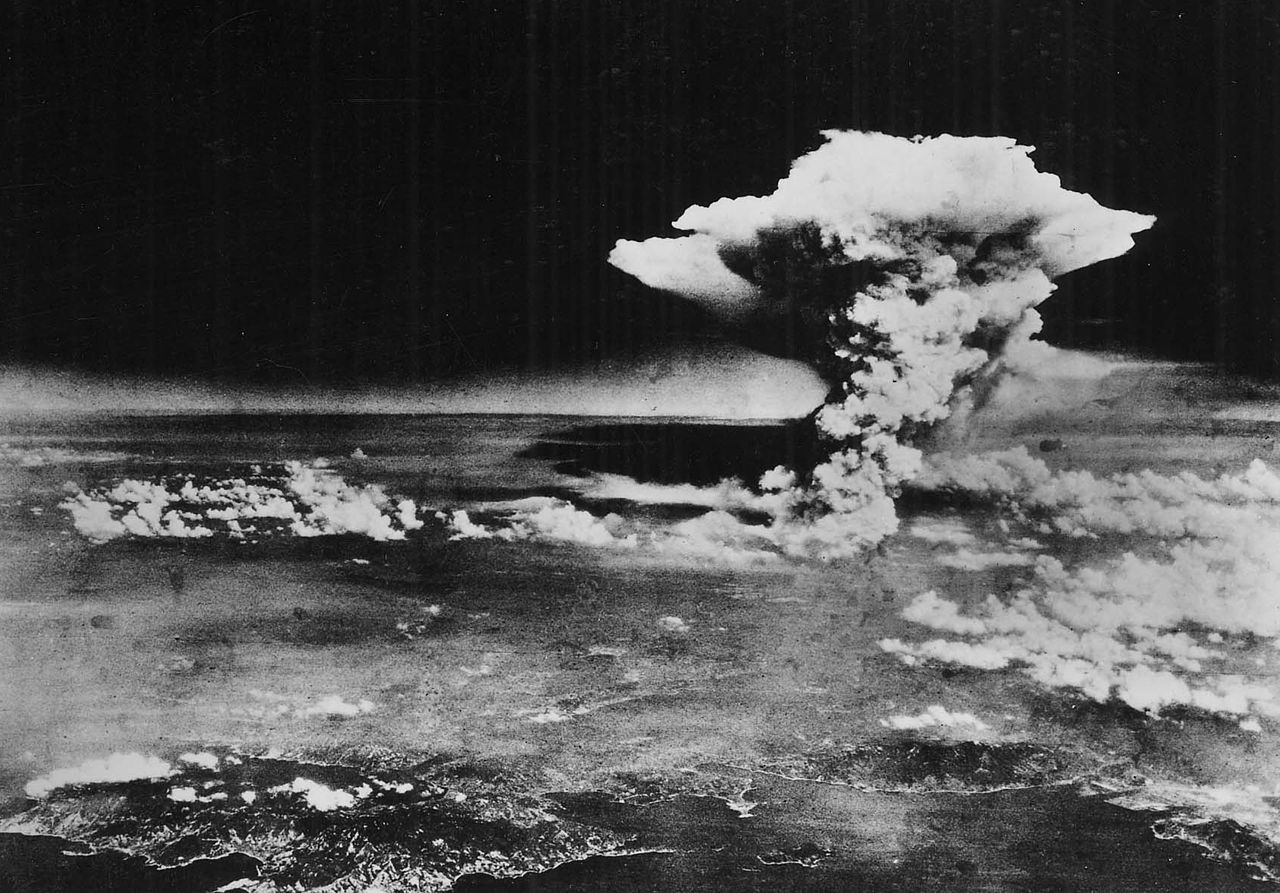
Atomic cloud over Hiroshima, taken from “Enola Gay” flying over Matsuyama, Shikoku, 6 August, 1945.
US Army Air Force photo via Wikimedia Commons.
As someone who has studied nuclear war for close to forty years now, I am going to give you an answer that will blow your mind. Even if the entire Russian nuclear arsenal were used against Ukraine, it wouldn’t substantially change the course of the war. How could I possibly say that? Because, the power of nuclear weapons has been used as a boogeyman for so long that the actual power of a nuclear detonation has almost no relation to their actual destructive power. No nuclear power can afford to actually use one in combat because it would expose the mythical nature of nuclear weapons.
Nuclear weapons are hyped to the point that no one contradicts it when a media outlet publishes a statement indicating that even a single nuclear device will destroy the world. This is a blatantly, stupidly, obviously untrue, but never corrected. After all, two were used in WWII. BUT that is just the tip of the iceburg. I thought there had been a couple of hundred nuclear test that prove this point. I was off by over an order of magnitude. There have been nearly THREE THOUSAND NUCLEAR DETONATIONS ALREADY, that are either known or suspected and this has not effected the survivability of life on Earth even slightly.
Well then, how dangerous are nuclear weapons? Nuclear weapons, if they weren’t their own catagory, would be classified as incendiary weapons. They set stuff on fire. They set a lot of stuff on fire. In fact they can set things on fire as far as two miles away from the actual detonation. Besides this, nuclear detonation are very bright, capable of blinding people 20–30 miles away. This is only constrained by the curvature of the earth. They also create hurricane force winds as the air around the detonation expands and contracts. If you are outside and unshielded and within a mile of a nuclear detonation, you are going to die.
The problem here is that Ukraine is really big. I mean the size of Texas big. Cities there tend to be spread out in modern times and their larger ones cover over a hundred square miles. The average nuclear detonation are only burn 2–3 square miles of territory. A city the size of Kiev would take on the order of 200 warheads to cover the whole thing.
Which brings us to our next point. Modern cities are just not that vulnerable to incendiaries. Modern city centers and industrial areas are made of concrete and steel. Most of the damage in Hiroshima and Nagasaki was done because almost all the buildings were made of wood and paper. The initial blast set the city centers on fire which spread and ended up burning down most of the city. Modern cities are just not that vulnerable. In Ukraine, despite millions of rounds of being poured into their cities, not one of them caught fire and burned to the ground like the Great Chicago or Great London Fires in the 19th century or the fire storms of WWII. In the Japanese nuclear detonations, the brick buildings were still standing, despite being much less sturdy than modern buildings. This leads to the most surprising revelation about nuclear detonations: If you are not outside, you stand a good chance of surviving even within the blast zone. Nuclear blasts are mainly line of sight killers. The vast majority of “radiation” created by an nuclear detonation is infrared radiation, or heat the same as a gas stove or fireplace makes. Unless the building you are in is collapsed by the wind or you fail to leave if it catches on fire or you happen to be in front of a window with a direct line of sight to the detonation, you are probably going to be fine.
Thus we get to the real reason why Putin will not use nuclear weapons: they’re just not all that effective compared to the boogeyman that is in our collective imaginations. Were a nuclear missile to detonate over central Kiev, no one would believe that it was an actual nuclear blast because the city is still there and all the major buildings are still standing.
Secondly, he doesn’t have very many of them. The numbers given for the Russian nuclear arsenal are an outright farce. You get that number by taking of bombs that the USSR claimed to have built, and subtract the number used in their testing program. This leaves you with about 9,000 warheads. First of all, Russia doesn’t have nearly enough delivery systems to put those warheads on. The second problem here is that nuclear warheads have a very short shelf life. Nuclear warheads require a detonator made of conventional explosives. These detonators are some of the most precision pieces of engineering in the history of mankind. A series of explosives has to go off in such a way that the core is hit by the same amount of pressure from all directions simultaneously. If any of those explosives are even slightly off, the nuclear warhead will not go off. You now have an extremely precise machine sitting around a core of material emiting hard radiation. Hard radiation is not friendly to machines. Nuclear warheads need to be rebuilt a least every five years and maintained a lot more often than that. Even with that, a twenty year old warhead is a piece of junk. It’s been more than twenty years since the Putin kleptocracy came to power. I’m sure that Russia has a number of Potemkin warheads that are kept in top shape for inspectors, but given the current Russian system, the Russian nuclear arsenal most likely resembles the Russian tank reserves: the bare minimum kept in service while the rest is a scrap pile.
Currently, the spector of the vast Russian nuclear arsenal is the last card he has in his hand. If he were to actually use it, it would expose that he never had anything but a junk hand and bluffing to back it up.
H/T to Never Yet Melted for the link.
CDR Salamander also looks at the nuclear question:
Some are looking closer at the nuclear option that Russia has. I think they are looking too hard. A good example of this line of concern was in yesterday’s WaPo by Joseph Cirincione.
NB: Before the pull quotes, a fair warning – Cirincione is selling a book titled, Nuclear Nightmares: Securing the World Before it is Too Late, so keep that in consideration;
Russian President Vladimir Putin is losing his war. If the Ukrainians continue to liberate areas of their country from his invading army, would he actually use nuclear weapons as he has threatened? If so, how? And what would the U.S. response be?
It is difficult to put percentages on risk. Nor does it really matter. Given the stakes, if the chances are 10 percent or 40 percent, the response would be the same: Minimize the possibility of nuclear use, and prepare responses in advance.
This is when I remind everyone that “we” are horrible at predicting the next war early enough to prevent them. The track record is simply not very good. However, Cirincione has invested a lot of time and effort in looking at this — so we should give his ideas some consideration;
The next quote reminded me of a little reminder a peer gave me back when I was a NATO staff weenie at the other end of the HQ p-way from him. As a JO, he was on the other side of the wire as an JO in the Warsaw Pact. “Americans may not follow their doctrine very well, but Russians do.”
Russian military writings describe in detail how, if Russia is losing a conflict, it could use nuclear weapons to force its enemy to retreat. This “escalate to de-escalate” or “escalate to win” strategy is somewhat controversial, but it is not dissimilar to various U.S. plans for using nuclear weapons first.
Well, sometimes we follow our doctrine. Sometimes the Russians don’t … but if you are playing odds …
I still stand by my belief — and that is a weak thread, I know — that in the next war, nuclear weapons will be what chemical weapons were during WWII. Everyone had them; no one used them.
If nuclear weapons were to appear on the Ukrainian stage, Cirincione does not have this COA as his most likely … but it is my most likely if one must choose from the “Nuke” basket;
Demonstration shot. One option is for Russia to fire a nuclear weapon over an uninhabited area — say, part of the Black Sea — as a demonstration of its seriousness in hopes that the West will back down. Some scientists involved in the Manhattan Project urged just such a demonstration shot as an alternative to bombing Japanese cities at the end of World War II. While no one would be killed and there would not be physical damage, the explosion would stop the world in its tracks. There has not been a nuclear weapon used in combat in 77 years. No one has even seen a nuclear explosion above ground since 1980.
This is their neighborhood and fallout will drift to their lands if nukes are used. Is anyone going to buy grain downwind? No. Next to underground explosions, explosions high over the water or in the atmosphere create the least secondary radiation effects. Don’t underestimate the lingering memory of Chernobyl. I see “Demonstration Shot” of the most likely COA of the least likely Nuke COAs.
As shocking as this would be, Russia would likely reject this option for the same reason U.S. military leaders did in 1945: It is not shocking enough.
Don’t agree. Russia believes their own FITREPs, so to speak. The arrogance of their initial OPLAN speaks to this. They hold most of Central and especially Western Europe in contempt. I am sure a nuke over the Black Sea would be shocking enough (and they’re right).
Comments Off on Putin’s nuclear option may not be as decisive in Ukraine as many fear
September 27, 2022
The War That Made Germany Prussian – Austro-Prussian War 1866
Real Time History
Published 23 Sep 2022After settling the Schleswig-Holstein question in 1864, Austria and Prussia are uneasy allies. Both are the biggest players in the German confederation. In Bismarck’s dream of a united Germany, he sees Prussia as the only leader and wants to force the so called “small German solution” without Austria. And so, in 1866 a war between Austria and Prussia (plus other German states like Bavaria, Baden, Württemberg, Saxony, Hanover) breaks out to settle this question once and for all.
(more…)
Comments Off on The War That Made Germany Prussian – Austro-Prussian War 1866
Arex Delta Gen2: How Gun Designs Iterate and Improve
Forgotten Weapons
Published 25 May 2022In firearms, as in really all technology, the market iterates and improves concepts over time. A novel new system — like the polymer-framed, striker-fired semiauto pistol — will never be perfect on its first introduction. Over time, as users and manufacturers gain more insight into the details of using and building the system, changes are made to improve it. At the same time, the cost of production comes down (especially after applicable patents have expired).
The Arex Delta Gen2 pistol is a really good example of this, I think. While offering no fundamental innovation, it is markedly better in all sorts of ways than similar pistols that preceded it. It has great handling, safe disassembly, near-universal optics compatibility, slim lines, light weight, and a good trigger. And it does this for a remarkably low price.
I am looking forward to really putting one through the wringer at Slovenian Brutality this June!
(more…)
Comments Off on Arex Delta Gen2: How Gun Designs Iterate and Improve
September 24, 2022
Life Inside a Panzer – Tank Life Part 1 – WW2 Special
World War Two
Published 23 Sep 2022The German Panzers are high on the list of the most feared and respected weapon systems of the Second World War. Much of their effectiveness however did not simply stem from technical or tactical superiority, but was achieved through rigorous training and the tight camaraderie of their crews. Days, weeks, or even months on end, the men operating a Panzer would stay together, maintaining the tank, and training for the battle to come. Through summer and winter, heat and snow, mud and rain, the tank would become their home.
(more…)
Comments Off on Life Inside a Panzer – Tank Life Part 1 – WW2 Special
Business Intrigue Gone Wrong: High Powers for Oman
Forgotten Weapons
Published 16 May 2022The story of the Browning High Power pistols with Omani national crests is an interesting one. It begins with a man named Paul Van Hee brokering a contract for Cadillac-Gage “Commando” armored cars for the Omani government in the late 1960s. These were to be equipped with FN MAG machine guns, and it came to Van Hee’s attention that Oman might also be interested in High Power pistols. He wasn’t an FN agent, but figured he could make that deal happen (and presumably make a nice profit on it).
Van Hee imported 36 new High Powers into the US, and then had them engraved with Omani crests (although the first 9 were accidentally engraved backwards). Around the time he was showing the guns to the Omani delegation, though, the deal fell apart. FN got wind of it and arranged the sale themselves, eventually shipping 5,000 pistols to Oman (without any special markings).
The demonstration guns remained in the US, and were sold off onto the collector market having never actually seen Oman. Interestingly, they are exempted from the NFA when fitted with original Belgian shoulder stocks, like this one is.
(more…)
Comments Off on Business Intrigue Gone Wrong: High Powers for Oman


