
Quotulatiousness

March 2, 2017

Possible end-game for the British nuclear deterrent

Filed under: Britain, Military, Russia, Technology, USA — Tags: , , , , — Nicholas @ 03:00

Charles Stross speculates on a few ways that Il Donalduce could trigger the end of Britain’s nuclear-armed ballistic missile submarines:

Working hypothesis #1: Donald Trump is an agent of influence of Moscow. Less alarmingly: Putin’s people have got blackmail material on the current President and this explains his willingness to pursue policies favourable to the Kremlin. Russian foreign policy is no longer ideologically dominated by communism, but focusses on narrow Russian interests as a regional hegemonic power and primary oil and gas exporter.

Clearly, it is not in Russia’s geopolitical interest to allow a small, belligerent neighbor to point strategic nuclear missiles at Moscow. But this neighbor’s nuclear capability has a single point of failure in the shape of the resupply arrangements under the 1958 UK-USA Agreement. Donald Trump has made no bones about his willingness to renegotiate existing treaties in the USA’s favor, and has indicated that he wants to modernise and expand the US strategic nuclear capability. Existing nuclear weapons modernization programs make the first goal pointless (thanks, Obama!) but he might plausibly try to withdraw British access to Trident D-5 in order to justify commissioning four new US Navy SSBNs to carry the same missiles and warheads.

(Yes, this would break the “special relationship” between the USA and the UK for good — but remember, this is Donald Trump we’re talking about: the original diplomatic bull in a china shop who decapitated the state department in his first month in office.)

Trump could present this as delivering on his promise to expand the US nuclear capability, while handing his buddy a gift-wrapped geopolitical easter egg.

Working hypothesis #2: Let us suppose that Donald Trump isn’t a Russian agent of influence. He might still withdraw, or threaten, British access to Trident as a negotiation lever in search of a better trade deal with the UK, when Theresa May or her successor comes cap-in-hand to Washington DC in the wake of Brexit. It’s a clear negative sum game for the British negotiating side — you can have a nuclear deterrent, or a slightly less unpalatable trade deal, but not both.

In this scenario, Trump wouldn’t be following any geopolitical agenda; he’d just be using the British Trident renewal program as a handy stick to beat an opponent with, because Trump doesn’t understand allies: he only understands supporters and enemies.

As for how fast the British Trident force might go away …

Missiles don’t have an indefinite shelf-life: they need regular servicing and maintenance. By abrogating the 1958 agreement, or banning Royal Navy warships from retrieving or delivering UGM-133s from the common stockpile at King’s Bay, POTUS could rely on the currently-loaded missiles becoming unreliable or unsafe to launch within a relatively short period of time — enough for trade negotiations, perhaps, but too short to design and procure even a temporary replacement. It’s unlikely that French M51 missiles could be carried aboard Dreadnought-class SSBNs without major design changes to the submarines, even if they were a politically viable replacement (which, in the wake of Brexit, they might well not be).

QotD: Presidential derangement syndromes

Filed under: Media, Politics, Quotations, USA — Tags: , , , , , — Nicholas @ 01:00

In the 1990s, a serious malady appeared on the American public square in which citizens were driven over the edge by their antipathy for incumbent presidents. It came to be known as the “presidential-derangement syndrome” and over the course of the Bill Clinton, George W. Bush, and Barack Obama administrations its victims grew in number. But while it was a given that whoever won last November’s election would have one named after them, we really had no idea what we were in for once Donald Trump moved into the White House. As we’ve seen this past week, presidential paranoia has not only gone mainstream in terms of the public, it’s now found a home in the mainstream media.

Though it was limited at first to the fever swamps of American politics where some on the right first imagined that black helicopters were about to swoop in and steal their freedom or that the Clintons were operating a drug cartel, the derangement virus adapted to the changing political environment in the years that followed. Those deranged by Bush were less marginal than the Clinton victims but shared the belief that the 43rd president was somehow a front for a vast conspiracy and not only blamed him for “lying” the country into war but viewed the entire national-security response to 9/11 as a put-up job intended to mask the theft of liberty.

As awful as the Bush version was, the Obama-derangement syndrome was in many ways even worse as the 44th president’s citizenship was questioned along with his religious faith and anything else about him that anyone could think of. Though Obama’s liberal policies and power grabs were bad enough from a conservative point of view, some on the right preferred to instead spend their energy pondering the authenticity of his birth certificate (see Trump, Donald) or whether or not he was an Islamist mole. We can blame the Internet and the rise of social media for the more pervasive nature of Obama conspiracy theories but even that dispiriting spectacle may turn out to be insignificant when compared to the psychological torment Trump has inspired among not merely the far Left but also mainstream liberals.

Jonathan S. Tobin, “The Paranoid Style of Anti-Trump Politics”, National Review, 2017-02-12.

March 1, 2017

The different “flavours” of propaganda

Filed under: China, Media, Politics, Russia, USA — Tags: , , , , — Nicholas @ 03:00

Cory Doctorow on the various types of propaganda in use around the world:

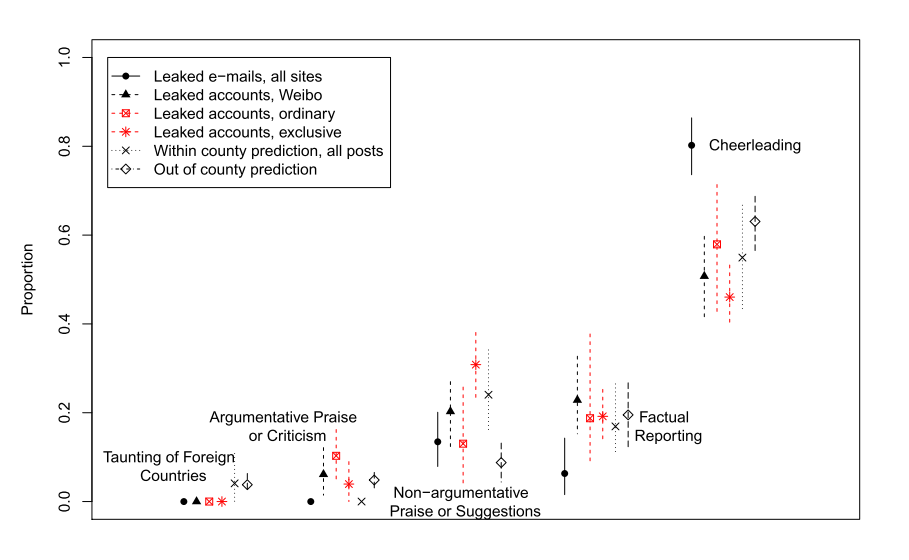
Jonathan Stray summarizes three different strains of propaganda, analyzing why they work, and suggesting counter-tactics: in Russia, it’s about flooding the channel with a mix of lies and truth, crowding out other stories; in China, it’s about suffocating arguments with happy-talk distractions, and for trolls like Milo Yiannopoulos, it’s weaponizing hate, outraging people so they spread your message to the small, diffused minority of broken people who welcome your message and would otherwise be uneconomical to reach.

Stray cites some of the same sources I’ve written about here: Tucker Max’s analysis of Yiannopoulos’s weaponized hate and The Harvard Institute for Quantitative Science team’s first-of-its kind analysis of leaked messages directing the activities of the “50-cent army, which overwhelms online Chinese conversation with upbeat cheerleading (think of Animal Farm‘s sheep-bleating, or Nineteen Eighty-Four‘s quackspeak).

But I’d never encountered the work he references on Russian propaganda, by RAND scholar Christopher Paul, who calls Russian disinformation a “firehose of falsehood.” This tactic involves having huge numbers of channels at your disposal: fake and real social media accounts, tactical leaks to journalists, state media channels like RT, which are able to convey narrative at higher volume than the counternarrative, which becomes compelling just by dint of being everywhere (“quantity does indeed have a quality all its own”).

Mixing outright lies with a large dollop of truth is key to this tactic, as it surrounds the lies with a penumbra of truthfulness. This is a time-honored tactic, of course: think of the Christian Science Monitor‘s history of outstanding international coverage, accompanied by editorials about God’s ability to heal through prayer; or Voice of America‘s mixture of excellent reporting on (again) international politics and glaring silence on US crises (see also: Al Jazeera as a reliable source on everything except corruption in the UAE; the BBC World Service‘s top-notch journalism on everything except UK complicity in disasters like the Gulf War, etc).

In addition to this excellent taxonomy of propaganda, Stray proposes countermeasures for each strain: for Russia-style “firehoses of falsehood,” you have to reach the audience first with an alternative narrative; once the firehose is on, it’s too late. For Chinese quackspeak floods, you need “organized, visible resistance” in the streets. For pathetic attention-whores like Yiannopoulos, Stray says Tucker Max is right: you have to ignore him.

February 27, 2017

QotD: Check your privilege

Filed under: Politics, Quotations, USA — Tags: , , — Nicholas @ 01:00

So who am I betraying by not conforming to the baneful Marxist stereotype of who I should be? Oh, right, the SJWs. That’s okay, I’m fine betraying them. Or at least fighting them. Hard to betray what you never belonged to. And, you know, most of them, even those with exotic names and claiming exotic identities (rolls eyes) are pasty-assed white people with real privilege as defined by having money and having attended the best universities and hanging out with all the “right” people and having the “right” (left) opinions. If they knew the meaning of the word privilege, they’d see it all over themselves.

But there are more egregious definitions of privilege. You see “check your privilege” is a tool of would-be elite whites to keep competition and challengers in check, while riding to glory by defining themselves as champions of the downtrodden. (It’s an old game, in place at least since the French revolution, but it’s the only one they have. Remember they lack both empathy and imagination. And since they have more or less overtaken the press, no one on the street realizes how old and tired this “clever” gambit is.)

However, when that hits academia, it becomes something even more poisonous.

Recently I heard someone talk about a difficult (as in very poor, with two working, Asian immigrant parents barely scrabbling to get by) childhood and say that as they always had books and were pushed to succeed they had “tons of white privilege.”

This person was a graduate of an ivy league school. So, of course, he had internalized the definitions of “white privilege” as meaning “doing that which brings success.”

This is sort of a self-defeating thing. If you want to have a voice in politics, you avoid “white privilege” which means if you want to have a voice in politics, you must not display those traits which logically lead to success in the culture. (You see how this is a tool of the white overclass to avoid competition from anyone else.)

This poisonous, totally unwarranted view of privilege serves only one purpose: to keep everyone else floundering and mute while these not-very-competent, credentialed, correctly-connected, politics-as-a-social good, lacking in empathy, totally devoid of imagination, largely white would-be-aristos lord it over us.

Sarah Hoyt, “The Privilege Of Not Caring”, According to Hoyt, 2015-05-17.

February 25, 2017

“Sophisticated and affluent Americans, as a group, are pretty gullible”

Filed under: Media, Science, USA — Tags: , , , , , — Nicholas @ 03:00

Andrew Ferguson on the gullibility of SAPs (sophisticated and affluent people) in social science fields:

Every few weeks, it seems, a new crack appears in the seemingly impenetrable wall of social-science dogma. The latest appeared last month with the publication of a paper by the well-known research psychologist Scott Lilienfeld, a professor at Emory University and coauthor of the indispensable primer 50 Great Myths of Popular Psychology. Among other things, he is a great debunker, and he has trained his skeptical eye on “microaggressions.”

Sophisticated, affluent people in the United States (SAPs) have been trained through years of education to respect whatever is presented to them as “science,” even if it’s not very good science, even if it’s not science at all. Their years of education have not trained them how to tell the difference. Sophisticated and affluent Americans, as a group, are pretty gullible.

So when their leaders in journalism, academia, and business announce a new truth of human nature, SAPs around the country are likely to embrace it. The idea of microaggressions is one of these. It was first popularized a decade ago, and now the pervasiveness of microaggressions in American life is taken as settled fact.

We could have seen it coming. Already, by the time microaggressions became widely known, social scientists had invented the Implicit Association Test (IAT). The test, administered online and to college students throughout the country, pretended to establish that anti-black and anti-Latino prejudice among white Americans was ever-present yet, paradoxically, nearly invisible, often unrecognized by perpetrator and victim alike. Even people who had never uttered a disparaging remark about someone of another color were shown by the IAT to be roiling cauldrons of racial animus. You know who you are.

The IAT thus laid the predicate for microaggressions. They were the outward, unwitting expressions of implicit racism; not only were they evidence of it, they were offered as proof of it. (Circularity is a common tool in cutting-edge social science.) Microaggressions are usually verbal but they don’t have to be. In their pathbreaking paper “Racial Microaggressions in Everyday Life” (2007), the psychologist Derald Wing Sue and his team of researchers from Columbia University helpfully listed many common microaggressions. Saying “America is a melting pot” is really a demand that someone “assimilate to the dominant culture.” Having an office that “has pictures of American presidents” on the wall announces that “only white people can succeed.” Also, an “overabundance of liquor stores in communities of color” carries the microaggressive message that “people of color are deviant.”

H/T to Colby Cosh for the link.

February 24, 2017

The danger of expanding Presidential power when “your” party is in power

Filed under: Government, Politics, USA — Tags: , , — Nicholas @ 04:00

Danny Sjursen on the somehow unforeseen problems when “the other party” comes to power:

Many Americans were fond of Barack Obama. He left office with some of the highest approval ratings of his entire term. On foreign policy, as in most matters, he seemed reflective, deliberate, and rational. An effective communicator, he maintained composure and presidential poise, no matter the topic. In rare moments of frustration, Obama channeled “disappointed sitcom dad” rather than “blustering bully.” Love him or hate him, Obama was a gentleman. And that’s the problem. Mainstream progressives – who cried foul at George W. Bush’s every move – looked the other way as Obama expanded unfettered presidential power in foreign affairs. Why? Because they trusted him – his judgment, character, and motives. Maybe that trust was warranted. Here’s the catch: the 22nd amendment. No president may serve for more than eight years, no matter how beloved (by some). Furthermore, each chief executive creates important precedents for his successor. For this reason, many liberals – and perhaps the former president himself – may come to lament Obama’s principal foreign policy legacy: the unbridled expansion of executive power in matters of (endless) war.

Presidential primacy is nothing new, of course. Executive power has gradually expanded for centuries, especially since World War II. The Obama administration eschewed imprudent, large-scale, conventional invasions, but his legacy is also defined by a sustained campaign of extrajudicial killings of terrorists, expanding the range and geographic scope of military operations, and cracking down on media leaks and whistleblowers. In each sphere, Obama’s hawkish behavior surpassed even that of George W. Bush. This is one reason why Republican criticism of Obama’s supposedly “weak” and “feckless” foreign policy was so confusing. Sure, it’s fair to debate the wisdom of the Iran nuclear deal, his handling of the Syrian civil war, and his near-total withdrawal from Iraq. These are thorny issues worthy of complex analysis. But to label Obama a “dove” is just empirically false.

[…]

Finally, we turn to the much maligned “crooked” media. Sure, the recent invective between journalists and the Trump administration is spiraling out of control. Yet, even here, Obama’s legacy presents cause for concern. All early campaign rhetoric to the contrary, the last administration was notoriously opaque on certain aspects of national security. In fact, Obama used the controversial 1917 Espionage Act to prosecute more leakers and whistleblowers than all previous administrations combined. While there’s certainly a need for reasonable levels of government secrecy, the classification process and national security state have grown increasingly pernicious. When in doubt, government agencies’ default course is to reflexively classify. No matter their political persuasion, citizens ought to desire a free, fair press. Independent journalists require anonymous sources to maintain the transparency Americans once held dear. More prosecutions and threats of serious jail time will inevitably reduce the likelihood courageous sources will step forward. And given President Trump’s contentious “running war” with the press, Obama’s precedent may only be the beginning.

QotD: Western culture is in decline

Filed under: Liberty, Media, Quotations, USA — Tags: , , , , , , — Nicholas @ 01:00

Paglia: At first, I was very excited about the ethnic identity movement, because I feel very Italian-American and have always been in revolt against the WASP style that dominated academe — Leslie Fiedler himself was a victim of this, Harold Bloom was — there weren’t any Jews hired in the Yale English department in the mid-1950s, there were quotas on Jewish students admitted to Harvard, all things like that. But over time, what’s happened, I think, is that gender identity has become really almost fascist. It’s to me a very shrunk and miniaturized way of perceiving your position in the world and in the universe.

There [comes] a time when these fine gradations of gender identity — I’m a male trans doing this, etc. — this is a symbol of decadence, I’m sorry. Sexual Personae talks about this: That was in fact the inspiration for it, was that my overview of history and my noticing that in late phases, you all of a sudden get a proliferation of homosexuality, of sadomasochism, or gendered games, impersonations and masks, and so on. I think we’re in a really kind of late phase of culture.

reason: So that the proliferation of cultural identities, the proliferation of all sorts of possibilities is actually a sign that we’re…

Paglia: On the verge of collapse? Yes! Western culture is in decline. There’s absolutely no doubt about it, in my view, looking at the history of Egypt, of Babylon, of Byzantium, and so on. And so what’s happening is everyone’s so busy-busy-busy with themselves, with this narcissistic sense of who they are in terms of sexual orientation or gender, and this intense gender consciousness, woman consciousness at the same time, and meanwhile…

reason: Is that also racial or ethnic consciousness as well?

Paglia: Right now, to me, the real obsessions have to do with gender orientation. Although I think there’s been this flare-up [regarding race]. I voted for Obama, but I’ve been disappointed. I think we had hoped that he would inaugurate a period of racial harmony, and I think the situation has actually become even worse over recent years. It seems to be overt inflammatory actions by the administration to pit the races against each other, so I think there’s a lot of damage that needs to be healed.

But I think most of the problems as I perceive them in my students and so on, is that there’s this new obsession with where you are on this wide gender spectrum. That view of gender seems to me to be unrealistic because it’s so divorced from any biological referent. I do believe in biology, and I say in the first paragraph of Sexual Personae that sexuality is an intricate intersection of nature and culture. But what’s happened now is that the way the universities are teaching, it’s nothing but culture, and nothing’s from biology. It’s madness! It’s a form of madness, because women who want to marry and have children are going to have to encounter their own hormonal realities at a certain point.

Camille Paglia, “Everything’s Awesome and Camille Paglia Is Unhappy!”, Reason, 2015-05-30.

February 23, 2017

Words & Numbers: The CBO Can’t Count

Filed under: Economics, Government, USA — Tags: , , — Nicholas @ 04:00

Published on 22 Feb 2017

In this episode, Dr. Antony Davies, Professor of Economics of Duquesne University in Pittsburgh, and Dr. James R. Harrigan, Senior Research Fellow at Strata, in Logan, Utah discuss the way the Congressional Budget Office works, and outline its history of failure at accurately forecasting increases in the national debt.

Find out more about the CBO and debt projections here:
https://fee.org/articles/the-congressional-budget-office-cant-count

here:
http://www.usnews.com/opinion/economic-intelligence/articles/2017-02-01/the-cbo-federal-budget-predictions-are-dangerously-optimistic

and here:
http://www.huffingtonpost.com/entry/58a0810be4b0e172783a9daa

Plus, check out this great 360 Video from Learn Liberty with Antony Daves that helps put the massive scale of the current US Federal debt into perspective: https://www.youtube.com/watch?v=ErUZjM16r1M

And track the National Debt in real time here:
http://www.usdebtclock.org/

An open letter to the DHS on social media identities

Filed under: Government, Liberty, Technology, USA — Tags: , , , — Nicholas @ 03:00

Cory Doctorow:

A huge coalition of human rights groups, trade groups, civil liberties groups, and individual legal, technical and security experts have signed an open letter to the Department of Homeland Security in reaction to Secretary John Kelly’s remarks to House Homeland Security Committee earlier this month, where he said the DHS might force visitors to America to divulge their social media logins as a condition of entry.

The letter points out that the years’ worth of private data — including commercially sensitive information; privileged communications with doctors, therapists and attorneys; and personal information of an intimate and private nature — that the DHS could access this way would not belong only to non-US persons (who are, of course, deserving of privacy!), but also US persons, whose lives the DHS would be able to peer into without warrant, oversight or limitation.

The letter also points out that once America starts demanding this of foreigners visiting its shores, other governments will definitely reciprocate — so American travelers would be forced to reveal everything from trade secrets to the most personal moments with their loved ones with governments hostile to US interests.

Trade disputes tend to devolve into tit-for-tat retaliation. Initiatives like this will work exactly the same way (except you can be certain that politicians will hold out for their own right to privacy while demanding that private citizens and foreigners give up theirs).

February 22, 2017

TEDxWarwick – Tim Harford – Management Lessons from the War in Iraq

Filed under: Middle East, Military, USA — Tags: , , , — Nicholas @ 03:00

Uploaded on 17 Mar 2011

Tim Harford is an economist who writes about economics theories behind our daily lives in books and as a Financial Times columnist. All of his books have been sold worldwide and widely translated, namely The Undercover Economist that has sold one million copies. He is the also only person who runs a problem page “Dear Economist” in Financial Times in which readers’ problems are answered with the thought-provoking economic ideas. Tim currently presents the BBC radio series More or Less and contributes regularly to other radio, TV programmes and publications. His talk in TEDxWarwick this year focuses on the similarities between the War in Iraq and the organisation’s top-down management.

About TEDx, x = independently organized event

In the spirit of ideas worth spreading, TEDx is a program of local, self-organized events that bring people together to share a TED-like experience. At a TEDx event, TEDTalks video and live speakers combine to spark deep discussion and connection in a small group. These local, self-organized events are branded TEDx, where x = independently organized TED event. The TED Conference provides general guidance for the TEDx program, but individual TEDx events are self-organized.* (*Subject to certain rules and regulations)

Interestingly, the name H.R. McMaster pops up a few times in this talk…

So who is this H.R. McMaster dude?

Filed under: Military, Politics, USA — Tags: , , — Nicholas @ 02:00

John Ringo strongly approves of the choice of Lt. Gen. H.R. McMaster for National Security Adviser:

McMaster for NSA.

Fuck. Yeah.

For those who don’t know much about McMaster, just check his wiki [https://en.wikipedia.org/wiki/H._R._McMaster] which isn’t all that ‘edited for lefty sensibilities.’

Short answer: Took his troop (company) in against a brigade of Republican Guard (about ten times his firepower) in Desert Storm and stomped them. In 23 minutes. And I mean Stomped. Them. Hard.

Won the Silver Star (very well deserved, there are arguments for DSC. Also later two bronze and a purple heart.)

In Iraq took over a ‘hot’ sector and turned it basically cold. (Then had it go hot when he left when the replacement unit didn’t use the same tactics.) Essentially created the tactics the Marines (under Mattis) later used to get the Al Najar tribes on our side. Which looked to actually be working right up until we pulled out and the place went to shit.

The Old Bull generals at the time hated him. He didn’t take their pronouncements of Olympian Superiority as Gospel. He wasn’t Cold War, zero defect, there’s-nothing-strategically-important enough for them. He was one of the new generation of officers who had been fighting various low-intensity mixed with high-intensity fights since the end of the Cold War. So they black balled him. (Refused to promote him to General.) Bush basically shoved him down their throat and at least partially broke the log-jam against officers with actual, you know, COMBAT EXPERIENCE making rank. (Was one of those big discussions back on boards like this at the time.)

Beloved by his troops. Well respected by his peers and superiors. Mind like a quantum physicist. Edetic memory. Universally curious.

Bright eyed intellectual warrior. Can tell you everything there is to know about the politics of any country on earth down to who’s who of the major players. (Something Trump desperately needs.) Great ‘out of the box’ thinker.

And his ‘high protein, low carb’ fruit salad makes Mattis’ balls shrivel up a little.

Q: If Rommel and McMaster went up against each other, same TOE, same level of training, same numbers, who wins?

A: God. Cause the Almighty would be breaking out the popcorn for that one.

QotD: The microaggression micro-environment

Filed under: Politics, Quotations, USA — Tags: , , , , , — Nicholas @ 01:00

… these guidelines put whitemalemiddleclassheterosexualcisgender people in the wrong whatever they do. The rules are literally impossible to obey. The safest policy is not to interact with blackfemaleworkingclassLGBTQ people any more than you must. This avoidance will be yet more proof of your prejudice, but it’s not like there are any possible circumstances in which you would be declared unprejudiced. Not that anyone nowadays seeks wisdom from a dead white male, but Tacitus could have predicted the result of all this in AD 98: “Proprium humani ingenii est odisse quem laeseris.” The doctrine of microagression teaches that the victim classes are forever being injured by your acts. Let us hope that human nature has changed enough in the last nineteen hundred years that Tacitus’ observation that it is human nature to hate a person whom you have injured no longer applies.

What is it like to be the object of this code?

– Lonely. You will feel surrounded by enemies. And all outside your exact caste must be enemies: it is impossible for friendship to develop across the divides of privilege when every mundane interaction that might in other circumstances have led to friendship is fraught with tension. Thus one one of the main benefits claimed to accrue from diversity on campus is lost.

– Exhausting. You will be continually on the defensive, and for all your obligation to be constantly angry, passive and unable to control your own destiny. How could it be otherwise? You have chosen to centre your life on how your enemies perceive you. If black, your constant concern is what whites think of you; if female, what males think of you; whatever category you belong to defines you.

One of the attributes of status is that other people have to watch what they say around you, to mind their P’s and Q’s. The demands of political correctness can force high-status people to temporarily behave to low-status people in this respect as if their positions were reversed. But victim status is a very poor imitation of actual status. For one thing the apparent respect you get is gone the minute your back is turned – or a deniable microsecond earlier if the microagressor decides that he might as well be hanged for a sheep as a lamb and go macro. For another it’s, like, victimhood. You are officially a loser.

Natalie Solent, “Victim status is a lousy substitute for real status”, Samizdata, 2015-07-03.

February 21, 2017

Political “discussion” in Trump’s America

Filed under: Politics, USA — Tags: , , , , — Nicholas @ 04:00

L. Neil Smith on what has happened to political discussion since the accession of Il Donalduce:

It’s very difficult to convey the unreality, the surreality, of things that those of us who think for a living (or at least a serious hobby) have been subjected to, since the General Election last November, and especially since Inauguration Day in January. The other day I found myself embroiled in a passionate argument with an old friend which had started out to be about my reasons for voting for Donald Trump and had somehow inched its way around to the subject of lynching black people. I don’t exactly remember how, but, apparently, since I was born decades after the era of lynchings in the South, had never actually seen a lynching, or been lynched, myself, in the view of the person I was arguing with (who was black, but had also never seen a lynching), I was denying that lynchings had ever happened.

I was not, of course. Nor did my friendly antagonist ever explain to me what alleged factual or historical connection exists between lynchings and Donald Trump. I play very close attention to these things — for example, I actually heard the man when he accused the Mexican government of deliberately sending its criminals to the United States, which is decidedly _not_ a racist remark — and, to my knowledge, Trump, who is the same age I am, never lynched anybody, either. Unfortunately, this is a reasoned observation I am making, and the Leftists’ way of dealing with a reasoned observation is to scream as loud and talk as fast as they can, peppering everything they say with absurd Orwellian slogans. They do this all over the country to shut down speakers they don’t like and to stifle truths they can’t bear to hear—or to have heard by the public.

If you require an example, I suggest that you look up Milo Yiannopoulis on YouTube. He is a remarkable young man, an editor for Breitbart, who combines the outlooks of Thomas Jefferson, Mark Twain, and H.L. Mencken. He is constantly shouted down on college campuses, although what he has to say is witty and urbane. The Left just can’t take a joke any more, it seems. These are the very mobs, first seen in France, that our Founding Fathers feared, and the reason they made Presidential elections indirect. If you don’t like the Electoral College, blame Black Lives Matter or the disgraceful and disgusting Precious Snowflakes who make our political lives so tedious these days, If they were on fire, the Founding Fathers wouldn’t have crossed the street to piss them out.

“… let’s face it, triggering rage in a leftist is not a terribly hard thing to do”

Filed under: Liberty, Politics, USA — Tags: , , , — Nicholas @ 03:00

Jim Geraghty on the “Milo at CPAC” issue:

An observation for everyone bothered or worse at the thought of Yiannopoulos addressing CPAC: Fighting Yiannopoulos with protests and boycotts is like fighting a fire with gasoline. The most salient point Yiannopoulos makes in his shtick is that the Left is intolerant, filled with rage, and incapable of respecting any dissenting view … and campus leftists live down to his portrait, time after time. He has become a big show because he more or less is a walking, talking perpetual threat of a riot, and a big part of this is that he keeps going to places like Berkeley, the places most inclined to respond to provocations through violent outbursts.

It would be an enormous blunder for the Right to make the same mistake. And thankfully, the CPAC crowd is not a rioting crowd.

Perhaps the right measuring stick of Yiannopoulos is, what does he really have to offer an audience of conservative activists when he isn’t being shouted down, attacked, or besieged by riotous Leftists? We on the Right will rightfully instinctively defend anyone threatened by the pincers of a politically correct speech code and the radical mob. Once that threat to free speech is removed … then what?

Are there things Yiannopoulos can teach us to advance the conservative cause, conservative ideas, or conservative policies? Can the methods that get him what he wants be used by others, or are they non-replicable? Does the toolbox of the provocateur really have the kinds of tools useful to those of us who want to build something more lasting and create structural changes – i.e., tax reform, a stronger military, a solution to the opioid addiction crisis, a thriving economy full of innovation and consumer choice, support networks of community and family, etcetera? I’m skeptical, but willing to listen. Let’s hear it.

Yiannopoulos triggers rage in Leftists like no one else in the world today other than Donald Trump, and a lot of folks on the right will cheer that. But let’s face it, triggering rage in a leftist is not a terribly hard thing to do.

Update: Fixed broken link.

February 20, 2017

Rand Paul – “McCain’s been wrong on just about everything over the last four decades”

Filed under: Politics, USA — Tags: , , , , , — Nicholas @ 04:00

On Sunday, Rand Paul got some media coverage for his criticism of Senator John McCain:

Sen. Rand Paul (Ky.) ripped fellow Republican Sen. John McCain (Ariz.) on Sunday after McCain criticized President Trump’s escalating war of words with the media.

He argued that the nation is “very lucky” that Trump is president and not McCain, who won the 2008 GOP nomination but lost to Barack Obama in the general election.

Paul said that McCain’s recent criticisms of Trump are driven by his “personal dispute” with the president over foreign policy.

He added that McCain and Trump are at odds because McCain supports the wide deployment of U.S. troops to protect and promote American interests abroad while he characterized Trump’s views as closer to a realpolitik approach to foreign policy.
“Everything that he says about the president is colored by his own personal dispute he’s got running with President Trump and it should be taken with a grain of salt because John McCain’s the guy who’s advocated for war everywhere,” Paul said on ABC’s This Week.

“He would bankrupt the nation. We’re very lucky John McCain’s not in charge because I think we’d be in perpetual war,” Paul added.

« Newer PostsOlder Posts »

Powered by WordPress

