
Sometimes I fear we are on the cusp of another age du merde again — a catastrophic meltdown in taste not seen since the 70s. I check the weekly catalogs with mounting dread. This week’s report: Furniture is in good shape. Appliances have survived the iMac wannabee phase. Men’s fashions are reasonably dull, as usual. Woman, as it often happens, are screwed:
[… image from Marshall Fields catalogue …]
Ponchos. Good God. Ponchos. And what’s with this blonde’s hair? How many My Little Ponys did they kill to make this wig?
[…]
God forbid our children should ever be happy. Not when they can have ATTITUDE, which is what we all really want from our kids.
[… image of sneering, posturing child models …]
Charming. Remember: Fashion means never having to say you’re happy. From Dutch supermodels to haughty tykes, the watchword from Dame Fashion is “pissed.” Now put on your poncho and radiate sullen blankness.
James Lileks, “The Bleat”, 2004-08-17 (Reposted from the old blog).
Note: Jon mentioned that he looked at the images in Lileks’ article and at first thought they were actual 1970s catalogue photos, but in that dreckful decade, the models would have been smiling. A valid point, I think, and one of the issues Lileks has with the current fashion industry. Nowadays, you can’t be a fashion model without the kind of surly attitude best expressed by thugs and angry bar patrons after last call.
September 5, 2019
QotD: Fashion
September 4, 2019
English spelling – a bit mad, but perhaps the best system around
Lindybeige
Published on 12 Nov 2015Support me on Patreon: https://www.patreon.com/Lindybeige
Many people think that the English system of spelling is just mad. The random quirks of history have certainly played their part, and today we have spellings that follow so many different rules that at times it can seem just random. However, here I argue that actually the fact that our spelling does not match our pronunciation is a strength, not just a weakness.
I see from the comments that several viewers have misunderstood me, and have thought that I am saying that only when people are reading English do they recognise words in the same way as we recognise faces. No, this is how people read in all languages. This being the case, phonetic spelling is not such a great advantage, since people are not decoding the words using sound, and spelling based on derivation has advantages.
Lindybeige: a channel of archaeology, ancient and medieval warfare, rants, swing dance, travelogues, evolution, and whatever else occurs to me to make.

September 3, 2019
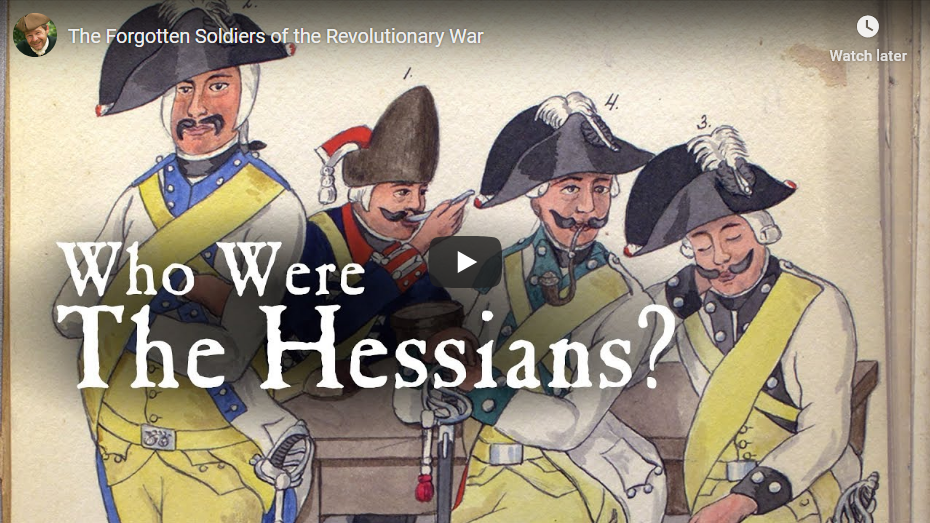
The Forgotten Soldiers of the Revolutionary War
Townsends
Published on 25 Jan 2018Get the book here! ▶ https://www.amazon.com/Hessians-Three…
Visit Our Website! ▶ http://www.townsends.us/
Help support the channel with Patreon ▶ https://www.patreon.com/townsend
Sign up for the YouTube Mailing List! ▶ http://www.townsends.us/youtube_list.htm
When “raising awareness” works too well
Dylan Gibbons reports on a recent finding from the Harvard Business Review:

A new study published by the Harvard Business Review shows that in addition to men’s growing fears about women in the workforce and potentially being falsely accused, women are becoming more aware of the backlash and are actually less likely to hire certain women, specifically attractive women.
“Most of the reaction to #MeToo was celebratory; it assumed women were really going to benefit,” said Leanne Atwater, a management professor at the University of Houston. However, Atwater was skeptical. Rather than seeing an endless trail of steps forward before her, she and her colleagues forecasted a backlash.
“We said, ‘We aren’t sure this is going to go as positively as people think — there may be some fallout.'” And so, they tested their hypothesis.
The study began in early 2018. Two surveys were created, one for men and one for women. These surveys were then distributed to workers in various professional fields. In the end, they collected a large amount of data from 152 male and 303 female responders.
According to the study, 74% of women now say they are more willing now to speak out against harassment, while 77% of men anticipated being more careful about potentially inappropriate behaviour.
As for the idea that men do not know what constitutes harassment, the researchers found the opposite was true. Both genders appear to both know what constitutes harassment, and women may be more lenient with some of their own definitions of what constitutes harassment.
According to the report, “The surveys described 19 behaviors — for instance, continuing to ask a female subordinate out after she has said no, emailing sexual jokes to a female subordinate, and commenting on a female subordinate’s looks — and asked people whether they amounted to harassment.”
“Most men know what sexual harassment is, and most women know what it is,” Atwater says. “The idea that men don’t know their behavior is bad and that women are making a mountain out of a molehill is largely untrue. If anything, women are more lenient in defining harassment.”
Another recent action intended to increase the number of women in STEM subjects at an Australian university — by selectively lowering academic standards for admission — will almost certainly not achieve its stated goals, but will work to increase negative views of those women in the working world:
[A female engineer] also rightly points out that this lowering the bar for women is unfair to men losing the university places to women with lesser qualifications.
She points out that male students will notice that women are struggling more with the course material — the women allowed in because the bar was lowered.
She feels this is a net negative for women in the engineering sector in general, and I have to agree.
How, she asks, can employers be expected to see a woman’s engineering degree the same as a man’s if the employer knows the women got a break getting into the program?
She uses the term “positive discrimination” to describe the leg-up practices, and I really prefer that to “affirmative action” to describe it because the word “discrimination” is plain in it. And that’s exactly what it is. Discrimination against qualified people that will ultimately harm women who are qualified.
As she puts it, the only way to ensure that a woman’s qualifications mean as much as a man’s is to have equal hurdles for women.
I’m completely with her.
September 2, 2019
What You Didn’t Know About the 1968 Machine Gun Amnesty
Forgotten Weapons
Published on 11 Oct 2017Sold for $23,000.
When the 1968 machine gun amnesty was announced in the US, it was treated with widespread suspicion among gun collectors. Some thought it would merely a pretense to find and arrest owners of unregistered machine guns. Others though it was just the first step in a prohibition and confiscation of machine guns. Both of these groups would prove to be wrong, however and the amnesty was in fact a true amnesty.
In fact, the amnesty was even more substantial than people recognize even today. It was not just an amnesty for possession of an unregistered machine gun, but also pretty much any crime associated with the gun. For example, it would legalize guns that had been stolen from military property rooms, and guns with defaced serial numbers. In fact, it even allowed felons to register machine guns, and retain the legal right to own them to this very day.
http://www.patreon.com/ForgottenWeapons
Cool Forgotten Weapons merch! http://shop.bbtv.com/collections/forg…
If you enjoy Forgotten Weapons, check out its sister channel, InRangeTV! http://www.youtube.com/InRangeTVShow

QotD: The abolition conspiracy of the 1850s
But there was another conspiracy afoot in the 1850s: The abolition conspiracy. You don’t hear about this one in high school history because the victors write the textbooks, but it was quite real. And this one really was a conspiracy, in that they had a clear goal: The end of chattel slavery. And it was a conspiracy in a more fundamental sense, in that it was illegal. The so-called “slave power conspiracy” was obstructionist to the bone, but it’s perfectly legal for legislators to vote against proposed legislation. It’s not legal to advocate armed insurrection but that’s what the abolitionists did.
On October 16, 1859, a lunatic abolitionist named John Brown led a partisan band in an attack on the Federal arsenal at Harper’s Ferry, Virginia. He wanted to distribute the stolen guns to local slaves, thus sparking a race war. We know this because Brown was captured alive, and the great state of Virginia put him on trial, as they were legally required to do. Being a fanatic, and knowing that he was a dead man already, Brown took the opportunity to advertise his cause to the world …
At which point it became obvious that not only did Brown have the financial backing of several prominent Northerners, but he had the moral backing of a large segment of the Northern population. Brown became a martyr, literally — he was frequently compared to Jesus Christ in Northern periodicals. The important thing to note is this: Brown was captured in armed insurrection against the United States, and lots of the country was ok with it. This man simply decided that the legal processes could never result in the outcome he deemed morally necessary, so he took the law into his own hands — with the active connivance of prominent Northern financiers and intellectuals, and the avid approval of many Northern citizens.
Remember that, and Southern belligerency makes a whole lot more sense. The North was obviously ready to go to the gun in 1861, because they’d already gone to the gun in 1859. The “John Brown Moment,” then, is the point at which violence becomes inevitable, because one significant, influential segment of the country not only passively tolerates it, but actively cheers it.
Severian, “The John Brown Moment”, Rotten Chestnuts, 2019-07-16.
September 1, 2019
Gene Roddenberry was his own worst enemy
Ed Driscoll reviews the first of three volumes by Marc Cushman, relating the story behind the legendary original Star Trek TV series. Much of the first volume is apparently about the problems of getting NBC to let Gene Roddenberry back into their good graces after he humiliated the network over an earlier TV show:
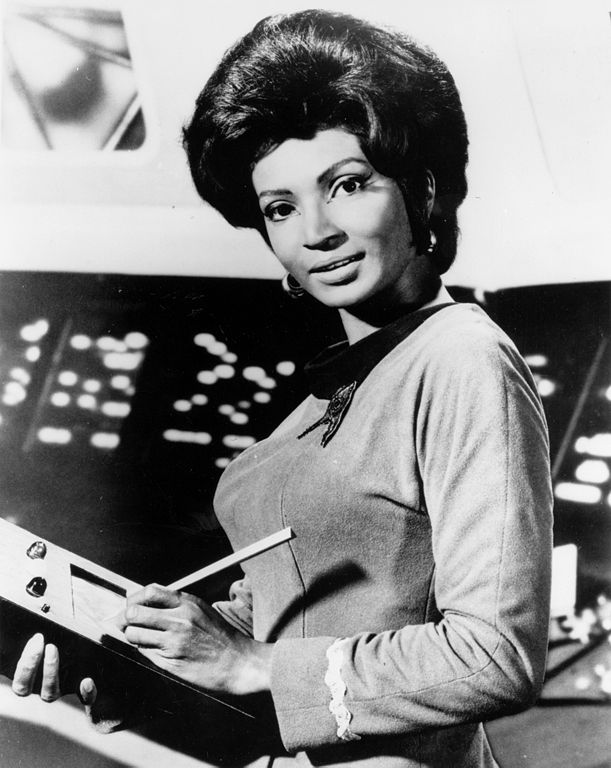
Nichelle Nichols was born in Robbins, Illinois on December 29, 1936. She played Lieutenant Uhura the Communications Officer on the U.S.S. Enterprise in the original series, Star Trek. Nichols stayed with the show and has appeared in six Star Trek movies. Her portrayal of Uhura on Star Trek marked one of the first non-stereotypical roles assigned to an African-American actress. Before joining the crew on Star Trek, she sang and danced with Duke Ellington’s band.
NASA photo via Wikimedia Commons.
Gene Roddenberry (1921-1991) was a religious agnostic and left-leaning Texan who became a WWII Army Air Force B-17 pilot, then an LA policeman who wrote numerous scripts for the burgeoning television industry in the 1950s. Eventually, he graduated to producing his own TV show in 1963, The Lieutenant, purchased by NBC and built around Gary Lockwood, the future guest star of Star Trek‘s second pilot, and the co-star of another landmark 1960s science fiction achievement, Stanley Kubrick’s 2001: A Space Odyssey.
The Lieutenant was for the most part a formulaic “military procedural” about life at Camp Pendleton, and featured numerous future Star Trek guest stars and cast members. However, Roddenberry, as was his wont, eventually decided to push the envelope, and put into production an episode on racism in the Marines called “To Set It Right,” with guest stars Dennis Hopper, future Star Trek regular Nichelle Nichols and future Trek guest star Don Marshall. The episode lost the support of the Marines, and the good will of NBC. As Roddenberry later recounted, “My problem was not the Marine Corps; it was NBC, who turned down the show flat … There was only one thing I could do, I went to the NAACP and they lowered the boom on NBC.”
As Cushman writes, this did not endear himself with NBC’s executive suit. “Roddenberry had won the battle … but lost the war. Despite satisfactory ratings, The Lieutenant was cancelled.” And NBC’s executives would not forget being hung out to dry by one of their product suppliers.
Even before The Lieutenant‘s only season of production was complete, Roddenberry began crafting a television show he called Star Trek. He had somehow stumbled into the perfect format for an hour-long network television series. While he admired shows such as Rod Serling’s The Twilight Zone and its recombinant network rival The Outer Limits for their ability to comment on American society through the metaphors of science fiction and horror, these were anthology shows, introducing a new cast each week. He knew the most successful network series were those with a recurring cast, such the many westerns that aired during the 1950s and ’60s, such as the long-running Bonanza and Gunsmoke. Viewers treated these archetypal characters almost as their own family members, which in turn encouraged them to tune in each week.
Given the networks’ love of westerns in the 1960s, it’s no coincidence that Roddenberry’s first pitch to the networks used the phrase “Wagon Train to the stars” as a metaphor to describe the show. (As Cushman writes, veteran western and science fiction writer Samuel Peeples actually coined that phrase, the first of many bits of Star Trek lore that Roddenberry would eventually co-opt and take credit for.)
It’s also no coincidence that the show’s second in command was written by Roddenberry as “a mysterious female, slim and dark, expressionless, cool, one of those women who will always look the same between years 20 and 50.” As Cushman deadpans, “To be more specific: actress Majel Barrett, Roddenberry’s lover.” (Roddenberry was also having a tryst with Nichelle Nichols; she would find her way into Star Trek‘s regular cast as well.) While the pointed-eared alien Mr. Spock was also present, he was much more in the background in Roddenberry’s first draft of Star Trek.
QotD: Wonks inside the Beltway
There are few words that stir the blood of a Beltway wonk like “the Commission has issued its report.” That means that those in the government must now react, importantly, and those in the media must now react as well — dissect, digest, explain to the benighted groundlings what it means, and issue Important Recommendations by way of reasoned editorials aimed at the corridors of power, but more likely received by a schoolteacher in Iowa who photocopies it off and puts it on the bulletin board in the staff lounge with yellow highlight-lines through the better parts.
The commission has issued its report! Mo better, the commission has issued recommendations! And the Washington press corps open their beaks, spindly necks trembling, waiting for the savory worm to be dropped from the blue-ribbon mother bird.
Unless you’ve spent some time in DC you can’t imagine the tremendous self-importance that possesses the people who feed off the government. They’re like people who live in the same town where NASA has a tracking station, and think that it makes them all astronauts.
James Lileks, Bleat, 2004-07-23.
August 31, 2019
General Motors Diesel: The Modern Power (1937 and 1942)
PeriscopeFilm
Published on 6 May 2016Support Our Channel: https://www.patreon.com/PeriscopeFilm
First made in 1937 by General Motors and then repackaged for the WWII war effort, DIESEL THE MODERN POWER tells the story of the development and principles of the diesel engine. The film uses live action and animation to show how the diesel engine works, and live action footage of Sherman tanks, streamlined locomotives, switching engines, ships, and more.
The film begins with an historical overview that includes a brief lesson on how to make fire, including two stones, rubbing pieces of wood, and even the “fire syringe” that was used by the people of Southeast Asia. The syringe is used to demonstrate the operation of a piston in an engine.
At 14:30, 600 hp diesel engine are seen at the Century of Progress Exposition in Chicago. At 14:46, the Burlington Pioneer Zephyr is seen running from Chicago to Denver. Mainline passenger locomotives are seen, providing up to 6000 hp. Diesel switch engines are seen at the 15:30 mark.
At 18:40, lumber equipment, oil pumps, and earth moving equipment are seen — all driven by diesel engines.
The Detroit Diesel works is seen at the 19 minute mark. Diesel powered submarines, mine sweepers and coast patrol boats as well as fleet tugs, are also seen.
A two-stroke diesel engine is a diesel engine that works in two strokes. A diesel engine is an internal combustion engine that operates using the Diesel cycle. Invented in 1892 by German engineer Rudolf Diesel, it was based on the hot-bulb engine design and patented on February 23, 1893. During the period of 1900 to 1930, four-stroke diesel engines enjoyed a relative dominance in practical diesel applications. Charles F. Kettering and colleagues, working at the various incarnations of Electro-Motive and at the General Motors Research Corporation during the 1930s, advanced the art and science of two-stroke diesel technology to yield engines with much higher power-to-weight ratios than the two-stroke diesels of old. This work was instrumental in bringing about the dieselisation of railroads in the 1940s and 1950s.
All diesel engines use compression ignition, a process by which fuel is injected after the air is compressed in the combustion chamber, thereby causing the fuel to self-ignite. By contrast, gasoline engines utilize the Otto cycle, or, more recently, the Atkinson cycle, in which fuel and air are mixed before entering the combustion chamber and then ignited by a spark plug.

August 30, 2019
Communist Revolution in America? – The Red Scare 1919 I THE GREAT WAR 1919
The Great War
Published on 29 Aug 2019Get a free audiobook and 2 Audible Originals with a 30-day trial: http://audible.com/greatwar or text
greatwarto 500 500.The American intervention in the Russian Civil War, the economic hardships of workers and returning veterans and the strikes all over the US in 1919 created a hysteria that we know as Red Scare today. But how realistic was the idea of a Bolshevist revolution in America really?
» SUPPORT THE CHANNEL
Patreon: https://www.patreon.com/thegreatwar
Merchandise: https://shop.spreadshirt.de/thegreatwar/» SOURCES
US Congress. Senate. Bolshevik Propaganda: Hearings before a Subcommittee of the Committee on the Judiciary. 65th Cong., 3rd sess., February 11, 1919, to March 10, 1919
Brecher, Jeremy. Strike! Revised edition. South End Press, 1997.
Hanson, Ole. Americanism versus Bolshevism. New York and London: Doubleday, Page, & Co., 1920.
United States Department of Justice. Red Radicalism as Described by Its Own Leaders, Exhibits Collected by A. Mitchell Palmer, Including Various Communist Manifestos, Constitutions, Plans, and Purposes of the Proletariat Revolution, and Its Seditious Propaganda. Washington: Government Printing Office, 1920.
Cocks, Catherine, Peter C. Holloran, Alan Lessloff. The A to Z of the Progressive Era. Maryland: Scarecrow Press, Inc., 2009.
Dick, William M. Labor and Socialism in America. New York: Kennikat Press, 1972.
Gould, Lewis L. The Progressive Era. New York: Syracuse University Press, 1974.
Hagedorn, Ann. Hope and Fear in America: 1919. New York: Simon & Schuster, 2007.
Jaffe, Julian F. Crusade Against Radicalism: New York During the Red Scare, 1914-1924. New York: Kennikat Press, 1972.
Kornweibel, Jr., Theodore. “Seeing Red”: Federal Campaigns Against Black Militancy, 1919-1925. Indianapolis: Indiana Press University, 1998.
Hawley, Ellis W. The Great War and the Search for a Modern Order: A History of the American People and Their Institutions, 1917-1933. New York St Martin’s Press, 1979.
Murray, Robert K. Red Scare: A Study of National Hysteria, 1919-1920. New York: McGraw-Hill Book Company, 1964.
Powers, Richard Gid. Not Without Honor: The History of American Anticommunism. Yale University Press, 1998.»CREDITS
Presented by: Jesse Alexander
Written by: Jesse Alexander
Director: Toni Steller & Florian Wittig
Director of Photography: Toni Steller
Sound: Toni Steller
Editing: Toni Steller
Mixing, Mastering & Sound Design: http://above-zero.com
Motion Design: Christian Graef – GRAEFX
Maps: Daniel Kogosov (https://www.patreon.com/Zalezsky)
Research by: Jesse Alexander and Jonathan Dunning
Fact checking: Florian WittigChannel Design: Alexander Clark
Original Logo: David van StepholdA Mediakraft Networks Original Channel
Contains licensed material by getty images
All rights reserved – Real Time History GmbH 2019

EFF sues Homeland Security over illegal GPS vehicle trackers
Kieren McCarthy on a recent lawsuit by the Electronic Frontiers Foundation:

The Electronic Frontier Foundation (EFF) has sued the US Department of Homeland Security to find out more about a program where, it is claimed, officers secretly stick GPS trackers on vehicles they are suspicious of as they come through the border.
The EFF has made repeated freedom of information act (FoIA) requests about the program’s policies but has been stonewalled, with Homeland Security’s responses claiming any information would contain “sensitive information” that could lead to “circumvention of the law.”
The foundation’s main concern is that Homeland Security is carrying out its secret tracking without a warrant, or even anything beyond a single officer’s suspicion. And it points to a recent US Supreme Court decision where it ruled that warrantless GPS tracking was unconstitutional under the Fourth Amendment.
Details of the program came to light last year when customs officers revealed in court filings that they had used GPS trackers without a warrant at the border. Since then the EFF has tried to find out what the policies and procedures are for deciding when a vehicle can be tagged. The relevant authorities have not been keen to go into any detail.
There’s another legal precedent too: a California court ruled that government officials’ use of GPS devices to track two suspected drug dealers without getting a warrant violated the Supreme Court decision, made in 2012, and was government misconduct.
QotD: Racism in London during WW2
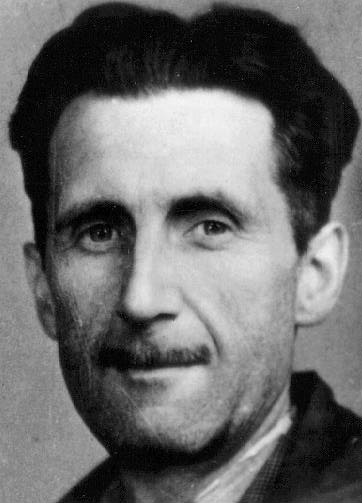
Orwell’s press card portrait, 1943
A few days ago a West African wrote to inform us that a certain London dance hall had recently erected a “colour bar”, presumably in order to please the American soldiers who formed an important part of its clientele. Telephone conversations with the management of the dance hall brought us the answers: (a) that the “colour bar” had been cancelled, and (b) that it had never been imposed in the first place; but I think one can take it that our informant’s charge had some kind of basis. There have been other similar incidents recently. For instance, I during last week a case in a magistrate’s court brought out the fact that a West Indian Negro working in this country had been refused admission to a place of entertainment when he was wearing Home Guard uniform. And there have been many instances of Indians, Negroes and others being turned away from hotels on the ground that “we don’t take coloured people”.It is immensely important to be vigilant against this kind of thing, and to make as much public fuss as possible whenever it happens. For this is one of those matters in which making a fuss can achieve something. There is no kind of legal disability against coloured people in this country, and, what is more, there is very little popular colour feeling. (This is not due to any inherent virtue in the British people, as our behaviour in India shows. It is due to the fact that in Britain itself there is no colour problem.)
The trouble always arises in the same way. A hotel, restaurant or what-not is frequented by people who have money to spend who object to mixing with Indians or Negroes. They tell the proprietor that unless he imposes a colour bar they will go elsewhere. They may be a very small minority, and the proprietor may not be in agreement with them, but it is difficult for him to lose good customers; so he imposes the colour bar. This kind of thing cannot happen when public opinion is on the alert and disagreeable publicity is given to any establishment where coloured people are insulted. Anyone who knows of a provable instance of colour discrimination ought always to expose it. Otherwise the tiny percentage of colour-snobs who exist among us can make endless mischief, and the British people are given a bad name which, as a whole, they do not deserve.
In the nineteen-twenties, when American tourists were as much a part of the scenery of Paris as tobacco kiosks and tin urinals, the beginnings of a colour bar began to appear even in France. The Americans spend money like water, and restaurant proprietors and the like could not afford to disregard them. One evening, at a dance in a very well-known cafe some Americans objected to the presence of a Negro who was there with an Egyptian woman. After making some feeble protests, the proprietor gave in, and the Negro was turned out.
Next morning there was a terrible hullabaloo and the cafe proprietor was hauled up before a Minister of the Government and threatened with prosecution. It had turned out that the offended Negro was the Ambassador of Haiti. People of that kind can usually get satisfaction, but most of us do not have the good fortune to be ambassadors, and the ordinary Indian, Negro or Chinese can only be protected against petty insult if other ordinary people are willing to exert themselves on his behalf.
George Orwell, “As I Please” Tribune, 1944-08-11.
August 29, 2019
“‘Neo-liberalism’ is actually little more than … ‘market socialism'”
Peter Boettke responds to a New York Times opinion piece by Binyamin Appelbaum, blaming economists for the state of the western world:
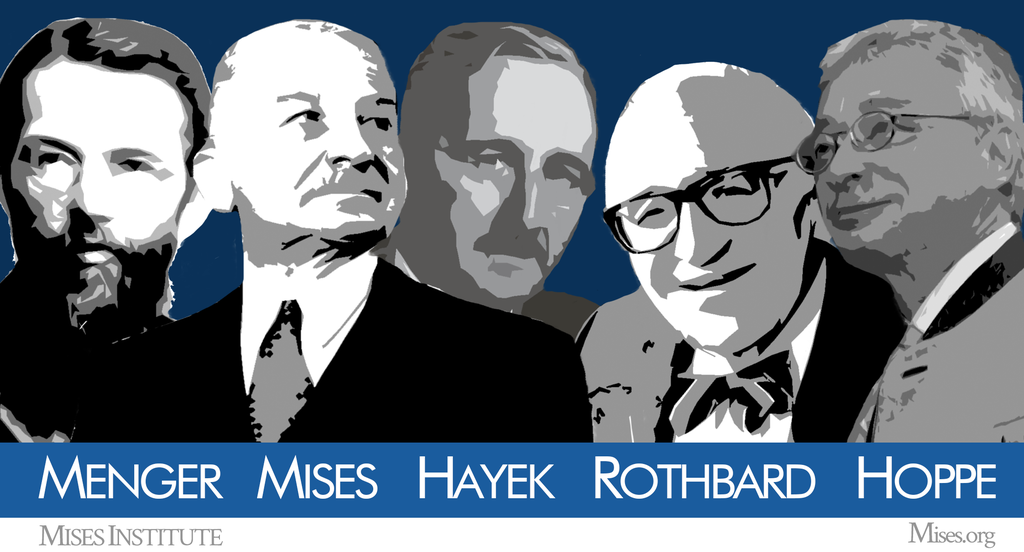
A Mises Institute graphic of some of the key economists in the Austrian tradition (Carl Menger, Ludwig von Mises, Friedrich Hayek, Murray Rothbard, and Hans-Hermann Hoppe.
Mises Institute via Wikimedia Commons.
But the problem is deeper than economists, it is ANYBODY put in this position of power and prestige, and to do so is fundamentally anti-democratic as was argued by Frank Knight in various writings, and then by Vincent Ostrom in The Intellectual Crisis of American Public Administration, and more recently in David Levy and Sandra Peart’s Escape from Democracy. We cannot fix this problem by replacing one set of “experts” with another set. We have to stop thinking of the relationship between economics and public administration along these lines altogether.
I try to lay out the argument in my SEA address on “Economics and Public Administration“, which also served as an attempt to summarize two decades of research that several of us have undertaken in this spirit. The critical argument in that text for this issue is that I argue that economics is a derived demand, if we conceive of the task of public administration one way, that will shape not only shape the supply and demand of economists, but dictate what it means to produce an economist — and thus, what is means to be an economist.
The problem with narratives like Appelbaum’s isn’t that he is suspicious of the pretensions of economists, it is that he is blaming the wrong culprit for the mess we’re in. Here it is important that everyone of these critics read Gregory Mankiw’s very important piece, published BEFORE the financial crisis, on the macroeconomist as scientists (read Chicago New Classical and Monetarists) and the macroeconomists as engineers (read MIT/Harvard Keynesian and New Keynesians). The Chicago folks — and the Austrian, Virginia, UCLA, etc. folks — did not go to DC, did not write laws, didn’t attempt to orchestrate economic miracles abroad, or stimulate growth at home. They taught, they lectured, the researched and wrote papers in journals and published books, and a subset of them wrote opinion editorials and did interviews in various forms of popular media. In short, they were teachers and students of society. They did not get paid to be experts for the government in general. They were not advisors. But others were — from Keynes to Larry Summers — the line is long. Just look at the number of central bankers that were PhD students under Stan Fischer at MIT. Can you trace that same lineage to Milton Friedman? How about to F. A. Hayek? Mises? Right, I didn’t think so.
“Neo-liberalism” is actually little more than an effort to bring neoclassical models of efficiency into the operation of governmental agencies — that in another era was called “market socialism” — just look at Abba Lerner’s The Economics of Control. He actually thought he had found the right way to combine socialist aspirations with the teachings of economics so he could ensure microeconomic efficiency and macroeconomic stability and provide economists with the tools to successfully steer the economic ship. That basic idea from mid-20th century to today has never disappeared in those halls of power — what has appeared is a waffling between liberal (in the American sense) Keynesianism, and conservative Keynesianism, but Keynesianism exists throughout. The Samuelsonian Neo-classical synthesis achieved the status he hoped for it … and provides the meaning behind his statement in the teachers manual “I don’t care who writes a nation’s laws … if I can write its economics textbooks.” Samuelson knew that if he could wrest control of the tacit presuppositions of public policy functionaries, then there thoughts and actions would be guided by what he taught about market failure, macroeconomic instability, and government as a corrective to our economic woes. It’s an amazing achievement what he did. For at least a generation, perhaps two, he controlled both the introduction to economics market, and the advanced training of PhD students in economics market.
Thinkers rose up in opposition to this hegemony from the older generation such as Knight, Mises and Hayek, but also among his contemporaries such as Alchian, Coase and Friedman, and of course a younger generation such as Becker and Lucas, but also Demsetz, Kirzner, etc. But, look at those names … they did not go to Washington DC to work for domestic policy agencies or the international agencies in economic policy. They were content in their jobs as economic scholars/teachers. They were humble students of society, and some among them rose to the status of social critics and intellectuals. But again none were master manipulators of the organs of power to try to shape the economy into the image of their ideal.
August 27, 2019
The Secret Invention That Made D-Day Possible | INTEL
Forces TV
Published on 7 Jun 2019As much as the success of D-Day was down to the bravery of soldiers … it was made possible by inventions and new machines. These Mulberry Harbours were a real World War 2 engineering victory.
More Mulberry: https://www.forces.net/d-day/mulberry-harbours-how-allies-floated-concrete-win-d-day
Forces Net D-Day Hub: http://forces.net/dday

So much for nil nisi bonum
The old Latin phrase De mortuis nihil nisi bonum encourages us to only speak well of the dead. The recent death of libertarian billionaire David Koch has brought forth a torrent of vituperation from many people in media and politics, as James Piereson and Naomi Schafer Riley record:
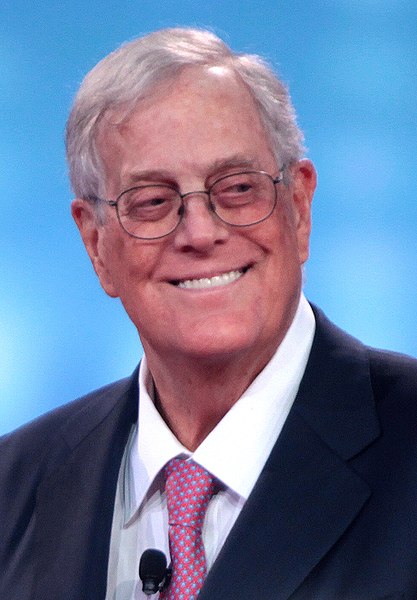
David Koch speaking at the Defending the American Dream Summit in Columbus, Ohio, 21 August 2015.
Photo by Gage Skidmore via Wikimedia Commons.
“Yesterday David Koch of the zillionaire Koch brothers died … of prostate cancer. I guess I’m going to have to reevaluate my low opinion of prostate cancer.” That was Bill Maher last Friday night, joking before his approving audience. Maher went on to say, “The Amazon is burning up. I’m glad he’s dead.” Maher is not known for his kindness toward those with whom he disagrees. In that sense, he reflects the thinking of a growing number of progressives and leftists who openly despise conservatives and libertarians. David Koch, along with his brother Charles, have for decades been targets of harsh rhetoric from the far Left.
What is it about David Koch that inspired such hatred? “We live in the world that he helped build, and it is on fire,” wrote Sarah Jones in New York, denouncing Koch’s “monstrous legacy.” In Esquire, Charles Pierce writes: “Except for his surviving brother, Charles, no man had a worse effect on American politics since the death of John C. Calhoun. Every malignancy currently afflicting us can be traced in one way or another into their wallets, and that’s not even to mention the lasting damage they’ve done to the planet as a whole.”
This is the kind of language that religious cults reserve for heretics and apostates — and in many ways, David and Charles Koch were blasphemers to the liberal orthodoxy. They believed in smaller government and thus criticized the welfare state, excessive taxation, and a great deal of government regulation. At the same time, they criticized America’s wars abroad, along with high levels of defense spending, and were sympathetic to the causes of gay rights and gay marriage. They were consistent in their views across a range of issues, antagonizing liberals but also vexing conservatives. The claim that David Koch was a reflexive right-winger is a caricature of his beliefs.
The Kochs believed in smaller government. Whether it was gay marriage or land wars in Asia, they consistently argued that less government intervention would produce freer and happier people. Their support for drug legalization and abortion rights irked plenty of conservatives, but it drove few over the edge as their support for lower taxes and greater school choice did for liberals. Perhaps nothing irked liberals more, though, than the Kochs’ fight for less environmental regulation. Blaming Charles and David Koch for singlehandedly destroying the rainforests or raising the temperature of the earth seems to be a common theme among critics — an attribution of immense power beyond the capacity of any man or family or company.


