
… in 2011, the only time Conservatives have managed to win a federal majority in the last three plus decades, they ran one of the most effective campaigns in recent memory against Michael “just visiting” Ignatieff by waging a patriotic campaign against him. In Ignatieff the Conservatives had the perfect rival to attack; a patrician member of the Laurentian new class. But the campaign against Ignatieff wasn’t just effective because it successfully portrayed him as an elite, it was effective because in attacking the time Ignatieff had spent aboard and at Harvard especially, they actually managed to make the Conservatives the champions of Canada, and the Liberals the more American party.
Ben Woodfinden, “True North Patriotism and a Distinctly Canadian Conservatism”, The Dominion, 2020-10-20.
February 8, 2021
QotD: The deeply rooted anti-Americanism in Canadian politics
February 7, 2021
Pearl Harbor Avenged! – WW2 – 128 – February 6, 1942
World War Two
Published 6 Feb 2021The Japanese advance in Burma and the Dutch East Indies, but they’ve reached the end of the Malayan Campaign- Singapore, which they have under siege. They now prepare for the final assault. The Allies are going on the offensive at sea, though, in the Marshalls-Gilberts Raids, while on land in the Soviet Union the Red Army launches another series of offensives against the Germans.
Join us on Patreon: https://www.patreon.com/TimeGhostHistory
Or join The TimeGhost Army directly at: https://timeghost.tvFollow WW2 day by day on Instagram @ww2_day_by_day – https://www.instagram.com/ww2_day_by_day
Between 2 Wars: https://www.youtube.com/playlist?list…
Source list: http://bit.ly/WW2sourcesWritten and Hosted by: Indy Neidell
Director: Astrid Deinhard
Producers: Astrid Deinhard and Spartacus Olsson
Executive Producers: Astrid Deinhard, Indy Neidell, Spartacus Olsson, Bodo Rittenauer
Creative Producer: Maria Kyhle
Post-Production Director: Wieke Kapteijns
Research by: Indy Neidell
Edited by: Iryna Dulka
Sound design: Marek Kamiński
Map animations: Eastory (https://www.youtube.com/c/eastory)Colorizations by:
– Mikołaj Uchman
– Julius Jääskeläinen – https://www.facebook.com/JJcolorization/
– Dememorabilia – https://www.instagram.com/dememorabilia/
– Norman Stewart – https://oldtimesincolor.blogspot.com/Sources:
– National Portrait Gallery
– Ministerie van Defensie
– Arrow by 4B Icons from the Noun Project
– Yad Vashem: 76BO2, 4331_21Soundtracks from the Epidemic Sound:
– Rannar Sillard – “Easy Target”
– Jo Wandrini – “Dragon King”
– Fabien Tell – “Last Point of Safe Return”
– Howard Harper-Barnes – “Sailing for Gold”
– Craft Case – “Secret Cargo”
– Rannar Sillard – “Split Decision”
– Flouw – “A Far Cry”
– Johannes Bornlöf – “The Inspector 4”
– Johan Hynynen – “Dark Beginning”
– Edward Karl Hanson – “Spellbound”
– Howard Harper-Barnes- “Underlying Truth”Archive by Screenocean/Reuters https://www.screenocean.com.
A TimeGhost chronological documentary produced by OnLion Entertainment GmbH.

QotD: The greatest sin of the Baby Boomers
If that’s harsh on the Boomers, well, sorry, Moonbeam — History don’t care about your feelings. But “the Sixties” isn’t the gravest charge History can lay against you. This is: After all that, you gave the world us, Gen X, the Dumbest Generation of Narcissists in the History of the World. Yes, you guys are responsible for both “Rocky Raccoon” and “Smells Like Teen Spirit.”
Severian, “The Look”, Rotten Chestnuts, 2020-10-09.
February 6, 2021
“WebMD is the Internet’s most important source of medical information. It’s also surprisingly useless”
Scott Alexander discusses why WebMD is not the be-all and end-all of internet medical resources:

WebMD is the Internet’s most important source of medical information. It’s also surprisingly useless. Its most famous problem is that whatever your symptoms, it’ll tell you that you have cancer. But the closer you look, the more problems you notice. Consider drug side effects. Here’s WebMD’s list of side effects for a certain drug, let’s call it Drug 1:
Upset stomach and heartburn may occur. If either of these effects persist or worsen, tell your doctor or pharmacist promptly. If your doctor has directed you to use this medication, remember that he or she has judged that the benefit to you is greater than the risk of side effects. Many people using this medication do not have serious side effects. Tell your doctor right away if you have any serious side effects, including: easy bruising/bleeding, difficulty hearing, ringing in the ears, signs of kidney problems (such as change in the amount of urine), persistent or severe nausea/vomiting, unexplained tiredness, dizziness, dark urine, yellowing eyes/skin. This drug may rarely cause serious bleeding from the stomach/intestine or other areas of the body. If you notice any of the following very serious side effects, get medical help right away: black/tarry stools, persistent or severe stomach/abdominal pain, vomit that looks like coffee grounds, trouble speaking, weakness on one side of the body, sudden vision changes or severe headache.
And here’s their list of side effects for let’s call it Drug 2:
Nausea, loss of appetite, or stomach/abdominal pain may occur. If any of these effects persist or worsen, tell your doctor or pharmacist promptly. Remember that your doctor has prescribed this medication because he or she has judged that the benefit to you is greater than the risk of side effects. Many people using this medication do not have serious side effects. This medication can cause serious bleeding if it affects your blood clotting proteins too much. Even if your doctor stops your medication, this risk of bleeding can continue for up to a week. Tell your doctor right away if you have any signs of serious bleeding, including: unusual pain/swelling/discomfort, unusual/easy bruising, prolonged bleeding from cuts or gums, persistent/frequent nosebleeds, unusually heavy/prolonged menstrual flow, pink/dark urine, coughing up blood, vomit that is bloody or looks like coffee grounds, severe headache, dizziness/fainting, unusual or persistent tiredness/weakness, bloody/black/tarry stools, chest pain, shortness of breath, difficulty swallowing.
Drug 1 is aspirin. Drug 2 is warfarin, which causes 40,000 ER visits a year and is widely considered one of the most dangerous drugs in common use. I challenge anyone to figure out, using WebMD’s side effects list alone, that warfarin is more dangerous than aspirin. I think this is because if WebMD said “aspirin is pretty safe and most people don’t need to worry about it”, people might use aspirin irresponsibly, die, and then their ghosts might sue WebMD. Or if WebMD said “warfarin can be dangerous, be careful with this one”, people might refuse to take warfarin because “the Internet said it was dangerous”, die of the stuff warfarin is supposed to treat, and then their ghosts might sue WebMD. WebMD solves this by never giving the tiniest shred of useful information to anybody.
This is actually a widespread problem in medicine. The worst offender is the FDA, which tends to list every problem anyone had while on a drug as a potential drug side effect, even if it obviously isn’t. This got some press lately when Moderna had to disclose to the FDA that one of the coronavirus vaccine patients got struck by lightning; after a review, this was declared probably unrelated. For the more serious version of this, read Get Ready For False Side Effects. Why does the FDA keep doing this if they know it makes their label information useless? My guess is it’s because they don’t want to look like cowboys who unprincipledly consider some things but not other things. What if someone accused the person deciding what things to consider of being biased? So the FDA comes up with a Procedure, and once you have a Procedure it has to be “take everything seriously”, and then it falls on random small-fry people who aren’t the FDA to pick up the slack and explain which side effects are worth worrying about or not, and then those small fries don’t do that, because they could get sued.
I think the same concern motivates WebMD diagnosing everything as cancer. If they said something other than cancer, then people might sigh with relief, not bother to get a cancer screening, die from some weird cancer that doesn’t present the way normal cancers do, and then their ghosts might sue WebMD.
Of course, WebMD and other online medical information sites didn’t invent hypochondria, they merely made it easier to do to yourself what Jerome K. Jerome did one fine London morning in 1888:
I remember going to the British Museum one day to read up the treatment for some slight ailment of which I had a touch — hay fever, I fancy it was. I got down the book, and read all I came to read; and then, in an unthinking moment, I idly turned the leaves, and began to indolently study diseases, generally. I forget which was the first distemper I plunged into — some fearful, devastating scourge, I know — and, before I had glanced half down the list of “premonitory symptoms,” it was borne in upon me that I had fairly got it.
I sat for awhile, frozen with horror; and then, in the listlessness of despair, I again turned over the pages. I came to typhoid fever — read the symptoms — discovered that I had typhoid fever, must have had it for months without knowing it — wondered what else I had got; turned up St. Vitus’s Dance — found, as I expected, that I had that too, — began to get interested in my case, and determined to sift it to the bottom, and so started alphabetically — read up ague, and learnt that I was sickening for it, and that the acute stage would commence in about another fortnight. Bright’s disease, I was relieved to find, I had only in a modified form, and, so far as that was concerned, I might live for years. Cholera I had, with severe complications; and diphtheria I seemed to have been born with. I plodded conscientiously through the twenty-six letters, and the only malady I could conclude I had not got was housemaid’s knee. […] I had walked into that reading-room a happy, healthy man. I crawled out a decrepit wreck.
February 5, 2021
The 369th Infantry Regiment in WW1 – the “Harlem Hellfighters”
Lawrence W. Reed remembers the US regiment that spent the most days in combat during WW1 and was awarded the French Croix de Guerre for the unit’s incredible fighting efforts:
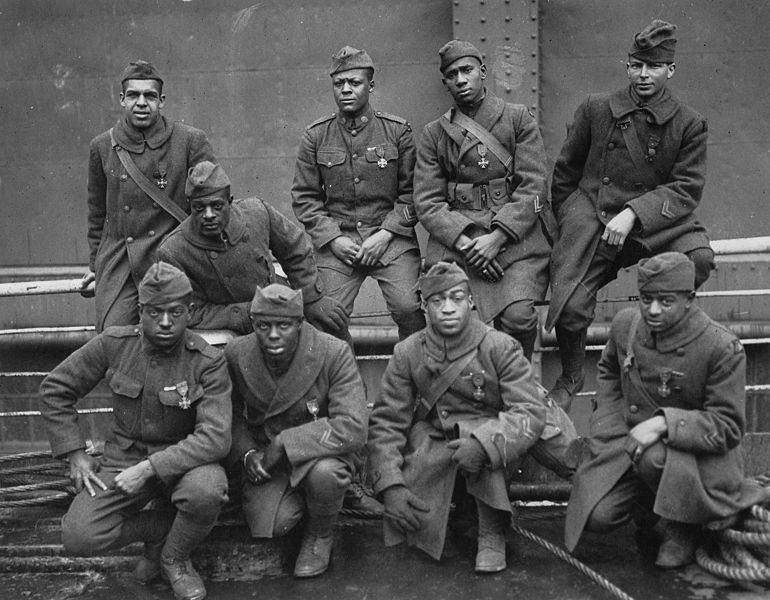
“Some of the colored men of the 369th (15th N.Y.) who won the Croix de Guerre for gallantry in action.” Left to right. Front row: Pvt. Ed Williams, Herbert Taylor, Pvt. Leon Fraitor, Pvt. Ralph Hawkins. Back Row: Sgt. H. D. Prinas, Sgt. Dan Strorms, Pvt. Joe Williams, Pvt. Alfred Hanley, and Cpl. T. W. Taylor.
Records of the War Department General and Special Staffs via Wikimedia Commons.
Formed from a New York National Guard unit, the men of the 369th learned basic military practices at Camp Whitman, New York, before being sent to Camp Wadsworth in Spartanburg, South Carolina, for combat training. They were not welcomed by many of the locals there, and some were subjected to discrimination and vile epithets for no more reason than their color. In December 1917, they were shipped to France where they expected to see action on the front lines.
Their high spirits were quickly dashed when it became apparent the Army did not want to deploy them for anything other than manual labor, far from the fighting. Even the rifles they brought with them were confiscated by US Army officials.
The commander of the American Expeditionary Force, General John J. Pershing, was reluctant to commit any US troops to the front until he felt he had assembled them in sufficient numbers to ensure victory. The French, meanwhile, were desperate for manpower. Finally bowing to French pressure, Pershing gave them the 369th. While some regarded black troops as expendable, they ultimately proved themselves indispensable.
Consider this amazing record of the Harlem Hellfighters: No American unit experienced more time in combat than they did — no less than 191 days under fire. They never lost an inch of ground. The enemy never captured a single of their number. They suffered the highest casualty rate of any US regiment. None deserted. The grateful French bestowed their highest military honor, the Croix de Guerre, upon the entire regiment. Many individuals of the regiment received the US Army’s second-highest award, the Distinguished Service Cross. Posthumously, Henry Johnson received America’s Medal of Honor in 2015. The 369th ended up as the most decorated US regiment of the war.
Another distinguishing feature of the Harlem Hellfighters was their band, the largest and best-known of any regiment. Its leader was James Reese Europe, whose enlistment in 1917 proved to be a boon for recruitment. He was one of America’s best-known black musicians and others like Noble Sissle, who became Europe’s lieutenant and lead vocalist, were eager to serve with him.
Europe’s band was extremely popular with the French, even when Europe introduced his own arrangement of La Marseillaise, France’s national anthem. The Hellfighters’ band brought both jazz and ragtime music to France, where nobody had heard either before.
February 4, 2021
Ace reads the upper middle class out of the conservative movement
At Ace of Spades H.Q., Ace himself explains why he doesn’t consider anyone who evinces loyalty to “the mores of the upper middle class” to be in any way, shape, or form “conservative”:

Never once do these bougie “cons” notice that the class whose class markers they are so eagerly collecting like Cub Scout merit badges are entirely created by progressives.
I’m going to say this more straightforwardly than I’ve ever said it. I’ve hinted around it, I’ve never said it straight up.
But here goes:
People loyal to the mores of the upper middle class are left-liberal. Period.
They should have no place in the leadership and “thought” leadership of any “conservative” movement. They are not conservative.
They are all pro-gay marriage.
They are all pro-abortion.
They are all in favor of shipping out every single working-class job to China, and, for those few remaining jobs which must be performed in America, shipping in workers from the third world to displace Americans.
They are all supporters of a soft version of the SJW progressive stack. They all believe in “White Privilege,” for an obvious reason — as the rich children of the prosperous upper-middle class, they’re actually the ones born to privilege, but they wish to obscure that fact. So they buy into the left’s claims about the “White Privilege” of 63% of the country, instead of focusing on the wealth privilege of 10%.
Jake Tapper will entertain he shares a kind of privilege with two thirds of the country but he will never acknowledge his real privilege, one shared by only 10% of the country.
And the social-climbing “conservative” media class is almost entirely born from the same prosperous class. They too do not want to talk about real privilege.
I always want to ask these guys, so desperate to peonize the working class: How far back in time do you have to go to find an ancestor who had a job which caused callouses to form on his hands?
Was it two generations ago? Three? It’s obvious the “conservative” media class has never had to work a shovel in their lives. The toughest job they’ve ever held was working in their dad’s law office, or valet parking Beemers at the country club.
And yes, they support the leftwing SJW claims about race. Bullshit like “minorities can’t be racist,” or at least not racist in a way that should be held against them.
That’s why they all rushed to defend notorious, swaggering racist Sarah Jeong, and refuse to even acknowledge the eyebrow-singing anti-white racism seen every single day in the media.
To acknowledge there’s such a thing as “anti-white racism,” and that it ought to be condemned, is, they’ve decided, an “alt-right” idea, and the alt-right is a lower class phenomenon, and, as I’ve noted, they really, really really need you to know they are not lower class.
The only way in which they are arguably “conservative” is that … they are in favor of oligarchical fascism directed by the billionaires signing their paychecks.
Which is of course not “conservative” at all. But that’s the one category in which they can make an arguable case for their “conservatism” — in always championing the Ruling Class’ right to rule over the downscale Dirties.
Is that the “conservatism” we want? A gonzo left-liberalism which is also thoroughly anti-republican, anti-egalitarian?
Also at Ace of Spades H.Q., OregonMuse quoted this rather timely Barry Goldwater statement:
I have little interest in streamlining government or in making it more efficient, for I mean to reduce its size. I do not undertake to promote welfare, for I propose to extend freedom. My aim is not to pass laws, but to repeal them. It is not to inaugurate new programs, but to cancel old ones that do violence to the Constitution or that have failed their purpose, or that impose on the people an unwarranted financial burden. I will not attempt to discover whether legislation is “needed” before I have first determined whether it is constitutionally permissible. And if I should later be attacked for neglecting my constituents’ “interests”, I shall reply that I was informed that their main interest is liberty and that in that cause I am doing the very best I can.
February 2, 2021
The History of Hollywood
The Cynical Historian
Published 3 Sep 2020This episode is about the history of Hollywood, and it’s quite a long one. This is part 9 in a long running series about California history.
————————————————————
references:
Bernard F. Dick, Engulfed: The Death of Paramount Pictures and the Birth of Corporate Hollywood (Lexington: The University Press of Kentucky, 2001). https://amzn.to/3f2Yb0SHollywood’s America: United States History Through its Films, eds. Mintz, Steven and Randy Roberts (St. James, N.York: Brandywine Press, 1993). https://amzn.to/2tZIoJT
Richard Slotkin, Gunfighter Nation: The Myth of the Frontier in Twentieth-Century America (New York: Atheneum Books, 1992). https://amzn.to/2KX0jI2
Kevin Starr, Inventing the Dream: California through the Progressive Era, (Oxford, U.K.: Oxford University Press, 1985). https://amzn.to/2VPTbVX
————————————————————
Support the channel through PATREON: https://www.patreon.com/CynicalHistorian
or by purchasing MERCH: teespring.com/stores/the-cynical-hist…LET’S CONNECT:
Twitch: https://www.twitch.tv/cynicalhistorian
Discord: https://discord.gg/Ukthk4U
Twitter: https://twitter.com/Cynical_History
Subreddit: https://www.reddit.com/r/CynicalHistory/————————————————————
Wiki: By 1912, major motion-picture companies had set up production near or in Los Angeles. In the early 1900s, most motion picture patents were held by Thomas Edison’s Motion Picture Patents Company in New Jersey, and filmmakers were often sued to stop their productions. To escape this, filmmakers began moving out west to Los Angeles, where attempts to enforce Edison’s patents were easier to evade. Also, the weather was ideal and there was quick access to various settings. Los Angeles became the capital of the film industry in the United States. The mountains, plains and low land prices made Hollywood a good place to establish film studios.
Director D. W. Griffith was the first to make a motion picture in Hollywood. His 17-minute short film In Old California (1910) was filmed for the Biograph Company. Although Hollywood banned movie theaters — of which it had none — before annexation that year, Los Angeles had no such restriction. The first film by a Hollywood studio, Nestor Motion Picture Company, was shot on October 26, 1911. The H. J. Whitley home was used as its set, and the unnamed movie was filmed in the middle of their groves at the corner of Whitley Avenue and Hollywood Boulevard.
The first studio in Hollywood, the Nestor Company, was established by the New Jersey–based Centaur Company in a roadhouse at 6121 Sunset Boulevard (the corner of Gower), in October 1911. Four major film companies – Paramount, Warner Bros., RKO, and Columbia – had studios in Hollywood, as did several minor companies and rental studios. In the 1920s, Hollywood was the fifth-largest industry in the nation. By the 1930s, Hollywood studios became fully vertically integrated, as production, distribution and exhibition was controlled by these companies, enabling Hollywood to produce 600 films per year.
Hollywood became known as Tinseltown and the “dream factory” because of the glittering image of the movie industry. Hollywood has since become a major center for film study in the United States.
————————————————————
Hashtags: #history #Hollywood #California

Well, it is a very, very cunning plan …
In the latest Libertarian Enterprise, Sarah Hoyt explains why the progressives’ cunningest of cunning plans may not be cunning enough:

The left has a plan so cunning that if it were a person, it would be teaching cunningology at Oxford. And the ones who get the reference will also know that their plan is about to go pear shaped in all sorts of interesting ways, and at the end of it there might very well be a turnip or two involved, but not as the only item available in the shelves of the grocery store.
Look, someone pointed out in the comments the left are trying to follow the “plan” for other communist revolutions round the world.
He’s right. They’re trying to follow it to the letter. Partly because it’s worked before, and partly, because to be fair, they’re a cult, and cults don’t know the reason for the ritual, they just follow it.
… but it’s already going wrong. And it’s only going to get worse.
You see, part of the problem is that the cult of communism and the procedures for “the revolution” were set in the early twentieth century. And it’s designed for the early twentieth century. To the extent they worked in places like Venezuela, it is because the underlying structures of the society were still very much “early twentieth century.”
The US? Well, not so much. In fact we never were much like the early twentieth century in Europe, which is why they’ve had a hell of a time getting a foothold here.
The communist revolution is designed to work in a country that is mostly urban, with a vast urban underclass that can’t rise above for reasons both internal and external despite working unreasonable hours. It’s designed for a country with a firm aristocracy of the hereditary sort (even if that aristocracy is often from trade), it is designed for a country with a conscript army where the plum assignments go to the “good families” as a matter of course, it is designed to work — most of all and very importantly — in a country where they ABSOLUTELY control all the means of mass communication and do so without the vast majority of the people being aware of it.
The last time they could have pulled that off in the US was in the mid seventies. And my guess, honestly, is that they tried. I don’t know for sure, since the news of the time were all reported by biased sources, and besides I’m too lazy and too busy […] to spend my day chasing down hints. I bet they did try, though. I bet they gave it a sporting try. And I bet part of the issue back then — as now, btw — is that they were pinning their hopes on a race war, having both not realized how much of a minority people of African descent are in the US (last estimate is what? 14%? Sizeable, sure, but not a large minority and certainly not a majority. Also, and seriously, a lot of that minority is middle class and whatever they voice from the mouth-out as uninterested as the rest of us in having the apple cart overturned. Apples are tasty. Genocide not so much.) Mostly because that sh*t was so successful in Africa, and again the left doesn’t think. It ritualistically applies “what worked” without being able to account for changed conditions.
Anyway, that was the last time they could have MAYBE credibly have followed their little red map to revolution and have it work. And even then Americans were just too darn contrarian. Why everyone and their parents were telling us that Republicans were so dangerous, that they were going to start the nuclear war, that — And we went and voted Reagan in. (Well, not me. I only worked towards it. I didn’t vote. I wasn’t a citizen and I’m not a democrat.)
In fact, America could have engraved on its door lintel “authorities can go f*ck themselves.” The left keeps forgetting that. And sometimes justifiably. Take their Covid-psy-ops. It worked. And it was all run on the “experts” and how important it was.
Uh uh. So, they think their control is back! They’re golden again, baby!
February 1, 2021
In the wake of l’affaire GameStop, frantic regulators call for more power to intervene in the market
“Regulatory capture” is the term for situations where the regulators and the regulated begin to get too close and the regulated industries or organizations begin to indirectly control the actions of the regulator for their own benefit. A topical example would be the sudden, agonized cries of politicians and market regulators for new powers to clamp down on disruptive players like the Redditors or other small investors who triggered the rise in GameStop share prices causing potentially ruinous financial losses for regulated hedge funds.

“GameStop” by JeepersMedia is licensed under CC BY 2.0

Although the story has garnered the attention of regulators and even the White House, the wrong takeaway is to suggest options for retail investors should be restricted more than they already are. Yet this is precisely what William Gavin, Secretary of the Commonwealth of Massachusetts, has called for. Gavin argued that there should be a 30-day trading suspension on GameStop to protect “small and unsophisticated investors.”
Gavin’s suggestion would have serious extended consequences. First, consider the knowledge problem that is involved in constructing such a restrictive regulation. When exactly would a rally become unacceptable? Despite years of decline, Kodak experienced a rally after its announcement that it would move into pharmaceuticals. Would this be permissible? If so, one could simply point to GameStop’s decision to appoint three new directors in an effort to turn the company around. If this is not enough, regulators must clearly state what identified the investments as unacceptable.
It is unclear if there is a perfect benchmark to distinguish rallies. But without such a measure, the suspension proposal would put every rally at risk of wrongful closure — potentially halting the growth of companies and industries, alike. Worse yet, the fear of missing out on a rising stock may push some investors to rush in with less information than they would otherwise acquire. Even if it is in a traditional rally, an uninformed decision could cause more harm than good.
Yet suppose the knowledge problem is solved and there is a perfect measure in place. Should other protections be put in place? One could make the case for a law against allowing “unsophisticated” gamblers from going to Las Vegas and losing money. And although this may seem like a leap, Gavin himself told Reuters, “This isn’t investing, this is gambling,” when he spoke of the GameStop rally.
The rally has attracted the world’s attention, but it does not require it. Rallies are a normal part of financial market activity. The only difference here is that it was Main Street that pulled one over on Wall Street.
January 31, 2021
Fortress Singapore Stands Alone! – WW2 – 127 – January 30, 1942
World War Two
Published 30 Jan 2021The Japanese advance on Singapore has gotten close enough that the British have destroyed the causeway to Singapore Island. The Japanese are also making attacks in the Solomon Islands, Burma, the Philippines, and the Dutch East Indies — their threat to Australia is real. Erwin Rommel’s surprise spoiler offensive in North Africa takes Benghazi, and on the eastern front the Soviets break a hole in the German lines in the north even as the temperature drops to the -50s.
Join us on Patreon: https://www.patreon.com/TimeGhostHistory
Or join The TimeGhost Army directly at: https://timeghost.tvFollow WW2 day by day on Instagram @ww2_day_by_day – https://www.instagram.com/ww2_day_by_day
Between 2 Wars: https://www.youtube.com/playlist?list…
Source list: http://bit.ly/WW2sourcesWritten and Hosted by: Indy Neidell
Director: Astrid Deinhard
Producers: Astrid Deinhard and Spartacus Olsson
Executive Producers: Astrid Deinhard, Indy Neidell, Spartacus Olsson, Bodo Rittenauer
Creative Producer: Maria Kyhle
Post-Production Director: Wieke Kapteijns
Research by: Indy Neidell
Edited by: Iryna Dulka
Sound design: Marek Kamiński
Map animations: Eastory (https://www.youtube.com/c/eastory)Colorizations by:
– Mikołaj Uchman
– Jaris Almazani (Artistic Man) – https://instagram.com/artistic.man
– Norman Stewart – https://oldtimesincolor.blogspot.com/Sources:
– JoJan, Berserker276 – from Wikimedia Commons
– National Portrait Gallery
– Termometer by Andi Nur Abdillah from the Noun Project
– Bundesarchiv – Bild 101I-811-1881-33
– Mil.ruSoundtracks from the Epidemic Sound:
– Rannar Sillard – “Easy Target”
– Jo Wandrini – “Dragon King”
– Rannar Sillard – “Split Decision”
– Craft Case – “Secret Cargo”
– Reynard Seidel – “Rush of Blood”
– Flouw – “A Far Cry”
– Fabien Tell – “Weapon of Choice”
– Johan Hynynen – “Dark Beginning”
– Gunnar Johnsen – “Not Safe Yet”
– Fabien Tell – “Last Point of Safe Return”Archive by Screenocean/Reuters https://www.screenocean.com.
A TimeGhost chronological documentary produced by OnLion Entertainment GmbH.

M37: The Ultimate Improved Browning 1919
Forgotten Weapons
Published 8 Mar 2019http://www.patreon.com/ForgottenWeapons
Cool Forgotten Weapons merch! http://shop.bbtv.com/collections/forg…
In November of 1950, the US Ordnance Department requested an improved version of the Browning 1919 air-cooled machine gun for use in tanks. The new version was to be able to feed from either the left or right, a feature which was unimportant for an infantry gun but much more relevant when mounting guns into the tight spaces of an armored vehicle. An interim conversion of existing guns to the M1919A4E1 pattern came first, followed by manufacture of all-new guns by the Rock Island Arsenal and Saco-Lowell company from 1955 until 1957.
The design of the gun fell to Bob Hillberg at High Standard. He came up with a clever set of reversible plugs to change the bolt between left and right hand feed, as well as a captive recoil spring, manual safety, improved top cover and rear cover latches, and several other strengthened parts. He also incorporated a charging handle extension with integral manual hold open and a link ejection chute that could be mounted to either side of the gun. His T153 design was formally adopted as the M37, in caliber .30-06. A 7.62mm NATO version (the M37E1) followed as well. The M37 would serve into the late 1960s on the M48 and M60 tanks as well as several helicopters.
Contact:
Forgotten Weapons
PO Box 87647
Tucson, AZ 85754

QotD: Sixties music wasn’t what you think it was
Tom Jones is great, I love his stuff, but he’s not going to melt your face with his guitar riffs, and he’s there at #8, right in front of “Build Me Up, Buttercup.” Which is one hell of a catchy tune, and compared to “Love Theme from Romeo and Juliet” (#15) it’s practically Slayer, but rock it ain’t. Ray Stevens is at #61, for pete’s sake, with “Guitarzan.” If that hasn’t convinced you that The Sixties were nothing like they show in the movies (and that maybe the Viet Cong deserved to win), I don’t know what would.
Severian, “Entertainers (III): Hair Metal Attains Nirvana”, Rotten Chestnuts, 2020-10-08.
January 30, 2021
Obey your technocratic elites, peasant!
Scott Alexander considers some historical (and current) examples of you peasants being steamrolled by the powers of the government at the behest of the technological elites of the day:
I am not defending technocracy.
Nobody ever defends technocracy. It’s like “elitism” or “statism”. There is no Statist Party. Nobody holds rallies demanding more statism. There is no Citizens for Statism Facebook page with thousands of likes and followers.
[…] it worries me that everyone analyzes the exact same three examples of the failures of top-down planning: Soviet collective farms, Brasilia, and Robert Moses. I’d like to propose some other case studies:
1. Mandatory vaccinations: Technocrats used complicated mathematical models to determine that mass vaccination would create a “herd immunity” to disease. Certain that their models were “objectively” correct and so could not possibly be flawed, these elites decided to force vaccines on a hostile population. Despite popular protest (did you know that in 1800s England, anti-smallpox-vaccine rallies attracted tens of thousands of demonstrators?), these technocrats continued to want to “arrogantly remake the world in their image,” and pushed ahead with their plan, ignoring normal citizens’ warnings that their policies might have unintended consequences, like causing autism.
2. School desegregation: Nine unelected experts with Harvard and Yale degrees, using a bunch of Latin terms like a certiori and de facto that ordinary people could not understand let alone criticize, decided to completely upend the traditional education system of thousands of small communities to make it better conform to some rules written in a two-hundred-year-old document. The communities themselves opposed it strongly enough to offer violent resistance, but the technocrats steamrolled over all objections and sent in the National Guard to enforce their orders.
US Highway System needs in 1965 from “Needs of the Highway Systems 1955-1984”, a letter from the Secretary of Commerce to the House Committee on Public Works, approved May 6, 1954.
US Government Printing Office via Wikimedia Commons.3. The interstate highway system: 1950s army bureaucrats with a Prussia fetish decided America needed its own equivalent of the Reichsautobahn. The federal government came up with a Robert-Moses-like plan to spend $114 billion over several decades to build a rectangular grid of numbered giant roads all up and down the country, literally paving over whatever was there before, all according to pre-agreed federal standards. The public had so little say in the process that they started hundreds of freeway revolts trying to organize to prevent freeways from being built through their cities; the government crushed these when it could, and relocated the freeways to less politically influential areas when it couldn’t.
4. Climate change: In the second half of the 20th century, scientists determined that carbon dioxide emissions were raising global temperatures, with potentially catastrophic consequences. Climatologists created complicated formal models to determine how quickly global temperatures might rise, and economists designed clever from-first-principle mechanisms that could reduce emissions, like cap-and-trade systems and carbon taxes. But these people were members of the elite toying with equations that could not possibly include all the relevant factors, and who were vulnerable to their elite biases. So the United States decided to leave the decision up to democratic mechanisms, which allowed people to contribute “outside-the-system” insights like “Actually global warming is fake and it’s all a Chinese plot”.
5. Coronavirus lockdowns: The government appointed a set of supposedly infallible scientist-priests to determine when people were or weren’t allowed to engage in normal economic activity. The scientist-priests, who knew nothing about the complex set of factors that make one person decide to go to a rock festival and another to a bar, decided that vast swathes of economic activity they didn’t understand must stop. The ordinary people affected tried to engage in the usual mechanisms of democracy, like complaining, holding protests, and plotting to kidnap their governors – but the scientist-priests, certain that their analyses were “objective” and “fact-based”, thought ordinary people couldn’t possibly be smart enough to challenge them, and so refused to budge.
Nobody uses the word “technocrat” except when they’re criticizing something. So “technocracy” accretes this entire language around it – unintended consequences, the perils of supposed “objectivity”, the biases inherent in elite paradigms. And then when you describe something using this language, it’s like “Oh, of course that’s going to fail – everything like that has always failed before!”
But if you accept that “technocracy” describes things other than Soviet farming, Brasilia, and Robert Moses, the trick stops working. You notice a lot of things you could describe using the same vocabulary were good decisions that went well. Then you have to ask yourself: is Seeing Like A State the definitive proof that technocratic schemes never work? Or is it a compendium of rare man-bites-dog style cases, interesting precisely because of how unusual they are?
I want to make it really clear that I’m not saying that technocracy is good and democracy is bad. I’m saying that this is actually a hard problem. It’s not a morality play, where you tell ghost stories about scary High Modernists, point vaguely in the direction of Brasilia, say some platitudes about how no system can ever be truly unbiased, and then your work is done. There are actually a bunch of complicated reasons why formal expertise might be more useful in some situations, and local knowledge might be more useful in others.

The Extraordinary Voyage of USS Marblehead
The History Guy: History Deserves to Be Remembered
Published 6 Jan 2021By May 1942, nearly half of the forty surface ships of the U.S. Asiatic fleet would be sunk, including the fleet’s largest vessel, the heavy cruiser USS Houston. But the improbable survival of one of the fleet’s vessels, the light cruiser USS Marblehead, is the stuff of legend. The extraordinary voyage of the Marblehead is history that deserves to be remembered.
This is original content based on research by The History Guy. Images in the Public Domain are carefully selected and provide illustration. As very few images of the actual event are available in the Public Domain, images of similar objects and events are used for illustration.
You can purchase the bow tie worn in this episode at The Tie Bar:
https://www.thetiebar.com/?utm_campai…All events are portrayed in historical context and for educational purposes. No images or content are primarily intended to shock and disgust. Those who do not learn from history are doomed to repeat it. Non censuram.
Find The History Guy at:
Patreon: https://www.patreon.com/TheHistoryGuy
Please send suggestions for future episodes: Suggestions@TheHistoryGuy.netThe History Guy: History Deserves to Be Remembered is the place to find short snippets of forgotten history from five to fifteen minutes long. If you like history too, this is the channel for you.
Awesome The History Guy merchandise is available at:
teespring.com/stores/the-history-guyScript by THG
#usnavy #thehistoryguy #WWII

“The only thing ‘dangerous’ about a gang of Reddit investors blowing up hedge funds is that some of us reading about it might die of laughter”
Matt Taibbi says “Suck it, Wall Street!”
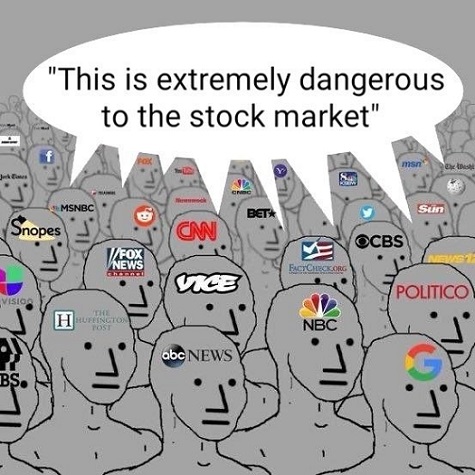
Meme stolen from Ace of Spades H.Q.
The press conveyed panic and moral disgust. “I didn’t realize it was this cultlike,” said short-seller Andrew Left of Citron Research, without irony denouncing the campaign against firms like his as “just a get rich quick scheme.” Massachusetts Secretary of State Bill Galvin said the Redditor campaign had “no basis in reality,” while Dr. Michael Burry, the hedge funder whose bets against subprime mortgages were lionized in The Big Short, called the amateur squeeze “unnatural, insane, and dangerous.”
The episode prompted calls to regulate Reddit and, finally, halt action on the disputed stocks. As I write this, word has come out that platforms like Robinhood and TD Ameritrade are curbing trading in GameStop and several other companies, including Nokia and AMC Entertainment holdings.
Meaning: just like 2008, trading was shut down to save the hides of erstwhile high priests of “creative destruction.” Also just like 2008, there are calls for the government to investigate the people deemed responsible for unapproved market losses.
The acting head of the SEC said the agency was “monitoring” the situation, while the former head of its office of Internet enforcement, John Stark, said, “I can’t imagine there isn’t an open investigation and probably a formal order to find out who’s on these message boards.” Georgetown finance professor James Angel lamented, “it’s going to be hard for the SEC to find blatant manipulation,” but they “owe it to look.” The Washington Post elaborated:
To establish manipulation that runs afoul of securities laws, Angel said regulators would need to prove traders engaged in “an intentional act to push a price away from its fundamental value to seek a profit.” In market parlance, this is typically known as a pump-and-dump scheme …
Even Nancy Pelosi, when asked about “manipulation” and “what’s going on on Wall Street right now,” said “we’ll all be reviewing it,” as if it were the business of congress to worry about a bunch of day traders cashing in for once.
The only thing “dangerous” about a gang of Reddit investors blowing up hedge funds is that some of us reading about it might die of laughter. That bit about investigating this as a “pump and dump scheme” to push prices away from their “fundamental value” is particularly hilarious. What does the Washington Post think the entire stock market is, in the bailout age?
H/T to Larry Correia for the link.


