Quotulatiousness

May 4, 2021

Preparing for the worst (and hoping it won’t happen)

Filed under: Economics, Politics, USA — Tags: , — Nicholas @ 03:00

I’m generally optimistic about the big picture in any given situation no matter how pessimistic I’m inclined to be on smaller matters and individual details. For this reason, I try not to think too much on just how bad things might get if too many current cultural trends continue as they are. Sarah Hoyt, on the other hand, has some suggestions for getting past any potential social upheavals we may face in the very near future:

If you’re in a major city and I like you, I beg you, with tears in my eyes to get out as soon as you can (and yes, we’re working on it.) Some neighborhoods and places will be safe-ish, but in the US the brunt of the horrific will be in big cities, because that’s what the left thinks MATTERS and where they’ll concentrate their effort.

Forgive me for corporate speak from the nineties, but in this case it applies: their paradigm is broken and they can’t see it because they’ve done everything possible to insulate themselves from input coming from outside the paradigm.

When this happens and the people of the dead paradigm still have some power, the result is kind of like when you fill a container with gasoline, then drop a match in. It’s best to be in the places they think don’t matter.

Other than that: well, you don’t know how interconnected the world supply chains are, until they break. These last two years have been a lesson and no mistake. When I say we’ll unfuck ourselves relatively fast, it doesn’t mean we’ll reverse disastrous globalization in an eye blink. We won’t.

Try to have the things you think you’ll need for five-ten years. That includes newish computers (the silicon crisis is real) perhaps more expensive than you’re used to buying, and raw materials for what you’ll need, from fabric to … I don’t know. Probably not clay. But now might be a bad time to downsize and get rid of that “for company” dish set, depending on your rate of breakage of the everyday one. Lay by paper, too. If we start getting electricity brownouts and blackouts, having stuff you want to keep printed might help.

Food. I don’t need to say it. I think I have maybe enough for a year and a half, though at the end our diet would be mighty strange. But we’re already hearing screams of food supply failure. (I want to get us moved, and start laying in more food. The delays and set backs are driving me nuts.)

And what about the stupid laws proscribing wrong thinkers? For now? Nothing. If you’re hidden and submerged stay that way. Look at it this way: if the people who hid Jews in their attics had come out early to defend them, they too would be in the camps and unable to help. We’re already past the point where “a brave stand” will help. The left knows they’re losing. They can’t understand why, but they know they’re losing, and they’re angry and murderous because of it. And they won’t let go, until it all explodes in their faces. So if you are hidden, stay thus, and get ready to hide people in your metaphorical attic. Because those like me who are exposed, if they have a good bit of luck, just might manage to make it there.

Just prepare, prepare as hard as you can.

You’ll be blindsided. We all will be. Seriously. Books that go through this lie. It’s always more complex and more difficult than you can imagine, and you will be caught off guard.

If you’re lucky, the things you’re caught in won’t kill you.

If we’re all lucky we’ll come out the other side alive and well, most of us. Which is good, because we’ll be needed if we want future generations to grow up under a constitutional republic.

The rest of the world? Foggedaboutit. Not a chance. They’re going to try to crawl back to pre-English enlightenment. Some areas will manage it, too.

For us? I don’t know. There is a chance. Honestly. A chance is all we can ask for.

So, let’s survive and be ready to push the odds. Because the destruction will be everywhere. But the re-building must begin in America.

May 2, 2021

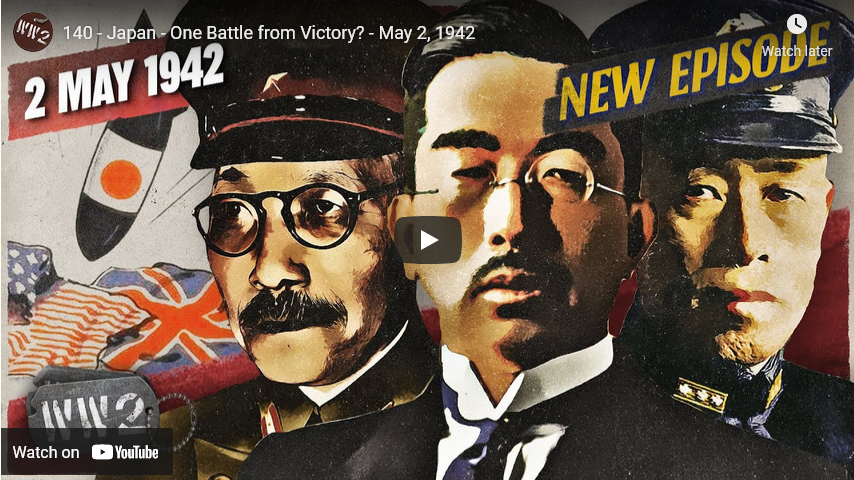
Japan – One Battle from Victory? – 140 – May 2, 1942

Filed under: Britain, China, Germany, History, Japan, Military, Pacific, Russia, USA, WW2 — Tags: , , , , , — Nicholas @ 04:00

World War Two
Published 1 May 2021

Now Burma and control of the Burma Road have fallen to the Japanese. Can nothing stop them? The Allies are thinking about maybe using the Solomon Islands as a base to build to try and fight back, but to do that they’ll need control of the Coral Sea, but both sides are sending warships there since the Japanese plan to take Port Moresby. The Allies are aware of this, however, since they have the advantage of being able to read a substantial part of Japan’s radio traffic. It is a week of foreshadowing not just there, but also as the Allies send ships to take Madagascar from the Vichy French and the Soviets prepare to launch an offensive in the south of the Eastern Front.

Join us on Patreon: https://www.patreon.com/TimeGhostHistory
Or join The TimeGhost Army directly at: https://timeghost.tv

Follow WW2 day by day on Instagram @ww2_day_by_day – https://www.instagram.com/ww2_day_by_day
Between 2 Wars: https://www.youtube.com/playlist?list…
Source list: http://bit.ly/WW2sources

Written and Hosted by: Indy Neidell
Director: Astrid Deinhard
Producers: Astrid Deinhard and Spartacus Olsson
Executive Producers: Astrid Deinhard, Indy Neidell, Spartacus Olsson, Bodo Rittenauer
Creative Producer: Maria Kyhle
Post-Production Director: Wieke Kapteijns
Research by: Indy Neidell
Edited by: Iryna Dulka
Sound design: Marek Kamiński
Map animations: Eastory (https://www.youtube.com/c/eastory​)

Colorizations by:
– Daniel Weiss
– Norman Stewart – https://oldtimesincolor.blogspot.com/​

Sources:
– IWM JAR 1240, A 9483

Soundtracks from the Epidemic Sound:
– Rannar Sillard – “Easy Target”
– Jo Wandrini – “Dragon King”
– Fabien Tell – “Other Sides of Glory”
– Brightarm Orchestra – “On the Edge of Change”
– Edward Karl Hanson – “Spellbound”
– Johan Hynynen – “Dark Beginning”
– Rannar Sillard – “Split Decision”
– Dream Cave – “The Beast”

Archive by Screenocean/Reuters https://www.screenocean.com​.

A TimeGhost chronological documentary produced by OnLion Entertainment GmbH.

QotD: The “I don’t watch sports” bore is even more rare than the Libertarian bore

Filed under: Humour, Media, Quotations, Sports, USA — Tags: , — Nicholas @ 01:00

I have always believed that I am the kind of person who doesn’t like sports. I don’t like playing them, and I don’t like watching them. Despite growing up in a sports-friendly household, I don’t think I have ever watched a complete game of professional basketball. I enjoy the over-the-top production values of the Super Bowl, but not football itself. I appreciate baseball as an exercise in the generation of discrete statistical outcomes, but I can’t bring myself to feel any passion about the game. All I know about hockey is that there’s something called the icing rule, which sounds delicious.

Only about 7 percent of American adults don’t watch sports at all. That means that non-sports-watchers are, by some counts, even rarer than libertarians. What I’m trying to say is, I’m fun at parties.

Peter Suderman, Call of Duty Is the Best Sporting Event in the World”, Reason, 2018-10-19.

May 1, 2021

When the libraries failed

Filed under: Books, History, USA — Tags: , , , , — Nicholas @ 03:00

In another of a series of book reviews by Astral Codex Ten readers, Scott Alexander posted this review of Double Fold by Nicholson Baker, which helps to indicate just when libraries — and librarians — lost their mojo:

“Nottingham central library” by JuliaC2006 is licensed under CC BY 2.0

If you enter a major research library in the US today and request to see a century-old issue of a major American newspaper, such as Chicago Tribune, The Wall Street Journal, or major-but-defunct newspapers such as the New York “World”, odds are that you will be directed to a computer or a microfilm reader. There, you’ll get to see black-and-white images of the desired issue, with individual numbers of the newspaper often missing and much of the text, let alone pictures, barely decipherable.

The libraries in question mostly once had bound issues of these newspapers, but between the 1950s and the 1990s, one after another, they ditched the originals in favor of expensive microfilmed copies of inferior quality. They continued doing this even while the originals became perilously rare; the newspapers themselves were mostly trashed, or occasionally sold to dealers who cut them up and dispersed them. As a consequence, many of these publications are now rarer than the Gutenberg Bible, and some 19th and 20th century newspapers have ceased to exist in a physical copy anywhere in the world.

When Double Fold by Nicholson Baker came out in 2001, it was described as The Jungle of the American library system. After 20 years, the book remains universally known, sometimes admired but often despised, among librarians. The reason for their belligerence is that Baker publicly revealed a decades-long policy of destruction of primary materials from the 19th and 20th centuries, based on a pseudoscientific notion that books on wood-pulp paper are quickly turning to dust, coupled with a misguided futuristic desire to do away with outdated paper-based media. As a consequence, perfectly well preserved books with centuries of life still ahead of them were hastily replaced with an inferior medium which has, at the moment that I am writing this review, already mostly gone the way of the dodo. Despite its notoriety among librarians, however, Double Fold is little-known among the general public, even compared to Baker’s other non-fiction and his novels.

This is a shame, since the mass destruction of books and newspapers by libraries in the post-war era deserves to be better known as one of the most egregious failures of High Modernism, comparable with the wackiest plans of Le Corbusier. The story combines an excessive reliance on simplistic mathematical models, wilful ignorance to the desires of actual library-users and scholars, embracement of miniaturization and modernization as terminal values, and an almost complete disregard of 19th century books as historical artefacts. Unlike industrial farms, which can be broken up, and Brasília-style skyscrapers, which can be torn down and replaced with something else, the losses caused by the mass deaccessioning of books and newspapers from libraries were often irreplaceable.

As part of the uproar that followed the book’s publication, the Association of Research Libraries published an online anti-Baker FAQ, and in 2002, the book Vandals in the Stacks? by Richard J. Cox came out, presenting an attempted refutation of Baker’s theses. I have read both of these and discuss Cox’s arguments later on, but I must admit in advance that I was mostly convinced by Baker’s argumentation much more than by that of his opponents. Nonetheless, it is uncommon to have a polemical book receive a book-length response, and anyone interested in Baker’s thesis is advised to check out Cox as well.

QotD: “WOLF! Film at 11”

Filed under: Media, Politics, Quotations, USA — Tags: , , , , , — Nicholas @ 01:00

Yes, false conspiracy theories are dangerous. One of the best defences a polity has against them is a reasonable level of trust in the authorities and the media. In the long run the only way to gain this trust is to be worthy of it, i.e. not to lie and not to hide the truth. By their promiscuous propagation of any story, however baseless, that might harm the Republicans and their enthusiastic censorship of any story, however credible, that might make the Democrats look bad, the American Woke Media, old and new, have lost this trust. As a result reality ensues, to quote TV Tropes. Or if you prefer the same truth in an older format, take your quote from William Caxton’s summary at the end of his retelling of the fable of the boy who cried wolf, “men bileve not lyghtly hym whiche is knowen for a lyer“.

Natalie Solent, “Why do Americans think the media might be hiding things from them? Let’s try asking Tony Bobulinski on Twitter”, Samizdata, 2021-01-13.

April 29, 2021

“Tokyo Rose” – WW2 Traitor or Victim?

Filed under: Australia, History, Japan, Military, Pacific, USA, WW2 — Tags: , , — Nicholas @ 04:00

Mark Felton Productions
Published 28 Apr 2021

This is the story of “Tokyo Rose”, a Japanese-American from LA who broadcast propaganda for the Japanese during WW2. Was she a traitor or a victim?

Dr. Mark Felton is a well-known British historian, the author of 22 non-fiction books, including bestsellers Zero Night and Castle of the Eagles, both currently being developed into movies in Hollywood. In addition to writing, Mark also appears regularly in television documentaries around the world, including on The History Channel, Netflix, National Geographic, Quest, American Heroes Channel and RMC Decouverte. His books have formed the background to several TV and radio documentaries. More information about Mark can be found at: https://en.wikipedia.org/wiki/Mark_Fe…​
Visit my audio book channel ‘War Stories with Mark Felton’: https://youtu.be/xszsAzbHcPE​

Help support my channel:
https://www.paypal.me/markfeltonprodu…​
https://www.patreon.com/markfeltonpro…

Disclaimer: All opinions and comments expressed in the “Comments” section do not reflect the opinions of Mark Felton Productions. All opinions and comments should contribute to the dialogue. Mark Felton Productions does not condone written attacks, insults, racism, sexism, extremism, violence or otherwise questionable comments or material in the “Comments” section, and reserves the right to delete any comment violating this rule or to block any poster from the channel.

April 26, 2021

Was GENERAL SHERMAN a WAR CRIMINAL?!?!?!?!

Atun-Shei Films
Published 11 Aug 2020

Checkmate, Lincolnites! Debunking the Lost Cause myths surrounding William Tecumseh Sherman during the American Civil War, including the Atlanta Campaign, the March to the Sea, and the burning of Columbia — and tackling the “slavery would have gone away on its own” thing while we’re at it. Surprisingly, Johnny Reb gets in one or two really solid points.

[Updated 8 Feb 2023: Vlogging Through History’s reaction video to Atun-Shei’s interpretation is here – https://youtu.be/CTVr4YgB5VI]
(more…)

QotD: Maple-flavoured schadenfreude

Filed under: Cancon, Humour, Media, Quotations, USA — Tags: , — Nicholas @ 01:00

Schadenfreude is of course the German word for taking pleasure in the discomfort of others. There should be a specific Canadian variant to indicate our enjoyment of Americans’ discomfort, which is and always has been a major source of satisfaction for many of our media elites. Maybe schadenfreud-eh?

William Watson, “Smug Canada probably wouldn’t let in a caravan of migrants either”, Financial Post, 2018-10-26.

April 25, 2021

They don’t call it “neo-Marxism”, but that’s what Critical Race Theory really is

Filed under: Politics, USA — Tags: , , , — Nicholas @ 05:00

In City Journal, Christopher Rufo explains why Critical Race Theory is a natural child of orthodox Marxist thought:

Critical race theory is an academic discipline, formulated in the 1990s and built on the intellectual framework of identity-based Marxism. Relegated for many years to universities and obscure academic journals, it has increasingly become the default ideology in our public institutions over the past decade. It has been injected into government agencies, public school systems, teacher training programs, and corporate human-resources departments, in the form of diversity-training programs, human-resources modules, public-policy frameworks, and school curricula.

Its supporters deploy a series of euphemisms to describe critical race theory, including “equity,” “social justice,” “diversity and inclusion,” and “culturally responsive teaching.” Critical race theorists, masters of language construction, realize that “neo-Marxism” would be a hard sell. Equity, on the other hand, sounds non-threatening and is easily confused with the American principle of equality. But the distinction is vast and important. Indeed, critical race theorists explicitly reject equality — the principle proclaimed in the Declaration of Independence, defended in the Civil War, and codified into law with the Fourteenth and Fifteenth Amendments, the Civil Rights Act of 1964, and the Voting Rights Act of 1965. To them, equality represents “mere nondiscrimination” and provides “camouflage” for white supremacy, patriarchy, and oppression.

In contrast to equality, equity as defined and promoted by critical race theorists is little more than reformulated Marxism. In the name of equity, UCLA law professor and critical race theorist Cheryl Harris has proposed suspending private property rights, seizing land and wealth, and redistributing them along racial lines. Critical race guru Ibram X. Kendi, who directs the Center for Antiracist Research at Boston University, has proposed the creation of a federal Department of Antiracism. This department would be independent of (i.e., unaccountable to) the elected branches of government, and would have the power to nullify, veto, or abolish any law at any level of government and curtail the speech of political leaders and others deemed insufficiently “antiracist.”

One practical result of the creation of such a department would be the overthrow of capitalism, since, according to Kendi, “In order to truly be antiracist, you also have to truly be anti-capitalist.” In other words, identity is the means; Marxism is the end.

An equity-based form of government would mean the end not only of private property but also of individual rights, equality under the law, federalism, and freedom of speech. These would be replaced by race-based redistribution of wealth, group-based rights, active discrimination, and omnipotent bureaucratic authority. Historically, the accusation of “anti-Americanism” has been overused. But in this case, it’s not a matter of interpretation: critical race theory prescribes a revolutionary program that would overturn the principles of the Declaration and destroy the remaining structure of the Constitution.

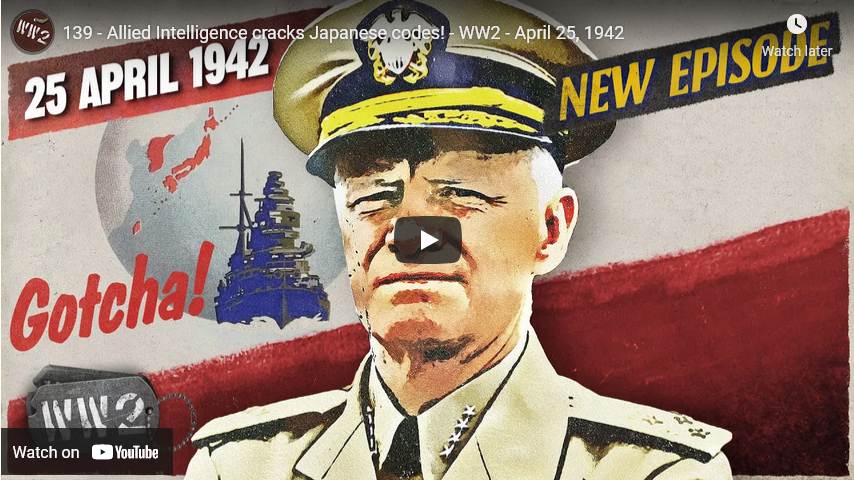
Allied Intelligence cracks Japanese codes! – 139 – WW2 – April 25, 1942

Filed under: Britain, Germany, History, Japan, Military, Pacific, Russia, USA, WW2 — Tags: , , , , , — Nicholas @ 04:00

World War Two
Published 24 Apr 2021

After last week’s Doolittle Raid on Tokyo, pretty much the entire Japanese fleet is sent out looking for American ships. They do not find them, but the enormous amount of radio traffic they generate is a treasure trove for Allied codebreakers to work on. The Allies ship 46 British Spitfire planes to Malta … and all of them are destroyed by the Axis within 48 hours. Germany begins bombing tourist and cultural destinations in Britain, and to make things even worse for the British this week, they realize they can’t hold Burma and are now making tracks for India, with the Japanese Army in hot pursuit.

Get Collectibles here: https://timeghost.tv/collectibles/​

Join us on Patreon: https://www.patreon.com/TimeGhostHistory
Or join The TimeGhost Army directly at: https://timeghost.tv

Follow WW2 day by day on Instagram @ww2_day_by_day – https://www.instagram.com/ww2_day_by_day
Between 2 Wars: https://www.youtube.com/playlist?list…
Source list: http://bit.ly/WW2sources

Written and Hosted by: Indy Neidell
Director: Astrid Deinhard
Producers: Astrid Deinhard and Spartacus Olsson
Executive Producers: Astrid Deinhard, Indy Neidell, Spartacus Olsson, Bodo Rittenauer
Creative Producer: Maria Kyhle
Post-Production Director: Wieke Kapteijns
Research by: Indy Neidell
Edited by: Iryna Dulka
Sound design: Marek Kamiński
Map animations: Eastory (https://www.youtube.com/c/eastory​)

Colorizations by:
– Mikołaj Uchman
– Daniel Weiss

Sources:
– National Portrait Gallery
– Naval History and Heritage Command
– Book by Rob Crosswell, Arrow by 4B Icons – from the Noun Project
– Russian International News Agency

Soundtracks from the Epidemic Sound:
– Rannar Sillard – “Easy Target”
– Jo Wandrini – “Dragon King”
– Howard Harper-Barnes – “Underlying Truth”
– Edward Karl Hanson – “Spellbound”
– Craft Case – “Secret Cargo”
– Johan Hynynen – “Dark Beginning”
– Andreas Jamsheree – “Guilty Shadows 4”

Archive by Screenocean/Reuters https://www.screenocean.com​.

A TimeGhost chronological documentary produced by OnLion Entertainment GmbH.

QotD: “The Great Satan”

Filed under: Books, Economics, Politics, Quotations, USA — Tags: — Nicholas @ 01:00

As soon as you see the recommendation from Noam Chomsky on the cover of the book, you can pretty much guess where McQuaig is coming from. I refer to the Chomskyan school of thought as American Monist: in short, the only actor on the world stage is America. It is the sole source of evil and depredation. Everyone else is motivated solely by love and concern for humanity, whilst America is, singularly, motivated only by greed, lust for power and a general animus for all things good, sunny and nice. Only America acts; everyone else is acted upon by the Hegemon, and can’t be blamed for the consequences of their actions. America is the Primus Mobilis. And America is bad. So, for example, the notion that an economy-based increased lust for oil is driving foreign policy is solely a characteristic of America; no other nation on earth appears to give a shit about oil. Certainly not France, Russia or China; McQuaig hardly mentions them. While McQuaig is forced to acknowledge that French, Russian and Chinese support for Saddam (and attendant undermining of UN sanctions) was related in some fashion to the oil deals they had each struck with Iraq, she airily dismisses the role that oil plays in their respective foreign policies. So the “oil as the root of all evil” trope is batted away in the space of two sentences when talking about other countries, but more than 300 pages are required to explain how oil and America are mutually catalyzing demon twins. When the rapaciousness of oil companies is discussed, it is almost exclusively American oil companies which are named; hardly ever any of the European, Russian or other oil companies. Because those other oil companies don’t possess the true indicia of evil, you see: they don’t stamp their barrels “Made in the USA”.

Bob Tarantino, “LIB Review: It’s the Crude, Dude”, Let It Bleed, 2005-03-05.

April 24, 2021

[“white” evil is] “not only objectivity, individualism, and writing, but linear thinking, quantitative reasoning, the Protestant work ethic, planning for the future, and being on time”

Filed under: Education, Media, Politics, USA — Tags: , , — Nicholas @ 03:00

The latest post by John McWhorter at It Bears Mentioning discusses the “white” behaviours and thought patterns that many activists believe are as harmful to American blacks as outright white supremacism:

John McWhorter’s Twitter thumbnail image

The organization 1776Unites, founded by my mentor and model Bob Woodson, has tweeted out a video where various black people decry a now fashionable idea that “whiteness” includes being smart. As in, precise, objective, fond of the written word, oriented towards dispassion, on time.

Those things are all manifestations of intelligence, vigilance, discipline. But according to our Elect folk, we black people are best off channeling our Crazy Badass Mothafucka. Because that’s more “authentic.” And, I get the feeling, fun to watch.

Because so many think that the battle that I and others are waging against Critical Race Theory’s transmogrification into education for children is an obsession with something that isn’t a real problem, I want to explore a bit. Someone I deeply respect not long ago surmised to me that the idea that black kids should be exempt from real standards is something being promulgated via mere paper “handouts,” and that the real problem is censorship from the right. I just don’t think so.

First, watch this, the 1776Unites video. Just a few minutes.

And now, as to what we are referring to, it starts actually before last summer. I knew something was really wrong when in 2019 at a conference in New York City for the city’s principals and superintendents, participants were presented with an idea that to teach with sensitivity to race issues meant keeping certain issues in mind.

These included ways of looking at things that are “white” rather than correct: namely, objectivity, individualism, and valuing the written word. Schools Chancellor Richard Carranza was fine with this, happily telling the media that it’s white people’s job to do the “work” of identifying the racist assumptions in how they go about their business.

So: to stand outside of matters and analyze them with one’s own private mind, and perhaps couch one’s conclusions with the considered artifice of writing rather than the spontaneity of speaking, is inauthentic for black and Latino people. It is racist to impose such things on black and Latino (and Native American?) kids. Or at best, brown kids should be taught this uptight “white” business only as a gloomy alternative to the realness of just hanging out sharing passing personal impressions via chatting.

[…]

This view of precision and detachment as white is a view about, more economically, reason. The idea is that to master close reasoning is suspect. It is exactly the roots of the “Math is Racist” notion, and if you want a whiff of how religiously people can glom on to such ideas, take a look at my Twitter feed in the week after I posted about that here.

Yet, seeing this educational philosophy laid out in the sunlight, The Elect cannot dismiss it as fringe “kookiness” — unless they want to insult the curators of a national museum devoted to celebrating the very black people The Elect live to liberate. At the African-American History Museum in Washington, D.C., for a hot minute or two in 2020 you could see a variation on the Jones-Okun business, an expanded presentation of what we must reject as “white” evil. An educational poster was displayed that slammed not only objectivity, individualism, and writing, but linear thinking, quantitative reasoning, the Protestant work ethic, planning for the future, and being on time.

April 23, 2021

Treaties and War, The Washington Naval Conference

Filed under: Britain, France, History, Italy, Japan, Military, USA, Weapons — Tags: , , , , , — Nicholas @ 02:00

The History Guy: History Deserves to Be Remembered
Published 17 Aug 2017

The History Guy remembers the Washington Naval Conference, a watershed in diplomacy.

The episode discusses events and shows some artwork depicting warships, which some viewers may find disturbing. All events are described for educational purposes and are presented in historical context.

The History Guy uses images that are in the Public Domain. As photographs of actual events are often not available, I will sometimes use photographs of similar events or objects for illustration.

Patreon: https://www.patreon.com/TheHistoryGuy

The History Guy: Five Minutes of History is the place to find short snippets of forgotten history from five to fifteen minutes long. If you like history too, this is the channel for you.

Awesome The History Guy merchandise is available at:
teespring.com/stores/the-history-guy

The episode is intended for educational purposes. All events are presented in historical context.

#ushistory #thehistoryguy #militaryhistory

April 22, 2021

Al Capone, Prohibition, and the American Dream | B2W: ZEITGEIST! I E.16 – Summer 1922

Filed under: History, Law, Religion, USA — Tags: , , , , , — Nicholas @ 04:00

TimeGhost History
Published 21 Apr 2021

The Prohibition era is still just getting started, but criminal enterprises have already sprung up everywhere to supply thirsty Americans with their drink. In the “summer of sin” of 1922, one man in particular is making waves in the Chicago underworld.

Join us on Patreon: https://www.patreon.com/TimeGhostHistory​

Hosted by: Indy Neidell
Written by: Francis van Berkel
Director: Astrid Deinhard
Producers: Astrid Deinhard and Spartacus Olsson
Executive Producers: Astrid Deinhard, Indy Neidell, Spartacus Olsson, Bodo Rittenauer
Creative Producer: Maria Kyhle
Post-Production Director: Wieke Kapteijns
Research by: Francis van Berkel and Lewis Braithwaite
Image Research by: Daniel Weiss
Edited by: Daniel Weiss
Sound design: Marek Kamiński

Colorizations:
Daniel Weiss – https://www.facebook.com/TheYankeeCol…​

Sources:
Library of Congress

Soundtracks from Epidemic Sound
– “One More for the Road” – Golden Age Radio
– “London” – Howard Harper-Barnes
– “Infinity Pool & Pool Tables” – Mythical Score Society
– “Rush of Blood” – Reynard Seidel
– “It’s Not a Game” – Philip Ayers
– “Please Hear Me Out STEMS INSTRUMENTS” – Philip Ayers
– “Not Safe Yet” – Gunnar Johnsen
– “On the Edge of Change” – Brightarm Orchestra
– “British Royalty” – Trailer Worx
– “Break Free” – Fabien Tell
– “Steps in Time” – Golden Age Radio
– “Magnificent March 3” – Johannes Bornlöf

Archive by Screenocean/Reuters https://www.screenocean.com​.

A TimeGhost chronological documentary produced by OnLion Entertainment GmbH.

From the comments:

TimeGhost History
3 days ago
As you hopefully realized from the title, thumbnail, description, and first words coming out of Indy’s mouth, a big focus of this episode is the beginning of the gangland Prohibition era and the rise of Al Capone.

It’s a fascinating topic, but something else to draw attention to in this episode is the Catholic Church’s campaign against modernity. Last episode we saw how religion was forced into retreat by the Bolshevik regime in Russia, well this episode we’re seeing one of the oldest religious institutions in the world make its fightback. It shows that the story of modernity isn’t just “old things” fading away and being replaced by “new things”. Instead, it is a story of continual tension, negotiation, and adaption, between the old and the new.

Anyway, philosophical musings on religion aside, this really is an exciting episode and there will be much more on Al Capone and the Beer War in years to come.

April 21, 2021

“The error in Western thinking was to view CCP officials as civilised counterparts”

Filed under: China, Economics, Europe, Government, USA — Tags: , , , , , — Nicholas @ 03:00

In Quillette, Aaron Sarin traces the last twenty years of successful diplomacy, industrial espionage, and ever-increasing CCP media influence in China’s relationships with western nations:

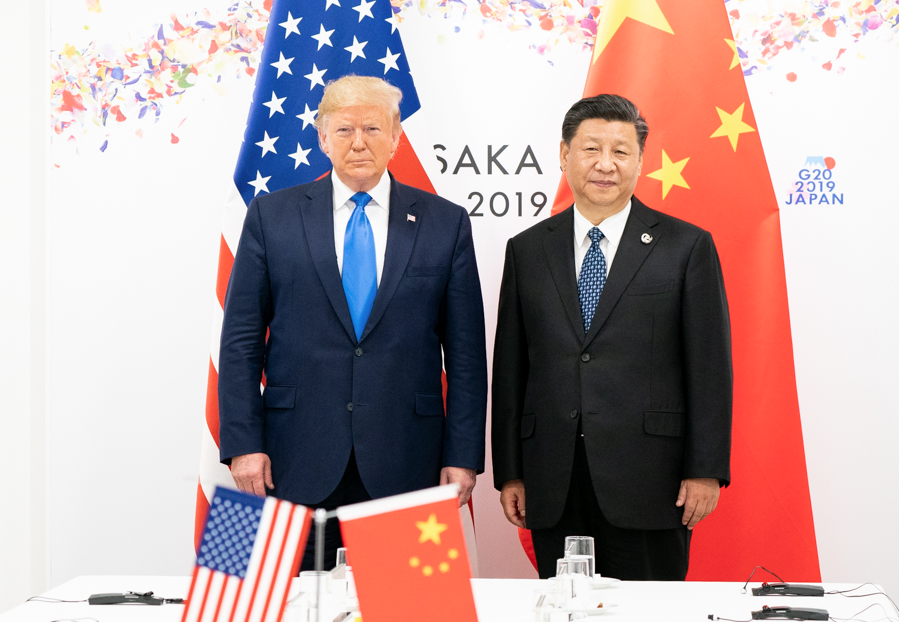
President Donald Trump and PRC President Xi Jinping at the G20 Japan Summit in Osaka, 29 June, 2019.
Cropped from an official White House photo by Shealah Craighead via Wikimedia Commons.

By the end of 2020, China’s relationships with the US and Australia had reached their lowest point in living memory, while Sino-British relations weren’t far behind. Yet the European Commission chose this moment to sign a major new investment treaty with Beijing. The deal appeared to have been rushed to completion just before Joe Biden’s inauguration, as if to avoid the fuss that a new American administration would be sure to make. Indeed, incoming National Security Adviser Jake Sullivan felt sore enough to send a pointed tweet: “The Biden-Harris administration would welcome early consultations with our European partners on our common concerns about China’s economic practices.”

The truth is that Brussels has been drifting further and further from Washington ever since the election of Donald Trump, and there are few signs the winds will change now that Biden has taken office. In 2017, Merkel said that Europe could no longer rely on America. By 2020, it seemed truer to say that Europe would rely on China from now on. Indeed, diplomats like Emmanuel Bonne (Macron’s foreign policy adviser) have been most enthusiastic about “France’s readiness to step up strategic communication with China.” In his gushing deference, Bonne can sometimes sound like a man with a gun to his head: “France respects China’s sovereignty, appreciates the sensitivity of Hong Kong-related issues, and has no intention of interfering in Hong Kong affairs.” There are times when the language of neutrality reveals with painful clarity that a side has been chosen.

Brussels officials talk of “strategic autonomy,” of course. They hope to carve out a path to self-sufficiency while at the same time enjoying mutually beneficial relationships with partners like Beijing. The problem is that mutually beneficial relationships are not possible with predators. As successive American administrations have found, those who maintain close connections with the Communist Party will eventually suffer large-scale intellectual property theft and the loss of millions of manufacturing jobs.

Brussels can hardly expect that Beijing will respect this new agreement. Recall the various promises that were made regarding Hong Kong: all of them were broken. Party officials may have signed a legal document recognising the city’s special administrative status, but this was purely for show. In 2017, having apparently now ascended to a position above the law, they declared that the document had “no practical significance.” Remember how Barack Obama was given firm assurance that Beijing would never militarize the South China Sea? There were handshakes and smiles all round, and then Beijing proceeded to militarize the South China Sea.

Indeed, some of the commitments included as part of the new deal echo those made 20 years ago, when China first joined the World Trade Organisation. It was agreed in 2001 that prices in every sector would be determined by market forces; that state-owned enterprises would begin operating free of state influence; that international norms regarding intellectual property would be respected; and so on. After two decades, we can see that the Communist Party has kept not one of its promises.

The error in Western thinking was to view CCP officials as civilised counterparts. We failed to see that we were dealing with a pack of thugs and grifters — men for whom the rule of law is neither reality nor ideal, but façade. This lesson has now been learned in some quarters, but clearly not in the upper echelons of the European Union. This new investment deal even includes a reference to “commitments on forced labour,” which is little short of an insult when we consider the hundreds of thousands of Uyghurs who have been made to toil all day till dusk in the cotton fields of Xinjiang. The truth is that the EU has been fooled. There will be no “win-win situation.” Not when dealing with the Communist Party, which has always viewed geopolitics as a zero-sum game. In the words of Bilahari Kausikan, once Singapore’s top diplomat, “only the irredeemably corrupt or the terminally naïve take seriously Beijing’s rhetoric about a ‘community of common destiny.'”

« Newer PostsOlder Posts »

Powered by WordPress