
World War Two
Published 27 Nov 2021Last week’s counterattack was just the beginning, for the Soviets launch another giant offensive this week. And things look bad for the Axis powers in the south of the USSR. Meanwhile in France, the French scuttle their navy rather than allow it to fall into German hands.
(more…)
November 28, 2021
Bigger Than Uranus? – Mars – WW2 – 170 – November 27 1942
Comments Off on Bigger Than Uranus? – Mars – WW2 – 170 – November 27 1942
QotD: Hidden political pay-offs as “book advances”
Anyway, as I’ve complained many times before, these “advances” given to leftwing figures are not advances at all.
True advances are, well, advances against expected future royalties. That’s why they’re called “advances”.
People expect that a J.K. Rowling book will produce at least $5 million in royalties, so you give her a $5 million advance on those royalties. You’re giving her a payment on her royalties in advance of actually seeing those sales.
But you do expect them.
You don’t pay her fresh royalties until the royalties she generates exceeds the initial advance on royalties you paid her.
When she makes $5 million and one hundred dollars, you send her a fresh check for one hundred dollars.
When these major media conglomerates, all left-leaning and most with business before the government, give millions to Hillary Clinton and Hunter Biden and Andrew Cuomo, there is no one at that company that expects the books will ever make that much in royalties.
They’re just payoffs. Or disguised political donations.
It’s not an “advance” if you cannot show a plausible stream of sales which will meet or exceed that “advance”.
Personally, I’d love to see some kind of law on this subject to force these large media corporations to prove that they have a genuine, rational belief that a Hunter Biden book will make $10 million in sales (which would justify a million dollar advance, assuming a royalty of 10%).
And I’d like to see their corporate officers sign certifications for the government that they’re not fudging the numbers. And that they understand that there might be prosecutions for perjury if they do lie about expected future royalties.
Much like people in the financial sector are constantly required to sign.
Why should media corporations be immune from such requirements?
And I’d love to see these disguised campaign donations treated and limited just like actual campaign donations.
Or, better yet: No “advances” for serving politicians, declared politicians who are running, or any politician ten years after his term of service ends. They can just take their royalty checks as royalties actually accrue.
If Hunter Biden really sells $10 million in books — LOL — then he’ll get that million dollars eventually in royalty payments. They’ll just come over the course of a year or two rather than all at once in an “advance” on future earnings.
If not — then not.
This isn’t stopping them from getting paid for books they sell — it’s to stop mega-media-corporations with business before the government, and a strong desire to pay off politicians they like, from giving “advances” to favored politicians that bear no relationship whatsoever to the actual expected royalties the books will generate.
Ace, “Ethics Agency Might Claw Back Cuomo’s $5 Million ‘Advance’ For His ‘Book'”, Ace of Spades H.Q., 2021-08-27.
Comments Off on QotD: Hidden political pay-offs as “book advances”
November 27, 2021
How Andrew Cuomo got megabucks for his (ghostwritten) book on the pandemic
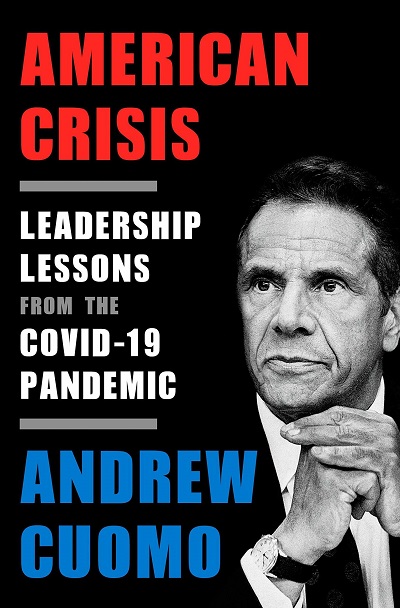
In the latest issue of the SHuSH newsletter, Kenneth Whyte details how former New York state Governor Andrew Cuomo managed to get a $5.1 million advance from Random Penguin for a book that was mostly written by Cuomo staff members and an outside ghostwriter:
Penguin Random House contacted Cuomo’s agent about writing a book on March 19, 2020, about three weeks after the first COVID-19 case landed in New York. Cuomo was a TV darling in the early days of the pandemic. On July 1, his agent got back to Penguin Random House to say he’d written 70,000 words and he was ready to make a deal. How did a governor of America’s hardest-hit pandemic state produce a fat manuscript in three months flat? It appears he had his staff and a ghostwriter author the book for him, in violation of state ethics prohibitions against the use of any state resources or personnel to produce the book.
Meanwhile, Cuomo’s office was churning out doctored statistics to make his pandemic policies, particularly around nursing homes, look better than they deserved.
July 8, Cuomo’s book went to auction. Penguin Random House kicked things off with a $750,000 offer and wound up winning with a bid of $5.1-million. It was a triumph for Cuomo, and not his first in the publishing world: about seven years ago, he took HarperCollins for a $700,000 advance on what the New Republic called an “overlong … cliché-ridden, and hopelessly dull” memoir, All Things Possible. That one sold 4,000 copies in hardcover, a number that would warrant an advance of maybe $10,000.
Several weeks after the auction, Cuomo was asked by the media if he got a lot of money to write the book. “Well,” he replied. “Only if I sell a lot of copies.” Which is not how it works. Advances are non-returnable, and he’d banked $3.1 of the $5.1 before publication. The rest of Cuomo’s advance was spread out over two more years, presumably for tax purposes.
Weeks after the grandly titled American Crisis: Leadership Lessons from the COVID-19 Pandemic was released in October 2020, Cuomo was hit with the first of a long series of sexual harassment allegations. He was forced to resign in August 2021. By then, it had also emerged that Cuomo’s office had covered up roughly half of the fatalities among state nursing home residents during the pandemic.
American Crisis managed to sell at least ten times more copies than Cuomo’s previous book, which is progress, I suppose, but still a nightmare for his publisher. A sale of 50,000 copies might warrant a solid six-figure advance. But $5.1 million? Disastrous.
Comments Off on How Andrew Cuomo got megabucks for his (ghostwritten) book on the pandemic
Armored Vehicles of Operation Torch Pt. 2: America and Britain (and France) – by the Chieftain
World War Two
Published 26 Nov 2021Part two of Chieftain’s return to the North African campaign. Here he looks at the armored fighting vehicles of the British and Americans with a small bit on the French as well. We see the introduction of the iconic Sherman and the varied fortunes of British designs.
(more…)
Comments Off on Armored Vehicles of Operation Torch Pt. 2: America and Britain (and France) – by the Chieftain
QotD: The zombie that used to be Abercrombie & Fitch
The name changed hands repeatedly and was revived in the late 1990s as a completely different kind of entity. The new revival markets sissy fashions to metrosexuals. It’s rather as if after Papa Hemingway shot himself, his name was sold repeatedly, and revived decades later as “Ernestine Hemingway”, an authoress of Gay Romance Novels.
David Zincavage, “From the Good Old Days: Abercrombie & Fitch, Change Sucks”, Never Yet Melted, 2021-08-24.
Comments Off on QotD: The zombie that used to be Abercrombie & Fitch
November 26, 2021
The modern carrier debate
I recently started reading A Collection of Unmitigated Pedantry, a fascinating historical blog run by Dr. Bret Devereaux. You can expect to see plenty of QotD entries from his blog in future months, as I’ve been delighted to find that he not only has deep knowledge of several historical areas I find interesting, but that he also writes well and clearly. This post from last year is a bit outside his normal bailliwick, being modern and somewhat speculative rather than dealing with the ancient world, classic-era Greece, Republican and Imperial Rome, or the Middle Ages in Europe and the Mediterranean basin:

The Nimitz-class aircraft carrier USS Theodore Roosevelt (CVN 71) underway in the Persian Gulf, 3 December 2005.
U.S. Navy photo by Photographer’s Mate 2nd Class Matthew Bash via Wikimedia Commons.
Let’s talk about aircraft carriers for a moment […] There is currently a long-raging debate about the future of the aircraft carrier as a platform, particularly for the US Navy (by far the largest operator of aircraft carriers in the world), to the point that I suspect most national security publications could open companion websites exclusively for the endless whinging on aircraft carriers and their supposed obsolescence or non-obsolescence. And yet, new aircraft carriers continue to be built.
As an aside, this is one of those debates that has been going on so long and so continuously that it becomes misleading for regular people. Most writing on the topic, since the battle lines in the debate are so well-drawn, consists of all-or-nothing arguments made in the strongest terms in part because everyone assumes that everyone else has already read the other side; there’s no point in excessively caveating your War on the Rocks aircraft carrier article, because anyone who reads WotR has read twenty already and so knows all of those caveats already. Except, of course, the new reader does not and is going to read that article and assume it represents the current state of the debate and wonder why, if the evidence is so strong, the debate is not resolved. This isn’t exclusive to aircraft carriers, mind you – the various hoplite debates (date of origin, othismos, uniformity of the phalanx) have reached this point as well; a reader of any number of “heterodox” works on the topic (a position most closely associated with Hans van Wees) could well be excused for assuming they were the last word, when it still seems to me that they represent a significant but probably still minority position in the field (though perhaps quite close to parity now). This is a common phenomenon for longstanding specialist debates and thus something to be wary of when moving into a new field; when in doubt, buy a specialist a drink and ask about the “state of the debate” (not “who is right” but “who argues what”; be aware that it is generally the heterodox position in these debates that is loudest, even as the minority).
Very briefly, the argument about carriers revolves around their cost, vulnerability and utility. Carrier skeptics point out that carriers are massive, expensive platforms that are increasingly vulnerable to anti-ship missiles and that the steadily growing range of those missiles would force carriers to operate further and further from their objectives, potentially forcing them to choose between exposing themselves or being pushed out of the battlespace altogether (this, as an aside, is what is meant by A2/AD – “Anti-Access/Area-Denial” – weapons). The fear advanced is of swarms of hypersonic long-range anti-ship missiles defeating or overwhelming the point-defense capability of a carrier strike group and striking or even sinking the prize asset aircraft carrier – an asset too expensive to lose.
Carrier advocates will then point out all of the missions for which carriers are still necessary: power projection, ground action support, sea control, humanitarian operations and so on. They argue that no platform other than an aircraft carrier appears able to do these missions, that these missions remain essential and that smaller aircraft carriers appear to be substantially less effective at these missions, which limits the value of dispersing assets among a greater number of less expensive platforms. They also dispute the degree to which current or future weapon-systems endanger the carrier platform.
I am not here to resolve the carrier debate, of course. The people writing these articles know a lot more about modern naval strategy and carrier operations than I do.
Instead I bring up the carrier debate to note one facet of it […]: the carrier debate operates under conditions of fearsome technological uncertainty. This is one of those things that – as I mentioned above – can be missed by just reading a little of the debate. Almost none of the weapon systems involved here have seen extensive combat usage in a ship-to-ship or land-to-ship context. Naval thinkers are trying to puzzle out what will happen when carriers with untested stealth technology, defended by untested anti-missile defenses are engaged by untested high-speed anti-ship missiles which are guided by untested satellite systems which are under attack by untested anti-satellite systems in a conflict where even the humans in at least one of these fighting forces are also untested in combat (I should note I mean “untested” here not in the sense that these systems haven’t been through test runs, but in the sense that they haven’t ever been used in anger in this kind of near-peer conflict environment; they have all been shown to work under test conditions). Oh, and the interlinked computer systems that all of these components require will likely be under unprecedented levels of cyber-attack.
No one is actually certain how these technologies will interact under battlefield conditions. No one can be really sure if these technologies will even work as advertised under battlefield conditions; ask the designers of the M16 – works in a lab and works in the field are not always the same thing. You can see this in a lot of the bet-hedging that’s currently happening: the People’s Republic of China has famously bet big on A2/AD and prohibiting (American) carriers from operating near China, but now has also initiated an ambitious aircraft carrier building program, apparently investing in the technology they spent so much time and energy rendering – if one believes the carrier skeptics – “obsolete”. Meanwhile, the United States Navy – the largest operator of aircraft carriers in the world – is pushing development on multiple anti-ship missiles of the very sort that supposedly render the Navy’s own fleet “obsolete”, while also moving forward building the newest model of super-carrier. If either side was confident in the obsolescence (or non-obsolescence) of the aircraft carrier in the face of A2/AD weapons, they’d focus on one or the other; the bet hedging is a product of uncertainty – or perhaps more correctly a product of the calculation that uncertainty and less-than-perfect performance will create a space for both sets of weapon-systems to coexist in the battlespace as neither quite lives up to its best billing.
(I should note that for this brief summary, I am treating everyone’s development and ship procurement systems as rational and strategic. Which, to be clear, they are not – personalities, institutional culture and objectives, politics all play a huge role. But for now this is a useful simplifying assumption – for the most part, the people procuring these weapons do imagine that they are still useful.)
In many ways, the current aircraft carrier debate resembles a fast moving version of the naval developments of the late 1800s and early 1900s. Naval designers of the period were faced with fearsome unknowns – would battleships function alone or in groups? Would they be screened against fast moving torpedo boats or forced to defend themselves? How lethal might a torpedo attack be and how could it be defended against? Would they be exposed to short-range direct heavy gunfire or long-range plunging gunfire (which radically changes how you arm and armor these ships)? With technologies evolving in parallel in the absence of battlefield tests, these remained unknowns. The eventual “correct solution” emerged in 1903 with the suggestion of the all-big-gun battleship, but the first of these (HMS Dreadnought), while begun in 1904 was finished only after the Battle of Tsushima (May 27-8, 1905) had provided apparently startling clarity on the question.
Comments Off on The modern carrier debate
Look at Life — Air Umbrella (1961)
PauliosVids
Published 20 Nov 2018A look at NATO’s international squadrons, with footage of the F104 Starfighter.

Comments Off on Look at Life — Air Umbrella (1961)
November 25, 2021
Why The Most Expensive US Martial Pistol Exploded A Lot
Forgotten Weapons
Published 12 Aug 2021http://www.patreon.com/ForgottenWeapons
https://www.floatplane.com/channel/Fo…
Cool Forgotten Weapons merch! http://shop.forgottenweapons.com
The Colt Model 1847 Walker is one of the most valuable of all US military handguns in the collecting community, with examples sometimes breaking seven figures. However, the Walker was in many ways a remarkable failure as a service sidearm, mostly because it tended to explode. By today’s standards, it exploded quite a lot.
Why?
Basically, a combination of several factors:
– The Walker was made of wrought iron, and not always the best quality wrought iron. Cylinders had internal flaws that became weak points and failed upon firing.
– The Walker had a huge powder capacity in its chambers, between 50 and 60 grains depending on the projectile used. This was basically rifle size, and it left the cylinder design with a very small margin of safety.
– Powder composition and grain size was less standardized in the 1840s than it is today, making overpressure loads more likely than today.
– The Walker was designed for a conical “Pickett” bullet that was tricky to load correctly (point forward). Loading it backward could increase the powder volume in a chamber.Of nearly 400 Walkers issued for the Mexican-American War, only 191 were returned after a year’s service, and only 82 of those were serviceable. Some of those missing guns were lost and stolen, but a substantial number — generally accepted to be 20%-30% — suffered burst barrels, burst cylinders, and broken cylinder arbors. Whoops!
Contact:
Forgotten Weapons
6281 N. Oracle 36270
Tucson, AZ 85740

Comments Off on Why The Most Expensive US Martial Pistol Exploded A Lot
November 24, 2021
The Marshall Plan
The Cold War
Published 6 Jul 2019Our series on the history of the Cold War period continues with a documentary on the Marshall Plan and how the USA was able to help in the rebuild of the post-War World and gained valuable allies while doing it
Consider supporting us on Patreon: https://www.patreon.com/thecoldwar

Comments Off on The Marshall Plan
Rousseau versus “original sin” in modern-day culture
In UnHerd, Mary Harrington ponders the two irreconcilable camps struggling for cultural supremacy in western countries, as most recently highlighted by the Kyle Rittenhouse trial in Kenosha, Wisconsin:

Portrait of Jean-Jacques Rousseau (1712–1778) by
Maurice Quentin de La Tour, circa 1753.
Wikimedia Commons.
The Rittenhouse argument is just such a case. It’s powered by a profound disagreement about human nature: one that fuels many of the most intractable modern culture wars, from Mumsnet bunfights about babycare to arguments about classroom discipline and what the police force is for.
Are humans naturally good given the right circumstances? Or are we flawed and in need of threats and guidelines to keep us on the straight and narrow? The split is a legacy of radical ideas stretching back to the revolutionary 18th century.
Perhaps the most famous proponent of intrinsic human goodness is Rousseau, who claimed in Emile (1762) that children are born virtuous. As Rousseau sees it, we only need freedom, love and the right environment to spontaneously come to an understanding of what’s right.
When Emile was first published, it stood in stark challenge to the then-dominant view, emerging from the Christian tradition, that humans are tainted by “original sin”. From this vantage point, we’re naturally flawed, and must always struggle against our less virtuous instincts. Rousseau’s claim so appalled adherents of this then-dominant view that copies of his book were burned in the street.
Today, though, the boot is on the other foot. The high-status view among contemporary elites is unmistakeably Team Rousseau.
At the tiniest scale, it’s expressed in the school of parenting that believes it’s wrong or even cruel to teach children how to live. I’ve written before about the currently popular ideas of “attachment parenting” and “gentle parenting”, which emphasise self-discovery in a loving environment over routine, authority or punishment — and about how these views skew wealthy and liberal.
In education settings, the same idea appears as “child-centred pedagogy”, an approach that emphasises individual pathways and discovery over rote learning and teachers as authority figures. And at the biggest scale, it crops up as the claim that all the root causes of crime are external to humans: poverty, trauma, discrimination and so on. From this perspective, if we could only replace policing with tailored community services that eliminated these root causes, there would no longer be any crime.
Even outbreaks of mass public disorder are treated by Team Rousseau as an unfortunate-yet-understandable response to bad governance: when BLM protesters in Baltimore toppled a statue of Christopher Columbus last year, the Democrat politician Nancy Pelosi responded by shrugging it off as a natural expression of that community’s wishes. If the community doesn’t want the statue, she said, “the statue shouldn’t be there”. From this vantage point, public unrest is something akin to the weather: a naturally-occurring phenomenon in which leaders must strive to create the conditions for goodness, or else “people will do what they do”.
Comments Off on Rousseau versus “original sin” in modern-day culture
November 23, 2021
Tucker Carlson’s new book The Long Slide
Wilfred M. McClay reviews Carlson’s collected essays for First Things:
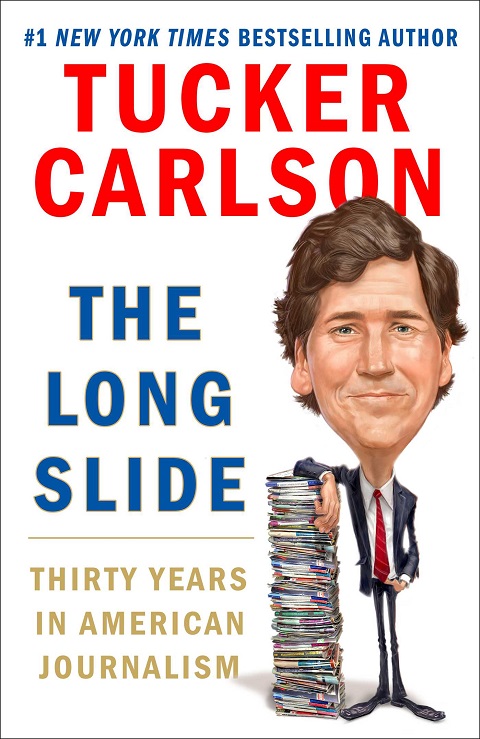
Tucker Carlson has become such a fixture in the world of cable-television news that it’s easy to forget he began his journalistic career as a writer. And a very good one at that, as this wide-ranging and immensely entertaining selection of essays from the past three decades serves to demonstrate. Carlson’s easygoing, witty, and compulsively readable prose has appeared everywhere from The Weekly Standard (where he was on staff during the nineties) to the New York Times, the Spectator, Forbes, New Republic, Talk, GQ, Esquire, and Politico, which in January 2016 published Carlson’s astonishing and prophetic article titled “Donald Trump is Shocking, Vulgar, and Right”. That essay has been preserved for posterity in these pages, along with twenty-two other pieces, plus a bombshell of an introduction written expressly for the occasion. More of that in a moment.
The first response of many of today’s readers, particularly those who don’t like the tenor of Carlson’s generally right-populist politics or the preppy swagger and bubbly humor of his TV persona, will be to dismiss The Long Slide as an effort to cash in on the author’s current notoriety by recycling old material to make a buck. That was my assumption when I first opened this collection. But the book has an underlying unity, and a serious message. It evokes a bygone age, an era of magazine and newspaper journalism that seems golden in retrospect, and is now so completely gone that one must strain to imagine that it ever existed at all. The simple fact is that almost none of these essays could be published today, certainly not in the same venues: They are full of language and imagery and a certain brisk cheerfulness toward their subject matter that could not possibly pass muster with the Twittering mob of humorless and ignorant moralists who dictate the editorial policies of today’s elite journalism.
Carlson’s writing style reflects the influence of the New Journalists such as Tom Wolfe and Hunter Thompson, who brought a jaunty, whiz-bang you-are-there narrative verve and high-spirited drama to the task of telling vividly detailed stories about unusual people and places, generally relating them in the first person. Carlson’s prose is not as spectacular as Wolfe’s or as thrillingly unhinged as Thompson’s. But it has its own virtues, being crystal clear, conversational, direct, and vigorous, never sending a lardy adjective to do the work of a well-chosen image, and never using gimmicky wild punctuation or stretched-out words to fortify a point. He’s a blue-blazer and button-down-collar guy, not a compulsive wearer of prim white suits or a wigged-out drug gourmand wearing a bucket hat and aviator glasses. But many of Carlson’s writings give the same sense of reporting as an unfolding adventure, a traveling road show revolving around the reactions and experiences of the author himself.
Carlson usually shows a certain fundamental affection for the people he writes about, even if he also ribs or mocks them in some ways. In particular, there is none of that ugly contempt for the “booboisie” and ordinary Americans that one finds, for example, in the pages of H.L. Mencken, and in a great deal of prestige journalism. Instead, he reserves his contempt for the well-heeled know-it-alls who genuinely deserve it. In that sense, the Carlson of these essays does not seem very different from the Carlson of today. He always has been a bit of a traitor to his class, and commendably so.
Comments Off on Tucker Carlson’s new book The Long Slide
QotD: Generation X and the 1990s
I’m referring, of course, to Gen X’s patented brand of “irony”. We’ve talked about this before, but here’s a quick recap: Every middle-class kid born after about 1965 was raised to believe that Authenticity was the thing, the only thing. Just do what you feel. Question authority. Don’t listen to The Man!
The problem, of course, is that we were told this by The Man.
It had a weird, telescoping effect. On campus, you were surrounded by people who actually were hippies, plus a whole bunch of wild-eyed fanatics who were sure they would’ve made truly excellent hippies if they hadn’t been in elementary school at the time, plus a bunch of kids — these would be your classmates — who thought of “Woodstock” as a brand name, a kind of backpacking-through-Europe, taking-a-year-off-to-find-myself experience that everyone has as a matter of course before settling down to the serious business of making partner at the law firm.
In short: Our parents were stuck in adolescence, and, being adolescents ourselves, we didn’t understand that “Rebellion” wasn’t something the hippies invented. We wanted to experience sex, drugs, and rock’n’roll, too, but since the Baby Boomers treated those as their exclusive property instead of what they actually are — i.e. the natural impulses of teenagers in all times and places — we had to be all, like, you know, whatever about it. […]
That was the 1990s. Faced with a paradox that everything your parents say, do, and believe is lame — according to your parents! — the only safe way is to make sure nobody can figure out exactly what your attitude is at any given instant. You might end up working 90 hour weeks at the office to pay the nut on the McMansion and the Volvo the same way they did, but at least you’d be, you know, ironic about it. The ketman of the suburbs.
See what happens when you listen to your elders, kids?
Severian, “The Virtue of Hypocrisy”, Rotten Chestnuts, 2019-01-19.
Comments Off on QotD: Generation X and the 1990s
November 21, 2021
The Red Army Kicks Ass – Operation Uranus! – WW2 – 169 – November 20th, 1942
World War Two
Published 20 Nov 2021After months of stubborn defense the time has finally come for the Soviet counterstroke, but is it in time to save Stalingrad? And can the Allies reach Tunis and take all of North Africa before the Axis can reinforce?
(more…)
Comments Off on The Red Army Kicks Ass – Operation Uranus! – WW2 – 169 – November 20th, 1942
November 20, 2021
Twenty years of TSA bullying
In Friday’s Reason Roundup newsletter, Robby Soave calls for the end of the Transportation Security Administration after twenty long years of futility on making travel safer but brilliant success in making the travel experience so much worse for passengers:

Exactly 20 years ago today, President George W. Bush signed the Aviation and Transportation Security Act into law and created the Transportation Security Administration, better known as the TSA. A response to the 9/11 attacks, the TSA was thought to be a necessary tool for confronting the new reality of terror in the skies.
Two decades later, the TSA has more than 54,000 employees, a budget of $8 billion dollars, and a long track record of harassing passengers for no good reason. Far from contributing to actual safety, the TSA is a stunning example of government failure: Its absurd travel restrictions make air travel no safer, deprive passengers of their civil liberties, and make the process of flying much more costly, time-consuming, inconvenient, and unenjoyable. The agency should never have been created, and its 20th birthday is as good a time as any to abolish it.
For starters, the TSA routinely fails at its main purpose: preventing passengers from carrying deadly weapons onto airplanes. TSA agents constantly miss weapons, drugs, and other illicit items when government agents try to smuggle them in as part of testing.
“TSA screeners failed to detect weapons, drugs, and explosives almost 80 percent of the time,” noted the Heritage Foundation in 2017. “While the exact failure rate is classified, multiple sources indicate it is greater than 70 percent.” During one test, at the Minneapolis–Saint Paul International Airport, the TSA’s failure rate was 95 percent.
The 9/11 terror attacks, in which a small number of men were able to use crude, simple weapons to hijack airplanes and crash them into important buildings, were a scarring moment for the nation. The U.S. government vowed to be more vigilant. But the truth of the matter is that preventing hijackings is now trivially easy: Pilots can lock the cockpit doors, which are almost impossible for intruders to breach. Prior to 9/11 most airplane hijackings involved detours to different locations; hijackers did not intend to crash the planes, and thus neither crews nor passengers had much reason to fight back. This calculus is forever changed: Would-be plane hijackers will face insurmountable difficulties, whether or not they’ve received aggressive pat-downs from the TSA.
Meanwhile, the TSA’s security theater has made air travel a much more grueling process. It’s not just the ritualistic humiliation of having to remove belts and shoes, empty out backpacks and suitcases, and submit to full-body scanners. TSA agents are also frequently caught stealing from passengers, groping them, and delaying them for no reason. Again, there is no point to any of this. It does not make people safer. If anything, it makes us less safe: It is likely that some people choose to drive to their destination, rather than deal with the hassle. Car travel, though, is far more dangerous than air travel — many more people die in car crashes than in plane crashes each year. And not even COVID-19 could tip the scales in airplanes’ favor, according to The Washington Post.
Enough is enough. There is not a single good reason that Americans should have to endure such misery at the hands of this utterly pointless bureaucracy. The best time to abolish the TSA was right after it was created. The second-best time is now.
Remy made a parody video on the TSA that’s definitely worth a watch. Back in 2010, Iowahawk created some helpful new slogans for the TSA, free of charge.
Comments Off on Twenty years of TSA bullying
QotD: Cheating with both hands
Batches of counted votes can be very unbalanced towards either candidate or they can be large, but there is a strong inverse relationship between the two. The paper analyses a lot of data to show the improbability of both very unbalanced and very large. This is a good test because it tends to get past fraudsters, who are focussed on the raw margin of votes more than the ratio or the batch size.
A secondary tell – and this one is already well-known in fraud detection in third-world countries – is improbable ratios of the losing candidate to minor candidates, e.g. Trump getting little more than twice as many votes as the minor candidates in the second Michigan anomaly when the state’s average (calculated including that data point) was 31 to 1. The paper finds this combination of grossly-violated size-margin ratio and grossly-violated Trump-to-third-party ratio particularly suspicious (as do I). It also computes what happens if you pull these four data points in towards merely the 99th percentile of the size-margin relationship – leaving them still anomalous but not so wildly implausible. (Biden loses his alleged lead in all three states.) It also notes some related statistical oddities.
My guess is that the idea of the US waking up to what I’d woken up to – Trump the heavy odds-on favourite – terrified his enemies. Their pre-election narrative was that Trump would at first “appear” to win, after which “days and weeks of counting” (Zuckerberg) would show he had lost. But while Zuckerberg promised to “educate” America to believe in that, I think someone in the early hours of the 4th panicked that if the US electorate woke up to a bookies-call-it-for-Trump breakfast on Wednesday morning, that would never be erasable from the US mind, no matter how many votes they then “found”. So they made sure that didn’t happen. (You never know: it might yet be that what they did to prevent that becomes equally hard to remove from America’s consciousness. You don’t have to be a statistician to think a sudden step function in a smooth graph looks odd.)
So the good news is that my memory for numbers is working fine. The bad news is that I may lose a night’s sleep next election. The very first of the four anomalous points went into the Georgia vote totals soon after 6:30 AM my time – half-an-hour after the normal rising time of Donald Trump and Margaret Thatcher, I am told. (I guess the reason I’m not PM or president is that I’m usually asleep then.) When I first glanced at the results, I thought Georgia was surprisingly close given e.g. the Florida result, but if I’d missed the other three oddities as completely as Georgia’s, I’d have been far less cautious in reviewing the outcome.
Niall Kilmartin, “Good News! I can believe my eyes”, Samizdata, 2020-12-01.
Comments Off on QotD: Cheating with both hands


