
Steve Ramsey – Woodworking for Mere Mortals
Published 2 Sep 2022This is the story about woodworking on YouTube and how it got started. The first year of YouTube was mostly about sharing videos with friends, family and even colleagues, and on December 13, 2005 John Leeke, @John Leeke a historic preservationist made history by posting the platform’s first woodworking video.
Frank Howarth @frank howarth would create the first woodworking channel on July 8, 2006, followed shortly after by Marc Spagnuolo @The Wood Whisperer on Oct 18, 2006 and Matthias Wandel @Matthias Wandel on Apr 9, 2007.
The recession in 2008 contributed to only a handful of new channels emerging over the next few years. Ones who are still posting today include Carl Jacobsen, Colin Knecht, Chad Stanton, WoodWorkers Guild Of America, Chop With Chris, myself, Ana White, Jon Peters, Alain Vaillancourt, Stumpy Nubs, Samurai Carpenter, John Heisz, and Paul Sellers.
In 2013, the flood gates opened, ushering in the Golden Age of YouTube woodworking and maker channels (2013-2017), followed by the Influencer Era and the COVID era.
If you’ve been a long time YouTube viewer, I hope you enjoy this nostalgic look at the early days and if you’re new to the platform, maybe you’ll check out some of this early content. A lot of it might seem rough by today’s standards, but it was content made by a few passionate people for the sheer joy of sharing videos about woodworking.
(more…)
September 6, 2022
The Story of Woodworking on YouTube: 2005-2017. A Documentary About Sharing a Craft.
August 26, 2022
Bristol/Magellan CRV7 Ground Attack Rockets; Simply The Best
Polyus
Published 19 Aug 2022Sometimes a weapon is produced that no one can ignore. Something so much better than anything else on the market that it becomes the de facto standard. Winnipeg, Manitoba’s Bristol Aerospace created such a weapon in the early 1970s. It combined high speed and long range with a powerful knockout punch. It was the CRV7 rocket and it would eventually become ubiquitous among western aligned armed forces.
(more…)
August 23, 2022
Progressives and the (always just-over-the-horizon) promise of fusion power
I was busy over the weekend, so I didn’t get a chance to post this from Severian at Founding Questions, but it’s still one of those things I wish I’d written:

Nuclear fusion breakthrough as “ignition” finally achieved
Woohoo. They’ve been promising us fusion power my entire life. I can’t even tell how many “breakthroughs” ago I stopped believing it. But since God has a sense of humor, this might actually be it. Wouldn’t that be hilarious? Finally we have pretty much limitless energy, for free… and there’s no fucking way the Left would ever allow it to come online. Because that would result in a massively increased standard of living for the average person, and that’s one thing the Left simply will not allow.
That was really the point of that “if I were rich” post the other day. I will admit up front that Envy has never really been a problem for me (for me, all the hit points that would’ve gone into Envy have been allocated to Gluttony, Sloth, and Lust). Nonetheless, I’ve never been able to understand the sheer pettiness of the Left. It doesn’t bother me that some people have more. Even if they don’t “deserve” it. Hey, them’s the breaks. And in fact, I even largely agree with the very old school Liberal idea of “progressive” taxation — the rich can afford to front their communities a little bit more money, provided it actually goes to the community.
But the PoMo Left is all-in on Envy. But it’s a weird kind of envy — like everything else in Clown World, it’s inverted. They don’t want to have more, themselves, personally — they want you to have less.
To the PoMo Leftist, the only possible point of being rich is to keep other people from having stuff. They don’t want you to eat the bugs because it’s better for the Earth. They want you to eat the bugs to keep you from eating steak. See what I mean? It’s not “you must eat bugs in order that they can have steak,” because of course they can already have steak. Rather: you also can have steak, and that’s bad. You shouldn’t be able to, you filthy prole. You don’t deserve to eat steak, because you’re not Enlightened like they are.
So with fossil fuels and all the rest. You don’t deserve to be able to fly places. If you must travel — you know, if they need your labor somewhere else — you should be down there in steerage. And so on, because that’s what you deserve, peasant. Free, limitless, clean energy would be nice … in the abstract. But since you people would just use it to run your air conditioners and whatnot, we’re going to store the Mr. Fusion machine in that big warehouse with the Ark of the Covenant.
August 19, 2022
The DeLorean Story
Big Car
Published 5 Jan 2020There’s much more to the DeLorean Motor Company than Doc’s 88mph time machine in Back to the Future. It’s a story of a playboy founder with a meteoric rise, a story of hope and regeneration in an area torn apart after a decade of fighting, and of a cocaine smuggling fall from grace. Yes, this story has it all!
(more…)
August 13, 2022
Mysterious Home Features No Longer Used
Rhetty for History
Published 22 Apr 2022Home designs have changed a lot over the years and so have the features. In this video we will take a look at some of the mysterious features no longer used in new homes. You may run across these if you purchase an old home or you visit one.
(more…)
August 12, 2022
The 1983 “Gimli Glider” Incident
TheHistoryGuy
Published 27 Apr 2022Captain Sully’s US Airways Flight 1549 lost its engines almost immediately after takeoff, after reaching an altitude of only 2,800 feet. In 1983, a very different flight lost power at a staggering 41,000 feet, and the pilots had no choice but to try to land the plane without engines.
(more…)
August 8, 2022
QotD: How houses have changed to fit the times
It’s unexceptional today to come across an open-plan apartment, because (except for the very rich) we don’t typically share our homes with servants, and we have efficient ventilation and climate control. Try to imagine living in an open-plan Victorian flat with a coal-burning kitchen range and fireplace puffing out smuts, a maid and a cook to keep on top of the grime and the food preparation: it doesn’t work. Try, also, to imagine a contemporary home without a living room with a TV in the corner. Go back to the 1950s and well-designed homes also had a niche for the telephone — the solitary, wired communications device, typically bolted to the wall in the hallway or at the foot of the stairs, for ease of access from all other rooms.
But today telephones have collapsed into our pocket magic mirrors, and TVs are going in two directions — flattening and expanding to fill entire walls of the living room, and simultaneously shrinking to mate with our phones. A not-uncommon aspect of modern luxury TV design is that they’re framed in wood or glass, made to look like a wall-hanging or a painting. The TV is becoming invisible: a visitor from the 1960s or 1970s might look around in bafflement for a while before realizing that the big print in middle of the living room wall is glowing and sometimes changes (when it’s in standby, running a screensaver). Meanwhile, microwave ovens and ready meals and fast food have reduced the need for the dining room and even the kitchen: to cook a family dinner and serve it in a formal dining room is an ostentatious display of temporal wealth, a signal that one has the leisure time (and the appliances, and the storage for ingredients) to practice and perfect the skills required. The middle classes still employ cooks: but we outsource them to timeshare facilities called restaurants. Similarly, without the daily battle to keep soot and dirt at bay, and equipped with tools like vacuum cleaners and detergents, the job of the housemaid has been shrunk to something that can be outsourced to a cleaning service or a couple of hours a day for the householder. So no more cramped servants’ bedrooms.
The very wealthy ostentatiously ape the behaviour of the even richer, who in turn continue the traditions they inherited from their ancestors: traditions rooted in the availability of cheap labour and the non-existence of labour-saving devices. Butlers, cooks, and live-in housemaids signal that one can afford the wage bill and the accommodations of the staff. But for those who can’t quite afford the servants, the watchword seems to be social insulation — like the dining room at the opposite end of the corridor from the kitchen.
The millionaire’s home cinema, in an auditorium of its own, is the middle class TV in the living room, bloated into an experience that insulates its owner from the necessity of rubbing shoulders with members of the public in the cinema. Likewise, the bedroom with en-suite bathroom insulates the occupants from the need to traipse down a corridor through their dwelling and possibly queue at the bathroom door in the middle of the night.
Types of domestic space come and go and sometimes change social and practical function.
The coal cellar is effectively dead in this era of decarbonization and clean energy, as is the chimney stack. Servants’ quarters are a fading memory to all but the 0.1% who focus on imitating the status-signaling behavior of royalty, although they may be repurposed as self-contained apartments for peripheral residents, granny flats or teenager basements. The dining room and the chef’s kitchen are becoming leisure pursuits — although, as humans are very attached to their eating habits, they may take far longer to fade or mutate than the telephone nook in the hallway or the out-house at the end of the back yard.
Likewise, outdoor climate change and indoor climate control are changing our relationship with the window. Windows used to be as large as possible, because daylight lighting was vastly superior to candlelight or oil-lamp. But windows as generally poor insulators, both of sound and heat, and indoor lighting has become vastly more energy efficient in recent years. Shrinking windows and improving insulation (while relying on designed-in ventilation and climate control) drive improvements in the energy efficiency of dwellings and seem to militate against the glass bay and big sash windows of yesteryear.
Charles Stross, “Social architecture and the house of tomorrow”, Charlie’s Diary, 2019-04-29.
July 22, 2022
Inventing historical connections with slavery where they don’t exist
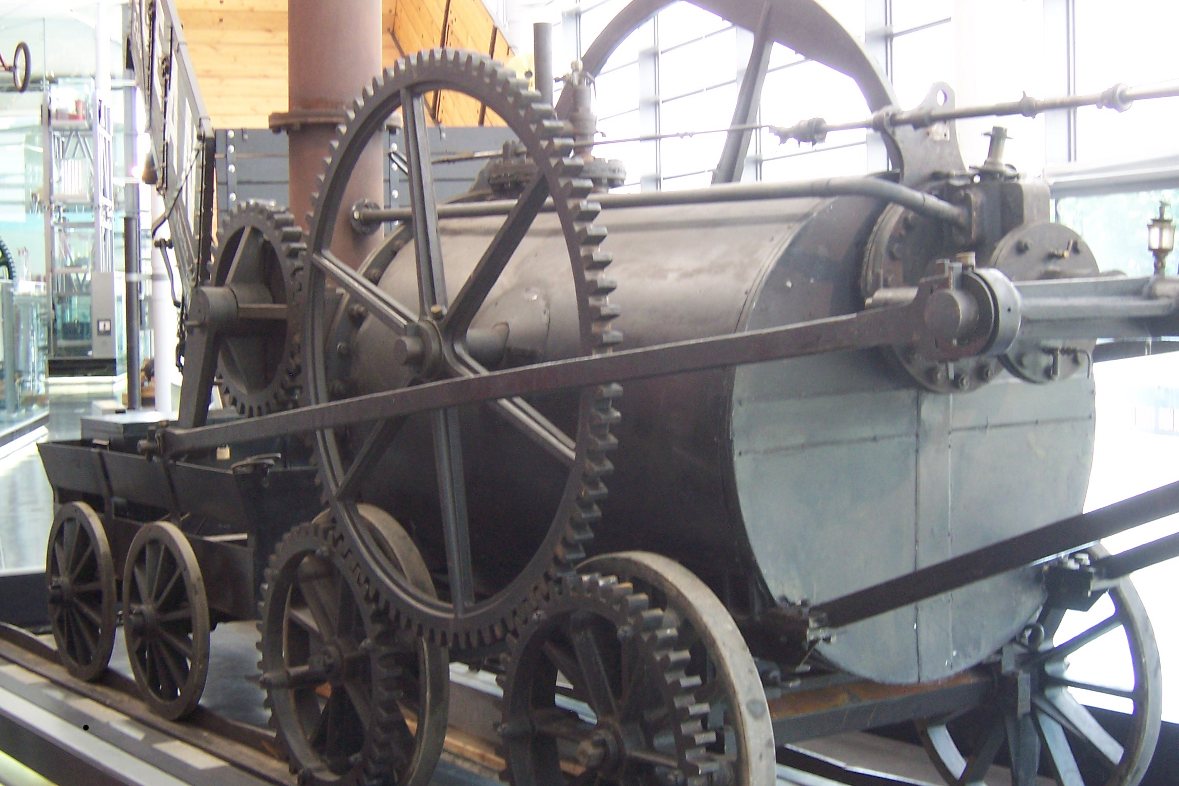
In Quillette, David Foster recounts the story from the National Museum of Wales which effectively fabricated a connection to the slave trade as part of their politically correct performative “decolonization” efforts:
A replica of Richard Trevithick’s 1802 steam locomotive at the National Waterfront Museum in Swansea.
Photo by Chris55 via Wikimedia Commons.
In March, Britain’s Daily Telegraph and GB News channel both reported that the National Museum of Wales would be relabelling a replica of the first steam-powered locomotive, unveiled by its Cornish inventor Richard Trevithick in 1804. Trevithick had no links to slavery, but the amendment has apparently been included anyway as part of the museum’s commitment to “decolonizing” its collection. In a statement defending what it described as the addition of “historical context”, the museum said: “Although there might not be direct links between the Trevithick locomotive and the slave trade, we acknowledge the reality that links to slavery are woven into the warp and weft of Welsh society.” The statement continued:
Trade and colonial exploitation were embedded in Wales’ economy and society and were fundamental to Wales’ development as an industrialised nation. As we continue to audit the collection, we will explore how the slave trade linked and fed into the development of the steam and railway infrastructure in Wales.
[…]
When a society compulsively disrespects its historical accomplishments — when it obsessively seeks to turn every good thing into a bad thing — the outlook for that society is bleak. It destroys social cohesion, and sends the wrong kind of message to actual and potential opponents. The matter of the steam locomotive display in Wales may seem minor, and certainly trivial when compared with the appalling events in Ukraine or the threat of Iranian nuclear weapons. But it is not.
The behavior of the museum administrators in Wales is of a piece with other contemporary symptoms, such as the eagerness within influential circles in the US to embrace the conclusions of the New York Times‘s revisionist 1619 project. It is part of the politicization of everything. Science, technology, and art cannot — indeed, must not — be appreciated simply on the grounds of beauty, utility, or truth; everything must be reduced to race, gender, and other academically and media-approved categories of analysis.
Trends such as these have real-world implications, including the growth and decline of nations and their relative power. Writing in 1940, C.S. Lewis, warned about the dangers of what he called the National Repentance Movement, which focused on the need to apologize for Britain’s sins (thought to include the Treaty of Versailles) and to forgive Britain’s enemies.
Certainly, the British State had done many bad things during its long and eventful history — as well as many good things. But the excessive focus on its sins was part of a phenomenon manifested in a 1933 motion debated at the Oxford Union: “This House will under no circumstances fight for King and country”. To the Nazis and the Imperial Japanese, attitudes like these indicated that aggression would not meet much resistance. They also informed a policy of appeasement.
Liberals and progressives (as they call themselves) claim to be greatly concerned with physical sustainability of resources and ecosystems. But they are too eager to undercut the social sustainability of their own societies and the physical infrastructures on which those societies depend, however fond they may be of repeating the word “infrastructure”.
July 19, 2022
Drawing the proper lessons from the massive Rogers outage earlier this month
In The Line, Matt Gurney explains the really important lesson that seems to have escaped a lot of the critics who covered the Rogers internet/cell/TV outage that took a third of the country offline for 24 hours or more:

Most of the conclusions reached after the Rogers telecommunication outage two weeks ago are wrong. Millions of people lost home internet, television and cellphone service for the better part of a day (some for much longer). For those who had all their services bundled with Rogers, this meant being entirely cut off, including from access to emergency services. It was a big deal, both in terms of lost economic productivity and for those Canadians who needed help and could not access it.
The problem isn’t with Rogers, though. The problem is with everyone else.
I don’t want to be misunderstood. Rogers is bad. It did have a big problem. I am not a fan. Their customer service is generally awful. Their reliability and performance is decidedly meh and the meh costs a fortune. So don’t take this column as some sort of apologia for Rogers. I am one of their customers, but I’m only one of their customers because none of the other options are much better.
But still. The lesson of two Fridays ago shouldn’t be that Rogers is bad. It also shouldn’t be that the CRTC is bad or that our politicians are spineless and that our regulators are thoroughly captured. All of those things are true, but they’re not the lesson. That wasn’t the failure of two Fridays ago. The failure of two Fridays ago was that when one of our telecom companies went down, a pretty horrifying cross-section of Canadian society had no back-up plan.
Let’s imagine an alternate universe where things in Canada simply functioned better. Close your eyes and just dream it up. You’re in a different Canada now. The CRTC is awesome. Our politicians are terrific. Rogers is an incredibly good company that is masterful at delivering services that are overwhelmingly reliable and affordably priced. Even in this increasingly far-fetched parallel timeline, no telecom company is going to bat a thousand. You will never have 100 per cent service reliability. This alternate Canada still has outages — maybe they’re rare and brief, but they’re not unheard of or impossible.
And that’s why we can’t look at what happened two weeks ago as a failure at Rogers. Obviously Rogers failed. But the real failure was a failure of imagination and planning on the behalf of millions of individuals, and a worryingly diverse set of institutions, that did not have a back-up plan.
How dating apps have changed the dating world
Rob Henderson on the changes dating sites have accelerated in the dating community:

“In the United States, 35 percent of Tinder users are college students ages 18 to 24 … ‘I’ve heard a joke on campus that goes something like this: ‘First base is hooking up, second base is talking, third base is going on a date and fourth base is dating’.“ (source).
I am just old enough to remember what the dating scene was like before the rise of Tinder and other dating/hook-up apps. It has changed a lot.
2012 was another world in many ways.
The situation has changed for everyone on the dating market. Even those who don’t use these apps. This is because even for the people who don’t use the apps, they still live in an environment where others use them. Over time, those who don’t use apps must adapt to the preferences and behavior of those who use them. Not the other way around.
One example of how the scene has changed. I have a friend from college. A good-looking guy. He showed me how many women he has matched with: More than 21,000. Twenty-one thousand. Tinder actually identified him as a valuable user early on, and gave him free perks and upgrades. They lifted his radius restrictions. This allowed him to match with even more women. I have another friend. Doesn’t have the best pictures on his profile. But not a bad looking guy. Over roughly the same period of time as my other friend, he has matched with seven women.
Some findings on dating apps:
- 18 to 25 percent of Tinder users are in a committed relationship.
- Women aged 23 to 27 are twice as likely to swipe right (“liked”) on a man with a master’s degree compared with a bachelor’s degree.
- Men swipe right (“liked”) on 62 percent of the women’s profiles they see; women swipe right (“liked”) on only 4.5 percent of the men’s profiles they see.
- Half of men who use dating apps while in a committed relationship reported having sex with another person they met on a dating app. All women who used dating apps while in a committed relationship reported having sex with another person they met on a dating app.
- 30 percent of men who use Tinder are married.
- In terms of attractiveness, the bottom 80% of men are competing for the bottom 22% of women and the top 78% of women are competing for the top 20% of men.
One way dating apps might be changing the dating scene. People used to have to go out to meet people. And it was costly to lose a relationship partner, in part because of the process involved in meeting someone new. Today, people know that a new partner is a few swipes away. Partners might be more replaceable. If things start deteriorating with their current partner, some can pull out a goldmine in their pocket.
There may be some sexual stratification going on as well. My two friends are examples of the above finding that being slightly more attractive as a man leads to far more matches.
July 17, 2022
Earlier almost-steam-engine developments
In the latest Age of Invention newsletter, Anton Howes picks up the story of the development of the steam engine (part one was linked here):
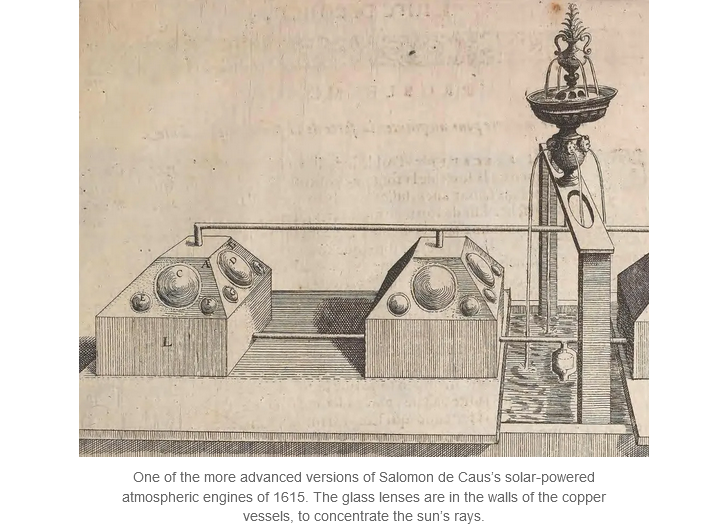
As I explained in Part I, the spark for my investigation was noticing that one Salomon de Caus, as early as 1615, had very probably made what amounts to a solar-powered version of Savery’s engine. By concentrating the sun’s rays on trapped air above the water in copper vessels, the resulting expansion of the trapped air and steam drove the water up a pipe to make a fountain flow. Most crucially of all, however, when the vessels cooled again they sucked water up and into them from a cistern below — a principle that de Caus also applied to having statues make music when the sun shone, and which he hinted may be useful for other things too.
Noticing this machine was a big shock to me, but de Caus’s invention was not even that original. It was actually an improvement of another, almost entirely ignored device described by Hero of Alexandria as early as the 1st Century, and which Hero in turn derived from one Philo of Byzantium who wrote in the 3rd Century BC.
Philo’s original device was very simple: a hollow leaden sphere with a bent tube rising out of it and into some water at the bottom of a jug. As the sun heated the sphere, the expanding air was pushed up the tube and into the jug’s water, escaping by bubbling out of the water. And crucially, when the sphere was removed from the sun and allowed to cool, the water was then drawn up the tube and into the sphere — Philo, about 1,900 years before Savery, had already encapsulated in a simple model the power of condensation to raise water.
Philo’s device was simple, but the principles it illustrated do appear to have been applied. Hero’s work, for example, includes a libas, or “dripper” fountain. In this alternative version of Philo’s apparatus, Hero connected the jug and sphere by two other pipes to a cistern underneath, as well as starting with some water already in the sphere. The jug now acted more like a funnel, into which the original bent tube now dripped its water like a fountain when the sun shone on the sphere. When cooled, however, the sphere replenished itself from the cistern underneath. It was almost exactly like de Caus’s version, which merely improved the strength of the fountain when it was heated, seemingly by replacing the lead with more heat-conductive copper and by using glass convex lenses to concentrate the sun’s rays.
Hero’s solar-powered dripping fountain doesn’t sound all that impressive, but both Philo and Hero appreciated the wider potential of its underlying principles.
Philo, for example, noted that it might make use of alternative heat sources: he described how his apparatus would work whether pouring hot water over the sphere, or by heating it over a fire. Once it cooled, it would always draw the water up.
Hero even suggested a mechanical use for the effect. By setting a fire on a hollow, airtight altar, the heated air within would flow down a tube into a sphere full of water, which in turn would be pushed up another tube into a hanging bucket. The bucket, when sufficiently heavy with water, would then pull on a rope to open some temple doors. Crucially, when the fire was extinguished, Hero noted that the cooling of the air in the altar would draw the water back into the sphere again, lighten the bucket, and so allow the doors to be closed by a counterweight. Although the condensing phase was really just for resetting the device, the fundamental ideas behind a Savery engine were already there: it raised water, used a fuel, and exploited condensation. It even did some light mechanical work.
July 14, 2022
July 12, 2022
Shoe Repair: The Work Of The Cobbler – Historical Buckle Shoe Repair
Townsends
Published 21 Mar 2022Our Brand New Viewing Experience ➧ https://townsendsplus.com/ ➧➧
Retail Website ➧ http://www.townsends.us/ ➧➧
Help support the channel with Patreon ➧ https://www.patreon.com/townsend ➧➧
Instagram ➧ townsends_official

July 11, 2022
Canadians deserve better than “core network maintenance problems” for critical cell phone and internet services
Our internet service provider, Rogers, suffered a major network failure early on Friday morning, taking down not just wired internet services, but also cable TV, and cell phone services and causing knock-on issues that utterly disrupted many emergency 911 services, government websites, banks (including ATM and point-of-sale terminals) and many more. I subscribe to both Rogers internet and Rogers cell phone services, but fortunately my wife has a different wireless phone provider so we weren’t completely offline all of Friday and most of Saturday. Michael Geist and his family weren’t as lucky:
Like many Canadians, I spent most of the massive Rogers outage completely offline. With the benefit of hindsight, my family made a big mistake by relying on a single provider for everything: broadband, home phone, cable, and wireless services on a family plan. When everything went down, everything really went down. No dial tone, no channels, no connectivity. Work was challenging and contact with the kids shut off. It was disorienting and a reminder of our reliance on communications networks for virtually every aspect of our daily lives.
So what comes next? We cannot let this become nothing more than a “what did you do” memory alongside some nominal credit from Rogers for the inconvenience. Canada obviously has a competition problem when it comes to communications services resulting in some of the highest wireless and broadband pricing in the developed world. Purchasing more of those services as a backup – whether an extra broadband or cellphone connection – will be unaffordable to most and only exacerbate the problem. Even distributing the services among providers likely means that consumers take a financial hit as they walk away from the benefits from a market that has incentivized bundling discounts. Consumers always pay the price in these circumstances, but there are policy solutions that could reduce the risk of catastrophic outages and our reliance on a single provider for so many essential services.
First, there is a need to better understand what happened and why. Rogers CEO says the problem lies with maintenance to the core network, which caused some routers to malfunction. But that’s just tech talk. Canadians deserve answers that explain not only how this happened, but how we find ourselves in a position where malfunctioning routers at one company cause a nationwide payment system to go down, government services to be taken offline, and emergency services to be rendered inaccessible. It is one thing for my household to make a mistake, but another for Interac to do so. That means conducting an open CRTC process into this outage alongside a Parliamentary hearing on the broader issues since this is a matter that requires both regulatory and political response. There is no need to wait: these hearings must happen this month with the goal of identifying the scope and source of the problem along with potential policies that might mitigate future harms.
Neither the CRTC nor the current government has shown much inclination to challenge the big telcos. CRTC Chair Ian Scott has reversed years of a consumer-focused Commission into one more comfortable supporting the big providers, while the government has been far more interested in sabre rattling or shaking down Internet companies than taking on big telecom. Yet as we were reminded on Friday, the linkage to the availability of essential services – payments, health care, government services – runs through the telcos, not the Internet companies.
This is the second object lesson in concentrated power in a small number of government-approved hands this year. Our first wake-up call was when the government prompted chartered Canadian banks to cut off some of their customers from all financial services even though no crimes had been committed and no charges were laid. It’s not clear how many people were affected, but arbitrarily denying people access to their bank accounts and credit cards should have rung alarm bells for many people. Now, we’ve been shown how dangerous it can be to allow a very small number of companies to divide the mobile phone and internet service market between them and use the power of government to keep out potential competitors. Will enough Canadians notice?
July 10, 2022
Seven easy steps to fix military procurement
CDR Salamander wrote these for the US military, so some of them are far out-of-scale for tiddlers like the Canadian Armed Forces, but the spirit is still valid and relevant:
1. No weapon system presently under production will be allowed to stop production until its replacement is under production itself.
2. Acknowledge we have lied to ourselves for decades actual magazine requirements in war (use “new” lessons from the Russo-Ukraine War for the tender to save face — whatever works) — and accelerate/restart production of everything from ASW weapons to strike weapons of all types.
3. Acknowledge that we do not have enough weapons — specifically anti-air and land attack — on our warships. Every war proves this and recent experience tells us this.
4. If I take away your access to satellite VOX & DATA and you cannot navigate and fight, you are not a wartime asset and your funding sent somewhere useful.
5. Accelerate capacity for repair away from fleet concentration areas, preferably afloat. Maximize production of sealift and begin the process to replace the C-5M.
6. If your combat unit does not have organic, robust unmanned ISR under the command of your unit’s commander, you are worthless in the war to come and you will have such a capability by FY25 or you will be disestablished.
7. Pass the Salamander Bill: no General of Flag Officer shall, for a period no less than 5-yrs from retirement date, receive compensation of any kind or anything of value from any publicly or privately held company that does business with the federal government, nor shall they serve in any non-paid positions with same.
Yes, #7 is important. If you have not realized why in 2022, you are part of the problem.


