
Practical Engineering
Published 21 Jun 2022
Let’s set the record straight for a few construction misconceptions!Errata: The shot at 4:16 is of the Greek Acropolis (not a Roman structure).
Over the past 6 years of reading emails and comments from people who watch Practical Engineering, I know that parts of heavy construction are consistently misunderstood. So, I pulled together a short list of the most common misconceptions. Hope you don’t mind just a little bit of ranting from me 😉
(more…)
October 26, 2022
Four Myths About Construction Debunked
Comments Off on Four Myths About Construction Debunked
October 25, 2022
A Multi-Trillion Dollar Pipe Dream
PragerU
Published 16 Jun 2022Are we heading toward an all-renewable energy future, spearheaded by wind and solar? Or are those energy sources wholly inadequate for the task? Mark Mills, Senior Fellow at the Manhattan Institute and author of The Cloud Revolution, compares the energy dream to the energy reality.
(more…)
Comments Off on A Multi-Trillion Dollar Pipe Dream
October 15, 2022
From perpetual motion machines to “Philosopher’s Stoves” (no, that’s not a misprint)
In the latest Age of Invention newsletter, Anton Howes digs deeper into the question of why it took so long for the steam engine to be invented:
As I hinted in Part II, there were still more wonders to issue from [Cornelis] Drebbel’s workshop — many of them building on the same principles as his perpetual motion machine.
So it’s worth a very brief recap of how that device worked. Drebbel had improved upon an ancient experiment involving an inverted flask in water: that is, to heat the base of a long-necked glass flask and place it mouth-first into a bucket of water. The heated air trapped inside the flask would bubble out, and as the remaining air cooled, the water of the bucket would rise up into the flask.
The inverted flask experiment. The air bubbles out on the left. As the remaining trapped air cools, on the right, the water rises up the flask (in fact pushed up by the pressure of the atmosphere).Drebbel’s big breakthrough was to notice that once the water was already sucked into the flask, it would continue to rise and fall even when it wasn’t being heated or cooled on purpose — movements that were the result of natural changes to atmospheric pressure and temperature.
From this continued movement — to his mind, a harnessing of the perpetual movement of the universe itself — Drebbel then constructed a machine that seemed to show the ebb and flow of the tides, as the liquid inside it rose and fell between the cold of night and the heat of day. He also exploited that same rise and fall of the liquid in order to rewind clockwork that continually showed the time, day, months, and years, along with the cycle of the zodiac and the phases of the moon.
Few have now heard of Drebbel’s perpetual motion machine, but noticing that same rise and fall of the liquid in response to changes in the weather would also serve as the basis for the invention of the thermometer and barometer. Or, more accurately, to the reinterpretation of the ancient inverted flask experiment as a device capable of measuring both temperature and atmospheric pressure. (The two different applications were not disentangled and isolated until later, as we’ll see below, and so in modern terminology the initial device is often referred to as an air thermoscope.)
[…]
For alchemists like Drebbel, being able to control the temperature of furnaces and ovens was a valuable prize, because so much of their skill in manipulating metals and minerals depended upon it. The alchemist’s art — the intangible, tacit skill built up over years of experience — was one of sensitivity to heat, being able to judge, by feel and by look, the varying intensities of flame, and then to manipulate it so as to keep it at a constant level. The art was known as pyronomia, or as regimen ignis — the governing of fire.
At some point before 1624, Drebbel worked out that he could exploit the inverted flask experiment to radically improve furnaces. He did this in two ways. One was simply to affix a mercury thermometer to the furnace, to indicate its heat (mercury, with a higher boiling point, would be less liable than water to simply evaporate away). But the other, and more ingenious way, was to create a feedback mechanism to control the oven’s heat automatically. Drebbel placed a cork to float atop the mercury in yet another thermometer, which as it rose or fell would then cover or uncover the furnace’s air supply. He could thus choose a desired heat, and then let the oven do the rest. If it grew too hot, the air supply would be restricted. If it grew too cold, it would be increased. Drebbel had invented the thermostat, and perhaps one of the first widely-applied practical feedback control mechanisms.
Drebbelian self-regulating ovens, or Philosopher’s Stoves, spread beyond England, to be adopted in France, the Netherlands, Germany, and even across the ocean in New England — they were a major source of business for the husbands of Drebbel’s daughters, the brothers Abraham and Johannes Sibertus Kuffler, to whom he passed many of his secrets. Drebbel even applied its thermostatic principles to artificially incubating eggs, for which maintaining a constant temperature was essential. To give an idea of how big a deal this was, Francis Bacon filled his techno-utopian vision of a New Atlantis with “furnaces of great diversities, and that keep great diversity of heats; fierce and quick; strong and constant; soft and mild; blown, quiet; dry, moist; and the like”, some of which, like the incubator, were able to provide even the gentle heat of animal bodies. Drebbel, in Bacon’s lifetime, was thus producing the stuff of science fiction. He was, as one admirer termed him, a true Mysteriarch.
And the Mysteriarch did not stop there. Just before his death in 1633 he was working on improving the stoves, making them more efficient, reducing the need for people to attend the fire, and reducing their smoke. They could thus be applied to drying hops, malt, fruit, spices, and gunpowder, heating rooms in houses, and distilling fresh water from sea water. His heirs, the Kufflers, even made the stoves portable enough to be used for baking the bread for armies — they were allegedly used by Frederick Henry, Prince of Orange, in his various successful campaigns against Spain. Both the portable ovens and the seawater distilling machines were apparently used in the 1650s aboard ships headed for the Indian Ocean.
By the 1620s, then, many of the key elements for a steam engine were already coming into fairly widespread use. Scientists across Europe, inspired by Drebbel’s perpetual motion and Santorio’s thermometer, were eagerly pursuing the possibilities from expanding and contracting gases. And Drebbel had invented a widely-used thermostatic feedback system — a general concept that would later prove extremely useful in making steam engines practicable. Feedback systems and safety valves would come to regulate the movements of engines and reduce the risks of them overheating and exploding.

Comments Off on From perpetual motion machines to “Philosopher’s Stoves” (no, that’s not a misprint)
October 10, 2022
Janice Fiamengo on the #MGTOW affair – “In short, men who ‘go their own way’ have decided that they need women even less than the mythical fish needed its wheeled transport”
Recently, much impassioned wailing and howling has been directed at new Conservative Party leader Pierre Poilievre for his media team’s use of the notorious, misogynistic, coded-hate-speech metatag #MGTOW on postings to social media. Janice Fiamengo calls out the bold hypocrisy of most of the critics:
Remember “A woman needs a man like a fish needs a bicycle?”
Popularly credited to feminist icon Gloria Steinem, the slogan embodied the insouciance and independence claimed by Second Wave feminists. Women could get along just fine without men (though not without their tax money, as it turned out — more on this later) and lesbian feminists like Adrienne Rich (in “Compulsory Heterosexuality and Lesbian Existence”) explicitly called on all women to withdraw their caring from men as an act of female solidarity.
Nice, eh?
Anyone who objected to the anti-male rhetoric was dismissed as an apologist for patriarchal oppression (“Do you have a problem with equality?”), and generations of young women were given the message that wanting to love and be loved by a man was a betrayal of the sisterhood. What else was one to make of Professor of Law Catharine MacKinnon’s claim, in her 1989 essay for the journal Ethics, that “The major distinction between intercourse (normal) and rape (abnormal) is that the normal happens so often that one cannot get anyone to see anything wrong with it” (p. 336-337).
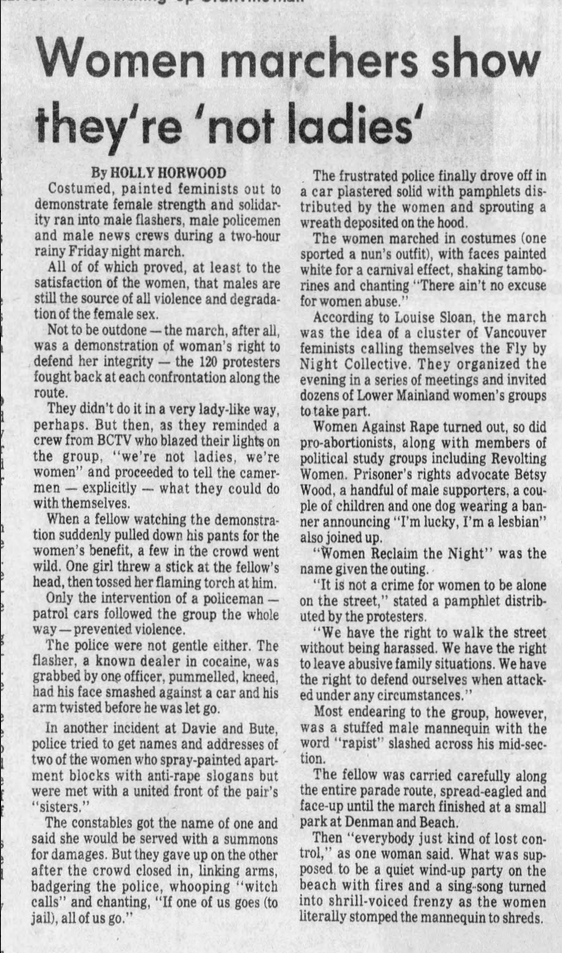
For decades, feminists in Canada have been given a free pass to vilify men as a group. In 1978, women’s groups held the first “Women Reclaim the Night” march in downtown Vancouver. It was a raucous, aggressive, property-destroying affair culminating in the symbolic murder of a stuffed male “Rapist” mannequin who was “literally stomped to shreds” by woman warriors.
[…]
So it is rather rich, now, five decades into the feminist revolt, to see pundits and political commentators huffing and puffing in outrage about MGTOW, dubbed a “misogynist men’s rights movement” or a “far-right misogynistic online movement”, and calling on newly-minted Conservative leader Pierre Poilievre (who, alas, seems eager to oblige) to disavow them. MGTOW stands for Men Going Their Own Way, and it was a happy day for the mainstream feminist-left when Global News allegedly discovered that Poilievre’s team had tagged many of his videos with the acronym.
The hypocrisy is off the charts.
It’s doubtful that any of the commentators getting on their high horses knows anything about MGTOW except the hysterical nonsense feminists have cooked up. MGTOW is not an official movement, far less an “organization”, as Poilievre mistakenly called it. It has no recognized leadership, no designated spokespersons, no political program, no lobbying power, and no public presence. It is not actually interested in “men’s rights” except to point out that men don’t have any. It has no philosophical connection with incels. It is basically a loose (mainly online) affiliation of men who have decided to check out of women’s lives.
Aren’t feminists always saying that they want men to stop dominating them, subjugating them, pestering them, harassing them, controlling them, and making them uncomfortable? That’s what MGTOW are all about.
Comments Off on Janice Fiamengo on the #MGTOW affair – “In short, men who ‘go their own way’ have decided that they need women even less than the mythical fish needed its wheeled transport”
October 8, 2022
Faint glimmers of hope for Canadians’ “right to repair”?
Michael Geist on the state of play in modifying Canada’s digital lock rules to allow consumers a tiny bit more flexibility in how they can get their electronic devices repaired:

“The Self-Repair Manifesto from ifixit.com ‘If you can’t fix it, you don’t own it’. Hear, hear!” by dullhunk is licensed under CC BY 2.0 
 .
.
Canadian anti-circumvention laws (also known as digital lock rules) are among the strictest in the world, creating unnecessary barriers to innovation and consumer rights. The rules are required under the World Intellectual Property Organization’s Internet Treaties, but those treaties leave considerable flexibility in how they should be implemented. This is reflected in the countless examples around the world of countries adopting flexible anti-circumvention rules that seek to maintain the copyright balance. Canada was pressured into following the restrictive U.S. approach in 2012, establishing a framework is not only more restrictive than required under the WIPO treaties, but even more restrictive than the U.S. system.
One of the biggest differences between Canada and the U.S. is that the U.S. conducts a review every three years to determine whether new exceptions to a general prohibition on circumventing a digital locks are needed. This has led to the adoption of several exceptions to TPMs for innovative activities such as automotive security research, repairs and maintenance, archiving and preserving video games, and for remixing from DVDs and Blu-Ray sources. Canada has no such system as the government instead provided assurances that it could address new exceptions through a regulation-making power. In the decade since the law has been in effect, successive Canadian governments have never done so. This is particularly problematic where the rules restrict basic property rights by limiting the ability to repair products or ensure full interoperability between systems.
The best policy would be to clarify that the anti-circumvention rules do not apply to non-infringing uses. This would enable the anti-circumvention rules to work alongside the user rights in the Copyright Act (also known as limitations and exceptions) without restricting their lawful exercise. This approach was endorsed by the 2019 Canadian copyright review, which unanimously concluded:
it agrees that the circumvention of TPMs should be allowed for non-infringing purposes, especially given the fact that the Nintendo case provided such a broad interpretation of TPMs. In other words, while anti-circumvention rules should support the use of TPMs to enable the remuneration of rights-holders and prevent copyright infringement, they should generally not prevent someone from committing an act otherwise authorized under the Act.
The government has not acted on this recommendation, but two private members bills are working their way through the House of Commons that provide some hope of change. First, Bill S-244 on the right of repair. Introduced by Liberal MP Wilson Miao in February, the bill this week passed second reading unanimously and has been referred to the Industry committee for further study. The lack of a right of repair exception in Canadian digital lock rules has hindered both consumers and Canadian innovation significantly, leaving consumers unable to repair their electronic devices and farmers often locked out of their farm equipment. After farmers protested against similar copyright restrictions, the U.S. established specific exceptions permitting digital locks to be circumvented to allow repair of software-enabled devices.
Given the impact on consumers, the agricultural sector, and the environment, a provision that explicitly permits circumvention for purposes of the right of repair in Canada is long overdue. Indeed, such an approach is consistent with the 2019 copyright review recommendation:
Recommendation 19
That the Government of Canada examine measures to modernize copyright policy with digital technologies affecting Canadians and Canadian institutions, including the relevance of technological protection measures within copyright law, notably to facilitate the maintenance, repair or adaptation of a lawfully-acquired device for non-infringing purposes.
Comments Off on Faint glimmers of hope for Canadians’ “right to repair”?
October 4, 2022
The History of the Wine Glass
Tasting History with Max Miller
Published 31 May 2022
(more…)
Comments Off on The History of the Wine Glass
October 1, 2022
Johann Hari’s unlikely career resurrection
I have to admit that Johann Hari was pretty much just a British media personality I had a vague awareness of, but I hadn’t paid much attention to him (his Wikipedia sockpuppeting came to my attention in 2011, and I quoted from an article he wrote for the Los Angeles Times in 2019). As this post by Ben at Ben’s Comedy News outlines, I’d largely missed the rest of his fall and rise:
Nowadays, Johann Hari is known as a pop psychology expert. He does TED talks and writes books with simplistic messages like:
- your smartphone is ruining your attention span! (Stolen Focus)
- you should cure your depression by throwing away your medication and joining a book club! (Lost Connections)
- the war on drugs is bad! (Chasing the Scream)
His books get positive blurbs from distinguished thinkers, such as the comedian and twink admirer Stephen Fry, the listicle entrepreneur Arianna Huffington, the feminist and sex offender’s wife Hillary Clinton, the comedian and fake revolutionary Russell Brand, and the TV doctor Doctor Rangan Chatterjee.
But when you look at how actual experts assess his work, it’s not so positive. The neuroscientist Dean Burnett responded to an extract of Lost Connections in his Guardian column, under the title Is everything Johann Hari knows about depression wrong? Burnett points out that:
despite Hari’s prose suggesting he’s uncovered numerous revelations, pretty much everything he “reveals” is well known already
Hari, in pursuit of an anti-anti-depressant narrative, makes the claim that you can be diagnosed with depression and put on medication immediately after a traumatic event like losing a child, which Burnett (who teaches psychiatry) describes as:
at best a staggering exaggeration, at worst an active fabrication to support a narrative.
But this article isn’t about what Johann Hari has been doing recently. It’s about what Hari was up to before he reinvented himself as some kind of expert, back when he was a journalist who ended up being disgraced.
It’s about how Hari has somehow rounded allegations of serious fabrication down to a record of minor plagiarism. It’s about how in trying to attack his critics, he seems to have inadvertently revealed his penchant for little brother incest fantasies with a troubling racial dimension. It’s about how I tried to fix the record on Wikipedia, and ran into trouble as Wikipedia’s policies collided with the sorry state of British journalism.
Back in 2010, Johann Hari was a star newspaper columnist (if you’re a millennial that means he wrote hot takes that got lots of clicks; if you’re Gen Z, think of him as a viral TikTok star but with words on paper).
In 2011 he was disgraced and kicked out of the profession.
Now if you look at the articles that were written about his comeback, like this New Statesman piece or this Guardian piece you’d conclude that he was disgraced for two things:
plagiarism – specifically, taking quotes from text someone had written in a book or article, and pretending that the person had said it directly to him
abuse of Wikipedia – in particular, using a fake identity to edit the pages of professional rivals with false allegations
I followed the whole Hari affair pretty closely at the time (I didn’t like him because he had been a cheerleader for the Iraq War, so I enjoyed watching his career go down in flames).
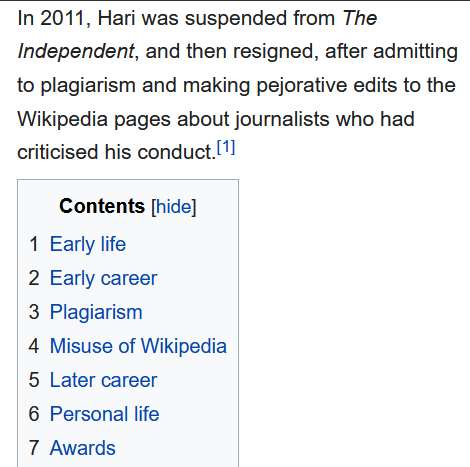
When his latest book came out a month ago, I looked at his Wikipedia entry. Wikipedia saves the history of all the different versions of each page, so here is a link to what I saw when I did that.
And here’s part of the summary and the table of contents:
The whole article struck me as weird because it didn’t mention two things I clearly remembered:
- Hari got in trouble, not just for minor plagiarism, but for allegedly making things up completely.
- Even more memorably, the fake identity he used to edit Wikipedia, “David Rose”, was also used to author an incest kink porn story with a hilarious title.
You can see why Hari (and whatever reputation management consultants he has working for him) would want to focus on the “plagiarism” angle. It’s not good to pass off a quote you got from someone’s book as something they told you directly, but it’s not as serious as completely inventing something. I suppose technically it’s plagiarism because you’re pretending you elicited the quote in an interview and you’re not citing the original book; but it’s a lot better than the typical case of plagiarism that involves passing off someone else’s work as your own. Hari’s defence is that he was “cutting corners” because he was under so much pressure due to his meteoric success at young age, etc. etc.
Comments Off on Johann Hari’s unlikely career resurrection
September 30, 2022
“To maintain the illusion of free, all our online activities are sinking into spam, scam, and sham”
Ted Gioia on the insatiable growth of predatory behaviour from providers of “free” content online:
The biggest trick the Devil ever played was convincing people that online stuff is free. But the Devil always collects, sooner or later — and we are starting to learn the actual terms of this cursed deal.
Consider some recent news stories:
- YouTube has been testing users’ willingness to watch 10 unskippable ads on a video. And the ads aren’t spaced out. They come at you, one right after the other, at the outset — because Google wants to be paid first, even if the video sucks.
- Nobody wants ads on iPhone, but they’re coming. Executives at Apple are allegedly planning to triple the ad revenue from phones.
- “For some Google searches literally the whole screen on Google is ads.”
- TikTok can track a user’s every keystroke, and Beijing has “access to everything”.
- “Scams are showing up at the top of online searches.”
- Snapchat has been forced to pay $35 million for storing and selling users’ biometric information without permission.
- Even if you pay for ad-free streaming, Spotify inserts ads in podcasts.
- Ads are coming to Netflix too.
- Etc. etc. etc.
This is what happens when “free” really isn’t free — but consumers prefer to stay in denial. Go ahead and rob me, just make sure I’m not looking when it happens.
It’s even worse than that. Web users are now hooked on free — and like all addictions, this one is far costlier than you realize at the outset.
You have more leverage when you negotiate an actual price. When I cancel a paid subscription, the corporate provider always comes back with a special offer to get me to reconsider. But how much bargaining power do I have if I refuse to click on those “terms and conditions” that always come with the free stuff?
I’ll answer that for you — none at all.
How bad will it get? YouTube described its ten unskippable ads as a “test” — but this wasn’t done in a laboratory or with volunteers. They just forced it on users, and watched them squirm. And squirm they did.
In fact, one person reported a 12-ad blitz.
This wouldn’t be so bad if it was just one business or sector of the economy that played these games. But this is the de facto business model for the entire digital economy. To maintain the illusion of free, all our online activities are sinking into spam, scam, and sham. Everything from sending an email to sharing a photo gets monitored and monetized by big tech companies — and often you’re the last person to find out what the real price is.
Comments Off on “To maintain the illusion of free, all our online activities are sinking into spam, scam, and sham”
Witness about to testify on Bill C-11? Time to break out good old Parliamentary bullying and intimidation tactics!
It’s had to believe, but the Liberal government continues to defy expectations in their continued mission to prevent public participation in political processes, as Michael Geist documents here:

“In the east wing of the Centre Block is the Senate chamber, in which are the thrones for the Canadian monarch and consort, or for the federal viceroy and his or her consort, and from which either the sovereign or the governor general gives the Speech from the Throne and grants Royal Assent to bills passed by parliament.”
Photo and description by Saffron Blaze via Wikimedia Commons.
The Senate Bill C-11 hearings have provided a model for the much-needed, engaged, non-partisan inquiry that was largely missing from the House committee’s theatrics in which the government cut off debate on over 150 amendments. But this week those hearings attracted attention for another reason: serious charges of witness intimidation and bullying by government MPs, most notably Canadian Heritage Parliamentary Secretary Chris Bittle (yes, the same Bittle who last month suggested I was a racist and a bully for raising concerns about Minister Pablo Rodriguez silence over Canadian Heritage funding of an anti-semite as part of its anti-hate program).
The Globe and Mail reported late on Tuesday night that Bittle – together with his colleague, Liberal MP Lisa Hepfner – had sent a letter to the Lobbying Commissioner to seek an investigation into the funding of Digital First Canada, a group representing digital first creators. The letter may have been shopped around to other MPs as Liberal MP Anthony Housefather has told the Globe he did not sign it. DFC’s Executive Director, Scott Benzie, had appeared before the Heritage committee months ago and Bittle used his time to focus on the organization’s funding. Leaving aside the fact that government MPs reserve these kinds of questions only for critics of Bill C-11 (there were no similar questions this week from Ms. Hepfner to the Director of Digital Content Next, whose organization supports Bill C-18 and counts Fox News among its members), the timing of Globe story was incredibly troubling. The Lobbyist Commissioner letter was apparently filed nearly two months ago and Benzie had been assured that he was compliant with the law. Yet the story was presumably leaked to coincide with Benzie’s appearance before the Senate committee last night.
The letter and leak smacked of witness intimidation and bullying with the government seeking to undermine critics of the legislation hours before a Senate appearance. Indeed, the entire tactic felt like the policy equivalent of a SLAPP suit, which are used to intimidate and silence critics through litigation. By the end of the day, the tactic had clearly backfired on Bittle and the government. Conservative MP John Nater filed a point of privilege in the House of Commons, arguing that Bittle had attempted to intimidate a Senate witness.
I rise on a question of privilege, for which I gave notice earlier this same day, regarding the conduct of the member for St. Catharines, who attempted to intimidate Scott Benzie, a witness appearing before a committee of the Senate studying Bill C-11, an act to amend the Broadcasting Act and to make related and consequential amendments to other acts, as reported yesterday by the Globe and Mail.
While I appreciate that this attempt to intimidate relates to proceedings of a Senate committee currently studying Bill C-11, the culprit in this case is a member of the House, and that same witness appeared before the House of Commons Standing Committee on Canadian Heritage during its deliberations on Bill C-11, an appearance where Mr. Benzie, no doubt, first established himself as an undesirable witness for the government on the merits of Bill C-11.
The government response was surprisingly muted with MP Mark Gerretsen simply asking for a couple of days to formulate a response, perhaps recognizing that defending Bittle would mean defending the indefensible.
Comments Off on Witness about to testify on Bill C-11? Time to break out good old Parliamentary bullying and intimidation tactics!
September 28, 2022
There are two kinds of people online talking about mental illness: those suffering with mental illness and those glorying in the attention they get for faking it
Freddie deBoer on the phenomenon of mental health culture online and the two primary kinds of participants (my headline over-dramatizes the case he’s actually making):
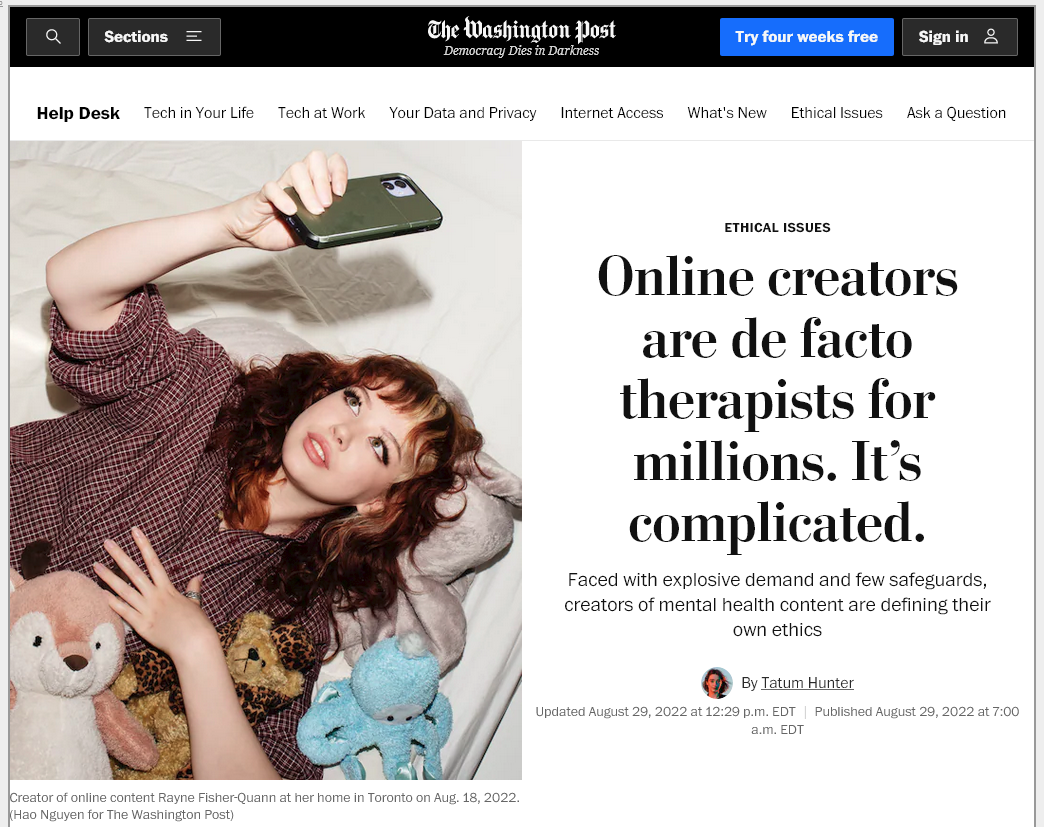
I was not, at first glance, inspired with confidence by this Washington Post piece on online mental illness culture. The piece has a header image of a “mental illness influencer” lounging in bed, taking a selfie. I’m someone who’s committed to de-glamorizing mental illness, and I’ve been begging people to stop romanticizing pathology for a long time. I suppose there’s an implied critique in that photograph, but it’s not ideal.
On substance, Tatum Hunter’s piece fails the way so many others have failed in this milieu: it studiously avoids the possibility that some people who talk about their mental illnesses online don’t really have them. I’m not specifically talking about simple fraud and lies, which I suspect are rare, but rather the weird combination of hypochondria, Munchausen’s syndrome, and social contagion that we see all around us in these spaces. Spend any time at all in these communities on Tumblr or Tik Tok and you will find many people, most of them young, who are using mental illness as a means to self-define, to differentiate themselves from the hordes of other people they see online who are just like them. I’ve written again and again about why it’s a bad idea to want to be your mental illness, and it’s even worse to want to be mentally ill, period – not just bad for other people, but bad for you. But there are people who have become influencers and garnered hundreds of thousands of followers on their apps of choice by performing mental illness. People use their disorders to chase clout. That’s just reality.
Hunter considers the problems of misdiagnosis, of self-diagnosis, of people undertaking mental health care on the advice of internet randoms rather than under the care of a doctor, but nowhere does she seriously consider the possibility that the basic problem for many people is that they believe they have mental disorders they don’t in fact have. I think doing so is seen, at this point, as a kind of identity crime, and thus unlikely to be found in the Washington Post.
But hypochondria exists. Munchausen’s syndrome exists. Psychosomatic illness exists. I can get people to admit to those realities in the abstract, now, but they stay entirely in the abstract – to suggest that any group of people is suffering under those conditions, rather than under authentic mental illness, is treated as a sin. This was my biggest disappointment with Ross Douthat’s book on his chronic illness, which I quite liked overall; Douthat never stops his narrative to ask whether any of the people who believe themselves to be sick from chronic illness actually aren’t. (Surely he himself suffered, but because of the woo and mysticism found in that space, an accounting was necessary.) And I don’t know how we confront the spiraling number of people claiming to have illnesses for which there are no objective tests without being frank about the existence of hypochondria, Munchausen’s, and psychosomatic illness – particularly when people insist on deepening the social incentives by giving the sick more and more attention.
Even for the authentically ill, online culture is fraught. The meta-problem with pieces like that in WaPo, obviously, is that by giving certain members of this community the glamour shot treatment (literally in this case), they’re creating direct incentive for people to make illness their identity -and to not get better. Young people understand the allure of being seen; they don’t yet understand the horror of being frozen in other people’s gazes. They don’t understand the costs of being defined. There have been many opportunities for me to make myself the mental illness guy, certainly including financial opportunities. Perhaps I’ve already fallen into that trap, despite my efforts to remain a generalist. But I’ve fought to avoid that because I know just how painful and limiting self-definition can become. I’m sorry to pull wizened old guy here, but young people don’t understand. They don’t understand that pinning yourself down that way can produce a kind of horror.
Comments Off on There are two kinds of people online talking about mental illness: those suffering with mental illness and those glorying in the attention they get for faking it
September 24, 2022
PayPal shuts down the Free Speech Union’s account for some reason
Ellie Wheatley on PayPal’s arbitrary decision to cut off the Free Speech Union’s account without notice:

The irony of the Free Speech Union’s PayPal account being shut down is that it proves we are in need of the union more than ever.
The online payment company shut down the FSU’s account (thus making it more difficult for people to donate) without any clear explanation as to why it did so. The same was done to its founder, Toby Young, and his online newspaper, the Daily Sceptic.
The shame is, PayPal is an innovative tech company that has made transferring money almost seamless for millions across the world. You can donate money to an organisation within seconds; there’s no faff trying to find your credit card, or having to re-type your details for the twentieth time that week. It’s a brilliant service that has made life easier for many people, businesses and charities. PayPal is not a political company, it’s a tech company worth over $102bn, so why have they been banning other organisations from using their services?
Although PayPal said they couldn’t comment on the decision, they did proclaim that they “weren’t discriminatory”, but is this really true?
Is it unclear whether they shut down these accounts simply because they disagreed with what the FSU and Toby Young stand for. Although PayPal hasn’t clarified what exactly FSU and Toby Young did wrong, it appears that they must have breached their acceptable use policy. This includes myriad of things but the most prominent are hate speech and “misinformation” on topics such as the COVID vaccine.
Hate speech is one thing (although it seems that anything can be deemed offensive and hateful now) but “misinformation” about topics being a breach of policy takes us down a dark and sinister path.
Misinformation is a term that is often used to label content that goes against the elite or prevailing “groupthink” point of view. Questioning mainstream thought is unacceptable, and it breaches Big Tech’s policy, thus you can (and often will) be shut out.
Comments Off on PayPal shuts down the Free Speech Union’s account for some reason
September 22, 2022
RAF Coastal Command vs U-Boats
The History Guy: History Deserves to Be Remembered
Published 5 Oct 2020The contest between aircraft and U-Boats during the Second World War was one of competing technological innovations, culminating with a decisive struggle in the summer of 1943. The History Guy tells the forgotten story of the development of anti-submarine warfare and the contest between the aircraft of RAF Coastal Command and U-Boats of the Kriegsmarine in the Bay of Biscay.
(more…)
Comments Off on RAF Coastal Command vs U-Boats
Why Electronic Voting Is Still A Bad Idea
Tom Scott
Published 9 Dec 2019We still shouldn’t be using electronic voting. Here’s why.
(more…)
Comments Off on Why Electronic Voting Is Still A Bad Idea
September 18, 2022
Forget #GamerGate already, here’s #NAFO!
At Samizdata, Perry de Havilland briefly recaps the story of #gamergate and the incomprehension of the “official” gaming press and PR departments of gaming companies that their actions to ridicule and shutdown the “racist/sexist/homophobe” #gamergate activists not only failed but drew more attention to the #gamergate issue, and compares it to a new instance of the same phenomenon:
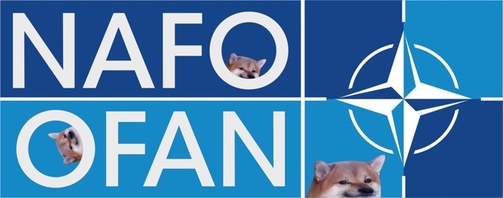
Fast forward to 2022 and behold #NAFO: the North Atlantic Fellas Organisation.
And who are “the fellas”? A large and growing online pack of attack dogs countering, dare I say smothering, official Russian troll factory output, as well as other pro-Kremlin talking heads online. And their mascots are daft cartoon dogs (variations of a Shiba Inu to be precise). If journalistic collusion was a constant target of #GamerGate, the Russian troll farms are the modern analogy to that, constantly targeted and smothered by NAFO posting either pro-Ukrainian counter-narratives or just ridiculing or flagging up pro-Russian ones.
Many people, particularly those operating within institutions, don’t understand #NAFO for same reason PR departments of various video games companies & press outlets didn’t (and still don’t) understand #GamerGate.
Is #NAFO engaged in “information warfare”? Absolutely. They even get a shout out from the Ukrainian Ministry of Defence. But they are not managed out of an office in Langley, Virginia nor by some adjunct of the Ukrainian intelligence services. #NAFO is a hashtag, a phenomena, it isn’t “run” by anyone, because it doesn’t need to be. Like GamerGate, NAFO is a confluence of the motivated willing in every timezone on the planet.
And just as GamerGate had a single original trigger, which was then largely forgotten as the “movement” grew and started attacking larger more juicy prey, NAFO started as a fund raising effort for the Georgian Legion (a now battalion sized unit of about 600 within the Ukrainian army made up mostly of Georgian volunteers). At blinding speed, NAFO rapidly morphed into a wider distributed online effort supporting Ukraine in the “information space”.

Comments Off on Forget #GamerGate already, here’s #NAFO!
September 9, 2022
The Velvet Glove and Sparrow II missiles; A Beginners Guide To Post-War Bomber Interception Tactics
Polyus Studios
Published 14 Jul 2018The Velvet Glove was a semi-active guided missile system developed by the Canadian Armament Research and Development Establishment. Its successor, the Sparrow II, was developed by Canadair in association with the US Air Force. This is the story of the development of the missiles in the context of contemporary weapons systems.
(more…)
Comments Off on The Velvet Glove and Sparrow II missiles; A Beginners Guide To Post-War Bomber Interception Tactics


