Pleated-Jeans has done the heavy lifting to pull the old, outdated Maslow diagram into the 21st century:
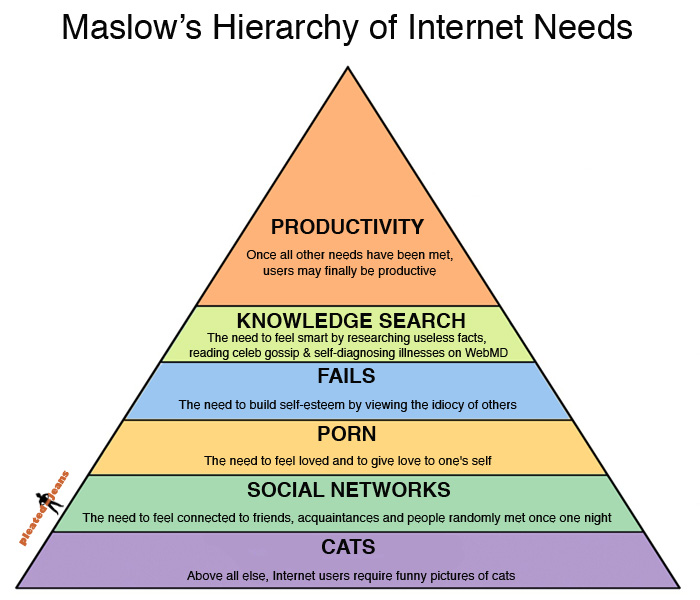
H/T to Michael O’Connor Clarke who advises “Caution: may cause psych majors to eject hot coffee through nasal passages.”

Pleated-Jeans has done the heavy lifting to pull the old, outdated Maslow diagram into the 21st century:
H/T to Michael O’Connor Clarke who advises “Caution: may cause psych majors to eject hot coffee through nasal passages.”
I have a Facebook account, but I use it infrequently (the vast majority of my FB activity is just status posts echoed from my Twitter account, actually). For certain groups, however, Facebook is far more critical to their lives . . . young women, for example:
According to a new report released by Oxygen Media and Lightspeed Research, about one-third of women on Facebook between 18 to 34 in age check this social networking site in the morning as the first thing even before going to bathroom. Some of the other astonishing facts deduced from this research on young women are as follows.
* 21% of women age 18-34 check Facebook in the middle of the night
* 63% use Facebook as a networking tool
* 42% think it’s okay to post photos of themselves intoxicated
* 79% are fine with kissing in photos
* 58% use Facebook to keep tabs on “frenemies”
* 50% are fine with being Facebook friends with complete strangers
Clearly there haven’t been enough stories about people losing their jobs over inappropriate posts on Facebook . . . maybe they aren’t being posted to Facebook itself.
In the twinkling of an eye (by the standards of bureaucratic time, which is slower than geologic time but more expensive than time spent with Madame Claude’s girls in Paris) the thing was done. On March 7, 1989, the DOT-NHTSA-ODI-TSC-OPSAD-VRTC . . . effort produced an eighty-one page report written by an eight man group of engineering savants with more than fifty years of college among them. This document presented evidence from exhaustive experiment and analysis that proved what everybody who understands how to open the hood of a car had known all along about SAIs: “Pedal misapplications are the likely cause of these incidents.”
Yes, the dumb buggers stepped on the gas instead of the brake. [. . .] Anyway, the truth was out at last. The government had released a huge report showing that there was no such thing as unintended acceleration in automobiles. Stand by for huge government reports on fairies stealing children and poker wealth gained by drawing to inside straights. Meanwhile, cars did not fly away of their own accord. They could be safely left unattended.
. . . So the truth was out, and we people who like automobiles and can tell our right foot from our elbow should have been glad. But there was, in fact, no reason to celebrate. This message from the federal bowl of Alpha-Bits had cost us taxpayers millions of dollars and came too late to save Audi from the ignorance, credulity, opportunism and sheer Luddite malice directed toward that corporation and its products. Furthermore, the Department of Transportation press release introducing the SAI report absolved the paddle-shoed, dink-wit perpetrators of sudden acceleration. It just let Betty Dumb-Toes and Joe Boat-Foot right off the hook:
NHTSA declined to characterize the cause of sudden acceleration as driver error. Driver error may imply carelessness or willfulness in failing to operate a car properly. Pedal misapplication is more descriptive. It could happen to even the most attentive driver who inadvertently selects the wrong pedal and continues to do so unwittingly.
The next time I get pulled over by the state highway patrol, I’m telling the officer, “You probably intend to ticket me for speeding, which would be driver error. But pedal misapplication is more descriptive of what occurred. It could happen to even the most attentive driver who inadvertently selects the wrong pedal and continues to do so unwittingly.”
P.J. O’Rourke, Parliament of Whores: A Lone Humorist Attempts to Explain the Entire US Government, 1991
BBC News reports that Apple has called a surprise news conference:
The company has refused to give details about whether the event will address reception problems that some users have reported with the phone, launched just last month.
Apple has faced mounting criticism from analysts and consumers over its handling of the issue.
Industry watchers said the firm was in danger of damaging its “rock star” reputation over how poorly it had dealt with what would normally be a minor problem.
“It seems there has been a real crisis of leadership here,” said Patrick Kereley, senior digital strategist for Levick Strategic Communications which deals in crisis managment and reputation protection.
“There are so many conflicting reports about this issue and a lot of confusion in the marketplace. They need a plan of attack. Today’s companies have to react quickly before chatter on Facebook or Twitter turns into news headlines as is the case here,”
Of course, blaming the problem on Facebook and Twitter users isn’t particularly appropriate: there is a problem with the iPhone 4 and even the most pro-Apple folks are noticing it and complaining. Apple has reacted very badly to their most enthusiastic customers, and (for a change) appears to be damaging their reputation. Now that they’re no longer seen as underdogs, the haughty and uninformative response won’t work.
adamburtle: “The first iPhone captivated the world because the interface was so well done, so snappy, so interactive; it was like nothing before it. Of course it was, it was an Apple product. That, right there, is why I buy Apple products. And I didn’t even mind that it was missing “copy and paste,” MMS, ringtones, etc — because I knew Apple would eventually get to these through software updates. And eventually they did. Unfortunately they kept coming out with new phones. With faster processors. And they wrote all their software updates for these phones, with little attention to deprecated models. I don’t really use third party software on my phones, I honestly don’t even use ringtones. I just my phone for SMS, web, maps, and occasionally as an actual phone, so the 3G model was more than I ever needed.
“Except over time, it’s fulfilled my needs less and less. And it’s not because my needs have grown. It’s not because I’ve installed a bunch of laggy software. It’s because Apple’s firmware has become bloated, with respect to the processing power of the 3G iPhone. I just installed iOS 4 two weeks ago, and at this point, I’d be happy to roll back to the first firmware I ever had, just to have that original speed again; forget about the copy and paste, I don’t need it that badly. “
H/T to Michael O’Connor Clarke for the most graphical example of why you don’t always want to be the first one to install new software.
With the reminder yesterday that Microsoft has ended support for Windows XP Service Pack 2, I figured it was time to look at upgrading my computers to Windows 7. I’m not a “bleeding edge” kind of guy: I figure it’s safer to let other folks be the quality assurance department and I usually wait until the cries of pain and anguish from the first bunch of upgraders dies down before trying it myself.
I looked at the array of options (remember the days when there were only one or two flavours of operating system to worry about?) I was going to upgrade my laptop first, as it’s already been blighted with Vista, which is supposed to mean that the upgrade preserves all your installed programs and settings. I have a variety of programs I need to run, some of which are getting a bit long in the tooth, so I thought it safer to get a version of Windows 7 that offers the “Windows XP Mode” just in case some of them won’t play nice in the new OS natively. That meant I needed to buy Windows 7 Professional or Windows 7 Ultimate. The differences between those two versions was price: Ultimate offers BitLockerTM and the option of working in 35 languages, neither of which is important to me. So I picked up a copy of Windows 7 Professional.
This morning, when I tried to run the upgrade, having backed up my laptop’s hard drive, I discover that I should have bought the Ultimate version instead — because the laptop was shipped with Vista Home Premium installed, I can’t upgrade directly to Windows 7 Professional using the “preserve files and settings” option, but instead would have to re-install everything.
Well, I guess I can use this copy to upgrade the desktop, since it’ll need the full re-install everything option anyway. Drat.
Update, 15 July: Well, the actual updating part went pretty smoothly (unlike the last few times I’ve installed OSes from Microsoft), so now it’s find the programs, download updates and drivers, and get back into a working state. The longest part so far has been using the Microsoft “Windows Easy Transfer” wizard: both saving the files off the original and re-installing them on the new OS is a multi-hour exercise.
Update, 20 July: It took time, but unlike previous OS-upgrade tales of woe, this was merely time-consuming. The last of the programs I was having issues with has started to behave (although in one case it was an extremely good idea that I got the version of Windows 7 that included Windows XP Mode: my backup program hiccoughs under native Windows 7).
I can comfortably recommend the Windows 7 Easy Transfer tool: it even eased the pain of updating iTunes. I can see why some folks don’t feel the urge to move on from Vista: it “feels” very similar to Vista so far.
Cory Doctorow links to some photos and posters from the golden age of streamlined trains, saying “by contrast, today’s trains seem to be designed to say, ‘The future will not arrive, but if it does, it will be more of the same.'”:
The gorgeous streamlined steam and diesel locomotives from the 1920s-1930s scream “steampunk” and “dieselpunk” to anyone who can appreciate it, and also provide an ample field for research for train historians and collectors. This was the era of The Mighty Streamlined Machine, and it plainly shows even in black-and-white photographs that remained.
Although the images represent a wide variety of streamliners, they missed one of the most famous:
 LNER 4468 “Mallard” (Image from Scarborough Railway Society)
Trevor Pott manages to deter a newly evangelized Apple fan:
The event sticks out for me because the user was not impressed by the iPhone because it was Apple, or the phone was hip. Rather it was because at a tradeshow they caught a colleague watching the Canucks getting beat on an iPhone. The concept of being able to stream video on a cellular network had never occurred to them before this. They saw it first on an Apple, it was evangelised by an ardent fan, and thus Apple “invented” it.
In this way Apple has “invented” everything of use in mainstream computing. From being the only computer for design, to inventing the MP3 player, smartphone, tablet computer, video conferencing and now, apparently, 3G streaming. When introduced to non-Apple alternatives, the people crying loudly for Apple gear seem shocked that it already existed in a previous form. The lesson I took from this is that users don’t care about the technology. With the exception of a few loudmouths on the internet, nobody cares that this was made by Apple, Sony, Microsoft or anyone else.
Users care about what a product can do. They care about how easily that product can do it. Users care about looks, but not as much as ease of use, good documentation, presentation of features and fantastic marketing. What’s more, good businessmen care about these things too; this is what makes their company tick, and what makes them money.
There’s a reason why a lot of successful technology folks try to sell “solutions” rather than products: it’s a much better way of addressing the users’ actual needs (even if it means you don’t recommend the glitzy, whizzy, shiny new Apple iThing). If you can de-mesmerize them long enough to actually address their needs instead of their wants, you’ll be doing them a much better service.
The Register looks at the “Tyrannos” flying jeep:
Who remembers the “Transformer TX” flying-car project, intended to equip the US Marines with a small four-seat vehicle able to drive about on the ground like a jeep, hover like a helicopter, or fly like a plane? The first team to publicly offer a contending design has now stepped forward.
That design is the “Tyrannos” from Logi Aerospace, allied with other companies and organisations including the South West Research Institute and Californian electric-vehicle firm ZAP.
The Tyrannos is nominally intended to provide Marines with the ability to leapfrog over troublesome roadside bombs, mines, and ambushes while remaining able to drive on the ground as they normally might. However, it promises to be much quieter than ordinary helicopters in use and far easier to fly and maintain.
If the Tyrannos can do all its makers claim, it really does have the potential to become the flying car for everyman.
That last sentence really does wrap up the situation: if it can do all that is claimed, it’ll be a fantastic new toy for the military and (eventually) lead to the flying cars we were promised forty years ago. The specs seem hopelessly optimistic, but perhaps I’m just jaded because I don’t have a flying car of my own yet . . .
Reader beware, however. The Transformer TX project is being run not by the Marines themselves but by DARPA, the Pentagon crazytech agency which won’t even touch a project unless it is extremely unlikely to succeed.
“Give us ideas that probably won’t work,” that is DARPA’s motto: and the Tyrannos team assembled their design specifically to DARPA requirements. And, let it be noted, they have yet to satisfy even DARPA’s very relaxed rules on what kind of ideas should get taxpayers’ money spent on them.
Using an iPhone is like taking a holiday to some corrupt country: It may be beautiful and offer simple pleasures, but you’re going to pay bribes to people who shamelessly charge you for what’s free elsewhere.
Mike Elgan, “5 Big iPhone Rip-Offs”, PC World, 2010-07-06
Having recently inherited Elizabeth’s printer/scanner because it stopped being willing to play nice with her computer, I found that if anything, James Lileks is being over-charitable to scanner ergonomic design teams:
I just fear dealing with the Canon scanner interface, although it can’t be worse than HP. Yes, yes, I know, buy VueScan. But I had just gotten used to the HP interface on the new scanner. It was designed, as usual, by engineers with no taste who presume Great-gramma is trying to scan something so she can send it by the inter-mails to someone, and needs to be shown in the most obvious way possible that she is old and stupid and should not use computers. Hence it has two icons: one says DOCUMENTS, with a little badge that says “300,” and another says IMAGES, with a badge reading “200.” I assume that means dpi, but who knows? You can make custom profiles, but it never remembers them. There’s no button that actually says SCAN, which would be helpful. It’s as if the GUI team is a bunch of malicious bastiches who came up with the most non-intuitive interface ever, then said “Okay, now let’s add one more step between deciding to scan and actually achieving a scan. Johnson, you’re good at this. What would you recommend?”
“Well, just off the top of my head, I’d say have the default setting for saving put it into some proprietary image-collection program buried deep in the User’s library, so it can’t be found no matter how hard they look.”
“Excellent! Make it so.”
An absolutely brilliant post at The Secret Diary of Steve Jobs tells you all about the reality of marketing:
It’s a pretty safe assumption that if you’re reading this blog, you’ve seen “The Matrix.” And you may or may not remember the scene where a kid explains to Neo that the trick to bending a spoon with your mind is simply to remember that, “There is no spoon.”
So it is with marketing. One thing I learned very early in life, thanks to intentional overuse of psychedelic drugs, is that there is no reality. As a guy at the commune once put it: “The reality is, there is no reality.”
So some guy says his iPhone 4 is having reception issues. I say there is no reception issue. Now it’s his reality against my reality. Which one of us is living in the real reality?
There’s a two-part answer: 1, there is no real reality, and 2, it doesn’t matter.
The only thing that matters is which reality our customers will choose to adopt as their own.
[. . .]
What I realized many years ago — and honestly, it still amazes me — is that most people are so unsure of themselves that they will think whatever we tell them to think.
So we tell people that this new phone is not just an incremental upgrade, but rather is the biggest breakthrough since the original iPhone in 2007. We say it’s incredible, amazing, awesome, mind-blowing, overwhelming, magical, revolutionary. We use these words over and over.
It’s all patently ridiculous, of course. But people believe it.
H/T to Chris Anderson for the link.
Lester Haines reports that the Apple iPhone 4 has received top marks from the discerning folks at Suicide Girls:
In an absolutely shameless piece of bandwagon-jumping self promotion, the internet’s leading repository of female tattoos and body piercing has taken the latest manifestation of the Jesus Phone out for a spin (link NSFW).
Screen grab from iPhone 4 showing young lady with exposed breastSuicide Girls has put the iPhone’s 4’s imaging capabilities to the test as is the local custom — by photographing women with their tops off.
The snap seen here apparently demonstrates an “unexpected feature”, in that “when you point it at Rambo her boob pops out”. We’re pretty sure someone has indeed written an app for that, but are surprised it got past the Apple Titfinder General.
Image at El Reg is probably NSFW for workplaces in North America . . . images at Suicide Girls are even more so. Don’t say I didn’t warn you.



Powered by WordPress