
Even with an American ad agency working for them, the market wasn’t ready for this in 1969:
September 9, 2010
Ever wonder why Japanese cars didn’t become popular at first
Comments Off on Ever wonder why Japanese cars didn’t become popular at first
September 5, 2010
No longer “underhand, underwater and damned un-English”
BBC News looks at the newest nuclear-powered attack submarine in the Royal Navy, HMS Astute:
It is the stealthiest sub ever built in the UK, able to sit in waters off the coast undetected, listening to mobile phone conversations or delivering the UK’s special forces where needed.
The 39,000 or so acoustic panels which cover its surface mask its sonar signature, meaning it can sneak up on enemy warships and submarines alike, or simply lurk unseen and unheard at depth.
The submarine can carry a mix of up to 38 Spearfish heavyweight torpedoes and Tomahawk Land Attack Cruise missiles, able to target enemy submarines, surface ships and land targets, while its sonar system has a range of 3,000 nautical miles.
[. . .]
HMS Astute itself should never need refuelling over the next 25 years, thanks to the latest nuclear-powered technology which means it can circumnavigate the world submerged.
It even creates the crew’s oxygen from seawater as it sails, meaning that the air on board is no longer heavy with diesel fumes, as submariners used to complain of older vessels. The only limit to how long it can stay underwater is the amount of food on board, enough for 90 days at sea.
Rather a big step up from the diesel-electric clunkers we bought from them, wouldn’t you say? H/T to Adrian MacNair for the link.
Craigslist surrenders, problem totally resolved
Dan Tynan recounts the glorious moral victory scored by unhappy state legislators against the final bastion of sin and decadence, Craigslist:
Bowing to pressure from 17 state attorneys general, Craigslist has begun censoring its Adult Services ads. Visitors coming to any of the 400+ Craigslist sites will encounter a big black CENSORED tab where Adult Services used to be.
As we all know, the scourge of prostitution had been entirely eradicated from modern society before Craigslist came along. And now that Adult Service ads are banned, you can expect all those hard-working gals to pack up their condoms and lubricants and enroll in secretarial school.
Alas, we fear that — despite the best intentions of 17 state attorneys general desperately trying to get re-elected — a ban on Adult Services won’t quite put an end to adult-oriented advertising on Craigslist.
Comments Off on Craigslist surrenders, problem totally resolved
September 3, 2010
Why we still need technical writers
Eric S. Raymond has been pleased with the upgrade to his “backup” Android phone, but encountered a very common problem in technology (especially in open source projects, but still too common in commercial products):
As usual in such exercises, the hard part was interpreting the instructions. The hackers who wrote them were trying very hard to be clear, but the result was a thicket of poorly-organized details. I could follow the procedure, but I had to do it almost blind; there was nothing that gave me a high-level view of the process so that I could grasp clearly why each step was necessary and why they had to happen in the order they did. As a result, for troubleshooting I absolutely had to have live help on an IRC channel.
I wish someone would write a bird’s-eye view of the smart-phone modding process. It can’t be that complicated, and I know what’s involved in writing boot loaders for general-purpose computers. Shout to my readers: has anyone done this already, or do I need to put it on my over-full to-do list?
Much of the problem is that folks who are deeply involved in the technical details are often unable to simplify-without-dummifying their knowledge. That’s not surprising, as most are nowhere near as gifted in verbal skills as they are in their own area of technical ability.
September 2, 2010
Rival electric car manufacturers already positioning for dirty ad campaigns
Lewis Page rounds up the GM-versus-Tesla ad campaigns of the near future:
As US motor mammoth GM gears up for the launch of its plug-in hybrid Chevrolet Volt, it has applied to trademark the term “range anxiety” — meaning the fear suffered by battery-car owners regarding their ability to get home again after a given journey. Upstart battery car maker Tesla Motors has issued a panicky and unconvincing statement in response.
[. . .]
GM feels that “range anxiety” is a major reason why its original EV-1 battery car of the 1990s failed.
”We’ve been here before,” says GM marketing honcho Joel Ewanick. “We have first-hand experience with what the issues are.”
In short, the difficulty with an all-electric battery car is that there is little certainty of actually being able to complete any journey even close to the vehicle’s rated range, as battery endurance is highly variable — and manufacturers can’t publicise the worst-case (or even perhaps the likely-case) figures. If they did, nobody would ever buy their products.
[. . .]
Meanwhile, reputable Swiss boffins have lately pointed out that in fact a VW Golf powered by one of the new, super-low-emission injected turbodiesels is responsible for less carbon emissions over its lifespan than one with a li-ion battery running on typical grid power.
So, to wrap up the discussion briefly, nobody will be buying Tesla Roadsters or Government Motors Volts for their economic virtues: they’ll be buying them as expensive status-signalling devices to show off their (real or imaginary) environmental awareness.
Comments Off on Rival electric car manufacturers already positioning for dirty ad campaigns
August 25, 2010
LED lightbulbs won’t save energy in the long run
Not because they aren’t more efficient than ordinary lightbulbs, but because of the inevitable side-effects of human nature:
Federal boffins in the States say that the brave new future in which today’s ‘leccy-guzzling lights are replaced by efficient LEDs may not, in fact, usher in massive energy savings.
This is because, according to the scientists’ research, people are likely to use much more lighting as soon as this becomes practical. The greater scope for cheap illumination offered by LEDs will simply mean that people have more lights and leave them on for longer.
“Presented with the availability of cheaper light, humans may use more of it, as has happened over recent centuries with remarkable consistency following other lighting innovations,” says Jeff Tsao of the Sandia National Laboratory. “That is, rather than functioning as an instrument of decreased energy use, LEDs may be instead the next step in increasing human productivity and quality of life.”
According to Tsao and his colleagues at Sandia, the fraction of gross domestic product spent on lighting has remained constant as candles were replaced by oil lamps, then again in the transition to the gaslight era, then yet again with the arrival of electric lighting. What changed with each of these innovations was that lighting became more and more common.
Hands up, anyone who didn’t see this one coming.
Bans on texting while driving have not measurably improved highway safety
This report should come as no real surprise to anyone who’s been paying attention:
The two biggest highway-safety issues right now, as far as Washington is concerned, are runaway Toyotas and distracted driving. But what if these aren’t the most important factors driving the nation’s annual highway death toll, which averages about 100 fatalities a day?
That’s the view of Adrian Lund, president of the Insurance Institute for Highway Safety, who says the U.S. Transportation Department, Congress and the media have gotten sidetracked by issues like texting while driving.
“There’s nothing rational about the way we set highway safety priorities,” Mr. Lund says in the Insurance Institute’s Aug. 21 “Status Report” newsletter.
Mr. Lund’s organization is the safety research and advocacy arm of the insurance industry. The IIHS has been critical of the government’s highway safety policies over the past few years, usually arguing that the government wasn’t moving fast enough to require better crash-prevention technology from auto makers.
Mr. Lund and the Insurance Institute also say recent laws banning motorists from using mobile phones behind the wheel don’t correlate with a significant reduction in accidents.
“You’d think from the media coverage, congressional hearings, and the U.S. Department of Transportation’s focus in recent months that separating drivers from their phones would all but solve the public-health problem of crash deaths and injuries,” he wrote. “It won’t.”
Comments Off on Bans on texting while driving have not measurably improved highway safety
August 24, 2010
Censors to poke noses into what Aussies can load on their iPhones?
Roger Henry sent this information to one of my mailing lists and I repost it here with his permission:
An interesting bombshell in Oz. Apple iPhones, and presumably other similar devices, have been put on notice that all, or nearly all, of the apps that people buy and install should, by law, have been submitted for “Classification” (i.e., censorship). Failure to do so is a criminal offence with penalties of some AU$35,000 per offence. Purchasing said ‘apps’ without a Classification label is also a criminal offence, punishable with jail time and/or fines. Seems that getting these ‘apps’ Classified attracts a charge varying from AU$470 to AU$2,600 so a lot of money is outstanding. With 50,000 apps already in use, the government accepts that there are some practical limitations to the matter but they aren’t going to let the matter just fade away.
This is Roger’s summary from information posted in The Australian‘s weekly IT Notes. And then, in response to a “Dude, WTF?” query:
It may well be that Apple will cease making apps available in Oz. Yes. It is known that they have their own censors. This merely compounds their culpability. What might have been an accidental oversight is now clearly a deliberate attempt to A) avoid censorship and B) defraud the government. This cannot go unpunished. As for the consumers, well, they are all probable pedophiles and identified thieves. No punishment can be too severe . . . it might take awhile but Justice will be served.
While it likely will all end in a round of dignified press releases and backslaps all ’round, there’s still the outside possibility of a highly entertaining politico-technical train wreck here. Let’s hope the wilder spirits prevail.
Comments Off on Censors to poke noses into what Aussies can load on their iPhones?
August 23, 2010
QotD: Peak Culture
The height of their society peaked in 1969. They used militarism and socialism to put two guys on the Moon, they trotted out their public-private partnership (Concorde) to build exclusive supersonic transport for the rich. Max Faget and some other brilliant engineers designed a space shuttle fleet of ten vehicles capable of hundreds of flights a year to make access to low Earth orbit cheap and routine. And the Advanced Research Projects Agency had some geeks create an inter-networking protocol that could survive a nuclear war.
Obviously, they shot their wad, as it were, and no longer put guys on the Moon. They no longer fly supersonic transports. Their space shuttle is going to stop flying soon, if it hasn’t already. Those geeky guys went on to develop open source cryptography, open source software, and totally private economic transactions. The future we’re creating is going to be very, dramatically different. It is going to be decentralised to a fare thee well.
Right now, today, two people anywhere in the world *can* have a totally private economic exchange that cannot be detected by anyone else. And since it cannot be detected, it cannot be regulated, it cannot be prohibited, and it cannot be taxed. Even inflation cannot tax it, if the exchange is denominated in some money like silver or gold. Which means that those who dream of ruling the world sowed the seeds of their own damnation?
Jim Davidson, “Peak Culture”, Libertarian Enterprise, 2010-08-22
Comments Off on QotD: Peak Culture
August 20, 2010
“C will not only let you shoot yourself in the foot, it will hand you a new magazine when you run out of bullets”
Charles Stross enumerates some of the ways “we went wrong” in the rush to today’s computing world:
According to one estimate pushed by the FBI in 2006, computer crime costs US businesses $67 billion a year. And identity fraud in the US allegedly hit $52.6Bn in 2004.
Even allowing for self-serving reporting (the FBI would obviously find it useful to inflate the threat of crime, if only to justify their budget requests), that’s a lot of money being pumped down a rat-hole. Extrapolate it worldwide and the figures are horrendous — probably nearer to $300Bn a year. To put it in perspective, it’s like the combined revenue (not profits; gross turnover) of Intel, Microsoft, Apple, and IBM — and probably a few left-overs like HP and Dell — being lost due to deliberate criminal activity.
Where does this parasitic drag come from? Where did we go wrong?
I’m compiling a little list, of architectural sins of the founders (between 1945 and 1990, more or less) that have bequeathed us the current mess. They’re fundamental design errors in our computing architectures; their emergent side-effects have permitted the current wave of computer crime to happen . . .
I make it a rule never to believe the order of magnitude claimed by a self-interested party about how much money is “lost” because of their current hobby-horse mopery and dopery. Even if the amount claimed by the FBI is off by an order of magnitude, that’s still serious money.
Comments Off on “C will not only let you shoot yourself in the foot, it will hand you a new magazine when you run out of bullets”
August 16, 2010
Practically speaking, the end is in sight for passwords
Advances in computing are not always uniformly beneficial: short passwords are increasingly vulnerable to brute-force cracking:
The availability of password-cracking tools based on increasingly powerful graphics processors means that even carefully chosen short passwords are liable to crack under a brute-force attack.
A password of less than seven characters will soon be “hopelessly inadequate” even if it contains symbols as well as alphanumerical characters, according to computer scientists at the Georgia Tech Research Institute. The security researchers recommend passwords at least 12 characters long.
The number crunching abilities of graphics processors were recently applied to commercial password auditing and recovery tools from Russian developer ElcomSoft. It’s a safe assumption that black hats are able to use the same type of technology for less laudable purposes. Richard Boyd, of the Georgia Tech Research Institute, told the BBC that the number-crunching capacity of graphics cards compares to those of supercomputers built only 10 years ago.
Passwords are going to go away, sooner rather than later. All of us have too many passwords to remember that it’s pretty much guaranteed that you’re using one of the following coping strategies:
- Using the same password on many different sites (or, shudder, all of them)
- Using a simple password (among the most commonly used are “password” and “letmein”)
- Leaving a sticky note on your monitor or your keyboard with your passwords listed
- Using the name of the site as your password for that site
There are tools available to generate passwords that avoid the most obvious pitfalls (too short, no numeric or non-alphanumeric characters, using full words), but very few people use them consistently. I don’t know what the replacement for passwords will be, but we clearly need to move to more secure ways of verifying identity as soon as we can.
Comments Off on Practically speaking, the end is in sight for passwords
August 11, 2010
Felicia Day talks about making The Guild
More at Fast Company.
Comments Off on Felicia Day talks about making The Guild
iPhone girls are easy
Colby Cosh links to a dating website that actually provides useful photography information:
oh, also — iPhone users have more sex.
File this under “icebreakers, MacWorld ’11”. Finally, statistical proof that iPhone users aren’t just getting fucked by Apple:
The chart pretty much speaks for itself; I’ll just say that the numbers for all three brands are for 30 year-olds, so it’s not a matter of older, more experienced people preferring one phone to another. We found this data as part of our general camera-efficacy analysis: we crossed all kinds of user behaviors with the camera models and found we had data on the number of sexual partners for 9,785 people with smart phones.
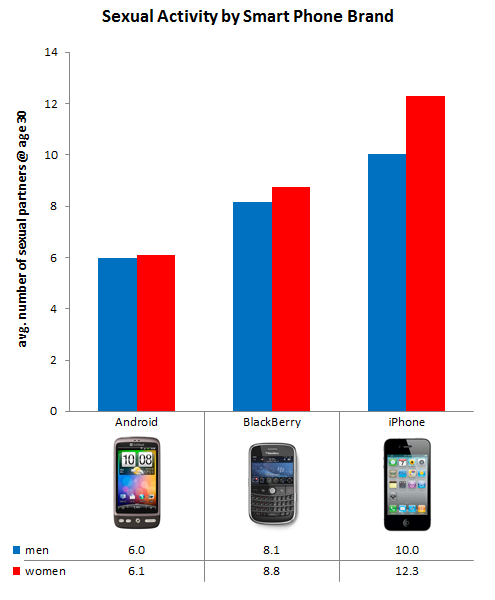
Okay, I’ve posted the funny bit. The rest of the article actually does have useful photography tips, especially if you’re a user of dating websites.
August 9, 2010
Apple execs’ worst fears coming true
Apple has seemed almost ham-handed in their attempts to control the media “storyline” since the iPhone 4 was released. If Eric Raymond is correct in his analysis, Apple will continue to struggle:
Apple’s bid to define and control the smartphone market is going down to defeat. I was going to describe the process as “slow but inexorable”, but that would be incorrect; it’s fast and inexorable. My prediction that Android’s installed base will pass the iPhone’s in the fourth quarter of this year no longer looks wild-eyed to anybody following these market-share wars; in fact, given the trends in new-unit sales a crossover point late in the third quarter is no longer out of the question.
There’s an important point that, so far, all the coverage seems to have missed. You can only see it by juxtaposing the market-share trendlines for both 1Q and 2Q 2010 and noticing what isn’t there — any recovery due to the iPhone 4. This product has not merely failed to recover Apple’s fortunes against Android, it has not even noticeably slowed Apple’s loss of market share to Android.
Forget for now the blunder the trade press has been calling “Antennagate”; I had fun with it at the time, but bruising as it was, it’s only a detail in the larger story. With the iPhone 4, Apple tried to counter the march of the multiple Androids using a single-product strategy, which was doomed to fail no matter how whizbang the single product was. As I predicted would happen months ago, the ubiquity game is clobbering the control game; Apple has wound up outflanked, outgunned, and out-thought.
As I’ve noted before, Apple had been running a very slick, very successful media image-building strategy of coolness and technological sophistication. For several years, they barely put a foot wrong in their complex dance of marketing and public-perception-influencing. When something finally did go wrong, they clearly lacked the ability to respond gracefully and recapture the wavering affections of both the reporters and the readers.
In short, the short-term effect of “antennagate” could have been limited to a one-off glitch: give the punters a free “bumper” for their phones, do it quickly and ungrudgingly, and reap the PR reward for being pro-active and showing that you care for your customers. Instead, the “smartest guys in the room” managed to squander almost all their accumulated goodwill in a few short weeks of bluster, denial, and arrogance. Nice work.
Comments Off on Apple execs’ worst fears coming true
IPv6 still not ready for primetime?
As you’ve probably heard, the current internet addressing system, IPv4, is running out of unallocated addresses. The replacement is called IPv6 and was supposed to be in use by now. Security concerns are holding it back:
The internet’s next-generation addressing scheme is so radically different from the current one that its adoption is likely to cause severe security headaches for those who adopt it, a researcher said last week.
With reserves of older addresses almost exhausted, the roll-out of the new scheme — known as IPv6 or Internet Protocol version 6 — is imminent. And yet, the radical overhaul still isn’t ready for prime time — in large part because IT professionals haven’t worked out a large number of security threats facing those who rely on it to route traffic over the net.
“It is extremely important for hackers to get in here fast because IPv6 is a security nightmare,” Sam Bowne, an instructor in the Computer Networking and Information Technology Department at the City College of San Francisco, said on day one of the Defcon hacker conference in Las Vegas. “We’re coming into a time of crisis and no one is ready.”
Chief among the threats is the issue of incompatible firewalls, intrusion-prevention devices, and other security appliances, Bowne said. That means many people who deploy IPv6 are forced to turn the security devices off, creating a dangerous environment that could make it easier for attackers to penetrate network fortresses.
Comments Off on IPv6 still not ready for primetime?


