
March 11, 2011
Reason.TV: Should governments subsidize alternative energy?
Nothing to see here, citizen iPhone 3G user, move along
An impertinent Apple iPhone 3G user risks becoming a non-person by asking why Apple’s latest security fixes exclude customers using earlier iPhones:
A Reg reader who brought up Apple’s decision to exclude the iPhone 3G and other older devices from its latest security update on an official forum has received a firm rebuke for his effort.
Apparently the post, which was quickly deleted, failed three separate rules of the Apple Discussions soviet, as a curt notice to our source explained (extract below):
Apple removed your post on Apple Discussions, titled “Please Apple, you cannot leave a major share of your customers vulnerable,” because it contained the following:
Speculation or Rumors Discussion of Apple Policies, Procedures or Decisions Petitions
Damn straight. Frankly our man can consider himself fortunate not to have his account deleted for suggesting Apple (at minimum) ought to release patches for Safari for the iPhone 3G. An iOS 4.3 update, released on Wednesday, which includes a number of critical security fixes, is incompatible with both the iPhone 3G and older versions of the iPod Touch. You need the iPhone 3GS, or later, or iPod Touch third generation to take advantage of the update, which includes a number of critical security fixes as well as performance and functionality improvements.
You don’t question us, Apple customer. We question you.
March 10, 2011
March 9, 2011
Charles Stross on the future of gaming (from 2007)
Charles Stross is the author of many fine books, but it was Halting State that many gamers would know him from. At the time the book was published, he wrote an article for GuildCafe on the future from a gamers viewpoint. The original article disappeared, so he’s reposted it on his blog:
I’ve been asked by our hosts to take a stab at identifying how online games will affect our culture over the next couple of decades. That’s an interesting target because it covers a bunch of time scales. So I’m going to look at where we stand today, and where we might go at various stages along that 25 year time-line.
That’s a tall order; technology doesn’t stand still, and it’s no good trying to guess where the gaming field is going without knowing where the tech base is taking us. So we need to look at where we are and where we’ve come from in order to plot a course ahead.
[. . .]
The first symptom is that Reuters pay Warren Ellis or some other cutting-edge cyber-celebrity to move into SL. (And, whaddaya know, if they did the job right, they picked someone who actually knows what they’re talking about.) Warren drinks their retainer or injects it into his eyeball or something, then dashes off some febrile prose which gets syndicated. Heads turn at AP and UPI: “why don’t *we* have someone covering this Whizzumajig? We’re falling behind! Hire Hunter Thompson!”
At the same time, some random gamers in places like the Swedish Foreign Ministry or the French Nazi Party decide they can get some free publicity by staking out some territory and figuratively mooning the straights. Exploding pigs, flying lutefisk, and other whackiness ensues.
And then the tidal wave of mass media awareness arrives, complete with the usual foaming mess of sewage, uprooted trees, and general crap turned out by the tabloid press and cheap news channels as they try to spew one lurid scenario after another through the playground. “It encourages pedophiles! Or terrorists! Kids get into Whizzumajig and fail their college exams! Users get hair in their palms and go blind! Ban Whizzumajigs now, before it steals our precious bodily fluid!”
“It’s the libertarians who push this crap”
Dave Weigel tries to find the answer to the burning question “Why do conservatives hate trains so much?”:
But it could hardly make less sense to liberals. What, exactly, do Republicans, conservatives, and libertarians have against trains? Seriously, what? Why did President George W. Bush try to zero out Amtrak funding in 2005? Why is the conservative Republican Study Committee suggesting that we do so now? Why does George Will think “the real reason for progressives’ passion for trains is their goal of diminishing Americans’ individualism in order to make them more amenable to collectivism”?
“You need to distinguish between Republicans and conservatives and libertarians when you look at this,” says William Lind, the director of the American Conservative Center for Public Transportation. “It’s the libertarians who push this crap.”
Libertarians, of course, have no problem with trains (see, e.g., Atlas Shrugged). They do have a problem with federal spending on transportation, as do many Republicans. Atlas Shrugged was published in 1957; Amtrak took over the rails in 1971. Since then, conservatives will sing the praises of private rail projects but criticize federally funded projects that don’t meet the ideal. Rep. John Mica, R-Fla., for example, pushed a high-speed rail initiative through Congress in 2008. By 2010, he was denouncing “the Soviet-style Amtrak operation” that had “trumped true high-speed service” in Florida. In 2011, as the chairman of the House Transportation Committee, he is interested in saving the Orlando-Tampa project by building 21 miles between the airport and Disney World. This is about 21 miles farther than local Republicans want to go.
March 8, 2011
Lastest boon to spammers? The move to IPv6, apparently
John Leyden reports that with all the good things about moving to the vastly larger address space of IPv6, we can expect at least one negative:
The migration towards IPv6, which has been made necessary by the expansion of the internet, will make it harder to filter spam messages, service providers warn.
The current internet protocol, IPv4, has a limited address space which is reaching exhaustion thanks to the fast uptake of internet technology in populous countries such as India and China and the more widespread use of smartphones. IPv6 promises 3.4 x 1038 addresses compared to the paltry 4.3 billion (4.3 x 10⁹) addresses offered by IPv4.
While this expansion allows far more devices to have a unique internet address, it creates a host of problems for security service providers, who have long used databases of known bad IP addresses to maintain blacklists of junk mail cesspools. Spam-filtering technology typically uses these blacklists as one (key component) in a multi-stage junk mail filtering process that also involves examining message contents.
“The primary method for stopping the majority of spam used by email providers is to track bad IP addresses sending email and block them — a process known as IP blacklisting,” explained Stuart Paton, a senior solutions architect at spam-filtering outfit Cloudmark. “With IPv6 this technique will no longer be possible and could mean that email systems would quickly become overloaded if new approaches are not developed to address this.”
March 7, 2011
Your energy consuming future
Britain is facing a very different future, from the point of energy consumption, according to Steve Holliday, CEO of National Grid:
Because of a six-fold increase in wind generation, which won’t be available when the wind doesn’t blow, “The grid is going to be a very different system in 2020, 2030,” he told BBC’s Radio 4. “We keep thinking that we want it to be there and provide power when we need it. It’s going to be much smarter than that.
“We are going to change our own behaviour and consume it when it is available and available cheaply.”
The more of your electricity that is produced from wind power, the more there will be very noticeable peaks and valleys in available electricity. Not only do you need more sources, you need over-capacity in some areas to generate sufficient power to supply to areas which are becalmed.
Under the so-called “smart grid” that the UK is developing, the government-regulated utility will be able to decide when and where power should be delivered, to ensure that it meets the highest social purpose. Governments may, for example, decide that the needs of key industries take precedence over others, or that the needs of industry trump that of residential consumers. Governments would also be able to price power prohibitively if it is used for non-essential purposes.
Perhaps it’s just the libertarian in me that finds the term “highest social purpose” to be very disturbing: just who the hell is going to be making that determination? And on what basis will the new high priests of the lightnings be making that call?
Smart grids are being developed by utilities worldwide to allow the government to control electricity use in the home, down to the individual appliance. Smart grids would monitor the consumption of each appliance and be capable of turning them off if the power is needed elsewhere.
Like the idea that someone at your local electrical board can decide that you don’t really need to run that TV set or that toaster right now? If the control freaks at the utilities manage to foist this off on us, we’ll be techno-peasants who are only allowed to run electrical devices that meet “social purpose” guidelines.
Bullet train sports big nose to cure big noise

It looks rather odd, but there’s method to its ugliness:
The nose of the E5 Series, at 15 metres, is a massive 9 metres longer than the previous incarnation of the bullet train (shinkansen), the E2 Series. This, according to its designers at JR East, will help eliminate the phenomena of “tunnel boom”.
Japan’s rail tunnels are somewhat narrower than their European counterparts, so when the shinkansen enters a tunnel at speeds above 200 kilometres per hour, the sudden increase in air pressure can cause a loud “boom” at the other end of the tunnel. In some cases, such shock waves are thought to have damaged tunnels in Japan, ripping chunks of material from tunnel ceilings.
The shape of the front car has evolved gradually to combat this danger, and the striking “Long Nose” design of the E5 Series is the result.
March 4, 2011
Can you upgrade from Windows 1 to Windows 7?
I doubt very many of you ever used Windows 1.0 (I certainly didn’t: 3.0 was the first time I used Windows). Charles Arthur writes about an interesting experiment conducted by Andrew Tait to test how well your system would work if you somehow needed to upgrade through all the major Windows versions:
The question is: how robust is it? Can you really do all that updating? You have to start with MS-DOS 5.0, of course, because early versions of Windows needed that.
It’s a bit hairy and config.sys-y in the early versions up to 3.1.
But what’s really impressive is that Doom 2 and Monkey Island — installed right at the beginning — work all the way through, right up to Windows 7. Well, apart from in Windows 2000, where it hung at the start (lack of DOS support).
Well done Andrew Tait, alias Rasteri, the YouTube/Reddit user who had the enormous patience to do all this. Especially for sounding like Sean Connery all the way through. “It is indeed possible to upgrade through every version of Windows… and have some settings remain. This is nearly 20 years of application compatibility and Microsoft should be applauded.”
Of course, the real stumbling block to doing this would be the hardware: nothing that was available in the Windows 1.0 era would be able to run the far more demanding software of the Windows NT family of operating systems. To get around that, Tait used VMWare’s virtualization software:
March 3, 2011
Eurofighter Typhoon sets new standard for “bloated expense” and “limited usefulness”
Lewis Page is on record as thinking the Eurofighter Typhoon was a bad bargain, but even he is shocked at just how bad a bargain the plane is:
Probably the most dismal figure we are given is that the RAF will actually put into service just 107 Typhoons. At the moment it has received 70: the last of the 160 planes ordered by the UK will be delivered in 2015. But, we are told, “by 2019” all the Tranche 1 jets (which were still being delivered to the RAF at the start of 2008) will be “retired” — that is, thrown away. We’ll pay for 160 jets (actually we’ll pay for 232), but we’ll only ever get a fleet of 107.
This shows the acquisition cost of the Eurofighter/Typhoon in an even worse light than it had previously appeared, when an RAF fleet of 160 had been expected. It is now acknowledged that the development and production cost to the UK of Eurofighter will be £23bn with planned upgrades.
This means that we UK taxpayers will have shelled out no less than £215m for each of our 107 jets — that’s $350m at today’s rates, rather more than the US taxpayers have been made to pay for each of their 185 Raptor superfighters, almost all of which will be used operationally. And the Raptor has third-generation Stealth: the Eurofighter has no stealth features at all. The Raptor has thrust vectoring for unbeatable manoeuvrability in a dogfight: the Eurofighter doesn’t.
But, for all the expense, at least the RAF has a fine, modern, fully in-service fleet? Well, almost:
The lack of planes actually fit to fly is serious — the NAO reports that of the 70 Eurofighters the RAF currently possesses, just 42 are actually available to flying squadrons. And the lack of flight hours has meant that some flyboys haven’t been able to get into the cockpit at all [. . .]
The RAF currently has eight pilots who are capable of undertaking ground attack missions on Typhoon … The Department plans to have sufficient numbers of trained pilots to conduct a small scale ground attack mission by 2014 and aims to deliver sufficient flying hours to train enough pilots to undertake the full range of planned tasks by 2016.
What a joy it is to think that we paid £119m to upgrade the Tranche 1 planes back in 2008 so that they could do ground attack. In 2016 the RAF will finally have the pilots it needs to use this capability: but by then the Tranche 1s will already be being thrown away – all of them will be gone by 2019, remember.
We paid all that money upgrading the Tranche 1s and now we’ll dispose of them without ever having pilots trained to use the upgrade! The Eurofighter story really just gets better and better.
March 1, 2011
American high speed rail plans an expensive mirage
Philip Klein looks at the faulty notions behind the Obama administration’s push for high speed railways:
To most Americans, the passing reference to California was likely an afterthought, lost amid all the dreamy rhetoric of rebuilding the nation. But upon closer inspection, the state’s proposed high-speed rail system serves as a perfect example of the gap between the promise of transformational liberalism and the reality of big government. Taxpayers everywhere should pay attention, because the project has already been granted $3.2 billion in federal funds, mostly through Obama’s economic stimulus package — and its backers hope to gobble up billions more over the next decade.
The $43 billion transportation project to link Los Angeles to San Francisco with a bullet train by 2020 would be considered grandiose during the plushest of times, yet it’s being pursued during an era when governments at all levels are mired in deep fiscal crises. The plan has been subject to a series of scathing reports by independent analysts, raising concerns about everything from its cost estimates to its business model. The University of California at Berkeley has questioned its lofty ridership projections. And even the Washington Post has editorialized against it.
It’s a huge wodge of cash from a government that’s already struggling with record deficits, handed to state governments who are in many cases even worse off financially, yet must match the federal funds or lose the subsidy.
Calling it a “system” is misleading, as none of the currently imagined lines would inter-connect. Nobody seems to be worried that there will not be enough passenger traffic to justify the enormous acquisition, construction, and operational costs for these train services.
“The cost projections are overly optimistic,” Wendell Cox, a public policy consultant and co-author of a critical report for the libertarian Reason Foundation, says. “The ridership projections are absolutely crazy. The thing will have no impact on highway traffic and will have little or no impact on the amount of planes in the air. This project really defines the term ‘boondoggle.'”
[. . .]
BRINGING HIGH-SPEED RAIL to America has been a decades-long dream for liberals, who have long envied Europe’s extensive rail system. Building a high-speed rail network, they hope, would move the nation away from automobiles and reduce pollution. It has the added bonus of being a massive, centrally planned public works project. The problem is just because rail has worked elsewhere, that doesn’t mean it makes sense here.
“We’re not like Spain or France, where the population densities are a lot higher, and the cities are not as spread out,” Ken Orski, a former transportation official in the Nixon and Ford administrations and publisher of the newsletter Innovation Briefs, says. “So you can connect cities like Barcelona and Madrid or Paris and Marseilles easily.”
The best place to build a high speed rail system for the US would be the Boston-New York-Washington corridor (aka “Bosnywash”, for the assumed urban agglomeration that would occur as the cities reach toward one another). It has the necessary population density to potentially turn an HSR system into a practical, possibly even profitable, part of the transportation solution. The problem is that without an enormous eminent domain land-grab to cheat every land-owner of the fair value of their property, it just can’t be done. Buying enough contiguous sections of land to connect these cities would be so expensive that scrapping and replacing the entire navy every year would be a bargain in comparison.
The American railway system is built around freight: passenger traffic is a tiny sliver of the whole picture. Ordinary passenger trains cause traffic and scheduling difficulties because they travel at higher speeds, but require more frequent stops than freight trains, and their schedules have to be adjusted to passenger needs (passenger traffic peaks early to mid-morning and early to mid-evening). The frequency of passenger trains can “crowd out” the freight traffic the railway actually earns money on.
Most railway companies prefer to avoid having the complications of carrying passengers at all — that’s why Amtrak (and VIA Rail in Canada) was set up in the first place, to take the burden of money-losing passenger services off the shoulders of deeply indebted railways. Even after the new entity lopped off huge numbers of passenger trains from its schedule, it couldn’t turn a profit on the scaled-down services it was offering.
Ordinary passenger trains can, at a stretch, share rail with freight traffic, but high speed trains cannot. At higher speeds, the actual construction of the track has to change to deal with the physical problem of safely guiding the fast passenger trains along the rail. Signalling must also change to suit the far-higher speeds — and the matching far-longer safe braking distances. High speed rail lines cannot be interrupted with grade crossings, for the safety of passengers and bystanders, so additional bridges and tunnels must be built to avoid bringing road vehicles and pedestrians too close to the trains.
In other words, a high speed railway line is far from being just a faster version of what we already have: it would have to be built separately, to much higher standards of construction.
Getting back to the California HSR line; it goes from A to B on this map:
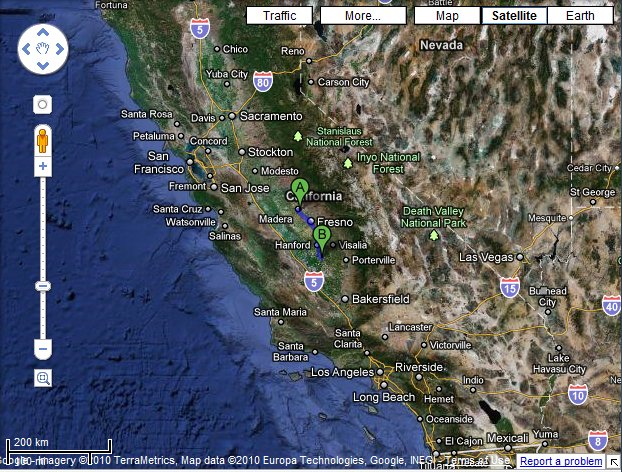
Okay, you think, at least Fresno will get some snazzy slick rail service . . . except this section will be built but not operated until further connecting sections are built . . . at a later date. Maybe. It will be the track, including elevated sections through Fresno, and the physical right-of-way, but no electrical system to power the trains; but that’s fine, because the budget doesn’t include any actual trains.
Of course, this is an old hobby horse of mine and I’ve posted about High Speed Railways a few times before.
This may provide the boost 3D TV has been waiting for
Lester Haines reports that Penthouse will be launching a European 3D TV service:
Marc Bell, big swinging dick of Penthouse owner FriendFinder Networks, enthused: “We are very excited about the launch of the Penthouse 3D channel. Our goal is always to deliver the latest technology on the world’s best platform.”
Jacky Wauters, head of Penthouse distributor NOA Productions, joined the love-in, saying: “Thanks to the increasing consumer acceptance of 3D, I am delighted to work with Penthouse to be able to satisfy the needs of the consumers and broadcasters alike who demand high quality, cutting edge entertainment backed by a solid and well established brand like Penthouse.”
Penthouse originally announced it’d be launching 3D porn in the US in the second quarter of this year, but has obviously decided to come early over European viewers.
Pornographic content has traditionally been one of the first major uses of new technology.
February 28, 2011
London’s “congestion charge” didn’t keep pace with traffic after all
Remember the great fanfare (usually from “urban advocates” and local government bureaucrats) over the stunning success of London’s road pricing scheme? It immediately reduced traffic volumes in the downtown core of London, which also reduced the travel times for those drivers who were willing to pay the usage charges. It looked like a solid win for pay-for-use roads (which do, incidentally, make a great deal of economic sense . . . if they’re not being used as a cash cow to fund other transportation options instead).
Fast forward to today, and we discover that all the gains from introducing the congestion charge have been wasted:
According to Yass’ analysis, based on figures obtained from the Department of Transport and local bodies such as councils and Transport for London, the increase in traffic lights — and perhaps even more so, the increasing trend to prioritise pedestrian movement through junctions by changing lights’ programming — is seriously increasing congestion for wheeled road traffic (buses excepted in some cases, as they too are favoured by the lights).
The report indicates that a large fall in congestion was seen in London following introduction of the capital’s congestion charging scheme introduced by the previous mayor Ken Livingstone. A noticeable proportion of motorists ceased to drive in the charging zone, and vehicle numbers in the zone remain well down on previous levels. Nonetheless, congestion is now back up to its old state:
Monitoring reports of the congestion charging zone show that, after an initial improvement, congestion has been increasing again and is back to pre-charge levels, even though the number of vehicles entering the zone has not increased.
How could this have happened?
According to Yass, the gains achieved by the congestion charge have been wiped out by Mayor Ken’s parallel policy drive to cut down the time it takes to cross the road in London, and in particular to make the streets safer for the disabled. A large number of London’s new traffic lights would seem to have been put in at new pedestrian crossings — “most junctions were already controlled by lights”, writes Yass — and those at junctions now usually have “full pedestrian stages” where all traffic is held stopped in both directions.
February 27, 2011
Athletes in the age of Facebook and Twitter
John Holler makes several good points in this story about a couple of NFL hopefuls who are having to defend their reputations due to the wonderful rumour-spreading abilities of social media and the willingness of sports reporters to try to create controversy:
Saturday at the Scouting Combine in Indianapolis, we got our first intense view of this media “New World Order.” Cam Newton and Ryan Mallett are two of the top quarterback candidates in this year’s draft. Yet, both of them spent significant portions of their media access to address questions that have nothing to do with football.
Newton, who has been under the media microscope for the last several months, had to clarify a comment he made about wanting to be “an entertainer” and “an icon.” It was a flippant comment made by a kid who is going to turn 22 in May. In his case, the question should be, “Yeah, so?” not a sanctimonious rant by media “entertainers” and/or “icons” to pass judgment that he is not focused on being a football player, but more interested in being a rock star.
Guess what? Newton should have nothing to apologize for. If you’re a star in the NFL, you are an entertainer. People drop hundreds of dollars to watch you perform for three hours. There are thousands of people employed to discuss what you do for a living. There is little difference between Peyton Manning and Bruce Springsteen. They do the same thing — entertain packed houses wherever they perform. [. . .]
Mallett is a different story. He has been called to task by what everyone reporting on it claims are rumors that he not only has taken drugs in college (no!) but might have an addiction to the party lifestyle. If it is true, he won’t be the first and he won’t be the last college football player to do things he wouldn’t put on his résumé. The timing of the accusations, the week of the NFL Scouting Combine, seems interesting. However, his response was hard to justify.
If there was no basis to the accusations, Mallett should have been advised to come out aggressive — denying the charges immediately and owning the situation before he gets his 15 minutes with NFL teams. Instead, he deflected the questions, which only gives rise to more speculation. In the Facebook/TMZ world we live in now, you can bet that media members are going to be provided with information — some will pay for it, others won’t — that will portray a bad side of Mallett that he likely doesn’t deserve, but will surely have to answer to.
The stakes are high for both of these young men: a badly chosen phrase could lose them literally millions of dollars by lowering their chances of being a high draft choice. It’s tough enough for media personalities and politicians to tap-dance around awkward situations, but young 20-something athletes don’t have the experience to avoid falling into the verbal traps.
February 26, 2011
The increasing length of freight trains in Canada
Some eye-opening statistics on the length of freight trains being run by Canadian National (CN) and Canadian Pacific (CP) these days:
Transport Canada launched a six-part study into the long-train strategies at the country’s largest railways this month with an eye on developing policies for how these longer, heavier trains are assembled and run. The goal of the two-year study is to develop science-based regulations that will hopefully reduce the number of derailments in the country.
Despite the concern from regulators, these longer, heavier trains in recent years have been a godsend for North American railways, which swear by their safety. Not only do they improve the efficiency of the rails by reducing the number of trains required to transport goods, but they in turn reduce the crews needed and the fuel used to move their shipments.
If properly built, they can also reduce wear and tear on the trains and the tracks themselves by cutting down on in-train forces, lowering maintenance costs substantially over time.
The cynic in my asks why, if CN (for example) actually managed to reduce the number of rail accidents to an all-time low last year, the regulators are now launching the investigation. Fewer accidents now equals a point of serious concern on the part of the regulators? Why?
Up until the 1990s, the average freight train in Canada was about 5,000 feet (1.54 kilometres) long and weighed 7,000 tons. But it is now not uncommon to see these trains stretch to 12,000 feet, sometimes as much as 14,000 feet (more than four kilometres), weighing up to 18,000 tons.
While CN is comfortable sticking with the size of its longest trains now, about 12,000 feet, CP continues to push the boundaries of how long it can build its trains by developing some of the industry’s most cutting-edge technology in recent years to help it do so.
The benefits are clear. CP estimates, for example, that the labour costs alone on a typical transcontinental train are now 30% lower than they would be if it was using smaller trains.
So, the trains are longer, carry far more freight, cost less to run, and customers are happy. The government must act!


