
Incidentally, I am thoroughly convinced that a majority of self-described incels are men who could find meaningful and fulfilling sexual and romantic success, both short-term and long, but who have developed such a wildly unrealistic idea about what actual human women look like that their standards are laughably high. And it’s easy to make fun of that, but I also think that the conditioning inherent to constantly looking at filtered and photoshopped pictures is powerful.
Freddie deBoer, “Some Reasons Why Smartphones Might Make Adolescents Anxious and Depressed”, Freddie deBoer, 2023-03-07.
June 15, 2023
June 14, 2023
QotD: In hindsight, calling it “Operation HONOUR” was quite ironic
Loyalty up, remember?
As a young soldier, I had actually worked for this particular NCO. He was an artifact of the Old Army and had a reputation as a hardman. He liked to brag about picking Friday night fights in Native bars out on the Prairies (he wore weighted gloves for extra knock-out power). He described to us in detail what he would do to his wife after a training weekend. He told us she would never say no, followed up with a chuckle and “like she has a choice”. If you were weak in his eyes, he’d belittle you publicly as a “queer” or a “faggot”. The funny thing was that this guy was overweight and never showed up for ruck marches or PT tests. His annual conduct-after-capture briefing was basically forty minutes of “you’re gonna get raped but that doesn’t make you gay”. One of his favourite war stories was about stray dog duty in Bosnia. He’d lure in the strays with peanut butter on the end of shotgun then blow their brains out. Riveting stuff.
Overnight I had gone from from being this man’s subordinate to being his superior, so when the General said we had a duty to report, I did my duty. The next week I was in front of the Regimental Sergeant-Major being asked why I was interfering with a strong NCO’s career prospects. That’s when I learned that loyalty up meant loyalty to the Regiment, and that sensitive matters such as this were handled internally and off the record. That one-way conversation was a major push towards putting in my application for the Regular Force. I didn’t want to be around that type of nonsense (“oh my sweet summer child” says the peanut gallery). Not long after I left, my former supervisor sexually assaulted the mess steward.
[…]
In February 2021, an investigation was opened into General Jonathan Vance, who had just finished his tenure as Chief of Defence Staff. Major Kellie Brennan, a subordinate of Vance at various times, accused him of a preventing her from disclosing their long-running affair. Since their relationship began in 2001, Vance had been married twice. DNA testing confirmed that Vance was the father of one of Brennan’s children, but he had never acknowledged or taken responsibility for the child. Vance plead guilty to obstruction of justice in March 2022 and received a conditional discharge with twelve months of probation.
The heat and light generated by an investigation of the outgoing Chief of Defence Staff led to an unprecedente level of scrutiny on the CAF’s senior leadership. In 2021 alone, the Governor General of Canada, the Minister of National Defence, the incoming Chief of Defence Staff, the Vice Chief of Defence Staff, Commander Canadian Special Operations Command, and Commander Military Personnel Command, amongst others, would resign, retire, or be re-assigned amidst allegations of impropriety. Since 2021, recruiting and retention levels have continued to free fall and the federal government has set aside $900 million in class-action lawsuit compensation for current and former CAF members who experienced sexual harassment, assualt, or discrimination. The social trap has been sprung.
“Shady Maples”, “A Question of Loyalty”, The Powder Horn, 2023-03-12.
Comments Off on QotD: In hindsight, calling it “Operation HONOUR” was quite ironic
June 13, 2023
QotD: The purge of the Socialist Revolutionaries
As Solzhenitsyn explained it, in the early days of the Bolshevik revolution, these SRs were part of a coalition government with the Bolsheviks. As such, they had to be given a certain amount of jobs in the ministries, including the justice ministry. They actually believed that stuff about The Workers, so they weren’t ready to send people to Siberia for twenty, thirty, forty years like Lenin demanded. They broke with Lenin (over other issues as well, obviously), the Bolsheviks crushed them, and once the Bolsheviks had power over all the ministries, there’s your gulag archipelago. Same as it ever was.
The Nazis had their “Left SR’s”, too. These were the Strasserites, led by brothers Otto and Gregor, the guys who put the “Socialist” in “National Socialism”. The Night of the Long Knives was a purge against both “left” and “right” — though Röhm and his butt boys get all the press, one of the Strasser brothers got his, too. That’s German efficiency for you!
And then there was the original Terror, in France, and even before that we had ours, too — the Whiskey Rebellion and Shays’ Rebellion aren’t usually taught as ideological (they’re usually not taught at all, of course), but they were. We’ve had two revolutions (before this week), in fact, and in both cases you had those pesky “we really believe this shit!” types causing all kinds of problems for the revolutionary government — see, for example, those state governors who made Jeff’s life hell in Richmond, objecting to the nationalization of their state militias on the grounds that the Confederacy is actually, you know, a confederacy, and that drafts and war production boards and taxes in kind and all the rest are exactly the kind of tyranny you’d expect from Abe’s gang in Washington …
Severian, “Speaking of Purges…”, Rotten Chestnuts, 2021-01-08.
Comments Off on QotD: The purge of the Socialist Revolutionaries
June 12, 2023
QotD: Cities in the pre-modern era
I find myself interested in pre-modern economies and militaries in roughly equal measure (in part because both are such crucial elements of state or societal success or failure). One of the reasons is that they are so interconnected: how military force is raised, supplied, maintained and projected is deeply dependent on how the underlying economy (which supplies the men, food, weapons and money) is structured and organized. And military institution and activities often play an important role in shaping economic structures in turn. So even if you are just here for the clashing of swords, remember: every sword must be forged, and every swordsman must be fed.
(Additional aside: I am assuming a west-of-the-Indus set of cereals: grain, barley and millet chiefly. Specifically, I am not going to bring in rice cultivation – the irrigation demands and density of rice farming changes a lot (the same is also true, in the opposite direction, to agriculture based around sorghum or yams). Most (western) fantasy and historic dramas are not set in rice-planting regions (and many East Asian works seem to have a much better grasp on where rice fields go and need no correction), so I’m going to leave rice out for now. I’m honestly not qualified to speak on it anyway – it is too different from my own area of research focus, which is on a Mediterranean agricultural mix (wheat, barely, olives, grapes), and I haven’t had the chance to read up on it sufficiently).
Lonely Cities
There’s a certain look that castles and cities in either historical dramas or fantasy settings set in the ancient or medieval world seem to have: the great walls of the city or castle rise up, majestically, from a vast, empty sea of grassland. […] These “lonely cities” are everywhere in fantasy and historical drama. I think we all know something is off here: cities and other large population centers do not simply pop up in the middle of open fields of grass, generally speaking. So if this shouldn’t all be grassland, what should be here? Who should be here?
What is a City For?
I think we need to start by thinking about why pre-modern towns and cities exist and what their economic role is. I’ll keep this relatively brief for now, because this is a topic I’m sure we’ll return to in the future. As modern people, we are used to the main roles cities play in the modern world, some of which are shared by pre-modern cities, and some of which are not. Modern cities are huge production centers, containing in them both the majority of the labor and the majority of the productive power of a society; this is very much not true of pre-modern cities – most people and most production still takes place in the countryside, because most people are farmers and most production is agricultural. Production happens in pre-modern cities, but it comes nowhere close to dominating the economy.
The role of infrastructure is also different. We are also used to cities as the center-point lynch-pins of infrastructure networks – roads, rail, sea routes, fiber-optic cable, etc. That isn’t false when applied to pre-modern cities, but it is much less true, if just because modern infrastructure is so much more powerful than its pre-modern precursors. Modern infrastructure is also a lot more exclusive: a man with a cart might visit a village where the road does not go, but a train or a truck cannot. The Phoenician traders of the early iron age could pull their trade ships up on the beach in places where there was no port; do not try this with a modern container ship. Infrastructure is largely a result of cities, not their original purpose or cause.
So what are the core functions of a pre-modern city? I see five key functions:
- Administrative Center. This is probably the oldest purpose cities have served: as a focal point for political and religious authorities. With limited communications technology, it makes sense to keep that leadership in one place, creating a hub of people who control a disproportionate amount of resources, which leads to
- Defensive/Military Center. Once you have all of those important people and resources (read: stockpiled food) in one place, it makes sense to focus defenses on that point. It also makes sense to keep – or form up – the army where most of the resources and leaders are. People, in turn, tend to want to live close to the defenses, which leads to
- Market Center. Putting a lot of people and resources in one place makes the city a natural point for trade – the more buyers and sellers in one place, the more likely you are to find the buyer or seller you want. As a market, the city experiences “network” effects: each person living there makes the city more attractive for others. Still, it is important to note: the town is a market hub for the countryside, where most people still live. Which only now leads to
- Production Center. But not big industrial production like modern cities. Instead it is the small, niche production – the sort of things you only buy once-in-a-while or only the rich buy – that get focused into cities. Blacksmiths making tools, producers of fine-ware and goods for export, that sort of thing. These products and producers need big markets or deep pockets to make end meet. The majority of the core needs of most people (things like food, shelter and clothes) are still produced by the peasants, for the peasants, where they live, in the country. Still, you want to produce goods made for sale rather than personal use near the market, and maybe sell them abroad, which leads to
- Infrastructure Center. With so much goods and communications moving to and from the city, it starts making sense for the state to build dedicated transit infrastructure (roads, ports, artificial harbors). This infrastructure almost always begins as administrative/military infrastructure, but still gets used to economic ends. Nevertheless, this comes relatively late – things like the Persian Royal Road (6th/5th century BC) and the earliest Roman roads (late 4th century BC) come late in most urban development.
Of course, all of these functions depend, in part, on the city as a concentration of people. but what I want to stress – before we move on to our main topic – is that in all of these functions the pre-modern city effectively serves the countryside, because that is still where most people are and where most production (and the most important production – food) is. The administration in the city is administering the countryside – usually by gathering and redistributing surplus agricultural production (from the countryside!). The defenses in the city are meant to defend the production of the countryside and the people of the countryside (when they flee to it). The people using the market – at least until the city grows very large – are mostly coming in from the country (this is why most medieval and ancient markets are only open on certain days – for the Romans, this was the “ninth day”, the Nundinae – customers have to transit into town, so you want everyone there on the same day).
(An aside: I have framed this as the city serving the economic needs of the countryside, but it is equally valid to see the city as the exploiter of the countryside. The narrative above can easily be read as one in which the religious, political and military elite use their power to violently extract surplus agricultural production, which in turn gives rise to a city that is essentially a parasite (this is Max Weber’s model for a “consumer city”) that contributes little but siphons off the production of the countryside. The study of ancient and medieval cities is still very much embroiled in a debate between those who see cities as filling a valuable economic function and those who see them as fundamentally exploitative and rent-seeking; I fall among the former, but the latter do have some very valid points about how harshly and exploitatively cities (and city elites) could treat their hinterlands.)
Consequently, the place and role of almost every kind of population center (city, town or castle-town) is dictated by how it relates to the countryside around it (the city’s hinterland; the Greeks called this the city’s khora (χώρα)).
Bret Devereaux, “Collections: The Lonely City, Part I: The Ideal City”, A Collection of Unmitigated Pedantry, 2019-07-12.
Comments Off on QotD: Cities in the pre-modern era
June 11, 2023
QotD: The revolt against “meritocracy”
When we say “merit” and “meritocracy” they think we’re using “code words” to say “white males”. There are reasons for this, besides the fact that the left is heavily into Manichaean thought systems that go something like: identify problem — find a person who MIGHT be responsible for/benefits from the system as it exists — assume that if that person were removed, the problem would be gone. See, French Revolution.
The initial confusion on the left arises from the fact that they might never, in fact, have witnessed meritocracy in their dealings or those of people around them.
This is because, as part of the long march, and to secure absolute control of all fields and institutions, the left has a mythology (the Manichaean thing again) that anyone who disagrees with them is evil. And of course, you don’t hire evil people.
The problem with that type of hiring is that you’re NOT hiring the best. And most people know they’re not the best. And hire someone less bright than they are. This in four generations takes you to the level of management/operation that takes monarchies twenty generations of inbreeding to achieve.
Right now, in everything but the hard sciences and STEM (and they’ve gotten into some of those, and can’t always be routed around.) the people in power would consider pouring piss out of a boot with the instructions written on the sole a feat of unachievable genius.
Most of them are so vacuous they don’t even know they’re incompetent. Or, like Michelle Obama in her essay on why everyone was mean to her at Harvard, they assume everyone else is just as incompetent.
The reason they get hired, stay hired and continue to get push/accolades/power is that they have the “right picture in head” by which you should understand “the left picture in head”. They view the world exactly as they were taught to view it by their Marxist teachers and professors. Reality is Manichean, and if there is any issue at all, you find the person who might be causing it (hint, usually you find the person who is a heretic to the left, even if in a minor thing) and you attack that person. If the person is not immediately obvious, you look for deviationism or examples of hidden thought crime.
It’s appalling, and in a society with no protection for the individual, it fills mass graves, but it is the way their minds — for lack of a better term — operate. They’ve been trained to operate that way. Not to look at human nature, or the conditions in the world, or even the limits of engineering and materials (what’s holding us back on batteries, for instance. They prefer to think oil executives, personally, are holding back the all-electric solar cars we should already have.) No. “Find the culprit” “Eliminate him/her” “Everything is beautiful in the garden”. Seen in this light, the Green Nude Heel makes “perfect sense”. And is a genius work in scope. Which is why she got all upset at criticism and thought that it only meant people wanted her to find all the little subculprits and work out all the details of the pogroms necessary to make it work. Not getting that people were saying “Not in this world, not with these humans, not in this REALITY”.
Sarah Hoyt, “Just Deserts”, According to Hoyt, 2019-06-06.
Comments Off on QotD: The revolt against “meritocracy”
June 10, 2023
QotD: The word “objectively”
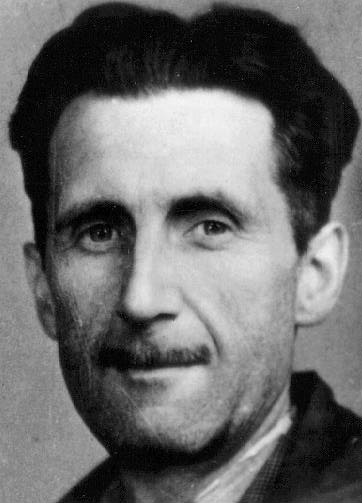
Orwell’s press card portrait, 1943
For years past I have been an industrious collector of pamphlets, and a fairly steady reader of political literature of all kinds. […] When I look through my collection of pamphlets — Conservative, Communist, Catholic, Trotskyist, Pacifist, Anarchist or what-have-you — it seems to me that almost all of them have the same mental atmosphere, though the points of emphasis vary. Nobody is searching for the truth, everybody is putting forward a “case” with complete disregard for fairness or accuracy, and the most plainly obvious facts can be ignored by those who don’t want to see them. The same propaganda tricks are to be found almost everywhere. It would take many pages of this paper merely to classify them, but here I draw attention to one very widespread controversial habit — disregard of an opponent’s motives. The key-word here is “objectively”.
We are told that it is only people’s objective actions that matter, and their subjective feelings are of no importance. Thus pacifists, by obstructing the war effort, are “objectively” aiding the Nazis; and therefore the fact that they may be personally hostile to Fascism is irrelevant. I have been guilty of saying this myself more than once. The same argument is applied to Trotskyism. Trotskyists are often credited, at any rate by Communists, with being active and conscious agents of Hitler; but when you point out the many and obvious reasons why this is unlikely to be true, the “objectively” line of talk is brought forward again. To criticize the Soviet Union helps Hitler: therefore “Trotskyism is Fascism”. And when this has been established, the accusation of conscious treachery is usually repeated.
This is not only dishonest; it also carries a severe penalty with it. If you disregard people’s motives, it becomes much harder to foresee their actions. For there are occasions when even the most misguided person can see the results of what he is doing. Here is a crude but quite possible illustration. A pacifist is working in some job which gives him access to important military information, and is approached by a German secret agent. In those circumstances his subjective feelings do make a difference. If he is subjectively pro-Nazi he will sell his country, and if he isn’t, he won’t. And situations essentially similar though less dramatic are constantly arising.
In my opinion a few pacifists are inwardly pro-Nazi, and extremist left-wing parties will inevitably contain Fascist spies. The important thing is to discover which individuals are honest and which are not, and the usual blanket accusation merely makes this more difficult. The atmosphere of hatred in which controversy is conducted blinds people to considerations of this kind. To admit that an opponent might be both honest and intelligent is felt to be intolerable. It is more immediately satisfying to shout that he is a fool or a scoundrel, or both, than to find out what he is really like. It is this habit of mind, among other things, that has made political prediction in our time so remarkably unsuccessful.
George Orwell, “As I Please”, Tribune, 1944-12-08.
Comments Off on QotD: The word “objectively”
June 9, 2023
QotD: The Fundamental Paradox of Internet Liberalism
- If you were smart enough to understand what I’m saying, you’d be a liberal, too
- You aren’t smart enough to understand it, because you’re not a liberal
- And yet here I am, arguing with you anyway.
So who, exactly, is the dumb one?
Severian, “Alienation II”, Rotten Chestnuts, 2020-10-30.
Comments Off on QotD: The Fundamental Paradox of Internet Liberalism
June 8, 2023
QotD: Heroes, demi-gods and gods in the ancient Greek world
These figures – complete with tales of being swept up into divinity while still alive or at the moment of their death – are in some way atypical of hero worship in the Greek world. More typical is a figure like Achilles, who very definitely was mortal and very definitely died and whose spirit is very much in the Underworld in the Odyssey (and neatly contrasted with Heracles – only Heracles’ shade is in the underworld, for his soul was divine; but cf. Pindar on Achilles, Olympia 2.75-85). Our sources (e.g. Plin. Nat. 4.26) continue to speak of Achilles as a man, with a physical tomb. And yet Alexander pays him honors (Arr. Anab. 1.12.1) and we have ample evidence for cult observances of Achilles in the Greek world. it was possible to be a man in life, and yet have enough influence to be worthy of cult in death.
This sounds strange, but its worth noting that some of the most common mortal figures to receive this kind of cult worship were founder figures – people (often legendary or mythical in nature) credited with the foundation of a community. We’ve actually discussed that here before in Lycurgus and Theseus, but as you might imagine, such figures were very common. It is not entirely crazy to assume that these figures have some power to shape your world or life, because they already have – you live in the city they founded! They deeds in life continue to shape the confines of your experience – why wouldn’t that influence, in some way, carry with them?
(And while I’m here, I should note that the American architectural veneration of our founder figures on the National Mall is explicitly framed in terms of Mediterranean cult observance. The Lincoln and Jefferson memorials both borrow their forms from Roman temples and contain super-life-sized cult statues exactly as and where a Roman temple would has the cult statue of the god, while the Washington Monument – as an Egyptian style obelisk – mimics Egyptian practice quite intentionally. We even have our monuments to the di manes [the divine shades of your dead ancestors who watch over you] in our war memorials, framed around collective veneration. A Roman time-traveler would have no problem interpreting the display, and might think the many millions of visitors coming from all corners quite pious in their observance.)
Bret Devereaux, “Collections: Practical Polytheism, Part IV: Little Gods and Big People”, A Collection of Unmitigated Pedantry, 2019-11-15.
Comments Off on QotD: Heroes, demi-gods and gods in the ancient Greek world
June 7, 2023
QotD: A “second front” in 1943
There are some points in their favour. The invasions of North Africa definitely took resources that could have been built up in Britain, and therefore slowed things down. (And the withdrawal of the new escort carriers, escort groups, and shipping from the Battle of the Atlantic for the North African adventure, definitely did huge damage in the loss of shipping and supplies, slowing things down further.) As a result the huge buildup in North Africa was much easier to use against Italy before moving on to France. Certainly another distraction or delay … but only if you don’t think that knocking Italy out of the war would make Germany weaker!
But once Sledgehammer [the plan to invade France in 1942] was abandoned, this operation was the only possible way to get US troops into combat in Europe, short of shipping some to Russia. It was also the only possible way of coming close to keeping Roosevelt’s ridiculous promise to the Russians.
[…]
Nonetheless it is wrong to think that the British never had any intention of [mounting Operation] Roundup. Despite what Roosevelt and many other Americans convinced themselves, the British were, at the start of 1942, far more optimistic about the possibility of invading Europe through France in 1943 than they had been about Sledgehammer. Their studies seemed to show that Germany would only have to be weaker, not suddenly collapse, to make invasion in 1943 a realistic possibility. Realistic that is as long as the rest of the plans for training and shipping troops, building and concentrating invasion craft, and moving enough supplies to make it sustainable, all came together.
They didn’t.
For the British, the middle of 1942 revealed how little would be available in time for the middle of 1943. Even on the best assumptions of American training and preparation, there was no chance that the majority of forces for Roundup would not be British … assuming they could supply them either. In practice mid-1942 saw the Axis continue to advance on every front. Burma collapsed; the Allied position in New Guinea was under threat; the Japanese were still expanding to places like Guadalcanal; Rommel was advancing in Egypt; the Germans were advancing on the Caucasian oil fields and towards the Middle East; and more and more was needed just to keep Russia in the war. As a result British troops, shipping and supplies were continuing to flow away from Britain, not towards it.
Much of the Royal Navy was trying to save the dangerous losses caused by [US Chief of Naval Operations Admiral] King’s refusal to have convoys in American waters (too “defensive-minded” he thought.) These alone, the worst eight months of the war, were threatening to scupper Roundup. The rest was so busily deployed in the Indian and Pacific Oceans against the Japanese, or North Atlantic trying to fight supplies through to Russia (a high proportion of tanks and planes defending Moscow were British-supplied), that there was virtually nothing left in the Med to slow Rommel’s advance. The merchant ships surviving the fight across the oceans were actually more vitally needed to take men and equipment from the UK to other places than to bring in a buildup for the UK.
Nor was the American buildup going to plan. Less well-trained troops were becoming available too slowly, could not be shipped in adequate numbers anyway, and were in no condition to face German veterans. (The very best US units to go into action in 1942 – the Marines in Guadalcanal – and 1943 – the 1st Infantry and 1st Armored divisions which were actually professional troops not conscripts in North Africa – had very steep learning curves. Particularly at Kasserine. They were clearly not fit to face German veterans yet.
And American resource buildup was also not up to promises. King and MacArthur were milking supplies far beyond what had originally been agreed under “Germany first”. In practical terms they were doing so for the same reasons the British were: an immediate desperate situation had to be saved before a future ideal one could be pursued.
Nonetheless I have read all sorts of apparently serious suggestions that after North Africa was cleared, or at the very least after Sicily was cleared, an invasion of France should have happened.
Delusional.
Nigel Davies, “The ‘Invasion of France in 1943’ lunacy”, rethinking history, 2021-06-21.
Comments Off on QotD: A “second front” in 1943
June 6, 2023
QotD: “A second front” in 1942
[…]
A plan put together for the incredibly unlikely event of sudden German collapse, was Sledgehammer. This was the understanding of Sledgehammer adopted by most Americans. A very limited offensive by very inadequate forces, which could only succeed had Germany already gone close to collapse. Given the circumstances this was somewhat delusional, but it never hurts to plan for eventualities, and the British were happy to go along with this sort of plan.
[…]
Any attempt at Sledgehammer would of course have failed. The German army had not yet been bled dry on the Eastern front, and the Luftwaffe was still a terrifying force which could be (and regularly was) easily moved from Russian mud to Mediterranean sunshine and back again in mere weeks. Even ignoring the opposition, the British were gloomily aware that the Americans had not a clue of the complexities of such a huge amphibious operation. At the time of discussion – May 1942 – the British were using their first ever Landing Ship Tanks and troopships equipped with landing craft to launch a brigade-size pre-emptive operation against the Vichy French on Madagascar. (Another move many historians think was useless. But coming only months after the Vichy had invited the Japanese into Indo-China – fatally undermining the defenses of Malaya – and the Germans into Syria, it was probably a very sensible precaution. Certainly Japanese submarines based in Madagascar [could] have finally caused the allies to lose the war at sea!)
The British deployed two modern aircraft carriers, and a fleet of battleships, cruisers, destroyers and escorts and a large number of support ships, on this relatively small operation. It was the first proper combined arms amphibious operation of the war, and was very helpful to the British to reveal the scale of amphibious transport needed for future operations. By contrast the US Marines hit Guadalcanal six months later from similar light landing craft, and with virtually the same Great War-vintage helmets and guns that the ANZACS had used at Gallipoli. Anyone who reads the details of the months of hanging on by the fingernails at Guadalcanal against very under-resourced Japanese troops, will be very grateful that the same troops did not have to face veteran German Panzer divisions for several years.
So I do not know of any serious historian who imagines that an invasion of France in 1942 could have led to anything except disaster. There are no serious generals who thought it either. (Only Marshall and his “yes-man” Eisenhower consistently argued that it might be possible. And Eisenhower later came to realise – when he was in charge of his third or fourth such difficult operation – that his boss was completely delusional in his underestimation of the difficulties involved. See Dear General: Eisenhower’s Wartime Letters to Marshall for Eisenhower’s belated attempts to quash Marshalls tactical ignorance about parachute drops and dispersed landings for D-Day.)
In practice no matter how much Marshall pushed for it, only British troops were availabe for such a sacrificial gesture, and the British were not unnaturally reluctant to throw away a dozen carefully nurtured and irreplaceable divisions on a “forlorn hope”, when they would prefer to save them for a real and practical invasion … when circumstances changed enough to make it possible.
Unfortunately Roosevelt told the Soviet foreign minister Molotov that “we expect the formation of a second front this year”, without asking even Marshall, let alone wihtout consulting his British allies who would have to do it with virtually no American involvement. The British Chiefs of Staff only had to show Churchill the limited numbers of landing craft that could be available, and the limited number of troops and tanks they could carry, to make it clear that this was ridiculous. Clearly this stupidity was just another example of Roosevelt saying stupid things without asking anyone (like “unconditional surrender”) that did so much to embitter staff relations during the war, and internationaly relations postwar. But it seems likely that the British refusal to even consider such nonsense was taken by Marshall and Stimson as a sample of the British being duplicitous about “examining planning options”.
The British fixed on a “compromise” to pretend that a “second front” could be possible. North Africa, could be conquered without prohibitive losses. It was not ideal, and in practical terms not even very useful. But it might satisfy the Americans and the Russians. Nothing else could.
Marshall in particular spent the rest of the war believing that when the British assessment clearly demonstrated that action in Europe was impractical and impossible, they had just been prevaricating to get what they always intended: operations in the Med. In some ways he was correct. The British had done the studies on France despite thinking that it was unlikely they would be practical, and were proved right. Marshall and Eisenhower had just deluded themselves into thinking an invasion might be practical, and could not accept that there was not a shred of evidence in favour of their delusion.
Nigel Davies, “The ‘Invasion of France in 1943’ lunacy”, rethinking history, 2021-06-21.
Comments Off on QotD: “A second front” in 1942
June 5, 2023
QotD: The four types of college papers for English Majors – 4. The Old Switcheroo
That’s because the Old Switcheroo turns everything into its opposite. If you master this technique, you can prove anything, no matter how implausible. Water isn’t wet. War is Peace. We have always been at war with Eastasia. You name it.
Everybody thinks that Shakespeare’s King Lear is a tragedy, but for the Old Switcheroo, you prove that it’s actually a comedy. Everybody thinks that Mozart is a great composer, but you prove that he stole everything he wrote from Salieri’s butler. Frankenstein wasn’t a monster, but a respected scientist. Etc. etc.
Up is down. Black is white. Fire is ice.
Make no mistake, the Old Switcheroo is A+ work, and no fooling. Even more, it’s a surefire path to career success. There’s just one tiny problem: The people who master the Old Switcheroo are batshit crazy and have a psychological profile dangerously close to that of a serial killer. They might end up in the White House, but you wouldn’t trust them to house-sit your chia pet.
Ted Gioia, “The 4 Types of College papers for English Majors”, The Honest Broker, 2023-02-27.
Comments Off on QotD: The four types of college papers for English Majors – 4. The Old Switcheroo
June 4, 2023
QotD: The four types of college papers for English Majors – 3. The DIM
Those bozos think that Moby Dick is a novel about a great white whale. But we know there’s a Deep Inner Meaning to the book — that whale is actually a stand-in for the author’s annoying mother-in-law. Or maybe it’s a surrogate for the President of the United States. Or a displaced sex object.
Let your imagination run free. It really doesn’t matter which you choose. It just can’t be anything obvious. And then you need to talk a good game, and not pay too much attention to facts and plausibility.
And who said you don’t learn useful job skills as an English major?
If you spread the B.S. thick enough, and never let on that you even sniff the stench, you have better than even odds of getting a top grade. It helps, by the way, if you show up in class dressed in something unseemly and having omitted several steps in your morning grooming routine — which are seen as signs of incipient genius in the School of Humanities.
Ted Gioia, “The 4 Types of College papers for English Majors”, The Honest Broker, 2023-02-27.
Comments Off on QotD: The four types of college papers for English Majors – 3. The DIM
June 3, 2023
QotD: The four types of college papers for English Majors – 2. The TWIT (They Were Idiots Then)
We know that unfailingly, for the simple reason that they didn’t think like us. They were stupid and stodgy and superstitious and held all sorts of irritating views.
And it’s true. You can take absolutely any book from a hundred years ago, and find infractions on almost every page. The past is a different country, where everybody is a knucklehead.
Here’s how to write a TWIT: You take a yellow marker and highlight every time somebody in the book makes a blunder, according to our current rules of decorum this week. Trust me, you won’t even have to read the whole book. Within a chapter or two, your book will have more yellow highlights than Nicki Minaj’s hairdo.
Now you’re ready to roll.
You write up the infractions like it’s a district attorney’s indictment. But here’s the key — you must give it some fancy name. You can’t just call a twit a twit in your TWIT paper; you have to refer to your harangue as a critique or an exegesis or a deconstruction, starting with the title — which should be something like “A Critique of Phallogocentrism in Henry James’s Turn of the Screw“.
Once you get the hang of this, it’s as easy as shooting fish in a barrel. There’s just one problem — everyone else in the class is also writing TWIT papers. It’s the most popular thing on campus since the invention of the senior admin job. So you only get a B on these. Or maybe B+ if you throw in a few French words (for example, inserting différance whenever you’d normally say difference).
Ted Gioia, “The 4 Types of College papers for English Majors”, The Honest Broker, 2023-02-27.
Comments Off on QotD: The four types of college papers for English Majors – 2. The TWIT (They Were Idiots Then)
June 2, 2023
QotD: The four types of college papers for English Majors – 1. The Reliable C&C
Then you list 5 ways they are similar and 5 ways they are different. Voilá — you’ve written a college paper!
Ernest Hemingway and Jane Austen are both writers who share the same language: English. But Hemingway is an American who liked bullfighting and drinking martinis. Jane Austen is English and never fought a bull. She probably drank tea, because the martini wasn’t invented until 1863, some 47 years after her death …
You can write this stuff in your sleep, provided you dream about Wikipedia entries. But be forewarned: the reliable C&C probably only gets you a reliable C grade.
Ted Gioia, “The 4 Types of College papers for English Majors”, The Honest Broker, 2023-02-27.
Comments Off on QotD: The four types of college papers for English Majors – 1. The Reliable C&C
June 1, 2023
QotD: “The Puritans were the SJWs of their day”
The Puritans, as English Calvinists were called, wrote difficult prose, but in translation it sounds shockingly modern. The Puritans were the SJWs of their day, obsessed with their own pwecious widdle selves. They didn’t get around to making up xzheyr own pronouns, but they did give themselves self-righteous new names — when Ben Johnson called his caricature Puritan Zeal-of-the-Land Busy he got big laughs, but he wasn’t really joking, they really did stuff like that. To be a Puritan requires two things: An obsessive focus on the tiniest micro-movements of your own soul …
… and an equally obsessive focus on forcing other people to disclose the tiniest micro-movements of their souls. There’s nothing anyone could ever do, so trivial that a Puritan could in good conscience overlook it. Calvin’s Geneva was the closest thing to a police state 16th century technology allowed, and when their turn came, Oliver Cromwell and the boys gave importing it to England the old college try. And, of course, Plymouth Bay Colony started as a Puritan police state …
Ideology, then, removes the distinction between public and private. You can’t simply say you’re a Puritan, you really have to BE one — constantly, perfectly, since there’s nothing that Puritanism doesn’t touch. And the only way to do that, of course, is to do everything in full public view at all times. Calvin did — as Walzer remarks, John Calvin, the man, is almost completely absent from Calvin’s writings. (Unlike Luther, whose idiosyncratic, not to say lunatic, personality comes through in practically every sentence). Calvin achieved that clear windowpane prose Orwell claimed was the mark of a great writer — nothing between audience and subject at all. Calvin would, indeed, take the remark that he’s almost a complete cipher, personally, as a very high compliment.
Severian, “Ideology II”, Rotten Chestnuts, 2020-11-09.
Comments Off on QotD: “The Puritans were the SJWs of their day”


