
Last week’s civil liberties bill was hardly perfect but it’s still a step in the right direction. And, frankly, it’s bonny and startling in equal measure to have a Deputy Prime Minister who says things like this:
“I need to say this — you shouldn’t trust any government, actually including this one. You should not trust government — full stop. The natural inclination of government is to hoard power and information; to accrue power to itself in the name of the public good.”
I’m quite happy to oblige Mr Clegg. I don’t trust this government either. I think it’s intentions are often fine but I doubt whether it has the courage of those convictions. Government necessitates trimming and compromising but the troubling ease with which this crew can be blown off course does not bode well for stormier times ahead. It needs to make a proper — muscular, you might say — defence of its liberalism. Thus far it has been too wimpy by far and, for that matter, too content to try and blame everything on its predecessor. That dog won’t hunt anymore.
Cameron, Clegg, Clarke, Grieve, Gove, Alexander, IDS and so on are, on the whole, decent men with decent ideas. Their government still has a surprising amount of potential and the ability to do some good. But that doesn’t mean they can be trusted.
Alex Massie, “Nick Clegg is Right. Again.”, The Spectator, 2011-02-14
February 15, 2011
QotD: Don’t trust your government
February 13, 2011
QotD: The hardest economic question is “What comes next?”
The hardest economic question is, What comes next? What, in other words, are the new sources of economic value? How can businesses grow and our standard of living rise?
Sometimes the answer is simply more of the same. Growth comes from rolling out existing goods and services to new markets, until there’s a chicken in every pot and a car in every garage. This kind of progress may be hard to achieve, but you at least start with a clear notion of what it would look like.
That’s why catch-up economies like China today or South Korea in the past can grow so fast. Their businesses don’t have to figure out what to make or sell. They know what’s possible by looking abroad, and have a reasonable idea of what consumers, local or international, want to buy. Refrigerators and air conditioning are popular; so are shampoo and disposable diapers.
At the economic frontier, the hardest question gets much harder. You no longer have a clear vision of the future. You know neither what’s possible nor what people want. You can only guess. Starbucks or FedEx may sound obvious in retrospect, but they were once crazy ideas.
Virginia Postrel, “Would Bogie Wear Gore-Tex?: The next big thing often consists of lots of little things”, Wall Street Journal, 2011-02-12
February 9, 2011
QotD: (Historical) weather and climate
I read a lot of history and thus know a fair bit about how weather impact has been perceived by humans over time. It is a fact that the 20th century was an abnormally lucky hundred years, meteorologically speaking. The facts I managed to jam into tweets included (a) the superstorm that flooded 300 square miles of the Central Valley in California in the 1860s, (b) rainfall levels we’d consider drought conditions were normal in the U.S. Midwest before about 1905, and (c) storms of a violence we’d find hard to believe were commonly reported in the 1800s. I had specifically in mind something I learned from the book Wicked River: The Mississippi When It Last Ran Wild, which relays eyewitness accounts of thunderstorms so intense that travelers had to steeple their hands over their noses in order to breathe air instead of water; but a sense that storms of really theatrical violence were once common comes through in many other histories.
We had a quiet century geophysically as well — no earthquakes even nearly as bad as the New Madrid event of 1812, which broke windows as far north as Montreal. And no solar storms to compare with the Carrington Event of 1859, which seriously damaged the then-nascent telegraph infrastructure and if it recurred today would knock out power and telecomms so badly that we’d be years recovering and casualties would number in the hundreds of thousands, possibly the millions.
(I’m concentrating on 19th-century reports because those tended to be well-documented, but earlier records tell us it was the 20th century calm that was unusual, not the 19th-century violence.)
The awkward truth is that there are very large forces in play in the biosphere, and when they wander out of the ranges we’re adapted to, we suffer and die a lot and there really isn’t a great deal we can do about it; we don’t operate at the required energy scales. For that matter, I can think of several astronomical catastrophes that could be lurking just outside our light-cone only to wipe out all multicellular life on Earth next week. Reality is like that.
Eric S. Raymond, “Heavy weather and bad juju”, Armed and Dangerous, 2011-02-03
February 7, 2011
QotD: Genomics
There’s been enormous progress in genomics; we’re now on the threshold of truly understanding how little we understand. While the anticipated firehose of genome-based treatments hasn’t materialized, we now know why it hasn’t materialized, and it’s possible to start filling in the gaps in the map. Turns out that sequencing the human genome was merely the start. (It’s not a blueprint; it’s not even an algorithm for generating a human being. Rather, it’s like a snapshot of the static data structures embedded in an executing process. Debug that.) My bet is that we’re going to have to wait another decade. Then things are going to start to get very strange in medicine.
Charles Stross, “Reasons to be cheerful”, Charlie’s Diary, 2010-12-31
February 2, 2011
QotD: “Welcome to the Canadian Internet. Now stop using it.”
Welcome to the Canadian Internet, where extreme concentration in telecoms and a weak, lame regulator have given rise to a nation where your Internet access is metered in small, ungenerous dribs, and where ranging too far afield during your network use results in your ISP breaking into your browsing session to tell you that you’re close to being cut off from the net.
The incumbent telcos have successfully petitioned for “usage based billing,” wherein their customers only get so much bandwidth every month (they’ve also long practiced, and lied about, furtive throttling and filtering, slowing down downloads, streams, and voice-over-IP traffic). This will effectively make it cheaper to use their second-rate voice-over-IP and video-on-demand service than it is to use the superior services the rest of the developed world enjoys.
If you were a Canadian entrepreneur or innovator looking to start your own networked business, this would be terminal. How can an innovative service take hold in Canada if Canadians know that every click eats away at their monthly bandwidth allotment? I can think of no better way to kill Canadians’ natural willingness to experiment with new services that can improve their lives and connect them with their neighbours and the wide world than to make them reconsider every click before they make it.
Cory Doctorow, “Welcome to the Canadian Internet, now stop using it”, BoingBoing, 2011-02-02
January 31, 2011
QotD: A hopeful view of Egypt’s way forward
The Old Media — not to mention Hillary Clinton’s comic relief State Department — apparently don’t have a clue what’s really going on. Conservative talk radio already assumes that the whole thing has been orchestrated by militant “Islamists”, in particular, the 80-year-old Muslim Brotherhood. Whenever you see that word, mentally remove the first R to get a clearer picture if what they’re really up to.
The Botherhood of Man is gonna gitcha if you don’t look out.
But I digress.
America’s home grown would-be dictators clearly believe “It can’t happen here”, as demonstrated by their reactions — dazed at first, then hysterical — to the far gentler rise of the Tea Parties and the results of the 2010 election, which they are trying to believe never happened. They’ve spent all of their time since, not changing so that they won’t be despised any more, but trying to shut their critics up by destroying talk radio and requiring individuals to have Internet permits.
[. . .]
Out of sheer habit, if nothing else, it is very difficult not make the same mistake as the pundits and politicians. As Robert A. Heinlein observed, every revolution is a freak. By definition there can be no rules to govern or even understand them, and we must avoid thinking collectively about them. There are as many reasons to rebel as there are rebels, and that’s the only important truth we’ll ever glean from them.
It’s also very difficult to say from what we know now, and I could easily be wrong (I have been before), but it seems to me that this is not a fundamentalist uprising like we saw in Iran a generation ago — although the fundamentalists are desperately trying to coopt it — but an essentially secular revolt by the productive class against both fundamentalism and the fascist management states that dominate the region.
L. Neil Smith, “Egyptian Tea Party”, Libertarian Enterprise, 2011-01-30
January 30, 2011
QotD: The baby blue movies
In the late ’70s in Toronto, Citytv started showing “blue movies” at 11 p.m. every Friday. Pretty soon, every kid was asking their parents if they could sleep over at whatever kid had an unsupervised TV set in the basement. The films were pretty lame: convict gets out of jail; convict tries to integrate himself into society; convict is rejected by an unforgiving society. There was a vague social message, but all kids like me cared about was whether or not the stripper with the heart of gold was going to take off her tank top (she was). A few years later, cable started showing scrambled porn in the middle of the night. My friends called these films the “fuzzy blues,” remembering times when kids would crouch in front of the set, imagining a boob here, a crotch there, until inevitably, a penis would flash across the screen, rejecting the attention of everyone but Edward. These days, not only are the blues unscrambled, but titillation and nudity comes so easily, it’s a wonder kids today haven’t decided to dress in Mennonite vests and long hats in an attempt to rebel against all of this mainstream sexual telegenia. A teen show with sex in it? Show me a teen show without sex, and maybe we’d have something to discuss.
Dave Bidini, “It’s a friggin’ nuclear Technicolor smutfest!”, National Post, 2011-01-30
January 28, 2011
January 26, 2011
QotD: The elephant in the living world
Here in peaceful and progressive Canada, it is so easy to feel smug towards larger countries that get their hands dirty in the world arena. Especially that one country built on the conquest and near eradication of its peaceful natives who have received hardly any compensation or even an apology. You know, the one founded on belligerent exceptionalism and manifest superiority over other cultures that was turned into a national religion that has historically led to imperialist conquest and mass slaughter. This country still has an actual federal law that requires all foreigners to carry their papers with them at all times, or risk being deported by any policeman who can, simply on a whim, question and detain them. The country so primitive and barbaric that it actively uses the death penalty, shrugging off international protests about it just as coldly as it does in important environmental issues. Its provincial masses bitterly cling to their traditional values while their media feeds them a constant diet of mindless pap and actively hushes up embarrassing facts. They rarely travel abroad, being not just obsessed with ethnic purity and deeply suspicious, even afraid, of anything foreign, but also unapologetically sexist and classist, especially towards this one minority they consider dirty, criminal and less evolved. We can only sigh in relief that sun is finally setting on the once so unstoppable economic juggernaut… of Japan.
Ilkka, “The elephant in the living world”, The Fourth Checkraise, 2011-01-20
January 25, 2011
Neil Gaiman on feeling like a ghost
Neil Gaiman wrote a book that came back to haunt him the other day:
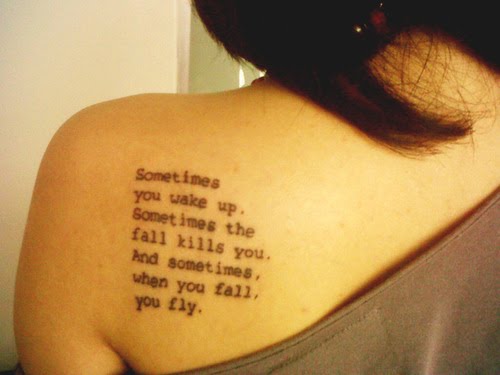
There were a couple – a man and a woman, both in their twenties at a guess, both short and dark-haired, looking into a shop window, with their backs to me. The woman had a tattoo on her shoulderblade – writing – and because I cannot pass writing without reading it, I glanced at it. Part of the writing was covered by a strap.
But I could still read it. And I knew what the words covered by the strap were.
The tattoo (thank you Google Image Search) was a lot like this (which is to say, the same content, and similar typeface, but probably not the same person. I’m already trying to remember if it was the left or the right shoulderblade):
(I took that photo from here.)
I read the tattoo, read words I had written to try and exorcise my own small demons eighteen years ago, and I felt like a ghost. As if, for a moment, under the hot Sydney sun, I was only an idea of a person and not a real person at all.
I didn’t introduce myself to her or say anything (it didn’t even occur to me to say hello, in all honesty). I just walked home, through a world that felt flimsier and infinitely stranger than it had that morning.
January 22, 2011
QotD: Sikhs, the kirpan, and the courts
The [Supreme] court didn’t find for the appellants on the grounds that “the kirpan is not a weapon”. Indeed, all parties to the suit accepted the premise “that the kirpan, considered objectively and without the protective measures imposed by the Superior Court, is an object that fits the definition of a weapon.” The court found for the appellant because the school board’s zero-tolerance policy towards weapons, based largely on fears that the presence of a knife would somehow allow spooky negative vibes to propagate throughout the school, did not constitute a minimal infringement upon the rights of a religion that happens to insist upon the carrying of a weapon. (Anyone who has studied the remarkable history of the Sikhs can only be surprised that they don’t carry about five of them.)
I hate to break it to Nav Bains and to admirers of leading comparative-religion scholar Michael Ignatieff, but reciting “It’s not a weapon” won’t give us a magic wormhole we can all leap through to avoid debates over religious accommodation in public services. As I understand matters, and I am perfectly prepared to receive instruction on this point, the whole point of the kirpan is that it’s an avowedly defensive weapon. The reference books, including those written by Sikhs, tell us that it is worn precisely to signify and reinforce the Sikh’s wholly admirable preparedness to protect his faith, his community, and innocent human life. I suppose I could have added the words “just as a handgun might be”, but that would send altogether too many of my readers scrambling for the Preparation H.
Respectable efforts to establish a modus vivendi on the kirpan in secured public spaces can’t begin with evasion if they hope to be successful (and certainly it sets a terrible precedent for evasion to be designated courage). I’ll add that the problems are not really all that thorny for those of us who have never consented to fanaticism about security theatre or to cretinizing “zero tolerance” of blades in schools
Colby Cosh, “That non-weapon sure is pointy”, Maclean’s, 2011-01-21
January 20, 2011
QotD: The ongoing retreat of freedom of speech in Canada
It used to be there actually had to be a violent protest before public institutions caved in and cancelled controversial events. That was unjustifiable, too. Police and officials should always seek to protect law-abiding speakers and organizers from the angry mob. Those who seek to disrupt events just because they disagree with the speakers should be the ones inconvenienced, not those exercising their constitutional rights.
Now, though, it seems the mere whiff of protest is enough for officialdom to bow to would-be protestors’ demands. Get together a group of unhinged radicals or zealots in someone’s rumpus room, make a couple of angry phone calls and — poof! — you can get your way and silence free speech and free assembly. Organizers, especially those connected with public institutions such as universities, museums and galleries, apparently care not a whit about free expression or individual choice. Their first instinct is to crater to protestors; let the forces of oppression and extremism have their way. Forget about preserving democracy and open debate, officials will act as the forces of censorship want.
Some of this has to do with the increased anger and vehemence of protestors, no doubt. In recent years, young lefties in particular have convinced themselves that only their positions are fact-based and only their positions can save the world. All other opinions are lies, as well as being threats to mankind and the planet. Therefore they are justified in any action they take to stymie opposing views, which they also believe are unworthy of free speech protection. They truly believe they are doing a public service when they shout down speakers or force the cancellation of events by smashing windows or jostling attendees outside the doors.
Lorne Gunter, “We’ve become a wimpy state, as well as a nanny state”, National Post, 2011-01-20
January 17, 2011
QotD: The impermanence of “The Cloud”
We adopt many web services because they’re convenient (and free!), but it’s only after becoming dependent on those services that we recognize why they were provided for free in the first place: after all, it’s only by eliminating the inconvenience of paying users that startups can snag attention and secure the freedom to alter, downgrade, or cancel their services at will. By then, of course, we’re trapped in an unstable relationship, and our only means of recourse is to wail as loudly as possible, “You broke my heart!”
The big lesson that should have come out of the Tumbleocalypse was that we trust too easily. Did any of us listen? Nah. Instead, we’re signing our friends up to Dropbox to score 250 megs of bonus storage space and sending our most important documents to “the cloud.” We trust Dropbox because we trust others who use Dropbox: web designers, tech writers and professionals who, we believe, would never gamble with an unproven, flaky, or suspect service. Without this kind of trust-by-proxy, free web services couldn’t survive at all. Can you imagine anybody in their right mind signing up for a Facebook account today without a good friend by the sidelines whispering, “Don’t mind all that privacy whaffle. I know these guys mean well.”
Cloud storage is convenient, of course — ask anybody who’s experienced the horrors of manually synching PC to iPhone — but we downplay the risks involved in outsourcing control of the data we own. We so badly want to live in the future that we’ve lost the ability to question what living in the future might actually mean.
[. . .]
Those who believe that “the cloud” can act as a storage platform for our collective memories believe that everything that was available to us yesterday will be just as available to us tomorrow. Where exactly does this conviction come from?
The web is like any other sprawling city, and maybe worse: it’s so damn rickety it’s a minor miracle it hasn’t collapsed entirely. When you link, you do so trusting that the data to which you direct your readers won’t just up and disappear into the virtual ether. Except that, inevitably, it will — the short history of the web has established that much. We live somewhere, we leave, it becomes forgotten, and then we come back years later to find our old haunts brutally 404’d.
Connor O’Brien, “Link Rot”, The Bygone Bureau, 2011-01-17
Modern updates to Bierce’s Devil’s Dictionary
I’ve always been a big fan of Ambrose Bierce’s collection of definitions, The Devil’s Dictionary. Many of his definitions ended up in various places in my original quotations website, as more than a century later, they were still both funny and true.
Paul Bonneau has a list of updates in the Bierce tradition:
A Cynic’s Political Dictionary
Democracy: Mob rule.
Republic: A euphemism for “police state”. See “Police State”. Also, a geographical region in which representative government is practiced. See “Representative Government”.
Representative Government: A refinement in Democracy in which a mob of people select the least moral among them, to police their morals.
Representative: A politician who claims to be able to simultaneously represent two other people who hate each other’s guts. See “Politician”.
Senator: A politician who spends more time drunk. See “Politician”.
Election: A type of circus, provided for entertainment and for giving a veneer of legitimacy to politicians. See “Politician”.
Politician: A euphemism for “liar”.
Public Servant: A euphemism for “master”.
Voter: A euphemism for “slave”.
Media: People whose job it is to propagate politicians’ lies far and wide.
Political party: A collection of people who participate in mindless team sports in an election. See “Election”.
Democrat: A Republican who claims to care. See “Republican”.
Republican: A Democrat who claims to support liberty. See “Democrat”.
Minarchist: An Anarchist in training. See “Anarchist”.
Anarchist: A slave suffering slavery burn-out.
Government: An amalgamation of masters.
State (or Country): An amalgamation of masters and slaves. Also, a plantation.
Police: Overseers on the plantation; also, tax collectors.
Taxes: A euphemism for “plunder”.
Police State: Typically refers to a country other than the one you happen to be a slave in. Also, a place where other people mind your business.
Jail: A jobs program for jailers.
School: A jobs program for teachers.
Teacher: One who turns children into voters for the government. See “Voter”.
January 10, 2011
QotD: Geeks and Hackers defined
One of the interesting things about being a participant-observer anthropologist, as I am, is that you often develop implicit knowledge that doesn’t become explicit until someone challenges you on it. The seed of this post was on a recent comment thread where I was challenged to specify the difference between a geek and a hacker. And I found that I knew the answer. Geeks are consumers of culture; hackers are producers.
Thus, one doesn’t expect a “gaming geek” or a “computer geek” or a “physics geek” to actually produce games or software or original physics — but a “computer hacker” is expected to produce software, or (less commonly) hardware customizations or homebrewing. I cannot attest to the use of the terms “gaming hacker” or “physics hacker”, but I am as certain as of what I had for breakfast that computer hackers would expect a person so labeled to originate games or physics rather than merely being a connoisseur of such things.
[. . .]
All hackers are, almost by definition, geeks — but the reverse is not true.
Eric S. Raymond, “Geeks, hackers, nerds, and crackers: on language boundaries”, Armed and Dangerous, 2011-01-09


