Quotulatiousness

May 30, 2023

Ban all the words!

Chris Bray reflects on the historical context of literature bans:

Before the Civil War, Southern states banned abolitionist literature. That ban meant that postmasters (illegally!) searched the mail, seized anti-slavery tracts, and burned them. And it meant that people caught with abolitionist pamphlets faced the likelihood of arrest. The District of Columbia considered a ban, then didn’t pass the thing, but Reuben Crandall was still arrested and tried for seditious libel in 1833 when he was caught with abolitionist literature. He was acquitted, then died of illness from a brutal pre-trial detention. Seizure, destruction, arrest: abolitionist literature was banned.

The Soviet writer Yevgeny Zamyatin wrote a 1924 novel, We, depicting a world in which an all-powerful government minutely controlled every aspect of life for an enervated population, finding as an endpoint for their ideological project a surgery that destroyed the centers of the brain that allowed ordinary people to have will and imagination. The Soviet government banned Zamyatin’s work: They seized and destroyed all known copies, told editors and publishers the author was no longer to allowed to publish, and sent Zamyatin into exile, where he died without ever seeing his own country again. Seizure, destruction, exile: Yevgeny Zamyatin’s work was banned.

During World War I, the federal government banned literature that discouraged military service, including tracts that criticized conscription. Subsequently, “socialists Charles Schenck and Elizabeth Baer distributed leaflets declaring that the draft violated the Thirteenth Amendment prohibition against involuntary servitude”. They were arrested, convicted, and imprisoned. The Supreme Court upheld the conviction. Anti-conscription literature was banned: It was seized and destroyed, and people caught distributing it were sent to prison.

In 2023, the tedious midwit poet Amanda Gorman posted on Twitter that she was “gutted” — the standard emotion for tedious midwits — to discover that one of her poems had been “banned” by a school in Florida. The news media raced to proclaim that Florida schools are banning books, the leading edge of the Ron DeSantis fascist wave.

As others have already said, Gorman’s boring poem was moved from an elementary school library shelf to a middle school library shelf, without leaving the library

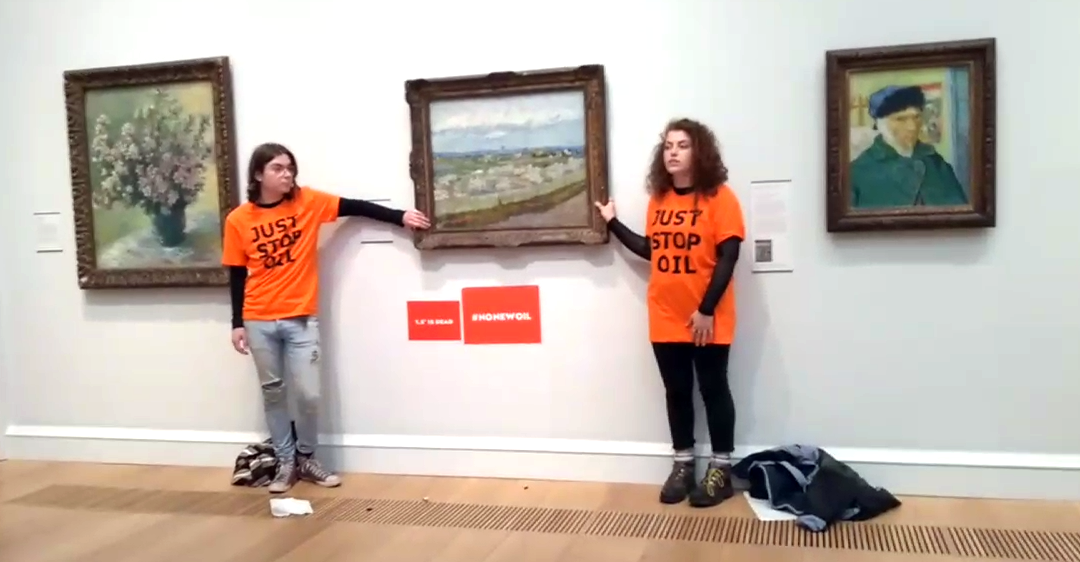
May 29, 2023

“I’m starting to think that Just Stop Oil is a Big Oil plant”

Tom Slater on the amazing tone-deafness of the Just Stop Oil “activists”:

“Just Stop Oil Courtauld Gallery 30062022” by Just Stop Oil is licensed under CC BY-SA 4.0 .

I’m starting to think that Just Stop Oil is a Big Oil plant. What else could explain these campaigners’ phenomenal ability to turn the public against them and confirm their critics’ worst prejudices. Namely, that this environmental activism / amdram troupe is stuffed with upper-middle-class irritants who couldn’t give a damn about working-class people. Surely, this has got to be on purpose?

Take their recent “slow marches” through London, aimed at bringing traffic to a standstill. The whole point of these stunts seems to be to force cab drivers, delivery men and builders to sit in traffic so that these protesters can preach their miserable little gospel. And as Edred Whittingham‘s (don’t laugh) deranged antics at the Crucible recently showed us, you now can’t even escape these bourgeois millenarians during your leisure time.

That this new generation of environmentalists are almost uniformly posh is an established empirical fact. An academic survey of those involved in Extinction Rebellion – the mothership organisation from which Just Stop Oil and Insulate Britain were spawned – found, to the surprise of precisely no one, that they were overwhelmingly middle class, highly educated and from the south. A full 85 per cent of them have some form of university degree.

So what we have here is the comfortably off classes – those with sufficient free time to glue themselves to roads on a Wednesday mid-morning – forcing their weird hangups on everyone else. Time and again, when they are criticised for making people’s lives a misery, they offer only patronising lectures. “We’re so sorry that we have to disrupt the lives of ordinary people”, said Just Stop Oil’s Eben Lazarus (I know) to Vice last year, but “hopefully people will see, further down the line, that the disruption we’re causing is microscopic compared to the disruption that we’re going to face because of the climate crisis”. Translation: we know better, you cretins.

No wonder that so many now respond to these cunning stunts with instant, visceral fury. First there was the Battle of Canning Town in 2019, when east-London commuters pulled two Extinction Rebellion people down from the top of a Tube train. And as police have failed to deal with these protests – they now seem to escort rather than stop these “slow marches” – motorists have increasingly decided to take matters into their own hands. Several clips of workers clashing – sometimes physically – with Just Stop Oil activists have gone viral in the past week alone, including one of a man shoving JSOers on Blackfriars Bridge, before promptly being arrested.

The high-water mark of the Vegan cult?

Filed under: Food, Media, Politics — Tags: , , , , — Nicholas @ 03:00

In Spiked, Patrick West celebrates the passing of peak food puritanism:

“Welcome to Las Vegans and Vegetarian, Whole Foods fake meat section, Las Vegas, NV, USA” by gruntzooki is licensed under CC BY-SA 2.0 .

Over the past few years, there has been an explosion of vegan processed food appearing in supermarkets. A growing number of the population also claims to be vegan. But there are signs this trend could be going into reverse. Demand for animal-free food and drink products has collapsed over the past year. One casualty is Swedish oat-milk firm Oatly, which has recently withdrawn its dairy-free ice cream in the UK. Another is the Yorkshire sausage-making company, Heck, which has scaled-down its vegan-friendly range from 10 products to two. Smoothie-maker Innocent discontinued its dairy-free range earlier this year. Supermarket sales of meat-free products fell by £37.3million between September 2021 and September 2022, according to the consumer intelligence firm NielsenIQ.

There seems to be two main reasons. Rising inflation has been cited as one cause, as consumers have scaled back on branded and luxury eatables. Plant-based processed foods are generally more costly than the meat and dairy products they purport to replace. Another explanation is that producers of vegan food may have overestimated the size of the market for veganism, and now they are having to readjust to reality.

Whatever the reasons, we should welcome the retreat of the cult of veganism. And I use the word cult deliberately, because veganism greatly resembles not so much a lifestyle choice, but a way of life itself. It’s a faith that resonates with today’s puritanical and conformist mood.

And I should know, as someone who became a vegetarian in 1996 and has not eaten meat since. Sure, my decision aroused some mockery and derision back then, but vegetarianism had mostly stopped being regarded as weird by the mid-1990s. Ever since then, most of the opprobrium and scolding we vegetarians face comes from vegans, largely because we continue to eat eggs, cheese and milk.

For vegans, nothing must be consumed or worn that derives from animals or insects – even if there is no killing or discernible harm involved. Anything else is a feeble cop-out. Their way of thinking is absolute. In this respect, the best exemplars of the vegan movement are the animal-rights fundamentalists, PETA, whose members are well-known for their shrill, exhibitionist narcissism. Their message is simple: they are better people than you.

It’s no surprise that veganism was turbo-charged in the mid-2010s, when wokery captured the minds of so many – when absolutist, extreme thinking, and the competition to be purer than the next man or woman, took over. The trans movement echoes this rush to extremes. It demands the transformation of your entire body. Indeed, bodily self-mutilation and mortification of the flesh have long been practised by religious fundamentalists.

May 28, 2023

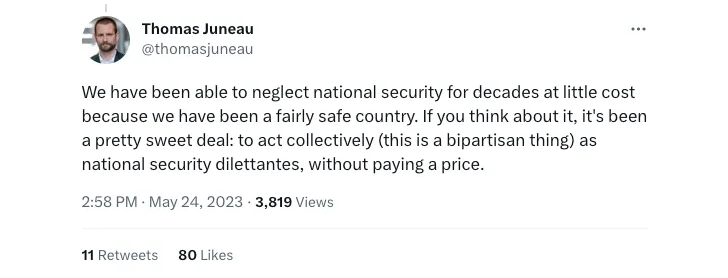
Thanks to geography, Canada has “been able to neglect national security for decades”

Filed under: Cancon, Government, Military, Politics — Tags: , , , — Nicholas @ 05:00

In the weekly Dispatch post from The Line‘s editors, an almost unremarkable comment comes into close focus:

Continuing with the Johnston report fallout, The Line has been pondering a tweet by Thomas Juneau, one of the country’s relatively few genuine experts in Canadian intelligence and national security. Let’s state this up front: The Line likes Thomas Juneau. He’s written for us before, we hope he’ll write for us again. Nothing that follows should be seen as disagreeing with or nitpicking the professor, because The Line broadly agrees with the point he was making, and found his entire thread on Twitter worth the read. But let’s zoom on this particular comment:

What specifically caught us was this part: “We have been able to neglect national security for decades”.

Again, no disagreement here. Both your Line editors would have made that literal exact argument countless times before in their careers, because it’s true, and likely with essentially identical language. But we read Juneau’s tweet when the Johnston report, and the POEC report before it, were much on our minds. And we’ve been unable to shake the feeling ever since that perhaps “neglect” isn’t the right word for how Canadians approach security. Maybe, we’re wondering, it’s something closer to “disdain”.

Canada has “neglected” a lot of things, after all. And we don’t even mean that in the sense of a lament or criticism. There’s a ton of policy areas or even simply fields of knowledge and expertise that Canada hasn’t paid any particular attention to or made a priority. As Line editor Gurney cracked on the podcast this week, we’ve also neglected botany as a national endeavour. But if some strange international development or social change required Canada to up its botany game, we suspect we’d just … do that. We’d recruit botanists from abroad, schools would open botany colleges, we’d create a Progressive Feminist Botanical Middle-Class Tax Credit (though you’d probably need to attest that you are pro-choice to apply for it). Pivoting to botany wouldn’t be a problem. We’d just emphasize botany, and let a thousand flowers bloom. As it were.

Whenever the issue is anything even remotely proximate to national defence and security, though, the mere suggestion that we should maybe do better, spend more money, allot greater resources, pay more attention, and build up current and future capabilities, is met with something that goes beyond neglect. Neglect implies a degree of apathy. The default Canadian response to any push for a greater emphasis on national defence and security is something closer to hostility.

“Like, why would we care about that weird stuff,” the default Canadian response goes. “That’s dumb. What, do you think Russia is going to invade us or something? What does Canada even need an army or spies for? Why would we even want to have experts on this stuff? This is Canada. We don’t need that stuff. Are you just some kind of weirdo or just some wannabe American?”

Your Line editors agree it’s a problem, but we aren’t sure exactly the root of it. Gerson thinks it might be more just an aversion to thinking about unpleasant things; we quipped on our podcast that talking about defence and security in Canada results in the kind of aghast stares a first-class passenger during the last dinner on the Titanic would have received from his dining companions if he’d casually mentioned he’d been counting the number of lifeboats and had noticed something interesting.

Whoa, dude, we’re having a lovely dinner here. Why you gotta be bringing that up? You think the ship is gonna sink or something?

Gurney thinks there’s truth to that, and would add that if that’s the problem, it goes beyond what we would think of as defence and security, and go all the way into emergency preparedness. Canada and Canadians are chronic under-investors on emergency preparedness and underpreparers because Bad Things Don’t Happen Here, They Happen Somewhere Else, Thank You Very Much. Our typical emergency response plan is “Don’t worry, that won’t happen.” Gurney also thinks this all might be related to how Canadians continually define themselves in opposition to Americans: since the Americans do invest heavily in national defence and security, there’s probably some Canadians out there who have concluded, even subconsciously, that that is an American thing to do, and we don’t do American things.

The above is all a bit theoretical, we grant, but we can’t stop thinking about it all the same. What if the problem isn’t that we neglect security so much as actively dislike thinking and talking about it? If so, that’s a bad habit that may prove difficult, and ultimately expensive, to break free from.

May 27, 2023

Communism, Democracy, Monarchy? Any form of government is inherently tyrannical once it gets big enough

Filed under: Government, Liberty, Politics — Tags: , , , , — Nicholas @ 03:00

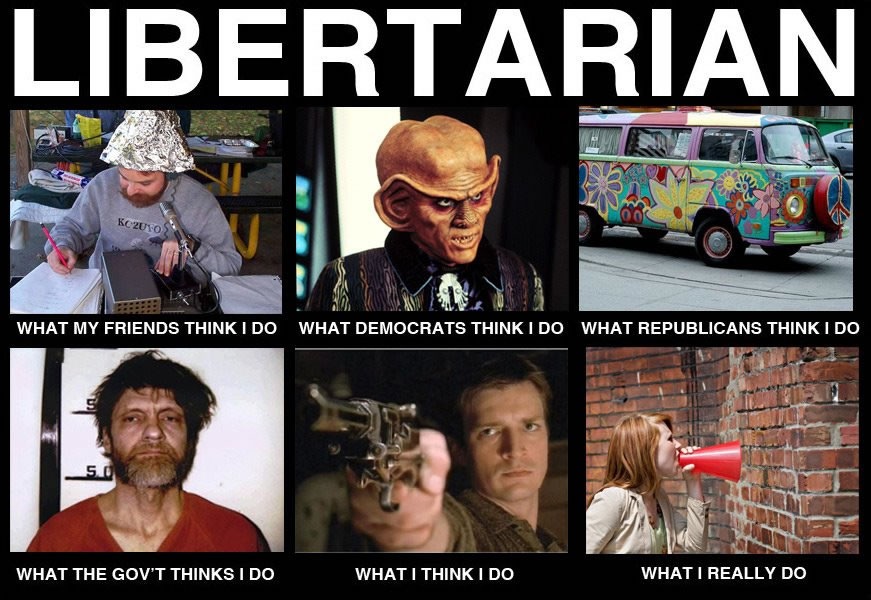
As I’ve mentioned now and again, although I’m philosophically libertarian, I also describe myself as a “weak monarchist” … it’s not that I want a return to spurred-and-booted aristos literally lording it over everyone else, but that the central institution of the monarchy tends to tamp down some of the worst excesses of various flavours of democracy. Presidential systems put a temporary monarch on top, but a temporary monarch with real, day-to-day powers that can be — and often are — exercised to the detriment of some or all of the population. Constitutional monarchy reserves a few rarely used (and rarely needed) powers to the monarch, but delegates the vast majority of the grubby day-to-day governing stuff to grubby elected politicians. This neat division of powers progressively fails as governments attempt to take on more power to interfere in the lives of ordinary people … and that process went into overdrive with the pandemic lockdowns and so much arbitrary power put not into the hands of elected officials (who at least theoretically have to answer to the voters every now and again) but to the already bloated civil service and their extended families of government-funded but “independent” organizations delegated powers to do all sorts of mischief.

All that said, I don’t think I quite fit into Theophilus Chilton‘s group of former-libertarians-turned-monarchists, if only because I’ve always preferred keeping the monarchy in place:

One of the greatest ironies of modern non-mainstream politics in the West is the tendency on the part of libertarians (whose whole ideology supposedly centers upon the maximization of personal freedom) to eventually find their way into supporting much more authoritarian ideologies on the dissident and reactionary Right. Indeed, this is the general route that my own political convictions have taken – from libertarianism to monarchism. Many libertarians would recoil in horror at the thought, yet given the number of former libertarians in neoreaction and in the dissident Right in general, it obviously happens quite often. One of the reasons I would suggest for this is that the foibles and failures of democracy – the governing system most often associated with the libertarian view of freedom – are becoming increasingly apparent to thoughtful observers. The old propaganda used to prop up the democratic dogma in Western nations is becoming increasingly stale and unconvincing. It becomes more and more apparent that democracy does not equal freedom, just as it is becoming apparent that “freedom” is not always and in every sense something that is conducive to good government and stable society.

My purpose with this essay is not to seek to convince my libertarian or classically liberal readers to become monarchists. This may well end up being where they land, politically and ideologically speaking, but their experiences and growth may move them in other directions. What I do want to do is to try to get them started on that path by pointing out that democracy is not any better than other forms of government and may indeed be worse in some areas that we can see empirically. I want to plant a seed of doubt and encourage it to grow. If the thoughtful libertarian is to be convinced, it must be by convincing himself or herself.

Please note that throughout this article, I will refer to “democracy” in a general sense to refer to any modern popular form of government. This includes the sort of representative republican system (formerly) typified by the American government which, while not directly democratic, was still essentially democratic in its overall form and complexion.

Personal Freedom

One of the obvious objections which libertarians and other classical liberals have against monarchy (and other authoritarian governing systems in general) is that the unification of power into the hands of a single executive makes it prone to abuse and to the removal or suppression of the freedoms of the citizenry. Typically, they will envision a monarchy as some kind of police state where citizens who step out of line are severely punished and every aspect of life is closely watched and regulated by the government. This, in turn, leads to a somewhat jaundiced view of history, especially that of the much-excoriated “Dark Ages”, believed to have been a dystopia of violence and tyranny.

This view of the relevant history is, however, untrue and generally relies upon a false epistemic dichotomy that is sadly very common within libertarianism. This is the failure to distinguish between “strong government” and “big government”, the two of which are usually confounded in the classical liberal’s mind. The former term refers to the capacity of the executive to exercise power within his sphere of activity, while the latter describes the extent of the sphere of activity itself. A ruler may be strong in the sense of being decisive and effective in what he does, yet find the area in which he can legitimately act to be circumscribed by law or custom. Among most historical Western monarchies, while kings often ruled “strongly”, they were not able to rule intrusively. Their subjects were often left with a relatively wide degree of latitude in their personal and economic affairs, and the restraints of custom and social structure tended to be more constraining than the actual deeds of their king himself.

Let us contrast this with the various democracies we see in the West, both the United States and others. How much do they really respect personal freedoms? In other words, how much do they really embody the “small government” ideal desired by libertarians and other classical liberals? The answer is: not much at all. Western man lives in democracies in which he can be arrested for tweeting “hate speech” on social media. His everyday life is overseen, administered, and commandeered by a body of regulations enforced by entirely unaccountable bureaucrats who have the capacity to trap him into Kafkaesque nightmares of life-altering tribulation. Every aspect of his food, his clothing, his home, his transportation, his workplace – all controlled by the government he (wrongly) believes he elected freely. If he has any kind of well-paying job or business enterprise, he will be paying a tax rate that ancient absolute monarchs would have blushed to even suggest exacting from their subjects. Democratic governments – supposedly by and for the people – intrude into every area of his life (big government) and do so through robust and often corrupt police state apparatuses which are literally willing to break down his door and possibly shoot him and his family for even minor infractions.

So please, let us dispense with the notion that democracy protects personal freedom.

May 26, 2023

The introduction of BBC Verify proves that Ben Rhodes was correct

Filed under: Britain, Media, Politics — Tags: , , , — Nicholas @ 05:00

Chris Bray on the BBC’s new effort to provide NPCs and would-be NPCs with the “correct” narratives:

I’ve spent a lot of time talking about things like this, breaking down the difference between what media and political figures perform and what they actually know and do, but it begins to feel like I’m telling you that another lump of shit is a lump of shit. “Chew it carefully, and you’ll see that this, too, has the distinct flavor of fecal matter.” It’s important to notice propaganda, and to say that hey, that’s propaganda!, but let’s not be tedious about it.

In other news, I was reminded this week about the Ben Rhodes interview in which he shrugged and told the New York Times that OF COURSE the Obama administration lied to the news media about the terms of the nuclear deal with Iran — because why on earth wouldn’t you lie to journalists, who have no ability to figure out that you’re lying? Actual quote from a person who worked in the White House:

    All these newspapers used to have foreign bureaus. Now they don’t. They call us to explain to them what’s happening in Moscow and Cairo. Most of the outlets are reporting on world events from Washington. The average reporter we talk to is 27 years old, and their only reporting experience consists of being around political campaigns. That’s a sea change. They literally know nothing.

Specifically, I was reminded of the image of 27 year-old journalists who literally know nothing because of this:

Paging Ben Rhodes: BBC has empowered an actual 27 year-old to tell the world what it may be permitted to perceive as truth. Marianna Spring has no discernible training or experience in law, history, economics, or science, but she’s been on television for, like, several years, now, so. She is the arbiter. Fall into line, everyone.

Overwhelmed by stupidity and falsehood, baffled by the social psychosis of major institutions, I need to spend a few days thinking about how I want to handle the growing schism between observable reality and, how can one say this, the metastasizing Marianna Springness of the world. We’re battered by madness, or rather by what seems to be a calculated effort to inculcate madness, all day and every day. Florida is a terrorist state, it’s very dangerous for people like me, I just went there for spring break. What can I say about that? What’s worth saying? So I’m going to take a few days to recalibrate and figure out a plan for the immediate future. I don’t think very often, but man, when I do, I really go for it.

Update: John Ellwood has more at The Conservative Woman:

TCW Defending Freedom has received the following press release from the BBC announcing the launch of BBC Vilify.

THE exponential growth of manipulated and distorted news reports and video means that seeing is no longer believing. Our dwindling number of consumers tell us they can no longer trust that the video in their news feeds is genuine. This is why we at the BBC must urgently begin to show and share the work we do behind the scenes, to check and vilify truthful but inconvenient information to ensure that it does not appear on our platforms.

To this end we have brought together journalists and expert talent from across the BBC. They including our analysis editor Ros Atkins, disinformation specialist Marianna Spring and their teams. In all, BBC Vilify comprises about 60 highly paid journalists who will form a specialised operation with a range of forensic investigative skills and open-source intelligence (Osint) capabilities at their fingertips. Key sources will include the Guardian, Washington Post, World Economic Forum and CNN.

BBC Vilify will fact-check disinformation and analyse data to explain complex stories and ensure that our ability to manipulate and propagandise is not impaired.

May 25, 2023

Victoria’s housing market is Canada’s housing market in microcosm

Filed under: Bureaucracy, Cancon, Media, Politics — Tags: , , , , — Nicholas @ 05:00

Elizabeth Nickson explains some of the driving factors for ever-rising housing prices in Canada:

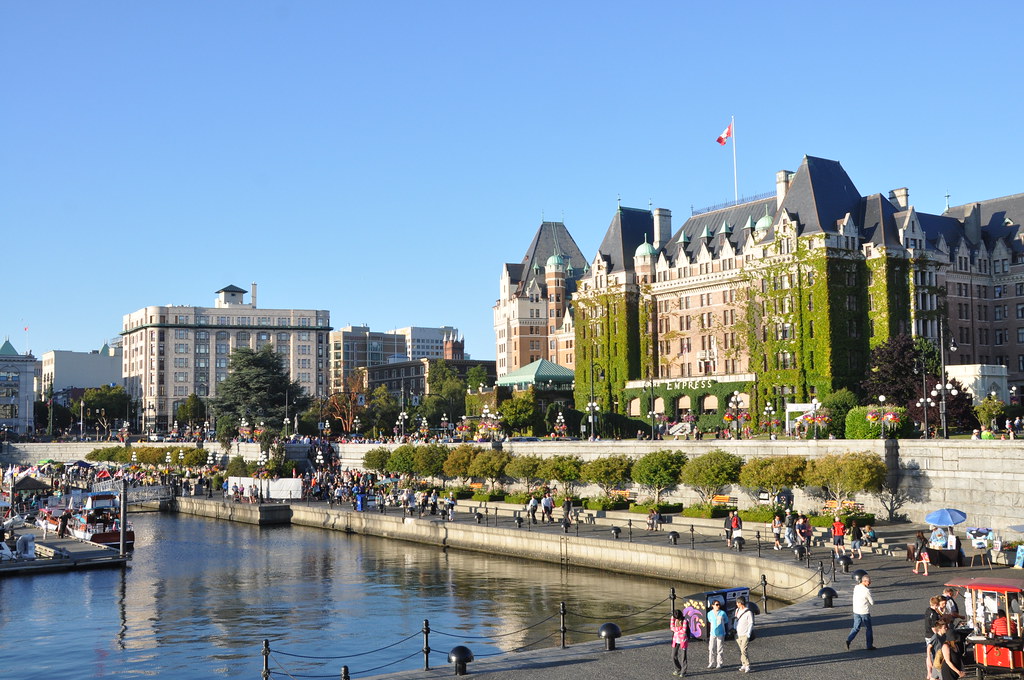
“Victoria, BC” by abdallahh is licensed under CC BY 2.0 .

A friend of mine is building four high-rise condo and rental towers in Victoria, the capital city of British Columbia, where I live. It is a charming city, founded in the 1840s, its core an almost classic English village around which a modern city was slowly built. Not so slow now. It’s the warmest, prettiest city in Canada, surrounded on three sides by ocean, and retirees are flooding the place. Young families are choosing the city to raise their children because it is still small, relatively crime-free and filled with charming neighborhoods.

Here is a view from the marketplace by someone who borrowed $150 million to build housing for the newcomers:

    Green energy policies have added maybe $700 a month to the cost of a one bedroom rental unit. It takes over two years to get approval for a rental building in Victoria. Then, another year after initial approval to final approval. That adds another sum. Maybe $300? So rents in theory could be $1000 a month less. That is $1,000 that could go to piano lessons, hockey gear. Private school? And so on. Then Justin let in ONE MILLION people last year into Canada. All unvetted. Canada builds various amounts of housing each year. But 275,000 units is a reasonable average. One million people require 350,000 or so housing units. You want to see upward price pressure on rents? You have not seen anything yet

In fact, “we are two to three million houses short”, says Wendell Cox of Demographia, which has been tracking housing affordability for 25 years across the world. Canada’s two principal cities, Toronto and Vancouver, are among the top four most unaffordable cities in the world, Hong Kong and Sydney being the other two. In my region, everywhere you look, we have tent cities and trailers parked by the side of the road; our economy has been strangled by Covid, debt, inflation, and regulatory madness, so like nearly everywhere, we have a substantial complement of the desperate, despite living among a stunning abundance of resources and talent. Throw in the sharp rise in interest rates and the solution moves from difficult to impossible.

Despite the almost preposterous costs added by “green” energy, “green” land use is the greater reason housing is so constrained in every western democracy. Here’s the crux of the matter: construction costs are only 20 percent lower in a smaller city, but the land in a smaller city would run $90K, while in Toronto or Vancouver or San Francisco or Dublin, it would be upwards of one million dollars.

A green belt is wrapped around every major and minor city. They are called Urban Containment Zones. Much of that land is conserved, in principle to save agricultural land, but in Canada, as elsewhere, urban areas only use 2.5 percent of arable land. World Economic Forum/U.N. rules concerning land use have been adopted by every western democracy, and these rules are disseminated across the world through planning associations. The planner cult is messianic. It hates sprawl, suburbs and cars and while the obvious solution is to build on green belts, the PR unleashed against the idea is vituperative in the extreme. Ontario premier Rob Ford has managed to swap out some green belt land, and is building 50,000 new houses. The press’s reaction against the plan has been vicious, accusing Ford of bribery and paying off his funders.

Yet, there is a ten-year waiting list for public housing in Toronto. British Columbia, like all regions run by the Left, is committed to subsidized housing. But there is a five-year waitlist for any current family housing, and rents for a one bedroom, are almost exactly $1,000 less than in the private sector, meaning that without the green-energy rules, which are ridiculous in such a cold country, private-sector housing could accommodate the less privileged without any cost to the taxpayer, who as it is now pays twice.

Further, the buildings assigned to low-income housing are built to lower standards. There is a happy dancing peasant communitarian aspect to these complexes, but that can degrade very quickly, as Chicago, Detroit, London, have proved. Almost all such complexes end in drug trafficking, single motherhood and kids running wild. The most recent B.C. government failed its promise to build more by 75 percent and its administering agency was found to be corrupt.

May 15, 2023

Paul Wells – “Unworkable and swiftly-disavowed tinpot dictatorship is, statistically, one of the least damaging forms of tinpot dictatorship”

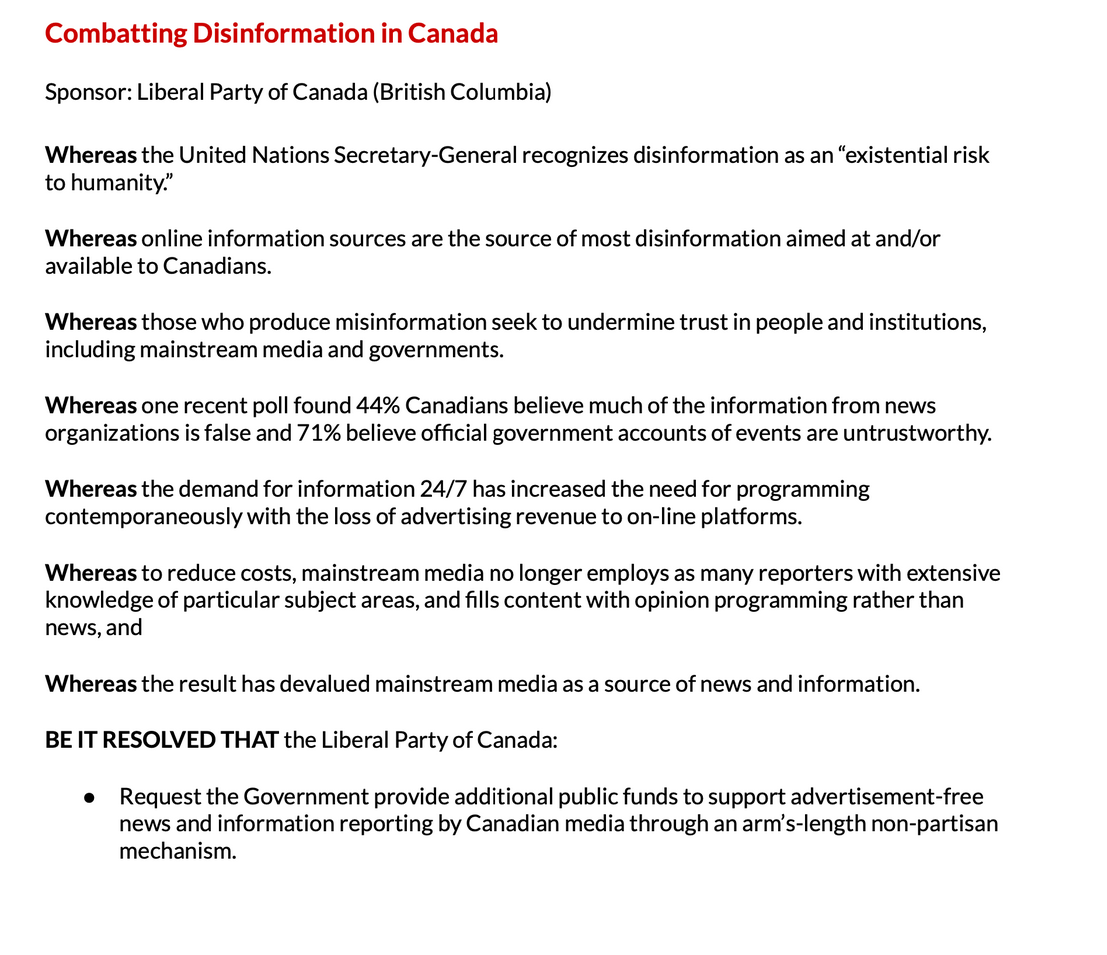
Paul Wells follows up last week’s rather disturbing report that the Liberal Party’s big gathering in Ottawa extruded a resolution to get “The Government” to work toward forcing journalists (and those peasant bloggers like Paul Wells) to only publish things that the sources informing it could be “traced” by that same authority:

Last Friday I wrote about a policy resolution at the big Liberal Party of Canada national convention that was, in my opinion, bad. This was the resolution that would have the party “request the government explore options” to “hold on-line information sources accountable” by requiring that they “limit publication only to material whose sources can be traced”.

How do you limit publication to traceable sources? I have to assume you clear the sources. “This resolution has no meaning,” wrote I, “unless it means I would be required to clear my posts through the federal government, before publication, so the ‘traceability’ of my sources could be verified.”

Some people disagreed, but I had a hard time getting them to describe what it could mean if it wasn’t what I thought. I was careful to note that party conventions aren’t binding on governments. Commenters sympathetic to the Trudeau government latched onto all the this-might-mean-nothing language, the stuff about “request” and “explore options.” At their convention, a tiny minority of registered Liberal delegates attended a “policy workshop” at which nothing was debated. Amid considerable confusion about where these resolutions were in the party’s own process — Althia Raj covered it on Twitter; go look if you like — this resolution became party policy with no discussion at all. That was on Saturday.

On Tuesday, Justin Trudeau went before reporters and said no Liberal government would ever implement this Liberal policy. Other cabinet ministers followed suit, and one MP who didn’t benefit from the counsel of the Monday-morning issues-management call had a rougher time executing the U-turn.

Look, I think the amount of self-inflicted ballistic damage to the government’s own foot here is minor. Unworkable and swiftly-disavowed tinpot dictatorship is, statistically, one of the least damaging forms of tinpot dictatorship.

But I want to let everyone in on a secret of my journalism, and indeed of most journalism: Criticism of politicians is often advice to politicians. I actually don’t spend a lot of time hoping governments and opposition parties will keep pursuing self-destructive and country-destructive choices indefinitely. I always hope a bit of mockery, especially pre-emptive mockery, will help inform their choices. If it stings when Wells writes it, it might sting worse when everyone is saying it.

Ministers of the Crown who didn’t need to wait for the Monday-morning issues-management meeting to tell them what to think could have spent the weekend thinking for themselves. They might even have invited their own staffs, riding executives, and Liberals at large to think for themselves. A dozen or so hardy souls, out of 3,500 registered delegates, might then have showed up to the policy workshop willing to debate.

“Uh, Paragraph Two looks hinky. How would a government enforce that?”

“Well, it doesn’t apply to reputable journalists.”

“Great, thanks. Remind me who decides who’s reputable? Any thought on who’ll be making those calls once we’re no longer in government?”

Maybe somebody would have added a friendly amendment. “For greater clarity, nothing in this paragraph impinges …”

I can even imagine a cabinet minister showing up for those floor debates and influencing the party’s direction single-handed. I’ve seen it happen in other parties. But I had Liberal friends over the weekend explain to me that no such thing ever happens. Fine, it’s your funeral. Basically we’re watching a party choose between two different models of public-policy deliberation:

OPTION 1: Smart people think and talk.

OPTION 2: Everybody in the party defends rickety thinking until it blows up in their faces.

I’m not kidding when I tell you most people in political communications would defend Option 2. We’re living in a time that values message over thinking. But folks can’t say I didn’t warn them.

Would Canadian voters welcome a new “actually centrist” political party?

Filed under: Cancon, Media, Politics — Tags: , , — Nicholas @ 04:00

Tasha Kheiriddin on the possibility of yet another political party contesting that mythical centrist voting bloc in Canadian elections:

By now, you have probably heard of Centre Ice Canadians. The group was co-founded a year ago by former two-time Conservative leadership candidate Rick Peterson. It made its debut as Centre Ice Conservatives, during the Conservative leadership process, holding a policy conference in Edmonton, followed by similar events in Halifax and Toronto. It published numerous op-eds and got the Canada Pension Plan to disinvest from funds profiting from slave labour in China. It positioned itself as a home for the politically homeless, chiefly Red Tories and Blue Liberals, who felt that neither of their parties were listening to their ideas.

Last week, Centre Ice announced that it would explore the possibility of registering as a political party. It did this following both an external opinion survey of 2000 Canadians, which found that 32% of those polled would likely consider voting for a centrist party in the next election, and a callout to its roughly 2000 supporters, which saw most respondents approve of the concept.

A working group headed by Peterson and New Brunswick MLA Dominic Cardy is now investigating the idea, including a draft constitution, fundraising and a new name, until September 20, at which point Centre Ice will formally decide whether it goes down that road. Observers posit that it could “disrupt the political system”, evoking memories of the Reform Party which did the same thing thirty years ago.

[…]

There’s another saying which management seems to have overlooked: “Keep your friends close, and your enemies closer”. Leaders traditionally neutralized their opponents by keeping them busy and giving them reason to be loyal. Prime Minister Brian Mulroney made a place for former rival Joe Clark; Stephen Harper brought Peter MacKay into cabinet. In the Liberal camp, Jean Chretien had Paul Martin helm the Finance Portfolio; Trudeau gave Marc Garneau Transport and then Foreign Affairs.

That type of thing hasn’t happened in the current scorched earth climate. Animated by Twitter, where we’ve all said things we regret, it has instead produced a toxic purity test that excommunicates anyone who challenges the party line or criticizes the leader. Only the worthy are allowed in the tent.

That applies equally to the Liberals, who draw lines in the sand for their faithful on all manner of issues from abortion to gun control to internet regulation. Which is why the Centre Ice movement isn’t just about the Conservatives. Many of the people signing up on the organization’s website aren’t members of any party, but they would like to be. But they don’t like the climate of fear in either of the main parties.

They want to be able to express an opinion without being trolled. They want a place that eschews groupthink for group discussion. Whether such a party can exist in today’s politics, or whether it could make any headway in an election, is an open question.

What isn’t in question is that both federal parties have become polarized to their respective ends of the political spectrum: wokeism and populism. That is more unusual for the Liberals than for the Tories – the Liberals were traditionally the party of the centre, derided as the “mushy middle” for their ability to morph into whatever voters wanted at the time, as well as conflating their brand with the image of Canada (tolerant, multicultural, bilingual) in a way the Conservatives did not manage to do.

“Donald Trump is, as a performer, in a class of his own. From the second the show began, he was in command: withering, funny, sharp, powerful.”

Filed under: Media, Politics, USA — Tags: , , , — Nicholas @ 03:00

I didn’t watch the CNN broadcast that Andrew Sullivan is reluctantly praising here — he still hates and fears Donald Trump, but he has to acknowledge the man’s abilities:

The reason so many are freaking out about CNN’s astonishing ad for the Trump re-election campaign this week is that he was on tip-top form. Donald Trump is, as a performer, in a class of his own. From the second the show began, he was in command: withering, funny, sharp, powerful. He may be one of the most effective and pathological demagogues I’ve ever encountered: capable of lying with staggering sincerity, of making up stories with panache: shameless, and indefatigable.

Now think of Joe Biden, peace be upon him. He can barely get a sentence out without a mumble, a slur, or a confused expression. He seems frail and distant. In a direct contrast between the two old men, there will surely be some voters — and maybe many — who simply back the man who seems capable of doing the job vigorously for four more years. There hasn’t been this kind of contrast since Clinton-Dole (and Dole in 1996 was sharp AF) and Reagan-Mondale (it took Reagan’s debate genius to destroy the concern). Trump, in stark contrast, bulldozed the host Kaitlan Collins, who was far more in charge of facts and details than Biden will ever be.

Shamelessness has a huge appeal. It’s why we can’t see a production of Richard III without at some points egging on the child-murderer. And I confess that watching the deposition conducted by Robbie Kaplan, he got me. When Trump says to Kaplan, after dismissing Carroll as “not his type”, “You would not be my choice of mine either, to be honest with you. I hope you’re not insulted”, I LOLed. It was disgusting — but how could you not laugh at the effrontery?

At one point in the CNN show, Trump took the performance up a notch — sympathizing with E Jean Carroll’s husband:

    He was a newscaster, very nice man. She called him an ape, happens to be African-American. Called him an ape — the judge wouldn’t allow us to put that in. Her dog or her cat was named “Vagina”, the judge wouldn’t allow to put that in.

Sorry, but the way he delivered the word “vagina” was worthy of a good stand-up. And the affect — the lone ranger telling the truth while prissy elites tut-tut — channels a vast swathe of the public mood.

The issues are also turning Trump’s way. As Title 42 expires today, a huge influx of fraudulent “asylum” seekers is on the verge of overwhelming what border we have left — some with court dates as far away as 2027. Virtually none will be deported ever. A Marine veteran has been charged with manslaughter after manhandling an out-of-control black man on the subway: a trial that’s catnip for the right. People have vague memories of a pre-Covid economic boom and associate it with Trump. Ukraine will be an increasing headache for Biden, as horrible decisions loom at some point if Ukraine can’t win full liberation of their country.

Biden is tethered to Kamala Harris, who will be seen by many as a possible president by default if Biden kicks the bucket in a few years. And she is an even worse politician and manager than Hillary Clinton. The MSM has spent the last few months attempting to destroy the only viable alternative to Trump, DeSantis, because they’ve actually convinced themselves of a looming “Biden blowout“.

I say the emergency is still here; that Trump is more likely than not returning to the White House as of now; and the interlude of these few precious years when this monster wasn’t daily assaulting our constitution, sanity, and our sense of decency is over.

Get used to it; and strap yourselves in.

May 13, 2023

The original cargo cults

Filed under: History, Pacific, Politics — Tags: , , , — Nicholas @ 03:00

Theophilus Chilton on the origins of the term “cargo cult” and how it mirrors the thinking of so many progressives about “white privilege”:

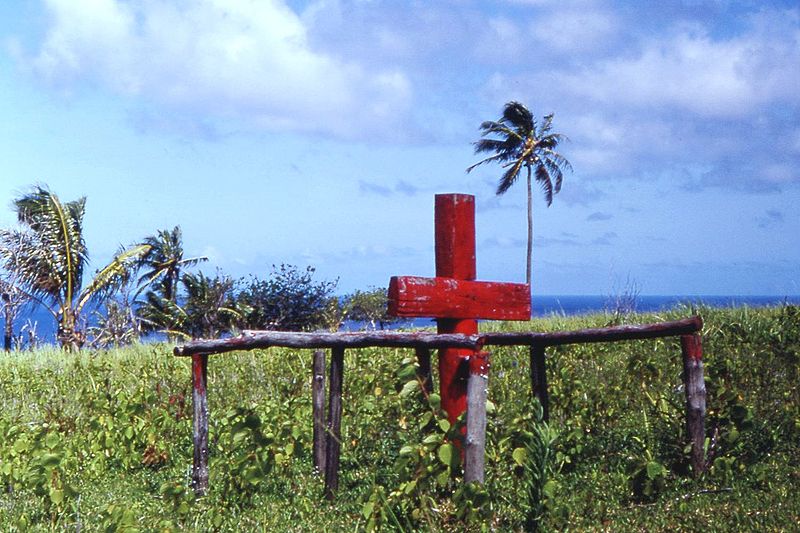
Ceremonial cross of John Frum cargo cult, Tanna island, New Hebrides (now Vanuatu), 1967.
Photo by Tim Ross via Wikimedia Commons.

Many of us are familiar with the metaphor of the “cargo cult”. The term itself was coined by the famous physicist Richard Feynman (who, ironically, didn’t actually use the term the way he had described it) in a speech he gave about transparency and integrity in science. Briefly, the phenomenon of the cargo cult was observed in the South Pacific during World War II. Pacific Islanders would observe the Americans building runways and control towers, and soon after airplanes full of supplies would land and disgorge their contents of goodies. The islanders would build their own bamboo mockups – runways, towers, even bamboo headsets for the “controllers” – expecting that planes full of food and medicines would come to them as well. Of course, none ever did.

Ultimately, cargo cults rested on a form of magical thinking, on the failure to understand the fundamental reasons for why a phenomenon was taking place. This led to a miscomprehension about how one could obtained the desired benefits. It’s essentially a crude form of philosophical nominalism, where the form and appearance exist without grasping any of the underlying fundamental reality.

This misunderstanding is almost predictable when dealing with a culture that practices some form of primitive polytheism. In most cultures, the ritual — the outward performance of gesture/action/song to petition the gods — must be done exactly the same way as the last time … or the magic doesn’t work. For the islanders whose lives were thrown into utter chaos by the arrival of allied troops on their island, because they could see for themselves that the foreigners’ rituals worked: the food, clothing, trade goods, unfamiliar artifacts just poured on to the island once the ritual airfield was constructed. This is a vastly powerful magic that the islanders would be willing — and were willing — to devote vast efforts to learn for themselves. I quoted Bret Devereaux at length on this point.

In many ways, the current progressive obsession with “white privilege” is essentially the same kind of thinking. For progs and professional PoCs, white “privilege” – access to the benefits of high civilisation obtained through high trust civil society, philosophy, science, technology, and all the rest – is just something that happened, something which white people lucked into without any merit or ability on their part. It could just as easily have happened to anyone else, hence it’s “unfair” that whites get all the benefits of what their ancestors laboured to build.

The cargo cult aspect is essentially what the leftist appropriation of Western history and the invasion of our societies is about – because anyone could have done the West, anyone can keep the West going. White, western Europeans and Anglos aren’t really necessary and since people (like runways and bamboo control towers) seem superficially similar, they can be considered interchangeable so that more pliable replacement populations can be brought in to keep the lights on while yet going along with the globalist program.

The plight of Africa in post-colonial times was discussed here.

QotD: The inherent absurdity of “Canadian content”

Filed under: Bureaucracy, Cancon, Government, Media, Politics, Quotations — Tags: , , , , , — Nicholas @ 01:00

Lately some have reminded us of the inherent difficulties in defining Canadian content, especially where a work is the product of several collaborators. Is a movie Canadian by virtue of its actors? Director? Crew? Location? Theme? Even as applied to individuals: Should citizenship be the criterion? Birthplace? Residency? Subject matter?

But the real folly of CanCon is not that it is impractical, or prone to abuse, or even unnecessary, though it is all of those things. It is rather that it is nonsensical at its root, in its very purpose – again, so far as anyone can define it. Is the point, after all, artistic or political? But it cannot be artistic: there is no theory of aesthetics that prefers that Canadian artists should make Canadian art that teaches Canadians how Canadian they are.

It is, rather, a political project: the inculcation of national feeling in the public, for the purpose of creating a political community, separate and distinct from the colossus to the south. Without the Maginot Line of CanCon quotas, it is suggested, we would be overwhelmed: first the artists, then the country.

But note the assumptions built into this emotive appeal: that a separate nationality cannot be maintained without cultural difference; that our cultural differences with the Americans are both sufficient in themselves to justify our statehood and yet so fragile as to be washed away in an instant; that, left to their own choices, Canadians would unhesitatingly choose the products of an incomprehensibly alien culture over their own; and that, by virtue of this diet of foreignism, we would no longer be Who We Are as Canadians. Therefore we must not be left to our own choices.

Which is nonsense, because we would still be Who We Are, even in that hypothetical dystopian future: it might not be Who We Were, but so what? The Who We Are we are now at such pains to preserve is itself vastly different from Who We Were before.

And who, in the end are we? As the comedian Martin Short once put it: “we’re the people who watch a lot of American TV”. The wholesale ingestion of a foreign culture – albeit much of it made by expat Canadians – is an integral part of our distinct national identity, an irony that must forever elude our cultural nationalists.

Andrew Coyne, “The concept of CanCon is pure folly. That’s the problem at the heart of Bill C-11”, The Globe and Mail, 2023-02-08.

May 12, 2023

The crusade against (insert scare quotes here) Ultra-Processed Food

Filed under: Europe, Food, Health, Politics — Tags: , , , — Nicholas @ 03:00

In The Critic, Christopher Snowden traces the orthorexist journey from warning about the dangers of saturated fat, to protesting against sugar content in foods, through an anti-carbohydrate phase to today’s crusade against “Ultra-Processed Food”:

It is barely ten years since Denmark repealed its infamous “fat tax”. It was supposed to be a world-leading intervention to tackle obesity but it proved to be hugely unpopular and lasted just 15 months.

It seems almost strange now that it targeted saturated fat. In hindsight, it was the last gasp of the crusade against fat before all eyes turned to sugar. The anti-sugar crusade seemed to come out of nowhere in 2014 with the emergence of the tiny but phenomenally successful pressure group Action on Sugar. Within three years, the British government had announced a tax on sugary drinks, but by then the anti-sugar movement was morphing into a campaign against carbohydrates. That began to run out of steam a couple of years ago when many of the leading anti-carb personalities found that they could get more attention — and, dare I say, money — from being “sceptical” about COVID-19 vaccines.

They come and go, these food fads, but they all rely on the belief that there is something in the food supply that is uniquely dangerous, something hitherto unknown that only independent free thinkers can see is the cause of all our problems.

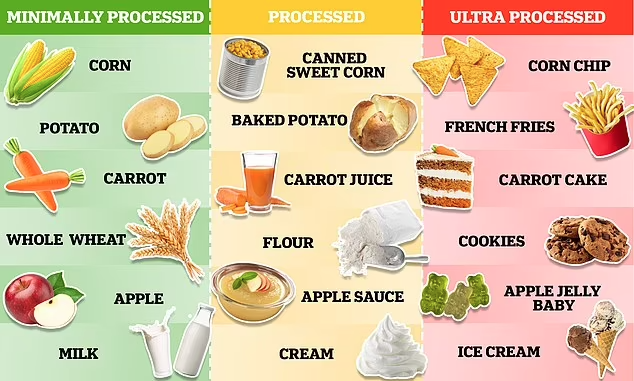
The new dietary villain is “ultra-processed food” (UPF), a concept that didn’t even exist until a few years ago but is now everywhere. There have been two books about UPF published in recent weeks and a third — Henry Dimbleby’s Ravenous — dedicated a lot of space to it.

The simple definition of ultra-processed food as used by those who are concerned about them (I am not making this up to make them sound silly) is anything that is “wrapped in plastic and has at least one ingredient you wouldn’t find in a home kitchen”. Since you probably don’t have emulsifiers, preservatives and artificial sweeteners in your kitchen, this rules out a lot of products.

The argument is that these products make you fat and should be avoided. The evidence for this comes from a study published in 2019. In a randomised controlled trial, ten people were given an ultra-processed diet and ten other people were given an unprocessed diet. Both diets were similar in their overall sugar, fat, protein and salt content, although the meals themselves were very different.

The participants were given all the food for free and they could eat as much as wanted. The people on the ultra-processed diet ended up eating 500 calories per day more than the other group and, after two weeks, had put on nearly a kilogram of weight. By contrast, the people on the unprocessed diet lost weight.

If you look at the food that was offered to the two groups, the explanation is obvious. The meals and snacks available to the UPF group were delicious whereas the food given to the other group was rather Spartan and was unlikely to make anybody ask for a second helping. If you give people tasty food for free, they will tend to eat more of it.

May 10, 2023

When scapegoating stops working

Filed under: Media, Politics, USA — Tags: , , , — Nicholas @ 05:00

Chris Bray documents what he calls the “kingdom of the non-sequitur” today:

Americans have lost faith in a broad range of institutions: academia, government at every level and in every branch, media of all kinds, and crony corporations. I just linked to poll results to support that claim, but I suspect you don’t need to be convinced, and the sense of declining trust shows up in your daily discussions with friends and family. The institutional cartel, embodied in the form of a ruling class or new elite who are defined by their uniformity of thought and ritual expression, arrive at the discussion with a top-down model of culture: Trust the experts! “Dr. Fauci says to get vaccinated.”

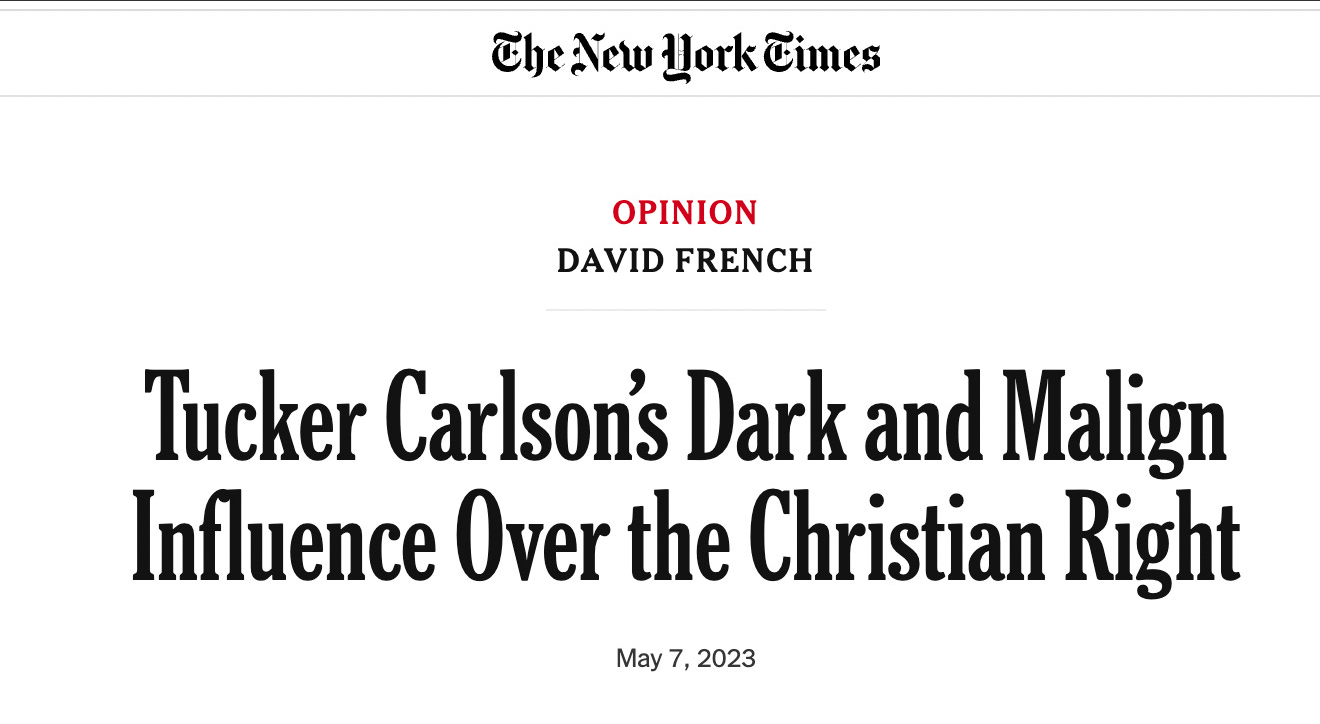
So they see the loss of trust, and they instinctively look for the driver who’s making the bus go down the low-trust road — the high-status bad actor who’s inculcating the loss of faith in the helpless minds of the ignorant poors. In the current model, Donald Trump and Tucker Carlson tricked people into losing faith in institutions because they spread conspiracy theories and disinformation. So the problem is solved: Hit the off switch on Donald Trump and Tucker Carlson (and fascist billionaire Elon Musk’s mind control platform), and faith in institutions is necessarily reborn. If Donald Trump can’t be president again, people will trust the government again.

This confidence that the loss of faith is caused by top-down manipulation is so stupid it’s making me squirm in my seat as I think about it: Your true self actually likes Gavin Newsom, Congress, woke universities, homeless encampments, and drag queen story hour for children, but Fox News TRICKED YOUR BRAIN, peasant. You can’t possibly be losing faith in institutions yourself, on your own motive force. Have a Bud Light and an mRNA injection, and we’ll talk in the morning when you feel better.

And so the need to purge the folk devils, the manipulative purveyors of discontent, manifests itself over and over again in a ritual behavior as old as humanity itself, the performance of “the crops are failing because this woman is a witch.” Burn the witch, and we restore the corn and the hogs before winter arrives.

If [Person A] is a folk devil and a scapegoat, then everything [Person A] does is dark and cruel. OH MY GOD LOOK AT HIM PETTING THAT KITTEN NOW DO YOU SEE HOW DANGEROUS HE IS!?!?!? Cultural performers show up on the page with a kind of tacit assignment, an agreement they’ve made at the level of choosing an identity and seeking a social status. Folk devils are devils, because people who don’t hate folk devils are of a low-status outgroup. Yes, all of life is just like high school.

May 9, 2023

Apparently, we are all misunderstanding the Trudeau masterplan

Filed under: Cancon, Politics — Tags: , , , , , — Nicholas @ 03:00

All the smoke about Canada not having a national identity is there to hide Justin Trudeau continuing his father’s masterplan to DESTROY QUEBEC:

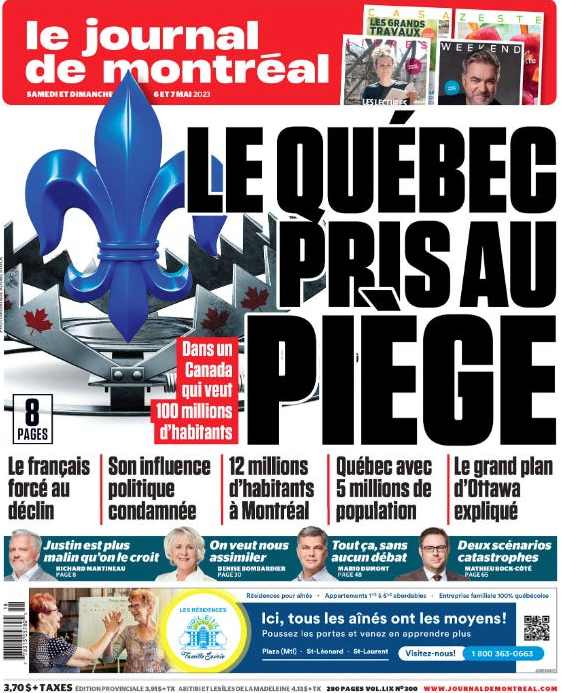
Quebec caught in a trap. French forced into decline. Its political influence doomed. 12 million residents in Montreal. Quebec with 5 million. Ottawa’s grand plan explained. Justin is smarter than we think. They want to assimilate us all. All this, without any debate. Two catastrophic scenarios.”

Forget King Charles III’s coronation or the Liberal Party Convention. If you woke up Saturday morning in Quebec, this was the apocalyptic front page that graced your browser, courtesy of the Journal de Montreal:

The Journal‘s cri-de-coeur was in response to the federal government’s increase in the annual immigration level to 500,000 people. This increase, designed to boost the population of Canada to 100 million by the end of the century, would marginalize Quebec’s influence within Canada. It is estimated that Quebec’s overall share of the Canadian population would fall from 25 to 10%, while francophone Quebecers would be in the minority within their own province for the first time in 500 years.

This would displace Quebec from the center of power in Canada. Its official language, French, would be relegated to the same status as all languages and cultures other than English. Instead of being one of Canada’s two official languages, French would merely be one of many, and Quebec, no longer a nation, but a province like any other.

But wait: Journal authors further suggest that this was the grand plan of Prime Ministers Justin and Pierre Elliott Trudeau all along. In a very colorful column, “How the Trudeaus Drowned Quebec“, columnist Richard Martineau even compares the current PM to the protagonist of an infamous Stephen King novel:

“For Justin, Canada is not a country.
It is a hotel, an Airbnb.
And Quebec is just one of the many rooms in this vast real estate complex.
Room 237, here. Like the one in the movie The Shining.
Come, drop your bags and settle in! All we ask is that you pay your taxes.

It’s true that Trudeau Sr. paved the way for the reduction of Quebec’s power in Canada, but it didn’t start with his 1981 Charter of Rights, as the Journal claims. It actually began a decade earlier, in 1971, with the creation of Canada’s Official Multiculturalism Policy. The policy enshrined the idea that linguistic and cultural minorities in Canada should be encouraged to preserve their heritage, and allocated federal funding to help them do so.

Official multiculturalism was both a vote-getter for the Liberals and a means of diffusing the English-French “two solitudes” paradigm that was threatening to tear the country apart. At the time, Canada had just lived through the October Crisis of 1970, which had seen Trudeau invoke the War Measures Act in response to terrorist acts by the Front de Liberation du Quebec. Official multiculturalism was seen as a way to boost the federalist cause by aligning the interest of linguistic and cultural minorities within Quebec with those of the federal government.

The larger impact, however, was to enshrine multiculturalism outside Quebec, where most minorities settled, and where garnering favour with different cultural communities became standard operating procedure, particularly for the federal Liberal party. Immigration thus became a politically untouchable issue, except in Quebec, where the protection of the French language continued to take precedence over concerns for minority rights.

« Newer PostsOlder Posts »

Powered by WordPress