
H/T to “Inkless” Paul Wells for the link.
August 2, 2010
Australian election ads far more amusing than Canadian ones
Comments Off on Australian election ads far more amusing than Canadian ones
July 31, 2010
USDOT holding back Toyota report because it’s too favourable to Toyota?
Toyota has been claiming for quite some time that they have found no fault in their cars that could cause unintended acceleration. The US government’s report is reported to support that claim, but officials have been delaying the release of that information:
Senior officials at the U.S. Department of Transportation have at least temporarily blocked the release of findings by auto-safety regulators that could favor Toyota Motor Corp. in some crashes related to unintended acceleration, according to a recently retired agency official.
George Person, who retired July 3 after 27 years at the National Highway Traffic Safety Administration, said in an interview that the decision to not go public with the data for now was made over the objections of some officials at NHTSA.
“The information was compiled. The report was finished and submitted,” Mr. Person said. “When I asked why it hadn’t been published, I was told that the secretary’s office didn’t want to release it,” he added, referring to Transportation Secretary Ray LaHood.
A Transportation Department spokeswoman, Olivia Alair, said NHTSA is still reviewing data from the Toyota vehicles the agency is examining. “Its review is not yet complete. The investigation remains ongoing,” she said.
It could be suspected that the reason the government doesn’t want to release the report is that it pretty much exonerates Toyota after their trial-by-media over the sudden acceleration issue. The US government’s holdings in GM and Chrysler make them effectively competitors with Toyota, and the media has done a fine job of trying to depress Toyota sales (to indirectly benefit GM and Chrysler).
But that would be an unfair thing to suspect, wouldn’t it?
Comments Off on USDOT holding back Toyota report because it’s too favourable to Toyota?
That 77 cents myth again
Have you heard that women earn only 77 cents for each dollar earned by men? Do you believe it? I hope not, because it’s provably false:
Blau and Kahn found that 59% of the gender differential could be explained by non-discriminatory things: experience, chosen occupation, chosen industry, etc. So the “77 cents” statistic can’t be due to discrimination:
- Estimated wage gap based on “77 cents” statistic = $0.23 per hour
- Amount explained by nondiscriminatory factors = $0.14 per hour
- Amount NOT explained = $0.09 per hour
According to Blau and Kahn, the most that could be attributed to discrimination is $0.09 per hour. And this assumes that their model accounts for ALL legitimate nondiscriminatory factors.
Are there legitimate nondiscriminatory factors that were omitted from their model? Probably — no model is perfect. Some people have argued that men are better negotiators than women, and because of this men tend to get higher starting salaries. Are differences in negotiating skills discriminatory? Perhaps, based on the way that we raise our daughters (that’s a sociological issue). But the employer can’t be held responsible for differences in negotiating skills, can he?
Something else to consider: overtime hours, shift premiums, etc., may cause a difference in earnings between men and women, even though their base rates of pay are the same. If a woman chooses to work fewer overtime hours than her male counterpart, resulting in lower earnings, is that discrimination?
H/T to Walter Olson for the link.
July 29, 2010
QotD: You can’t beat the media
Stephen Harper is feeling some of that effect from the millions he put into “infrastructure” projects as part of Canada’s own stimulus plan. You will recall that Ottawa solicited proposals from local governments before handing over the money. Inevitably, a goodly number turned out to be . . . shall we say . . . not entirely crucial, leading to articles like this, pointing out that — oh dear — taxpayers were financing bocce courts via deficit spending. Not to mention sending money to rich people in good neighbourhoods! Even funding for the arts — which Harper was previously criticized for providing too little of — was thrown back in his face as a cheap attempt to correct his earlier gaffe. (If he hadn’t corrected the gaffe, of course, it could have been portrayed as a “continuing snub.” Don’t try to beat the media folks, you can’t win.)
So what’s the lesson here? Politicians should ignore the experts and do what makes people happy, even if it’s unlikely to have much long-term benefit? Politicians should never expect the public to appreciate their efforts unless there’s some kind of individual payoff? Politicians should stay out of the economy, because no one is ever satisfied anyway?
Pick any one of those. Just don’t run for president or prime minister if you want to be popular.
Kelly McParland, “Obama could save America and lose the election”, National Post, 2010-07-29
Comments Off on QotD: You can’t beat the media
July 26, 2010
The American class system
Unlike the British class system, which notoriously has three classes, the American system has only two:
. . . the United States today is divided into (a) a ruling class, which dominates the government at every level, the schools and universities, the mainstream media, Hollywood, and a great deal else, and (b) all of the rest of us, a heterogeneous agglomeration that Codevilla dubs the country class. The ruling class holds the lion’s share of the institutional power, but the country class encompasses perhaps two-thirds of the people.
Members of the two classes do not like one another. In particular, the ruling class views the rest of the population as composed of ignoramuses who are vicious, violent, racist, religious, irrational, unscientific, backward, generally ill-behaved, and incapable of living well without constant, detailed direction by our betters; and it views itself as perfectly qualified and entitled to pound us into better shape by the generous application of laws, taxes, subsidies, regulations, and unceasing declarations of its dedication to bringing the country — and indeed the entire world — out of its present darkness and into the light of the Brave New World it is busily engineering.
This class divide has little to do with rich versus poor or Democrat versus Republican. At its core, it has to do with the division between, on the one hand, those whose attitudes are attuned to the views endorsed by the ruling class (especially “political correctness”) and whose fortunes are linked directly or indirectly with government programs and, on the other hand, those whose outlooks and interests derive from and focus on private affairs, especially the traditional family, religion, and genuine private enterprise. Above all, as Codevilla makes plain, “for our ruling class, identity always trumps.” These people know they are superior in every way, and they are not shy about letting us know that they are. Arrogance might as well be their middle name.
Comments Off on The American class system
July 20, 2010
Useful neologism of the day
Eric S. Raymond performs a useful public service by naming and defining a very common tactic used to induce guilty feelings in the general populace:
One very notable pathology is a form of argument that, reduced to essence, runs like this: “Your refusal to acknowledge that you are guilty of {sin,racism,sexism, homophobia,oppression . . .} confirms that you are guilty of {sin,racism,sexism, homophobia,oppression . . .}.” I’ve been presented with enough instances of this recently that I’ve decided that it needs a name. I call this general style of argument “kafkatrapping”, and the above the Model A kafkatrap. In this essay, I will show that the kafkatrap is a form of argument that is so fallacious and manipulative that those subjected to it are entitled to reject it based entirely on the form of the argument, without reference to whatever particular sin or thoughtcrime is being alleged. I will also attempt to show that kafkatrapping is so self-destructive to the causes that employ it that change activists should root it out of their own speech and thoughts.
My reference, of course, is to Franz Kafka’s “The Trial”, in which the protagonist Josef K. is accused of crimes the nature of which are never actually specified, and enmeshed in a process designed to degrade, humiliate, and destroy him whether or not he has in fact committed any crime at all. The only way out of the trap is for him to acquiesce in his own destruction; indeed, forcing him to that point of acquiescence and the collapse of his will to live as a free human being seems to be the only point of the process, if it has one at all.
[. . .]
It is essential to the operation of [the kafkatrap] that the subject’s attention be deflected away from the fact that no wrongdoing by the subject, about which the subject need feel personally guilty, has actually been specified. The kafkatrapper’s objective is to hook into chronic self-doubt in the subject and inflate it, in much the same way an emotional abuser convinces a victim that the abuse is deserved — in fact, the mechanism is identical. Thus kafkatrapping tends to work best on weak and emotionally vulnerable personalities, and poorly on personalities with a strong internalized ethos.
Comments Off on Useful neologism of the day
July 12, 2010
June 30, 2010
Coming to the small screen soon: “Modern Spies”
It’s a perfect media pitch: modern spies in America! It’s bound to be a mid-season replacement on Fox in 2011!
Charles Stross wonders why this is a surprise:
The only thing I’m startled at is that anyone would find this surprising. Pre-Glasnost, the KGB was heavily into the economic and corporate espionage business — not simply trying to suborn politicians and penetrate rival intelligence and counter-intelligence agencies, but actively trying to gain competitive advantage for the Soviet Union’s big industrial enterprises. From the early 1980s on, it was a huge priority for them — and indeed, Vladimir Putin was allegedly employed by the KGB directorate concerned with economic espionage. And human intelligence operations, even long-term infiltration ones, are comparatively cheap to engage in — given that agents need to work to maintain a cover identity, it takes relatively little money to maintain them in the field and to maintain a management structure at HQ: the cost of a single spy satellite would cover a hundred spies and their controllers for a multi-decade mission.

Looking at this, it’s hard to disagree with Jim Geraghty “I hope some creative casting director is signing Jewel Staite to play the alleged Russian spy Anne Chapman.”
June 28, 2010
Running with the nihilists
Tony Keller walked with the main union-led protest marchers on Saturday, pointing out that there was no single, unifying principle — it was a “grievance smorgasbord, an all-you-can-eat buffet of complaints, and apparently anyone protesting anything — anything — was invited”. What interested him the most, however, were the “hobbits”:
Standing in front of Cafe Lettieri, which was still open and doing a booming business even as protesters were packed so tightly outside that they pressed up against its windows, I heard someone to my right say, “Black Bloc, meet up on Queen!”
I turned to see six hobbits in black hoodies shuffling past me. It was on. Whatever “it” was going to be.
[. . .]
And then the non-peaceful part of our program started. The crowd suddenly began to surge away from the police lines at Spadina and Richmond, and back onto Queen Street. We were now heading east, violently following the route the non-violent march had just taken. A mass of maybe 100 people in black hoodies and balaclavas was moving at almost a run, accompanied by several hundred journalists and riot tourists. Occasionally someone would dart out from the group to smash a window or spray paint a slogan: “Against Police Against Prisons,” “F– the Police,” “F- Corporate Rule.”
[. . .]
The hoodie people weren’t just small in number, they were also small in stature. A lot of skinny white boys. And white women. (Some skinny, some really not). They looked like the kind of people who spend a lot of time playing video games in their parents’ basements. Or the graduating class of an art college. They were not marauding toughs. More like marauding geeks. Geeks marauding in a spontaneous yet carefully choreographed manner.
There’s a point in most peoples’ lives when getting out and protesting seems like such a good idea. And then you graduate and get a job . . .
Comments Off on Running with the nihilists
June 27, 2010
The stars were aligned for ugliness
Peter Kuitenbrouwer enumerates the reasons why the violence this weekend was pretty much inevitable:
Prime Minister Stephen Harper has something to answer for tonight. It is hard for this writer to escape the feeling that this summit was designed with every possible star aligned for ugliness to occur. The summit is held on a summer weekend, after university and high school exams are over; all the students are out and free and have time on their hands. Summer weather is perfect for a march. The summit takes place in the heart of Toronto: everybody in Canada has a friend in Toronto where they can stay during a protest.
And can we not say that assembling the greatest number of police in one spot in the history of Canada, and spending more on fences and security than Canada has ever spent before, has a provocative effect?
Why didn’t they keep both summits in Huntsville? Or, as several people have pointed out, at a remote Canadian Forces base where air transport and physical security are already in place?
Update: Jonathan Kay thinks the media and the echo chamber of Twitter, Facebook, blogs, and instant messaging combine to make a few incidents appear far bigger and more scary than they really are:
This is one of those stories the social media has gotten wrong: a million tweeters all tweeting up the same three burning police cruisers and few dozen wrecked storefronts. The number of protestors wasn’t even that big (even if the media insists on calling the protests “massive.”) The estimate I’ve seen thrown around is about 10,000. To put that figure in perspective, the number of protestors who swarmed Quebec City at the Summit of the Americas in 2001 was approximately 100,000 — tens times as large.
[. . .]
As I approached the intersection of Queen and Spadina, I could see a rowdy crowd of several thousand gathered. There were a few earnest placards in evidence (“Mother earth convenes the G-6billion. Fuck the G20″). But mostly, it was just excited-looking teenagers surrounding the cop car, like hyenas around their kill. In that moment, it looked like things were about to get truly ugly. I began eying the stores lining Queen, trying to predict which one would get trashed first.
But then came the sirens, and the atmosphere changed very quickly. From down Queen Street, headed eastbound, a speeding convoy of unmarked white busses stopped outside the Silver Snail comic store, and out poured police in full riot gear — helmets, batons, body armor. From an accompanying black suburban came a few even more serious-looking fellows, including at least one with a military-style assault rifle. They never said a word, never issued a threat, never fired any of their crowd-control weapons. They just advanced, in a line, several officers deep, toward the heart of Spadina and Queen. There wasn’t any violence — at least none that I saw. The worst I witnessed was a single protestor who threw a bottle from amidst the anonymity of the crowd, which gained a few oohs and ahs after it fell harmlessly on the concrete.
QotD: Toronto Saturday Night, G20 edition
You can walk a block or two from the action and Toronto is seen carrying on as normal. It’s not quite dangerous, but it’s not quite safe. The crowds are a mix of the indignant, the earnest and the opportunistic. Some obviously carry bad intentions. A lot seem simply bored. When the lights went out in 2003 and order unravelled slightly, Toronto turned into a party. Tonight, again, people are out in the streets, but the mood is simply dumb.
Aaron Wherry, “Toronto, tonight”, Macleans, 2010-06-26
Comments Off on QotD: Toronto Saturday Night, G20 edition
June 26, 2010
The smell of burning police cars
Just when you think the anarchists have decided to let the government look like fools, they pull stuff like this, allowing the security forces to justify the billion+ they’ve spent on the G8/G20 summit meetings:
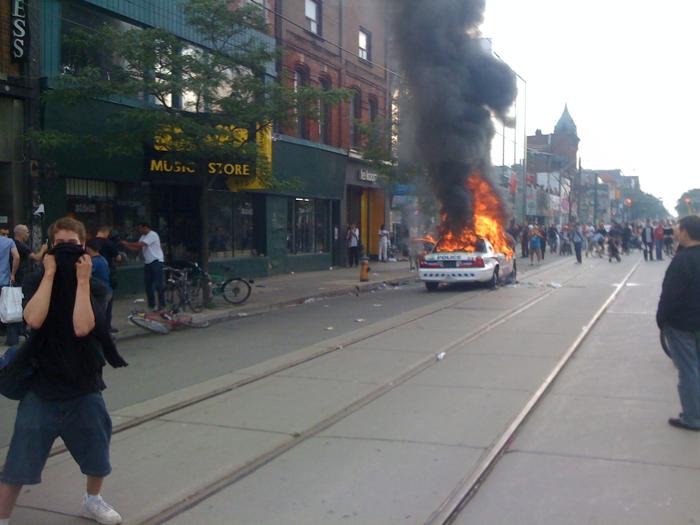
Pic from Eric Squair.
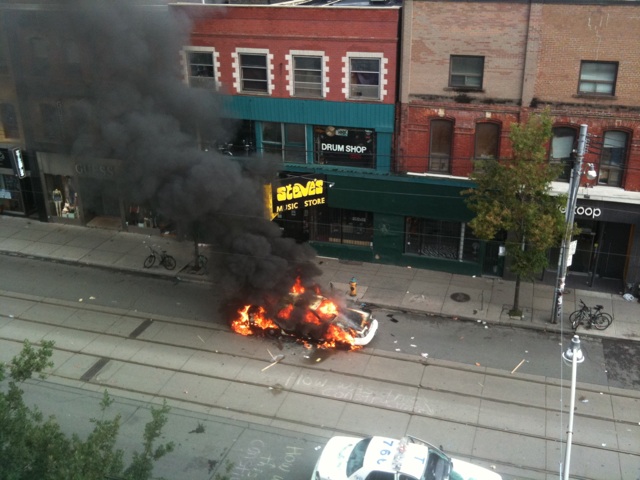
Pic from Pete Forde. The second police car in this photo also gets the warm treatment from the anarchists.
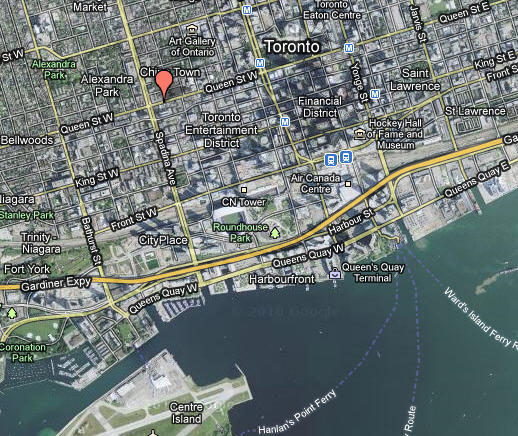
For those not familiar with Toronto, this is approximately here:
Update: Michael Coren has a suggestion to get the police more involved in deterring the rioters:
An idea. Tell the cops that these anarchist criminals are actually confused, gentle Polish visitors trying to find help at an airport. Not only will deadly force ensue but the police will lie about it all after the fact.
Update, the second: Another burning police car, further east at (I assume) Queen King St. and Bay St.
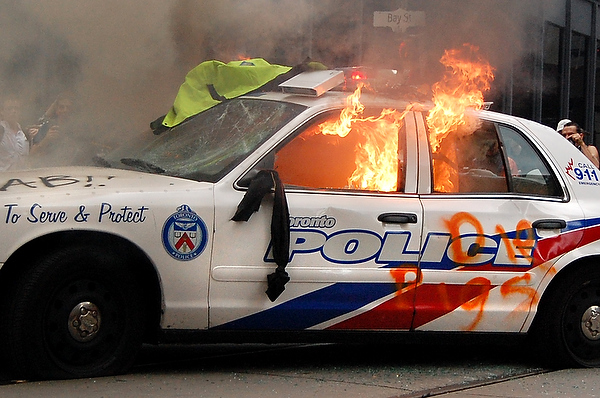
Pic by Marissa Nelson.
Update, the third: In spite of all the images available of burning or burnt-out police vehicles, the three above were the only ones. Rarely have so many twittered so much about so few . . .
Texas conservatives want to take you back
Take you back to the middle of the last century, or even further:
Texas Republicans are a conservative lot. Still, it’s difficult to imagine mainstream GOP voters demanding their neighbors be jailed for engaging in a little hanky-panky behind closed doors.
Nevertheless, the state’s Republican party has voted on a platform by which their candidates will stand, and it includes the reinstatement of laws banning sodomy: otherwise known as oral and anal sex.
The party’s platform also seeks to make gay marriage a felony offense, which may be confusing to most given that the state does not sanction or recognize same sex marriages, meaning any such ceremony conducted does not bear the weight of law. Whether this means the GOP wants gay couples married in other states to be pursued through Texas as dangerous criminals, the party did not specify.
“We oppose the legalization of sodomy,” the platform states. “We demand that Congress exercise its authority granted by the U.S. Constitution to withhold jurisdiction from the federal courts from cases involving sodomy.”
Texas Republicans must be a much more sexually repressed bunch if all of this managed to pass muster with the party faithful. They also appear to be in an anti-immigrant frenzy, with measures custom-designed to alienate Spanish-speaking voters also passed as part of the platform.
Comments Off on Texas conservatives want to take you back
June 25, 2010
QotD: The danger of electing real libertarians
I don’t know what it is, but when you go all the way down the libertarian path, it leads to complete insanity. Just look at Ron Paul followers — they’re pretend-to-be-Spock-and-bite-each-other crazy. The libertarian philosophy seems reasonable enough, but it somehow always leads to candidates who accidentally dye themselves blue or carry around a pet ferret named Gustav.
So anyway, let’s definitely get someone in 2012 sympathetic to libertarian ideals who is adamantly against fiscal irresponsibility and government expansion — and for individualism — but if any candidates start foaming at the mouth, screaming “FIAT MONEY!!!!!”, back away and don’t make eye contact. Still, pure libertarians have a place in the GOP, but they’re sort of like Murdoch to the Republican A-Team: They keep breaking him out of the insane asylum because he’s useful for certain situations, but they’re not going to put him in charge of anything. Or there will be much fool pitying.
Frank J. Fleming, “Libertarians and the Republican Party”, IMAO 2010-06-25
Comments Off on QotD: The danger of electing real libertarians


