
H/T to Terry Teachout.
June 25, 2010
June 24, 2010
The unhinged are now running Spanish “green” tech companies
As I read this, I kept hoping that it’d be fake:
Spain’s Dr. Gabriel Calzada — the author of a damning study concluding that Spain’s “green jobs” energy program has been a catastrophic economic failure — was mailed a dismantled bomb on Tuesday by solar energy company Thermotechnic.
Says Calzada:
Before opening it, I called [Thermotechnic] to know what was inside … they answered, it was their answer to my energy pieces.
Dr. Calzada contacted a terrorism expert to handle the package. The expert first performed a scan of the package, then opened it in front of a journalist, Dr. Calzada, and a private security expert.
The terrorism consultant said he had seen this before:
This time you receive unconnected pieces. Next time it can explode in your hands.
Dr. Calzada added:
[The terrorism expert] told me that this was a warning.
I have no idea what Spanish law says about this kind of blatant intimidation, but I hope there are charges laid and convictions resulting from those charges.
Spain, of course, recently announced that they were having to cut back on their plans to become the greenest country in Europe, as they couldn’t afford the additional costs, both up-front and in lost opportunities in other industries.
H/T to Ace for the link.
Update, 25 June: In the comments, Ed Darrell says I’ve been taken in and has a long post up with translations of the original article used by Ace and PajamasMedia: here. If Ed is right and I’ve been taken in, I’ll post a retraction. I’m sure he’ll do the same if it turns out to be true.
Update, 28 June: A clarification posted at Ace of Spades HQ makes it seem a bit less like a mock-bomb threat.
The Green company sending the package apparently had its actual package — a report — swapped with car parts at some point in the mailing. [. . .]
It didn’t look like, or feel like, a letter or report, so at that point Calzada got a security guard to scan it — and what was inside was a cylindrical object with wires attached. At that point, the security guard got an expert to examine it, with others in attendance. The contents were a container for diesel of some sort, and some other parts. The expert saw this as a bomb threat, based on a pattern used by, eg., ETA: “This one is a hoax bomb. The next one might not be.”
It’s a “Failure of its systems for monitoring”
Austin Bay thinks he’s identified the elephant in the European parlour:
Greece teeters on the edge. The Wall Street Journal‘s Paul Hannon wrote this week that “the failure of its (EU) systems for monitoring and controlling build-ups in government debt” are why the bailout loans given to Greece by the International Monetary Fund (IMF) and fiscally disciplined EU members like Germany became necessary.
He’s right. “Failure of its systems for monitoring,” however, is a euphemism — economic diplo-speak for a very difficult word: corruption. Greek governments cooked the books (its actual deficit is twice as high as officially reported), violated fiscal agreements and borrowed money they could not repay.
Corruption lies at the dirty core of the Euro-zone’s trouble. Governmental corruption and its cohort, illicit business practices, are a pervasive, multicultural, global affliction.
Corruption coupled with systemic lack of accountability — to include personal accountability, where managers and workers let lackadaisical and lazy work practices slide — eventually produces more than anger, cynicism and financial turmoil. Even among economies in the developed world, it stunts economic productivity, robs the future and sows the seeds of armed conflict. In the developing world it undermines aid efforts, manacles fragile economies and as a result condemns millions to poverty.
The big remaining question is no longer “Will the Euro fail?” but rather “Who’ll bail out first?”
Comments Off on It’s a “Failure of its systems for monitoring”
Australia changes PM
I hadn’t realized just how unpopular Kevin Rudd had become:
Although he scored a landslide election victory against an 11-year-old Liberal government led by John Howard in November 2007, he had said he was confident he would win the challenge. But commentators were already writing him off. “He’s a goner. You can stick a fork in him,” Nick Economou of Monash University told Reuters.
For Rudd, the transformation in his political fortunes has been startling. Only six months ago, with the opposition going through its third leadership change since he beat Howard, Rudd and his government seemed untouchable.
A year ago he rivalled Bob Hawke as Australia’s most popular prime minister. Now he will join Hawke as the only other Labor prime minister to be dumped by his party, making him the first one-term prime minister since 1932.
The new prime minister is Julia Gillard, who appears to be facing the kind of challenge that the first female prime minister of Canada faced: being held responsible for the sins of the last leader (Kim Campbell led the Progressive Conservatives into their worst election defeat ever, dropping from holding a decisive majority to only 2 seats).
Update: The Register thinks that one of the first changes Gillard will make is to fire the current Communications Minister:
Speculation was rife this morning (or evening, over in Australia) that controversial Communications Minister and architect of Australia’s great firewall project, Stephen Conroy may shortly be for the chop.
In his place, it is suggested, Australia’s new PM Julia Gillard might prefer the more conciliatory — and also better-informed — approach of Senator Kate Lundy.
If so, this is likely to prove a victory for those opposed to Conroy’s hard line on internet censorship, as Ms Lundy has made it clear over the last few months that she prefers to win support from Australia’s voters for an opt-in filter — instead of imposing a mandatory filter from the centre, which is the hardline stance favoured by the present Communications Minister.
If true, that will be a bit of good news for internet users in Australia.
June 22, 2010
June 17, 2010
Get in on Cap & Trade now!
If you were hesitating about whether to get involved in Cap and Trade, hesitate no longer:
I have become a convert on the Cap And Trade thing. I am all in; pedal to the metal; go for broke; shoot the moon; a true fracking believer now.
This C&T shit has more revenue generating potential than prohibition ever did. You’ll generally be dealing with a better class of people who aren’t as inclined to settle their differences with machine guns, which is a big plus. Another big advantage over bootlegging is there’s no actual product involved, so all the usual logistics and end point sales issues involved with smuggling vanish.
It is truly a beautiful beautiful thing; even better than selling lots on the moon or mars, because the government doesn’t force people to buy real estate on the moon and mars.
If Al Capone were alive today, he’d be a carbon trader.
Comments Off on Get in on Cap & Trade now!
June 11, 2010
What could possibly go wrong?
The US Senate is considering a bill that would give the President an internet “kill switch”. Funny how the one area most open to the widest possible spectrum of opinion and belief might be shut down at will, leaving only the regular propaganda outlets uncontrolled:
Under PCNAA, the federal government’s power to force private companies to comply with emergency decrees would become unusually broad. Any company on a list created by Homeland Security that also “relies on” the Internet, the telephone system, or any other component of the U.S. “information infrastructure” would be subject to command by a new National Center for Cybersecurity and Communications (NCCC) that would be created inside Homeland Security.
The only obvious limitation on the NCCC’s emergency power is one paragraph in the Lieberman bill that appears to have grown out of the Bush-era flap over warrantless wiretapping. That limitation says that the NCCC cannot order broadband providers or other companies to “conduct surveillance” of Americans unless it’s otherwise legally authorized.
Lieberman said Thursday that enactment of his bill needed to be a top congressional priority. “For all of its ‘user-friendly’ allure, the Internet can also be a dangerous place with electronic pipelines that run directly into everything from our personal bank accounts to key infrastructure to government and industrial secrets,” he said. “Our economic security, national security and public safety are now all at risk from new kinds of enemies — cyber-warriors, cyber-spies, cyber-terrorists and cyber-criminals.”
For those of you who think this is a super-cool neat idea (because Obama wouldn’t ever abuse this new rule), just try the mental image of George Bush or Sarah Palin with this kind of power. Still seem like a good notion?
Comments Off on What could possibly go wrong?
June 10, 2010
OTF threatens to punish students for ‘sins’ of the university
Spite and malice are the only reasons for this kind of blatant blackmail attempt by the Ontario Teachers’ Federation:
Nipissing University and the Ontario Teachers’ Federation may be headed for a full-blown confrontation over the institution’s decision to confer an honorary degree on former Ontario premier Mike Harris, a polarizing politician largely abhorred by the teaching community for his education reforms.
The federation warned the university in a May 12 letter that it “cannot predict how teachers may demonstrate their displeasure” if the ceremony goes ahead, but university president Leslie Lovett-Doust said on Wednesday Mr. Harris will, indeed, receive the honorary Doctor of Letters on Thursday afternoon.
[. . .]
The teachers’ organization has already hinted some of its members may choose not to place Nipissing students in highly coveted student-teacher positions, and the federation may add teeth to that veiled threat.
“The OTF executive could, as an option, inform Nipissing that we are going to recommend to our members that they not take teachers for practicum placement from Nipissing University,” said Sam Hammond, president of the Elementary Teachers’ Federation of Ontario, one of four affiliate organizations under the OTF.
Mike Harris has been out of politics for (effectively) the entire time the Nipissing students were in high school and university, yet their future careers are now being explicitly threatened by the OTF. What possible way can these young adults be held responsible for the actions of a long-retired politician? Clearly, even the idiots at the OTF don’t think this is reasonable . . . but they do think it’s worth ruining their public image to prevent Mike Harris from being given an honorary degree.
Update: Matt Gurney scrawls his illegible “x” on the dotted line of the protest petition:
Former premier Mike Harris personally and single-handedly destroyed my childhood. Just ask the Ontario Teacher’s Federation and its other, affiliated unions. They will happily confirm that Mr. Harris did indeed, knowingly and willfully, set out to ruin everything in this province that was pure and good. And they will not let that go unpunished.
The article, which must have been dictated and then painstakingly transcribed, is finished with this bio note: “Matt Gurney is a member of the National Post editorial board, even though, having been educated during the Harris years, he is, of course, illiterate.”
Penn Jillette wants more politicians like Rand Paul
Comments Off on Penn Jillette wants more politicians like Rand Paul
June 9, 2010
Book written in 1944 tops Amazon bestseller list
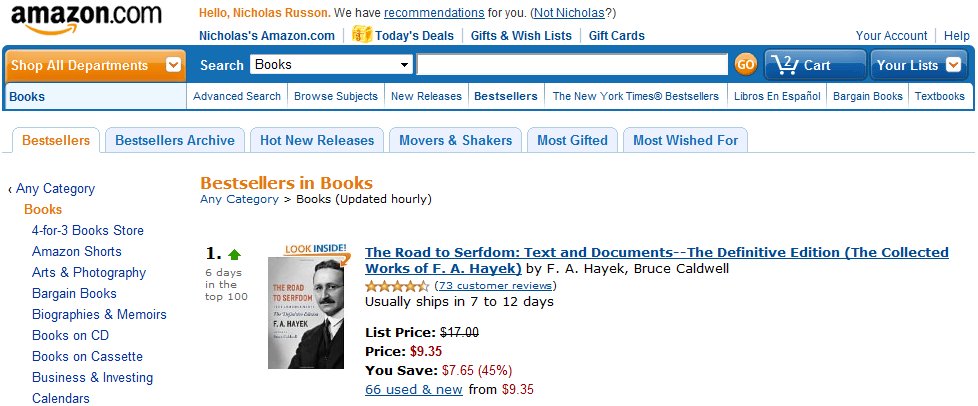
Admittedly, this is an updated and supplemented version of the original text, but it’s still impressive to see it selling so well.
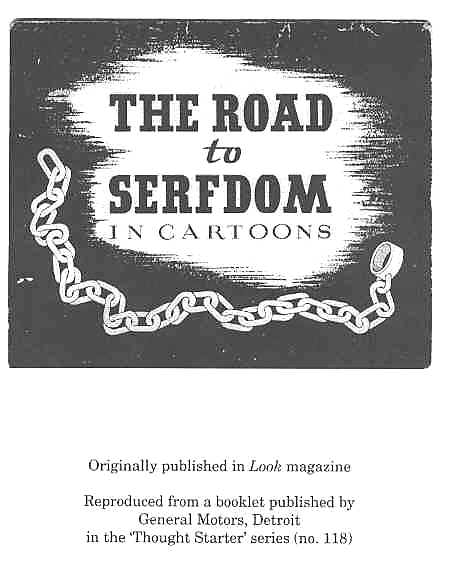
Update: American Digest has pages from the picture book version:
June 8, 2010
Questions of basic economics
Daniel Klein surveyed nearly 5,000 voting-age Americans on their basic comprehension of the political trade-offs on economic issues. He also asked them to identify themselves on the political spectrum. There were some interesting correlations:
Consider one of the economic propositions in the December 2008 poll: “Restrictions on housing development make housing less affordable.” People were asked if they: 1) strongly agree; 2) somewhat agree; 3) somewhat disagree; 4) strongly disagree; 5) are not sure.
Basic economics acknowledges that whatever redeeming features a restriction may have, it increases the cost of production and exchange, making goods and services less affordable. There may be exceptions to the general case, but they would be atypical.
Therefore, we counted as incorrect responses of “somewhat disagree” and “strongly disagree.” This treatment gives leeway for those who think the question is ambiguous or half right and half wrong. They would likely answer “not sure,” which we do not count as incorrect.
In this case, percentage of conservatives answering incorrectly was 22.3%, very conservatives 17.6% and libertarians 15.7%. But the percentage of progressive/very liberals answering incorrectly was 67.6% and liberals 60.1%. The pattern was not an anomaly.
[. . .]
The other questions were: 1) Mandatory licensing of professional services increases the prices of those services (unenlightened answer: disagree). 2) Overall, the standard of living is higher today than it was 30 years ago (unenlightened answer: disagree). 3) Rent control leads to housing shortages (unenlightened answer: disagree). 4) A company with the largest market share is a monopoly (unenlightened answer: agree). 5) Third World workers working for American companies overseas are being exploited (unenlightened answer: agree). 6) Free trade leads to unemployment (unenlightened answer: agree). 7) Minimum wage laws raise unemployment (unenlightened answer: disagree).
H/T to Ghost of a Flea.
Comments Off on Questions of basic economics
June 7, 2010
Suddenly, the decision makes less more sense
Kelly McParland connects the dots on Mayor Miller’s surprising conversion to honouring the fallen (original post here):
As Sun columnist Joe Warmington points out, there’s already a Highway of Heroes: It’s the route along the 401 that leads from CFB Trenton, where the bodies of Canadian soldiers killed in Afghanistan are brought home, to the coroner’s office near Queen’s Park in Toronto. Canadians spontaneously line the route each time a fallen soldier is returned. It’s not officially organized or directed — it’s just patriotic people showing their respect for the men and women who gave their lives to serve their country.
David Miller is about eight years late in recognizing that. Choosing a name that is similar but slightly different from the Highway of Heroes just confuses the issue: why does the route have to change names once it enters Toronto? Toronto is the city that couldn’t bring itself to allow fire trucks and ambulances to carry decals saying “Support our Troops”, and Miller was among those who wanted them taken off, in case someone got the mistaken impression Toronto actually supported the mission in Afghanistan.
Comments Off on Suddenly, the decision makes less more sense
June 5, 2010
Happy Tax Freedom Day! Maybe that’s not the right word . . .
Comments Off on Happy Tax Freedom Day! Maybe that’s not the right word . . .


