
I know a lot of people worry about slippery slopes; give the culture warriors an inch and they’ll take a mile. I think this is a very backwards way of looking at things. Like, the anti-gay people talked about a slippery slope and fought desperately hard against gay marriage, even though it was pretty hard to find anything actually objectionable about it other than that it might be on a slippery slope to worse things. That desperate fight didn’t delay gay marriage more than a few years, and it didn’t prevent whatever gay marriage was on a slippery slope to. What it did do was totally discredit conservatives in this area. Now any time anyone makes a family values argument, even a good family values argument, people can say that “family values” is code for homophobia, and bring up that family values conservatives really have held abhorrent positions in the past so why should we trust them now? It gave liberals huge momentum, and if there is a slippery slope then all that opposing gay marriage did was destroy the credibility of anybody who could have stopped us going down it.
Opposing a good idea on slippery slope grounds is a moral failure and a strategic failure …
Scott Alexander, “The Wonderful Thing About Triggers”, Slate Star Codex, 2014-05-30.
November 30, 2015
QotD: That dangerous “slippery slope”
November 29, 2015
President Nero
Last month, David Warren wrote about the Emperor Nero as if he were a modern American president:
While Rome burned, it is said, the Emperor Nero golfed, partied, and selfied. This, anyway, is my updated account. In an earlier version, he played his fiddle. The fire, which broke out in the evening of 18th July, 64 anno Domini (or 817, ab urbe condita), continued for a week, levelling ten of pagan Rome’s fourteen districts, and leaving at least half a million homeless. I gather it started in the merchant quarter, where fires usually started, back then. There were lots of merchants; there were lots of warehouse fires. And this despite numerous municipal regulations.
Read your Tacitus, however, and you will see that this rumour has been corrected. In fact, Nero rushed back to Rome from his palace at Antium (just outside the Beltway), took charge of the fire-fighting operation from the first night, opened public buildings and his own gardens to shelter the dispossessed, and made immediate arrangements to import huge quantities of grain into the city, for distribution free or at nominal cost. Criticisms of his Department of Homeland Security were feverish and unfair.
There is another problem with this rumour. The violin was not invented for another fifteen hundred years. Those still circulating the story should say he was playing on his cythera, instead. Nero was an enthusiastic and accomplished amateur musician; perhaps some people resented it. He was a man of culture; an Ivy League guy. But he was also an accomplished politician, and nobody’s fool.
Rumours that he set this fire himself are about as likely as rumours that George Bush started Hurricane Katrina. It would not have been in the chief executive’s interest to do so, in either case. For Nero was already sinking in the polls — curiously not because he’d ascended to office by having his mother kill his uncle, then killing his mother in turn; or many similar instances of hardball. Politics was politics then as now; success is to the ruthless. No, Nero was unpopular thanks to his growing reputation for ineffectuality. His failure to stop the fire hurt him in the same way as Bush’s failure to stop the hurricane.
After consulting with a few focus groups, Nero decided upon a scapegoat. He chose the Christians. He accused them of complicity in setting the fire, and his subsequent persecution of them — which included the martyrdoms of Saint Peter and Saint Paul — probably improved his popularity rating, at least slightly. From what I can make out, the early Christians were not well liked. People thought they were spooky and weird.
November 27, 2015
Wealth, inequality, and billionaires
Several months ago, the Washington Post reported on a new study of wealth and inequality that tracked how many billionaires got rich through competition in the market and how many got rich through political “connections”:
The researchers found that wealth inequality was growing over time: Wealth inequality increased in 17 of the 23 countries they measured between 1987 and 2002, and fell in only six, Bagchi says. They also found that their measure of wealth inequality corresponded with a negative effect on economic growth. In other words, the higher the proportion of billionaire wealth in a country, the slower that country’s growth. In contrast, they found that income inequality and poverty had little effect on growth.
The most fascinating finding came from the next step in their research, when they looked at the connection between wealth, growth and political connections.
The researchers argue that past studies have looked at the level of inequality in a country, but not why inequality occurs — whether it’s a product of structural inequality, like political power or racism, or simply a product of some people or companies faring better than others in the market. For example, Indonesia and the United Kingdom actually score similarly on a common measure of inequality called the Gini coefficient, say the authors. Yet clearly the political and business environments in those countries are very different.
So Bagchi and Svejnar carefully went through the lists of all the Forbes billionaires, and divided them into those who had acquired their wealth due to political connections, and those who had not. This is kind of a slippery slope — almost all billionaires have probably benefited from government connections at one time or another. But the researchers used a very conservative standard for classifying people as politically connected, only assigning billionaires to this group when it was clear that their wealth was a product of government connections. Just benefiting from a government that was pro-business, like those in Singapore and Hong Kong, wasn’t enough. Rather, the researchers were looking for a situation like Indonesia under Suharto, where political connections were usually needed to secure import licenses, or Russia in the mid-1990s, when some state employees made fortunes overnight as the state privatized assets.
The researchers found that some countries had a much higher proportion of billionaire wealth that was due to political connections than others did. As the graph below, which ranks only countries that appeared in all four of the Forbes billionaire lists they analyzed, shows, Colombia, India, Australia and Indonesia ranked high on the list, while the U.S. and U.K. ranked very low.
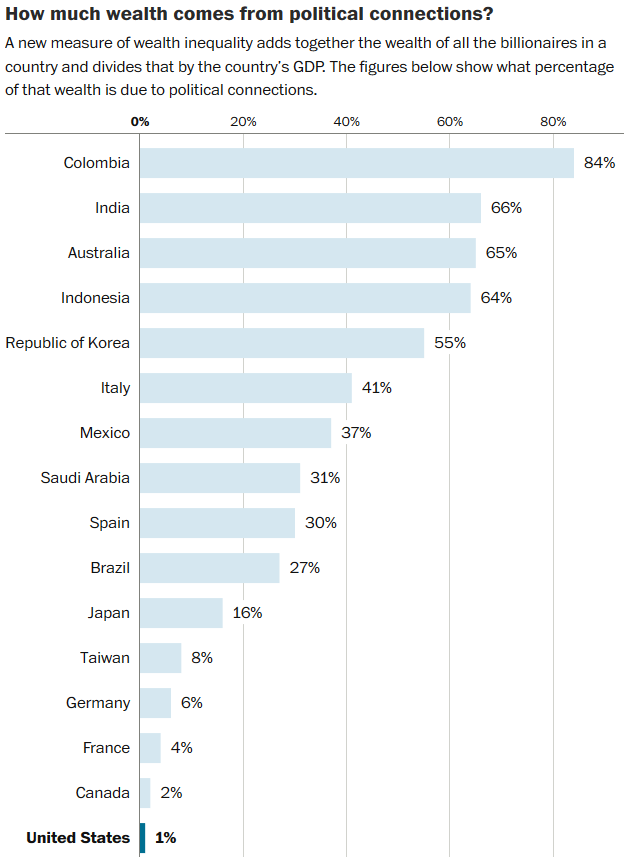
Looking at all the data, the researchers found that Russia, Argentina, Colombia, Malaysia, India, Australia, Indonesia, Thailand, South Korea and Italy had relatively more politically connected wealth. Hong Kong, the Netherlands, Singapore, Sweden, Switzerland and the U.K. all had zero politically connected billionaires. The U.S. also had very low levels of politically connected wealth inequality, falling just outside the top 10 at number 11.
When the researchers compared these figures to economic growth, the findings were clear: These politically connected billionaires weighed on economic growth. In fact, wealth inequality that came from political connections was responsible for nearly all the negative effect on economic growth that the researchers had observed from wealth inequality overall. Wealth inequality that wasn’t due to political connections, income inequality and poverty all had little effect on growth.
A different view of Uber and other ride-sharing services
Robert Tracinski on Uber as a form of “Objectivist LARP“:
If it sometimes seems like it’s impossible to restore the free market, as if every new wave of government regulation is irreversible, then consider that one form of regulation, which is common in the most dogmatically big-government enclaves in the country, is being pretty much completely dismantled before our eyes. And it’s the hippest thing ever.
I was reminded of this by a recent report about yet another attempt to help traditional taxis compete with “ride-sharing” services like Uber and Lyft: a new app called Arro, which allows you to both hail a traditional taxi and pay for it from your phone. So Arro takes a twentieth-century business and finally drags into the twenty-first century. This certainly might help improve the taxi experience relative to how things were done before. But it won’t fend off Uber and Lyft, because it doesn’t change the central issues, which are political rather than technological.
[…]
Uber has been hit with complaints that it’s running “an Objectivist LARP,” a live-action role playing of a capitalist utopia from an Ayn Rand novel. That’s pretty much what it is doing, and the results are awesome. And the benefits don’t stop with more drivers and lower rates. Uber is ploughing a fair portion of its profits into another wave of technological innovation—self-driving cars—that promises to offer even greater improvements in the future.
All of this should counter some of the despair about how to promote free markets, especially among urban elites who have been programmed by their college educations to embrace the rhetoric of the Left. Give them half a chance, and they will flock to capitalist innovations run according to the laws of the market.
The problem is that they don’t want to admit it. That’s where the euphemism “ride-sharing” comes in. To cover up the capitalistic nature of the activity, they tell themselves they’re “sharing” something that they are quite obviously paying for, and paying at market rates. Imagine what could be accomplished if they were just willing to drop the euphemisms and embrace the free market.
QotD: The myth of the “permanent majority”
Many Republicans seem confident that last week’s performance in the mid-term elections bodes the end of the Obama era, and the dawn of the bright Republican future. Many Democrats seem confident that last week’s performance in the midterms was a mere blip on the way to the Emerging Democratic Majority. Both sides would do well to read Sean Trende’s 2012 book, The Lost Majority, which I made my way through this weekend.
To state Trende’s thesis simply: There is no such thing as a permanent majority. Parties are coalitions of disparate groups of voters, and they win by strapping enough different groups together to push themselves across the electoral finish line. Unfortunately, the broader your coalition, the harder it is to hold together. Those different groups may have radically different values and interests; satisfying one may end up alienating the other. Trende suggests that the longest-lived coalition was not, in fact Franklin Delano Roosevelt’s famed “realignment,” which showed large cracks as early as 1937, but the Eisenhower coalition that lasted roughly from 1952 to 1988. As the dates suggest, the reason for unity was the external threat from the Soviet Union. That’s a pretty stiff price to pay for internal unity.
I took two major things away from the book: First, you can’t count on demographics to hand you a victory in such a vast and diverse country, because today’s coalition members may end up as a large and growing pillar of the opposition. And second, although both parties are constantly hunting for a mandate for radical change, the voters almost never deliver one. The party stalwarts may want to tear down the current edifice and start over, but the less ideological coalition partners are usually looking for some light redecorating, perhaps along with a specific personal interest like freedom of conscience in business operations, or less restrictive immigration policy. The harder the parties push on their ideological platforms, the faster the “coalition of everyone” starts leaking supporters to the opposition.
Megan McArdle, “No Party Will Get a Permanent Majority”, Bloomberg View, 2014-11-10.
November 26, 2015
November 25, 2015
National Review‘s Katherine Timpf will not apologize
At least, she’s not planning on apologizing for making a few (not-even-PG-rated) jokes about Star Wars. Her critics, in addition to pouring scorn and hatred on her for daring to joke about such a holy topic, also threaten her life:
Now, I received a few death threats right after I posted the aforementioned tweet — which, by the way, was why I was saying Star Wars fans were “crazy” in the first place. Overall, though, it wasn’t a big deal, and I kind of forgot about it.
Then, this week, one Star Wars super-super-super fan who calls himself “AlphaOmegaSin” made a ten-minute (!) video brutally ripping me apart.
The YouTube comments on his manifesto were even better. You know, stuff like:
justin 12 hours ago
Maybe a SW nerd needs to sneak into her dark room, dressed like her bf, rape her, but she doesn’t know it’s rape because she thinks it’s her BF.needmypunk 16 hours ago
I hope she gets acid thrown in her pretty little face.sdgaara2 1 day ago
Wouldn’t it be great if she was beaten to death with “space nerd sticks”Guardian978 22 hours ago
I want to cut that blonde c***’s face off and stick it to a thermal detonator. What a network full of c***s.dethklok21 1 day ago
Wow what a f***ing thunder c***. I hope this b**** gets hit by a f***ing car.Mikki Yeong 1 day ago
those death treaths are approved by me look at that b**** it’s a typical i wear big glasses to look smart but in fact i’m stupid as f*** btwthose glasses used to be only weared by nerds stupid h**TheValefor1984 1 day ago
We should get her address then bury her a** in Star Wars memorabilia lolTheGreenStreak452 1 day ago
I just want to burn Fox News to the ground and all their stupid employees.[Asterisks not in the original.]
To be fair, AlphaOmegaSin did say that he denounced threats on my life because “Just because you’re a f***ing idiot doesn’t mean that you should have to die.”
A problem with being a free speech absolutist is that you have to accept that some members of the community are going to use it to be as grotesquely offensive as they possibly can. Way to live down to expectations, Star Wars fans.
QotD: The microaggression industry
The bitterness, anger, and even hate that radiates from them is shocking to me. “This conversation doesn’t make me feel safe” is genuine, actual college speak, in the “microaggressions” school of thought. The purpose is to silence speech that the listener does not care for or that threatens their worldview.
They care nothing for liberty, or truth, or honesty, they do not want a world where people interact and learn from each other, they want nothing save a continual, comforting womb of support and confirmation of their worldview. And they’re more than willing to crush anyone or anything that threatens this.
This attitude might be a byproduct of the bubble wrap children, who were raised so carefully, protected, and supported that they never encountered anything that challenged or made them question themselves. It might be a subversive method of silencing speech and dissent from a political agenda that cannot survive rational discussion. It might be the result of a psychosis that cannot abide being questioned. It might be a combination of some or all of those things.
[…]
What’s most troubling to me is that the loudest, most insistent, and most publicly conspicuous of this group are those who at the same time insist that they are lovers of liberty and will not tolerate intolerance.
And yet here we are, in the 21st century, where academics have churned out an entire system designed to do exactly the opposite of what academia is meant to be: silence any debate, questioning, or interaction that in any way threatens one specific certain viewpoint. And its done with passive-aggressive behavior taken to an astounding depth of creativity and precision.
Christopher Taylor, “SOCIAL JUSTICE KITTENS”, Word Around the Net, 2014-10-22.
November 23, 2015
November 19, 2015
November 18, 2015
The Trudeau legacy
At Gods of the Copybook Headings, Richard Anderson isn’t impressed with the PM, who he refers to as “our selfie Prime Minister”, and contrasts him with his father:
Canada is a bubble nation. We have so long been at peace, so long been rich and free, that much of the world beyond our borders is akin to another planet. The working assumption of the Canadian Left — Justin very much included — is that Islamist terrorism is the product of some grave misunderstanding. If only we were to constructively engage with those who oppose us peace would be at hand. All we need is a chance for dialogue and our graduate school acquired “conflict resolution skills” would restore humanity and decency. This is among the gravest misconceptions of our age.
Trudeau the Elder considered both the FLQ and the PQ threats to Canada’s survival. Yet his response to each was radically different. Terrorism was beyond the bounds of legitimate democratic discourse. Force must be met with force. He explained this with great care in his speech justifying the invocation of the War Measures Act. It shows a statesman — however deeply flawed in other areas of public policy — fighting to sustain a democratic government against violent usurpation. The speech is also a stark and sobering contrast to his son’s juvenile pronouncements.
Yet PET took a very different approach in dealing with democratic separatism. The PQ — however obnoxious and cynical — was a legitimate democratic force. When the Pequistes formed their first majority government in 1976 the response from Ottawa was to argue, cajole and bribe. The usual instruments of a democratic state. It would have been thought absurd and utterly unCanadian to have dispatched federal troops to arrest Rene Levesque and his cadre of petty ethnic nationalists.
Pierre Trudeau could only occasionally distinguish between bad and outright evil. He could crush the FLQ and then saunter off to Cuba to play sing-a-long with a mass murdering tyrant. Though at least at that point in history Fidel Castro was hardly a threat to world peace. Trudeau’s 1976 trip was a morally repugnant though not a dangerous act.
Islamist fanatics are very much a threat to the peace of France, Canada and the world. In his first test as an international leader Justin has shown a dangerous inability to differentiate between bad and evil. Since Canada is a smaller player in a big world that might not matter very much in the short-term. Yet sooner or later this evil will come to Canada and the man charged with our defence has shown himself to be pathetically inadequate to the challenge.
November 17, 2015
Jonah Goldberg – “You Stupid Schmucks, Look at You Now”
Jonah Goldberg’s weekly “news”letter last week covered the entertaining spectacle of legions of progressive thinkers turning on their own allies:
… this “crisis” is 100 percent liberalism’s fault. Sure, sure, you can divvy up the slices of blame in different ways, but those guys tailgating in the parking lot drinking beers and eating bratwurst? Those are the conservatives and libertarians enjoying a day off, because they don’t have to wait in line for even a morsel of blame.
I almost feel sorry for those decent, sincere career liberals standing there in the quad as the little Maoists scream in their faces and strip off the suede elbow patches on their tweedy jackets like a lieutenant being busted down to a private. As the kids fit lifelong members of the ACLU with their duncecaps, the poor souls can hear the conservatives hooting and laughing off beyond the fence, throwing nerf footballs and telling jokes at the liberals’ expense.
[…]
Outside of the actual headquarters of the Democratic party itself, no major institution in America today is more thoroughly run and controlled by the Left than academia.
For several years now, whenever I’ve visited a college campus, I’ve tried to make the following point. It basically goes like this:
You kids think it is somehow rebellious to be liberal. So let me see if I get this right. The administrators at this school are liberal. The professors are liberal. Your high-school teachers were probably liberal. Your textbooks are, for the most part, liberal. Hollywood is liberal. The music industry is liberal. The fashion industry is liberal. Publishing is liberal. The mainstream media are liberal. Silicon Valley is liberal. Believe it or not, most corporations and the overwhelming majority of charitable foundations are liberal.
And yet, you think you’re sticking it to the man by agreeing with them?
Moreover, it’s been like this for generations. It was true when most of these administrators and faculty were born — they have grown up inside a universe where this fact was simply taken for granted. With the Left given total control of these oases of tolerance and citadels of progressivism, what do we get?
We get pampered and coddled students screaming that these institutions are hotbeds of racism, homophobia, sexism, and the rest of the 31 Flavors of Oppression.
I’m sorry, but over here by the hibachi in the parking lot, that’s just frick’n hilarious.
And it is fitting. It is just. It’s almost frick’n Biblical in its justness. You see, there is precious little bigotry and prejudice on college campuses. But the bulk of what does exist is aimed almost entirely at the guys and gals chilling at the tailgate party. Pro-life Christians, Israel-supporting Jews, libertarian professors, conservative scholars, climate-change skeptics, traditionalists of every stripe including classical liberals, and, of course, people who can take a joke: These make up the bulk of the victims of campus bigotry and prejudice. I can’t tell you how many professors I’ve met who have to keep their conservatism secret, at least until tenure, if not forever. I’ve never met or heard of a faculty member who had to keep her Marxism on the down-low.
November 14, 2015
Trigger warnings and Yale
Jonathan Rauch discusses the now famous Yale courtyard temper tantrum:
During protests that followed, undergraduates confronted Nicholas Christakis, the master of Silliman, in a courtyard. When he told a student he disagreed with her claim that his job is “to create a place of comfort and home for the students that live in Silliman,” she began screaming at him: “Then why the f–k did you accept the position! Who the f–k hired you? You should step down! If that is what you think about being a master, you should step down. It is not about creating an intellectual space! It is not! Do you understand that? You are disgusting!”
The self-infantilization on display in this tirade lacked even the dignity of a sinister ideology. Its point was more like: “I want my mommy.”
But if students feel the modern university’s job is to create a “place of comfort” rather than an “intellectual space,” that is hardly all their fault. Many parents of my generation make it their business to spare their children any exposure to upset and risk. Then kids and parents alike are wooed by colleges that promise idyllic experiences at very steep prices.
Yale, for example, markets its residential colleges as “little paradises.” No wonder if some students expect college to provide shelter from intellectual and interpersonal storms.
And no wonder the movement for trigger warnings and safe spaces is gaining traction at colleges around the country. Trigger warnings supposedly help students cope with (or avoid) exposure to upsetting ideas and images; their other purpose, I and many other free-speech advocates believe, is to chill the presentation of controversial material. Either way, they seek to make higher education emotionally safer by making it less intellectually dangerous.
He also suggests the most appropriate kind of trigger warning to provide:
So it is only fair to warn students and their parents that higher education is not a Disney cruise. Tell them in advance so they can prepare. Not, however, with multiple trigger warnings festooning syllabi. One will suffice:
“Warning: Although this university values and encourages civil expression and respectful personal behavior, you may at any moment, and without further notice, encounter ideas, expressions and images that are mistaken, upsetting, dangerous, prejudiced, insulting or deeply offensive. We call this education.”
Display that trigger warning prominently on the college website. Put it in the course catalog and in the marketing brochures. Then ask students and their parents to grow up and deal with it. And watch as they rise to the challenge.
November 12, 2015
“Camille Paglia is an intellectual flamethrower”
In The Chronicle of Higher Education, Rachel Toor talks to Camille Paglia:
Not long after she had splashed onto the scene with the publication of her first book, Sexual Personae: Art and Decadence From Nefertiti to Emily Dickinson, and followed that up with an essay in The New York Times claiming that Madonna was the future of feminism, I went to see Camille Paglia speak on a panel about political correctness at New York University. My recollection is of being frisked by armed guards before being allowed to enter the auditorium, but it’s more likely we just had to empty our pockets and go through a metal detector. That I thought the extra protection was for the professor from a small arts college in Philadelphia, and not for another speaker on the dais, Edward Said, tells you something about how Paglia was regarded in the circles in which I traveled.
Camille Paglia is an intellectual flamethrower. She’s fearless. She can be bully-mean and a name caller. She makes some people really, really mad. But she’s also a serious thinker who has been able to write important scholarly books that cross over into a wide readership, and you can regularly find her byline in national magazines, where it’s always a treat to read her sentences. Whether she’s writing about the Obama administration, characterizing cats (in Sexual Personae) as the “autocrats of self-interest,” rhapsodizing about The Real Housewives, or bludgeoning feminists, Christopher Hitchens, or Jon Stewart, she is sometimes right and never boring.
I approached her for this series with trepidation. I was eager to hear what she had to say about writing, but, to be honest, I was a little afraid of her (she called my former boss, Stanley Fish, a “totalitarian Tinkerbell”). Silly me. Camille could not have been more gracious, personable, or fun. She did tell me with a bit of glee that my former employer, Oxford University Press, was one of the seven publishers who rejected Sexual Personae. Thankfully that was before I started working there.


