
Reaction isn’t a conspiracy theory; it’s not suggesting there’s a secret campaign for organized repression. To steal an example from the other side of the aisle, it’s positing something more like patriarchy. Patriarchy doesn’t have an actual Patriarch coordinating men in their efforts to keep down women. It’s just that when lots of people share some really strong cultural norms, they manage to self-organize into a kind of immune system for rejecting new ideas. And Western society just happens to have a really strong progressivist immune system ready to gobble you up if you say anything insufficiently progressive.
And so the main difference between modern liberal democracy and older repressive societies is that older societies repressed things you liked, but modern liberal democracies only repress things you don’t like. Having only things you don’t like repressed looks from the inside a lot like there being no repression at all.
The good Catholic in medieval Spain doesn’t feel repressed, even when the Inquisition drags away her neighbor. She feels like decent people have total freedom to worship whichever saint they want, total freedom to go to whatever cathedral they choose, total freedom to debate who the next bishop should be – oh, and thank goodness someone’s around to deal with those crazy people who are trying to damn the rest of us to Hell. We medieval Spaniards are way too smart to fall for the balance fallacy!
Wait, You Mean The Invisible Multi-Tentacled Monster That Has Taken Over All Our Information Sources Might Be Trying To Mislead Us?
Since you are a citizen of a repressive society, you should be extremely skeptical of all the information you get from schools, the media, and popular books on any topic related to the areas where active repression is occurring. That means at least politics, history, economics, race, and gender. You should be especially skeptical of any book that’s praised as “a breath of fresh air” or “a good counter to the prevailing bias”, as books that garner praise in the media are probably of the “We need fifty Stalins!” variety.
Scott Alexander, “Reactionary Philosophy In An Enormous, Planet-Sized Nutshell”, Slate Star Codex, 2013-03-03.
November 12, 2015
QotD: What repression looks like from the inside
November 10, 2015
The “War on Christmas” opens another front … at Starbucks
Katherine Timpf can’t believe that anyone is taking this nonsense in any way seriously:
Please stop embarrassing yourselves.
I woke up this morning to find that real, adult people are actually upset that Starbucks’s holiday cups do not mention Christ or Christmas on them — and the absence of such language as an attack on their religion.
Yep, that’s right. The “War on Christmas” season has arrived, and Starbucks has chosen the side of the godless hedonism that is destroying our society. Don’t let the fact that it still sells a Christmas Blend, a “Merry Christmas” gift card, and an Advent calendar fool you — Starbucks is clearly The Devil’s Coffee, and you have every right to be this upset.
That is, of course, if you are an insane person.
The “culture of ‘You can’t say that!’ in all its swirling, borderline violent ugliness”
Brendan O’Neill in sp!ked on the Halloween derangement syndrome at Yale:
Video footage of Yale students losing the plot over a faculty head who said everyone should calm down about Halloween has caused much head-shaking in liberal circles. And it isn’t hard to see why. The head’s crime was that his wife sent an email suggesting academics and students should chill out about ‘culturally insensitive’ Halloween costumes. It’s okay, he said, to be a ‘little bit inappropriate or provocative or, yes, offensive’ on this one day. For his wife issuing this mildest of rebukes to over-sensitive over-18s, he was accosted by a mob of students insisting the email made them feel unsafe. When he told the crowd that he thinks university is about providing education, not a ‘safe home’, they screamed at him to ‘step down!’. ‘Who the fuck hired you?!’, the most unhinged of the students cries.
It’s unnerving, odd, a terrifying snapshot of the new intolerance. We could see the culture of ‘You can’t say that!’ in all its swirling, borderline violent ugliness. It wasn’t a whispered or implied ‘You can’t say that!’, of the kind we see all the time in 21st-century public life, in response to people who criticise gay marriage, say, or doubt climate change. No, this was an explicitly stated ‘You can’t fucking say that, and if you do we’ll demand that you be sacked!’ That it was stated at Yale, and in response to a bloody email about Halloween, has added to the hand-wringing among liberals, who want to know what’s gone wrong with the new generation.
Okay, fine. It is indeed interesting, and worrying, that students are so sensitive and censorious today. But I have a question for the hand-wringers, the media people, academics and liberal thinkers who are so disturbed by what they’re calling the ‘Yale snowflakes’: what did you think would happen? When you watched, or even presided over, the creation over the past 40 years of a vast system of laws and speech codes to punish insulting or damaging words, and the construction of a vast machine of therapeutic intervention into everyday life, what did you think the end result would be? A generation that was liberal and tough? Come off it. It’s those trends, those longstanding trends of censorship and therapy, that created today’s creepy campus intolerance; it’s you who made these monsters.
November 9, 2015
Premature revolutionaries
Nigel Davies doesn’t post frequently, so it sometimes takes me a while to see his latest effort. Back in September, he posted a discussion of the “Arab Spring” revolutions and the inability of western intellectuals to derive any lessons from them:
When journalists were going nuts a few years ago about the wonders of the wave of ‘revolutions’ that they decided to refer to as an ‘Arab Spring’, I was reminded how few modern academics, let alone journalists, have any understanding of history. None of the political analysts or professional pundits seemed to have much more of a clue about how things would INEVITABLY turn out, than babes in a wood.
Which is ridiculous, because you would imagine that anyone with a pretense of being worth consulting might have at least a clue that there might be historical parallels worth considering. Frankly it is terrifying that our modern ‘chattering classes’ honestly seem to imagine that they are above being able to learn anything from history.
1848 of course saw a wave of ‘revolutions’ all across Europe, which many people at the time hailed as the inevitable downfall of the ancient regimes, and the prelude of the rise of true modern democracy. How sweet.
In fact, of course, the revolutions led to a re-imposition of the ancient regimes, or much worse dictatorships: often with harder edges to prevent such things happening again. In fact it can be credibly argued that the results of this wave of revolutions was to slow down the democratization of Europe by at least 50 years.
I suspect the same thing will result from the Arab Spring.
‘Revolutions’ tend to kick off way before the society as a whole is really ready for them. Usually as pre-emptive takeover attempts by the newly educated middle class ‘intelligentsia’, (or chattering class as we would call them, or ‘twitteratti’ as I have recently heard the political ‘pundits’ ruthlessly described).
Unsurprisingly these newly graduated minor functionaries, petty civil servants, and junior lawyers, want more say in the power structure of the state than the traditional ruling class has previously allowed them. Unsurprisingly – I suppose – they want it immediately… Or as Billy Connelly said in a skit, “We want it now, we want it yesterday, we want to control half of that, most of that, f….ing ALL of that, and stay awake, because tomorrow the demands will change!”
The problem with the proto middle classes jumping the gun and trying to impose their idealized version of democracy before the working class (read average voter) is even half way down the trail to a similar level of literacy and political interest and philosophical conceptualization: is that the resulting mad theories are far too complex for the voters, and NO imagined safe-guard can stand up to the combined ignorance and misunderstanding of the newly enfranchised. The result is, absolutely inevitably, a dictatorship.
QotD: Suppressing dissent
These are the chocolate sipping onesie boys of the world, who emote without thought and cringe at perceived aggressions by people who challenge their certainties. Brutality, bullying, rape, they cry. And in a polite society, their approach tends to shut down any talk.
Its the flip side of the Online Forum Effect where there is a tourettes-like tendency of some to bring up in any conversation and any occasion their pet political viewpoints. They do it loudly and angrily, and become so unpleasant that everyone around them learns to just shut up about some topics in the hopes that they won’t provoke another episode that ruins everything for everyone. And in the process, they win by silencing any dissent or alternate viewpoint. By not allowing anyone to gainsay or question their absolute certainty on a topic, all that everyone is left with is their regular outbursts on every subject.
And in time, that wears down all but the most strong of wills by the Big Lie. After all, I don’t hear anyone disagreeing with them or showing how they are wrong, and they wouldn’t be so very strong and insistent about this if it wasn’t at least somewhat true. They aren’t crazy or lying all the time, nobody would do that…
And until this changes, until this atmosphere at institutions of higher learning changes, until this approach toward academia and culture is different, then the entire exercise of education is pointless. How can you expect anyone to get an honest, valuable education in this kind of atmosphere? What kind of worldview and what sort of behavior is being inculcated by this kind of attitude? Nothing healthy.
Christopher Taylor, “SOCIAL JUSTICE KITTENS”, Word Around the Net, 2014-10-22.
November 7, 2015
The demand for trigger warnings may make teaching “difficult” subjects practically impossible
In Salon, Rani Neutill explains what happened in the class she taught where she provided exactly the sort of trigger warnings in advance of all potentially disturbing material:
About a year ago I was asked to teach a class about the evolution of the representation of sex throughout American Cinema. I started with the silent film (The Cheat) and ended with Spike Jonze’s disembodied sex in Her. Along the way, I showed a number of sexually graphic films that caused a great deal of controversy.
At the time I was teaching the course, I was also figuring out a life outside of academia. I had been a wandering postdoc for a long time and was tired. A friend of mine had recently been violently sexually assaulted. I was a witness. The trauma she suffered, from the assault and the long, drawn-out trial of her assailants, led me to volunteer at my local rape crisis center. Working directly with folks who have experienced trauma, I entered the course believing in trigger warnings and gave them throughout the class, even though it seemed as though the title of the course was a trigger warning in and of itself. Regardless, I gave them for almost every film I showed. I even gave them for films that really shouldn’t have needed them (i.e., Psycho).
Midway through the semester, because of my work in sexual assault prevention, I was asked to fill in for the Director of the Office of Sexual Assault Prevention Services at the university. The Director had to take a short leave so I was there to fill in temporarily. In accepting the position, I took on a dual role. First, I was an activist against sexual violence, supporting survivors on campus, but I was also an educator who believed that learning is about shaking up one’s world and worldview. I didn’t realize that occupying both roles at once would be impossible; failure was inevitable.
[…]
I began class by talking briefly about learning through discomfort. The students were silent. I turned to them for questions about moments of feeling uncomfortable and how we could read these as productive. The student who came to my office raised her hand and asked, “Are we gonna talk about SSBAS.”
“Yes,” I said, “but I want us to talk about any of the films that made people uncomfortable. Let’s discuss the discomfort.” Her face fell. She started crying and ran out of the room. Her friend followed her. Right after she left I showed the scene with Omar. Later that day, she came to my office again, sobbing.
For the rest of the semester, I gave trigger warnings before every scene I screened. Every. Single. One. This wasn’t enough. A student came to me and asked that I start sending emails before class outlining exactly which disturbing scenes I would be showing so that I wouldn’t “out” survivors if they had to walk out of class when hearing what I was about to show. This took all the free form and off the cuff ability to teach. It stifled the teaching process. There would never be a moment for me to educate them by confronting them with the unknown, by helping them become aware of their own biases by making them feel uncomfortable.
DND briefings to the new minister
It would be fascinating to find out if the Department of National Defence briefing to incoming minister Harjit Sajjan are quite as blatantly PR-focussed as the documents provided to former minister Jason Kenney when he took over the portfolio in February:
A new Liberal defence minister will inherit a self-conscious department that seems more than a little concerned about how it’s perceived by the public.
When Jason Kenney took over as national defence minister in February 2015, he was briefed with a thicker stack of papers about public opinion and media operations than about the North Atlantic Treaty Organization, the North American Aerospace Defense Command, Operation Reassurance and Operation Impact combined.
Embassy obtained the transition books for Mr. Kenney through an access to information request. Similar documents may be provided to a new minister when prime minister-designate Justin Trudeau names his Cabinet Nov. 4.
In a book about “Key Strategic Issues,” about 70 pages long, there are 17 pages worth of public opinion and media analysis, complete with graphs tracking Canadians’ perceptions of the department over years of polling data.
Conversely, only two pages of the document appear to be entirely devoted to Operation Reassurance in Central and Eastern Europe, two pages to Operation Impact in Iraq and Syria, four to NATO and two to NORAD.
[…]
Another transition book, titled “Who We Are and How We Work,” provided a broader departmental overview to the new minister of national defence.
Just shy of 70 pages, it includes information about ongoing Canadian Armed Forces operations, including all international engagements. It also gave the incoming minister a handy guide to key department officials, complete with photos and biographies.
A brief on strategic decision-making acknowledges that a prime minister or defence minister can make unilateral decisions on defence policy.
Cabinet does not need to sit together as a whole for major decisions to be made, the document explains.
“In some cases, a deployment decision will be made by a cabinet committee and, in others by the prime minister, or by the minister of national defence alone, or in conjunction with the minister of foreign affairs,” the transition book states.
H/T to MILNEWS.ca for the link.
November 6, 2015
Canada’s new Minister of National Defence
In the National Post, Adrian Humphreys provides a look at the new defence minister in Justin Trudeau’s cabinet:
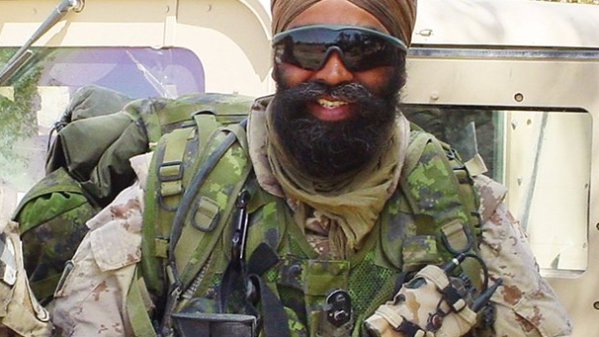
Many defence ministers pose for photos with military hardware, but few pull off the true badass combat stance as well as Harjit Singh Sajjan — draped in flak jacket and camouflage, gripping an assault rifle on an actual battlefield.
Sajjan was, until recently, a decorated Lieutenant-Colonel in the Armed Forces, the first Sikh Canadian to command an army regiment.
“Command breaks down barriers because no one looks at what you look like when the bullets are flying,” he said in 2011. “Having to carry your, you know, wounded soldiers off the battlefield, not just wounded, but the ones that have been killed and place them into a helicopter, nothing prepares you for that.”
Sajjan, sworn in Wednesday as Canada’s new Minister of National Defence, was, in military lingo, “a trigger puller.”
He was deployed to Bosnia-Herzegovina and three times to Afghanistan, for which he was awarded one of the military’s highest recognitions, the Order of Military Merit, for reducing the Taliban’s influence in Kandahar Province.
“He has a taste for the reality of war and that’s very, very important,” said David Bercuson, director of the Centre for Military, Security and Strategic Studies at the University of Calgary.
“He will have seen the aftermath of the effect of war on some of our men and women, which is a major issue with veteran’s affairs,” said Bercuson.
[…]
He served as a reservist, and was deployed with the Canadian peacekeeping forces to Bosnia in 1996.
In 2006 he served in Afghanistan, playing a key intelligence advisory role to Brig.-Gen David Fraser in the successful Operation Medusa offensive against the Taliban. He returned to Afghanistan in 2009 and 2011.
Rising to the rank of reserve lieutenant-colonel, he was named commander of the B.C. Regiment (Duke of Connaught’s Own), in 2012.
I’m pleased that Trudeau managed to find someone to fill this cabinet post who has actual military experience in the field (as opposed to a former general or admiral). I hope he can fight his political corner to get the Canadian Forces the updated equipment they so desperately need, even if the F-35 is not going to be part of the package (Trudeau explicitly promised to drop the F-35 purchase during the election).
Turkish politics, post-election
Austin Bay looks at Turkey’s domestic political situation following the re-election of Recep Erdoğan’s Justice and Development Party:
The threat to Turkish democratic institutions is a man notoriously jealous of Ataturk, current president Recep Tayyip Erdoğan. The snap election gave Erdoğan and his Justice and Development Party, AKP, overwhelming control of parliament (316 of 550 seats). The AKP had controlled parliament since 2002, but in the June 7 election it lost its one-party majority. Political haggling among opposition parties, including Ataturk’s Republican Peoples Party, the CHP, failed to produce a coalition government; a new election was necessary.
However, in the intervening month’s domestic terrorist incidents, the fitful war with the Islamic State in the Levant and Syria’s violent chaos dominated Turkish politics.
Erdoğan portrayed himself as the only leader capable of addressing Turkey’s deteriorating security situation. Domestic security certainly diminished; why it did stirs angry accusations. Erdoğan’s political opponents maintain that he used the violence to solidify political support. His more vicious critics accuse him of intentionally permitting violence. For example, they argue his government could have prevented the Oct. 10 terror bombing of a peace march in Ankara, now attributed to ISIL. Over 100 people were murdered in that attack.
Is it an over the top conspiracy theory-type accusation? Possibly. Erdoğan himself, however, believes over the top conspiracy theories, and he uses conspiratorial doubt and fear as political tools. His record for jailing journalists and intimidating political opponents associated with his alleged conspiracies is fact, not theory. The election didn’t assuage his fears — it ignited another surge of arrests. On Nov. 3, police arrested scores of people associated with Erdoğan critic and Muslim cleric Fethullah Gulen. At one time Gulen supported Erdoğan and the moderate Islamist AKP. However, Gulen broke with Erdoğan over credible charges of corruption within Erdoğan’s governing circle.
Daniel Pipes isn’t convinced that the terror stampeded voters in Erdoğan’s direction (especially Kurdish voters), and he suspects fraud in the election results:
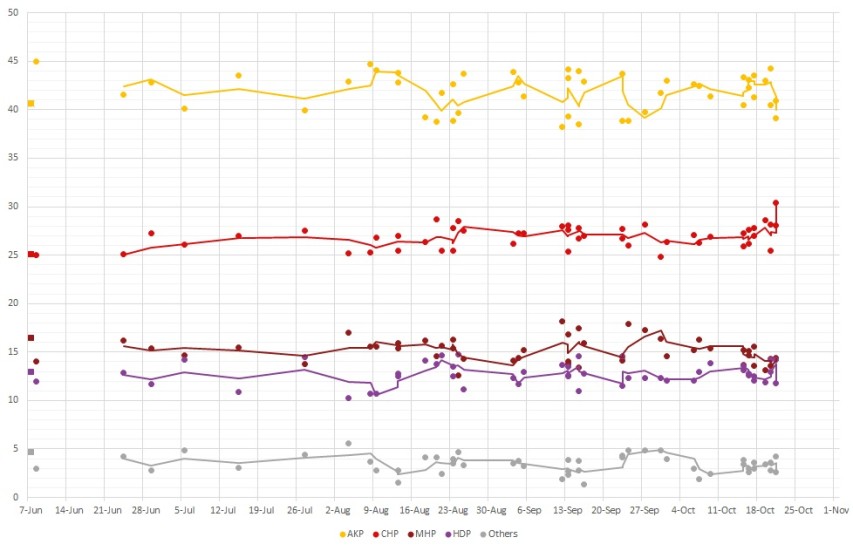
Like other observers of Turkish politics, I was stunned on November 1 when the ruling Justice and Development Party (Adalet ve Kalkınma Partisi, or AKP) was reported to have increased its share of the national vote since the last round of elections in June 2015 by 9 percent and its share of parliamentary seats by 11 percent.
The polls had consistently shown the four major parties winning about the same number of seats as in June. This made intuitive sense; they represent mutually hostile outlooks (Islamist, leftist, Kurdish, nationalist), making substantial movement between them in under five months highly unlikely. That about one in nine voters switched parties defies reason.
Polling results between the June and November 2015 Turkish elections
The AKP’s huge increase gave it back the parliamentary majority it had lost in the June 2015 elections, promising President Recep Tayyip Erdoğan a semi-legal path to the dictatorial powers he aspires to.
But, to me, the results stink of fraud. It defies reason, for example, that the AKP’s war on Kurds would prompt about a quarter of Turkey’s Kurds to abandon the pro-Kurdish party and switch their votes to the AKP.
November 5, 2015
Do you have a sufficient supply of pronouns yet?
Another link I saved a while back and then didn’t get around to using until now:
A private Southern California women’s college now offers students eight different gender pronoun options from which to select, expecting professors and others on campus to use the choices.
The Claremont-based Scripps College, nicknamed “The Women’s College,” offers the gender pronoun options to students through its online student portal accounts. Students use a drop-down menu to select their preference from ten choices – eight of which are various gender pronoun sets such as “Hu, Hum, Hus,” “Per, Pers, Perself” and “Ze, Zir, Zir.” The other two are “none” and “just my name.”
Once students select their preference, a note of it appears on class rosters and other documents informing professors and others.
Though an all-female institution, the drop-down list does not default to the “She, Her, Hers, Herself” option, but instead, “Select Pronoun.” In fact, the choices are listed in alphabetical order, which places the traditional “she/hers” choice as the seventh possibility.
The list of options, along with phonetic pronunciations for the less frequently used choices, was provided to The College Fix by a campus official:
1. E/Ey, Em, Eir/Eirs, Eirself/Emself (A, M, ear, ears, earself)
2. He, Him, His, Himself
3. Hu, Hum, Hus, Humself (hue like HUman,/hue-m like HUMan, hue-s, hue-mself)
4. Just My Name Please
5. None
6. Per, Per, Per/Pers, Perself (per/purr, pers, perself)
7. She, Her, hers, Herself
8. They, Them, Their/Theirs, Themse
9. Ze, Hir, Hir/Hirs, Hirself (zee, hear, hears, hearself)
10. Ze, Zir, Zir/Zirs, Zirself (zee, zeer, zeers, zeerself)
The high-church organic movement is feeling under threat
Henry I. Miller & Julie Kelly on the less-than-certain future of the organic farming community:
The organic-products industry, which has been on a tear for the past decade, is running scared. Challenged by progress in modern genetic engineering and state-of-the-art pesticides — which are denied to organic farmers — the organic movement is ratcheting up its rhetoric and bolstering its anti-innovation agenda while trying to expand a consumer base that shows signs of hitting the wall.
Genetic-engineering-labeling referendums funded by the organic industry failed last year in Colorado and Oregon, following similar defeats in California and Washington. Even worse for the industry, a recent Supreme Court decision appears to proscribe on First Amendment grounds the kind of labeling they want. A June 2015 Supreme Court decision has cleared a judicial path to challenge the constitutionality of special labeling — “compelled commercial speech” — to identify foods that contain genetically engineered (sometimes called “genetically modified”) ingredients. The essence of the decision is the expansion of the range of regulations subject to “strict scrutiny,” the most rigorous standard of review for constitutionality, to include special labeling laws.
[…]
Organic agriculture has become a kind of Dr. Frankenstein’s monster, a far cry from what was intended: “Let me be clear about one thing, the organic label is a marketing tool,” said then secretary of agriculture Dan Glickman when organic certification was being considered. “It is not a statement about food safety. Nor is ‘organic’ a value judgment about nutrition or quality.” That quote from Secretary Glickman should have to be displayed prominently in every establishment that sells organic products.
The backstory here is that in spite of its “good vibes,” organic farming is an affront to the environment — hugely wasteful of arable land and water because of its low yields. Plant pathologist Dr. Steve Savage recently analyzed the data from USDA’s 2014 Organic Survey, which reports various measures of productivity from most of the certified-organic farms in the nation, and compared them to those at conventional farms, crop by crop, state by state. His findings are extraordinary. Of the 68 crops surveyed, there was a “yield gap” — poorer performance of organic farms — in 59. And many of those gaps, or shortfalls, were impressive: strawberries, 61 percent less than conventional; fresh tomatoes, 61 percent less; tangerines, 58 percent less; carrots, 49 percent less; cotton, 45 percent less; rice, 39 percent less; peanuts, 37 percent less.
QotD: The Berlin Wall
The Berlin Wall was a symbol of the depravity and viciousness of the Marxist idea. Karl Marx was a pure hate monger masquerading as a social philosopher. His ideas may, in the end, be summarized thus: wealth can be gained only by stealing from others, and thus successful people are evil, and thus it is okay to threaten or kill rich people (or even people who are just a bit better off than you are), to steal their belongings, and to threaten anyone who might in the future have more stuff than you do. If you somehow get more things than other people, it is okay for other people to take your stuff, and if you resist, it is okay to beat you up or kill you.
Even more succinctly, Marxism is the idea that envy is laudable, and should be turned into social policy with the use of pervasive violence.
I am putting this more bluntly and baldly than the average Marxist would. They prefer concealing their central idea beneath a heavy blanket of words. They dress up their “philosophy” in avant garde costumes, adding layers of verbiage, complicated and counterfactual claims about language and logic, bizarre ideas about the nature of history, etc., all in the service of keeping people from seeing what they’re actually suggesting. What lies underneath is nothing much more than hate of people who have more stuff than you do, justified by little or nothing more than wanting to take what they have for yourself.
When you base your beliefs on this sort of foundation, the violence that proceeds is not an accident or the result of an improper understanding or implementation of an otherwise fine program. The violence is the direct and intentional result of the underlying program. The violence is the entire purpose of the underlying program.
In spite of the claims of apologists, the Marxism that fell twenty five years ago was the true Marxism. You cannot force people to work whether they get any benefit of it or not if they can flee from you, so you have to build walls. The Berlin Wall was not an aberration, it was the the only way to keep the quite literal slaves from fleeing their bondage. You cannot take stuff from people who have it without goons with guns, since they will not want to hand their material possessions over, so you bring in goons with guns to scour your population. In a free market, you get ahead by making things people want like bread or telephones, but in a Marxist society, the only way to get ahead is through gaining political power, and so people who are exceptionally talented at deploying violence and thuggery and are ambitious rise to the top of your society. Stalin or someone like him was not an accident, he was an inevitability.
Perry Metzger, “A memorable anniversary, and those who would forget it”, Samizdata, 2014-11-09.
October 31, 2015
QotD: Modern movies fail to reflect reality in the expected manner … unexpectedly
Ages are marked by their paranoias and despairs, and we see those paranoias and despairs in the art an age produces. What we dread in earnest we enjoy in fantasy.
After Watergate, there were a series of very paranoid and nihilistic films — The Parallax View, Capricorn One, The Conversation on the paranoid end; then all the violent ones about a growing nihilism in the world — Dirty Harry, Death Wish, and so on.
Cultural observers had no problem pointing directly at Watergate (and the assassinations of the Kennedys and Martin Luther King, Jr.) to explain the paranoia, and nor were they so blind as to not notice the decay and malaise (and rising tide of bloody crime) of the seventies were responsible for the various violent retribution films.
[…]
Since 9/11, we faced a lot of movies about cataclysm and the end of the world. It’s easy enough to see that connection.
But the Age of Obama has not produced any uplift, nor any respite from the current preoccupation of people with the End Times. As a non-religious person, I don’t mean this literally (though many may), but it is impossible not to note the idea of Apocalypse and Cataclysm is in the air.
Look at the number of zombie films and zombie TV shows — as obvious a metaphor for decay and rot as can be imagined. Or the still-doing-bonzo-business cataclysm fantasies. Even the latest Man of Steel was about cataclysm.
And now add into that the large number of paranoid, rotten dystopia movies.
If the Age of Obama is so swell, if we’re all filled with Hope, why is this age not producing the spate of feel-good, have-fun, get-rich movies the 80s did?
Why are our collective fantasies in the Age of Obama so single-mindedly focused on the idea of dystopia, cultural decay, and ultimately cultural destruction?
Whether liberal cultural critics want to admit it or not — and they seem very much to not want to admit it, because this is so obvious it’s painful, and yet they fail to make this obvious connection — the Obama years are years of economic want, emotional depression, and spiritual chaos, at least as reflected by entertainments resolutely focusing on the end-times and the wretched dystopias that arise after the End Times, when civilization is dead but just hasn’t stopped moving yet.
The Leftovers, The Returned, Revolution, the Walking Dead not only being a top-rated show, but spawning a top-rated spin-off — I dare anyone to find any previous moment in American history, including in the years of paranoia after Watergate, in which our fantasies have been so dark, depressive, anxious and foreboding.
This is all very obvious. The people in Hollywood turning out one cataclysm-and-dystopia entertainment after another surely sense this, as do the talentless idiots paid to comment on the culture at fluffy magazines like The Atlantic and New York and The New Yorker; and yet, another aspect of the Age of Obama — that one must never admit the horrible truth; one must always pretend it away, and give only praise to Dear Leader — keeps people from stating what is so obvious it’s increasingly uncomfortable to remain silent about it.
Ace, “Going By Movies, America Is In An Apocalyptic Frame of Mind”, Ace of Spades H.Q., 2015-10-27.
October 28, 2015
October 27, 2015
Cultural appropriation is bunk
At The Federalist, David Marcus explains how he considered the arguments of those pushing the idea of “cultural appropriation” … and rejected them:
I read a lot as a kid. Books were a pleasure and window into worlds. I read James Joyce and Marcel Proust, but I also read James Baldwin and Zora Neal Hurston. Every book spoke to me in its own way, and I felt a connection to their authors. I felt like I was having a private conversation with them. After finishing a book, I felt a kind of ownership of it. Each volume took a permanent place in my consciousness.
This was before the popular emergence of the idea of cultural appropriation. Nobody told me that books, music, and clothing created by people who didn’t look like me didn’t belong to me, that I was somehow borrowing them. Today, people do tell me this. They tell me that I must tread lightly when engaging in cultural forms not invented by my white ancestors.
I have listened to their arguments, read their theories, and arrived at a conclusion. They are wrong. All cultures are mine.
Over at The Atlantic, Jenni Avins writes about the dos and don’ts of cultural appropriation. To her credit, she explores how culture blending is central to the development of, well, everything. Since time immemorial, from the spice road to Times Square, cultures have influenced each other and produced the world as we know it.
[…]
But in America there is one culture that anyone and everyone is free to appropriate. White culture, be it classical music, the novel, or the business suit, is never the subject of claims of appropriation. Last week, a perfect example of this disparity was on display in an announcement from the theater world. Howlround, a website that describes itself as a theater commons and has a strong influence on the theater community, announced its call for 2020 to be a Jubilee year to promote diversity in theater.
What form will this Jubilee take? Well, it’s a doozy: “We declare the year 2020 the year of Jubilee. For the 2020–2021 season, all performances produced in the United States of America will be by women, people of color, artists of varied physical and cognitive abilities, and LBGTQA artists. Every theatre large and small is included in the vision…This is also a time for straight, white men to rejoice, to witness, to listen, and to be fed for one year by the stories they’ve also been denied. “
On its face, this is absurd nonsense. The idea that any American artists would seek to officially prohibit — in other words, ban — any artist’s work on the basis of his or her race or gender is mind-numbing. It is also quite likely that any theater company without an ethnically based mission that officially signed onto this plan would be breaking the law. Finally, it’s obviously not going to happen. But for all its preening silliness, this Jubilee fiasco tells us something interesting about cultural appropriation.
Here’s a clue: if the race or gender of an author or playwright matters more to you than the quality of the book or play, the problem isn’t the artist: the problem is you.


