
An obsession with politics is often the triggering factor. A man (women, of course, never go crazy) may swing from right to left, or left to right, on the great mental gallows. He may even do this without altering his voice; the tone may remain constant all the pendular way across; but still we spy the disconcerting movement. He walks from his commitments, and betrays all his friends.
Politics offers a terrible spiritual danger. To think politically, is an out-of-body experience. One is trying to imagine how the machinery of policy may engage with the machinery of life. It is a Cartesian operation; always short of the necessary information. Something similar may happen in an ecclesial stance. The man becomes detached from reality, by all this machinery in his head.
Career politicians seldom wobble quite so much, for they have little brain to loosen. The characters I’m thinking of are thinkers, intellectuals of some kind. Most know better than to run for public office; or if they do, the voters put them back in place. They are in product development; they tend anyway to sneer at the people in sales. A successful politician knows his market, instead. He knows what his constituents want to hear, and tells them. He remembers what side of the aisle he is sitting, and whom he owes for his seat. He is caught in a matrix of personal loyalties, with hell to pay when he skivs. His eye is fixed on the pay-off.
Whereas, your typical intellectual is coatless against the winds of fashion. He courts allies with a different kind of vanity. His party loyalties are ambiguous, and the cost of his betrayal is seldom very high. Friends become a fungible commodity, if all you require from them is Facebook Likes. He may actually improve his prospects by defecting. Depending where you live, there is a path of least resistance.
David Warren, “Brain disease”, Essays in Idleness, 2017-02-13.
January 19, 2019
January 18, 2019
QotD: Political colours in the US and Canada
We, Conservatives, were a coalition from the very beginning, in Canada. We were, of course, the Liberal-Conservative Party under Sir John A, reflecting the alliances formed between Ontario and Atlantic Canadian Tories and Louis Hippolyte Lafontaine’s moderate Parti bleu in Quebec. This was in contrast to the Liberals who were formed by the Clear Grits from Upper Canada and the Papineau’s radical Parti rouge in Quebec.
(So Quebec has always been central to both Conservative and Liberal political success in Canada and it was Quebec that gave us our modern Conservative blue and Liberal red icons ~ which are opposite to the Democratic blue and Republican red in the USA.)
Ted Campbell, “Our Conservative Roots”, Ted Campbell’s Point of View, 2017-03-05.
January 17, 2019
Jagmeet Singh and the federal NDP
Chris Selley on the political issues afflicting federal NDP leader Jagmeet Singh as he tries to win a byelection in British Columbia:
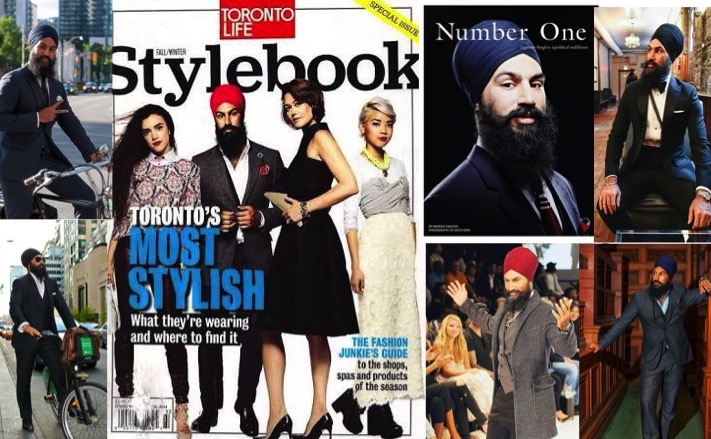
More and more New Democrats seem concerned that Jagmeet Singh mightn’t have been the best choice for leader, let alone deserving of a whopping 54 per cent first ballot victory. His various alleged crimes include rendering himself invisible for months, imposing draconian punishments on popular MPs, and going on TV to suggest we stop importing Saudi oil and get it from other countries instead — at a time when Alberta’s NDP government is fighting both for pipelines and for its continued existence.
[…]
Tom Mulcair was a pro. Dumping him appears to be the dumbest thing the NDP ever did. Still, if Singh wins his seat, there is reason to hope he might grow into the job. To skeptics he evinces a distinctly Trudeauvian brand of superficiality, and a similar gift for quotes that land well but fall to pieces if you actually read them back. That hasn’t hurt Trudeau, though — not much and not yet. Singh, a criminal lawyer, certainly boasts a more impressive resumé outside of politics. And goodness knows there are more than enough avenues for any NDP leader to attack a Liberal government that promised us the moon but left us conspicuously earthbound.
If Singh is an anchor on NDP fortunes, it doesn’t seem to be massively heavy one. Nanos Research has them at 15.4 per cent, as of last week — not good at all, but well within recovery distance of their 19.7 per cent performance in the 2015 election. Pre-campaign polls are generally held to be meaningless. Again assuming Singh wins his seat, he has plenty of time to introduce himself and his vision for the NDP.
It’s also possible, though, that the federal NDP in 2019 is a busted flush no matter who’s leading it. The combination of personal charisma and political circumstance that propelled it to Official Opposition status in 2011 might just be throttling back down toward cruising speed.
We shouldn’t overestimate just how improbable Jack Layton’s achievements were. He dragged the NDP to the political centre, where the votes are, marginalizing various breeds of crackpots along the way, while keeping the famously restive portside of the party relatively content. Then he stole a huge chunk of the Quebec nationalist vote in the dead of night.
When Jagmeet Singh was elected NDP leader, I really did think he’d be a significant challenge to Justin Trudeau due to the media’s apparent fascination with Singh (a love affair that appeared to be as deep and lasting as that of Justin’s teeny-bopper fan club for their darling), but it faded very quickly indeed. I guess as far as the Canadian media is concerned, there can only be one…
The byelection is looking pretty safe for Singh, as his Tory opponent beclowned himself quickly, and news broke on Wednesday that the Liberal candidate has withdrawn, after similarly beclowning herself:
BREAKING: Liberal Party says it has accepted Karen Wang's resignation as the party candidate in Burnaby South. That's in reaction to this story from @mdgmedia https://t.co/sPlEC9Djxr #cdnpoli pic.twitter.com/lZWbjPOMQ1
— Alex Ballingall (@aballinga) January 16, 2019
January 16, 2019
Justin Trudeau is against using refugees as political props … at least when others do it
Politicians traffic in hypocrisy, example seven million and three:
There were no good reasons to make a big show of [Rahaf Mohammed] Alqunun’s arrival, in other words, and plenty of good reasons not to. Furthermore, Justin Trudeau has been very clear about what he thinks of using refugees as political props. He was at his most thespian back in 2015 when it was alleged Stephen Harper’s office had been sifting through applications from Syrian asylum-seekers in search of potential photo ops.
“That’s DIS-GUST-ING,” Trudeau hissed at a campaign stop in Richmond, B.C. “That’s not the Canada we want; that’s not the Canada we need to build.”
In the end, though, there was Foreign Affairs Minister Chrystia Freeland with her arm draped around Alqunun, announcing that this “brave new Canadian” would not be taking questions. Luckily, Freeland herself had arrived equipped with some crimson talking points.
“I believe in lighting a single candle,” she said. “Where we can save a single person, where we can save a single woman, that is a good thing to do. … And I’d like to also emphasize, this is part of a broader Canadian policy of supporting women and girls in Canada and around the world.”
“Canada is a country that understands how important it is to stand up for human rights, to stand up for women’s rights around the world,” Trudeau chimed in.
It would be well-nigh impossible to argue against hearing, at the very least, Alqunun’s claim for asylum. But at this point, she is certainly also a political prop — a living symbol of the Liberal view of Canada’s place in the world, and an always-welcome opportunity for self-congratulation.
QotD: Patriotism
Patriotism is the primal love of your country which pre-exists any particular notion about how its political affairs should be arranged. You can espouse a single-payer health care program (or smaller government) as a loyal citizen of Denmark. You cannot, however, be an an American patriot in that same position, though you may be a most excellent Dane. True patriotism does not require us to choose between the many constituent identities that every individual has. But it does require you to decide where your first loyalties lie.
Your patriotism may indeed lead you to advocate various changes in the government, in the belief that this will make it a better place, just as your love of your spouse may cause you to urge them to give up their soul-sucking job in corporate law and pursue the nonprofit career they’ve always dreamed of. But your love of your spouse does not, one hopes, consist primarily of plans for their future or hopes for their improvement. (If it does, you aren’t their spouse; you’re their agent). Patriotism is similar. It can survive substantial disagreement about the reasons for that love, or the sacrifices that love should entail. It can’t survive one half of the partnership declaring that they will only start loving their country after it has perfected itself. As in a marriage, that would be a very long wait.
But shouldn’t we scorn patriotism, which drives us to war and so many other awful things? No more than we should scorn the progressive ideals that have led to so much good social change, and also so much human suffering under various left-wing regimes. Ideals are dangerous things with a tendency to run amok, but no society can live without them. And I submit that no nation can live long without a pretty healthy patriotism — a powerful symbolic identity that transcends the frictions and disagreements which otherwise make it impossible to unite for any common purpose.
Megan McArdle, “In Defense of Trump’s ‘Day of Patriotic Devotion'”, Bloomberg View, 2017-01-26.
January 15, 2019
Jagmeet Singh’s conservative opponent in Burnaby South
Normally, the byelection campaign by a major party leader to gain a seat in the House of Commons doesn’t get quite this … snippy:
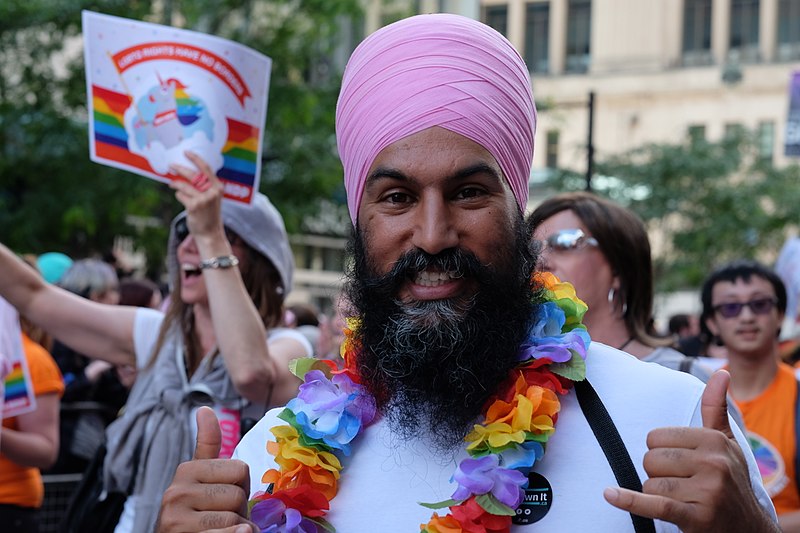
Federal NDP leader Jagmeet Singh taking part in a Pride Parade in June 2017 (during the leadership campaign).
Photo via Wikimedia.
Maybe someone should put in a kind word for Jagmeet Singh on the rare opportunities when an occasion presents itself. The federal NDP leader found himself on the right side of a ridiculous argument over the weekend as his byelection in the riding of Burnaby South got officially underway. Singh’s Conservative opponent for the open seat, commercial lawyer Jay Shin, promptly issued a press release suggesting that Singh was … apparently the wrong species of lawyer?
“While Jagmeet Singh has spent his pre-political career as a criminal defence lawyer keeping criminals out of jail, I have spent my legal career building Canadian businesses that create jobs and promote international trade,” Shin’s statement read.
When challenged by the Burnaby Now newspaper on his apparent suggestion that, as a former university instructor in International Mining Transactions, he was somehow ethically superior to the underpaid schmucks who provide criminal defence, Shin disavowed any such meaning.
Criminal lawyers “play an important role; everybody has a right to defence,” the Conservative candidate insisted. (Whew!) “What I’m saying is, he played that role. As a criminal lawyer, he defended criminals. That’s all I’m saying.”
One notices that even this characterization may leave a civil libertarian uneasy, since criminals aren’t criminals until the Crown successfully convicts them. A defence lawyer doesn’t “defend criminals”: he defends the accused. But maybe that is the sort of distinction you forget when you are busy building Canadian businesses, or trying to become a Conservative MP.
QotD: Masochistic anglophobia
Within the intelligentsia, a derisive and mildly hostile attitude towards Britain is more or less compulsory, but it is an unfaked emotion in many cases. During the war it was manifested in the defeatism of the intelligentsia, which persisted long after it had become clear that the Axis powers could not win. Many people were undisguisedly pleased when Singapore fell or when the British were driven out of Greece, and there was a remarkable unwillingness to believe in good news, e.g. el Alamein, or the number of German planes shot down in the Battle of Britain. English left-wing intellectuals did not, of course, actually want the Germans or Japanese to win the war, but many of them could not help getting a certain kick out of seeing their own country humiliated, and wanted to feel that the final victory would be due to Russia, or perhaps America, and not to Britain. In foreign politics many intellectuals follow the principle that any faction backed by Britain must be in the wrong. As a result, ‘enlightened’ opinion is quite largely a mirror-image of Conservative policy. Anglophobia is always liable to reversal, hence that fairly common spectacle, the pacifist of one war who is a bellicist in the next.
George Orwell, “Notes on Nationalism”, Polemic, 1945-05.
January 13, 2019
January 11, 2019
Jagmeet Singh’s plight
Federal NDP leader Jagmeet Singh will finally get his chance to win a seat in Parliament on February 25 in the Burnaby South byelection. Things have not been going well for Singh since he was elected leader in 2017. At that time, I thought he would be a serious threat to Justin Trudeau’s popularity with the media (Justin’s teeny-bopper fan club) and allow the NDP to be taken more seriously as a potential government. That hasn’t happened and Singh’s media coverage has been much more critical than any NDP leader might have expected. Andrew Coyne explains:
It is safe to say Singh has not proved quite the rock star New Democrats hoped when they elected him leader in October 2017. Undertaker would be closer to the mark. While the party trundles along at a little under 17 per cent in the polls, about its historic average, Singh himself is in single digits, slightly behind Elizabeth May as Canadians’ choice for prime minister.
Singh’s trajectory is a cautionary tale on the importance of experience in politics. With just six years in the Ontario legislature, Singh was barely ready for the job of provincial leader, still less the much sharper scrutiny to which federal leaders are subject. It has showed.
He appears frequently to be poorly briefed, on one memorable occasion having to ask a member of caucus, in full view of the cameras, what the party position was on a particular issue. He badly mishandled what should have been a softball question on where he stood on Sikh terrorism, and alienated many in the party with his knee-jerk expulsion of Saskatchewan MP Erin Weir for what appeared to be no worse a crime than standing too close to women at parties.
The decision not to seek a seat in the House until now has robbed him of what visibility the leader of a third party can expect, though his manifest weakness as a communicator makes it debatable whether this is a plus or a minus. Fundraising has dried up. Party morale is in freefall. Caucus members speak openly, if not on the record, of their desire to be rid of him.
For the Liberals, on the other hand, Singh is the answer to all their prayers. The prime minister’s own approval ratings may have dropped precipitously, but as long as the NDP vote can be kept to current levels of support or less the Liberals are unlikely to lose. (The NDP’s average share of the popular vote when the Conservatives win: 19.5 per cent. When the Liberals win: 14.8 per cent.) And nothing so guarantees a calamitous NDP showing as Singh’s continued leadership.
Hence the curious unspoken subtext of the Burnaby South race, with Liberals more or less openly rooting for him to win — and New Democrats hardly less publicly hoping he loses.
QotD: Libertarian “co-ordination”
… advocates of liberty are about as good at coordinated action as a bunch of cats. I pretty much laughed myself (physically) sick when I read that the Sad Puppies “strictly enforced slate voting.” Not only did the numbers completely deny this (the only lockstep voting was no award) but the idea of anyone on our side doing anything “lockstep” just about… Giggle, snort.
If you told most people on our side “you have to do it this way, it’s the only way” you’d get “Who’s gonna make me, you and whose army?” And if you said “you have to do it this way or we’ll kill you,” you’re still likely to get “You’re not the boss of me.” We should have “Stupidly individualistic” stamped on our foreheads.
So long, coordinated marches like what the left (they of the collectivist will) executed are really impossible for us.
On the other hand… On the other hand, we seem to do pretty well in our long uncoordinated march of building under and building around and building over.
We might all be marching in different directions and to the tune of a different kettle of fish, but the other side is so profoundly incompetent, that even so we can still replace the moribund institutions they took over.
It’s just going to take a little while. Not a hundred years, but probably twenty. Not three generations, but one and a half.
In the end we win, they lose, but you can’t stop when your ankles first start hurting.
The last mile of the long march is always the hardest one, but the goal is almost in sight.
Sarah Hoyt, “The Long March”, According to Hoyt, 2015-12-20.
January 10, 2019
A timely reminder about the dangers of expanding government power
At Coyote Blog, Warren Meyer points out to the Republicans that if it was bad during the last presidency, it’s just as bad during this one:
Dear Republicans:
The last thing we need now is even more expansion of executive power. I remember when, gosh it was like only two or three years ago, you Republicans were (rightly) bemoaning Obama’s executive actions as unconstitutional expansions of Presidential power. You argued, again rightly, that just because Congress did not pass the President’s cherished agenda items, that did not give the President some sort of right to do an end-around Congress.
But now, I hear many Republicans making exactly the same arguments on the wall that Obama made during his Presidency, with the added distasteful element of a proposed declaration of emergency to allow the army to go build the wall.
[…]
I can pretty much guarantee you that if Trump uses this emergency declaration dodge (and maybe even if he doesn’t now that Republicans have helped to normalize the idea), the next Democratic President is going to use the same dodge. I can just see President Warren declaring a state of emergency to have the army build windmills or worse. In fact, if Trump declares a state of emergency on a hot-button Republican issue, Democratic partisans are going to DEMAND that their President do the same, if for no reason other than tribal tit for tat.
Patreon’s changing role
At Quillette, Uri Harris outlines how Patreon has changed over the last year or so and what those changes mean for both content creators and financial supporters:
On December 6, crowdfunding service Patreon removed the account of popular YouTuber Carl Benjamin, who is better known by his YouTube moniker Sargon of Akkad. In a statement, Patreon explained that Benjamin was removed for exposing hate speech under its community guidelines, which prohibit: “serious attacks, or even negative generalizations, of people based on their race [and] sexual orientation.” The incident in question was an appearance on another YouTube channel where Benjamin used racial and homosexual slurs during an emotional outburst. (The outburst was transcribed and included for reference as part of Patreon’s statement.)
Patreon’s reaction sparked immediate accusations of political bias from many centrists and conservatives, as Benjamin—who identifies as a classical liberal—is a frequent and outspoken critic of contemporary progressivism, receiving hundreds of thousands of views on many of his videos. The fact that Benjamin was removed from Patreon for an outburst on another YouTube channel almost a year ago, when he produces hours of content every week on his own channels and appears regularly on many others, suggested that this was a targeted attempt to remove him due to his politics, either by Patreon employees themselves or as a response to outside pressure.
This belief was bolstered by the fact that Patreon’s CEO Jack Conte had appeared on popular YouTube talk show “The Rubin Report” last year to explain the removal of conservative YouTube personality Lauren Southern, where he seemed to suggest that Patreon’s content policy had three sections and that hate speech was in the first section, meaning that it only applied to content uploaded to Patreon’s own platform. (Southern was removed for off-platform activity because she had “crossed the line between speech and action,” Conte maintained, which he implied was covered by the more severe second and third sections of their content policy.)
There’s nothing unusual about a company revising its content policy, of course, but it seemed suspicious that Benjamin was being removed for a different set of rules than those Patreon’s CEO had previously articulated. In fact, several people pointed out the prevalence of similar slurs on Patreon’s own platform as further indication that Benjamin was specifically targeted for his political views.
QotD: Pacifism
The majority of pacifists either belong to obscure religious sects or are simply humanitarians who object to the taking of life and prefer not to follow their thoughts beyond that point. But there is a minority of intellectual pacifists whose real though unadmitted motive appears to be hatred of western democracy and admiration of totalitarianism. Pacifist propaganda usually boils down to saying that one side is as bad as the other, but if one looks closely at the writings of younger intellectual pacifists, one finds that they do not by any means express impartial disapproval but are directed almost entirely against Britain and the United States. Moreover they do not as a rule condemn violence as such, but only violence used in defence of western countries. The Russians, unlike the British, are not blamed for defending themselves by warlike means, and indeed all pacifist propaganda of this type avoids mention of Russia or China. It is not claimed, again, that the Indians should abjure violence in their struggle against the British. Pacifist literature abounds with equivocal remarks which, if they mean anything, appear to mean that statesmen of the type of Hitler are preferable to those of the type of Churchill, and that violence is perhaps excusable if it is violent enough. After the fall of France, the French pacifists, faced by a real choice which their English colleagues have not had to make, mostly went over to the Nazis, and in England there appears to have been some small overlap of membership between the Peace Pledge Union and the Blackshirts. Pacifist writers have written in praise of Carlyle, one of the intellectual fathers of Fascism. All in all it is difficult not to feel that pacifism, as it appears among a section of the intelligentsia, is secretly inspired by an admiration for power and successful cruelty. The mistake was made of pinning this emotion to Hitler, but it could easily be retransfered.
George Orwell, “Notes on Nationalism”, Polemic, 1945-05.
January 9, 2019
“I felt resolved to write this article in order to defend my generation”
Godfrey Elfwick refuses to accept the abuse heaped on his generation by “dinosaurs” like Louis C.K.
I sat down on my futon the other night to enjoy a nourishing but humble bowl of organic vegan noodles with wakame seaweed and steamed honey-gilded pak choi. As I sat cross-legged at my chabudai and browsed the Wot’s Woke blogosphere on my iPad, the enjoyment of my simple peasant’s dish was severely marred as I came across a story about Louis C.K.
The article contained the link to a clip of a ‘so-called’ ‘stand up’ ‘comedy’ ‘routine’ in which ‘Louis’ ‘C.K.’ stood in front of his ‘audience’ and ‘delivered’ what can only be described as a torrent of hatred, the like of which I have not experienced since Ricky Gervais refused to call Caitlyn Jenner stunning and brave. He was accusing my generation of being weak and overemotional. Disrespecting the genuine need for nonbinary pronouns. My shoulders began to shake. Blind rage took over as I hurled my bowl of artisan noodles across the room, where they rained down like the tentacles of a tiny sea monster onto my priceless collection of Thelonius Monk original vinyl recordings.
As I sat there on my zabuton cushion, watching pieces of pak choi slide nonchalantly down the face of the greatest improvisational jazz pianist who ever lived, I felt hot angry tears drip down onto my cheeks. I rolled onto my back and wailed like a newborn babe. I let the sound of my screams cleanse and renew me. I did not hold back. After a while, maybe an hour or so, I curled my body into the fetal position where I slowly drifted off into an exhausted sleep.
I awoke around 4 a.m., the spiteful words of that vile white cisgender ogre still ringing in my ears. I had no more tears to give, I was spent. Instead, I felt resolved to write this article in order to defend my generation. To combat the hatred of old white cisgender men who accuse nonbinary people of being ‘attention seekers’ who only obsess over their fashionably made-up pronouns because they have a need to constantly feed their victimhood fetish… I mean, as if that could even be true! I felt resolved to confront this detestable bigotry head on. To fight the oppression with my fists a-flailing (metaphorically). To resist the prejudice (literally). To rise up to the challenge of our rival. To fight for the will to survive.
January 8, 2019
QotD: RINOs and other soft conservatives
The RINOs you complain about are RINOs now but they weren’t always. I don’t know how many of you remember the seventies. The right here was kind of like the right in Europe. It assumed that in the end communism would not only win, but DESERVED to win, and what the right disagreed with was the way to get there. It is useful to remember this was a time when William Buckley’s dictum that conservatism was “Standing astride History yelling stop” found deep resonance. Unpack that phrase. It assumes history comes with an arrow, that it’s not going our way, and that at best we can get it to pause.
Those RINOs who, by the way, took immense flack back then were as conservative as anyone dared to be. Because everyone knew in the end the reds won.
Then the wall fell down and we knew what true horrors lurked on the other side.
Individuals process these things fast enough. Well, my generation, at any rate, awakened by Reagan and shown that the win of the dark side was not inevitable, was more pro-freedom than people ten years older than us.
But when we saw the wall fall down, it pushed many of us further into the liberty side of the isle. Not only wasn’t a communist win inevitable, but their vaunted “strengths” like superior planning and better minority integration didn’t exist unless you really wanted to plan for three million size thirty boots for the left foot only, and integration meant grinding the minorities very fine and spreading them in the soil.
However cultures aren’t individuals. Cultures re-orient and process startling events very slowly.
Yeah, those older Republicans are still with us, and they were over 45 when the wall fell, which means they couldn’t reorient anymore. (Studies have been done.)
Sarah Hoyt, “The Long March”, According to Hoyt, 2015-12-20.


