
I’m reminded that, in 1966, the late, great former US Secretary of State Dean Acheson, reflecting on a long, productive life in the international arena, quipped that Canada, very often, too often he suggested, sounded like “the stern daughter of the voice of God.” It was a reflection of a regrettable Canadian tendency, even in the 1950s when we were more than just “pulling our weight,” to preach when we should have been content to practice in silence. He wasn’t faulting Louis St Laurent or even Mike Pearson, he was simply commenting on the fairly general and unfortunate habit that Canadian elites had, then, and retain, now, towards self congratulatory moralizing.
About all we have done, consistently, for most of the past 50 years is look on and do nothing: we have, mostly, been sitting on the sidelines, doing little except to chide and cast reproving glances at those who are acting. That approach almost certainly makes the Laurentian Elites more comfortable, but I suspect that many, many Canadians are just a little bit ashamed of themselves because of what our government is doing.
Ted Campbell, “Hypocrisy”, Ted Campbell’s Point of View, 2017-09-27.
October 9, 2019
QotD: The long history of elite Canadian smugness
October 8, 2019
Sarah Hoyt on the “rough music”
Sarah Hoyt borrows a notion from Terry Pratchett’s Discworld series to explain a real phenomenon in our world:
Pratchett’s “Witches” world was so similar to my own, from jumping over fires to get married (not legal in my day, but there was memory of it) to various local folk superstitions, that it was always a surprise when he pulled something I’d never heard of.
One of these is the “rough music.”
When someone has done just about enough that a small village can no longer put up with him, the men in the village get together and play a barbarous and terrible music as they nerve themselves up for the barbarous and terrible things they have to do.
In Europe — hell, all over the rest of the world — the rough music is playing. Just because no one is reporting on this, it doesn’t mean it’s not going on, and growing, and nerving itself up to … something.
“Gilets jaunes #12” by Christophe Becker is licensed under CC BY-NC-SA 2.0
The level at which the Gilets Jaunes have been under reported is extraordinary, except that it hasn’t stopped the uprising either.
(And now I think about it, how much do we see in main stream news about Hong Kong? And it hasn’t stopped the uprising either.)
[…]
So, let’s talk about the rough music. Sure, you can hear it. I can hear it too. The stomp and the drumming can be heard all over the world.
That which can’t go on, won’t.
But I implore you to stop and think: if the rough music plays, what comes after?
There might be no hope for Europe, but Europe’s … ah … how do we put this? Europe’s tenets, their stand before the world, an improvement as they were on everything before them, are not ours.
Even in Europe I suspect when this bursts — and there it will burst. The elites flaying and screaming is only making it worse — you’re going to see things that will make you wonder why on Earth good American boys died in WWII. Because we’re about to get National Socialism, the sequel. National because they’re getting tired of the international elites (and who isn’t) and socialism because the poor bastards have not experienced anything else their entire adult lives.
It will happen. It is necessary. The EU was probably one of the most bizarre ideas in the history of bad ideas. The way it’s run which essentially steals the franchise from ordinary people was just the old style “good families” coming back into power through a back door.
But what comes after will probably be horrific. If we’re all lucky it will also be briefish and like France after the revolution they’ll find their way to something slightly less insane. With or without Napoleon and Europe wide war? Ah … that’s where we need to talk.
First however, let me say that hearing the rough music from the rest of the world is starting to echo here. We see what’s going on there. And we hear strange and stupid stuff, like the “whistleblower of the day” and an impeachment without voting and of course, pancake-gate.
Faced with that kind of behavior you obviously think “It’s insane.” And “We have to stop it.”



Extinction Rebellion – “an upper-middle-class death cult”
Brendan O’Neill watched a death cult hold one of their ceremonies in public on the streets of London the other day:
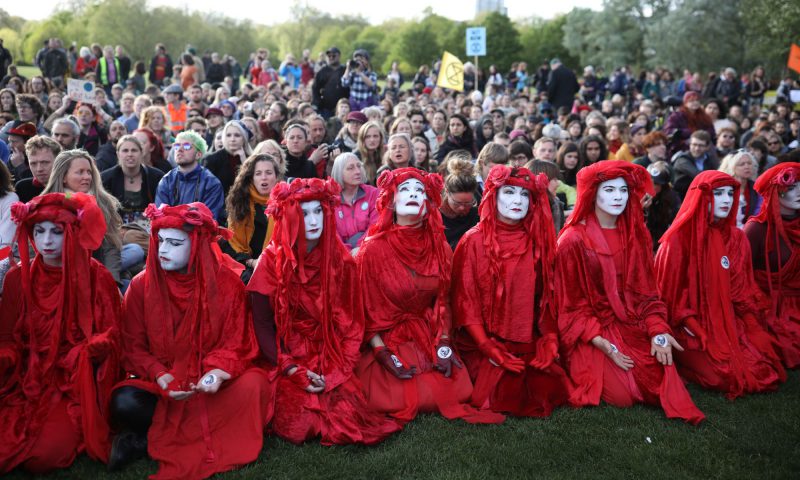
This was, of course, Extinction Rebellion. Let us no longer beat around the bush about these people. This is an upper-middle-class death cult.
This is a millenarian movement that might speak of science, but which is driven by sheer irrationalism. By fear, moral exhaustion and misanthropy. This is the deflated, self-loathing bourgeoisie coming together to project their own psycho-social hang-ups on to society at large. They must be criticised and ridiculed out of existence.
Yesterday’s gathering, like so many other Extinction Rebellion gatherings, was middle-aged and middle-class. The commuters heading in and out of King’s Cross looked upon them with bemusement. “Oh, it’s those Extinction freaks”, I heard one young man say. It had the feel of Hampstead and the Home Counties descending on a busy London spot to proselytise the cult of eco-alarmism to the brainwashed, commuting plebs.
It was a gathering to mark Extinction Rebellion’s week of disruption. The group is asking people in London and other cities around the world to “take two weeks off work” and join the revolt against the “climate and ecological crisis”. You can tell who they’re trying to appeal to. Working-class people and the poor of New Delhi, Mumbai and Cape Town – some of the cities in which Extinction Rebellion will be causing disruption – of course cannot afford to take two weeks off work. But then, these protests aren’t for those people. In fact, they’re against those people.
Extinction Rebellion is a reactionary, regressive and elitist movement whose aim is to impose the most disturbing form of austerity imaginable on people across the world. One of the great ironies of “progressive” politics today is that people of a leftist persuasion will say it is borderline fascism if the Tory government closes down a library in Wolverhampton, but then they will cheer this eco-death cult when it demands a virtual halt to economic growth with not a single thought for the devastating, immiserating and outright lethal impact such a course of action would have on the working and struggling peoples of the world.
Extinction Rebellion says mankind is doomed if we do not cut carbon emissions to Net Zero by 2025. That’s six years’ time. Think about it: they want us to halt a vast array of human activity that produces carbon. All that Australian digging for coal; all those Chinese factories employing millions of people and producing billions of things used by people around the world; all those jobs in the UK in the fossil-fuel industries; all those coal-fired power stations; all that flying; all that driving … cut it all back, rein it in, stop it. And the people who rely on these things for their work and their food and their warmth? Screw them. They’re only humans. Horrible, destructive, stupid humans.
The Toronto chapter of the death cult shut down one of the major bridges across the Don Valley on Monday morning:
Just in time for rush hour on Monday morning, hundreds of climate change activists have barricaded themselves across a major four-lane bridge in the heart of Canada’s largest city.
Extinction Rebellion (XR) Toronto, the local arm of an environmental protest group with demonstrations taking place across the world today, shut down traffic on the Prince Edward Viaduct between Bloor Street and Danforth Avenue around 8 a.m. on Monday morning.
Members of the group formed blockages on both sides of the truss bridge with their bodies and props, including a larger-than-life set of letters reading “ACT NOW.”
Eco protest shuts down Bloor Viaduct this morning #ClimateChange #environment #Toronto #cdnpoli pic.twitter.com/zliNjj49kT
— Rupen Seoni (@RupenSeoni) October 7, 2019
October 7, 2019
QotD: Politicians’ promises
Niall Killmartin, “The promise that was never meant to be kept is now the hill they have chosen to die on”, The Great Realignment, 2019-09-04.
October 6, 2019
Finally a reason to climb on the impeachment bandwagon
Andrew Heaton, in his latest newsletter, explains why he’s finally come down on the side of impeaching President Trump:
Okay, here’s the main thing I wanted to talk to you about: America is about to slap a TWENTY-FIVE PERCENT tariff on scotch. The underlying story involves the WTO and Airbus, but I think I can save everybody a lot of time by pointing out that our president is a mouthbreathing protectionist who’s too lazy to read Adam Smith’s wikipedia page.
Here are a few things to consider:
- Tariffs are just taxes, designed to punish you for having the gall to buy something from a foreigner.
- This will hurt Scottish distillers, and potentially price out distillers with low profit margins.
- I might have to switch to wine on dates.
- We have now spent more money needlessly bailing out farmers from a trade war with China than we did bailing out banks under Bush.
- We’ve known about the idiocy of tariffs since The Wealth of Nations came out in 1776.
- Trump, a man lacking an ideological core, for reasons which boggle the mind, seems to genuinely believe tariffs and protectionism are good things, as he has maintained since the 80s.
Chances are if you subscribe to this newsletter you’re not a teetotaler, but on the off chance you are, allow me to make a case against whisky taxes even if you are not personally apoplectic about a tax hike on Laphroaig. (A concoction personally invented by Almighty God. It’s like you’re drinking a campfire. Try it.)
There’s an old saying: when goods don’t cross borders, armies do. I concur with this. In fact my largest contribution to the field of economics (Nobel Prize forthcoming) is Heaton’s Peace Through International Mistresses Theory.My groundbreaking idea is that we want to have an interconnected, global economy with lots of transnational trade, because businessmen will be less supportive of bombing cities their mistresses live in. When trade wars happen, international trade collapses, and suddenly businessmen are flying to Berlin and Paris a lot less. Pretty soon we’re firebombing Tokyo.
It would probably be more appropriate of me to dedicate my political analysis to the forthcoming Ukraine/Trump/Biden/Impeachment circus which will dominate our lives for the next few months. However in my case I don’t need to. The president has messed with my scotch. Now it’s personal. I’m all in.
Impeach the guy.
#FreeTrade

You can subscribe to Andrew’s email newsletter here.
QotD: Modern middle-class “cosmopolitans”
Still, there is a good chance that Jennifer and Jason actually like their IKEA dressers, and prefer them to the old oak chest that their grandparents tried to foist on them. Indeed, the extraordinary popularity of IKEA testifies not only to its convenience but to its ability to appeal to the middle-class self-image. Jennifer and Jason are drawn to IKEA because it reflects who they are: they too are modern, movable, and interchangeable, their wants satisfiable in any neighborhood with a food co-op and a coffee shop. More fundamentally, Jennifer and Jason are untraceable, a “composite material” made from numberless scraps and pieces. They have a long catalog of home towns, and their accents are NPR neutral. They can probably rattle off the various nationalities in their family trees — Dutch, Norwegian, Greek, and Jewish, maybe some Venezuelan or Honduran for a little color. From these backgrounds they retain no more than a humorous word or phrase, a recipe, or an Ellis Island anecdote, if that. They grew up amidst a scramble of white-collar professionals and went to college with a scramble of white-collar professionals’ kids. Their values are defined mainly by mass media, their tastes adorably quirky but never straying too far from their peers’, and like the IKEA furniture that they buy in boxes, they too cut themselves into manageable, packaged pieces and market themselves online. They are probably “spiritual but not religious.” They have no pattern or model of life that bears any relation to the past before the internet. For all intents and purposes, they sprang up de novo in the modern city. Whereas the Veneerings’ high fashion covered over an essential vulgarity, Jennifer’s and Jason’s urbane style masks a hollowness.
It may be tempting to call Jennifer and Jason, and the the group of people whom they represent, “cosmopolitans.” (And indeed, IKEA, with its vaguely exotic Swedish names, provides a dash of cosmopolitanism on the cheap.) However, Jennifer and Jason are something newer and more bizarre than cosmopolitans: as Ross Douthat aptly pointed out in the wake of the Trump election, the increasingly insulated college-educated classes of the coastal cities do not grapple with real, substantive differences in beliefs and values, associating instead with cliques of like-minded classmates. In addition, classic cosmopolitans seek out what is best in others’ traditions while showing a fierce pride in their own — a Jordanian extolling the majesty of Petra, a Mexican diplomat breaking into lines of Octavio Paz, etc. Westerners like Jennifer and Jason show no such pride or attachment, instead leaping at opportunities to mock the foibles of their native lands.
Conversely, we must also avoid cheap epithets. The word “cosmopolitan” is a double-edged sword – long a shibboleth for worldly sophistication, it has lately turned upon its makers, serving as a political weapon against urban liberals; it is not surprising that a Trump spokesman recently attacked the “cosmopolitan bias” of a journalist who questioned the White House’s immigration policies. There is nothing particularly new or insightful about attacking urbanites tainted by association with the foreign, like the Judean exiles railing against the silken whores of Babylon. Still, as shallow and hackneyed as this rhetorical strategy might be, it packs a populist punch because the very concept of “cosmopolitan” is purely relative: since no one, legally speaking, is a citizen of the world, one can be “cosmopolitan” only in contrast to someone else – a “provincial” in the Victorian terminology, or a “xenophobe” in contemporary talk. In other words, the idea of cosmopolitanism carries an unavoidable subtext of class superiority.
Samuel Biagetti, “The IKEA Humans: The Social Base of Contemporary Liberalism”, Jacobite, 2017-09-13.
October 5, 2019
Sultan Knish – Hillaryland must be the saddest place on earth
I think it would be safe to say that Daniel Greenfield does not anticipate Hillary Clinton making a move to enter the Democratic primaries for the 2020 election, based on this:
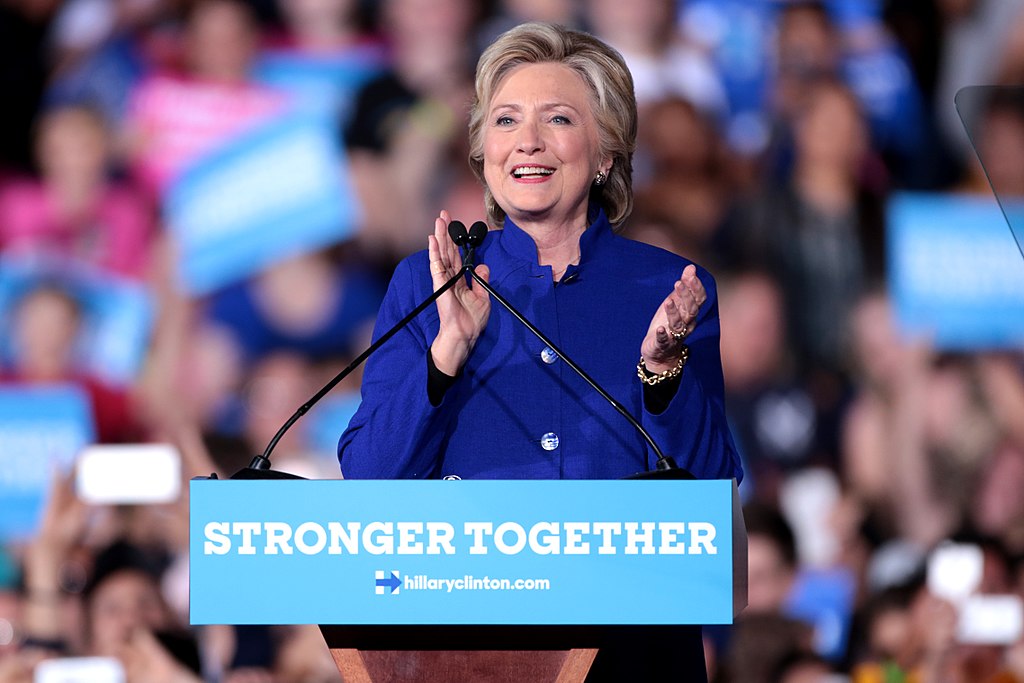
Former Secretary of State Hillary Clinton speaking with supporters at a campaign rally at the Intramural Fields at Arizona State University in Tempe, Arizona on 2 November 2016
Photo by Gage Skidmore via Wikimedia Commons.
They say that Disneyland is the happiest place on earth, but Hillaryland must be the saddest.
What is Hillaryland? It’s a social network “aiming to connect all the people who’ve worked for Hillary Rodham Clinton during her more than 40 years of public service.” It’s run by “volunteers” and offers a plain white $15 Hillaryland tote bag which it claims that it’s selling “at cost” and “not for profit”.
How the mighty have fallen.
Once upon a time, Hillary and her people gaslit the country on the big issues. Now they’ve gone from Benghazi to trying to convince a declining handful of suckers that $15 is the cost price for a tote bag.
Hillaryland is the sad successor to Clintonworld networks like the Clinton Foundation which connected world leaders, foreign criminals and a prospective president. The alumni network is now a joke. The Clintons will never hold public office again. Hillaryland isn’t an alumni network, it’s a political leper colony run by “volunteers” too dumb to realize that the S.S. Slick Willy will never rise again.
Hillaryland promotes such promising ventures as Nasty Women Serve which holds an annual Hillary Rodham Clinton Day of Service. The highest level of service in Hillaryland is hosting a “house party” on November 8, which is National Hillary Day, also known as the day of Hillary’s downfall and defeat. The party will have, “in the true spirit of HRC — some Chardonnay” and will go on “until the wine runs out”.
Only Nazi war criminals in Argentina have sadder and more pathetic reunions than Hillary minions.
Nazis and potheads have 4/20 to get high. Hillary fans have 11/8 to get drunk on white wine. And both of them even blame the Russians for the defeat of their miserably corrupt murderous regimes.
And where’s Madame Fuhrer?
Hillary stopped by the Venice Biennale, the umbrella organization that includes the Venice Film Festival, allegedly a favorite stalking ground of old Clinton pal, Harvey Weinstein, to attend the exhibit of “HILLARY: The Hillary Clinton Emails.”
For an hour, Hillary sat in a replica of the Oval Office pretending to read her own emails as part of an art project. To make her humiliation more complete, HILLARY was staged at the Despar Teatro Italia, a former theater turned into a supermarket. Confused shoppers watched a former American presidential contender pretending to be the President of the United States in an Italian supermarket.
There’s your chicken, your canned tomatoes and your pasta. Upstairs is a crazy lady who thinks she’s the President of the United States. Go easy on the chardonnay, you don’t want to end up like her.
Even Lady Macbeth went mad with more dignity than Hillary Clinton.
The Oval Office recreated in an Italian supermarket is only the second most famous piece of eponymous Hillary art. The National Museum of Women in the Arts also features a 6-foot-tall painting of a black fabric swatch named Hillary gifted to it by Heather and Tony Podesta. Heather and Tony have since split up. And Tony, a Hillarylander, got caught up in the Russia scandal and shut down his lobbying operation.
Sic transit gloria clintonmundi.
October 4, 2019
Rise of Evil – From Populism to Fascism | BETWEEN 2 WARS I 1932 Part 4 of 4
TimeGhost History
Published 3 Oct 2019Democracy finds itself in a crisis as the 1930s take off. On a global scale, Fascist or otherwise authoritarian and repressive movements and governments seek to destroy the pillars of liberal society.
Join us on Patreon: https://www.patreon.com/TimeGhostHistory
Subscribe to our World War Two series: https://www.youtube.com/c/worldwartwo…
Hosted by: Indy Neidell
Written by: Spartacus Olsson and Joram Appel
Directed by: Spartacus Olsson and Astrid Deinhard
Executive Producers: Bodo Rittenauer, Astrid Deinhard, Indy Neidell, Spartacus Olsson
Creative Producer: Joram Appel
Post-Production Director: Wieke Kapteijns
Research by: Joram Appel and Spartacus Olsson
Edited by: Wieke Kapteijns
Sound design: Marek KamińskiSources icons: Graphic Enginer, Luis Prado
Colorizations: Daniel Weiss, Cassowary Colorizations, KlimbimA TimeGhost chronological documentary produced by OnLion Entertainment GmbH.
From the comments:
TimeGhost History
1 hour ago (edited)
This episode might be a little more academic than our other episodes, but we wanted to cover the global Fascist surge AND that it’s just too simple to refer to all totalitarian states and authoritarian and repressive movements as “Fascist”. Fascism is a very complicated concept that is still today being debated by political scientists and historians, as well as politicians and journalists. We try to give some insight to what Fascism is, what it isn’t and what all those movements and countries were, if not Fascist. We appreciate that you might have a different opinion as to what Fascism was or is, and we’re interested to hear your opinion. Just keep it civil and try to stay away from modern political debates, as that is not what we’re here for. EDIT: As for comments claiming that Fascism was left-wing/socialist, watch the video again. Don’t bother commenting if you can’t bring a proper argument to the table.
Cheers,
Joram

Foreign aid now an issue in the federal election
The Milk Dud actually said something worthwhile on the campaign trail the other day:
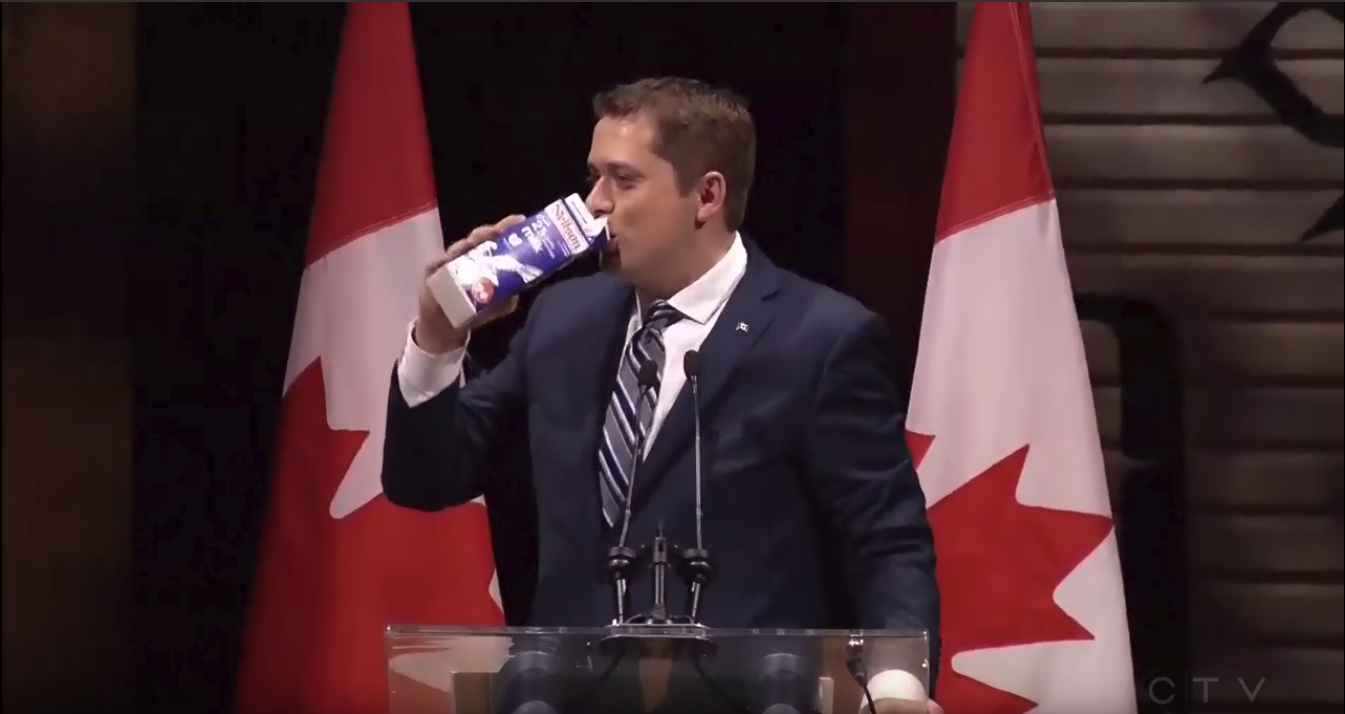
Andrew Scheer, paid tool of Big Dairy, chugs some milk during a Press Gallery speech in 2017. I’ve called him the “Milk Dud” ever since.
Screencapture from a CTV video uploaded to YouTube.
Andrew Scheer’s announcement that a Conservative government would cut foreign aid by 25% has been met with the usual wailing and gnashing of teeth by the out-of-touch elites.
Yet, it’s a policy that all Canadians can support because it will benefit all of us.
As I’ve said many times, the Canadian government is called “Canadian” for a reason.
It exists to serve the Canadian People, not to serve foreign, often corrupt, countries.
When we have such serious problems here at home, including a growing opioid epidemic, veterans who are homeless and struggling, and many Indigenous communities that lack access to good housing and even clean drinking water, then it’s obvious to everyone that we need to focus our resources here at home.
Personally, I would like to see all foreign aid (aside from disaster relief) eliminated and redirected towards Canadian citizens.
Still, the Conservative proposal has (along with earlier calls by the PPC to end all foreign aid) finally shifted the conversation around foreign aid, and will help wake up many Canadians to the reality that a large amount of our tax dollars are given away to foreign countries while Canadians here at home are suffering.
It’s appalling that the Canadian government sends money to foreign regimes (where the money is often appropriated by corrupt leaders and used for things very different than aiding the poor and destitute) while First Nations communities here in Canada still lack basic drinking water and sanitation facilities.
October 3, 2019
Toronto’s gun problem
The city of Toronto has a gun problem, and politicians are lining up to offer variations of the same idea as the solution. You see, unlike every other city in North America, all of the gun crime in Toronto is committed by legal owners of AR-15 and AK-47 “assault weapons”. They’re all fully registered with the federal government, and have taken all the required training courses and keep their weapons under the strict storage and transportation rules, never taking them anywhere but to the legally designated shooting range and always on the permitted route to and from that range (and they’re all life-members of the NRA, of course). This is why, unlike every other city in North America, a ban on “assault weapons” will eliminate 100% of the gun-related crime in Toronto.
In the real-world version of Toronto, however, the proposed ban will have almost no impact on the crime rates, because almost none of the gun-related crimes committed in Toronto involves any kind of “assault weapon”, most being turf disputes involving illegal handguns between drug dealers and personal grudges among “young aspiring rappers who are just about to turn their lives around”:

Colt Canada’s model SA20, a commercial version of the Canadian C7A2 rifle.
Image from the Colt Canada website.
If Liberals are re-elected to a second term in government, their plan to tackle gun violence includes a ban on high-velocity, semi-automatic rifles like the AR-15, and gun marketing bans that evoke America’s favourite action figure.
“There are sometimes advertisements and videos that appear (on social media) … to imply that we can be GI Joe on our main street,” Public Safety Minister Ralph Goodale said about the Liberal platform’s vague reference to “limit the glorification of violence by changing the way firearms are advertised marketed and sold in Canada.”
During a Q&A with reporters in Ottawa on Sunday, where Goodale fielded questions about their incumbent government’s election promises, the minister attempted to qualify freedom of expression implications with the types of promotional material that could be targeted.
“(It) depicts a kind of behaviour that is simply inappropriate and some people would find it quite threatening … and it leads to the impression of military assault weapons is something you just do, every day,” explained Goodale.
I’m not a big consumer of advertising, but I can’t recall the last time I saw any kind of ad for firearms in Canada that wasn’t in a gun magazine (and there are not many of those sold in typical corner stores). Scary black guns in Hollywood movie ads, sure … they’re everywhere … but that’s not in any way related to the advertising, sale, or use of guns in Canada.
QotD: Media coverage of Liberal and Conservative scandals, respectively
A re-elected Liberal government [will] expand the Learn To Camp program.
Under the Learn To Camp program, every Canadian will be provided with a tub of boot polish, a novelty turban, a jewel to stick in your belly button, and genie slippers with curly toes, and trained how to swish across a Vancouver ballroom while asking other guests to tally your banana.
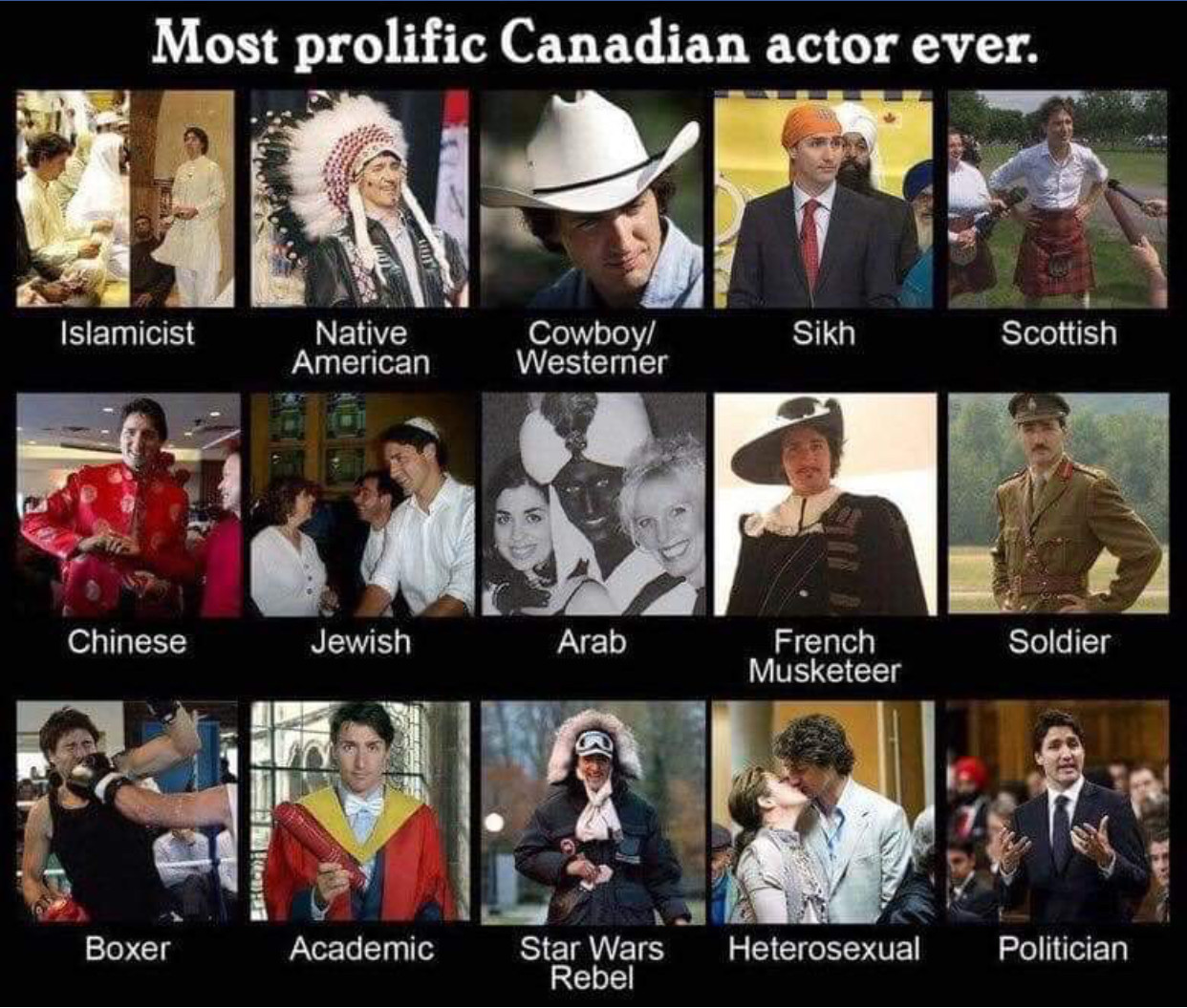
Oh, wait, sorry, that was last week’s Justin story. In America a ten-minute phone call to some fellow in Kiev is all the pretext you need for two years of multi-million-dollar investigation. But in Canada the news that the Prime Minister has spent half his adult life as the world’s wokest mammy singer is just a blip in the day’s news cycle, soon to be supplanted by a genuinely eye-catching scandal such as whether or not the Tory leader had a valid license from the Insurance Councils of Saskatchewan or the Canadian Association of Insurance Brokers back in 1997, or 1978, or whenever. You can understand why the Canadian media would rather stampede after the Andrew Scheer scandal: what journalist with a nose for a great red-meat story wouldn’t prefer chasing down the officially approved accreditation from the Department of Paperwork’s archives than, say, the fruiterer who supplies the Prime Minstrel with his trouser bananas. Was Justin accredited by the Minstrelsy Council of Quebec or the Canadian Association of Burnt Cork Fetishists? Would that make the story more interesting for the CBC et al?
The Toronto Star, like all good government-subsidized Canadian media, has been doing its best to neutralize the mammy songs. The most potentially damaging of the three (so far) blackface incidents is the middle one – a grainy video from the 1990s showing Boy Justin capering about like an ape. So the Star set its crack investigators on the story and tracked down a much better version of the video, and conclusively proved that Tories were misleading the public when they claimed that the Prime Ministrel in blackface, blackarms, blacklegs and blackwhatever-other-appendage was wearing a T-shirt with a banana on it. After all, the banana would imply Justin is a racist who likens black people to monkeys. Whereas prancing around in full-body blackface waving your arms and sticking your tongue out implies no such monkey-like slur.
So the Star‘s new HD minstrel video is of sufficient quality to show that the banana on the T-shirt is, in fact, the beak of a toucan. Unfortunately, the new video is also of sufficient quality to show that the banana is instead stuffed down Justin’s trousers. That risks suggesting the Prime Minstrel is exploiting old white neuroses about the black man’s sexual prowess. But don’t worry – The Toronto Star is only a day or two away from a full-page exclusive asserting that the Negro, impressive though his endowments be, pales in comparison to the average Quebec high-school drama teacher: When Rastus makes the mistake of appearing on stage next to Justin, he’s the one who needs the banana. Not for nothing is Quebec’s provincial dialect called joual, derived from cheval, as in horse.
Mark Steyn, “Blackface Narcissus”, Steyn Online, 2019-09-30.
October 2, 2019
“When the next American Civil War starts…”
David Warren goes all soothsayery and predicts the course and outcome of a potential Red-versus-Blue armed conflict arising from the current Red-versus-Blue verbal conflict:
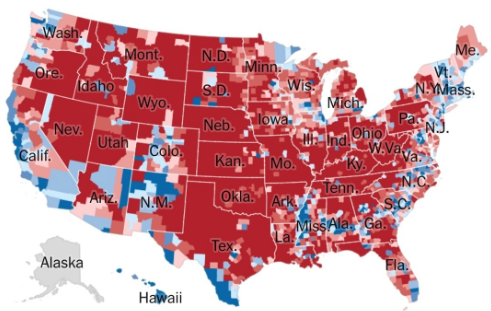
When the next American Civil War starts, I imagine it will look something like Hong Kong: a big melee spreading through all public spaces (I note that USA is bigger than Hong Kong). But there will be fairly limited casualties, at first, each of which will become the subject of unrestrained media outrage, until the media collapse under physical reprisals. Later, the better and better armed demonstrators, on both sides, will tactically “evolve.” The surveillance state itself will begin to disintegrate, and with it any hope of restoring public order, through agencies such as police, courts, and prisons. Things like border surveillance will be abandoned, with immediate consequences, but as the attraction of going to the States diminishes, no one will mind. More noticeably, the economy will break down. Because the American military was designed chiefly to defend against foreign powers, on a very large scale — and the threat will instead be domestic and scattered — the Army will be (at first) effectively neutralized. Isolated firefights between Democrat and Republican soldiers will escalate to firefights between ships and aeroplanes, but these will end fairly quickly as a Pentagon dictatorship seizes control. Within a year, I expect, though only a small part of their arsenal will prove useful, bullet-enforced curfews will restore relative peace to the streets. I don’t expect the death toll to be more than a few hundred thousand, at least from direct conflict as the guns come out. Interruptions of food supply, and the spread of disease, will cost much more — but possibly less (proportionately) than in the last Civil War, in which both sides were better organized.
That it will have spread to Canada, I cannot doubt, developing from the refugee crisis across “the world’s longest undefended border,” as snowflakes of all descriptions, by their millions, run for their lives, then resume their clashes up here. Mexico would also suffer from this “white flight,” except, the chaos from Mexican cartels’ energetic efforts to reclaim significant parts of Texas, California, and the Southwest, would have the paradoxical effect of ending the outbound refugee traffic there. For the most part, other foreign countries would avoid direct engagement. Instead, Islamist and Socialist regimes around the world would be busy consolidating their own local positions, sparking numerous “little wars” by their attempts at regional expansion. Each would be settled as the larger and more ruthless power won.
Still, I shouldn’t expect the anarchy to continue. Tyranny quickly fills a vacuum of authority (moral as well as material), and answers to the growing demand for safety. Nothing, of course, will be learnt from the adventure, and I should think that within a decade or less, resistance to the new President-for-Life will have all but evaporated.
In a crowded field, Election 2019 may be the worst we’ve seen so far
Chris Selley makes the case that this year’s federal election is the worst of all:
It has been widely suggested that this might be Canada’s Worst Election. Certainly it is dreary as all get-out. We began with interminable back-and-forth about abortion, which all party leaders pledge to do absolutely nothing about. If one or more of them are lying, it seems very unlikely they would admit to it at a press conference. The next mania was over Justin Trudeau’s blackface revues, which were radioactively damaging to whatever was left of his Most Enlightened Gentleman brand, but which mostly served as an opportunity for exhibitionist partisan insanity and cringeworthy journalism.
[…]
By rights the Conservatives should be mopping the floor. But they can hardly attack Trudeau’s social-engineer budgeting when they’re relaunching their flotilla of boutique tax credits for kids’ sports and arts programs and public transit. Why not just make their tax cut even bigger and let people spend their money how they please?
Similarly, the Conservatives would be on much firmer ground criticizing Trudeau’s housing-market interventions if they weren’t promising to review the mortgage stress test and bring back 30-year mortgages — something Stephen Harper’s government eliminated in 2012. Having decided carbon pricing was evil almost entirely because Justin Trudeau supports it, the Tories still struggle to defend any effective or efficient policy against climate change.
Any hope that Maxime Bernier might hold Scheer’s feet to the fire on free minds and free markets went up in flames ages ago as his People’s Party attracted far more authoritarian/nativist refugees from the Conservative Party of Canada than libertarian ones. Jagmeet Singh is bargaining hard to sell the NDP’s credibility down the river to appease all-but-totally uninterested Quebec nationalists — shamefully promising not to intervene against Bill 21, as if he would ever get the chance. Elizabeth May and her Green Party constantly remind us that they’re really quite odd: May insisting Longueuil candidate Pierre Nantel isn’t a separatist while Nantel shouts “I’m a separatist!” through a bullhorn is the weirdest thing she has done since the last weird thing.
The debates have worked out as badly as conceivably possible: The Leaders’ Debate Commission, created by the Liberals to solve a problem that didn’t exist — aieeee! Too many debates! — has reinvented the wheel, crushing both Maclean’s debate (which Trudeau declined to attend) and the Munk debate on foreign affairs (which has been cancelled due to Trudeau’s lack of interest) beneath it.
QotD: Senator Joe McCarthy
Pretty early on in the reading, it has occurred to me that the collusion between Democrat politicians, government departments and agencies, and liberal press to cover up the official sins of commission and omission, derail McCarthy’s investigations thereof, blacken his name, and destroy him personally and politically runs according to a very familiar script. It’s essentially what the progressive political and cultural elites have done to any number of conservative politicians and activists seen as a threat to their power and reputation. Donald Trump is merely the latest in a long and distinguished line.
To paraphrase Shakespeare’s Marc Antony, I came here not to praise Donald but to see how the left is trying to bury him. Until reading Evans’s book, I have not quite realised how similar and similarly underhand, vicious and persistent the campaign against Joe McCarthy had been. The “Swamp” is real; it was real in the 1940s and 1950s, and it is just as real now and just as committed to destroying any outside threats to its continuing position and influence. This is not a conspiracy theory; this is simply how power structures work to protect and perpetuate themselves. The viciousness is a function not just of the unshakable self-belief in one’s intellectual and moral rightness and superiority but also of a certain form of snobbery directed by the members of the “in-crowd” – what once used to be known as the Liberal or the East Coast Establishment and now more broadly, among many other names and designations, as the “coastal elites” – against outsiders who don’t share their sophisticated social, educational or professional background. The Swamp managed in the end to defeat McCarthy and turn him in the historical and popular memory into one of the great villains of American history; the book is still open on Trump’s ultimate fate and legacy. None of this is to suggest that McCarthy or Trump are flawless human beings and faultless political figures; quite the contrary. But the campaigns of destruction they are subjected to ultimately have little to do with their specific failings and mistakes. It’s a total war.
Arthur Chrenkoff, “Before there was Trump, there was Joe McCarthy”, Daily Chrenk, 2019-09-30.
September 30, 2019
QotD: Oil price volatility
There was a wave of nationalisation in the oil industry beginning in the 1960s. Today some 90 per cent of oil reserves are held by nationalised companies. ExxonMobil and BP are minnows compared with the whales owned by the governments of Saudi Arabia, Venezuela, Iran, Iraq, Kuwait, the United Arab Emirates, Nigeria and Russia. Post-colonial nationalisation affected many resource-based industries, but whereas many mineral and metal companies were privatised in the 1990s as their grotesque inefficiencies became visible, the same has not happened to state oil companies.
The consequence is that most oil is produced by companies that are milked by politicians, and consequently starved of cash (or incentives) for innovation and productivity. Lamenting “politicians’ extraordinary ability to mess things up”, the two authors note “the severely destructive role that can be played by political fights over the oil rent and its use”.
If politicians don’t get in the way, and we have two decades of relatively cheap oil it will be bad news for petro-dictators, oil-igarchs, ISIS thugs, and the promoters of wind power, solar power, nuclear energy and electric cars. But it is good news for everybody else, especially those on modest incomes.
Matt Ridley, “Low oil prices are a good thing”, The Rational Optimist, 2016-02-14.


