
Any survey – and certainly any careful study – of the history and reality of tariff policy confirms that tariffs (and other trade restrictions) are almost always dispensed, not for any plausible public-interest reasons, but to satisfy the private interests of rent-seekers. Even if, contrary to fact, economic journals and textbooks were filled with several plausible scenarios under which trade restrictions can improve the economic well-being of home-country residents, the actual history of trade policy is that this policy is one in service to domestic plunderers.
Many who agree with me here will nevertheless scold me for using, à la Bastiat, the provocative word “plunderers.” But I stick to my choice of words.
“Plunderers” is descriptive, for plunder is in fact what trade restrictions are all about. For two and a half centuries now we proponents of free trade have played mostly on the rhetorical turf of protectionists. On this turf there are language biases galore, such as “trade deficit,” a lowering of home-country tariffs described as “concessions” to foreign countries, the arrival in the home country of especially low-priced imports condemned as “dumping,” and, indeed, the word “protection” itself. Also, don’t forget the constant, clanking parade of inapposite military and sports metaphors.
For two and a half centuries now we proponents of free trade have typically treated the efforts of rent-seekers and rent-dispensers to portray their use of the state to enrich themselves at the expense of others with intellectual and moral respect. Why?
No one attempts to intellectually rationalize the theft and violence committed by street gangs. No one attempts to rationalize shoplifting, vandalism, armed robbery, arson, or rape. (It would, do note, be child’s play for a competent economics graduate student to develop a coherent theory of “optimal gang violence” that shows that, under just the right set of circumstances, there is an “optimal” amount of gang violence that improves the national welfare.) We call these destructive exercises of theft, coercion, and violence “theft,” “coercion,” and “violence.” We call these predatory activities what they really are.
By calling protectionism what it really is – the plunder of the many by the politically powerful few – we more vividly and widely expose protectionism’s ugly and cruel reality.
Don Boudreaux, “Quotation of the Day…”, Café Hayek, 2019-08-04.
September 29, 2019
QotD: Crony capitalists and corrupt politicians love tariffs
September 28, 2019
American politics as reality TV … maybe “reality” is a bit generous
At Catallaxy Files, John Comnenus guest-posts on The Trumpman Show of US politics:
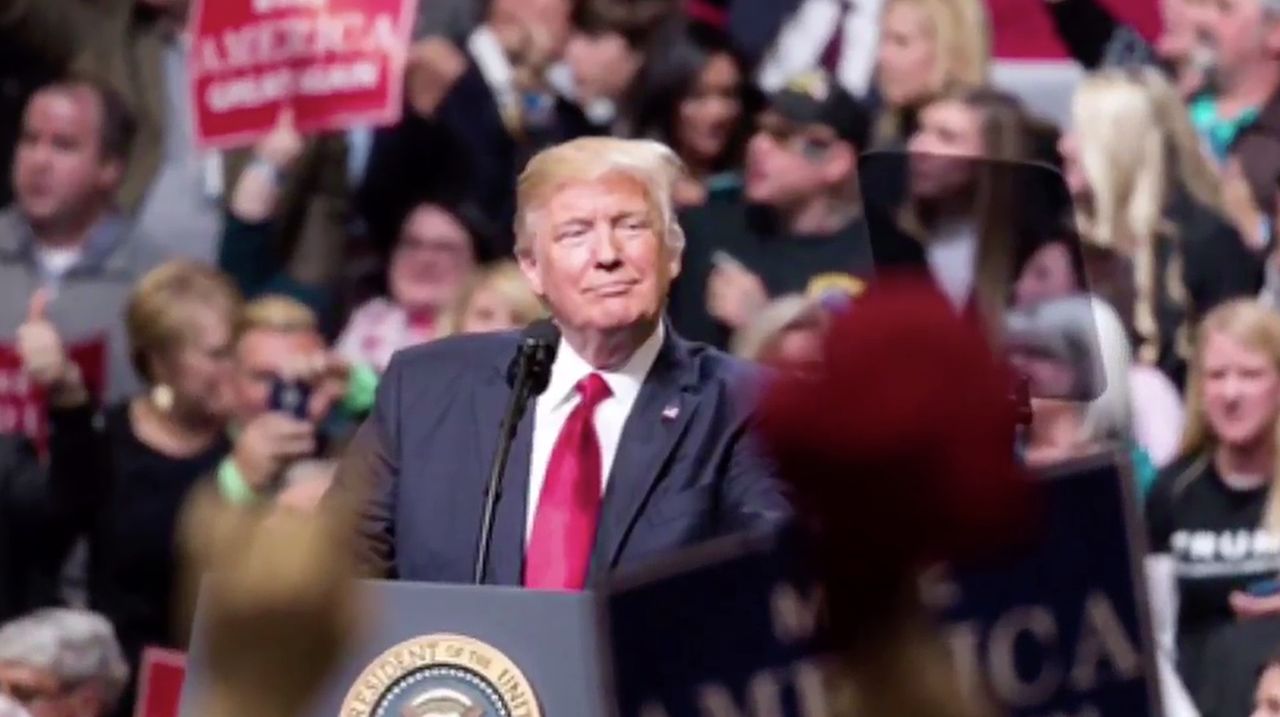
Donald Trump addresses a rally in Nashville, TN in March 2017.
Photo released by the Office of the President of the United States via Wikimedia Commons.
Politics is reality television, especially American politics where a cast of a dozen contest the primaries. Like a good reality television show, there are set events and episodes, such as debates and primaries, where the weaker contestants are gradually knocked out until one emerges to fight the other side for the ultimate prize – the Presidency.
Reality television shows typically assemble a cast of mismatched characters who bond together and feud amongst each other over tasks that are assigned by the script writers and star. They inject challenges into the cast to create tension and drama that changes the cast’s allegiances and relationships in a way that engages the audience and leads to a cast member(s) being removed from the show.
Donald Trump produced and starred in the highly successful reality television show, The Apprentice, for 11 years. I believe Donald Trump is the first politician to conduct politics as if it were a reality television show. Rudolph Guliani claims the Ukraine story, which blew up this week, was a trap laid for the Democrats who walked straight into it. Trump knew the cast of Democrat Congressmen and Presidential candidates couldn’t resist the challenge Trump injected into the cast.
Succeeding in reality television is about timing that creates the drama that engages the audience and gradually removes cast members. So why inject this Ukraine story now? I suspect Trump injected this script item into the Democrat Party cast now to ensure that he dramatically realigns the cast’s relationships and allegiances as they go into primary season. He wants to do this by removing the front runner. If I am right, Trump wants a viciously divided Democratic Party Convention that can barely stand the nominee the Party selects as the Democratic challenger to Donald Trump.
The Ukraine trap effectively knocks Biden out of the race – he can’t go to a debate with highly credible and growing allegations of corruption swirling around him. The Democrat establishment will ensure he retires for “health reasons” to avoid Democrat corruption dominating the next debate. So the 20%-25% of Democrats who previously supported Biden will need to cast their lot with another candidate. But who?
September 27, 2019
A visual masterclass in trolling
For all that Donald Trump is known for trolling his opponents on Twitter, he’s certainly not the only one, as these makeshift posters in Massachusetts illustrate:
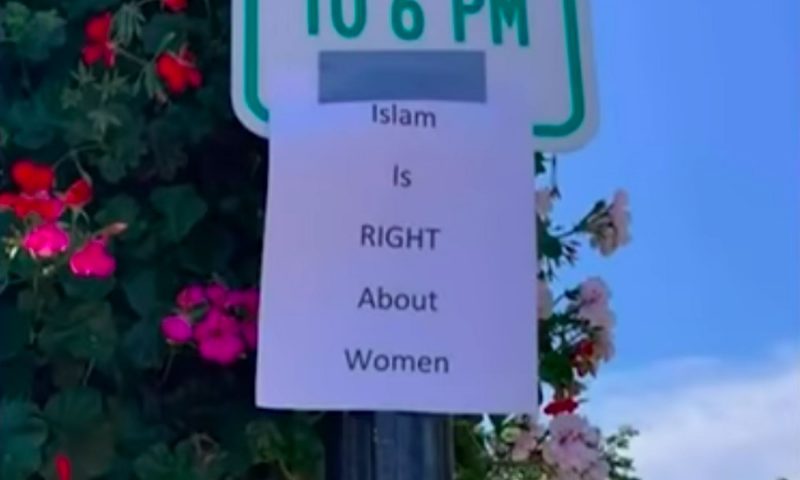
The locals are outraged, but as Alaa Al-Ameri describes, they’re not quite sure how to safely express their fury:
Think of Posie Parker’s billboards quoting the dictionary definition of the word “woman”. The power of such acts comes from two things. First, they acknowledge – usually with irreducible simplicity – that something that went without saying a moment ago has suddenly become unsayable. Secondly, the outrage they provoke does not come from any epithet, caricature or insult, but rather from having the nerve to draw the viewer’s attention to an act of cognitive dissonance that we are all engaging in, but would rather not acknowledge.
The result is that those who attempt to explain why the act is offensive end up simply tying themselves in knots, while revealing that they have never given a moment’s thought to the position they find themselves defending. This seems to generate even more anger, with the inevitable online mob quickly joined by politicians, journalists and other public figures, eager to see that the heretic is made an example of.
At their best, these acts of public disobedience are examples of real-life Winston Smiths pointing out to the rest of us that “Freedom is the freedom to say that two plus two make four”. Their persecutors, like his, are those who know and fear the truth of Smith’s next sentence: “If that is granted, all else follows.”
The example of perfectly crafted dissent that I’d like to submit here appears in this video from Massachusetts local TV news, showing some reactions to the fly-posting of white sheets of paper bearing the statement “Islam is right about women”. The reactions are deeply revealing. Nobody can clearly point out why they object to the statement – indeed, nobody seems to object to the statement at all on its face. Yet most seem to express offence at it – if a little unconvincingly.
The reason for their dilemma is obvious enough to anyone who has been paying attention. Western society has managed to convince itself (at least in public) that any statement criticising any aspect of Islam is, by definition, bigotry. As a result, Western societies have effectively decided to enforce Islamic restrictions on blasphemy, and called it “tolerance”.
The strain of conforming to this lie is evident in the fumbling attempts by the interviewees to explain their objections. Do they believe that Islam is right about women? If so, why the objection? Do they believe that Islam is wrong about women? If so, in what sense is the statement an attack on Islam or Muslims? Do they believe that the author of the poster is saying that “Islam is right about women”, but doing so ironically? In which case, the objection can only be that the author is guilty of a thoughtcrime by stating that “two and two make five” with insufficient sincerity. Or do they worry that they are guilty of thoughtcrime for noticing the irony?
September 26, 2019
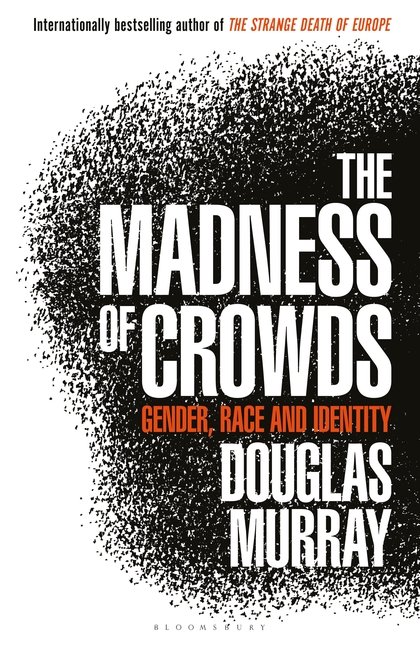
Titania McGrath reviews The Madness of Crowds by Douglas Murray
It’s a corker:
I’ve never reviewed a book before, and I fully intend to follow my editor’s advice and be as impartial as possible. But just to make it clear from the outset, Douglas Murray’s The Madness of Crowds is an abomination. It’s a sustained invective against woke culture, an attempt to reverse all the hard work of passionate civil rights activists such as Rosa Parks, Mahatma Gandhi and Lily Allen.
It’s essentially an Alt-right handbook, and I don’t think it’s too much to suggest that every copy ought to be incinerated. Preferably in a public square or something so that we can all see what happens when fascists try to spread their wicked ideology.
For the best part of 300 pages Murray spews his hateful bile – on white paper, no less – denouncing social justice, identity politics and intersectionality. Even the font has a certain heteronormative quality about it. He rails against “millennial snowflakes” who all “identify as attack helicopters” and how “you can’t say anything anymore” and that “you can go to prison for singing the national anthem these days”. I mean, he doesn’t actually write any of these words, but we all know that’s what he’s thinking.
The book is divided into four sections: “Gay”, “Women”, “Race” and “Trans”. These are all wonderful subjects – coincidentally, they also happen to be the names of my tropical fish – and so it is heart-breaking to see such noble ideas befouled in Murray’s grubby paws.
Needless to say, the last thing the world needs right now is yet another book by a straight white cis male. I’m told that Murray claims to be gay, but as journalist Jim Downs said of gay entrepreneur Peter Thiel after he appeared at the Republican National Convention, he “is an example of a man who has sex with other men, but not a gay man”. The idea that you can be gay and have conservative opinions is absurd. It was the same with Kanye West, who gave up being black once he’d put on that MAGA hat.
Murray seems to believe that, as a society, we have gone “through the crash barrier” (a typically male Top Gear-style analogy) and messed everything up through our supposedly divisive obsessions with race, gender and sexuality. “It is a curiosity of the age,” Murray writes, “that after the situation appears at the very least to be better than it ever was, it is presented as though it has never been worse”. What the hell would he know? As an ecosexual vegan intersectional feminist, I am surely better qualified than anyone to understand that ours is the most oppressive society on earth.
“Canadian politicians answer questions with talking points so ludicrous, counterfactual or shameless that you wonder how they can look their loved ones in the eye”
The extra-long headline is from Chris Selley’s article discussing how the Prime Racist is handling questions about his documented instances of wearing blackface:
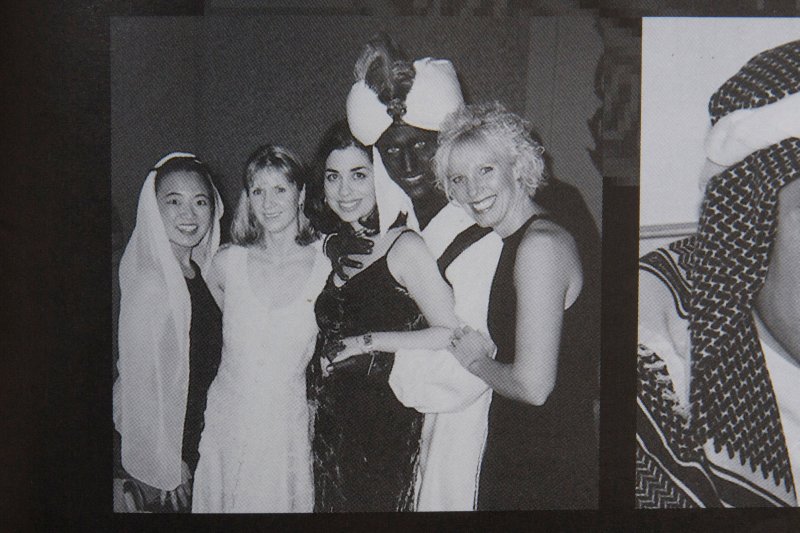
Justin Trudeau with dark makeup on his face, neck and hands at a 2001 “Arabian Nights”-themed party at the West Point Grey Academy, the private school where he taught.
Photo from the West Point Grey Academy yearbook, via Time
If anything rational can explain Trudeau’s odd performance at a Monday-morning press conference in Hamilton, Ont., perhaps it’s relief at those findings. Lucas Meyer, a radio reporter for Newstalk 1010 in Toronto, asked the PM a neat question about the video showing him capering around in blackface, apparently with something substantial shoved down the front of his trousers — namely, “what exactly was that costume?”
“I am continuing to be open with Canadians about the mistake I made,” Trudeau responded. “This is something that I take responsibility for. This is something that I should have known better, but didn’t. I will continue to work every day to fight racism, to fight discrimination, to fight intolerance in this country.”
Meyer tried again: “With all due respect, Prime Minister, that wasn’t even close to answering the question. What was that costume?”
“I have been open with Canadians, and I will continue to be open with Canadians,” Trudeau replied, eliciting various noises indicating astonishment from the assembled journalists. “I will continue to fight racism and intolerance every day.”
To be fair, it is by no means unusual to see Canadian politicians answer questions with talking points so ludicrous, counterfactual or shameless that you wonder how they can look their loved ones in the eye. […]
If an honest answer would have been problematic, “I don’t remember” or “it wasn’t a costume, I was just being a goof,” would have worked better. Just about anything would have been better than claiming to be consistently frank and open with Canadians while failing to answer what could be the simplest question he’ll get asked on the whole campaign.
On Tuesday in Burnaby, B.C., Trudeau was asked how he can say he’s being frank and open with Canadians when all he’ll say about the topic at hand is that he’s being frank and open with Canadians.
September 25, 2019
The Children’s Crusade against Carbon
Arthur Chrenkoff explains why political movements treasure and actively seek out the youth:
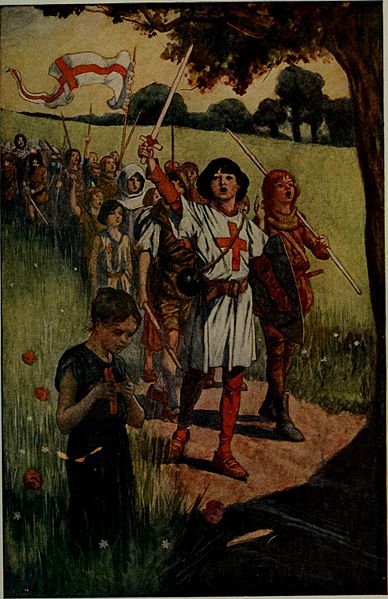
Illustration of the Children’s Crusade from Tales from far and near : history stories of other lands (1915).
York University Libraries via Wikimedia Commons.
It’s really a no-brainer. Revolutionary movements like communism and Nazism, which sought to overthrow the status quo and create a new society, have always placed huge importance on cultivating young following. I consider the green movement, particularly those sections of it that can be described as the Green religion, as a revolutionary movement too, because its main aim is to implement socialism under the pretense of saving the world from an environmental catastrophe.
There are several reasons why children and teenagers are so valued by utopian authoritarians:
1. As the cliché goes, children are the future. Invest in indoctrinating them now and your investment will last a lifetime, certainly outliving the less enthusiastic elders.
2. Children’s minds are more malleable and they are more impressionable, making them more receptive and accepting of your propaganda.
3. Peer group pressure helps to reinforce what the adults instill.
4. Children are (sorry children) ignorant and naive, having neither the sufficient education nor life experience that make adults more difficult to scare, persuade or bullshit into submission and belief.
5. Children have the energy and enthusiasm, which older people often lack.
6. Teenagers go through the proverbial rebellious stage, where they question their parents and other conventional sources of authority. This makes them very useful for the said revolutionary movements, whether fascist or socialist, which need to destroy the old, more conservative way of life so as to create a new social order according to their design.
September 24, 2019
More on the demands from the “climate strike” protests
Arthur Chrenkoff on the far beyond pie-in-the-sky demands coming discordantly from the amorphous climate protest groups coalescing around poor Greta Thunberg and her “climate strike”:
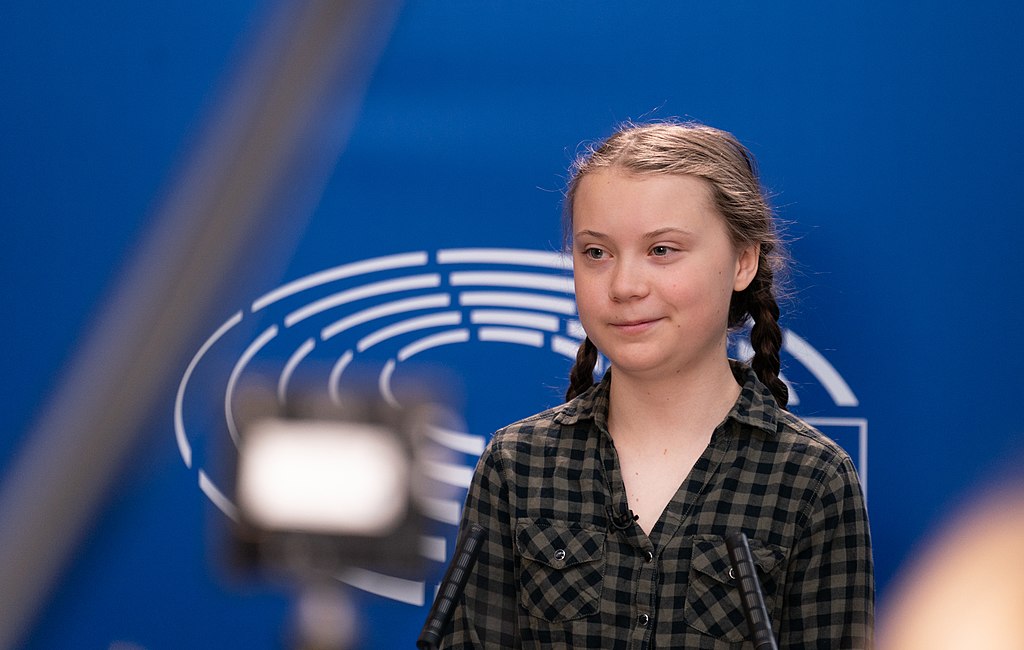
Greta Thunberg at the EU Parliament, 16 April, 2019.
European Parliament photo via Wikimedia Commons.
Fighting “climate change” is a very broad umbrella. What does the Global Climate Strike actually stand for? Greta Thunberg’s (I jokingly referred to her as St Joan of Arc of the Children’s Crusade against Carbon, but the marchers in Paris did carry a poster of Thunberg as a saint) initiative does not offer any extensive manifestos or programs on its website, perhaps not unexpectedly for a child-centric project, but it does provide a brief answer to the question “What are you [as a participant asking for?”:
The climate crisis is an emergency – we want everyone to start acting like it. We demand climate justice for everyone. Our hotter planet is already hurting millions of people. If we don’t act now to transition fairly and swiftly away from fossil fuels to 100% renewable energy for all, the injustice of the climate crisis will only get worse. We need to act right now to stop burning fossil fuels and ensure a rapid energy revolution with equity, reparations and climate justice at its heart [emphasis in the original].
It’s not much, but already more than a great majority of those taking part are probably aware of they were striking for.
It doesn’t help that some of the more outrageous claims are clearly not true:
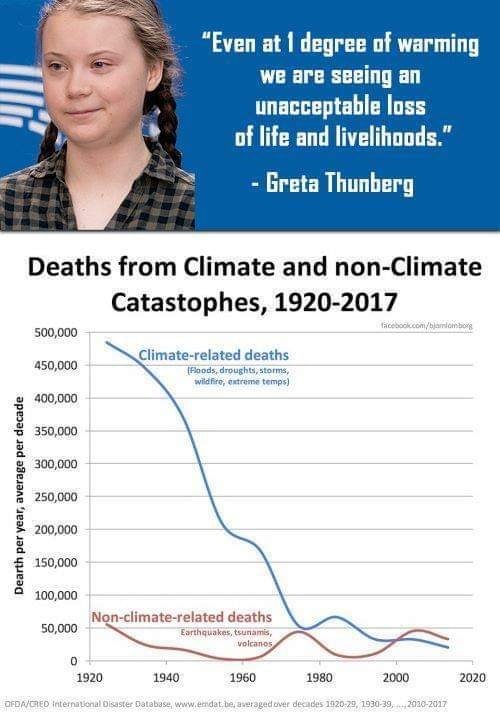
What of the other aspects of the Global Climate Strike’s five-sentence program? What exactly is “climate justice”? And what the hell are the “reparations” in this context?
The Strike site doesn’t provide answers, but “climate justice” in the last sentence hyperlinks to the website for The People’s Demands for Climate Justice, which explains itself as “Collectively shaped by people’s movements around the world, these demands are an international statement rooted in southern movements, and with input from numerous climate justice organizations and people’s movements around the world. The People’s Demands lays out a vision for a truly just international climate policy. We must ensure the demands of people, not the fossil fuel industry and other Big Polluters, is what is centered in the lead up to and during COP24 in Poland this December, 2018.” (a case here for updating your website.) While the Global Climate Strike is neither a “convening” nor an “endorsing” organisation among the 403 groups who are, by linking it clearly subscribes to the People’s Demands’ vision. Some of which includes:
Support global efforts for a just and equitable transition that enables energy democracy, creates new job opportunities, encourages distributed renewable energy, and protects workers and communities most affected by extractive economies …
Adopt a technology framework that recognizes the importance of endogenous and indigenous technologies and innovations in addressing climate change, and enables developing countries and communities to develop, access, and transfer environmentally sound, socially acceptable, gender responsive and equitable climate technologies.
Respect and enable non-corporate, community-led climate solutions that recognize the traditional knowledge, practices, wisdom, and resilience of indigenous peoples and local communities, and protect rights over their lands and territories …
Developed countries must make new concrete pledges of public climate finance accompanied by a definite timeline for delivery.
Commit to climate reparations to those most affected but least responsible for climate change.
In addition to fossil fuels, the People’s Demands are also against any market mechanisms to reduce emissions (like emission trading schemes), carbon offsets, carbon sequestration technologies, geoengineering and other “techno-fixes”, nuclear power, biofuels and use of biomass to generate energy, and large scale hydro projects – i.e. most of the potential solutions accepted by the serious mainstream climate change political-scientific consensus. This pretty much leaves only solar and wind, geothermal in a few lucky places (like Iceland, which is sitting on top of volcanoes) and small scale hydro to power the entire world post 2030. In other words, a complete fantasy world of green Luddites.
QotD: Conditions for the rise of tyrants in the Greek city states
Force can only ever be part of the answer. The poor have always been the majority, and sometimes the great majority. Armies of mercenaries to protect the rich have not always been available, and they have never by themselves been sufficient to compel obedience on all occasions in every respect.
Force, therefore, has always been joined by religious terrors. In Egypt, the king was a god, and the privileged system of which he was the head was part of a divine order that the common people were enjoined never to challenge. In the other monarchies of the near east, the king might not actually be a god. But all the priests taught that he was part of a divinely ordained order that it was blasphemy to challenge.
In the Greek city states until about a century before the birth of Epicurus, securing the obedience of the poor had not been a serious problem. There had been some class conflict, even in Athens. But most land was occupied by smallholders, and excess population could be decanted into the colonies of Italy and the western Mediterranean. There were rich citizens, but they were usually placed under heavy obligations to contribute to the defence and ornament of their cities.
Then a combination of commercial progress and the disruptions of the war between Athens and Sparta created a steadily widening gulf between rich and poor. There was also a growing problem of how to maintain large but unknown numbers of slaves in peaceful subjection.
The result was a class war that destabilised every Greek state. The sort of democracy seen in Athens could survive in a society where citizens were broadly equal. Once a small class of rich and a much larger class of the poor had emerged, there was a continual tendency for democratic assemblies to be led by demagogues into policies of levelling that could be ended only by the rise of a tyrant, who would secure the wealth of the majority — but who could secure it only so long as the poor could be terrified into submission. Once they could not be terrified by the threat of overwhelming force, they would rise up and dispossess the rich, until a new tyrant could emerge to subdue them again.
Unlike in the monarchies of the near east, no settled order could be maintained in Greece by religious terrors. During the sixth and fifth centuries, the Greek mind had experienced the first enlightenment of which we have record. There had been a growth of philosophy and science that revealed a world governed by laws that could be uncovered and understood by the unaided reason.
Now, enlightenments are always dangerous to an established religion. And the Greek religion was unusually weak as a counterweight to reason. The Greeks had no conception of a single, omnipotent God the Creator. Instead, they had a pantheon of supernatural beings who had not created the world, but were subject to many of its limitations. These were frequently at war with each other, and so they could be set against each other by their human worshippers with timely sacrifices and other bribes. They did not watch continually over human actions, and beyond the occasional punishment and reward to the living, they had no means of compelling observance of any code of human conduct.
And so, when the intellectual disturbance of philosophy and science spilled over into demands for a reconstruction of society in which property would be equalised, there was no religious establishment with the authority to stand by the side of the rich.
Sean Gabb, “Epicurus: Father of the Englightenment”, speaking to the 6/20 Club in London, 2007-09-06.
September 23, 2019
The “Global Climate Strike”
The big “let’s all play hooky from school” event’s Toronto organizers have been getting positive coverage from some of the local media, because of course they have. Here’s Tanya Mok for BlogTO, listing the totally reasonable and not in any way unrealistic “demands” of the movement:
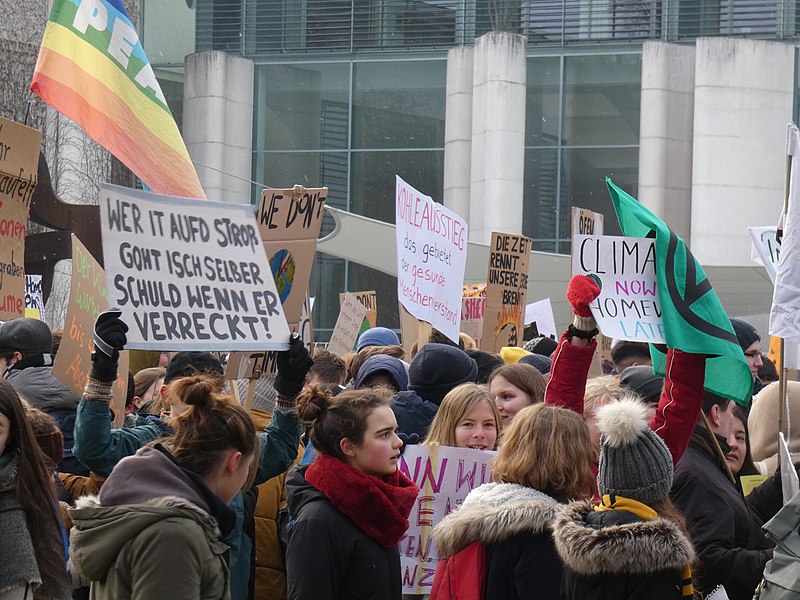
FridaysForFuture Demonstration, 25 January 2018 in Berlin.
Photo by C. Suthorn via Wikimedia Commons.
The coalition has made a list of seven demands, which “reflect the rallying cries of the intersectional movements” they belong to. Some of those demands include:
- Indigenous rights and sovereignty.
- The protection of forests, land, and water sources.
- A shift to publicly-owned renewable energy, and reducing national carbon emission by 65% by 203, reaching zero emissions by 2040.
- A $15 minimum wage for all, and higher taxation on the rich.
- Universal public services like health care and dental care, free university and college, housing as a human right, and free public transit.
- Justice for migrants and refugees, allowing status for all. That includes putting an end to deportations and allowing for the full access to public services.
There will be a concert at Queen’s Park after the rally, as well as a follow-up benefit concert at the Tranzac Club in the evening. A giant street mural project run by Greenpeace will also be taking place prior to the rally, around 10 a.m., at the southern point of Queen’s Park.
September 22, 2019
Justin “Harvey Weinstein” Trudeau to give the NRA his full attention
Chris Selley on Prime Minister Blackface’s latest attempt to switch the voters’ attention away from his racist activities onto a more traditional target for Liberal vituperation … the NRA and scary black fully semi-automatic assault machinegun murder machines of death:
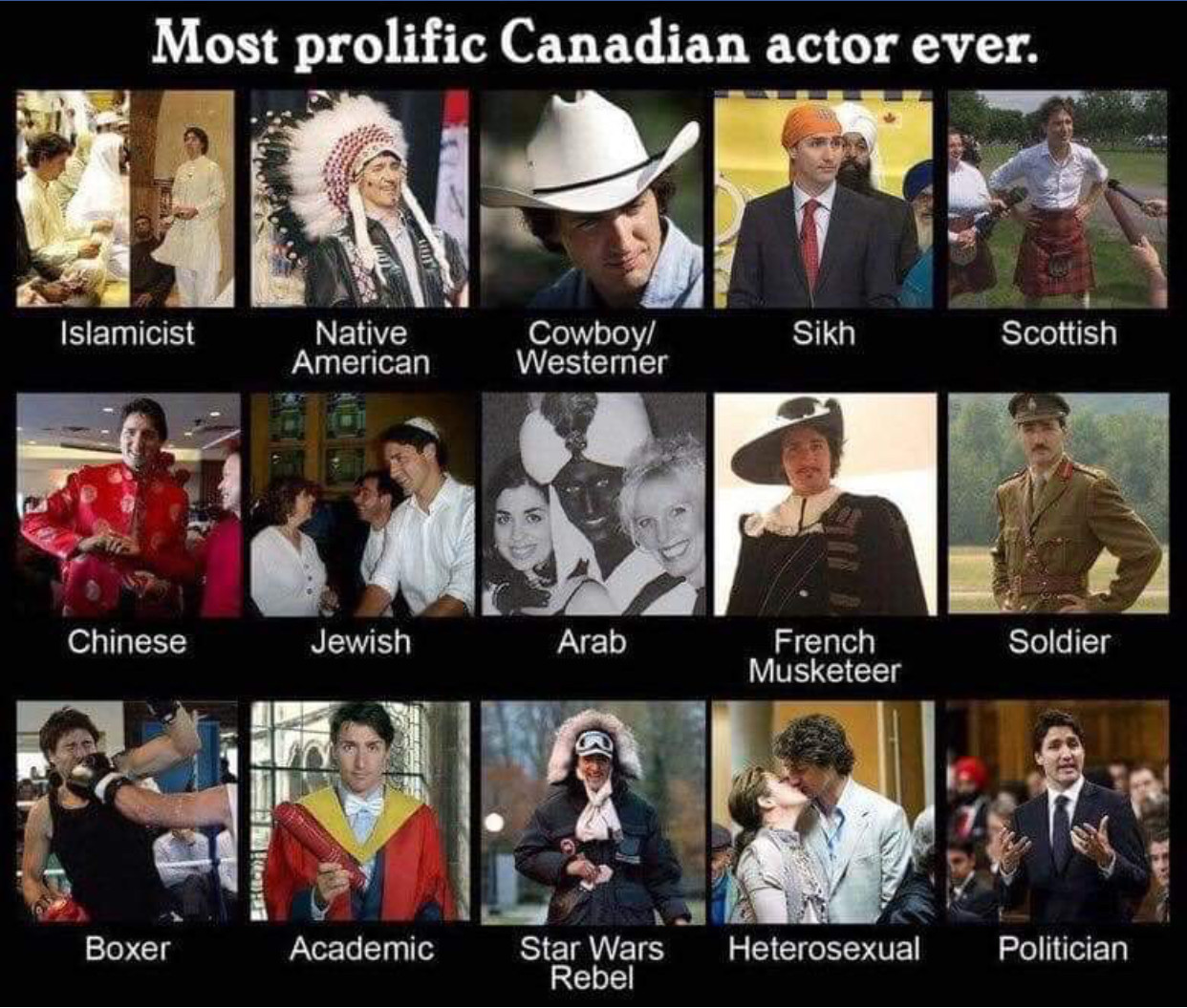
On Friday, amidst a force-nine crapstorm that (for now) makes SNC-Lavalin look like a spring shower, Justin Trudeau stood behind a podium in Toronto and announced his government would “ban all military-style assault rifles, including the AR-15.”
“You don’t need a military-grade assault weapon — one designed to take down the most amount of people in the shortest time — to take down a deer,” Trudeau intoned.
It was an utterly shameless, utterly formulaic attempt to change the narrative. Trudeau’s government spent much of its first term studying the need for new gun control measures and the result, Bill C-71, received royal assent exactly three short months ago. There was no ban on assault rifles or the AR-15. In fact, the government emphasized the importance of letting the RCMP’s gun boffins classify individual firearms. “It should not be politicized,” Public Safety Minister Ralph Goodale told CBC last year.
Now, well, there’s an election on and the boss isn’t sure how many more photos might be out there of him in blackface. So to hell with all that. A lot of people in Toronto and other big cities will eat it up, after all.
This sort of approach long predated Trudeau, of course, and he has used it many times before. In so many ways, over the past four years, he has shown himself to be a conventional Liberal politician. But recent days have taken us miles past conventional.
If blacking up wasn’t spectacularly uncommon in the days of Trudeau’s youth, it must surely nevertheless be the case that the vast majority of Gen-Xers haven’t ever done it — if not because they thought it was racist or knew it could get them in trouble, then because who on earth has that much time to kill? Those costumes clearly took a ton of effort, and he made a habit of it!
Small Dead Animals has a video of Stefan Molyneux discussing PM Dressup’s latest set of embarrassing incidents.
September 21, 2019
Justin Trudeau will magnanimously forgive Canadians for their systemic racism
It’s mighty generous of him, after all, it was our racist country’s culture that forced him to wear “skin-darkening make-up” in a totally innocent moment of amusement (or was it three totally innocent moments of amusement?). Andrew Coyne says Justin is no racist … but he is a sanctimonious fraud:
Justin Trudeau with dark makeup on his face, neck and hands at a 2001 “Arabian Nights”-themed party at the West Point Grey Academy, the private school where he taught.
Photo from the West Point Grey Academy yearbook, via Time
If you thought this affair meant an end to the Trudeau brand of conspicuous moral preening — if you thought the rank hypocrisy of lecturing his opponents for their sins against tolerance, even as he was concealing much worse in his past, would deter or even shame him — think again. He seems merely to have exchanged one hypocrisy for another, asking meekly for the forgiveness he has been so unwilling to extend to others.
Which is really what all this is about. It isn’t the insensitivity, or the self-absorption, or the hypocrisy, that will leave the most lasting impression: it’s the calculation, the fakery, the synthetic emotion, the sly manipulation. The prime minister has proved adept at deploying the jargon and cliches of the identitarian left (“microaggressions,” “intersectionalities,” and “ally” all featured highly in the Winnipeg press conference) in moments of maximum political danger: recall his earlier non-denial of having groped a young female reporter, this time as a 28-year-old: “men and women often experience situations differently.”
Is he a racist? No. He is a fraud. The racial masks he wore to conceal his identity 20 years ago are but one in a series: from blackface to feministface to sunnywaysface. If it were just a matter of comparing his youthful errors to his record on racial issues, his partisans might have a point. Certainly the Conservatives, with their record of having exploited fears of Muslims, or asylum-seekers, or God help us, the Global Migration Compact, are in no position to point fingers.
But the character and credibility of a leader is a much broader matter than one issue. It informs every part of his record, the whole of his platform. The leader we saw dissembling so skillfully this week in Winnipeg is the same one who lied to the public, repeatedly, about the SNC-Lavalin affair; who made solemn and explicit promises on electoral reform and balanced budgets he had no intention of keeping; who ran roughshod over Parliament in exactly the same ways he had most decried in his predecessor.
Oh, and: he is the same leader who boasted after the fact of having personally selected a “scrappy tough-guy senator from an Indigenous community” as his opponent for the charity boxing match that would launch his career because he would make “a good foil.” Even on race, that the current occupant of the Prime Minister’s Office is a sanctimonious fraud it is surely at least as significant as that his government sponsors anti-racism seminars.
September 20, 2019
Prime Minister Dressup and the make-up case
Prime Minister Justin Trudeau’s love of dramatic costume has been noted here before, but over the last couple of days it’s become evident that he’s also felt the attraction of stage make-up, even when most people would realize it’s no longer appropriate to wear blackface:
As Oscar Wilde almost said: “To be caught once wearing blackface may be regarded as a misfortune; to be caught doing so on three separate occasions in the run up to an election proves that there is a God, that he loathes liberal hypocrisy, and that he despises Justin Trudeau, especially.”
Here’s the first offending item:
Justin Trudeau with dark makeup on his face, neck and hands at a 2001 “Arabian Nights”-themed party at the West Point Grey Academy, the private school where he taught.
Photo from the West Point Grey Academy yearbook The View, via Time[…]
Will Justin Trudeau — President Bieber, as I prefer to call him — finally get his comeuppance as a result?
I doubt it. Alinsky’s Rules for Radicals tells us: “Make the enemy live up to its own book of rules.”
This is what we on the non-woke political side of the argument are doing right now. But it’s not going to make much difference, is it?
The other two “make up” incidents are covered in Time:
Speaking to reporters Wednesday night, following Time‘s publication of the photo, Trudeau apologized: “I shouldn’t have done that. I should have known better and I didn’t. I’m really sorry.” When asked if he thought the photograph was racist, he said, “Yes it was. I didn’t consider it racist at the time, but now we know better.”
Trudeau said he wore blackface “makeup” in high school to sing “Day-O,” a Jamaican folk song famously performed by African-American singer and civil rights activist Harry Belafonte. Time has confirmed that a photo shows Trudeau at a school talent show wearing blackface and an afro wig.
[…]
A third instance emerged Thursday — this one a grainy video showing Trudeau in blackface, raising his hands in the air. On Thursday, Astravas confirmed that the video showed Trudeau from the early 1990s. It comes despite Trudeau being asked at his press conference whether there were any other incidents he wanted to own up to.
#BREAKING: A video — obtained exclusively by Global News’ @MercedesGlobal — shows a third instance of Justin Trudeau in what appears to be racist makeup.#cdnpoli #elxn43 https://t.co/IEyeLFY0xc
— Global National (@GlobalNational) September 19, 2019
This is a critical moment for Trudeau, who began his re-election campaign on Sept. 11 under the cloud of a scandal over whether he pressured his then-attorney general to drop corruption charges against a large Canadian engineering firm [that’d be the SNC-Lavalin scandal, if you’re keeping track]. The Liberal Party leader has championed minority groups during his nearly four years as prime minister and made his embrace of Canada’s many cultures a major part of his leadership. At least seven of the 35 members of Trudeau’s cabinet are from ethnic minorities.
I doubt any of the remaining minority cabinet ministers will dare say much, as the Liberal Party has a long, long history of enforcing Omertà … or else. If they want to be back in cabinet on the lengthening odds that PM Dressup wins the October election, they’ll say little or nothing to the media.
The good news is that after careful consideration, the PM has found the guilty party … it’s the rest of Canada and its entrenched “systemic racism”:
At a press conference in Winnipeg, Justin Trudeau connects his black/brown face scandal to Canada’s issues with “systemic racism.” pic.twitter.com/sx9XNambyK
— Andy Ngo (@MrAndyNgo) September 19, 2019
Don’t you feel awful, fellow Canadians? That shame … that’s all yours, thanks to your shitty racist attitudes. Poor Justin is merely the victim.
The reason we don’t have – and will never have – an Economists Party
Andrew Coyne points out that the study of economics probably disqualifies you from being an effective politician, because achieving success in the sausage factory of politics requires you to ignore or even work against economic facts:
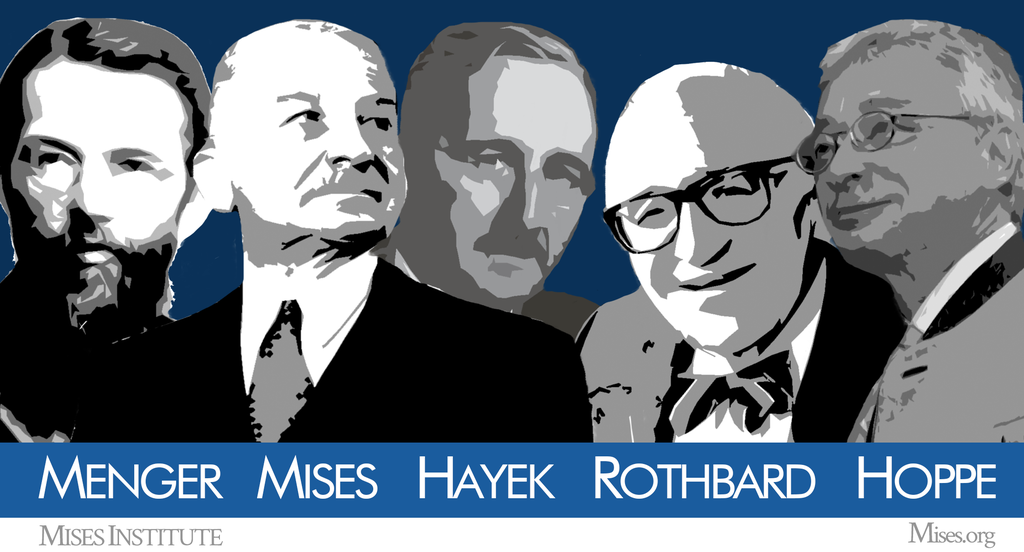
A Mises Institute graphic of some of the key economists in the Austrian tradition (Carl Menger, Ludwig von Mises, Friedrich Hayek, Murray Rothbard, and Hans-Hermann Hoppe.
Mises Institute via Wikimedia Commons.
I believe I was the first to propose the creation of an Economists Party, a political movement that would advocate for the sorts of policies favoured by people who study economics for a living, based on the principles at its core.
It could not happen, of course, any more than the existing parties are likely to suddenly embrace the teachings of economists they have so cheerfully ignored until now, and for the same reason: because politics is, at its core, the opposite of economics.
The basic principle of economics is that everything is scarce. The basic principle of politics is that nothing is scarce. Economics teaches that more of one thing can only be had at the expense of less of another. Politics teaches that we can have more of both things, and of everything else besides.
Since more of one thing means less of another, economics tells us there is no point in favouring one part of the economy over another: the resources diverted to one firm, industry or region are simply resources denied to all the rest. Whereas politics is all about such transfers: a perpetual merry-go-round of redistribution, not from rich to poor, which is appropriate, but from everybody to everybody, which is impossible.
And if, for some reason, a politician were to resist this impulse, he would shortly find himself out of work. For whereas the benefits of a given intervention are typically concentrated on this or that group, the costs are spread widely; its beneficiaries, accordingly, have every incentive to organize and agitate on its behalf, while those footing the bill — consumers, taxpayers, or both — have comparatively little at stake as individuals. They may not even know who they are.
Thus it is that politics inclines, more or less inevitably, to prefer the narrow interest over the broad; producers over consumers; the present over the future. The only difference between the parties is whether this bias to the expedient is dressed up as a philosophy and celebrated as a positive good, or merely yielded to.
QotD: Red Flag laws for politicians
Red Flag laws for Congress.
Any Congresscritter says or does, something unConstitutional, anyone should be able to file a Red Flag violation and have that politician’s powers to write bills, attend sessions of Congress, vote, draw a taxpayer-funded paycheque, live in a mansion in Washington DC, or anything else tied to the job of being a Congresscritter immediately suspended.
There would be a hearing within fourteen days before a judge in their home district, where the Representative or Senator would be given the opportunity to show where in the Constitution what they said, or the law they proposed, or the action they did, was explicitly authorised, and if they can show that, their rights to all the goodies of being an elected representative of the People would be restored.
If they can’t, then they can sit at home for a year and twiddle their thumbs. Not allowed into the Capitol, no drawing a paycheque, no voting, no proposing bills, nothing added to their pension funds, zip, zero, NADA to do with being an elected official.
And their party doesn’t get to fill that slot. Their party doesn’t get to vote on their behalf. Their party doesn’t get to help them with re-election.
No, that Congresscritter, and the seat they occupy, goes into the penalty box for a year.
After a year, if their term in office hasn’t expired, they can take up their duties again.
Unless, and until, they mention violating the Constitution again, and someone files another Red Flag complaint.
Lawdog, “Sauce for the goose…”, The Lawdog Files, 2019-08-06.
September 19, 2019
QotD: Parliament and democracy
But you see we’ve never worked out the relationship between the fact that we’ve got two sovereigns. There is the legal sovereign which is the Crown in Parliament and there is the real, political sovereign which is the sovereign people behind them. But what we did, and this is why Bercow’s behaviour is so disastrous; it’s why Theresa May’s behaviour has been so catastrophic: what we developed thanks to Erskine May and the Parliamentary Handbook and endorsed by Dicey, we developed a whole series of devices. They were conventions that turned MPs from more or less representatives into more or less delegates. And what are these things? They’re party affiliation. They are manifestos. They’re standing on a ticket and they’re being whipped when they’re in the house. That is the thing that binds them to the popular vote. No MP; Dominic Grieve was not elected in a personal capacity. He was elected because he stood as a Tory on a Tory manifesto which promised Brexit. That man did not dissent at the time. His claims to dignity, his claims to acting honourably, are totally false.
There are other rules in Erskine May about the procedures of Commons business which gives the government the basic control of the parliamentary timetable. Otherwise what happens is the house just dissolves into a talking shop. Becuase MPs have refused to vote for any deal: they’re strong in the negative but they’re hopelessly weak in the positive. They can’t agree on anything. We developed a series of conventions in the 1880s that turn MPs into something like the representatives of the people and what has systematically happened in this Parliament: we have broken those conventions.
Theresa May’s loss of the election and her absurd notion that you can keep people with completely contradictory opinions on a main platform of government policy in the same party broke down the whipping system. Bercow broke down the government’s control of legislation. And you’re left with this chaotic mess.
David Starkey talking to Brendan O’Neill on the Brendan O’Neill Show, 2019-09-15. (Transcription from The Great Realignment)


