
[Groupthink author Irving] Janis’s first rule is that a group of people come to share a particular way of looking at the world which may seem hugely important to them but which turns out not to have been based on looking properly at all the evidence. It is therefore just a shared, untested belief.
Rule two is that, because they have shut their minds to any evidence which might contradict their belief, they like to insist that it is supported by a “consensus.” The one thing those caught up in groupthink cannot tolerate is that anyone should question it.
This leads on to the third rule, which is that they cannot properly debate the matter with those who disagree with their belief. Anyone holding a contrary view must simply be ignored, ridiculed, and dismissed as not worth listening to.
Christopher Booker, “Groupthink on Climate Change Ignores Inconvenient Facts”, Foundation for Economic Education, 2018-02-24.
June 9, 2020
QotD: Groupthink
June 8, 2020
Andrew Sullivan can’t write about the riots or he’ll lose his job
I’d wondered why he hadn’t directly addressed the biggest news item in the United States over the last week:
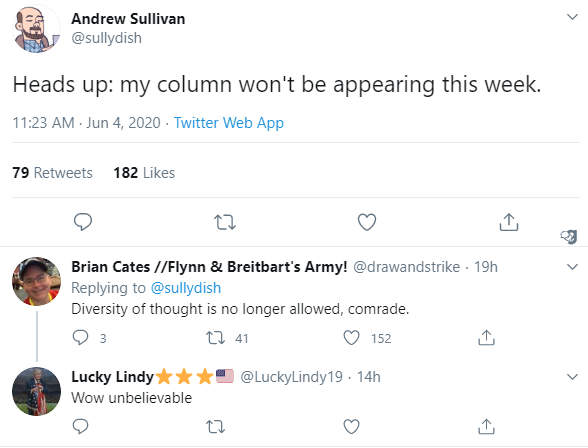
What has happened to New York media? Just as the New York Times was experiencing its own Inner Mongolia Moment over the now notorious Sen. Tom Cotton “Send in the Troops” op-ed, the Maoists at New York magazine were going after their best columnist, Andrew Sullivan.
Sullivan revealed on Twitter yesterday that his column wouldn’t be appearing. The reason? His editors are not allowing him to write about the riots.
Presumably Sullivan’s editors are frightened that he might make the radically bourgeois point that looting and violence are wrong.
Cockburn understands that Sullivan is not just forbidden from writing for the New York magazine about the riots; his contract means he cannot write on the topic for another publication. He is therefore legally unable to write anything about the protests without losing his job — at the magazine that, in 1970, published Radical Chic, Tom Wolfe’s brilliant and controversial excoriation of progressive piety. It’s the bonfire of the liberals!
June 6, 2020
Cognitive dissonance is real
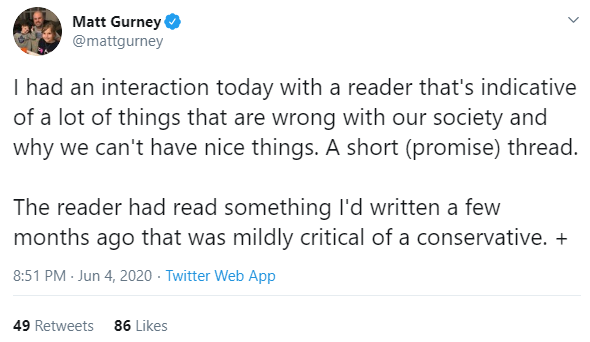
Matt Gurney had a discussion with one of his readers that left him shaking his head in disbelief:
I had an interaction today with a reader that's indicative of a lot of things that are wrong with our society and why we can't have nice things. A short (promise) thread.
The reader had read something I'd written a few months ago that was mildly critical of a conservative. +
— Matt Gurney (@mattgurney) June 5, 2020
The reader haughtily asked if I’d ever make such a criticism for a Liberal.
I said yes.
The reader didn’t believe me, and said, oh yeah, show me an example?
As it so happened, I actually had a column of mine open in another tab; I was referring back to it for research. +
—
The column in question contained a perfect example of me saying a very comparable thing about a Liberal as I had about the Conservative. So I had, OK, here you go. Pasted the link and replied.And the reader replied right away. The reader was very confused.
—
The reader had questions about how I could criticize both a Conservative and a Liberal. The reader asked about agendas — who had insisted I write one piece, and why had they then permitted me to write the other?I wrote both on my own initiative, I explained. +
—
And I made criticisms of both gentlemen, the Conservative and the Liberal, because they’d both done things that pissed me off.The reader didn’t believe this was possible. There had to be another explanation, or an ulterior motive. +
—
I eventually disengaged. But I’ve been thinking about that all day. There’s a grown-ass person in Canada, totally literate and presents very normally, who really struggled to understand that someone could be critical of both the left and right without being compromised.END
June 4, 2020
Trudeauvian “performative sanctimony” on display … again
Chris Selley on the Prime Minstrel’s latest attempt to virtue signal on racial issues:
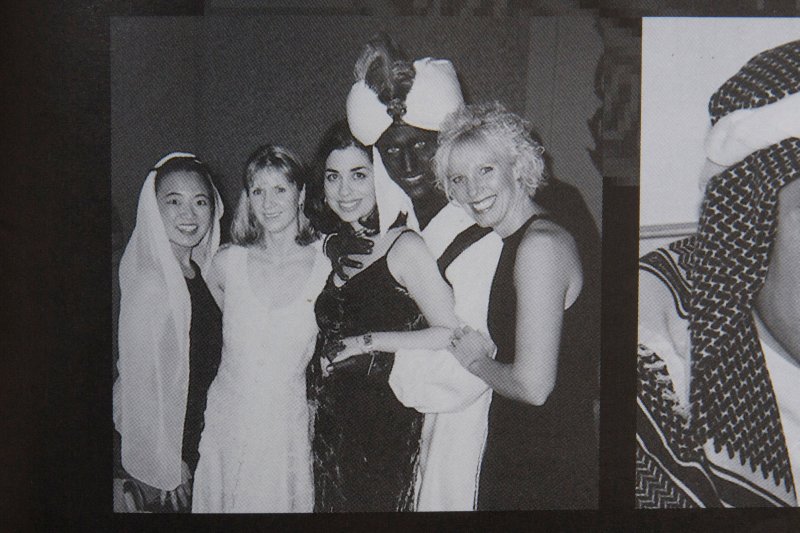
Justin Trudeau with dark makeup on his face, neck and hands at a 2001 “Arabian Nights”-themed party at the West Point Grey Academy, the private school where he taught.
Photo from the West Point Grey Academy yearbook, via Time
In agonizing for 21 seconds before answering a question about President Donald Trump’s threat to send the military after civilian protesters in American cities, Prime Minister Justin Trudeau likely risked causing as much trouble as he was hoping to avoid. Those who would like to see him denounce the president in full throat might be as annoyed as those who think he should accept there’s nothing Canada can really do to help and look out for our own best interests while the socio-political nightmare plays out.
Trudeau’s response wasn’t anything inspiring or novel or revolutionary. “It is a time for us as Canadians to recognize that we too have our challenges — that black Canadians and racialized Canadians face discrimination as a lived reality every single day,” he said. “There is systemic discrimination in Canada, which means our systems treat Canadians of colour, Canadians who are racialized, differently than they do others.”
He continued: “We need to see that, not just as a government and take action, but we need to see that as Canadians. We need to be allies in the fight against discrimination. We need to listen, we need to learn and we need to work hard to figure out how we can be part of the solution on fixing things.”
But here, at least, he was getting to the nub of the issue: To the extent the federal government can make things better for marginalized Canadians, Trudeau is the guy driving the boat. To read some of his ministers’ pensées, you would think they were just regular folks.
[…]
In the meantime, however, you can bet the farm we will soon learn that the Liberals’ changes to impaired driving laws — allowing police to stop and breathalyze drivers without any suspicion of impairment — have disproportionately affected black and Indigenous drivers in particular. Literally everybody saw it coming except Trudeau and his ministers.
OK, I’m kidding — they saw it coming too. They might want to log off, dial down the performative sanctimony and think on that a while.
QotD: Islamofascism
Dislike of George Bush’s foreign policy has led to an automatic support of those perceived to be his enemies. Paradoxically, this leaves the left defending people who hold beliefs that condone what the left has long fought against: misogyny, homophobia, capital punishment, suppression of freedom of speech. The recent reaffirmation by Iran’s Ayatollah Khamenei of the fatwa against Salman Rushdie has been met by virtual silence; as has the torture and murder in Iraq of a man who would be presumed to be one of the left’s own — Hadi Salih, the international officer of the Iraqi Federation of Trade Unions. The hard left these days is soft on fascism, or at least Islamofascism.
The religious right in America would, if it could, wind back access to abortion and some other women’s rights. But as far as I am aware, no Christian fundamentalist in the US has suggested banning women from driving cars, or travelling without their husbands’ permission, or forcing them to cover their faces. Contrary to popular opinion, one is not the same as the other.
Pamela Bone, “The silence of the feminists”, The Age, 2005-02-04
June 2, 2020
“Calling a modern ‘artist’ a poseur is like calling water wet — what could possibly be the point?”
Severian on modern “art” and its practitioners:
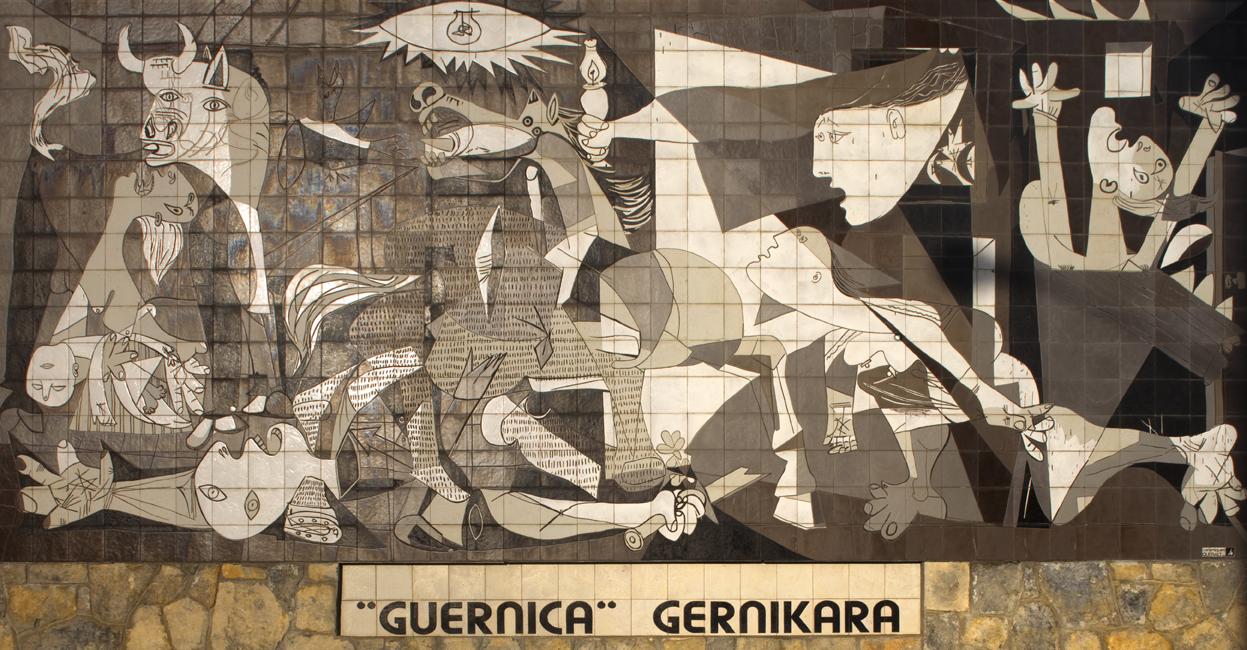
Picasso’s “Guernica” in mural form in the town of Guernica.
Photo by Papamanila via Wikimedia Commons.
Leszek Kolakowski, in his essay collection Is God Happy?, wrote several fascinating essays on Communism vs. other forms of Socialism, such as Fascism and generic Leftism. He notes that while Communism proper attracted lots of serious intellectuals and artists, who produced some works of real merit, generic “Leftism” had few, and Fascism almost none.
He also notes the degeneration of art on the Left. I don’t want / am not qualified to get deep into the weeds of art history, but let me use an example (mine, not Kolakowski’s): Pablo Picasso vs … oh, pick an artist, they’re all Lefties … let’s say Andy Warhol. Noting that “important” can be diametrically opposed to things like “good,” “aesthetically pleasing,” etc., we can all agree that both were important artists. Whatever else their differences, the most obvious one was:
Sincerity.
Picasso was a lifelong member of the Communist Party. He was also a sincere artist (which, again, can be miles away from “good;” I personally can’t stand Picasso’s art). Guernica is wildly overrated, and its sentiment jejune — we all agree that bombing civilians is bad, mmkay? — but at least it’s sincere. Warhol, on the other hand, never took a sincere breath in his life. Making your work superficial on purpose doesn’t absolve you from the sin of superficiality. Warhol (and Roy Lichtenstein, and the rest of the “Pop Art” crowd) gave wannabes permission to substitute “being ironic” for “having something to say,” and there’s your modern art in a nutshell. Calling a modern “artist” a poseur is like calling water wet — what could possibly be the point?
Which brings us back to Kolakowski. He notes that there are apostates aplenty from Communism, and they all seem compelled to write big long books full of critical self-examination. Cheering for the murder of millions would do that, one supposes… except that, as Kolakowski says, you can’t find one single ex-Leftist doing it. Hell, is there such a thing as an ex-Leftist, as opposed to an ex-Communist? Kolakowski couldn’t find one (as of 1995, I think), and I can’t think of one either. Every former radical I’m aware of was just that — a radical, a card-carrying Communist or at least a virulent fellow-traveler, e.g. David Horowitz. We probably all have heard of someone waking up one day (say, after 9/11) realizing that the Democratic Party they’d been knee-jerk voting for all their lives was out to lunch, but do you know of any True Believers seeing the light?
Antifa
Arthur Chrenkoff welcomes the move to designate the Antifa movement as domestic terrorists:
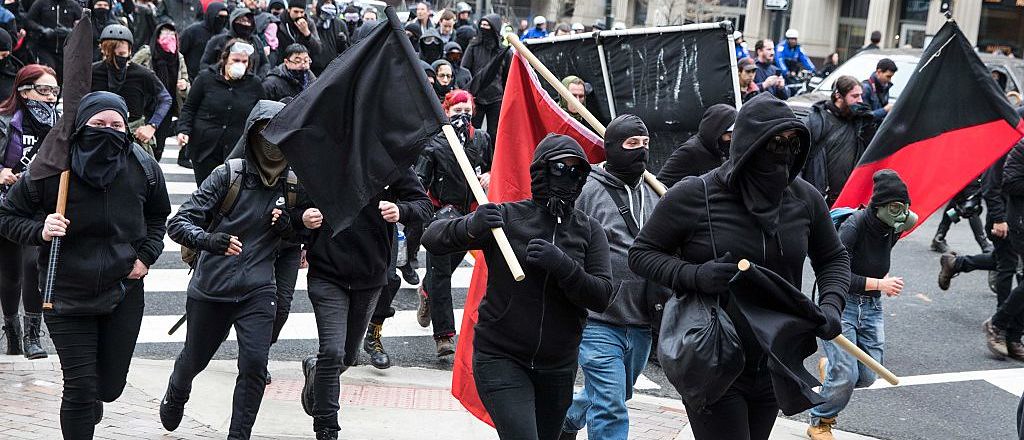
“antifa 8973ag” by cantfightthetendies is licensed under CC BY 2.0

President Trump’s decision to designate Antifa as a terrorist organisation is long overdue.
Whether you call them a terrorist organisation or a criminal organisation – or both – the underlying facts are the same: Antifa is a network of groups committed to a violent revolution to overthrow the democratic system of government and replace it with some sort of a communist “dictatorship of proletariat”, whoever the current proletariat is supposed to be (which does not in the end matter very much, because it’s all about the party organisation rather than “the masses”). To effect such revolution, Antifa uses tactics of violence against people it considers enemies as well as destruction of property. Remember, these people are not Scandinavian social democrats or even Bernie and AOC-style “democratic socialists” who advocate and follow a democratic and peaceful path of transformation to achieve their objectives of building what they consider a better and more just society. Antifa are thugs who desire to tear down and destroy the current political and economic order and erect their utopia on its ashes. They want to abolish democracy, capitalism, liberalism and all the other existing institutions in favour of a Marxist-Leninist state — or just for the fun of it if they are more of an anarchist rather than communist frame of mind. Groups whose the entire modus operandi is based on breaking law and criminal activity have no legitimate place in a democratic society. Antifa are the political organised crime.
The label Antifa has been used and abused too long to muddy the waters and confuse people — many of whom, granted, want to be confused. Because fascism is objectively bad (and considers so by an overwhelming majority of people), calling themselves “anti-fascist”, Antifa seeks to claim the moral high ground and the role of the good guys who stand up to white supremacists, neo-Nazis and other extreme element. But you cannot simply judge people by who their enemies are, or who they say their enemies are — you also have to judge them by their intentions, actions and aims. In the Second World War, the United States and the United Kingdom and their Western allies were anti-fascist, but so was the Soviet Union. Stalin hated fascists (except for a period of two years in 1939-41 when he collaborated with them). This did not make him a good guy, even if for the Allies at the time it made him the lesser of the two evils. Coincidentally, for Stalin the label “fascist” was a very broad one, applying not just to German Nazis and their sympathisers but to anyone opposed to communism and the Soviet Union and so in turn opposed by them, including at times even social democrats and other non-revolutionary socialists {“social fascists” in the Stalinist nomenclature). And so it is for Antifa — we are all fascists, from the few skinheads at the political fringes to all the mainstream parties and ideologies of both the right and the left. Just as in Russia in 1917 onward and all the other communist countries in history, your position on the democratic political spectrum can never give you an ultimate immunity, it only determines the order in which you will be shot (left-wingers and anarchists last, because they can be used the longest by the forces of revolution).
May 31, 2020
On “spontaneous” riots
David Warren had a brush with a riot as a youngster — not as a participant, but as a near-victim — so the psychology of riots has a personal edge:
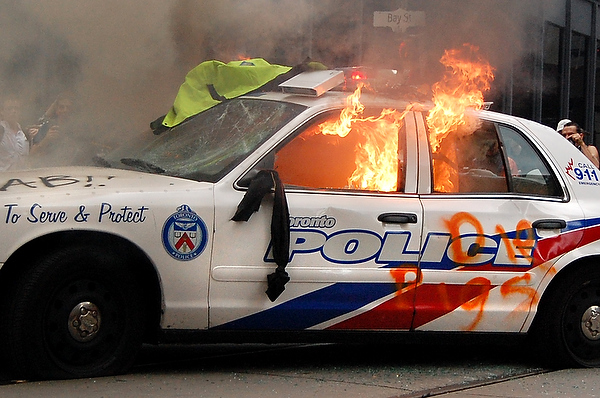
To a trained observer, the organizers of the riot stand out. They are dressed distinctly, they are giving orders; they are directing the attacks. They will usually be wearing expensive communications equipment. A drama coach would notice that their harangues are premeditated and rehearsed, to stir violence. That anger in the crowd was available to them, as their raw material, goes without saying; their art consists of “weaponizing” it.
Fascists — the real ones, in pre-war Italy and Germany — were masters of this art. So were the Communists with whom they had streetfights. The blackshirts today, a near-monopoly of the Left, descend from this rich tradition. When Antifa and other leftist scum shut down public discussions in universities and elsewhere, they may use the latest technology, but to old-fashioned ends.
What is alarming is not that these people exist — radical evil is a fact in human nature — but that they are given permission to act lawlessly. Rather than arrest and prosecute them, the liberal authorities agree to silence the legitimate speaker. They are trying to avoid confrontation, with people who sought confrontation, and will seek a larger confrontation next time. The prestige of these devils in human flesh is increased by their victories.
An injustice, such as the apparent murder of George Flynn by a vicious cop, while three more stood and watched, was the pretext for the riots. It was convenient for aggravating racial tensions, by which the Democrat party hopes to retrieve black votes that had been getting away from them. I would not wish to omit this dimension of the permission they grant to rioters. Politics are a cynical business.
But note, the mostly white folk in Antifa, prefer black neighbourhoods to start race riots, for that is where resentments will be easiest to exploit. (Masks help to conceal their whiteness.) This means that the victims of the riots, whose property and businesses are gutted, will also be mostly black. The media elide this aspect of the lawlessness, because they want Republicans to be defeated, too.
The moral stench is overpowering.
May 29, 2020
QotD: Historical ways to deal with your “rage heads”
Set the Wayback Machine to the turn of the 20th century. Lenin’s great insight is that “the masses” will never achieve the proper revolutionary consciousness without a dedicated cadre of hardcore, professional revolutionaries to lead the way. Lenin recognized the prevalence of incipient rage heads in his society — how could he not? — but realized that, absent some guiding hand, they’d flounder around incoherently. At best (from the “furthering the Revolution” point of view), they’d do what his, Lenin’s, idiot brother did: Try to knock off the tsar, and get himself hung for it. Thus, the Bolsheviks.
The problem, though, is that rage heads by definition suffer from poor impulse control. The tiny subset of them that are pure sociopaths (like Lenin), and thus have the icy-veined self-control to hold their fire, have to maintain the very tightest discipline over the Party, or all hell breaks loose. See, for example, the massive street battles in Weimar Germany between the KPD (German Commies) and the SD. Hitler, like Lenin, had to get his rage heads on a tight leash, so he channeled the disciplined sociopaths from the SD into the SS, cooled out the coolable in the SD by buying them off, and shanked the incorrigible remainder. See also the almost-exactly-contemporary Moscow Show Trials.
Note please that this is your best-case scenario for a purely ideological revolution. From Robespierre to Kim Il Sung, the first step in consolidating the Revolution is killing off a large fraction of the original revolutionaries.
The worst-case scenario (again, from the “furthering the Revolution” standpoint) is what the American wannabe-bolshies did / are currently doing. Knowing that you can’t shank or show-trial the dreadlocked poetry majors that make up your goon squad, you try to channel them into academia, the Media, the “arts.” Which fails egregiously, because whatever tenuous contact with reality they once had gets completely severed by those institutions’ social bubbles. They never were very good at holding fire, and now they can’t, literally can’t, see any reason to — life is great here on campus, so why can’t it be that way everywhere?
Severian, “Living in End Times”, Rotten Chestnuts, 2020-02-28.
May 27, 2020
QotD: “Hate speech” is the new secular heresy
Brendan O’Neill, “Why we must win the fight for free speech”, Spiked, 2020-02-26.
May 25, 2020
QotD: Sociopaths and politicians
The key thing about the modern sociopath is the ambivalence toward the truth. They think saying something is the same as doing something. What matters is if the words get the listener to do what the sociopath wants them to do. Standing in front of crowd, making false claims, is fine if it causes people to buy product. If the truth sells more product, then the truth is better. From the perspective of the modern sociopath, the difference is about the results, not the accuracy of the statements. The truth or a lie, whichever works.
Now replace “sociopath” with “politician” and “product” with “votes” and you have the modern managerial democracy. It’s not that our politicians lie. It’s that for them, a lie is indistinguishable from the truth. That’s why they seem so utterly shameless. Shame requires a sense of right and wrong, a knowledge that what you said or did is intrinsically wrong. For the people who rule over us, right and wrong only exist in the context of their own ambitions. Something is “right” if it benefits the person in the moment.
“The Z Man”, “Rule by Sociopath”, The Z Blog, 2018-02-21.
May 24, 2020
Zuby on why Joe Biden’s “you ain’t black” comment is one of the most racist things said by any US politician recently
I’d embed all the tweets here, but the page loading speed would be monumentally slow, so here’s the initial tweet and I’ve scraped the text from the rest and put it in blockquotes:
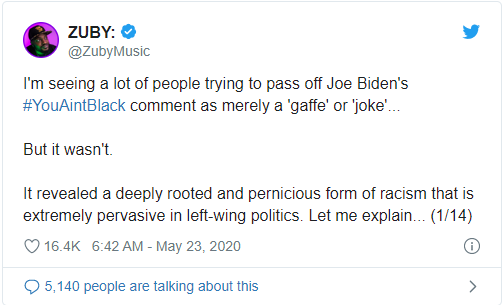
I'm seeing a lot of people trying to pass off Joe Biden's #YouAintBlack comment as merely a 'gaffe' or 'joke'…
But it wasn't.
It revealed a deeply rooted and pernicious form of racism that is extremely pervasive in left-wing politics. Let me explain… (1/14)
— ZUBY: (@ZubyMusic) May 23, 2020
Every black person is aware of the power and pain of being considered an ‘outsider’ within one’s own ‘race’.
This happens everywhere, but it is a common phenomenon particularly amongst Black Americans, due to history and culture. (2/14)
—
You are probably familiar with terms like ‘Uncle Tom’, ‘coon’, ‘house n*gga’, ‘coconut’, ‘Bounty’ and ‘race traitor’.
These slurs are used to demean black people by stripping them of their ‘Blackness’. (3/14)
—
ALL black conservatives, libertarians, centrists, or even moderate liberals have been on the receiving end of at least one of these slurs.
Usually levied by another black person, but occasionally by a particularly bold ‘woke white progressive’ type. (4/14)
—
This form of ostracisation is particularly painful for Black Americans. Who are largely disconnected from their African roots due to the horrors of slavery.
As a substitute, many cling to a fuzzy concept of ‘Blackness’. For the sake of identity and community. (5/14)
—
So, to be considered ‘not black’ is like being an outcast of a community that often already feels alienated… (6/14)
—
I am not American and I do not speak on behalf of anybody but myself. These are my own thoughts.
My name is Nzubechukwu and my heritage is of the Igbo tribe in Anambra state in Nigeria 🇳🇬
So NOBODY can take my ‘Blackness’ from me! They will look foolish trying! (7/14)
—
Most Black Americans don’t have this SOLID sense of heritage.
People (of all colours) know this and weaponise it against them to prevent individuals from stepping out of the ‘groupthink’.
Anyone who is perceived to go ‘against’ ‘The Black Community’ must be punished. (8/14)
—
Left-wing politicians, activists and professional race hustlers have used this psychological warfare to keep black people ‘in check’ and voting for them for many decades.
It’s demeaning, discriminatory, and it strips black people of our agency. (9/14)
—
So, when Biden suggested that ‘you ain’t Black’ if you consider voting for Trump instead of him, he exposed a much deeper form of racism.
The sense of ‘ownership’ of Black people. Unearned allegiance and entitlement.
It was a vile statement… (10/14)
—
But it was also honest. Because that’s how a lot of these politicians and ‘progressives’ really feel about black people.
Like they own us. (11/14)
—
If you were born black, then you will die black. There is no such thing as being ‘politically black’. This is nonsense designed to CONTROL you and keep you needy.
NOBODY can take away your ‘Blackness’. Your ‘Black Card’ is your birthright. Regardless of who you vote for. (12/14)
—
I would never dream of telling anyone who they must vote for, based on their skin colour nor genitalia.
That would be extremely arrogant, condescending and discriminatory.
Be VERY suspicious of anybody who talks like that. They want to control your mind. (13/14)
—
That is all. I hope you enjoyed my TED talk.
Much love. 👊🏾
Zuby
#ImStillBlack
H/T to Darleen for posting the link to David Thompson’s blog.
Justin Trudeau explains why Canada is still ferociously invested in getting that temporary UN Security Council seat
Chris Selley strives manfully to avoid directly calling the Prime Minstrel of Canada an utter moron:
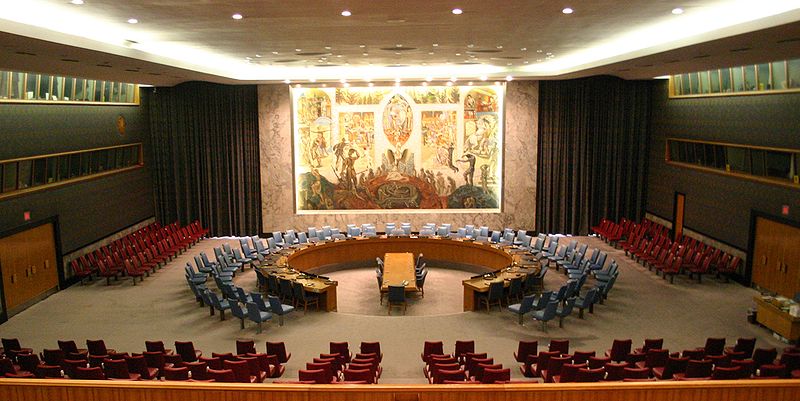
The United Nations Security Council Chamber in New York, also known as the Norwegian Room.
Photo by Patrick Gruban via Wikimedia Commons.
“We are doing well managing the economy in the COVID era while keeping to the principles and values that we hold dear,” said Trudeau.
There are times when the prime minister opens his mouth and I genuinely wonder how he doesn’t burst into flame. This was one of those times.
Which principles and values exactly?
Not our international obligations to asylum-seekers, certainly. Until very recently the Liberals would shift into maximum dudgeon at the very suggestion that tens of thousands of people crossing the border “irregularly” — let no one say “illegally”! — at Roxham Road constituted any sort of problem.
“FACT: Providing asylum claimants due process is not a choice. It is the law,” then Immigration Minister Ahmed Hussen tweeted in July 2018. Trudeau was dispatched to Queen’s Park to educate Premier Doug Ford, who wasn’t being welcoming enough. “It didn’t seem to me that the premier was quite as aware of our international obligations to the UN convention on refugees, as he might have been,” Trudeau faux-lamented. “So I spent a little time explaining.”
And then in March, it all got chucked into the incinerator. Try to cross the border illegally — we can say it now! — and you’ll get turned back into American custody.
Plus the sardonic amusement that Canada, whose educational and cultural organizations make such a big deal about our critical role in UN peacekeeping over the years, currently has a massive force deployed on such missions … thirty five in total … that’s not 35 missions, that’s 35 people.
May 21, 2020
The Milk Dud’s (final?) flip-flop
Walking political liability Andrew “The Milk Dud” Scheer managed to bring himself to the attention of the media yet again for his decision to backtrack on renouncing his American citizenship … did Justin need him to take the heat off for another Trudeau blunder?
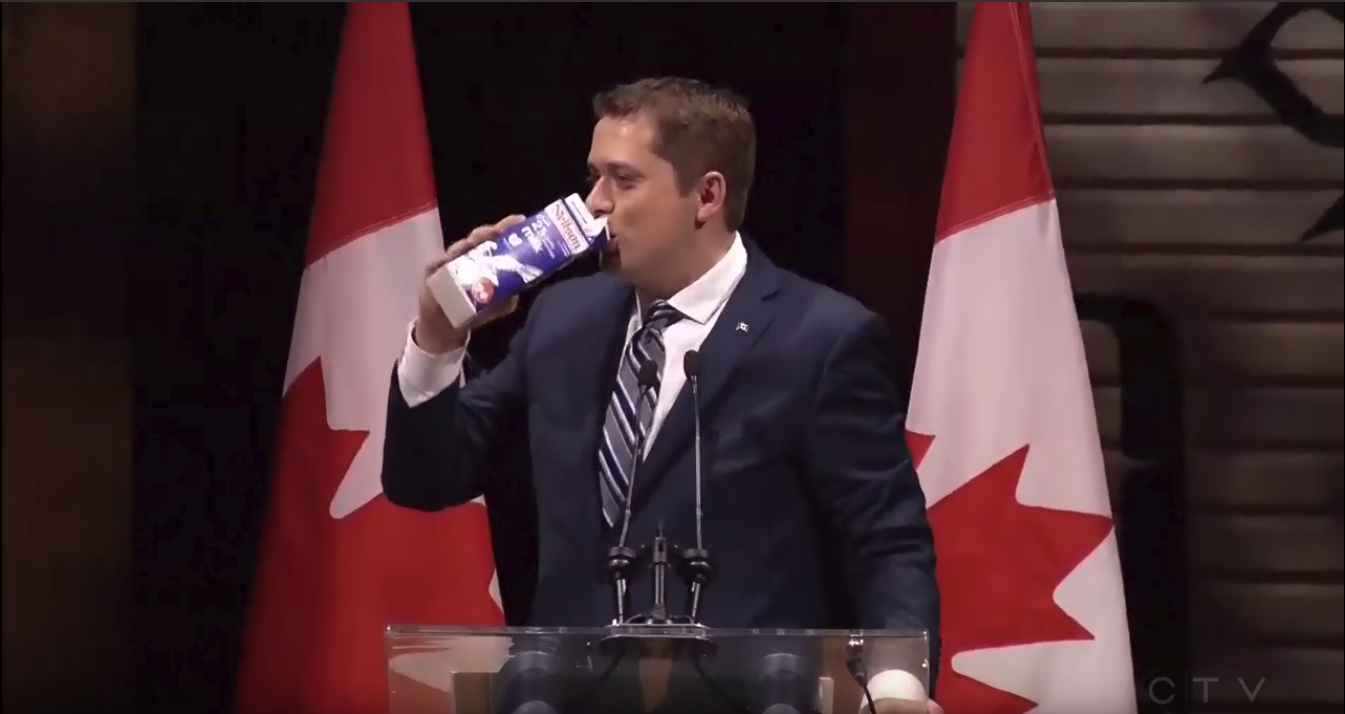
Andrew Scheer, paid tool of Big Dairy and dual citizen of Canada and the United States, chugs some milk during a Press Gallery speech in 2017.
Screencapture from a CTV video uploaded to YouTube.
I don’t suppose Conservative Leader Andrew Scheer’s flip-flop on renouncing his U.S. citizenship will be of interest very long, but I have parting shots to take about it. In backtracking on his original intention to give up the United States of America, Scheer showed an awareness that there is at least one position in Canadian government, that of prime minister, which requires going the extra mile to avoid the appearance of divided or compromised allegiance. I am being careful not to say “loyalty,” which, unlike allegiance, might be regarded as a purely private matter.
It is a good thing that Scheer recognizes the importance of these issues. But he made a big deal about the disavowal being a “personal decision” during the 2019 election. What’s changed now, he says, is that he will never be prime minister. So he is now free to be an American, which, by definition, is the freest goldurn thing you can be.
But: “I’ll never be prime minister” seems like a hell of a thing for the leader of the Opposition, which Scheer still is until August at the earliest, to say. Our House of Commons is in a hung state. No party commands a majority. The Conservatives (who would want us to remember that they led in the 2019 popular vote) chose not to have an interim leader in Scheer’s place while permanent successors were sized up. The Liberals don’t have anything like a binding supply-and-confidence agreement with any other party. The country is in the grip of epidemic disease.
When the behind-the-scenes Liberal-friendly Quebec dairy folks selected Scheer as their preferred patsy to “lead” the “Conservative” party, they chose very well indeed. Scheer might as well be wearing a Washington Generals jersey from now on.
May 18, 2020
QotD: Science, evidence and “cognitive creationism”
What can we do about this problem? First, we must acknowledge that for most issues most conservatives and liberals are pro-science. Recent surveys show that over 90 percent of both Republicans and Democrats in the U.S., for example, agreed that “science and technology give more opportunities” and that “science makes our lives better.” In other words, anti-science attitudes are formed in very narrow cognitive windows — those in which science appears to oppose certain political or religious views. Knowledge of a subject helps a little. For example, those who know more about climate science are slightly more likely to accept that global warming is real and human-caused than those who know less on the subject. But that modest effect is not only erased when political ideology is factored in, it has an opposite effect on one end of the political spectrum. For Republicans, the more knowledge they have about climate science the less likely they are to accept the theory of anthropogenic global warming (while Democrats’ confidence goes up).
In another Scientific American column I wrote about this “backfire” effect, in which the more information you give someone that contradicts a cherished belief, the less likely they are to change their mind; in fact, they double-down on the belief. But this only applies to important political, religious, or ideological beliefs.
If you don’t have a dog in the fight then the facts can change your mind. But the cognitive dissonance created by facts counter to beliefs by which you define yourself will almost always be resolved by spin-doctoring the facts, not by changing your mind. Thus, when I engage in debate or conversation with creationists, for example, I don’t give them the choice between Darwin and Jesus, because I know who’s going to lose that one. Instead, I try to convince them that evolution was God’s way of creation, just like people in Newton’s time and after came to believe that gravity was God’s way of creating solar systems. I don’t believe that myself, of course, but the point is to get people to embrace science, not to win an argument. With climate deniers, I know from research and personal experience that when they hear “global warming” they think “anti-capitalism,” “anti-freedom,” “anti-American way of life.” So I take that off the table by showing them how investing in green technology is going to be one of the most lucrative enterprises in the history of capitalism. I call this the Elon Musk Model.
Michael Shermer, interviewed by Claire Lehmann, “The Skeptical Optimist: Interview with Michael Shermer”, Quillette, 2018-02-24.


