Quotulatiousness

November 10, 2019

Theodore Dalrymple on today’s doomsday cults

The recent antics of Extinction Rebellion activists in London encouraged Theodore Dalrymple to do a bit of reading on the psychology of such cults and their followers:

Man is the only creature, as far as we know, that enjoys the contemplation of its own disappearance from the face of the earth. We find the prospect of our annihilation by disease, famine, war, asteroid, or climate change deeply satisfying. We feel, somehow, that we deserve it and that the world would be a better planet without us.

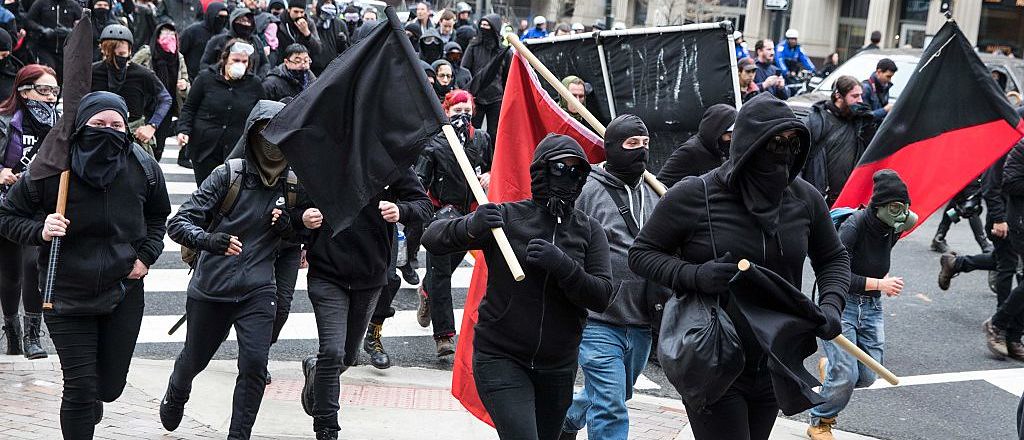
When to this strange source of satisfaction is conjoined a license to behave badly in the name of salvation from earthly perdition, we can expect a mass movement that approaches insanity. So it is with the Extinction Rebellion, whose fanatical members have brought chaos to London recently by blocking streets, occupying crossroads, gluing themselves to public buildings and railings, and standing atop underground trains, to the fury of thousands of rush-hour commuters who don’t want to save the world but only get to work.

In order to try to understand their state of mind, I recently read a book by three psychologists, Leon Festinger, Henry W. Riecken, and Stanley Schachter, first published in 1956, called When Prophecy Fails. It recounts the reaction of a small doomsday sect in America founded by a housewife, who believed that most of North America was soon to be inundated by a great flood. When this failed to happen on the predicted date, members did not immediately conclude that the absurd grounds upon which their belief was based were false, but became even more convinced of their truth. When there is a contradiction between what we want to be the case and what is the case, our desire to believe often triumphs, at least for a time.

The beginning of the book gives a brief and selective history of sects that have predicted Man’s total annihilation in the near future, among them that of the Millerites in the 1840s in the United States. Reading the account of this sect, I could not help but think of the Extinction Rebellion that is now gripping London, to the growing fury of the rest of the population.

November 9, 2019

The Milk Dud and “sin”

Filed under: Cancon, Media, Politics, Religion — Tags: , , , — Nicholas @ 03:00

Chris Selley believes that introducing the notion of “sin” as an appropriate thing to discuss with a politician will be a very bad idea for Canadian politics:

Andrew Scheer, paid tool of Big Dairy, chugs some milk during a Press Gallery speech in 2017. I’ve called him the “Milk Dud” ever since.
Screencapture from a CTV video uploaded to YouTube.

At a Wednesday press conference in Ottawa, a Globe and Mail reporter asked Andrew Scheer if he believes homosexuality is a “sin.” He didn’t answer, as has become his trademark on this file; instead he pledged, for the umpteenth time, simply to stand up for gay rights in all their forms.

It has been maddening to watch: Despite literally dozens of opportunities, he could never bring himself to explicitly support equal marriage. Bringing “sin” into the question is a novelty, though, and it’s one of which we need to be exceedingly leery.

[…]

The question of “sin” takes us into new and dangerous territory, however. There is what politicians do, and then there is what they think, and then — buried way down under many layers of irrelevance — there is their personal relationship, if any, with higher powers and their associated scriptures; there is the question of what they think that higher power would make of other people’s behaviour; there is what they believe will happen to those people’s immortal souls.

These are not topics the secular media should be concerning themselves with, and nor should the average voter. No one would approve of someone they like being put through such an inquisition. Liberals would be aghast if their avowedly Catholic leader were asked if his faith played a role in his government not eliminating restrictions on gay and bisexual men donating blood, for example. Liberals often speak glowingly of the days when politicians set aside religion and pursued the greater good — politicians like Pierre Trudeau, a devout Catholic who famously said “what goes on in private between two consulting adults is their own private business,” but who somewhat less famously spoke of “separating the idea of sin and the idea of crime.”

Trudeau Sr. was absolutely right that the state should have no dominion over sin, in any sense of the word. That should go for politics, too. Politicians of known faiths and devoutness have advanced many of progressive Canadians’ most cherished causes — public health care, most notably — and politicians of unknown faiths and devoutness have taken us down dark alleys. And vice versa. There is nothing we can do with information about a politician’s personal metaphysical views except raise new barriers to entry into a politics that needs fewer.

November 8, 2019

Brendan O’Neill on the “Battle of Canning Town”

Filed under: Britain, Environment, Politics — Tags: , , , — Nicholas @ 05:00

This piece is derived from a speech he gave on November 3rd at the Battle of Ideas festival in London:

One of my favourite political events this year was the Battle of Canning Town. This was the moment when Extinction Rebellion decided to send its painfully middle-class agitators to a working-class part of East London early in the morning to lecture and inconvenience people who just wanted to get to work. What could go wrong?

Quite a lot, it turned out. There were many wonderful moments. The two posh greens who climbed on top of a Tube train at Canning Town were mocked and eventually dragged down. A commuter can be heard branding one of the protesters a “ponytail weirdo”. Elsewhere on the Tube system that day, commuters pointed out that the London Underground is run on electricity and is therefore pretty eco-friendly. “Are you that fucking stupid?”, one asked a smug-looking couple of XR agitators. “No wonder you can’t get jobs …”

But the best moment came during the Battle of Canning Town, during that clash between working people and eco-elitists, when one of the commuters shouted at the protesters: “The world is not coming to an end!” I thought that was brilliant. This woman was just trying to get to her job and yet she found herself having to act as the voice of reason against the new hysteria. And she rose to the occasion wonderfully. She said what many of us know to be true: humankind does not face extinction.

The reason I admire the Battle of Canning Town is that it represented a potential turning point in modern green politics. It was really the first time in a long time that eco-hysteria was subjected to public judgement, to democratic rebuke, to the rational scepticism of the people. For far too long green ideology has been insulated from public challenge and public debate and this has allowed it to become increasingly eccentric and even unhinged. The Battle of Canning Town represented a reasoned, bottom-up pushback against the protected hysteria of modern environmentalism.

This is the thing I find most fascinating about Extinction Rebellion: its very name is a lie. Those two words themselves are untrue. Humankind does not face extinction, and all reasonable people know this. We know that there is nothing in the IPCC reports – which themselves are often over-the-top – to justify XR’s harebrained claims that we have 12 years to save the planet, and if we fail billions of people will die. They’ve just made this up.

As for the second word – “rebellion” – this is a lie, too. Extinction Rebellion is not a rebellion. Rather, its ideology and misanthropy are entirely in keeping with the outlook of mainstream politics and popular culture. From the educational sphere to Hollywood’s output, from the political elite to the worlds of advertising and publishing, the ahistorical, anti-human idea that mankind is destroying the planet and will be punished by Weather of Mass Destruction for having done so is entirely accepted, and increasingly unquestionable, in fact.

Don’t hold your breath waiting for the Feds to tackle Quebec’s ongoing repression against minorities

Filed under: Cancon, Law, Liberty, Politics — Tags: , , , — Nicholas @ 03:00

Chris Selley on the situation in Quebec, where first-class citizenship is only available to those who speak French and don’t expect their religious beliefs to be respected:

One of the fascinating things about Quebec politics is that it’s often impossible to predict which absurdities will become controversial and which will be accepted as reasonable. The province’s linguistic and more recently cultural debates operate in an atmosphere so divorced from normal reality that it’s impossible to know how any new idea or event might react to its unique and volatile mixture of gases.

The classic example is Pastagate: An inspector from the Office québécois de la langue française found an Italian restaurant’s menu was riddled with Italian — calamari, antipasti — and issued the appropriate cease-and-desist notice. At no point did anyone suggest he had misinterpreted the law. Despite universal scorn and worldwide mockery, at no point did anyone successfully explain why this inspector’s actions were obviously ultra vires, while the OQLF’s other insane diktats — say, forcing a bilingual community newspaper to segregate English-language and French-language content such that English-only advertising will never appear on the same page as a French-language article — were reasonable.

As a result, Quebec politics is like a festival of trial balloons. Most recently we saw languages minister Simon Jolin-Barrette float the idea of banning merchants from greeting customers with “bonjour-hi” — a Downtown Montreal-ism that turns language hawks crimson with rage — only to have Premier François Legault shoot it down a couple of days later amidst widespread ridicule.

By contrast, we’re supposed to think it’s totally reasonable that the National Assembly voted merely to request that merchants use state-sanctioned greetings. Unanimously. Twice.

Ban religious symbols for all civil servants, or only those “in a position of authority”? Which civil servants are “in a position of authority”? Should currently employed civil servants affected by Bill 21 be grandfathered in or not? You can poll all you like, but until any given idea goes through Quebec’s intense media ringer, no one knows how it’ll shake out. With fundamental rights at stake, the majoritarian randomness of it all is truly alarming.

November 7, 2019

Replacing “dead, white male” writers with contemporary First Nations writers

Filed under: Books, Cancon, Education, Politics — Tags: , , , — Nicholas @ 03:00

Barbara Kay, as you would expect is not a fan of this move by this school board in the Windsor area:

Some years ago, the late, great writer George Jonas asked me about my intellectual influences. Who did I remember as especially formative? Oh, George Orwell, of course. I read Animal Farm in my mid-teens, 1984 a little later, and most of his other writings over the course of my salad years. It would be hard to overstate his effect on my understanding of concepts like “freedom,” “power” and “decency.”

Since Orwell has never been “owned” by the right or the left, both admiring his prose as a model for clarity and coherence, he is the one English-language writer I would consider indispensable for any high school literature curriculum.

Up to now, most educators have concurred. But the Windsor, Ont.-area Greater Essex County District School Board has announced that, in accordance with the spirit of the Truth and Reconciliation Commission (TRC), Orwell and other canon favourites in the Grade 11 literature curriculum, including Shakespeare, will be set aside in favour of a course wholly devoted to Indigenous writing. Eight of the district’s 15 schools have already replaced former standards with such books as Indian Horse, In This Together and Seven Fallen Feathers under the rubric of Understanding Contemporary First Nations, Métis and Inuit Voices.

“This decision wasn’t made lightly,” said Tina DeCastro, a teacher consultant with the school board’s Indigenous Education Team. The decision arose from a motion passed by the school board’s trustees as a response to TRC calls for action. Eastern Cherokee Sandra Muse Isaacs, Professor of Indigenous Literature at the University of Windsor, defends the radical change as necessary on the grounds that Indigenous stories have been ignored in the past. “Our stories predate Canada. It’s as simple as that.”

Is it really that simple?

I don’t think there is a sentient Canadian today who isn’t aware that Indigenous voices have been neglected in the past, and who would not wholeheartedly support the addition of Indigenous writing to contemporary literature curricula. But an entire year devoted to Indigenous literature that supplants revered works by great writers from the civilization that produced Canada as a nation-state, in order to redress the offence of historical inattention to Indigenous people, is to rob the majority of Canadian students of their cultural patrimony.

November 6, 2019

Whitewashing the Vikings

Filed under: Europe, Health, History, Politics — Tags: , , , , — Nicholas @ 05:00

Sarah Hoyt notices the way history is being presented to subtly (or not-so-subtly) denigrate the recent past and idealize (some of) the distant past:

Europe According to the Vikings (1000) from Atlas of Prejudice 2 by Yanko Tsvetkov.

Their distortion of history so that everything America ever did is wrong and evil-bad is designed to make our own kids hate their own country and imagine themselves as “citizens of the world” which is to say citizens of nowhere.

Which in turn allows for wide open borders which bring in the population of 3rd world serfs the statists count on to keep them in power forever.

For the last ten years I’ve been disquieted and disturbed by the persistent myth of: Our ancestors were far more cleanly, happy and prosperous than we think. Yep. Your foot-in-the-mud ancestor didn’t suffer under the lash of his feudal overlord. Oh, no. He had hot running water, regular baths, religious holidays off and–

Spits. And the girls sang as they wove garlands on Mayday, I suppose.

Most of these myths are arrant nonsense. Some are arrant nonsense on stilts with a dash of oikophobia thrown in.

I’ve mentioned here that I went to the Viking exhibit at the museum some years back, and it was all about how free and egalitarian the Vikings were, male and female. Which I suppose was true, if you miss the large component of slavery. And the fact that they raided foreign shores for slaves and loot. And that almost every skilled artisan was a slave. And–

Then there is the continuous “The Vikings were much cleaner than the Christians and women preferred them.”

First let’s cut the crap. We have zero clue if women preferred them. When the raiders come to town, they don’t stop to ask thee fleeing women to sign “affirmative consent” forms.

Second, yeah, I’m sure in some Viking villages they were cleaner. We do have have reason to suspect some areas had functioning saunas. But then some of the areas raided had functioning Roman baths still extant.

I’m sure for some times and places, that was true. I’m also absolutely sure that for most times and places the Vikings were about as clean as everyone else, which is to say not very, due to the lack of easy-accessible soap (yes, it existed. In certain times and places. NOT everywhere and not of a kind you’d want to use on your skin) of easily accessible acceptable-temperature water, and/or of warm enough places to bathe in.

No, medieval people weren’t as utterly filthy as it’s imagined (though there were some, I’m sure) but I’m also utterly sure, having experienced this in a temperate climate, that washing in winter would be limited, careful, and therefore maybe not as thorough as we imagine. Or to put it another way, when the Victorians went on about catching a chill, they weren’t just blowing smoke, guys. People didn’t willingly strip down and dip in lukewarm water in the dead of winter and when clothes would take forever to dry, unless they had other clothes, and facilities for getting warm right after.

In other words, Vikings and the rest of the Middle Ages were, from our POV a little wiffy. As were most places until the late 20th century.

So why the cleanly and perfumed Vikings (Particularly since the records of the time don’t support this view, except in very few, highly publicized circumstances?)

Oh, that’s the “don’t go imagining Christians were better” wing of the oikophobe chorus. They will tell us Christians were filthy. The pagans, on the other hand, were cleanly and perfumed.

Weirdly the one people we know were cleaner than Christians, also more literate and prone to less domestic violence never come in for praise in these comparisons. I suspect being part of the foundational build of the West, the Jews aren’t considered “wonderfully other” enough. Or given some of the recent bs on the left and the people they embrace, perhaps it’s a hate thing.

BTW that Christians being filthy is bullshit. Later on, in defense of “but medieval people weren’t that filthy” they’ll bring in the injunction to change your underwear daily. Which is more than a little confusing when you researched the heck out of “underwear use” in various places in the renaissance and know most women at least wore none. Eventually you find out the injunction to change underwear was in monasteries. Monk’s orders in fact, also had various guidelines on cleanliness which, for their time, were amazingly enlightened. Even if, yes, by our standards, they were all a bit wiffy.

The same applies to a ton of other things. These revisionists tell us they ate better than we think, oh, and by the way, except for infant mortality they lived as long as we do.

All this is insanity on stilts.

QotD: “Fake news” is nothing new

Filed under: Books, History, Media, Politics, Quotations — Tags: , , , , , — Nicholas @ 01:00

… the basic ideas of “alternative facts” and “fake news” — our updated, revved-up forms of disinformation — were not foreign to Orwell. Working at the BBC as a news producer — a fancy term for war propagandist — he heard some of the Axis powers’ propaganda as well as that of his own side (even if he kept his own hands fairly clean). He justifiably feared that the very concept of objective truth was fading from the modern world. Winston Smith’s job at the Ministry of Truth is to rewrite or “rectify” history, so that it follows the current party line, whatever it may be at that moment.

Orwell himself saw all this happen when he read Catalan newspapers as well as British ones during the Spanish Civil War, several years before joining the BBC. Condemning press distortions, above all how several English newspapers reported the war, he wrote: “I saw great battles where there had been no fighting and complete silence where hundreds of men had been killed … I saw, in fact, history being written not in terms of what happened but what ought to have happened according to various ‘party lines.'” Given the gridlock in American politics, and the never-ending verbal warfare between news outlets on the Right such as Fox News and on the Left such as MSNBC, Orwell appears all too accurate in his “predictions.”

One of the features of the world of Oceania reflecting Orwell’s prescience is its official language, Newspeak, an argot resembling a kind of Morse code that satirizes advertising norms, political jargon, and government bureaucratese. The purpose of Newspeak is to limit thought, on the view that “you can’t think what you lack the words for.” Ultimately, this impoverished language seeks to narrow and control human thought. (Does Twitter represent a step in that direction?) Purged of all nuance and subtlety, denuded of variety, and reduced to a few hundred simple words, Newspeak ultimately promises to render all independent thought (or “thoughtcrime”) impossible. If it cannot be expressed in language, it cannot be thought. And anything can fill the vacuum, such as 2 + 2 = 5. That is the equation — a perfect example of “doublethink” — which O’Brien indoctrinates Winston to accept in Room 101 and which marks the final step of the latter’s brainwashing. As the Party defines it, “doublethink” consists in holding “two contradictory beliefs in one’s mind simultaneously, and accepting both of them.” In 2018, Trump’s lead lawyer, former New York mayor Rudy Giuliani, declared in a TV interview: “Truth isn’t truth.” A few months later, a talking head defended a critical news report on the grounds that, just because it is “not accurate doesn’t mean it’s not true.”

It testifies both to the brilliance of Orwell’s vision and to the bane of our times that Nineteen Eighty-Four retains so much relevance.

John Rodden and John Rossi, “George Orwell Warned Us, But Was Anyone Listening?”, The American Conservative, 2019-10-02.

November 5, 2019

QotD: Die Lösung (The Solution)

Filed under: Germany, History, Politics, Quotations — Tags: , , — Nicholas @ 01:00

German theatre director, dramatist, poet and theorist Bertolt Brecht in 1954.
Via Wikimedia Commons.


Nach dem Aufstand des 17. Juni
Ließ der Sekretär des Schriftstellerverbands
In der Stalinallee Flugblätter verteilen
Auf denen zu lesen war, daß das Volk
Das Vertrauen der Regierung verscherzt habe
Und es nur durch verdoppelte Arbeit
zurückerobern könne. Wäre es da
Nicht doch einfacher, die Regierung
Löste das Volk auf und
Wählte ein anderes?

After the uprising of June 17th
The Secretary of the Authors’ Union
Had leaflets distributed in the Stalinallee
Which said that the people
Had forfeited the government’s confidence
And could only win it back
By redoubled labour. Wouldn’t it
Be simpler in that case if the government
Dissolved the people and
Elected another?

Bertolt Brecht, 1953.

November 3, 2019

Alberta and the Liberals

Filed under: Cancon, Economics, Government, Politics — Tags: , , , — Nicholas @ 03:00

Andrew Coyne summarizes the deep-seated anger in Alberta toward the federal Liberals … and the rest of Canada:

The point sometimes arrives in politics when a complex of different issues coalesce into one; when people stop listening to the arguments in favour of or against each, and instead allow their emotions to dictate a single response to the lot. We are at such a point in Alberta.

Pipelines, carbon taxes, equalization, the Canada Pension Plan — to which familiar litany we can now add the departure of Encana’s headquarters from Calgary — have become, not so much issues in themselves, but arguments in another, grander meta-controversy. All of the questions raised by each (is there a problem? if so, how is it to be solved? who pays? etc) have been pureed into a single narrative: of a Liberal government that is at best indifferent and at worst hostile to Alberta, whose re-election confirms the rest of Canada is as well.

There is, it should be said, some truth in this. Whether the Liberals have failed to win more than a handful of seats in Alberta in over a half a century because of their historic disdain for the province, or whether the causation runs the other way, the chicken is as malignant as the egg. There’s no doubt some people in some parts of the country would cheerfully shut down the oilsands tomorrow, nor is it impossible to detect a strain of anti-Albertanism in some of the rhetoric on the subject.

Albertans, for their part, are not just in a fight to defend their major industry today, but have been for decades. It is inconceivable, to take the most obvious example, that the National Energy Program, that vast attempt to expropriate Alberta’s oil wealth for the benefit of central-Canadian oil consumers, would have been visited upon either Ontario or Quebec, were the situations reversed.

November 2, 2019

When entertainment morphs into propaganda

Filed under: History, Media, Politics, USA — Tags: , , , , — Nicholas @ 05:00

One of the key elements aiding Hitler and the NSDAP to take power and stay in power in Germany in the 1930s was the constant, ongoing propaganda campaign orchestrated by Joseph Goebbels. Hitler and the Nazi party were lauded as the perfect Germanic solution to every problem and Jews, socialists, homosexuals, and other undesireable elements were belittled and used as targets of hate. A big part of Goebbels’ propaganda revolved around one idea, the “Big Lie”:

Hitler, Göring, Goebbels and Hess.
Photo via Wikimedia Commons.

If you tell a lie big enough and keep repeating it, people will eventually come to believe it. The lie can be maintained only for such time as the State can shield the people from the political, economic and/or military consequences of the lie. It thus becomes vitally important for the State to use all of its powers to repress dissent, for the truth is the mortal enemy of the lie, and thus by extension, the truth is the greatest enemy of the State.

By suppressing competing voices and having all the methods of reaching the people repeating the same story, the Nazis solidified their control on power in Germany that lasted until 1945, and was only demolished by massive military effort by the United States, the Soviet Union, and the British Commonwealth. Propaganda is a very powerful tool that works distressingly well to implant and nurture evil ideas in a subject population.

Modern propagandists in the west generally don’t have the power of the state aiding them, but if they get enough of the channels of communication — especially the entertainment channels — to co-ordinate the message, the effects can be very strong:

… I perfectly understand the legitimacy of feminist concerns regarding the portrayal of women in the media as consistently demure, retiring, and subservient to men. I grant that, in most of the action/adventure movies that I saw growing up, women would typically twist an ankle or get captured and then require rescuing by the swashbuckling male hero — and I realize how galling this must have been to generations of women. And therefore, a certain correction was undoubtedly in order. But what is problematic now is the Nietzschean quality of the reaction, by which I mean, the insistence that female power has to be asserted over and against males, that there is an either/or, zero-sum conflict between men and women. It is not enough, in a word, to show women as intelligent, savvy, and good; you have to portray men as stupid, witless, and irresponsible. That this savage contrast is having an effect especially on younger men is becoming increasingly apparent.

In the midst of a “you-go-girl” feminist culture, many boys and young men feel adrift, afraid that any expression of their own good qualities will be construed as aggressive or insensitive. If you want concrete proof of this, take a look at the statistics contrasting female and male success at the university level. And you can see the phenomenon in films such as Fight Club and The Intern. In the former, the Brad Pitt character turns to his friend and laments, “we’re thirty year old boys;” and in the latter, Robert De Niro’s classic male type tries to whip into shape a number of twenty-something male colleagues who are rumpled, unsure of themselves, without ambition — and of course under the dominance of an all conquering female.

It might be the case that, in regard to money, power, and honor, a zero-sum dynamic obtains, but it decidedly does not obtain in regard to real virtue. The truly courageous person is not threatened by another person’s courage; the truly temperate man is not intimidated by the temperance of someone else; the truly just person is not put off by the justice of a countryman; and authentic love positively rejoices in the love shown by another. And therefore, it should be altogether possible to hold up the virtue of a woman without denying virtue to a man. In point of fact, if we consult the “all conquering female” characters in films and TV, we see that they often exemplify the very worst of the traditional male qualities: aggression, suspicion, hyper-sensitivity, cruelty, etc. This is what happens when a Nietzschean framework has replaced a classical one.

My point is that it is altogether possible — and eminently desirable — to say “you go boy” with as much vigor as “you go girl.” And both the boys and the girls will be better for it.

November 1, 2019

The “Wokescreen” protecting the Prime Racist

Filed under: Cancon, Politics — Tags: , , , — Nicholas @ 03:00

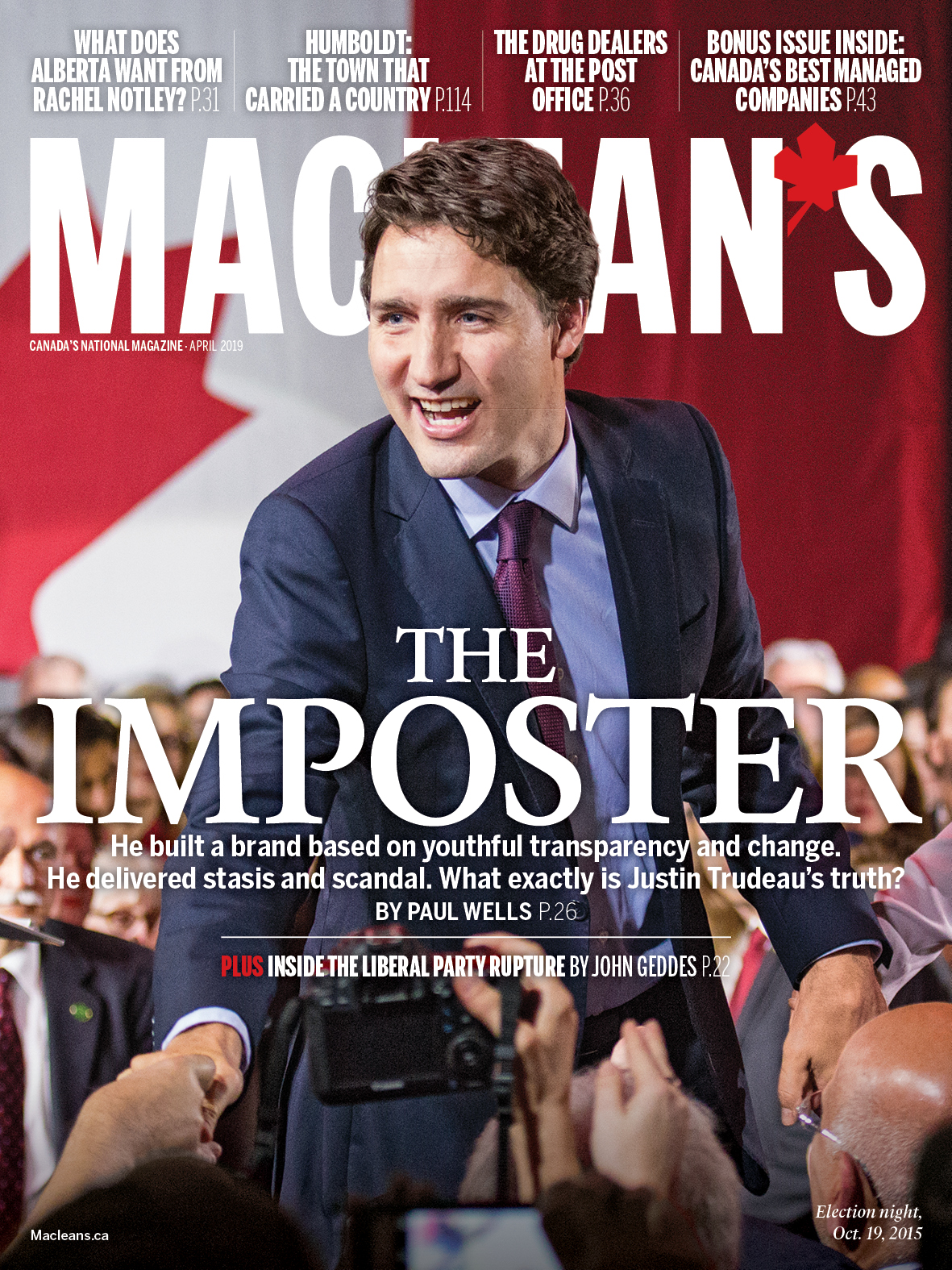
Justin “Blackface” Trudeau has been completely exonerated for any racist acts he committed, thanks to what Julie Burchill calls “the Wokescreen”:

Justin Trudeau with dark makeup on his face, neck and hands at a 2001 “Arabian Nights”-themed party at the West Point Grey Academy, the private school where he taught.
Photo from the West Point Grey Academy yearbook, via Time

Justin Trudeau seems as compulsively drawn to blacking up as his mother was to hanging around pop groups; after the third example of him doing so was revealed this year, he admitted that he had actually lost count of the number of times he’d done it. Nevertheless, he was defended by minority spokesmen and liberal commentators. This contrasts strikingly with the fate of Atlantic Records UK president Ben Cook, who was forced to resign earlier this month after old photographs of him in blackface emerged. As Cook is responsible for launching the career of Ed Sheeran, some might say he had it coming. But it’s weird how Trudeau, an ostentatiously woke politician, has survived and thrived, while Cook has limped away in disgrace. You’d think the former had betrayed both his beliefs and his followers far more.

[…]

So how come Trudeau got away with it? It’s part of a broader dodge – what the commentator Daniel Norris calls the Wokescreen. From behind this magical canopy, cliques can rob women of their hard-won private spaces (transgender activists) and enjoy the brutish thrill of racism (Corbynite anti-Semites) and because they’ve ticked the box which says Brotherhood Of Man it doesn’t make them bad people! Those people over there are the bad ones – like Jacob Rees-Mogg’s 12-year-old son.

It’s a mystery. But an even bigger one is why blackface is quite rightly unacceptable while drag gets bigger by the day. You’d have to be living in an Amish community not to have heard of RuPaul’s Drag Race, while Channel 5’s Drag Kids follows a process which we squares call “grooming”. Yet no one turns a hair. I’ve said it before and I’ll say it again: if the Black and White Minstrels are insulting and reactionary, why aren’t drag queens? If someone can explain to me why race-based parody is bad and sex-based parody “a bit of fun”, I’d love to know. Woke me up and tell me why!

October 30, 2019

In case it wasn’t already obvious – “Extinction Rebellion isn’t about the climate”

One of the self-described founders of Extinction Rebellion takes to Medium to explain what the organization’s real goals are:

I’ve been with Extinction Rebellion (XR) from the start. I was one of the 15 people in April 2018 who came together and made the collective decision to try to create the conditions that would initiate a rebellion. I was a coordinator of one of the original five working groups, and I’ve been organising with XR day-and-night since then (frugally living off my savings so I don’t have to work, having quit an industry that paid me £1000/week). And I’ve been in RisingUp (the organisation from which XR has emerged) since the first RisingUp action in November 2016. I’m a RisingUp Holding Group member, and a member of the XR Guardianship Team.

And for the sake of transparency: that previous paragraph is all about me “pulling rank” — I’m trying to convince you to listen to what I have to say …

And I’m here to say that XR isn’t about the climate. You see, the climate’s breakdown is a symptom of a toxic system of that has infected the ways we relate to each other as humans and to all life. This was exacerbated when European “civilisation” was spread around the globe through cruelty and violence (especially) over the last 600 years of colonialism, although the roots of the infections go much further back.

[…]

So Extinction Rebellion isn’t about the climate. It’s not even about “climate justice”, although that is also important. If we only talk about the climate, we’re missing the deeper problems plaguing our culture. And if we don’t excise the cause of the infection, we can never hope to heal from it.

This article is calling to all of those who are involved in XR who sometimes slip into saying it’s a climate movement. It’s a call to the American rebels who made a banner saying “CLIMATE extinction rebellion”. It’s a call to the XR Media & Messaging teams to never get sloppy with the messaging and “reduce” it to climate issues. It’s a call to the XR community to never say we’re a climate movement. Because we’re not. We’re a Rebellion. And we’re rebelling to highlight and heal from the insanity that is leading to our extinction. Now tell the truth and act like it.

QotD: Trotskyism

Filed under: Europe, History, Politics, Quotations — Tags: , , , , — Nicholas @ 01:00


[The word “Trotskyist”] is used so loosely as to include Anarchists, democratic Socialists and even Liberals. I use it here to mean a doctrinaire Marxist whose main motive is hostility to the Stalin regime. Trotskyism can be better studied in obscure pamphlets or in papers like the Socialist Appeal than in the works of Trotsky himself, who was by no means a man of one idea. Although in some places, for instance in the United States, Trotskyism is able to attract a fairly large number of adherents and develop into an organised movement with a petty fuehrer of its own, its inspiration is essentially negative. The Trotskyist is against Stalin just as the Communist is for him, and, like the majority of Communists, he wants not so much to alter the external world as to feel that the battle for prestige is going in his own favour. In each case there is the same obsessive fixation on a single subject, the same inability to form a genuinely rational opinion based on probabilities. The fact that Trotskyists are everywhere a persecuted minority, and that the accusation usually made against them, i.e. of collaborating with the Fascists, is obviously false, creates an impression that Trotskyism is intellectually and morally superior to Communism; but it is doubtful whether there is much difference. The most typical Trotskyists, in any case, are ex-Communists, and no one arrives at Trotskyism except via one of the left-wing movements. No Communist, unless tethered to his party by years of habit, is secure against a sudden lapse into Trotskyism. The opposite process does not seem to happen equally often, though there is no clear reason why it should not.

George Orwell, “Notes on Nationalism”, Polemic, 1945-05.

October 29, 2019

Parallels between the current Brexit mess and the 1906 general election

Filed under: Britain, Europe, History, Politics — Tags: , , , , , — Nicholas @ 09:10

Sean Gabb writes in the Libertarian Enterprise on the clusterfail in Parliament and an interesting historical parallel from the beginning of the 20th century:

… the Brexit debate that only began with the counting of the Referendum votes has been a valuable education. So far as it blurs the lines of accountability, membership of the European Union has been a useful entrenchment of our ruling class. It has also helped provide a mildly liberal and cosmopolitan gloss to a domestic project that has been anything but liberal. Its refusal to honour the Referendum has torn aside what remained of the democratic veil behind which power is exercised. These people are not our servants. They are a hostile elite. Their interests are not ours. They despise us. They fear us. They are determined not to give us even the shadow of what we were – perhaps unwisely – promised.

I have given a quotation from Chesterton. I am increasingly minded of parallels between his day and ours. In 1906, the Liberals won a large and unexpected majority in the House of Commons. They set about transforming the country on the lines they had been discussing since the end of their last majority government in 1885. In doing this, they faced a wall of resistance from the old ruling class. The Conservatives controlled the Law and education and most of the administration. They possessed the greatest mass of the national wealth. Above all, they dominated the House of Lords. They used their majority here to block the Liberal Government until such time as the people could be persuaded at the next election to bring back a Conservative Government.

Now, in that contest, I would have sided with the ruling class. I think England had a better future under the Conservatives than under the Liberals. I think most of the Liberal changes were bad. Moreover, the Conservative strategy showed some evidence of working. The Liberals lost a steady stream of by-elections — most notably Peckham in 1908. Then the Conservatives went too far. In 1909, the Liberals brought in a deliberately populist budget. The Conservatives broke more than two centuries of convention by voting this down in the Lords. This gave the Liberals their excuse. With the cry of “The People against the Peers,” they attacked the Conservatives in their most powerful stronghold. After two general elections in 1910, the Lords were stripped of their blocking veto. Of course, the Great War then changed everything. But it is reasonable to suppose that, had the Liberals won another election in 1915, most of the domestic changes that we blame on the War would have come about, if more slowly.

The lesson is that ruling classes often make strategic mistakes. Had the Conservatives before the Great War taken a more selective approach in their opposition, they might have won an election in 1911, and carried on with their own vision of the national future. As it is, they only lost the 1910 elections because the Liberals were able to rely on Labour and Irish support in the Commons. Because they overreached themselves, they eventually lost everything.

It may be the same now. Had our own ruling class pulled sad faces in 2016 and delivered a minimal Brexit — something like continued EEA membership and a Norwegian relationship — they might have put the issue to bed and continued riding us all to certain ruin. Instead, they went into a three-year filibuster, every so often drawing breath to suggest another referendum. The strategy appears to have failed. We may now have a more substantial Brexit than was intended. More to the point, the democratic veil has been torn aside. The continuing argument over Mr Johnson’s new Withdrawal Agreement is largely now unfinished business. The Agreement needs to be passed — but so we can go into a general election where the main issues will not be a new relationship with the European Union. These issues will be the nature and personnel of the country’s domestic government. I do not imagine that we shall become more “democratic.” But I can imagine that we shall find ourselves with a new ruling class that holds the mass of ordinary people in less vicious contempt.

October 28, 2019

The demonstrated need for “Clean Teen” fiction in the YA section

Filed under: Books, Politics, USA — Tags: , , , , — Nicholas @ 03:00

You don’t need to be a Bible-thumping traditionalist to be alarmed at what publishers are pushing into the Young Adult fiction market for teenagers and older pre-teens. There are themes and content choices that many parents would be unwilling to allow younger readers to encounter, but the criticisms are falling on deaf ears, as Megan Fox shows:

It’s tough to find a book for pre-teens and teens without graphic sex and violence. The “Young Adult” section, which is marketed to kids from nine to seventeen, is full of stuff most parents would not want their children reading about. Because of it, sites like Common Sense Media, where you can see what kind of content is in the books before you let your kid read them, are very popular with parents. Parents and kids rate the books according to how much violence, sex, drug use, mature themes, and the like are in them. Librarians and the American Library Association are staunchly opposed to anyone categorizing books by content and liken it to censorship. They’re out of their minds. On one hand, they tell parents, “It’s up to you to direct your child’s reading,” but they offer no help in actually doing that by their refusal to mark books that contain adult content. And now that some websites are answering parents’ calls for innocent plotlines by offering “Clean Teen” selections, SJW authors, who think every child should have the sexual knowledge of Caligula, have their panties in a twist about it.

“If they’re named ‘Clean Teen’ novels what are the rest called? ‘Unwashed Teen’ ‘Trash Teen’ ‘Didn’t shower after soccer practice Teen’ ‘Say three Hail Mary’s in confessional Teen?'” said Zorri Cordova, a supposed author.

The far-left weirdos are never satisfied to corrupt their own children, they want your kids too. The American Library Association loves to take potshots at Common Sense Media. “These days, Common Sense Media’s initiatives contain a less than subtle paternalism based on the conviction that its values should control children’s learning experiences,” wrote Joyce Johnston on the ALA’s Intellectual Freedom Blog. They have no problem, however, controlling children’s learning experiences with their far-left values. For a laughable example, check out ALA’s LGBT initiatives.

Publisher’s Weekly wrote about this topic.

    Kendra Levin at Simon & Schuster Books for Young Readers observes that “the meaning of ‘clean teen’ can depend on the context, but within publishing houses, I think it’s most often used to describe a buffer zone between middle grade and mature YA — books specifically geared toward the younger end of the teen spectrum. You could also call this young teen and 12-and-up YA, as opposed to 14 and up.

This suggests that 14-year-olds are ready for the Roman orgies and coke parties that are depicted in the majority of YA fiction these days (and yes, I’ve read them). I don’t know what planet these people are living on, but it’s starting to get to me. What is wrong with Little House on the Prairie? Oh yeah, Laura Ingalls Wilder has been branded a racist.

« Newer PostsOlder Posts »

Powered by WordPress