
According to the equalitarian model, progressives are dedicated egalitarians. They think that all individuals, all groups, all sexualities, and all sexes should be treated fairly. They are also especially sensitive to potential threats to egalitarianism, so they adhere to the belief that all demographic groups are roughly equal on all socially valued traits, a belief we call cosmic egalitarianism. Perhaps the most common form of cosmic egalitarianism is blank slate-ism, or the belief that humans are nearly infinitely malleable, and that all important differences among them are caused by the environment, not genes. Cosmic egalitarianism serves as a protective buffer to egalitarianism because it contends two things: 1) Group disparities are caused by prejudice and discrimination (unfairness), not group differences; and 2) We absolutely should treat all groups the same because they are basically the same. Equalitarians fear that if we accept that some demographic differences are genetically caused, we might start treating groups differently from each other. For example, maybe we would encourage men to pursue STEM careers more often than women. (It is worth noting that most people who believe that there are genetically-caused demographic differences would not forward such a bad argument and are committed to treating people as individuals. However, equalitarians, as noted, are very sensitive to potential threats to egalitarianism, and they view this as a potential threat.)
Bo Winegard, “‘Equalitarianism’ and Progressive Bias”, Quillette, 2018-02-07.
May 17, 2020
QotD: The egalitarian model of bias
May 15, 2020
Canada’s weird election laws
Chris Selley points out some of the oddities of the federal Elections Act:
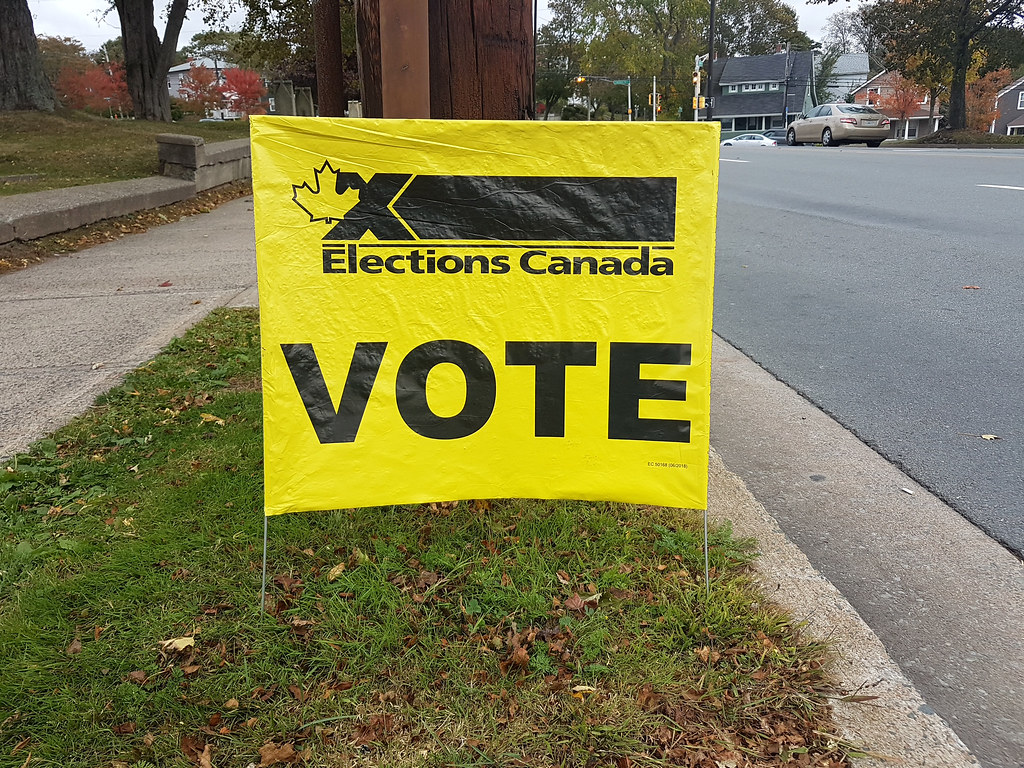
“2019 Canadian federal election – VOTE” by Indrid__Cold is licensed under CC BY-SA 2.0


It seems like about a hundred years ago, but one of the disquieting revelations of last year’s federal election campaign was that the Elections Act’s rules covering third-party spending are completely bananas.
Readers may recall Elections Canada warning environmental groups that they couldn’t just go on spending money in the fight against climate change without registering as third parties, with all the paperwork and bureaucracy that entails, all because People’s Party leader Maxime Bernier had supposedly made it a “partisan issue.” Now we have another bunch of overripe bananas on our hands: As the National Post first reported, the Commissioner of Canada Elections is investigating an anti-abortion organization called RightNow for having allegedly “recruited, trained and coordinated volunteers that were directed to over 50 campaigns” during the 2019 campaign.
RightNow’s mission is to identify pro-life candidates with a chance of winning, and connect them with volunteers eager to help them with their nomination and election campaigns. Readers may not find this particularly controversial. Members and supporters of all manner of groups, most famously and numerously labour unions, campaign alongside political candidates all the time. A quick rummage around Facebook from last year’s campaign finds both Toronto NDP MP Andrew Cash (who was eventually defeated) and Nova Scotia Liberal candidate Bernadette Jordan (who is now federal fisheries minister) thanking Unifor members wearing “Unifor Votes” t-shirts for their canvassing help. Photos on Unifor’s own Facebook page chronicle an October 5th event in Winnipeg called “Politics and Pancakes event plus canvassing for (NDP MP) Daniel Blaikie.”
[…]
At first blush, there doesn’t seem to be anything legally untoward with this — or indeed what RightNow was doing on a much smaller scale. (USW claimed $1.1 million in third-party expenses, PSAC $345,000, CUPE $161,000. RightNow splashed out a whopping $8,255.71.) “Volunteer labour” is explicitly exempt from the Elections Act prohibition against third parties donating to political parties or candidates, either in cash or in kind. But in an April 22nd letter to Albertos Polizogopoulos, RightNow’s legal counsel, the commissioner’s director of investigations, Mylène Gigou, argued that “the recruiting, training and coordinating of volunteers are core political activities of a political campaign” — and in performing those activities, RightNow may have “circumvented” the third-party donation prohibition.
This is, of course, preposterous. On what principle would we allow members or supporters of third parties to volunteer in election campaigns — as any healthy democracy ought to — while prohibiting spending so much as a dime to recruit said volunteers? “Training” or “coordinating” could be defined as narrowly as telling people what sorts of things to say on people’s doorsteps and what sorts of things not to. You don’t just turn people loose with your campaign materials, like sheep on a grassy meadow, and hope for the best.
May 10, 2020
QotD: “Shirtstorm” and other forms of systematic patriarchal oppression of women
Which totally justified making a rocket scientist cry on the day of his greatest triumph. After all, people like him had ruined her life, right?
But it gets worse than that – there was an entire campus filled with supposedly educated (ah!) women terrorized by the statue of a sleep walking man.
And then there’s the ever-elastic definition of “sexual assault” which – I’m not making this up – can now be ratcheted down to “Looked at me in a way that made me feel uncomfortable” or, for that matter “failed to sexually assault me.” Oh, sorry, that last was the definition of racism. Some Palestinian woman looked at rape statistics and found that Israeli women are raped by Palestinian men in much higher numbers than Palestinian women are raped by Israeli men, and immediately concluded this is because Israelis are racist. It beggars the mind.
Another thing that beggars the mind is the progressive image of women as great warriors. You know, in all the movies and half the books (often without supernatural explanation) a 90 lb chick can beat 300 lb men. And women were always great fighters throughout the ages. And, and, and …
And yet, women are peaceful – peaceful, d*mn it. This is why “peaceful planet of women” is a trope on TV tropes. Not just a trope, but a dead horse one.
Attempts to square that circle have included the explanation that women are only violent because patriarchy. There needs be nothing else said because in this context, and with apologies to the ponies, Patriarchy Is Magic. Honorable mention on trying to square the circle must go to Law and Order‘s attempted episode on Gamer Gate where the game the woman designer had written was about Peaceful Amazon Warriors.
Sarah Hoyt, “Give Me My Smelling Salts, Ho! A Blast From The Past From April 2015”, According to Hoyt, 2020-01-22.
May 7, 2020
“When it’s over we can shave the heads of a few easy victims and vilify a few who enjoyed it too much. But I collaborated too.”
The mandatory shutdown of most of the world’s economy is inducing some introspection:

Prime Minister Boris Johnson at his first Cabinet meeting in Downing Street, 25 July 2019.
Official photograph via Wikimedia Commons.
I looked again at the decisions of the Johnson government. Should they have followed my instincts? No lockdown. Shield the elderly and the vulnerable, like my elder daughters immuno-deficient boyfriend, but let all normal life continue. Let the virus rip. Let the football league play out its conclusion and more to the point let out beloved Dundee Stars Elite Ice Hockey Club break our hearts and miss the playoffs. Such a government would probably have fallen within days, battered by the broadcast media, backbench rebellion and a nation that preferred to be kept safe from the unknown that they feared. Had they survived the month, then the elderly who by choice refused to be shielded would have pitched up in their thousands at A&E, to be faced with experienced nurses like my wife who triaged them on the doorstep and sent many of them home to die, to preserve the ICU beds for those who could be saved. Instead of admitting them so that they could die with every bit as much certainty. Had he survived the first month, Johnson would have fallen regardless and nation would be traumatised by the memory of grandparents sent home to die
Had I been in his shoes, I too would have sued for peace. My nation demanded it of me. I would have convinced myself it was the right thing and when the chest pain and cough arrived, I would have felt relief that I had made the correct call. I would have looked at the Malice of Piers Morgan and convinced myself that I was still moderate. I would have dismissed the feeble objections of lunatic libertarians.
When it’s over we can shave the heads of a few easy victims and vilify a few who enjoyed it too much. But I collaborated too.
May 6, 2020
What’s on your bookshelf?
The self-appointed censors of righteousness demand to know!

Plenty of people like to be filmed against the backdrop of their bookshelves to convey the message or at least create the impression that they are smart. This has become even more common during the current extraordinary conditions of self-isolation, where virtually all the media interviews are conducted from home rather than in studio. Ditto for all the Zoom and other teleconferences. This, in turn, has given some people the opportunity to nose around and check out just what exactly others have on their shelves – presumably having read it and not just for decoration. It should be a fun exercise, but these days of perpetual outrage no fun goes unpunished.
By contrast, the picture of a bookshelf belonging to a Tory minister Michael Gove and his wife Sarah Vine was unsolicited, which probably adds to the regret right about now.
[…]
Books, like other human artifacts, are historical records and documents of our past. You might not like the course that the history took, but it’s important to know it and remember it.
And hypocrisy, because of the double standards.
Sure, Nazis, Nazi sympathisers, Holocaust deniers and assorted other apologists are mad, bad and dangerous to know. But what about communists? How many of those having a go at Gove and his wife for owning an Irving book have on their own shelves works by Marx, if not Lenin, Mao, Che and numerous related others? Those who have been inspired by and followed Marx’s idea (whether you think correctly or not) have been responsible for some 100 million premature deaths in the 20th century and other untold misery and devastation. Mao, the author of the little Red Book, accounts for up to 60 million of those (I happen to have a copy; does that make me a Maoist and a genocide fan?). But socialism is cool and you can’t blame Marx because to do so would be to delegitimise the whole socialist project. And of course the socialist ideals are all beautiful – equality! solidarity! community! dignity! – and, in any case, everyone has had good intentions. So all good, guys.
Read and own whatever the damn you like – and don’t let the fascists of any kind dictate your bookshelf. Except for 50 Shades of Grey. We’ll all judge you for that.
The main picture: some of my shelves – feel free to judge me.
I thought to take a picture of my own shelves, but Arthur Chrenkoff appears to have a broadly similar selection of books (more heavily weighted to British politics than mine), so I just nicked his photo to save the effort. (Thanks, Arthur! Hope you don’t mind!)
QotD: The French philosophes and the “lower orders”
The French philosophes thought the social classes were divided by the chasm not only of poverty but, more crucially, of superstition and ignorance. They despised the lower orders because they were in thrall to Christianity. The editor of the Encyclopédie, Denis Diderot, declared that the common people had no role in the Age of Reason: “The general mass of men are not so made that they can either promote or understand this forward march of the human spirit.” Indeed, “the common people are incredibly stupid,” he said, and were little more than animals: “too idiotic — bestial — too miserable, and too busy” to enlighten themselves. Voltaire agreed. The lower orders lacked the intellect required to reason and so must be left to wallow in superstition. They could be controlled and pacified only by the sanctions and strictures of religion which, Voltaire proclaimed, “must be destroyed among respectable people and left to the canaille large and small, for whom it was made.”
Keith Windschuttle, “Gertrude Himmelfarb and the Enlightenment”, New Criterion, 2020-02.
May 5, 2020
QotD: Social media encourages autistic behaviour
The genetic fallacy, you’ll recall, is the inability to separate the idea from the speaker. Or, if you’re under age 40, it’s simply “communication,” as our public discourse nowadays proceeds in very little other than genetic fallacies. Try it for yourself. We all know what kind of reaction you’ll get in respectable circles if you say “You know, Donald Trump has a point about …”, but you can do it on “our side” of the fence, too. Watch: Obama was right about Race to the Top. No, really: Compared to W’s No Child Left Behind bullshit, pretty much anything short of letting kids be raised by wolves would’ve been better (and hey, even being raised by wolves worked out ok for Romulus and Remus). Even with the qualifier attached, almost everyone on “our side” instinctively bristles — we’ve been so conditioned by the words “Obama” and “race,” especially in close proximity, that we can’t help ourselves. Even I do it.
It’s especially bad for the younger generations who, as I keep arguing, have been effectively autismized (it’s a word) by social media. Twitter, especially, is so constructed that “replies” can come in hours, days, months, years later. Blogs too for that matter — one of the reasons we close the comments here after a few weeks is to prevent drive-by commenters clogging things up trying to re-litigate something from years ago. Modern “communication” must take place in discrete, contextless utterances. That being the case, understanding a statement in context is impossible — I repeat, impossible. So Lenin (or Hitler, or Mao, or William F. Buckley, or the Stay-Puft Marshmallow Man) didn’t have a point about ___; because that requires understanding how his point fit into the larger context of his thought, his times, his culture, his world. None of that shit fits into a tweet, so we’re trained to respond to the name — Lenin (etc.) is either a good guy or a bad guy, full stop, so anything he says about anything must be good or bad, automatically.
I hardly need to elaborate on the effect this has on our public culture. If Our Thing really wants to get serious, the first thing any “organization,” no matter how loose, must do is: Ban social media.
Severian, “Education, the Genetic Fallacy, and the Spectrum”, Rotten Chestnuts, 2020-01-27.
May 4, 2020
QotD: The eternal “now” of Progressive stasis
None of that matters to the cultural marxist, though. How could it? As I wrote yesterday, to the fanatic, the past is one long catalog of freely chosen error. Nor is there any meaningful future to a fanatic. That seems wrong, I realize, but consider that time passes through contrast. People will be born and die in the Communist Utopia, but since everyone will always have everything, human activity will be exquisitely pointless …
Ignore what Leftists say. Watch what they do, and it’ll soon be obvious that what they long for above all things is stasis. They want everyone and everything to be one way, and one way only, forever. Homosexuals are the most flamboyant example. Imagine that — having your entire life defined by your sexual attraction. I like blondes, but you know, if the right brunette came along I’d go for her. Heck, I’d even go for a ginger (I know, I know, I’m a monster). But according to the Left, that’s not allowed. I like blondes, and therefore I’m only allowed to like blondes. Oh, and I can only vote for Bernie Sanders, because he’s the attracted-to-blondes candidate, and I must support abortion, and use the word “cisgendered,” and …
Thus, to the Leftist there’s no past, and no future either. There’s only now, and the only thing that matters now is power. How could it be otherwise?
Severian, “The Endless Now”, Rotten Chestnuts, 2020-01-23.
April 29, 2020
“The war on ultraviolet radiation because it might help Trump is an educational moment”
Arthur Chrenkoff on the sudden decision that the World Health Organization is the ultimate arbiter of what we’re allowed to say on social media platforms like Twitter and YouTube:

There is of course no evidence that the video represents any disinformation. It relates to legitimate scientific research by a medical company conducted in association with a respected hospital to develop a novel treatment of possibly crucial importance in the current conditions and into the future. The only problem with the video is that is indirectly supports Trump’s flight of fancy speculation about using light and chemicals to “disinfect” the body. Ergo, according to a NYT journalist it represents a problem and YouTube agrees. YouTube now has a standing policy of removing COVID information that goes against the World Health Organisation’s guidelines. Putting aside the question of the WHO’s credibility in the wake of the pandemic, we are not talking here about some guy in a tinfoil hat talking about 5G towers spreading the virus; this is a video relating to ongoing, respectable scientific research. Will it work? Probably not. But perhaps neither will any of the 150 or so COVID-19 vaccines being currently developed around the world. We won’t know until we know. But in the meantime, scientific news should not be censored, period.
[…]
Goldsmith and Woods are correct in pointing out not only the greater role that governments have been playing in regulating speech but more importantly how much of that effort has been embraced and driven by the big tech — and by the private individuals enabled and encouraged by the big tech — what I have previously called the “democratised censorship”. The difference is that people like Goldsmith and Woods think that’s a good thing.
The dirty little secret is that a great number of leftists, progressives and even centrist technocrats and activists look at China, with its authoritarian government, social credit score system, ubiquitous surveillance, and the ability to “get things done” and done quickly and supposedly efficiently (in China, bullet trains run on time, I hear), and pine for such a system to be applied in their own countries — as long as, of course, they are the ones in power and decide what is right, important and valuable. The left’s objections are rarely against authoritarianism and its means and methods per se, just with the possibility that someone else — like Trump — is the one behind the wheel, implementing their, not the left’s, agenda.
The war on ultraviolet radiation because it might help Trump is an educational moment. One could say, first they came for crazy conspiracy theorists and I said nothing because I’m not an anti-vaxxer or anti-5G activist — and so on. The problem with censorship is that it keeps creeping up on everyone else. And those who do the censoring — who decide what the ignorant masses should and shouldn’t be allowed to read — are not some detached and impartial spiritual beings but people with political agendas. People who think that ideas and beliefs of one half of the society are harmful and offensive. People who will censor news that doesn’t fit the agenda and support the narrative.
And then they came for ultraviolet radiation… You have been warned.
QotD: “Ethical” ways to prevent scientific progress
The hobbling of research is not just a symptom of bureaucratic mission creep. It is actually rationalized by many bioethicists. These theoreticians think up reasons that informed and consenting adults should be forbidden to take part in treatments that help them and others while harming no one. They use nebulous rubrics like “dignity,” “sacredness,” and “social justice.” They try to sow panic about advances in biomedical research with far-fetched analogies to nuclear weapons and Nazi atrocities, science-fiction dystopias like Brave New World and Gattaca, and freak-show scenarios like armies of cloned Hitlers, people selling their eyeballs on eBay, and warehouses of zombies to supply people with spare organs. The University of Oxford philosopher Julian Savulescu has exposed the low standards of reasoning behind these arguments and has pointed out why “bioethical” obstructionism can be unethical: “To delay by 1 year the development of a treatment that cures a lethal disease that kills 100,000 people per year is to be responsible for the deaths of those 100,000 people, even if you never see them.”
Steven Pinker, “The Intellectual War on Science”, Chronicle of Higher Education, 2018-02-13.
April 28, 2020
Robber Barons and the Battle of the Tunnel
The History Guy: History Deserves to Be Remembered
Published 1 Feb 2019During the gilded age ruthless businessmen fought for control of railway lines. The Albany and Susquehanna railroad was another battlefield in the “Railroad wars.” In this episode, The History Guy remembers “the Battle of the Tunnel”.
This is original content based on research by The History Guy. Images in the Public Domain are carefully selected and provide illustration. As images of actual events are sometimes not available, images of similar objects and events are used for illustration.
All events are portrayed in historical context and for educational purposes. No images or content are primarily intended to shock and disgust. Those who do not learn from history are doomed to repeat it. Non censuram.
Patreon: https://www.patreon.com/TheHistoryGuy
The History Guy: History Deserves to Be Remembered is the place to find short snippets of forgotten history from five to fifteen minutes long. If you like history too, this is the channel for you.
Awesome The History Guy merchandise is available at:
teespring.com/stores/the-history-guyScript by THG
#newyork #thehistoryguy #ushistory

April 27, 2020
QotD: H.L. Mencken’s literary theory
H.L. Mencken, “Private Reflections”, The Smart Set, 1922-12.
April 25, 2020
QotD: The entitlement mindset of intellectuals
Robert Nozick, “Why Do Intellectuals Oppose Capitalism?”, Cato Policy Report, 1998-01-01.
April 23, 2020
QotD: Idiotarianism
Glenn Reynolds, Instapundit, 2005-01-31.
April 21, 2020
Homeschooling is bad and should be tightly regulated or banned, says Harvard Professor of Karenism
An article in Harvard Magazine draws heavy fire from people who do not automatically demand to speak to the manager:

Illustration from Harvard Magazine via Twitter.
Harvard Magazine decided that this moment was the PERFECT time to take a gigantic shit on homeschooling parents. Author Erin O’Donnell decided write a piece on Elizabeth Bartholet, a “professor” who knows the best way to handle child education, and that is to turn them over to the State, immediately. Her rationale? Parents are simply too stupid to educate children without the state looking over their shoulder.
Yet Elizabeth Bartholet, Wasserstein public interest professor of law and faculty director of the Law School’s Child Advocacy Program, sees risks for children — and society — in homeschooling, and recommends a presumptive ban on the practice. Homeschooling, she says, not only violates children’s right to a “meaningful education” and their right to be protected from potential child abuse, but may keep them from contributing positively to a democratic society.”
“We have an essentially unregulated regime in the area of homeschooling,” Bartholet asserts. All 50 states have laws that make education compulsory, and state constitutions ensure a right to education, “but if you look at the legal regime governing homeschooling, there are very few requirements that parents do anything.” Even apparent requirements such as submitting curricula, or providing evidence that teaching and learning are taking place, she says, aren’t necessarily enforced. Only about a dozen states have rules about the level of education needed by parents who homeschool, she adds. “That means, effectively, that people can homeschool who’ve never gone to school themselves, who don’t read or write themselves.” In another handful of states, parents are not required to register their children as homeschooled; they can simply keep their kids at home.”
This practice, Bartholet says, can isolate children. She argues that one benefit of sending children to school at age four or five is that teachers are “mandated reporters,” required to alert authorities to evidence of child abuse or neglect. “Teachers and other school personnel constitute the largest percentage of people who report to Child Protective Services,” she explains, whereas not one of the 50 states requires that homeschooling parents be checked for prior reports of child abuse. Even those convicted of child abuse, she adds, could “still just decide, ‘I’m going to take my kids out of school and keep them at home.'”
Bartholet goes on to cite an example of one woman, who was raised by “Idaho survivalists” and was working in the family business instead of getting an education. Conveniently, while lauding “teachers and other school personnel” as mandated reporters, Bartholet fails to cite or even acknowledge that there is plenty of child abuse that happens on school property, by school employees, and maybe there are just evil people who do evil things to children because they have the opportunity to do so. Giving someone the title of “mandated reporter” does not magically make them into an upstanding citizen and defender of children.
Bartholet – and by extension, O’Donnell – makes no rational argument against homeschooling. It’s only her gut feeling that if the nanny state isn’t over the shoulder, trying to mold “young skulls full of mush” (as Rush Limbaugh has said more than once) into educated and functional adults, then there could be shenanigans afoot! Why, these children might end up RELIGIOUS. *GASP!*
Shruti Rajagopalan noted that the original illustration (which appears to have been corrected since the image at the top of this post was published) included the word “ARITHMATIC” on the spine of one of the books.


