
This is what happens when malevolent narcissists don’t get slapped and thrown to the ground. The kind of psychology we’re seeing, over and over again, overwhelmingly from the left, is an exercise in bad faith, a fundamental dishonesty. It therefore isn’t amenable to correction with facts or debate, or appeals to reciprocity or some higher purpose. Tolerating such behaviour — and worse, deferring to it — will only encourage an escalation of vanity, malice and sociopathy. It may, however, be discouraged with reminders of physical consequences. Ideally, physical humiliation. A reminder that nasty little egos can be publicly broken.
These are people who will lie as readily as breathing in order to excuse their antisocial urges. They aren’t being obnoxious reluctantly, in desperation, or under duress. They harass, provoke and delight in domination because it gives them pleasure. It makes them feel important and powerful. Power being conceived solely as power over others. It’s a focus for their spite. Anything else is a fig leaf, a pretext. Among Portland’s identikit radicals, the ones exulting in the alarm and misery of others, there is no good faith. And so, you can’t engage with such creatures on their own ostensible terms.
David Thompson, “Shamelessly, He Quotes Himself”, David Thompson, 2020-08-22.
August 24, 2020
QotD: Progressive malevolent narcissism
August 23, 2020
The right of asylum
Tim Worstall is writing here about the situation in the United Kingdom, with would-be asylum claimants risking their lives to cross the English Channel so they can legally claim asylum in Britain, but exactly the same situation should apply with claimants entering Canada from the United States:

An asylum seeker, crossing the US-Canadian border illegally from the end of Roxham Road in Champlain, NY, is directed to the nearby processing center by a Mountie on 14 August, 2017.
Photo by Daniel Case via Wikimedia Commons.
Everyone at even risk – let alone reality – of substantial discrimination in their home country has the right, the right, to asylum. This is one of those international things that we should indeed agree with too. Few of us have anything but contempt for those who wouldn’t let Holocaust fleeing Jews (and or gypsies, gays, whatever, it’s just that we have substantial documented evidence about Jews who were turned away) tarnish their national doormats. Few of us think those who abused such limitations are anything but heroes. I even know of one monk who married Jewesses multiple times to bring them out by train. Umm, married multiple people, not one many times. People working within the too restrictive rules even gave us one of the finest moments of TV ever.
So, asylum, good thing.
And here’s the next thing. That right is restricted. To claiming it in the first safe place you get to. This has some oddities, if you leave Sudan by plane and step off at Heathrow then the UK is where you can – righteously – claim asylum. If you come by land then you have passed through many safe places before reaching the UK. You don’t have the right to asylum in the UK and, to be strict about it, don’t even have the right to apply.
So, people drowning in the Channel because they have to make their asylum application once in the UK? This could be true of those who are being oppressed in France. It’s not true of anyone not being oppressed in France. So there is not that need to take the open boat the 26 miles.
Sure, there’s the desire, we all understand that. But that’s a desire, not a right to asylum.
Here in Canada, we had this arrangement with the American government under the Canada-United States Safe Third Country Agreement, which our Federal Court struck down last month — incorrectly, in my opinion — as being in violation of section 7 of the Canadian Charter of Rights and Freedoms. The court allowed six months for the federal government to act, but as we all know, the federal government is unlikely to do anything as politically radioactive as passing legislation that could — and would — be seen as anti-refugee.
Trudeau’s hopes for re-election hinge on promising “an organic chicken in every pot and a solar panel on every shed”
The Line wonders who the hell the Liberals think they are:
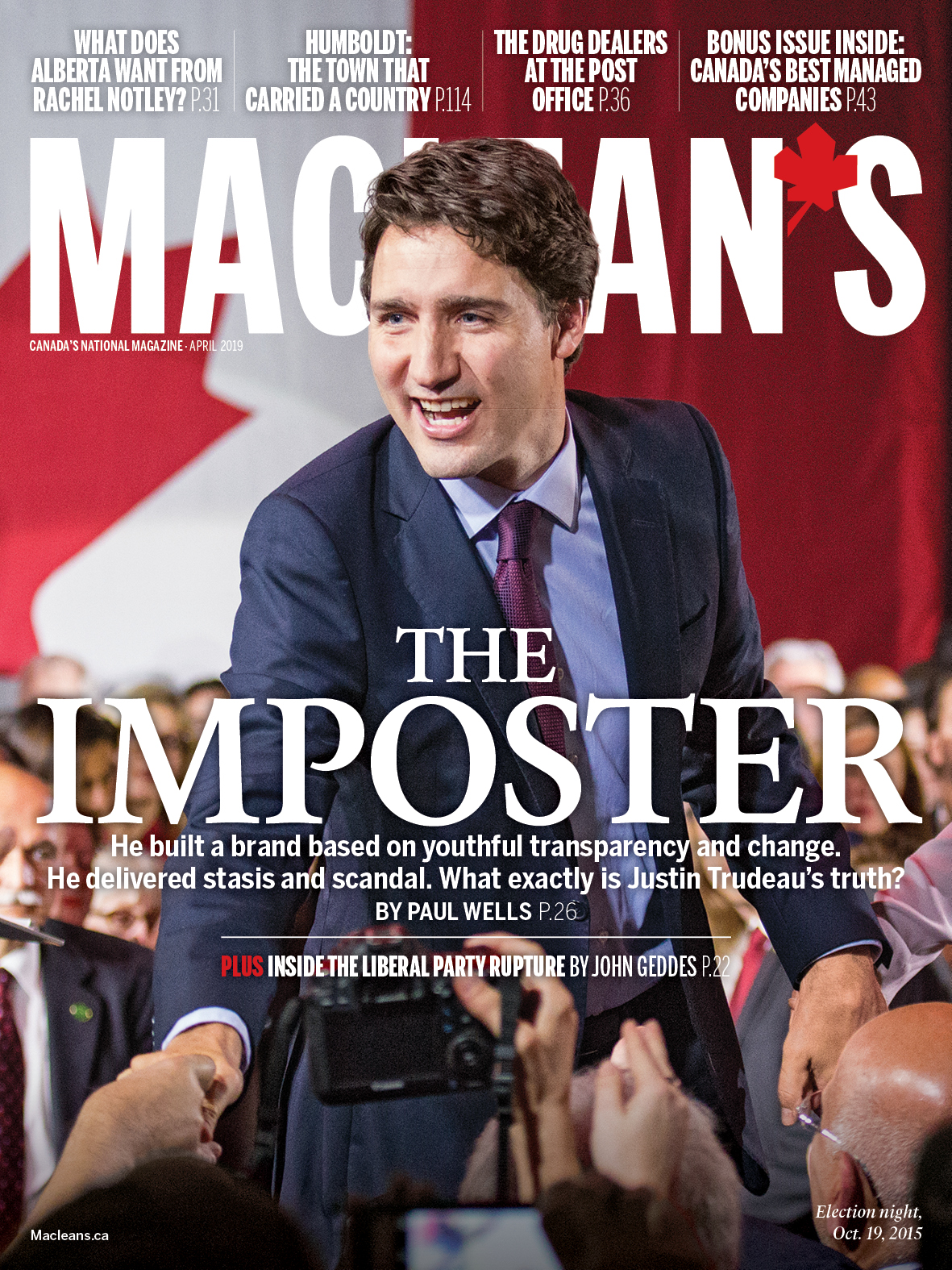
It may have been easy to miss amid the news coming out of Ottawa, but as the government lost its finance minister, appointed Chrystia Freeland to yet another job, prorogued parliament, halted testimony into its latest scandal, prepared for the announcement of a new Conservative Party of Canada leader and braced for a likely second wave of COVID-19, the prime minister promised to announce a transformative agenda. One that promises sweeping social change, and a wholesale re-invention of our economy in line with the greenest ambitions. We here at The Line have but one question.
Who the hell do these people think they are?
It is obvious to anyone who has been reading the news and possesses even residual brain function why the prime minister would like to be talking about a plan for transformative change. Talking about all the amazing things he could do for Canadians with borrowed money beats talking about his government’s bumbling of the WE file and the departure of now-former finance minister Bill Morneau.
Promising an organic chicken in every pot and a solar panel on every shed is obviously more appealing to Trudeau than repeating the last month. But it is astonishing to us — as jaded as we have undeniably become — that the government is talking about this instead of the necessary steps needed to shore up this country ahead of a likely second wave of COVID-19.
This government has a mandate to respond to the emergency, by mere unlucky virtue of being in power at the moment the virus hit. It is the duty of every Canadian government to safeguard the wellbeing of the population, full stop. But the emergency, contrary to what you may believe if you’ve been reading Liberal Party HQ memos, is not over. We have an urgent need to secure more medical equipment, to harden our long-term care facilities, to prevent any further lockdowns from derailing a fragile economic recovery, to ensure the resiliency of critical supply chains, and to shore up our health-care system. This is what every Canadian official should be focused on right now.
[…]
But can anyone maintain faith that the Liberals will stick to their knitting when we hear buzzwords like “transformative” social change? Sweeping climate-change reforms? Engineering a new green economy? They are all fine notions — let’s put them to the people and vote on them. Until calling that election is feasible (mid-pandemic, it is not) this government simply does not have the mandate to undertake such far-reaching efforts.
It’s easy to forget now, but only nine months ago this government was reduced to a minority of seats in parliament. The Liberals lost the popular vote, and saw one million of their own prior voters abandon them. They are only in government because the Conservatives, to the surprise of no one, found several novel and exciting new ways to fail.
August 22, 2020
Debra Soh’s new book is “a cancel-culture grenade”
Jen Gerson knows that any positive mention of Debra Soh’s The End of Gender: Debunking Myths About Sex and Identity has a strong resemblance to square-dancing in a minefield. Cancellations may fall like raindrops on the career of anyone so unenlightened as to even acknowledge the existence of such a work:
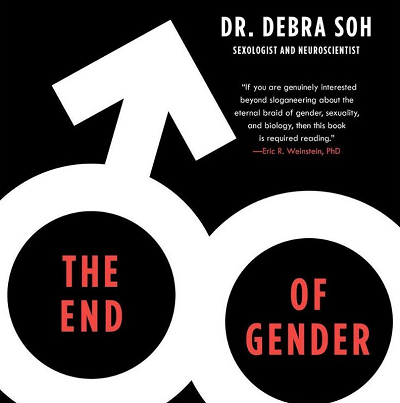
For that, at its heart, is what Soh’s book is: a lucid discussion of the best science we have to date on the nature of gender and sex, written for a lay audience. What gives the title its sizzle is not the content, but rather the cultural climate in which it is being published.
It maps the depth, scope and scale of current Culture War trenches in this particular theatre of battle. The End of Gender stomps on tripwires like the gender binary, whether transgender women are women, autogynephilia, Rapid Onset Gender Dysphoria, bathroom bans, and more.
It’s a cancel-culture grenade.
That’s not because these subjects ought to be contentious. Soh’s approach and tone are largely neutral. Rather, the controversy the book will inevitably incite is a reflection of a culture that has been warped into a state of existential terror by the very notion that these ideas can be responsibly discussed.
Soh begins by defining her terms.
So much of the debate around the most difficult topics of sex and gender stem from the simple fact that we are misusing the basic language. For example, sex and gender are not interchangeable concepts, even though they are often treated as such.
Sex is a term of biology. One’s sex, Soh argues, is determined by his or her gametes. With the exception of rare intersex disorders, 99 per cent of the population has a clearly defined biological sex that slots into one of two dimorphic categories: male or female.
Gender is more complicated. It’s now popular to state that there are more than two genders, but Soh disputes this. She argues that gender — or the set of characteristics that signal one’s sex to society — is also dimorphic. For 99 per cent of the population, gender correlates with sex. Further, even when expressions of gender are at odds with one’s biological sex, this, too, is mediated by biology. Whether one presents as gender typical or gender atypical is the result of prenatal testosterone exposure.
Soh notes that claiming to be gender non-binary, or gender fluid — or any one of a thousand variations that transcend the limiting concepts of male and female — is increasingly trendy, especially among teenagers and young adults. It seems to be the latest form of identity experimentation.
There are two reasons for this trend.
The first is that seeing the world through an intersectional framework encourages progressives to reverse the traditional hierarchies of race, sex and power. Therefore, claiming a marginalized identity — like genderqueer non-binary unicorn — accrues status within progressive peer circles.
The second is that the culture has undergone a massive awakening to transgender rights over the past decade. This has contributed expressive categories and vocabularies for people who otherwise might have struggled to find the language to explore their most authentic selves. As the cues, like cosmetics and dress, that we used to signal our gender are socially constructed, gender expression is limited only by our creativity.
QotD: Sex-differentiated status hierarchies
Girls can win by winning in their own hierarchy — by being good at what girls value, as girls. They can add to this victory by winning in the boys’ hierarchy. Boys, however, can only win by winning in the male hierarchy. They will lose status, among girls and boys, by being good at what girls value. It costs them in reputation among the boys, and in attractiveness among the girls. Girls aren’t attracted to boys who are their friends, even though they might like them, whatever that means. They are attracted to boys who win status contests with other boys.
“whatever that means”. Heh. Shivvy way to say, “which means nothing”.
When JP discusses sex differences, he could be reading CH posts. Whatever one thinks of the criticisms leveled against him (some are valid), he does have a decent grasp of the sexual market and how men and women navigate divergent routes through an ocean of mate prospects to get what they want.
However, this is one of the rare instances when I disagree with his premise. He’s generally correct that, at least within the bounds of our current cultural arrangement, women have two status hierarchies available to them while men only have one. Our gynarcho-tyranny not only encourages but aggressively impresses upon women the urgency and even moral duty of succeeding in male domains (leaning in), while simultaneously encouraging men to sacrifice their status within their own male domains to make way for more women (and consequently rendering themselves less sexually attractive to women who are now their equal or higher in social status).
Women who do succeed in the man’s world can expect to ascend the intrafemale status ladder (more precisely, the intra-feminist status ladder), but where JP is wrong is assuming these women don’t also suffer an SMV status loss the near-equivalent of the SMV status loss suffered by men who succeed at girlie games of one-uppance.
Just as girls aren’t attracted to effeminate males, and other men are repulsed by nancyboys, the inverse is as true: men aren’t attracted to masculine, status-striving girls, and other women don’t subconsciously look up to mouthy careerist shrikes with the same mix of envy and admiration that they look up to physically beautiful women.
CH, “Sex-Based Status”, Chateau Heartiste, 2018-06-04.
August 21, 2020
Virtuesplaining Blazing Saddles
Paul du Quenoy says that Mel Brooks is cancelled after all:

It seems like only yesterday that HBO Max, the financially troubled American cable television network’s new film streaming service, signalled its virtue by removing Gone With The Wind from viewing so that the classic film could be properly “contextualised” as what presenter and University of Chicago film professor Jacqueline Stewart calls “a prime text for examining expressions of white supremacy in popular culture”. She believes this is useful for the “re-education” of audiences who might otherwise stray into thoughtcrime.
Mel Brooks’s smash hit 1974 comedy Blazing Saddles, which seems to have been added to HBO Max since the Gone With The Wind dust up and is known for its liberal use of the feared and loathed “n-word”, arrived with a similarly patronising disclaimer already installed. In a three-minute introduction that apparently cannot be skipped over, Stewart is there again, this time to inform viewers that “racist language and attitudes pervade the film”, while instructing them that “those attitudes are espoused by characters who are portrayed here as explicitly small-minded, ignorant bigots … The real, and much more enlightened, perspective is provided by the main characters played by Cleavon Little and Gene Wilder”.
Thanks, Aunt Jacqueline. If you have not seen Blazing Saddles – and if you are under the age of forty there is an excellent chance some prudish authority figure sanitised it out of your cosseted millennial existence – it stands as one of the greatest, and the certainly the funniest, anti-racist films of all time. Based on a story by Andrew Bergman, Brooks conceived it as a scathing send-up of racism and the hypocrisy that still enabled it after the great civil rights victories of the 1960s. Brooks’s idiom was a parody of the classic Western, by then an exhausted genre that had, among other flaws, become inanely predictable and was much criticised for leaving out minorities. A landmark of American film, Blazing Saddles was selected in 2006 for inclusion in the US National Film Registry, which recognises “culturally, historically, or aesthetically significant films” worthy of preservation.
Drenched in hilarity – and by my count using the “n-word” 17 times in its 93-minute run – the plot involves a conspiracy by an avaricious U.S. state attorney general who wants to drive white settlers off land he needs to complete a profitable railroad project. After having outlaws wreak mayhem on the townspeople, he recommends that the governor appoint a black sheriff to restore law and order, cynically assuming that their racism will cause them to reject the new lawman and give up. Despite a rough initial reception, the sheriff outwits attempts to get rid of him and, with the help of a washed up but sympathetic alcoholic gunslinger, leads the townspeople to victory, winning their love and respect before moving on to other brave deeds.
While HBO no longer wants to risk having its paying customers think for themselves (and what stale corporate outfit uneasily transitioning to a crowded new market wouldn’t?), it could rightly be said that anyone dumb enough to miss the film’s message might be a recent product of Anglo-American higher education. I do not mean this at all facetiously. Decaying and run by a self-important clerisy whose demands to be taken seriously only become shriller as it declines in reach and vitality – and from which any participant can be dismissed for even the slightest speech or behavioural infraction – academia naturally discourages humour. Jokes, which can almost always cause some kind of offence, are simply too risky to be told or laughed at, even in private. Finding the wrong thing funny can invite career-hobbling accusations that one has demeaned a student or colleague and thereby made them feel unacceptably “uncomfortable” or even physically “unsafe”. Perceived flippancy bruises sanctified “professional seriousness” in a way tantamount to sacrilege. The only tolerated exceptions are a kind of solemn irony that offers comfort in coping with academia’s increasing irrelevance and a resigned gallows humor about its ever more limited prospects.
August 20, 2020
The attractive nuisance of conspiracy theories
In The Critic, Michael Coren pours scorn on the fans of QAnon and other conspiracy theories:

QAnon alleged clues about the NYC bombing, 10 December 2017.
Wikimedia Commons.
For those outside of the increasingly bizarre and surreal loop, something called QAnon is a pretty big thing in the United States, with increasing influence internationally. It’s a far-right conspiracy theory claiming that a secret deep state plot is at work against Donald Trump, who is the only person capable of smashing the power of a Satan-worshipping cabal of pedophiles composed of liberal and Democrat politicians, Hollywood celebrities, and high-profile mainstream media figures. There, nothing at all odd or bonkers about that. It goes on to allege that a planned coup by Hilary Clinton, Barack Obama, and – as always – George Soros was only prevented when President Trump hired former FBI director Robert Mueller to investigate.
The people who embrace all of this, and there are a large and increasing number of them, roar all sorts of quasi-religious language in their tweets and posts, speak of “The Storm” and “The Great Awakening” and are convinced that once they’re victorious, thousands of their enemies will be detained, incarcerated, likely sent to Guantanamo Bay, and the military will the take over the nation. Everyone loves a happy ending.
There’s plenty more involved, and every conspiracy theory one can imagine generally comes into play. Dive into social media and you’ll find the Q zealots, but look around a Trump campaign event and their posters and slogans will be just as common. Indeed, Republican candidate Marjorie Taylor Greene, a proud believer in QAnon, recently won the congressional nomination in Georgia’s 14th district. In that this area gave its last Republican candidate 76% of the vote it’s virtually impossible that Greene will not be a member of Congress. Many in her party were appalled but Donald Trump tweeted, “Congratulations to future Republican Star Marjorie Taylor Greene on a big Congressional primary win in Georgia against a very tough and smart opponent. Marjorie is strong on everything and never gives up — a real WINNER!” In other words, this is a serious concern.
Outside of democratic politics, the so-called Pizzagate scandal was part of the QAnon maze of lunacy. False claims were made that hacked personal e-mail accounts had revealed the existence of a child-sex ring involving several leading Democrat politicians. The whole thing was, it was alleged, based in a pizzeria in Washington DC. A North Carolina conspiracy believer then travelled to DC and opened fire in the restaurant with a high-powered weapon.
It’s likely that the people behind the entire Q madness are making a great deal of money and it could be that they’re not even directly politically motivated. Whatever their motives, it’s all gone well beyond its origins and was pushed into high gear when the apparently genuine case of the Jeffrey Epstein scandal came to light. His alleged links to senior lawyers, Democrats, and a member of the royal family, plus a bewildering suicide, were meat and drink to every conspiracy theorist with a mum’s basement worth the name.
Wikipedia says:
QAnon[a] (/kjuːəˈnɒn/) is a far-right conspiracy theory detailing a supposed secret plot by an alleged “deep state” against President Donald Trump and his supporters. The theory began with an October 2017 post on the anonymous imageboard 4chan by “Q”, who was presumably an American individual, but probably became a group of people. Q claimed to have access to classified information involving the Trump administration and its opponents in the United States. NBC News found that three people took the original Q post and expanded it across multiple media platforms to build internet followings for profit. QAnon was preceded by several similar anonymous 4chan posters, such as FBIAnon, HLIAnon (High-Level Insider), CIAAnon, and WH Insider Anon.
Q has accused many liberal Hollywood actors, Democratic politicians, and high-ranking officials of being members of an international child sex trafficking ring. Q also claimed that Trump feigned collusion with Russians to enlist Robert Mueller to join him in exposing the ring and preventing a coup d’état by Barack Obama, Hillary Clinton, and George Soros. “Q” is a reference to the Q clearance used by the U.S. Department of Energy. QAnon believers commonly tag their social media posts with the hashtag #WWG1WGA, signifying the motto “Where We Go One, We Go All”.
August 19, 2020
He calls it “unintended consequences”. I disagree … these consequences are very much intended
Brad Polumbo is being far too generous to Californian politicians by saying the impending collapse of the state’s entire gig economy was not the intended result of passing “worker protection” laws that penalized success:

UBER 4U by afagen is licensed under CC BY-NC-SA 2.0


This Friday, Uber and Lyft are set to entirely shut down ride-sharing operations in California. The businesses’ exit from the Golden State will leave hundreds of thousands of drivers unemployed and millions of Californians chasing an expensive cab. Sadly, this was preventable.
Here’s how we got to this point.
In September of 2019, the California state legislature passed AB 5, a now-infamous bill harshly restricting independent contracting and freelancing across many industries. By requiring ride-sharing apps such as Uber and Lyft to reclassify their drivers as full employees, the law mandated that the companies provide healthcare and benefits to all the drivers in their system and pay additional taxes.
Legislators didn’t realize the drastic implications their legislation would have; they were simply hoping to improve working conditions in the gig economy. The unintended consequences may end up destroying it instead.
Here’s why.
AB 5 went into effect in January, and now, a judge has ordered Uber and Lyft to comply with the regulation and make the drastic transformation by August 20. Since compliance is simply unaffordable, the companies are going to have to shut down operations in California.
Their entire business model was based upon independent contracting, so providing full employee benefits is prohibitively expensive. Neither Uber nor Lyft actually make a profit, and converting their workforce to full-time employees would cost approximately $3,625 per driver in California. As reported by Quartz, “that’s enough to boost Uber’s annual operating loss by more than $500 million and Lyft’s by $290 million.”
Essentially, California legislators put these companies in an impossible position. It makes perfect sense that they’d leave the state in response. It’s clear that despite the good intentions behind the ride-sharing regulation, this outcome will leave all Californians worse off.
QotD: The Canadian Broadcasting Corporation
But it is an infestation of leftist biases, and is often grossly unprofessional. For decades, despite being almost entirely funded by Canadian taxpayers, it was the principal house organ of the Quebec separatist movement, to the point that former prime minister Pierre Trudeau, shortly before the 1980 Quebec independence referendum, threatened to shut the French network down; when asked what he would replace it with, he responded with his customary vivacity of wit: “Still pictures of Chinese and Japanese vases, at least they have some cultural value.” It is compulsively misanthropic and nasty, and almost always takes a snide leftist view of everything, including foreign affairs. Brexiters were cavemen, U.S. President Donald Trump is a racist, sexist crook and moron, and it is racism and xenophobia to assert that the coronavirus originated in China. Can’t we have better and more original insights than this?
Conrad Black, “Canada needs a much better CBC”, New English Review, 2020-05-02.
August 18, 2020
Political polarization, or why Liberals and Conservatives really don’t understand each other
John Miltimore discusses the findings of Jonathan Haidt on the differences in moral worldviews of conservative and liberal Americans which seem to explain why communication across the political “aisle” is so difficult:
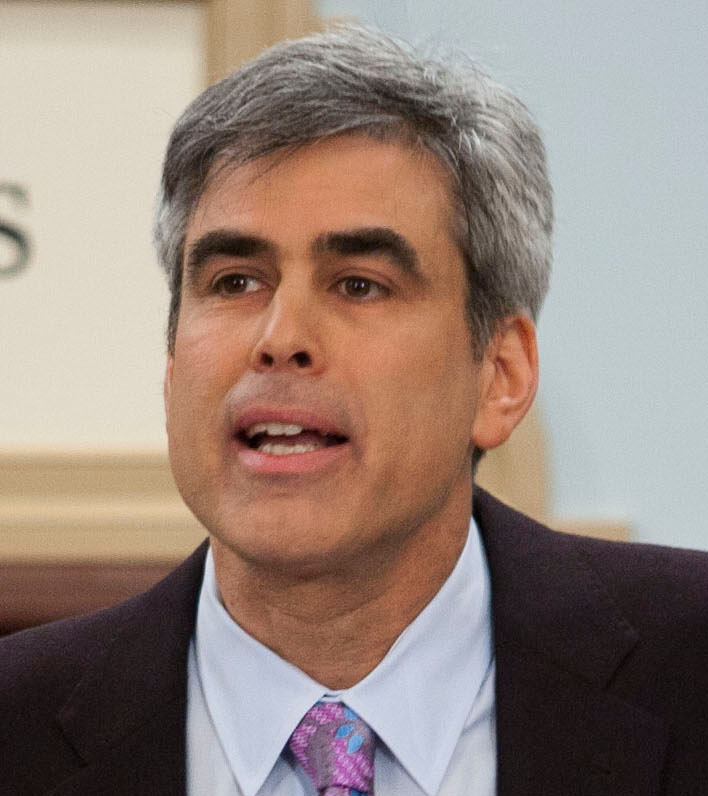
Jonathan Haidt at the Miller Center of Public Affairs in Charlottesville, Virginia on 19 March, 2012.
Photo via Wikimedia Commons.
During a TED talk a number of years ago, Haidt shared his discovery that contrary to the idea that humans begin as a blank slate — “the worst idea in all psychology,” he says — humans are born with a “first draft” of moral knowledge. Essentially, Haidt argues, humans possess innate but malleable sets of values “organized in advance of experience.”
So if the slate is not blank, what’s on it?
To find out, Haidt and a colleague read the most current literature on anthropology, cultural variations, and evolutionary psychology to identify cross-cultural matches. They found five primary categories that serve as our moral foundation:
- Care/harm: This foundation is related to our long evolution as mammals with attachment systems and an ability to feel (and dislike) the pain of others. It underlies virtues of kindness, gentleness, and nurturance.
- Fairness/reciprocity: This foundation is related to the evolutionary process of reciprocal altruism. It generates ideas of justice, rights, and autonomy. [Note: In our original conception, Fairness included concerns about equality, which are more strongly endorsed by political liberals. However, as we reformulated the theory in 2011 based on new data, we emphasize proportionality, which is endorsed by everyone, but is more strongly endorsed by conservatives.]
- Loyalty/betrayal: This foundation is related to our long history as tribal creatures able to form shifting coalitions. It underlies virtues of patriotism and self-sacrifice for the group. It is active anytime people feel that it’s “one for all, and all for one.”
- Authority/subversion: This foundation was shaped by our long primate history of hierarchical social interactions. It underlies virtues of leadership and followership, including deference to legitimate authority and respect for traditions.
- Sanctity/degradation: This foundation was shaped by the psychology of disgust and contamination. It underlies religious notions of striving to live in an elevated, less carnal, more noble way. It underlies the widespread idea that the body is a temple which can be desecrated by immoral activities and contaminants (an idea not unique to religious traditions).
[…]
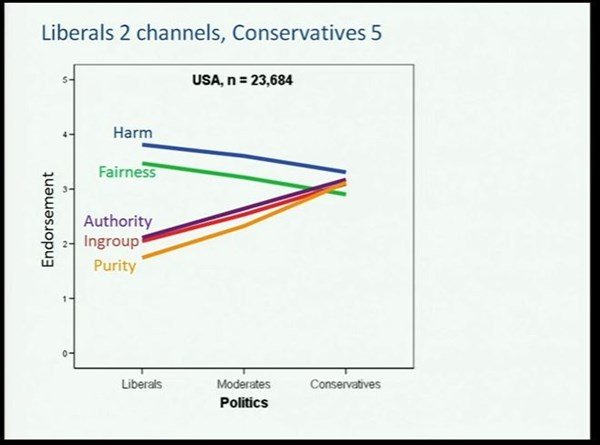
What Haidt found is that both conservatives and liberals recognize the Harm/Care and Fairness/Reciprocity values. Liberal-minded people, however, tend to reject the three remaining foundational values — Loyalty/betrayal, Authority/subversion, and Sanctity/degradation — while conservatives accept them. It’s an extraordinary difference, and it helps explain why many liberals and conservatives in America think “the other side” is bonkers.
August 16, 2020
QotD: Labour is now the “party of government” even when they’re not in power
Anyone official and highly educated sounding who challenges whatever happens to be the prevailing supposed wisdom of this governing class, on Coronavirus or on anything else, must be scolded into irrelevance and preferably silenced. The governors must be obeyed, even if they’re wrong. In fact especially if they’re wrong, just as the soldiers of the past were expected to obey their orders, no matter what they thought of the orders or of the aristocratic asses who often gave them. Whether they were good orders was an argument that those giving orders could have amongst themselves, but that orders must be obeyed was a given. “Capitalism” isn’t worth dying for, but this new dispensation is, right or wrong.
Our new class of entitled asses, together with all those who have placed their bets for life on carrying out their orders or trying to profit from them, seems now to be the limit of the Labour Party’s electoral ambition. And who knows? The awful thing is that this class and its hangers-on could be enough, in the not too distant future, to get them back into direct command of the governmental process that they so adore.
Brian Micklethwait, “Mick Hartley on the politics of the Lockdown”, Samizdata, 2020-05-15.
August 15, 2020
French President Emmanuel Macron – “We are a country that for decades is divided and in doubt”
Individuals in France may be chauvinistic, says Joseph de Weck, but the French as a whole are less chauvinistic and more self-critical than the British or the Germans:
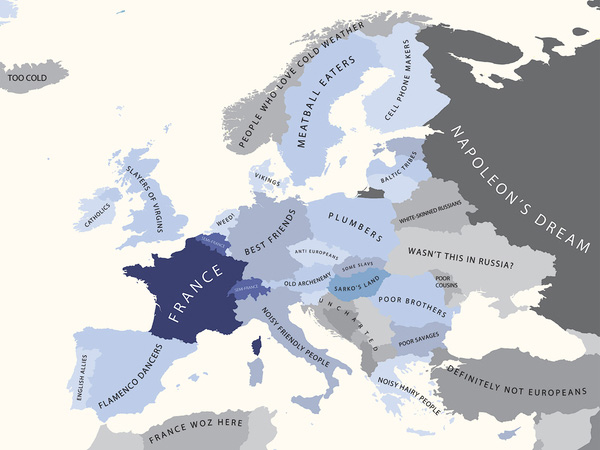
There is no doubt that the French are a self-sufficient bunch. After all, it was a Frenchman who once wrote, “Hell is other people.”
COVID-19 or not, the French rarely travel abroad for holidays. In terms of food, most French people think they have it best. And at housewarming parties in Paris, the music playlist is usually primarily made up of chansons and French rap classics.
And despite President Emmanuel Macron’s attempts to turn Europe into a global “balancing power,” what happens abroad doesn’t seem to spark much interest at home. The evening news on the public channel on average dedicates 16 percent of its coverage to European and foreign news. By comparison, that proportion rises to 50 percent in Germany. No surprise then that polls show the average French person knows little about the functioning of the EU.
But if this cliché about French aloofness is easily backed up with data points, another common trope about the Gauls doesn’t: that of French arrogance. At least when it comes to the present, the French are brutally self-critical.
In fact, France seem to be among the least chauvinistic countries in Europe. Asked whether they think their culture is superior to others, 36 percent of the French answered “yes” in a recent poll. This compares to 46 percent in the United Kingdom and 45 percent in Germany.
Or take the COVID-19 crisis: unlike other nations, the Republic’s citoyens won’t rally around the flag. Among Europeans, the French give their government the lowest grades for its handling of the pandemic. Never mind that four of France’s neighbors have significantly higher death-per-capita rates. Never mind either that France’s short-time work benefits are among the most generous, also explaining why consumption is almost back to pre-crisis levels.
Of course, one could explain the French’s dim view of the state’s COVID-19 response as being due to Macron’s unpopularity. But by French standards, the president is actually polling relatively well. At 39 percent, Macron’s approval ratings surpass his predecessors François Hollande (23 percent) and Nicolas Sarkozy (35 percent) at the same point in their terms.
The negative view the French have of their country goes far beyond the complaint du jour. As Macron put it, “We are a country that for decades is divided and in doubt.”
August 14, 2020
From protests to riots to …
In the Claremount Review of Books, Angelo M. Codevilla looks at historical patterns that may prefigure what is going on in major urban areas today:
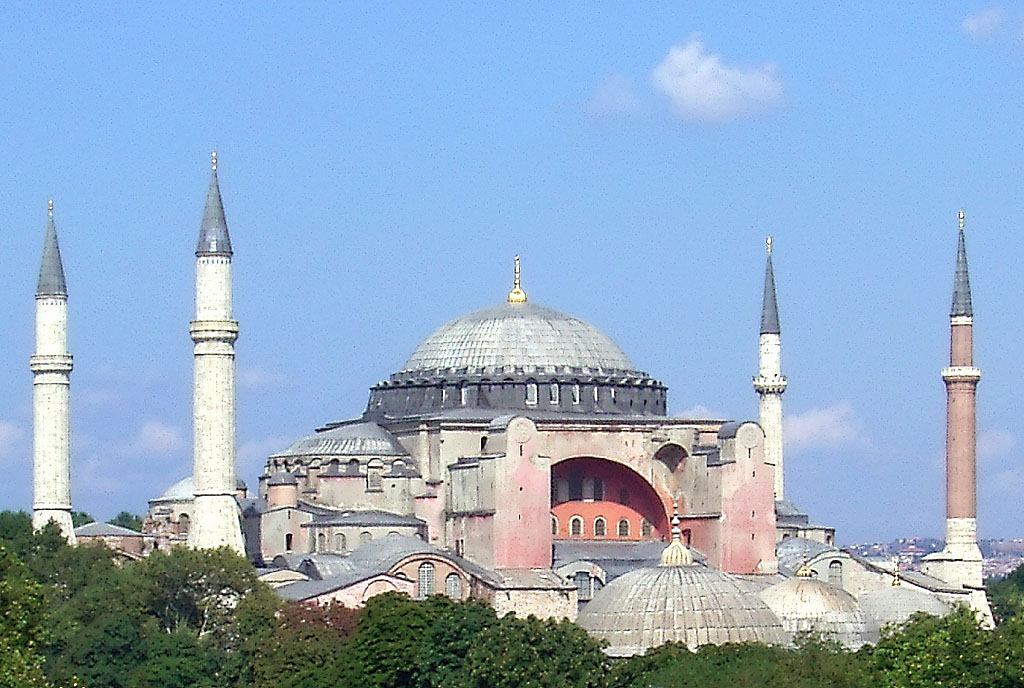
Hagia Sophia in the Faith district of Istanbul, 18 November 2004.
Photo by Robert Raderschatt via Wikimedia Commons.
The Americans who confess other people’s racism absolve themselves inexpensively by a moral mechanism common to humanity: the more I profess to hate evil, the more I showcase my own goodness. Such confessions, however, have a particular history of tragedy in Christian civilization. Again and again over the centuries, persons who have imagined themselves cleansed by ritual confessions have believed themselves elevated above the rest of humanity and, hence, entitled to oppress or even annihilate those around them. Today’s self-purifiers, arms outstretched in supine submission, who then countenance violence against persons, property, and cultural symbols, are mostly unwitting protagonists in yet another chapter of a hoary history.
Although Judeo-Christianity teaches that perfection is not of this world, nevertheless the Old Testament (see the Book of Daniel) and the New (Revelation, chapter 20) refer tangentially to a final state in human affairs in which all evil will have been defeated and the virtuous will have triumphed over their enemies. In the Book of Revelation, this final stage is to last for a thousand years. Jesus Christ’s warnings notwithstanding, people have hearkened periodically to “false prophets” who brandish the prospect of ultimate vengeance over evil. Between the 11th and 16th centuries, any number of movements of this sort used ritual confessions to cleanse themselves, and energized the mobs that waged Europe’s bloodiest wars of that age. Thereafter, though such movements secularized their terms, they fit into the same moral and intellectual categories. Now as ever, they are about destroying civilization in the name of altering the human condition.
But whereas revolutionary movements from the Middle Ages to roughly the middle of the 20th century opposed the ruling classes wholeheartedly and found no friends among them, this generation’s movements have intense, problematic relations with those classes, about which more below.
Today we see scenes of monuments which had stood for decades, now destroyed and defaced, as well as the forceful cancellation of names from circulation. Smashing others’ idols was, and remains, a staple of tribal warfare. The Old Testament recalls the divine command to destroy idols, and the clashes between Christian and Muslim armies always aimed as much at symbols as at people. The Song of Roland contains a lyrical account of Charlemagne’s iconoclasm in his campaign against the Saracens. In the 6th century, Emperor Justinian made Constantinople’s Hagia Sophia cathedral the Christian world’s biggest and most important church. The Muslims who added that city to the Ottoman Empire in 1453 killed its priests, toppled its statues, and made it into the principal mosque of the Muslim caliphate at war with Christendom. In 1923, Kemal Atatürk, Turkey’s modernizer, turned the building into a museum in order to end that war. But in July 2020 Turkey’s Islamist president Recep Erdogan, consistent with his hostility to Judeo-Christian civilization, turned it into a mosque again and began covering up what remain of the Christian frescoes on its walls. Destroying symbols, however, has had no place within Christian civilization. As the equivalent of torturing dead men, it has always been the work of cowards likelier to run from living enemies. On the other hand, war against statues, paintings, books, biographies, etc., has been a defining feature of civilization’s revolutionary enemies, consistent with their chosen identities as alien tribes.
What follows is a glance at the bloody history of this little-known flaw. It is a tale whose cautionary moral Aleksandr Solzhenitsyn best expressed: the line between good and evil runs not between persons — never mind between parties, classes, or races — but down the middle of every human heart. That is central to our civilization.
H/T to David Warren for the link.
August 12, 2020
Defending Sir John A.
In his latest post for The Dominion, Ben Woodfinden attempt to defend that horrible racist, sexist, homophobe, transphobe, non-intersectional, dead, white, cis-gendered male monster, Sir John A. Macdonald:

Statue of Sir John A. Macdonald that formerly stood in front of City Hall in Victoria, British Columbia.
Wikimedia Commons.
The way you’re supposed to begin a piece like this is with a sort of penitential act. I should begin a discussion of Sir John A. Macdonald with a confession of his various sins and crimes, before offering an apology, and a reluctant defence of our first prime minister that essentially boils down to “history matters,” without actually explaining what that history is or why it matters.
If you do this you’ve already lost the historical fight, because you’ve willingly ceded the narrative to Macdonald’s detractors, and fallen back to a defence of history in some abstract sense, instead of a defence of Macdonald himself. This kind of Girondin impulse is far too common amongst many liberals and conservatives now, especially in elites institutions and fields like journalism and academia.
[…]
No one, including me, claims that Macdonald was a saint, and Canada’s treatment of Indigenous people and migrants in the early days of Confederation was racist, and wrong. I doubt any serious person would deny this. But even on these questions, Macdonald’s record is complex. Tristin Hopper, wrote an excellent and accessible piece in the National Post simultaneously laying out both the bad things Macdonald was responsible for, and also Macdonald’s paradoxically ahead of his times views on Indigenous voting rights, and recognition of the terrible plight of Indigenous peoples.
But this is only part of the story of Macdonald, and the crucial role he played in our history. Too often this is all that gets discussed, ceding the narrative to Macdonald’s detractors and dooming him to inevitable damnatio memoriae. This is why, in the name of defending our history, we cannot simply defend capital H History, we have to defend the substance of our actual history.
Macdonald’s central role as the key architect of Confederation, and our country, is not well known because Canadian history, especially the history that led to confederation, is not well known by Canadians. It’s a national embarrassment, and in this vacuum it is easy to build incomplete and partial narratives about what Canada is and what Canada means.
Macdonald is best described as “the indispensable politician.” Confederation was not inevitable, it took adept figures like Macdonald to make it happen. Macdonald was not an ideologue, and his political career was defined by his masterful ability to forge coalitions and working compromises between seemingly intractable groups. He was an important political figure in the United Province of Canada (the union of Upper and Lower Canada), and proved adept at balancing and forging coalitions with the warring and disparate factions from Upper and Lower Canada forced into an uncomfortable union. He resisted, but worked and ultimately partnered with uncompromising reformers in the province like George Brown, while ultimately laying the groundworks for constitutional reform that Brown, though principled, could almost certainly never have achieved.
August 11, 2020
Orwell’s “Notes on Nationalism”
In Quillette, Adam Wakeling discusses George Orwell’s essay in the postwar magazine Polemic:
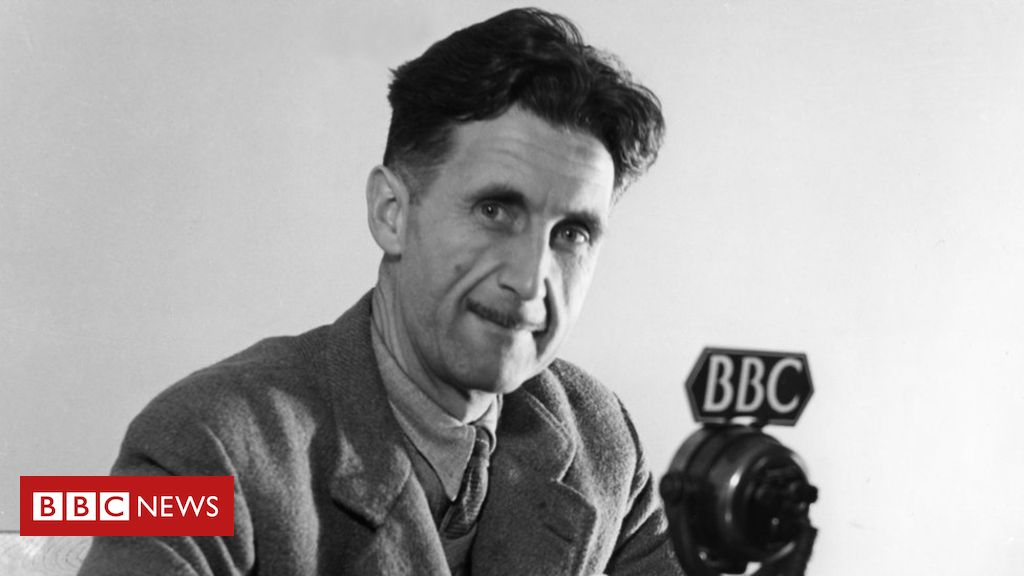
In the bleak post-war Britain of October 1945, an essay by George Orwell appeared in the first edition of Polemic. Edited by abstract artist and ex-Communist Hugh Slater, the new journal was marketed as a “magazine of philosophy, psychology, and aesthetics.” Orwell was not yet famous — Animal Farm had only just started appearing on shelves — but he had a high enough profile for his name to be a boon to a new publication. His contribution to the October 1945 Polemic was “Notes on Nationalism,” one of his best and most important pieces of writing. Amidst the de-Nazification of Germany, the alarmingly rapid slide into the Cold War, and the trials of German and Japanese war criminals, Orwell set out to answer a question which had occupied his mind for most of the past seven years — why do otherwise rational people embrace irrational or even contradictory beliefs about politics?
As a junior colonial official in Burma, the young Eric Blair (he had not yet adopted the name by which he would be known to posterity) had been disgusted by his peers and superiors talking up the British liberty of Magna Carta and Rule Britannia while excusing acts of repression like the massacre of Indian protestors at Amritsar in 1919. As a committed socialist in the late 1930s, he openly ridiculed those who claimed to be champions of the working class while holding actual working-class people in open contempt. And he had watched the British Communist Party insist that the Second World War was nothing more than an imperialist adventure right up until the moment when the first German soldier crossed the Soviet frontier, at which point it instantly became a noble struggle for human freedom.
Orwell’s most personally searing experience, though, had come in Barcelona in 1937. The previous year, he had travelled to Spain to fight in the Civil War on the Republican side. His poor relationship with the British Communist Party led him to enlist in the militia of an anti-Stalinist socialist party, the POUM (Partido Obrero de Unificación Marxista, or Workers’ Party of Marxist Unification). Even while it was fighting a bitter winter campaign in the Aragon mountains, the POUM was subject to a relentless propaganda campaign by pro-Soviet Republicans who insisted it was a secret front for fascism.
Over May and June 1937, the POUM and the other independent left-wing organisations in Barcelona were brutally suppressed by the Republican Government and Soviet-backed Communists. Orwell saw his friends and comrades smeared, arrested, and in some cases shot. He only made a narrow escape back into France himself. Upon his return to Britain, he found the British Communist Party resolute in its line that the POUM was a fascist party. Admitting that there could be a difference of opinion among left-wing groups with respect to the Soviet Union, or that the Spanish Communists could have acted unjustly, was unacceptable. And when Orwell published his own account of the events in Spain, Homage to Catalonia, few were interested in reading it. The betrayal of the POUM weighed on Orwell’s mind through the Second World War, and Animal Farm provided an outlet for his anger. But those bloody spring days in Barcelona also informed “Notes on Nationalism.”
“Notes on Nationalism” is not an ideal title, as Orwell was not talking only about loyalty to country. Rather, he used nationalism as a short-hand for any type of group loyalty — to a country, but also to a religion, a political party, or an ideology itself. A nationalist may be defined by his membership of a group, or by his opposition to one, which Orwell called “negative” nationalism. Orwell used anti-Semites as an example of the latter, as well as the “minority of intellectual pacifists whose real though unadmitted motive appears to be hatred of Western democracy and admiration of totalitarianism.” He then set out to explain how everyone — no matter how reasoned and level-headed — is capable of irrational and biased thinking when our sense of group identity is challenged.
He identified three characteristics of “‘nationalistic’ thinking.” First, obsession — the ideologue’s need to filter everything through an ideological lens. Entertainment is not entertaining unless it is orthodox. Second, instability — the ability of the ideologue to go from believing one thing to quickly believing another to follow the party line. And thirdly, indifference to reality. One of the most interesting aspects of “Notes on Nationalism” is the “inadmissible fact” — something which can be proven to be true and is generally accepted but cannot be admitted by the adherents of a particular ideology. Or, if the fact is admitted, it is explained away or dismissed as unimportant.
The ideas explored in “Notes on Nationalism” run through much of Orwell’s writing, most obviously his anti-totalitarianism and hatred of hypocritical pieties. But central to his argument is how nationalistic thinking exposes our inescapable biases. “The Liberal News Chronicle,” he wrote, “published, as an example of shocking barbarity, photographs of Russians hanged by the Germans, and then a year or two later published with warm approval almost exactly similar photographs of Germans hanged by the Russians.” This anticipated the doublethink of Nineteen Eighty-Four, in which atrocities “are looked upon as normal, and, when they are committed by one’s own side and not by the enemy, meritorious.” The first step down the deceptively short road to totalitarianism is believing that our political enemies pose such a grave threat that defeating them takes precedence over truth, consistency, or common sense.


