
The second thing they have wrong, and what I urge you to realize as soon as you can: They are not the “oppressed.” No, I don’t mean by that that there is no oppression in our society. Any human society has people with more power than others. It’s just that the groups and ideas that the left and their violent lap-wolves Antifa have cast as victims aren’t the victims.
In fact, their philosophy — the Marxist ideology they propound and the craziness behind it — has been in control of society, on top, since at least the seventies.
Being a leftist is a mark of being “good” and also well educated. The same way that in Elizabethan England poor mad Christopher Marlowe wrote his stage directions in Latin, to show that he had had an excellent education and deserved respect, so too the leftists of today pepper their works, from movies to TV to books to art, with odes to the oppressed and paeans to the coming revolution. It’s how you show you’re high-class and exquisitely educated.
All the old families, all the rich, all the captains of industry and power brokers signal left as hard as they can, because that’s where the power is — and in my field, the awards, the professorships, and the acclaim. Heck, remember what Trump signaled just to be allowed to do business.
And that’s why I’ve been watching in amusement the left going through the motions of kabuki theater revolution against a society … they control.
Sarah Hoyt, “We’re Seeing the Death Rattle of the Revolution, Not Its Birth”, PJ Media, 2020-07-28.
January 4, 2022
QotD: Status signalling
January 3, 2022
QotD: The Sisyphean quest of conservatives looking for progressive approval
Stop caring what liberals and their media toadies say. Be a conservative and make them pay.
It’s simple, effective, and much more satisfying than trying to get people who hate you to stop hating you.
It’s also more dignified. Look at Chimpy McBu$Hitlerburton. That was what they called George W. Bush back in the day. He was hardly hardcore – the guy was softer than a My Pillow and about 1 percent as based. But they hated him anyway, trashed him, slandered him, and even toobined to their assassination fantasies about him. But he was too gentlemanly to defend himself. Yet, once he retired to paint tacky pictures and began sucking up to the elite, he suddenly became a respected elder statesman. Now you have the Democrats positively orgasmic over his upcoming fundraiser for the doomed reelection bid of the Beltway Cowgirl Liz Cheney, who has likewise earned the temporary reprieve from the hate-tsunami by utterly betraying her fellow Republicans.
So, you can buy yourself some time. The price is your dignity, but if you crawl around on your belly and lick the toes of your vinyl-clad leftist dominatrix – oops, I assumed xis gender! – you’ll get a little less hatred for a little while.
These indisputable facts completely dispel the argument that the problem with conservatives is that they are too scary, that they must be bland and moderate and bipartisan and not upset the erotically-forgone wine women of the suburbs who channel their sexual frustrations into liberal politics. The idea that we will win these people over by not standing up for anything is just silly; how many times do you have to have a plan fail before you admit it’s a failure, GOP?
Kurt Schlichter, “Every Republican Is ‘Literally Hitler’, So Stop Caring What Libs Say”, TownHall.com, 2021-09-29.
January 2, 2022
In 1978, E.O. Wilson was “the only scientist in modern times to be physically attacked for an idea”
In the current year, I suspect many, many scientists have been physically attacked for advocating unpopular ideas. In Quillette, Alice Dreger publishes an interview she had with Wilson in 2009:

Edward O. Wilson in February 2003.
PLoS image by Jim Harrison via Wikimedia Commons.
Alice Dreger: I know you’ve spoken about it many times before, but I would like to begin by asking you about the session at the 1978 AAAS [American Association for the Advancement of Science] conference during which you were rushed on the stage and a protester emptied a pitcher of water onto your head. By all accounts, the talk you then gave was very measured. How on Earth were you able to remain so calm after being physically assaulted?
Edward O. Wilson: I think I may have been the only scientist in modern times to be physically attacked for an idea. The idea of a biological human nature was abhorrent to the demonstrators and was, in fact, too radical at the time for a lot of people — probably most social scientists and certainly many on the far-Left. They just accepted as dogma the blank-slate view of the human mind — that everything we do and think is due to contingency, rather than based upon instinct like bodily functions and the urge to keep reproducing. These people believe that everything we do is the result of historical accidents, the events of history, the development of personality through experience.
That was firmly believed in 1978 by a wide part of the population, but particularly by the political Left. And it was thought at the time that raising the specter of a biological basis for human behavior was not only wrong, but a justification for war, sexism, and racism. Biological gender differences could justify sexism, and any imputation that we evolved a human nature, or that human qualities might differ from one race to another, was dangerously racist.
So, furious ideologically based opposition had built up in 1978. That opposition had been fanned by a small number of academics including [paleontologist] Stephen Jay Gould and [evolutionary biologist] Richard Lewontin and two or three others on the Harvard faculty who thought this was a very dangerous idea and said so. These people helped organize the so-called “Science for the People” movement, or the branch of it called the “Sociobiology Study Group”. Their purpose was to discredit me personally for having brought up such a dangerous and destructive idea.
In fact, at that meeting, InCAR — the International Committee Against Racism — held up signs condemning me and sociobiology and racism in general. Of course, racism never even entered my thinking in developing these ideas. Anyway, after they dumped the water on me, amazingly, they returned to their seats while I was drying myself off. A couple of people then made short speeches — most notably Stephen Gould, of all people, the guy whose agitation and inflammatory essays had been partly responsible for all this. He addressed the demonstrators and said, in effect, that while he fully understood their motivation, violence was not the right way to achieve their goals.
As for me, I don’t know why, but I just get calm under a lot of stress. I’ve been in that sort of stressful situation many times, especially in the field. I started thinking to myself, this is probably going to be an historical moment, and it is very interesting. I wasn’t in the least doubt that my science was correct. I knew this was a kind of aberration. I understood the source because I knew the people who had been the chief thinkers, the ideological leaders. An astonishingly good percentage of them were on the faculty at Harvard. I wasn’t concerned this would come to anything in the long term.
So, someone found a paper towel and I dried my head. As soon as things settled down, I just read my talk. I knew things were going to work out — there was so much evidence accumulated already for a somewhat programmed human brain. By then, it was already coming from many directions, including genetics and neuroscience. There was no doubt about where things would go. There may be hold-outs but the inevitable conclusion from neuroscience and anthropology and genetics is for this way of thinking. [American anthropologist] Nap[oleon] Chagnon was present and he was certainly a leader in thinking about human nature and how valuable it is, and what its motivations are, by studying groups like the Yanomamö.
I knew history was on my side. I was young enough that I thought I would live through a good part of it. I was annoyed! But I wasn’t under stress in an extreme way. Before going home, I went to the next session, at which an anthropologist made the mistake of stating that I believe every cultural difference has a genetic basis, so that I am a racist. Of course, I rebutted that, but that was the kind of thing being exchanged at that meeting.
January 1, 2022
QotD: Heinlein’s “Crazy Years”, Alfred Korzybski’s General Semantics, and modern times
The great and dire events of the early Twentieth Century no doubt confirmed Korzybski in the rightness of this theory. Nothing prevents a race of people from contracting and fomenting a false-to-facts belief: the fantasies of the Nazi Germans, pseudo-biology and pseudo-economics combined with the romance of neo-paganism, stirred the psyche of the German people for quite understandable reasons. From the point of view of General Semantics, the Germans had divorced their symbols from reality, they mistook metaphors for truth, and their emotions adapted to and reinforced the prevailing narrative. They told themselves stories about Wotan and the Blood, about being betrayed during the Great War, about needing room to live, about the wickedness of Jewish bankers and shopkeepers, about the origin of the wealth of nations — and they went crazy.
The Russians, earlier, and for equally psychological and psychopathic reasons told themselves a more coherent but more unreal story about history and destiny, taken from a Millenarian cultist named Marx, and they were, on an emotional level even if not on a cognitive level, convinced that shedding the blood of millions would bring about wealth as if from nowhere. And, because they used the word “scientific” to describe their brand of socialism, they actually thought their play-pretend neurotic story was a scientific theory that had been discovered by rigorous ratiocination — and they went crazy.
Berlin was bombed into submission during the Second World War, and the Berlin Wall collapsed along with the Soviet Empire at the end of the Cold War. But the modern methods of erecting false-to-facts dramas appealing to mass psychology, once discovered, did not fall when their practitioners fell: scientific socialism, naziism, fascism, communism, all have in common the subordination of word-association to political will. All these doctrines have a common ancestor, which is the social engineering theory of language: if you change the connotation of word, so the theory runs, you change the connotations of thoughts. General Semantics says that if an individual, or whole people en mass, adopt deliberately false beliefs, supported by deliberately manipulative word-uses, he or they will have increasingly unrealistic and maladaptive behaviors. Introduce Political Correctness, ignore factual correctness, and the people will go crazy.
The main sign of when madness has possessed a crowd, or a civilization, is when the people are fearful of imaginary or trivial dangers but nonchalant about real and deep dangers. When that happens, there is gradual deterioration of mores, orientation, and social institutions — the Crazy Years have arrived.
John C. Wright, “The Crazy Years and their Empty Moral Vocabulary”, John C. Wright, 2019-02-18.
December 31, 2021
QotD: Justin Trudeau … “virtue-signalling made flesh”
This is only the latest in a long line of Trudeau blackface scandals, of course. The man appears to have spent a significant chunk of his younger years blacked up. There are three blackface incidents that we know of. There could be more. As one headline put it: “Trudeau says he can’t recall how many times he wore blackface make-up.” Imagine blacking up so often you can’t remember all the times you did it. Trudeau’s defenders say it was youthful daftness. Really? I don’t know a single person who has ever blacked up. I know people who have done daft things, of course. But not that.
Trudeau’s penchant for blackface is very odd. He puts it down to the fact that he has always been “more enthusiastic about costumes than is sometimes appropriate“. Riiight. It is mostly a matter for Mr Trudeau and his conscience, of course, as to why he was black-painting his face – and, in one incident, his tongue too – well into his twenties. But it’s a matter for all of us who inhabit the online world as to why Trudeau has never been cancelled, or even seriously threatened with cancellation, for doing something that would be ferociously denounced as racist if anyone else on earth had done it.
Brendan O’Neill, “The never-ending ridiculousness of Justin Trudeau”, Spiked, 2021-09-21.
December 20, 2021
Even libertarians can fall victim to progressive hysteria
In the latest Libertarian Enterprise, Sean Gangol mourns the discovery that Penn Jillette has abandoned his libertarian beliefs due at least in part to a bout of Trump Derangement Syndrome:
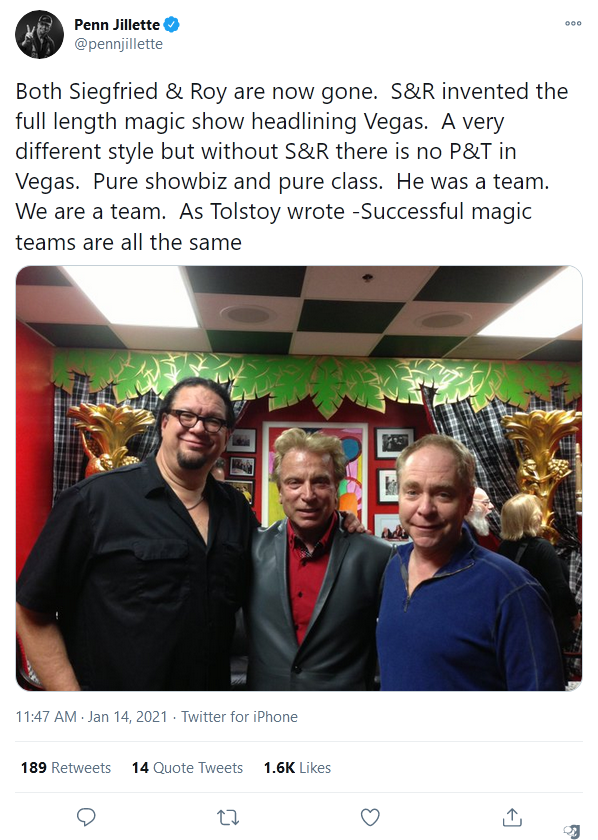
In the last three years I have found myself becoming increasingly disappointed with certain organizations and people who have called themselves libertarian. My first disappointment was Christopher Cantwell, a libertarian who joined the Free State movement in New Hampshire. I used to be a regular listener of his podcast up until he got involved in the so-called Alt-Right movement, where he found himself mixed up in the fiasco that took place in Charlottesville. To this day I still can’t comprehend how a no-nonsense Anarcho-Capitalist like Cantwell could trade the principles of individual freedom for the principles peddled by a neo-fascist group. Then there was Reason magazine, who blamed Trump for the death of a young protestor in Charlottesville, which led to me cancelling my subscription. I also got tired of libertarians constantly belly-aching about how Trump is far from their ideal president, which is why I stopped watching Kennedy. Though I would say that my biggest disappointment was Judge Andrew Napolitano who had an obvious vendetta against Trump since he seemed to support any charge that was made against the former president no matter how bogus it seemed. At least Napolitano was my biggest disappointment, up until I heard about Penn Jillette’s recent abandonment of his libertarian principles.
When I first discovered Penn & Teller’s Bullshit on Showtime back in 2005, I not only fell in love with the show but with the witty duo. They were never afraid to pull any punches when it came to the subjects that they went out of their way to debunk. It didn’t matter if the subject was gun control, The War on Drugs or just about every form of pseudoscience that Western Civilization had to offer. The most controversial episodes involved slave reparations, climate change hysteria and AA meetings. The episode on the AA meetings was so controversial that their own film crew threatened to go on strike over it. I had the pleasure of getting my picture taken with the duo back in 2008, when I went to see one of their magic shows in Las Vegas.
I can definitely say that I take no pleasure in criticizing Penn Jillette, but I couldn’t believe that he actually said these words on an episode of Big Think : “[A] lot of the illusions that I held dear, rugged individualism, individual freedoms, are coming back to bite us in the ass. It seems like getting rid of the gatekeepers gave us Trump as president, and in the same breath, in the same wind, gave us not wearing masks, and maybe gave us a huge unpleasant amount of overt racism.” When I heard those words, I wanted to ask Penn, “who the hell he was and what did he do with the real Penn Jillette?” This statement sounded like it came from somebody like Edwin Lyngar from Salon, who claims to be a former libertarian, but seems to know very little about the ideology that he now trashes. If I didn’t know anything about Penn Jillete, I would have thought of him as big of a phony as Lyngar. It’s hard to believe that this is the same man that went to a TSA checkpoint at the airport with his pants around his ankles to protest the invasive security measures that that they put the passengers through on a daily basis. What happened to that man?
I find it disappointing and perplexing that Penn Jillette would associate any damage caused by the CORONA virus to individualism, when it was a totalitarian government that caused the whole mess in the first place. I don’t know if anyone every explained this to him, but China isn’t renowned for their individualism. I also find it perplexing that a hard-nosed skeptic like Penn can have such a fixation with masks. I remember a time when Penn Jillete would criticize people who put their faith in certain ideas without evidence. It didn’t matter if it was a belief in a deity or a misguided faith in alternative medicine. Yet, he seems to believe in the same quackery that he and Teller used to routinely debunk on Bullshit. Yes, I do believe that masks are a form of pseudoscience and for that matter I believe that most of the measures that have been shoved down our throats for the past year and half are complete bunk. I assume these things are complete bunk because the officials pushing those measures have yet to show a single shred of evidence that they have been effective in reducing infection rates.
I’ve had the same disillusionments with former libertarians, and Penn’s conversion to progressive nostrums was certainly one of the most disappointing. I’m not renewing my more-than-30-year subscription to Reason magazine — in fact, I haven’t read many issues in the last several years, as I keep finding arguments that might appear in The Atlantic or other consciously progressive organs rather than the libertarian reporting they used to be so good at delivering.
December 19, 2021
Remember the megabucks Andrew Cuomo received for his (ghostwritten) book? It’s going to New York State instead
Back in November, Kenneth Whyte reported on the unlikely pay-off for Andrew Cuomo and his American Crisis. In this week’s SHuSH newsletter he’s delighted to report that the state government — which effectively funded the research and writing of the book — will be the eventual recipient of the whole advance:
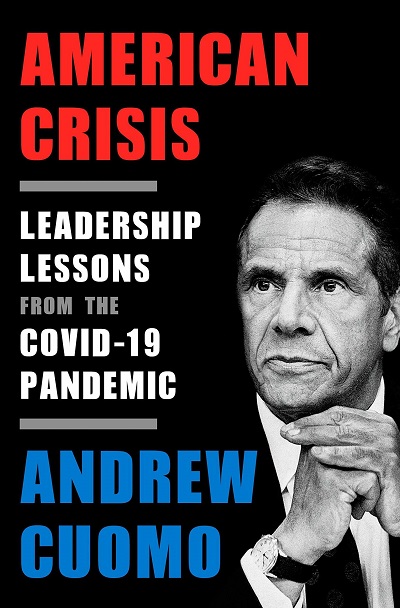
Sorry to keep harkening back to previous SHuSHs but I can’t overlook the latest on the Andrew Cuomo shambles.
You’ll remember that now-disgraced former governor of New York, Andrew Cuomo, played dirty with his publisher and the public while landing a lucrative book contract. More specifically, he suppressed bad news about pandemic deaths in his state while coaxing a $5.1 million advance out of Penguin Random House for a book about his heroic activities as a COVID-19 fighter.
I mentioned that it was astonishing that the governor of America’s hardest-hit pandemic state could produce a fat manuscript in just three months, and that media reports suggested his staff and a ghostwriter authored the book for him. The same reports said he was in danger of violating state ethics prohibitions against the use of state resources or personnel in producing his book.
I also noted that weeks after the grandly titled American Crisis: Leadership Lessons from the COVID-19 Pandemic was released in October 2020, Cuomo was hit with the first in a long series of sexual harassment allegations. He was forced to resign his office in August 2021. By then, it had also emerged that Cuomo’s office had covered up roughly half of the fatalities among state nursing home residents during the pandemic.
Penguin Random House took a bath on the project. American Crisis has sold only about 50,000 copies, about a tenth of what the publisher needed to cover the advance it paid the author.
This week it was Cuomo’s turn in the tub. An ethics panel ruled that he had broken his promises not to use state resources or government staff to write his self-congratulatory book, and gave him thirty days to hand over to the State of New York the $5.1 million he earned with the book.
‘Tis the season to be jolly
Fa-la-la-la-la, la-la-la-la
December 17, 2021
Those Olympic rings are more than just tarnished
In First Things, George Weigel notes the, ah, Olympian disdain for mere morality and human decency is far from a new thing as the IOC prepares for the Beijing games in 2022:
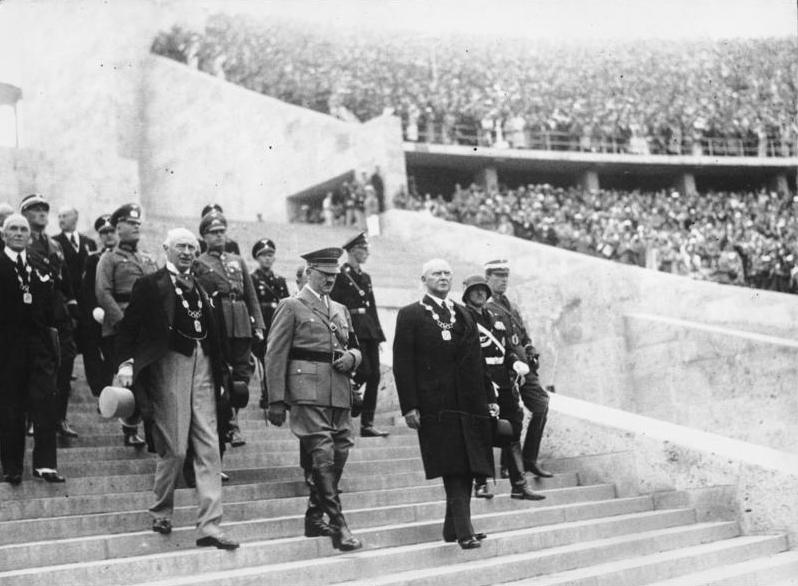
Google translation of the original German caption: “Before the ceremonial opening of the XI Olympic Games. Together with the members of the International and National Olympic Committee, the Führer and Reich Chancellor enters the stadium through the marathon gate. On the left of Adolf Hitler [Henry] Graf Baillet-Latour, on the right His Excellency [Theodor] Lewald.”
German Federal Archives (Accession number Bild 183-G00372) via Wikimedia Commons.
In July 2016, as we were sitting on the fantail of the Swiss sidewheeler Rhone while she chugged across Lake Geneva, my host pointed out the city of Lausanne, where a massive, glass-bedecked curvilinear building was shimmering in the summer sun. “Isn’t that the headquarters of the International Olympic Committee?” I asked. When my friend replied in the affirmative, I said, “I thought I smelled it.”
That rank odor — the stench of greed overpowering the solidarity the Olympics claim to represent — has intensified recently.
Even the casual student of modern Olympic history knows about the August 1936 Berlin Games, at which America’s Jesse Owens, a black man, took four gold medals and trashed Hitler’s Aryan supremacy myth. Fewer may be aware that, in February that year, the Olympic Winter Games were held in the Bavarian town of Garmisch-Partenkirchen. How, we ask today, could two Olympics be held in the Third Reich? How could people not know?
There was some controversy about holding the summer and winter Olympics under Nazi auspices. But in 1936, the German situation was not as comprehensively ghastly as it would become in later years. Yes, the Dachau concentration camp for political prisoners had opened in March 1933, and the Nuremberg Laws banning Jews from German citizenship and prohibiting marriage between Jews and “Aryans” had been enacted in 1935. The horrors of the Kristallnacht pogrom in November 1938 were two years in the future, however, and the satanic Wannsee Conference to plan the “Final Solution” to the “Jewish Question” would come six years later. Clear-minded people ought to have discerned some of the implications of the Nuremberg Laws. But the industrialized mass slaughter of millions, simply because they were children of Abraham, was beyond the imagination of virtually everyone.
So Hitler and his thugs temporarily behaved themselves (sort of) in the run-up to the Garmisch-Partenkirchen and Berlin Olympics. And the International Olympic Committee could salve whatever conscience it had in those days and proceed with the games.
The IOC has no excuses today, two months before the XXIV Olympic Winter Games open in Beijing. Because today, everyone knows.
QotD: The Kafkatrap that is known as “white feminism”
Many describe Franz Kafka’s disenchanted fables as tragic. And this is certainly true. But they are also farcical. To watch someone being relentlessly wrong can be grimly enjoyable — as long as you’re not the person in question.
The term white feminism, as it is commonly used today, is a classic example of the Kafka Trap. If you show too much interest in the lives of people of colour, you risk being accused of white saviourism — which is another way of saying you have a suspiciously condescending attitude to people of colour. But if you don’t show enough interest, you are insufficiently intersectional. You only care about the white, middle-class cisgendered women in your social circle.
White feminism is a classic example of the Kafka Trap because whatever you do is either too much or not enough. You are never right.
Tomiwa Owolade, “The problem with white saviours”, UnHerd.com, 2021-09-12.
December 15, 2021
Christopher Hitchens, ten years gone
In The Critic, Ben Sixsmith laments our loss of the “last cool columnist”:
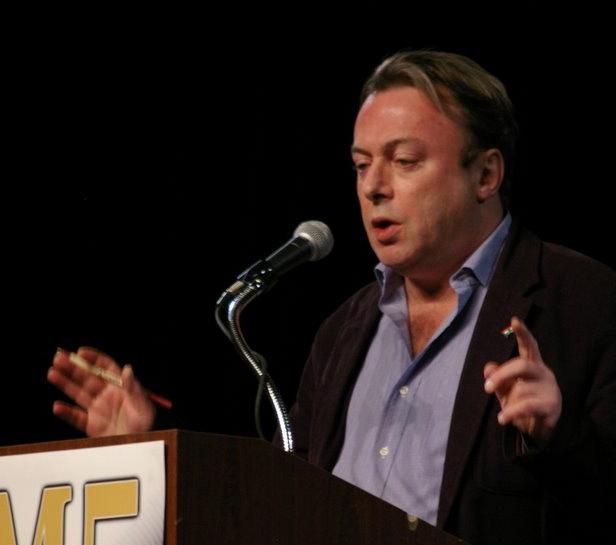
Christopher Hitchens speaking at The Amaz!ng Meeting held at the Riviera Hotel, Las Vegas, Nevada on 20 January 2007.
Photo detail by ensceptico via Wikimedia Commons.
The ten year anniversary of the death of Christopher Hitchens (15 December) brings to mind two questions. Firstly, has it really been ten years since Christopher Hitchens died? Secondly, has it only been ten years since Christopher Hitchens died? The vivid nature of his prose and rhetoric makes him feel like our contemporary. His obsessions, though, — like atheistic evangelism and Middle Eastern nation building — feel as dated as a Roman artifact.
Columnists have a short cultural lifespan. Once, millions of Britons read Bernard Levin every week. Now? I doubt that most young writers have even heard of him. Classic books are reprinted. Newspapers gather dust. Hitchens’s name does not have all the weight it had ten years ago but it has stayed alive, because the Internet archives essays and appearances and because of the esteem that he is held in by his peers.
Janan Ganesh, writing for the Financial Times, believes that Hitchens would have thrived if he had lived to comment on 2021. “He was made for our time, not his own,” Ganesh writes, “The great vacancy in today’s public life is for an equal scourge of the censorious left and the feral right … Hitchens would have been in his element.”
This is bunkum. Hitchens would have been hopelessly out of sorts in the 2020s. How, for example, would he have responded to the COVID-19 pandemic? It is as implausible to imagine that a man with such a lust for life would have endorsed long-term restrictions as it is to imagine that a man with such cheerful faith in the scientific establishment would have had time for COVID sceptics and vaccine hesitancy. Anybody hoping that Hitchens would have carved out some kind of nuanced middle ground, meanwhile, must have forgotten who we are dealing with. No, the plain truth is that the high moralism and rhetorical fury of “the Hitch” were perfectly suited to the heydays of the War on Terror and cable TV.
Liberal commentators like Ganesh miss Hitchens not so much because of his opinions as because he was cool. Ross Douthat mentions Mark Lilla, Anne Applebaum and Andrew Sullivan as other liberals who criticise the left and the right. But while I respect Lilla and Applebaum’s accomplishments and enjoy Sullivan’s writing, how many people do you think have fantasised about having a few drinks with them — or, indeed, with any other political commentator not named “Hitchens”?
QotD: Suppressing intellectual heresy
The young people at Middlebury who shouted down Charles Murray and assaulted a faculty member who had tried to engage him in civil debate were, in effect, suppressing the ideas of a heretic. After all, a heretic’s ideas are too dangerous to be heard.
Dangerous ideas are, of course, interesting ideas, especially to young people. When we fail to address dangerous ideas in our courses, we add to their mystique. When activists shout down or assault heretical speakers they send two messages. The first and intended message is a display of righteous disapproval. The other, unintended message, is that there is something so menacing about the idea being expressed that it cannot simply be laughed off or even argued with, rather it cannot be allowed to be spoken.
Consider how that looks to someone who is starting to question the premises of the liberal orthodoxy on race, gender, diversity and so on. Why, our alt-right curious person might wonder, are there some ideas that are so laughably false that one need not even mount a counter argument (a flat earth or the financial benefits of college athletics), some ideas that are considered contentious but still open to debate (supply-side economics), and some ideas that are so outré that they can only be met with back turning, shouting, or by punches to the face?
Might it be, our waverer must wonder, that these people don’t want me to hear this idea because they don’t have a good answer to it?
Erik Gilbert, “Liberal Orthodoxy and the New Heresy”, Quillette, 2019-02-04.
December 14, 2021
QotD: Insulated from reality
The first notable thing about today’s act of public nuisance masquerading as a protest was the hilarity of the campaign group itself. Remember when radicals fought for higher wages or better working conditions or for a revolution to replace capitalism with something else? Not anymore. Today’s self-styled militants demand the insulation of houses. “What do we want? The creation of a thermal envelope in people’s homes! When do we want it? Now!” What a crock to go to the barricades for. Also notable is the irony of supposed planet-lovers causing so much pollution by forcing hundreds of cars and trucks to sit still for ages, chugging fumes into the air for nought. Well played, greenies.
But the most striking thing about these kinds of protests is their sheer arrogance. Their inherently anti-democratic, anti-masses nature, where the aim is always, but always, to inconvenience the little people and teach us a lesson. You’re on your way to Heathrow for a much-needed jaunt to Malaga to escape the stresses of work? Not anymore, you’re not – the eco-elitists blocked junction 14, which leads to one of Heathrow’s terminals. You’re a knackered trucker who’s been driving all night long and now wants to get back to his family? Tough shit. These plummy alarmists have decided to make you the collateral damage of one of their narcissistic stunts.
Brendan O’Neill, “Environmentalism is a revolt against the people”, Spiked, 2021-09-13.
December 13, 2021
QotD: Cultural undermining of the British “establishment” was effectively complete by 1970
[…]
It also made the middle class, especially the educated and well-off middle class, despise themselves and feel a sort of shame for their supposedly elitist prejudices, based upon injustice and undermined by their failure to defend the nation from its enemies in the era of appeasement. Thanks to this, in another paradox, they have often felt unable to defend things within Britain which they value and which help to keep them in existence, from the grammar schools to good manners. They are ashamed of being higher up the scale, though for most middle-class people this is more a matter of merit than birth, and nothing to be ashamed of at all.
[…]
Since the 1960s, when the Left began its conquest of the cultural battlements, it has always been surprised and annoyed by Tory election victories. The 1970 Tory triumph, though entirely predictable, took the cultural establishment by surprise. The 1979 Tory win, though even more predictable, infuriated them. They had won control of broadcasting, of the schools, of the universities, the church, the artistic, musical and architectural establishment? How was it possible that they could not also be the government? Their rage was enormous, and increased with each successive Labour defeat. It was an injustice. How could the people be so foolish? Now, instead of aristocratic snobs misgoverning the country, the establishment was portrayed as a sort of fascistic semi-dictatorship, hacking at the NHS and the welfare state, waging aggressive wars abroad and enriching itself while the poor lived in misery.
This series of falsehoods has now become a weapon ready and waiting for unscrupulous demagogues to harness, and perhaps use against the new “establishment” which has benefited so much from the satire boom and the alternative comedians. Once you have begun to use dishonest mockery as a weapon, you can never be entirely sure that it will not eventually be turned against you, by others who have learned that abuse and jeering pay much easier and swifter dividends than hard fact or serious argument. It could be that the civilized mirth of the sixties leads in a direct line to the crude hyena cackling of the mob. In any case, there is no sign of the humour industry taking the side of traditional morality, patriotism or civility. The best it can do is dignify itself with noisy and public collections for sentimental and prominent charity. Once you step beyond the fringe, you sooner or later find yourself in very wild country indeed.
Peter Hitchens, The Abolition of Britain, 1988.
December 12, 2021
“[T]oday’s antiracism paradoxically requires the crudest of racist categories to justify and explain itself”
Andrew Sullivan on the racism of modern “anti-racist” movements and his hope that Hispanic Americans may provide a way out of the current political deadlock:
Of all the acronyms, euphemisms and sophisms pioneered by critical theory, one of the most revealing is the term “black and brown people”. You hear it all the time now. Whether it’s about “the lack of Black and brown representation in Hollywood”, vaccine hesitancy in “Black and brown neighborhoods in large cities”, the right to vote for “Black and brown people”, or “allyship between Black and brown people”, the “B&b” formula is now yet another ubiquitous media virtue-signal. It’s subtler than some others. It doesn’t shriek woke like “BIPOC”; it isn’t as instantly risible as “2SLGBTQIA+”; it gives “Black” a Capital Letter, and “brown” feels a bit like a lower-case add-on — but at least it uses actual English words, and doesn’t end in an X.
Still: what does it tell you that a staggering and brilliant array of totally different ethnicities, races, religions, histories and cultures can now routinely be reduced to just two drab colors?
I think it speaks to two things. The first is that today’s antiracism paradoxically requires the crudest of racist categories to justify and explain itself. A whole kaleidoscope of immigrant difference — from Kurds and Mexicans and Somalis to Dominicans, Chileans, Nigerians, and Pakistanis — has now been turned into one monochrome racial “brown” — just to fit into an oppressor/oppressed, white/black narrative.
Equally, a diverse African diaspora — ranging from Nigerian immigrants to descendants of Southern slaves to biracial men and women with mainly European ancestry who go back to this country’s miscegenated origins — is now just “Black”. And this new racial unit has one politics: left-Democrat. Individuals disappear; diversity of opinion within groups evaporate; all that matters is a single skin color and oppression.
The second aspect of critical theory that “B&b” helps reveal is that the crude binary of “black” and “white” simply has less salience with every passing day, as more and more races, ethnicities and cultures complicate and enrich our society, and render it structurally, demographically and culturally unrecognizable from even the recent past. To give one example: 60 years ago, four percent of Americans approved of inter-racial marriage; today, it’s 94 percent. Or check out the rapid decline in the “white Christian” share of the population — from 80 percent in 1996 1976 to 44 percent today. Look around you and you’ll see how the crude rubric of “white supremacy” is, in fact, wildly out of date.
This is why so many of the most passionately woke are so obsessed with history in America, and the further back the better, as the 1619 Project shows. The past is a world they are much more comfortable in than the present, a place where the racial divide was infinitely simpler, and racial inequality both brutal and actively enforced by the government. Before the Civil Rights Act in 1964, before mass non-white immigration began in 1965, before mass non-white illegal immigration since the 1990s, the “white supremacy” rubric had some lingering traction.
But in the 21st Century, it’s been hopelessly compounded by layer upon layer of mass immigration from every conceivable corner of the planet. The Latino population in the US is now larger than the African-American one; and Asians, of many different varieties, are now immigrating in higher numbers than Latinos. Before too long, the black/white dynamic may disappear into the multi-colored, multi-hued background entirely.
QotD: Britain’s alienated intelligentsia of the 1930s
It is clear that the special position of the English intellectuals during the past ten years, as purely negative creatures, mere anti-Blimps, was a by-product of ruling-class stupidity. Society could not use them, and they had not got it in them to see that devotion to one’s country implies “for better, for worse”. Both Blimps and highbrows took for granted, as though it were a law of nature, the divorce between patriotism and intelligence. If you were a patriot you read Blackwood’s Magazine and publicly thanked God that you were “not brainy”. If you were an intellectual you sniggered at the Union Jack and regarded physical courage as barbarous. It is obvious that this preposterous convention cannot continue. The Bloomsbury highbrow, with his mechanical snigger, is as out-of-date as the cavalry colonel. A modern nation cannot afford either of them. Patriotism and intelligence will have to come together again. It is the fact that we are fighting a war, and a very peculiar kind of war, that may make this possible.
George Orwell, “The Lion And The Unicorn: Socialism and the English Genius”, 1941-02-19.


