Quotulatiousness

August 11, 2022

N.S. Lyons offers a Public Service Announcement for folks in class B

Filed under: Media, Politics, USA — Tags: , , , — Nicholas @ 03:00

N.S. Lyons is talking to you. Yes, you in particular:
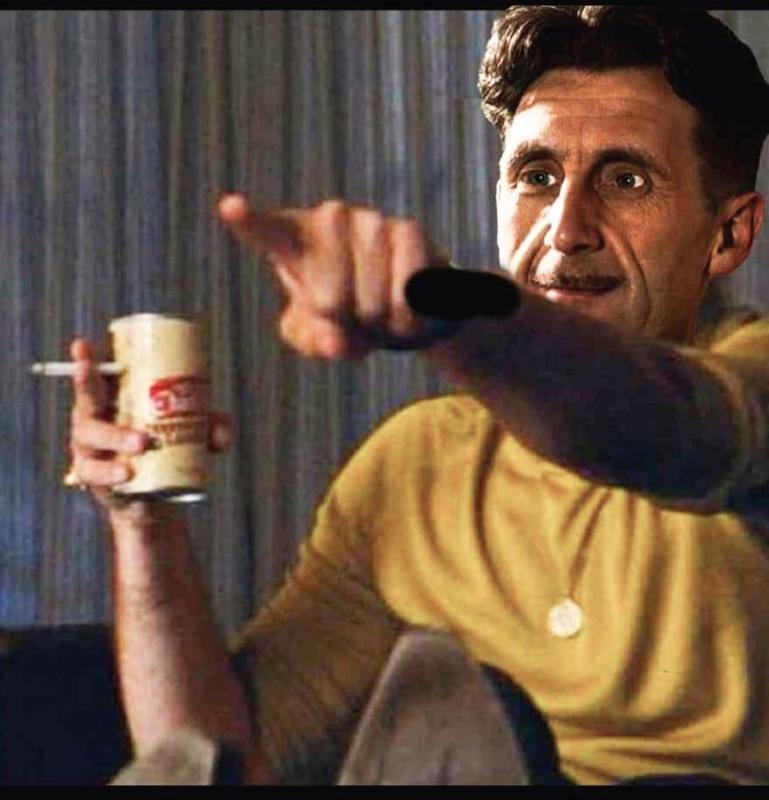
Hello Friend,

I saw your post on the interweb the other day about that nasty thing Team A did, even though they always completely lose their collective mind with moralistic outrage if Team B (which I understand is your team) even thoughtcrimes about doing something similar. In fact Team A seems to blatantly do things all the time that no one on Team B could ever get away with doing without being universally condemned as the absolute worst sort of immoral criminal/being openly threatened with mob violence/losing their livelihood/having their assets frozen/being rounded up by the state and shipped to a black site somewhere for some extended TLC.

Maybe the latest thing was breaking some very important public health rules, or pillaging and burning down government buildings for fun, or mean tweets, or polluting the planet with a private jet, or using allegedly neutral public institutions against political opponents, or just engaging in a little tax-dodging or corruption while doing, like, a ton of blow in a hotel room with some capital city hookers – I forget the specifics. In fact I forget what country you’re even living in nowadays.

But I did see that slick video you posted on how just pointing out “imagine if someone on Team B did this!” is all it takes to blow the lid off this glaring hypocrisy, thus totally destroying Team A with facts and logic. I’ve noticed you posting a lot of things like this, which is nice, since they are very witty and produce a pleasant buzz of smug superiority, even though this feeling never lasts very long.

However, I suddenly realized that you may not be in on the joke, so to speak, so I figured I’d write this short PSA to help explain what “hypocrisy” in politics actually is, just in case you didn’t know and had been fooled into seriously trying to benefit Team B with your comparative memes.

You see, it’s possible you are under the misapprehension that you are not supposed to notice what you described as the “double-standard” in acceptable behavior between Team A and Team B. And that you think if you point out this double-standard, you are foiling the other team’s plot and holding them accountable. This might be because, in your mind, you are still in high school debate club, where if you finger your opponent for having violated the evenly-applied rules a neutral arbiter of acceptable behavior will recognize this unfairness and penalize them with demerits.

Except in reality you are not holding Team A accountable, and in fact are notably never able to hold them accountable for anything at all. Even though Team A gets to hold you accountable for everything and anything whenever they want. This is because unfortunately there is no neutral arbiter listening to your whining. In fact, currently the only arbiter is Team A, because Team A has consolidated all the power to decide the rules, and to enforce or not enforce those rules as they see fit.

[…]

Much like the Great Khan, Class A has decided the greatest happiness in life is to crush its class enemies, see them driven before it, and hear the lamentations of their pundits.

Fundamentally, Class A believes the purpose of power is to reward its friends and punish its enemies. Which is what it does. That way it can keep its enemies down at the same time as it attracts more friends by offering great perks for class membership. And as a controversial Arab thought-leader once said: everyone prefers a strong horse to a weak horse.

If you, Class B serf, do not enjoy this arrangement, your lamentations about hypocrisy will not change it, no matter how loud and shrill. Only taking back control of the levers of power and then using that power to strike the fear of accountability into the hearts of your ruling class will ever be able to do that.
August 10, 2022

Raising a generation to emulate Pavel Morozov

Filed under: History, Politics, Russia — Tags: , , , , — Nicholas @ 05:00

Theodore Dalrymple on the dangers of a culture that welcomes and supports denunciation as a political mechanism:

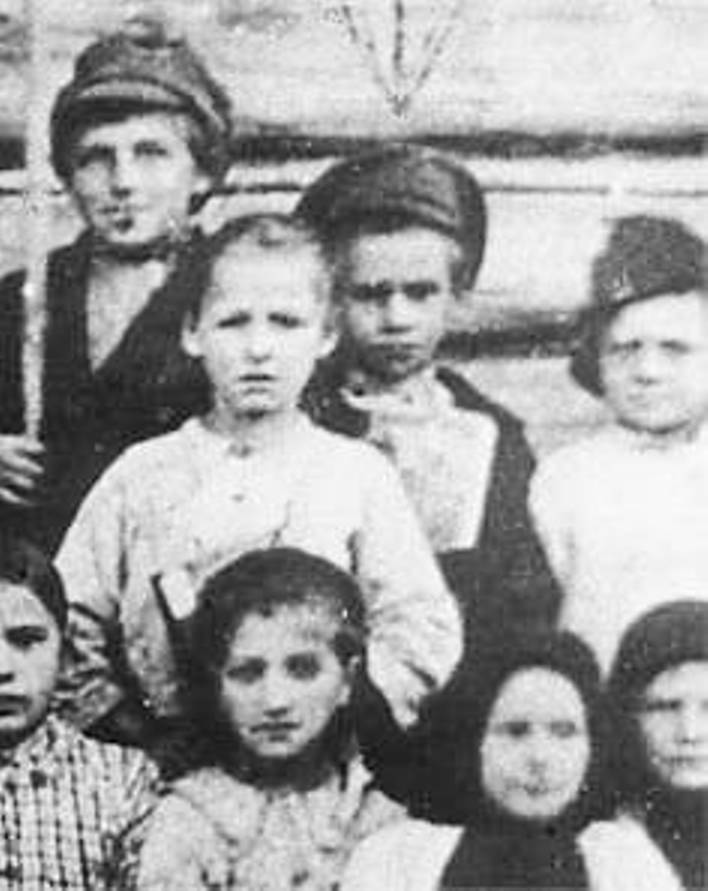
Believed to be the only photograph of Pavel “Pavlik” Morozov (centre, wearing cap), circa 1930.

… a culture of denunciation is an important step in the direction of totalitarianism. Is there anyone whose life is such that the discreditable things done or said by him or her could not be woven into a reason for public execration or worse? The habit of denunciation was a powerful weapon in the hands of every totalitarian dictator.

In the Soviet Union, for example, the story of Pavel Morozov — little Pavlik — was used to inculcate the habit of denunciation as a social duty into Soviet children. Little Pavlik denounced his own parents and grandparents as kulaks, that is to say as rich and exploitative peasants, to the Soviet authorities, and was thereafter “martyred” for his truthfulness. Soviet children were encouraged to emulate lovely little Pavlik by snitching on all around them. There were posters in school of heroic children denouncing their fellows for something that they had done wrong. This was the Soviet version of truth-telling.

We should not complacently suppose that it couldn’t happen here — wherever here is. In Britain recently, which is suffering from a shortage of water because of unusually hot weather, residents of some areas have been prohibited from using hosepipes to water their garden — and have been encouraged to denounce neighbors or others to the authorities who flout the prohibition.

One can just hear the arguments in favor of such denunciations. It’s only fair and right, for example, that everyone should share the hardship caused by the shortage of water. It’s almost psychopathic of some not to obey the rules while most do so: Who do they think they are, that they are not obliged to obey? Moreover, we live in such times that, if you approach such a person directly, he’s likely to become furious and violent. It’s safer to call the authorities and let them deal with him.

This overlooks how easily the culture of denunciation can establish itself, and lead to a society in which everyone fears everyone else. Such is the way in which people are constituted that for many, at least, it’s a pleasure to bring harm to others in the name of doing good for society. That was the justification of denunciation in Nazi Germany, Soviet Russia, and Maoist China, as well as in a host of other totalitarian fiefdoms. And Maugham — he who actively solicits denunciations of Nick Cohen — even admits, perhaps without really meaning to, the pleasure he would derive from passing on any denunciations he receives in a kind of meta-denunciation, as it were.

This is authentically disgusting, but it has the merit of reminding us that totalitarianism did not land on earth like an asteroid but had its origins in the human heart, and that no society can be immune from the temptations of totalitarianism once and for all. Totalitarianism has its pleasures, chief of which is doing harm to others, albeit that today’s denouncer tends to become tomorrow’s denounced.

August 9, 2022

When asking a simple, factual question is treated as a direct personal attack

Chris Bray explains why just asking for [certain] facts is enough to trigger people who think you’re somehow saying that they’re not “good people”:

Come back to the cultural sewer with me, just for a moment, because here’s the last time I’ll lay a quote on you from Klaus Schwab’s COVID-19: The Great Reset, from a discussion about public health measures to contain the pandemic:

    This is ultimately a moral choice about whether to prioritize the qualities of individualism or those that favour the destiny of the community. It is an individual as well as a collective choice (that can be expressed through elections), but the example of the pandemic shows that highly individualistic societies are not very good at expressing solidarity.

Now: Pharmaceutical products sometimes fail, and sometimes cause serious harm, and it frequently takes a while for reality to get out of the dugout and take the field, so keep taking your FDA-approved Vioxx. It’s safe and effective! I rarely give up on books, but I gave up on Ben Goldacre’s 2012 book Bad Pharma about halfway through — for the same reason you’d stop eating a skillfully prepared shit sandwich. I felt like, yes, I get the point: Sometimes a drug is ineffective, sometimes a drug is outright harmful, and the manipulation of science and of regulatory agencies is more common than you would ever have wanted to know.

But it’s different this time, even while “this time” fits a very long pattern. As much as Big Pharma course corrections are always hard, this one will be infinitely harder. We’re not currently debating the efficacy of a pharmaceutical product, or of a class of pharmaceutical products; instead, we’re debating self-conception, social status, and cultural position. The claim “I don’t think these mRNA injections are as safe as they’ve been made out to be” is a character attack that threatens to take people out at the core like dynamite under a bridge: Are you saying I’m not a good person?

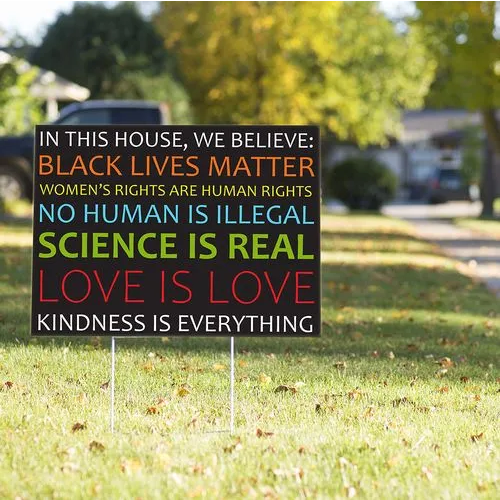
Bad Cattitude has been on fire lately on the topic of elite self-hypnosis and the descent into an “entirely hallucinatory landscape”. Consistent with this shrewd feline analysis, look again at what Klaus Schwab said about lockdowns and the suppression of economic activity in the name of public health: He said that shutting down our open societies was a “moral choice” about “expressing solidarity”. (My mask is for you, your mask is for me!) The discussion isn’t about what works, and has never been about what works. It has never been a discussion about the efficacy of anything; it’s a posture about social character, and always has been. Are you a bad, selfish person, or are you a good person who believes in kindness? The subtext about social class strikes me as too obvious to explicate, because mean people belong in their trailer parks in flyover country, and kind people are high-status. Review the lawn signs if you doubt this.

So when you question the little vial of fluid that goes into a syringe to be injected into your body, you’re not asking questions about the way a medical product works — or at least, you’re not asking questions that are perceived, by advocates of the injections (or the lockdowns, or the masks), as a discussion about safety and efficacy. You say, “Does it work? Is it safe?” — but they process it as an attack on their moral choice to express solidarity:

Are you saying we should have stood up for selfishness? Which means, if we bring the subtext to the surface, Are you saying we should have engaged in low-status behavior?

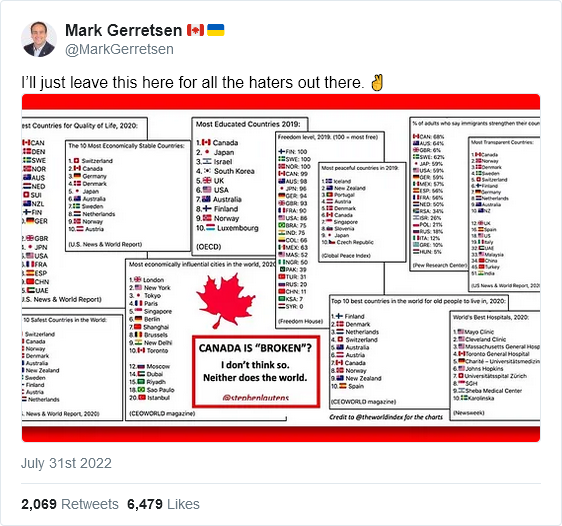
“Canada’s not broken: here’s a set of totally arbitrary social media listicles to prove it, h8rs!”

Filed under: Cancon, Media, Politics — Tags: , , — Nicholas @ 03:00

Meant to post this on the weekend, but another lengthy Rogers internet outage got in the way. From the most recent weekly Dispatch from The Line:

We try to avoid spending too much time on Twitter nowadays, but we’ve noticed a trend emerge on the site that irks us. It’s not new, exactly, but it seems to have become a favoured rhetorical tactic among Liberals and their apologists. And as it touches on virtually all of the blurbs above, it’s worth noting.

We’ll call it Rebuttal by Listicle, and it works a little like this: rather than actually engage with critiques of the country or the government, partisans will simply post random rankings that show Canada is at the top of some subjective set of metrics like “freedom” or “quality of life”.

To wit:

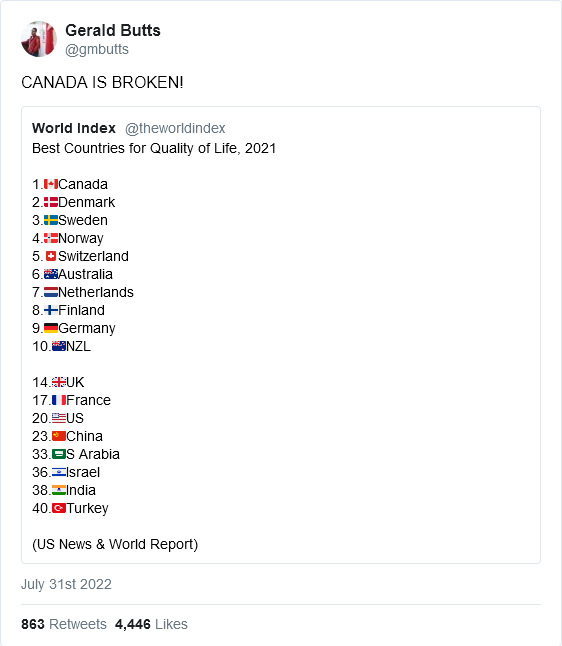
And this:

Because these listicles look impressive and official, the partisans in question can treat them with the weight of proven scientific truth. Canada’s great! Look, the list proves it! Them’s the facts!

We have three major problems with this rhetorical tactic.

The first is optics: Please tell the couple priced out of the housing market in every major urban centre, the one that is now worried about the grocery bill, can’t fill the car with gas, and frets about heating costs next winter, that none of these problems really matter. That they should just be grateful and happy with this definitely not-broken country because Canada scored well in a ranking compiled by an intern at an American newspaper. Show the lists to the person suffering a lingering illness, with no family doctor, in a town where the ER is closed, and wait patiently for their enthusiastic high five.

You want to guarantee Prime Minister Poilievre, this is the way to go about it: smarmily dismissing legitimate grievances and concerns by tweeting a list and calling it a day.

And, of course that’s presuming the ranking was subject to even a moderate degree of fact checking, logic, or scientific scrutiny goes into these rankings at all.

Let’s look a little more carefully at the ones posted by former Trudeau senior aide Gerry Butts, shall we?

He has a whole thread devoted to cherry picking Canada-topping rankings compiled by something called The World Index. What is The World Index? Well, we don’t know, Bob. The Twitter bio says: “Know the world. Focus on economics, art & culture, science, technology, sports, travel, politics and military affairs.” Okay. The only website listed takes us to an Instagram account with 37 followers.

The list above, in which Canada hits #1 for Best Countries for Quality of Life, 2021, is from U.S. News & World Report, an American media company. We checked out their methodology for the 2021 survey, and this is what we found: it’s a survey of 17,000 people, run by an academic. What’s being surveyed? Glad you asked! “Participants assessed how closely they associated an attribute with a nation.” You’ll be thrilled to note that these 17,000 people around the globe gave Canada near perfect scores on being “not bureaucratic”, and having a “well developed public health system”, “well-distributed political power”, and “transparent government practices”. (Lol, *dies inside*.)

Hey, it’s great that people associate Canada with being awesome, but we hope that when Liberals talk about “evidence-based policies”, they are using actual, you know, evidence, not just rankings by survey participants.

August 8, 2022

The British left briefly rediscovers an interest in free speech … no, wait, they’re back to loving Big Brother again

In Spiked, Tom Slater recounts the brief moment last week that the great and good of British left wingers found nice things to say about freedom of speech. A very brief moment:

The British left – or what passes for it today – briefly pretended to care about free speech this week. Which was kind of cute. It was all sparked by Tory leadership no-hoper Rishi Sunak’s bonkers suggestion that people who “vilify” Britain should be put on the Prevent anti-radicalisation programme, alongside all the Islamists and fascists. “Who are the real snowflakes?”, thundered one left-wing commentator. “Fascism creeps ever closer”, warned Richard Murphy, a one-time adviser to Jeremy Corbyn, as he wondered out loud if he might soon end up in “some camp of Sunak’s choosing for ‘re-education'”.

This is probably the meme that Darren Brady posted which drew the attention of Hampshire Police’s crack “hurty words and pictures” squad last week.

Such principled expressions of horror, over an insanely authoritarian policy that almost certainly will never be implemented, might have had a bit more weight had the exact same people not studiously ignored a very real incident of state censorship – and attempted re-education – that went viral last week. I’m referring, of course, to Hampshire Police’s arrest of 51-year-old army veteran Darren Brady, all because he posted an offensive meme, which arranged four “Progress Pride” flags to resemble a swastika – a clumsy commentary on the authoritarianism of the contemporary LGBT movement.

The details chillingly echo Richard Murphy’s tweeted fever dream. Reportedly, the police had visited Brady 10 days before they tried to arrest him, informing him that he had committed an offence by posting the flag meme. They offered him a deal: pay for a £60 “community-resolution course” and they’d downgrade his offence to a “non-crime hate incident”, which would still appear on an advanced background check. Brady refused and contacted Harry Miller, leading campaigner against thoughtpolicing, who was present at the arrest and spent a night in the cells himself for trying to obstruct the cops. Going by the footage, now seen around the world, the (several) officers who attended Brady’s home had no idea what offence he was supposed to have committed, saying only that he had “caused anxiety”.

So, state censorship? Yep. Threats of re-education? Yep. The police showing up at someone’s door for no other crime than expressing an opinion? Big yep. Just because it was done in a Keystone Cops sort of fashion doesn’t make the treatment of Brady any less sinister. And yet there hasn’t been a peep of protest from the left-leaning intelligentsia. The armed wing of the state is going about harassing and arresting people purely for upsetting someone on the internet. And yet the people who pass themselves off as liberal, progressive, radical even, are clearly not the tiniest bit bothered about it.

Brady isn’t an isolated case, either. Britain is fast becoming a warning to the Western world about “caring” censorship, about trying to quite literally police “hurtful” speech. According to one investigation, nine people a day are arrested in the UK over offensive things they post on the internet. On top of that, more than 120,000 people have had so-called non-crime hate incidents recorded against their name. These alleged incidents needn’t be investigated or even be credible to be recorded. So much so that an Oxford professor once managed to get a hate incident recorded against then home secretary Amber Rudd, for a speech she gave about immigration that he later admitted he hadn’t even listened to, let alone witnessed in person.

Boring British politicians

Filed under: Books, Britain, Government, History, Politics — Tags: , , , — Nicholas @ 03:00

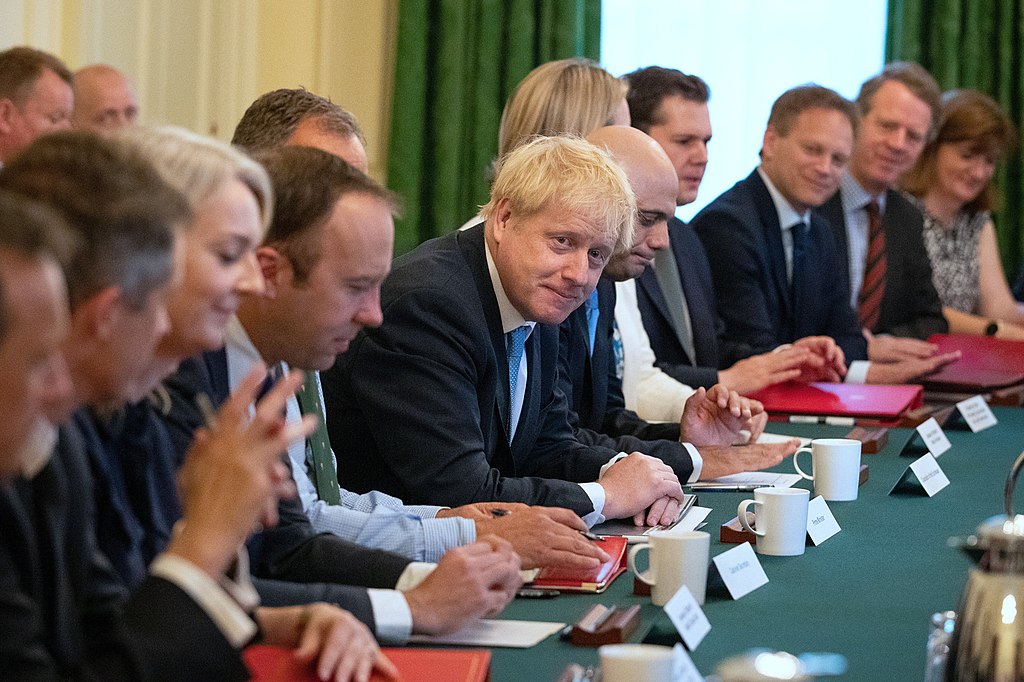
Katherine Bayford compares the last set of cabinet ministers appointed by lame duck PM Boris Johnson with some of the Parliamentarians of the 20th century … and it’s difficult not to feel nostalgic for a past Golden Age at Westminster:

Prime Minister Boris Johnson at his first Cabinet meeting in Downing Street, 25 July 2019.
Official photograph via Wikimedia Commons.

One of Boris Johnson’s final, whimpering acts of power in his premiership was to appoint a new cabinet. Fatally wounded by a team of ministers made up of those with little charm, intelligence or experience, who was actually left for Boris to replace them with?

A veritable who’s-that of the worst unknowns that can be found down the side of parliamentary benches was swiftly conscripted in. I tell a lie — Johnny Mercer MP achieved mild public recognition for defending elderly soldiers accused of war crimes and getting very angry at certain risqué insinuations made in the comments section of the Plymouth Herald.

[…]

There is nothing unusual about this class of minister, however. They are representative figures: dim, without verbal sparkle, frequently light on narrow policy insights and wider understandings of social and economic history. The median British politician has been like this for decades now. Tony Blair would bemoan the shoddy material he had to work with at every reshuffle, and David Cameron likewise found himself struggling for a front bench neither too hateful nor too stupid. The difference in political acumen and sophistication from the most forgotten of ministerial interviews from fifty years ago reveal a steep decline in both the eloquence and elegance of our politicians.

Perhaps the 20th century spoiled the voting public. Pick any decade and you will discover frontline politicians with vast hinterlands. Harold Macmillan recited Aeschylus — in the original Greek — whilst lying shot in the trenches. Enoch Powell rose from private to brigadier during the Second World War, after becoming the youngest professor in the empire. When Winston Churchill was attempting to stay solvent in the face of decades worth of excess, he maintained financial buoyancy by being the highest-paid journalist in the world. Publishers adored him. He could be trusted to write a million-word definitive biography of his relative, the first Duke of Marlborough. Roy Jenkins would in turn distinguish himself as a biographer of Churchill — as well as Gladstone, and the Chancellors of the Exchequer at large. Second-hand embarrassment is the only proper response when comparing such authorial endeavours to Boris Johnson’s biography of Churchill.

It’s not a matter of our politicians not being able to write anymore. Compared to the recent past they can barely speak. Political debates have succumbed to an entropic, deadening mediocrity. Recent discourse between a patronising, bland Sunak and a po-faced, blank Truss was not a nadir: it was standard fare.

Look upon this 1970 debate between Jenkins and Powell. Both men hold articulate and intelligent positions, arguing intricately and considerately, with a commitment to truth rather than point-scoring. They agree where relevant and have an ability to articulate clearly and fluently. Half a century on, political debate of such quality seems unrealisable. When watching vintage ministerial debates, the viewer is struck by the level of knowledge and attention that the speakers assumed their audience would possess, whether on the finer points of tackling inflation or whether IRA bombers deserved to the death penalty.

The slightest glance at cabinets fifty years ago demonstrates a far higher set of standards and abilities than those found today. Harold Wilson — always keen to consolidate as much power as possible — nevertheless packed his cabinet with the best and brightest, even if he kept them in positions in which they wouldn’t be able to outshine him. Wilson himself was a subtle and clever debater, not above using cheap PR tricks (such as his much-perfected pipe smoking) but always as a tool to realise his political vision.

Mediocrity requires mediocrity in order to survive. When judged against excellence — or even simple competence — the insufficiencies of today’s politician become intolerable. It is this which leads the public to distrust politicians more than their policy choices.

August 6, 2022

Britain’s woke Stasi | The spiked podcast

spiked
Published 5 Aug 2022

The spiked team discusses the rise of Britain’s thoughtpolice, Nancy Pelosi’s Taiwan trip and Beyoncé’s act of self-censorship.
(more…)

August 5, 2022

Don Camillo blesses the river Po

Filed under: Books, History, Humour, Italy, Politics — Tags: , , , — Nicholas @ 05:00

Perhaps the first foreign author I encountered as a child was Giovanni Guareschi — in English translation, of course, I’m not a natural linguist — and I’d read most of his stories by the time I was twelve. They didn’t always make a lot of sense to me as far as the political aspects were concerned, but the human stories always hit home. Clearly, Sarah Hoyt (who is a natural linguist … she read them in the original Italian, although I’d expect they would work very well for Portuguese readers) feels much the same way about the Don Camillo stories:

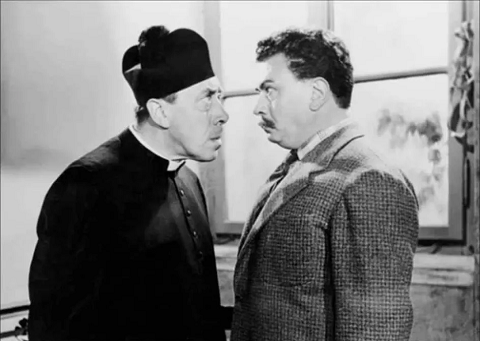
A still from one of the 1952-1965 film adaptations of the Don Camillo stories, with Fernandel as Don Camillo and Gino Cervi as Mayor Peppone.

There is a poignant scene in one of the Giovanni Guareschi Don Camillo books, (set in mid-century Italy, where communism and Catholicism are fighting it back and forth. They’re humorous, profoundly human, and easy reads. The stories are like 200 words each.) in which, during a period of high strife, the priest goes out to bless the river. Btw, if you need examples of how to be a flea on the side of the commies, that character is terribly subversive in little ways (as well as liking to hit them on the head. I might have taken him for a model when I was a pre-teen. Sigh. And Comrade Don Camillo is the best book for how to turn things on their heads if you’re in deep hiding in a lefty stronghold, either professional or geographic.)

Anyway, in the little village on the Po river where the priest and the communist mayor fight it out, the river is an ever present danger, and people cope with it the way they have coped with such things throughout history: every year the priest goes to the river and blesses it, in the hopes that it will become (I am remembering in Italian, the English translation is probably different) “A well behaved citizen and stay within its bounds”.

Now, this is not magic, of course, and the priest explains that. Blessing the river does not guarantee that the river won’t burst out of its bed and flood the village (later on in the book there are accounts of a flood, and if you think that a book can’t paint a picture, be sure it can. For the rest of my life, I’ll carry the image of the priest saying mass in the deserted and flooded village, while across the river, on the safe bank, his flock who fled the flood kneel on the muddy soil at the tolling of the consecration bell. BTW Guareschi is the writer I’d like to be when I grow up. Trained as a journalist, he uses minimal words, but the images stay with you.) It’s just that blessing it gives people hope it won’t, and allows them to live in a precarious place, at a precarious time without losing their minds. (It is important to remember that whatever else humans are, they’re creatures of ritual and habit, and sometimes those are the only panaceas for difficult situations.)

Well, the communists have their dander up, so they tell the priest they want to march in the procession to bless the river with their flags and paraphernalia and the priest says no, they say anyone in the procession will get beaten. They demand the priest cancel it, and people lose their minds. So, the priest says he’ll go alone, if needed. Needless to say, the communists follow, in what is an intimidation maneuver (they have no new moves, really.)

So, Don Camillo, without looking back, gets to the river and prays that the Lord will keep the river within its bounds. And of course, because he knows the audience at his back, he says “If the houses of decent people could float, I’d ask you for a flood like Noah’s. But since the houses of decent people are made of the same stone and brick and sink like the houses of scoundrels, I beg you to make the river behave.”

In case you’re wondering what went wrong in America, and why we are where we are: we forgot our houses can’t flood.

August 4, 2022

Boris wanted to be another Churchill, but he turned out to be another Lloyd George

Filed under: Britain, History, Politics — Tags: , , , , — Nicholas @ 03:00

Long before Boris Johnson achieved his goal of becoming Prime Minister, he was consciously modelling himself on Winston Churchill … but his real life adventure showed him to be much more the next coming of an earlier PM than Churchill:

Boris Johnson labours under the illusion that he is another Churchill. Actually the resemblance, astonishing both in gross and in detail, is to Churchill’s other great contemporary, David Lloyd George.

Indeed, the parallels between the two men and their careers are so close that it’s tempting to give Karl Marx’s dictum yet another dust-down and talk of history happening twice: first as tragedy and then as farce. Which would make Boris Johnson Napoleon III to the Welsh Wizard’s imperial premiership.

Which, to be truthful, sounds about right.

[…]

Consider A.J.P. Taylor’s masterly pen-portrait of Lloyd George:

He had no friends and did not deserve any. He repaid loyalty with disloyalty. He was surrounded by dependants and sycophants, whom he rewarded lavishly and threw aside when they had served their turn. His rule was dynamic and sordid at the same time. He himself gave hostages to fortune by the irregularity of his private life. But essentially his devious methods sprang from his nature. He could do things no other way.

There is scarcely a single word that does not apply equally to Boris Johnson.

These two extraordinary, outsize personalities also benefitted from extraordinary times. Lloyd George became prime minister in 1916 at the nadir of the First World War when it seemed, as he himself wrote, “we are going to lose this war”. Johnson reached Number Ten at a comparable moment in domestic affairs, when the three year-long crisis brought about by the furious rear-guard action of the Remainer elites against the Brexit referendum threatened to turn into a sort of national nervous breakdown.

Both therefore took the premiership over the political corpse of their failed predecessor (Herbert Asquith and Theresa May), and both were haunted by their unquiet ghosts. Finally, both had a single, though infinitely difficult, job: Lloyd George’s was to win the war; Johnson’s to cut the parliamentary Gordian knot and “Get Brexit Done”. And both were given, or took, carte blanche to do it.

Taylor makes no bones about it and calls Lloyd George “dictator for the duration of the war”. He even invokes the comparison with Napoleon I. Contemporaries, like the former Tory premier, A. J. Balfour, used the same language: “If [Lloyd George] wants to be dictator, let him be. If he thinks he can win the war, I’m all for him having a try.”

August 1, 2022

The fertilizer front in Justin Trudeau’s renewed war on Canada’s farmers

Filed under: Cancon, Economics, Environment, Government, Politics — Tags: , , , — Nicholas @ 03:00

In The Line‘s weekly dispatch, one of the items discussed was the Trudeau government’s decision to follow the Netherlands and Sri Lanka down the path of ensuring that millions may be at risk of starvation to mollify the global warming lobby and the WEF:

In 2020, the federal government announced a plan to reduce greenhouse gas emissions arising from fertilizer application by 30 per cent below 2020 levels within the next decade. The targets, then fairly vaguely spelled out, have been a subject of considerable consternation among farmers in the wheat belt ever since. However, as the feds moved into a consultation process, set to end by the end of August, it’s now become clear that those targets are a little more set in stone than they had previously feared. Further, the “consultation” process is looking increasingly tokenistic.

“The commitment to future consultations are only to determine how to meet the target that Prime Minister Trudeau and Minister Bibeau have already unilaterally imposed on this industry, not to consult on what is achievable or attainable,” according to a press release sent out jointly by the Alberta and Saskatchewan agriculture ministers last week.

Why does this matter? Well, firstly because these emissions targets are coming on top of tariffs placed on chemical precursors to fertilizer coming out of Russia. And further because according to industry lobbyists and many farmers themselves, it’s not going to be possible to meet these kinds of emissions targets without significantly reducing fertilizer use — which is already efficiently applied owing to the fact that the stuff is expensive.

The meat of it (ha!) is that if we reduce fertilizer use further, there is significant fear that we will cut into food yields, just as the world’s growing population is facing a possible famine thanks to war. It’s not like these concerns are temporary, either. In the long run, climate change is only going to add to food insecurity; and Canada may be well-positioned in a changing climate to address the global food supply.

And, yeah, all of this is very ironic. Of course we should be doing all we can to cut emissions, but, perhaps — just hear us out, here — given the broader geopolitical realities, agriculture is not the most obvious or well-placed target for those emissions cuts. Especially considering Canada still accounts for a very small fraction of global greenhouse emissions overall. (Yes, we know our per-capita emissions are high. That’s the unfortunate consequence of living in a very cold, poorly populated expanse. However, our actual population remains low. These two facts are not coincidences!)

Now, if we were going to give the federal government some benefit of the doubt, we’d point out that we’re still in a consultation process. We’d also further point out that if the government wanted to reduce agriculture emissions, there are probably some smarter ways to go about it — equipment upgrades, for example. Investments in soil testing could go a long way to helping farmers apply nitrogen more efficiently, which could help them increase yields while maintaining profits. Win-win!

Yet, from what we’ve seen from this government since the last election, we’re not betting on sensible, win-win solutions. Farmers in the Netherlands have been so put out by similar climate-change inspired emissions cuts that they’ve engaged in convoy-like protests themselves. Further, we suspect the Trudeau government salivates at the prospect of a bunch of another round of spitting-mad, truck-driving farmers rolling into Parliament to protest climate change policies. Every pissy article in the Federalist is a win to this cabinet.

If you’re angering the right people, you’re winning, right?

And how do we imagine arcane policies like this are going to play out internationally in the next three to nine months, if we witness more and more developing countries closing borders to grain exports and significant swathes of the developing world look set to starve? How well are these climate-change policies going to sit against real, hard geopolitical realities like a frozen Europe in winter or significantly curtailed industrial production in Germany, leading to further supply chain issues and economic recession?

If this government is not careful, they’re going to drag a lot of the progressive movement — and its genuinely very noble ideals — along with it. This is a government that appears to have said “fuck it,” retreating ever deeper into self-reinforcing ideological bubbles as the world decides it has much bigger problems than those that the Trudeau government seems able to address. To put it bluntly, how are pious climate-change goals going to look if they have to be measured against piles of emaciated bodies in the developing world? Because that’s the danger. Nobody in Canada is going to starve.

July 29, 2022

Joe “Leonid Brezhnev” Biden

Filed under: Media, Politics, USA — Tags: , — Nicholas @ 03:00

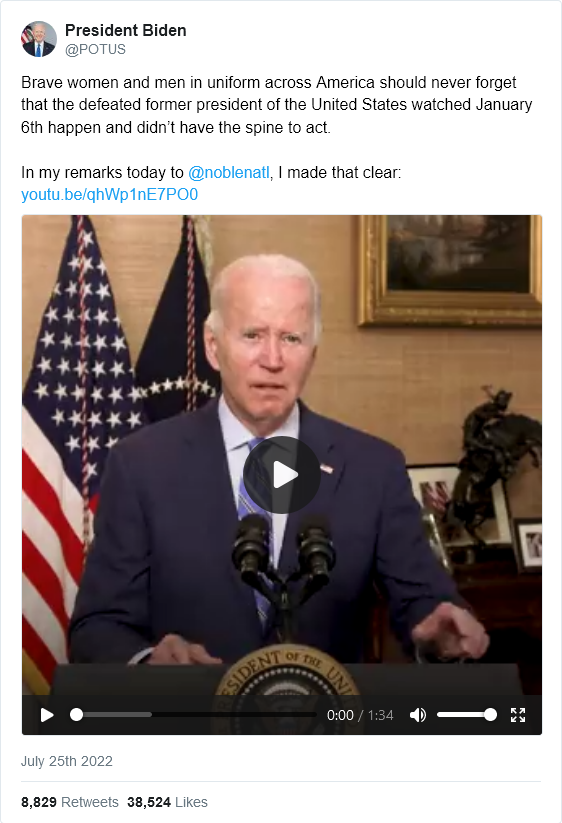
Chris Bray says if you saw anyone else speaking the way Joe Biden did the other day, you’d be concerned about medical or psychological crises:

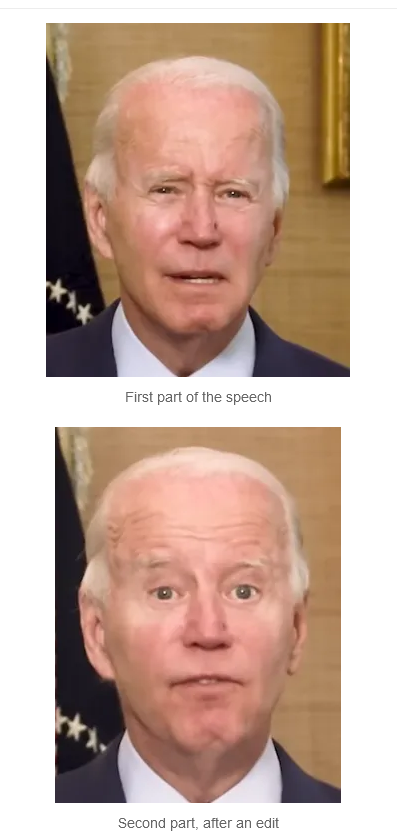
This is an increasingly strange moment, and the President of the United States is an increasingly strange and incoherent man. This is not something that has to be a partisan point, and I propose no next step that serves anyone’s politics — just notice, for now, and figure out the rest on your own terms. I’ve compared Joe Biden to Leonid Brezhnev, and Biden’s place in our political trajectory to Brezhnev’s position as an indicator of societal decline, and here we are again. I’ll get to the insane substance in a moment, but let’s start with the obviousness of the man’s bizarre affect. Turn off your politics for a moment and pretend you’re just watching the old guy who lives down the street. Watch this closely, ideally on full screen — and notice that he blinks once, around the 1:22 mark (and maybe a little one at 0:07):

If you saw a pastor or a small-town mayor or a school principal speaking like this, you would think it was unsettling. If you saw an elderly man in your family speaking this way, you’d call the doctor. This is video posted on the blue-checked POTUS account, official footage that someone at the White House decided to move to the foreground, and it’s disturbing. They didn’t notice the dead-eyed, overdosed stare?

The effect of the whole speech this footage is taken from is even more disturbing, if you can stomach it all. At least watch from 8:20 to 8:30, if you’re inclined to take notice of the thing, and watch the weird shift.

QotD: The US Civil War as a “revolt of the elites”

Filed under: Government, History, Politics, Quotations, USA — Tags: , , , , — Nicholas @ 01:00

They don’t teach it this way in college (for obvious reasons), but the Civil War was a revolt of the Elites. Put polemically, but not unfairly, The American People were offered four choices for President in 1860:

  1. tacitly pro-slavery;
  2. pro-slavery;
  3. fanatically pro-slavery; or
  4. fuck you.

These were embodied by John Bell, Stephen A. Douglas, John C. Breckinridge, and Abraham Lincoln, respectively, but the names on the tickets really didn’t matter, because it all boiled down to two options: Some flavor of politics as usual, or fuck you. And here’s the important part: The vast, vast majority of the country voted for politics as usual. “Fuck you” got 39.82% of the vote, which by my math means that 60% of a country that would soon be conducting the largest military mobilization yet seen in the history of warfare wanted things to keep going as they were.

In fact, it’s worse than that. As much as I hate to credit him with anything, Barack Obama was right — He truly was a Lincolnesque figure, in that Lincoln was vague to the point of incoherence about his origins, aims, and platform, too. A vote for Lincoln wasn’t a vote for disunion; it was a thumb in Dixie’s eye, no more. In other words, it was a vote to put the ball in the South’s court — an electoral-college version of the double dog dare. We voted for “none of the above,” pro-slavery people, now whatcha gonna do about it?

We know the answer — they haven’t yet forbidden us from teaching the fact that secession happened sorta-kinda-quasi democratically — but for obvious reasons they don’t teach that the secession conventions were all rigged in favor of the fire-eaters, and even then the motions barely passed. Which, again, means that “politics as usual” was nearly the default position of guys specifically summoned to discuss ending politics as usual. If you want to say that the Civil War was started by about twenty guys nobody’s ever heard of, with names like “Louis T. Wigfall” and “Laurence M. Keitt,” you won’t hear much argument from me.

Severian, “Misunderstanding the Civil War”, Rotten Chestnuts, 2019-05-29.

July 28, 2022

“… this time it will be worldwide”

Elizabeth Nickson recounts her journey from dedicated environmentalist to persecuted climate dissident and explains why so many of us feel as if we’re living on the slopes of a virtual Vesuvius in 79AD:

A screenshot from a YouTube video showing the protest in front of Parliament in Ottawa on 30 January, 2022.
Photo via Wikimedia Commons.

I was experiencing a time-worn campaign to shut down a voice that conflicted with an over-arching agenda. And in the scheme of things, I was nothing. But in fact, I was almost the only one, everyone else had been chased out. I was an easy kill, required few resources. It was personal, it was vicious beyond belief, and it had nothing to do with truth. If I had continued my work in newspapers, they would have attacked my mother and my brothers, two of the three of whom were fragile.

As of now, this has happened to hundreds of thousands of people in every sector of the economy. The chronicles of the cancelled are many and varied, and they all start with the furies, unbalanced, easily triggered and marshalled to hunt down and kill an enemy. These programs, pogroms, are meticulously planned, they analyze you, find your weakness, and attack it. In my case, it was my solitude, my income, my need to look after my family that made me an easy sacrifice.

I was such an innocent. I thought with my hard-won skills, my ability to reason, to number crunch, to apply economic theory and legit charting, and report, the truth would be valuable, useful.

Every single member of the cancelled has had their faith in the culture badly shaken. They all thought, as I did, that we were in this together, we needed the truth in order to make good decisions, decisions that would promote the good of all.

Not now. Not anymore.

The truth I found behind the fields and forests of the natural world is animating people on the streets in Europe today, the Dutch, French and German farmers. It animated the revolution in Sri Lanka.

Because what I and hundreds of others had found was censored, the destructive agenda has advanced to the point where their backs are against the wall. They don’t have a choice. They have to win. And they are in the millions.

Same with Trump’s people. They aren’t mindless fans or acolytes or sub-human fools. Their backs are against the wall. They have no choice but to fight.

But because I and the many like me, who know what happened, were shut down, disallowed from writing about it, cancelled and vilified, no one understands why this is happening in any depth. City people mock and hate rural people. My photographer colleague/best friend in New York: “racists as far as the eye can see”. My old aristocratic bf London: “Pencil neck turkey farmers”. No city person can take on board that they have allowed legislation and regulation which is destroying the rural economy because they have been brainwashed by the hysteria in the environmental movement. This destruction is not the only reason but it is the fundamental reason for our massive debts and deficits. The base of the economy has been destroyed. We have lost two decades of real growth.

And we did it via censorship.

There is a truism about revolutions in China. All of a sudden, across this great and massive country with its five thousand year culture, people put down their tools and start marching towards the capital, hundreds of millions all at once.

We are almost there. But this time it will be worldwide.

July 26, 2022

What’s worse than having a nepotistic elite running the country? Having an incompetent nepotistic elite running the country

Filed under: Government, Media, Politics, USA — Tags: , , , , , — Nicholas @ 05:00

Kurt Schlichter isn’t a fan of the kakistocratic “elite” running most of the western world at the moment:

The things we took for granted decades ago are uncertain, and there’s always an excuse — inevitably one that blames us. Like the new take on air conditioners, which is that they are an extravagance we should learn to live without. What the hell? Why?

And don’t get me started on the bizarre insistence of the resetters that we all need to give up beef and start eating bugs. I have a better idea. How about we eat ribeyes and burgers like Americans instead of crickets and locust like Third World famine victims?

A proper ruling class would see the problems and move to solve them, because the proper relationship between the ruling class and the rest of us is that the ruling class provides prosperity and security and the rest of us let them skim some cream off the top. If they were doing a decent job, their riches and luxuries would not bother us much; but when they have failed yet still expect full pay and benefits anyway, that grates. It is unsustainable.

So why doesn’t the ruling class try to get America moving again instead of telling us that we should settle for less and less? For one thing, because our ruling class is not competent. Joe Biden is, in a way, the perfect president for the resetters — stupid and getting seniler, corrupt, yet absolutely sure of his own genius despite literally no basis for that self-regard. Look, the solutions are there. Want to fix crime? Do what Giuliani did in New York City in the nineties. Want energy independence? Do what Trump did in 2016. Want the economy roaring? Do what Reagan and Trump did. These tactics are not secrets, yet they seem to be too hard for our elite to pull off. Our reset revolt will be to embrace someone who can.

Of course, the incompetence issue assumes that our elite wants to succeed in doing what elites should do. Does it really? Does it really want us prosperous, secure and free? Oh, the elite wants to succeed for itself, and it sure has. The elite is richer than ever. And it intends to stay that way even after you are reset to “Peasant” mode. The elite won’t be taking public transportation among the hobos like you. They will be safe behind armed guards while you are disarmed and victimized — defend yourself at your peril! And they will keep eating steak tartar while you slurp up beetle paste. Yum yum, proles!

The ruling caste has no intention of you living like a civilized citizen. No, you are their sacrifice, to Gaia, the angry weather goddess or whatever other pagan idol that empty void inside them worships. Your pain is the point. Remember, bullies love the raw exercise of power. Making you miserable is a manifestation of their urge to dominate and crush. That’s the genesis of those seemingly insane moves around the world like Sri Lanka giving up fertilizer or agricultural powerhouse Holland evicting farmers. But these moves — including the destruction of our own energy industry — only seem insane if you refuse to accept their ultimate goal. They want to hurt you. Your pain is a feature, not a bug — which will be your next meal if they get their way.

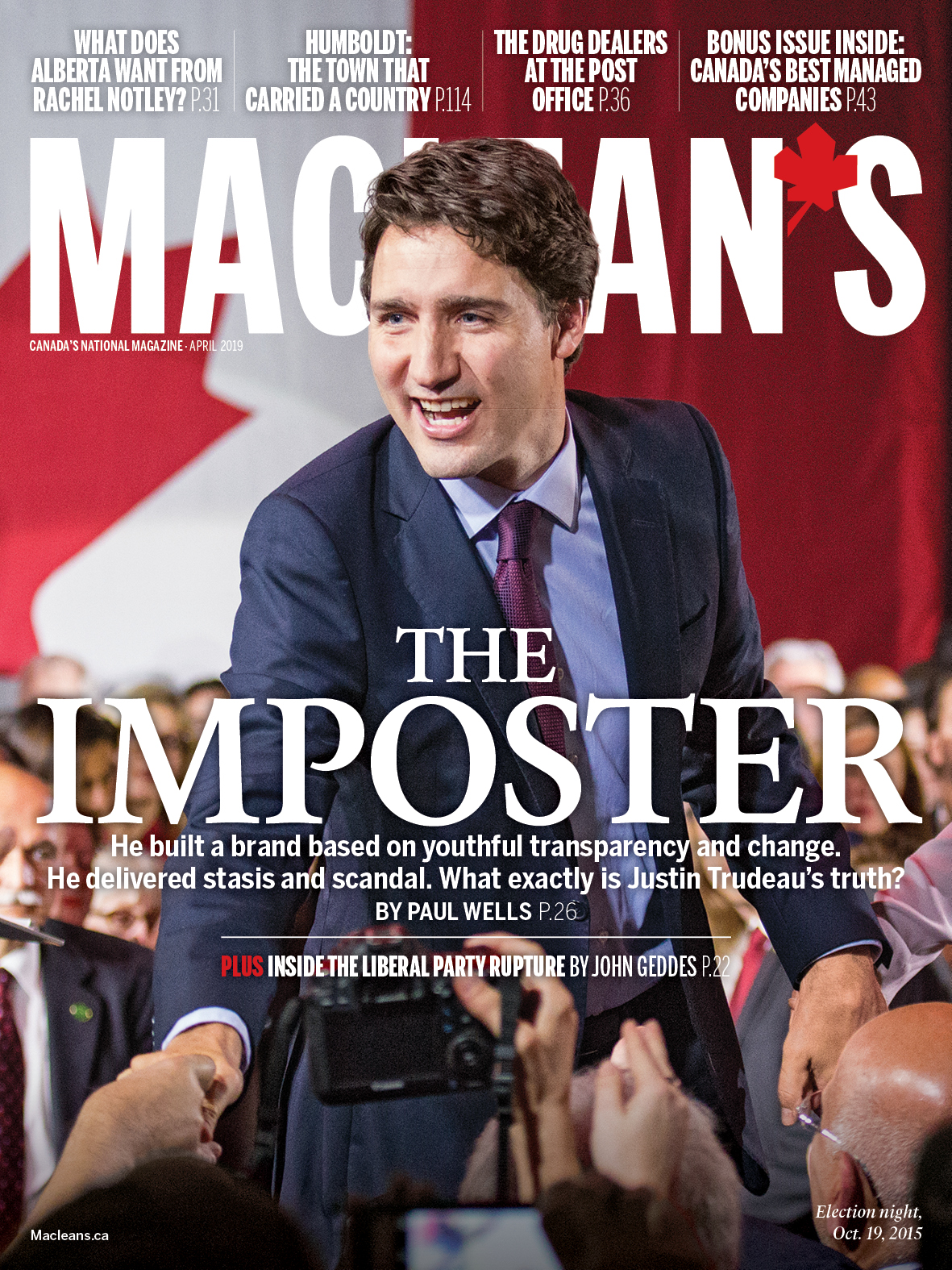
Is Trudeau channelling Caligula? – “Let them hate me as long as they fear me”

Filed under: Cancon, Government, Liberty, Media, Politics — Tags: , , , — Nicholas @ 03:00

Spencer Fernando, writing for the National Citizens Coalition:

When trying to ascertain where the Trudeau Liberals are trying to take the country, it’s important to look at the foundations of Justin Trudeau’s worldview.

Clearly, he was heavily influenced by his father, someone who continuously expanded the power of the state.

Justin Trudeau’s father was well known as a Communist-sympathizer, being a big fan of both Fidel Castro and Communist China.

Note, the version of the CCP that existed in Pierre Trudeau’s era was even more brutal than the CCP as it exists today. At the time, it was not far removed from the time of Mao’s Great Leap Forward, a government-imposed “reshaping of society” that led to roughly 45 million deaths.

To look at that, and still be a fan of the Chinese Communist Party, is to show a deep ideological commitment to authoritarian socialism and a deep aversion to human freedom.

The apple clearly didn’t fall far from the tree, as Justin Trudeau praised China’s “basic dictatorship” (AKA the centralized power structure that enables horrific crimes).

Trudeau also sought to move Canada closer to China’s orbit, only giving up on that when public opinion – and a subtle revolt among some backbench Liberals – rendered it politically unfeasible.

We can see how the authoritarian socialism that Trudeau praised in China (and let’s not forget his fawning eulogy for Fidel Castro), lines up with the fear and contempt he and the Liberals have for many Canadians.

Now, let’s also note this essential point:

The Liberals continuously target the same individuals that authoritarian socialists and communists have targeted:

    Rural Conservatives.

    Private Enterprise.

    Religious Groups.

    Freethinkers.

    Individualists.

    Private Farmers.

    Rural Gun Owners.

    Independent Press Outlets.

Historically, those are all groups that the far-left has targeted when given the opportunity.

We only need to look at how the Liberal approach to Covid was modelled after the approach taken by Communist China, and how both the Liberals and the CCP have been largely unwilling to move on.

While the Liberals are more constrained than the CCP by the fact that Canada maintains some freedoms, do we have any doubt that they would be far more severe if they could get away with it?

Remember, the moment he feared losing the 2021 election, Justin Trudeau used very divisive and disturbing rhetoric (especially disturbing when seen in a historical context), and purposely sought to direct hatred and blame towards those who resisted draconian state orders.

Since then, the Trudeau Liberals – even in the face of criticism by a few courageous Liberal MPs who were quickly “put back in their place” – have almost gleefully abused their power, purposely creating an “Us vs Them” narrative designed to pit Canadians against each other.

At the same time, they’ve continued their efforts to gain control over social media, silence dissenting views, and turn the establishment media into an extension of the state propaganda apparatus.

This is all being done because they fear those who have the intelligence and strength of character to see through their agenda.

They fear you, and have contempt for you.

« Newer PostsOlder Posts »

Powered by WordPress