Quotulatiousness

April 27, 2025

QotD: Fighting against Japan in the Pacific

Filed under: History, Japan, Military, Pacific, Quotations, USA, WW2 — Tags: , , , , , , — Nicholas @ 01:00

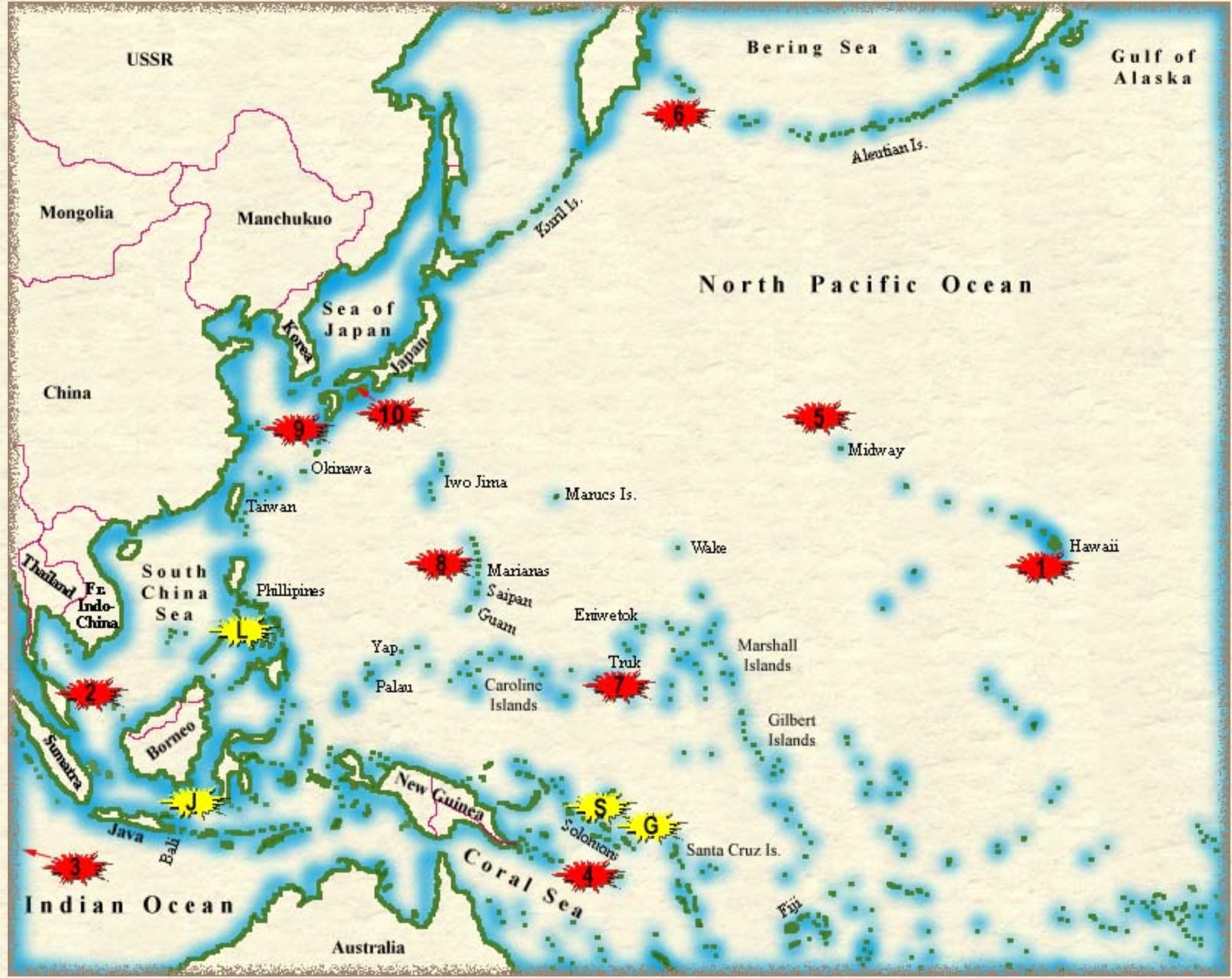
Japan’s biggest advantage in the Pacific was knowing the terrain. Volcanic atolls being what they are, there are only a few places in the whole South Pacific that can be turned into airfields. Not only that, but there are only a very few approaches to those places, and the Japanese knew them all. If you’re outmanned and outgunned, a strategy of digging in deep and selling your lives as dearly as possible is the only way to go. Bleed the enemy white.

And lord knows the Americans took the bait, more than once. If “bait” is really the right word, because if you’ve got no choice … the early campaigns in the Solomons were so legendarily nasty for that reason: You have no choice but to go right up the pipe to seize an objective, and if you do, the enemy has no choice but to go right up the pipe to get it back.

The genius of the later American strategy — and credit where it’s due, few people have a lower opinion of MacArthur than I, but this was brilliant — was to simply go around. Heavy bomber strips are a must, and in the even fewer places in the Pacific that can take heavy bombers, the Americans had no choice but to go right up the chute … but carrier airpower can do a hell of a lot, particularly when it can move about completely unmolested by the enemy. Thus the Americans turned all those guaranteed meat grinders the Japanese had set up for them into big open-air POW camps, without bothering to go in there and force them to surrender (which, of course, they wouldn’t). Have fun starving in your bunkers, boys; we’ll just leave a covering naval detachment, to make sure you can’t evacuate; see you when the war’s over.

Severian, “Strategy”, Founding Questions, 2021-11-21.

April 19, 2025

QotD: Allied air and sea operations won WWII

In [How the War Was Won author Phillips Payson] O’Brien’s methodology, we should look at what the Axis spent its productive effort making and consider what Allied actions slowed that productive effort. In both theaters, the answer is shocking. The Germans spent relatively little productive effort on tanks, focusing far more on aircraft, submarines, and vengeance weapons (i.e., proto-cruise missiles and rockets). The Japanese spent heavily on aircraft as well, but also a tremendous amount on freighters and oil tankers.

The Allies won the war by using air power to destroy the German and Japanese capacity both to produce military equipment and to transport it to the battlefield. By 1944-45, the Germans and Japanese could not use their economies to arm and supply their armies on the battlefield, leading to their inevitable defeat.

In the European war, American and British airpower: (a) directly destroyed a significant amount of productive capacity, (b) rendered remaining capacity far less efficient, (c) made it impossible for the Germans to defeat western ground forces, and (d) compelled the Germans to waste tremendous resources on air defense and exorbitant, ultimately ineffective vengeance weapons.

In the Pacific, the United States used carrier-based airpower, submarines, and bomber-deployed mines to isolate Japan from the resources of the empire it conquered in 1941-42. American bombers also directly destroyed factories and transportation systems, leading to similar levels of economic dysfunction as in Germany.

Anonymous, “Your Book Review: How the War Was Won“, Astral Codex Ten, 2024-08-09.

April 9, 2025

Battle of Saipan 1944: Total War in the Pacific

Filed under: History, Japan, Military, Pacific, USA, WW2 — Tags: , , , — Nicholas @ 02:00

Real Time History
Published 15 Nov 2024

In June 1944, an armada of warships and landing craft is getting ready for D-Day. Thousands of American soldiers are about to attack a prepared enemy with formidable defenses. But this isn’t Normandy, this is the island of Saipan. And the bloody battle there will bring total war to the Pacific.

Chapters:
00:00 Why the US Landed on Saipan
01:46 American Plan for Saipan
03:38 Japanese Defenses on Saipan
05:08 Preparations for D-Day on Saipan
06:39 D-Day on Saipan
08:46 Marine Combat Shotguns on Saipan
14:48 Japanese Counterattack
16:30 D-Day Plus 3 on Saipan
17:01 Battle of the Philippine Sea
20:45 D-Day Plus 7-9 on Saipan
22:33 D-Day Plus 11-15 on Saipan
24:10 Japanese Banzai Charge on Saipan
26:46 Civilian Casualties on Saipan
27:57 End of the Battle of Saipan
28:48 Battles of Tinian and Guam
30:04 Epilogue
(more…)

December 7, 2024

Aftermath: December 8

Filed under: History, Japan, Military, Pacific, USA, WW2 — Tags: , , , — Nicholas @ 02:00

The History Guy: History Deserves to Be Remembered
Published 8 Dec 2021

December 7, 1941 is remembered as the date that will live in infamy, but that term was spoken by President Franklin Roosevelt on December 8th. Nowhere was the weight of history more obvious than in the territory of Hawaii.
(more…)

November 12, 2024

Type 92 Japanese HMG

Filed under: France, History, Japan, Military, Pacific, Weapons, WW2 — Tags: , , , — Nicholas @ 02:00

Forgotten Weapons
Published Mar 9, 2015

The Type 92 was the final iteration of a machine gun that began as the Model 1897 Hotchkiss HMG made in France. The Japanese army purchased many of these guns, and then produced their own slightly refined version. These in turn were replaced by the updated Type 3 (1914) heavy machine gun, and finally the Type 92 (1932). A lightened upgrade to the Type 92 was prototyped (the Type 1, 1941), but never went into production. Mechanically, the Type 92 is very much like a scaled-up Type 11 light machine gun, using 30-round strips to feed. Despite being generally derided today, these machine guns were very reliable, accurate, and effective. This particular one happens to have a 7mm Mauser barrel in it, from a South American contract.

http://www.forgottenweapons.com

Theme music by Dylan Benson – http://dbproductioncompany.webs.com

September 15, 2024

The Occupation of Japan Begins – a WW2 Epilogue Special

World War Two
Published 14 Sep 2024

The war is over and the occupation of Japan has begun. The country has largely been destroyed by Allied bombs, and shall be rebuilt, physically, economically, and even governmentally. But what will the new government be? What shall become of the Emperor? Who is to actually do the occupation? Today we look at all this and more.
(more…)

September 3, 2024

The End of World War Two – WW2 – Week 314B – September 2, 1945

Filed under: China, France, History, Japan, Military, Pacific, Russia, USA, WW2 — Tags: , , , , , , , — Nicholas @ 04:00

World War Two
Published 2 Sep 2024

The Japanese sign the official document of surrender and the Second World War is over. There are still some Japanese garrisons yet to surrender, but they begin doing so one after the other. However, war is not over — and there is serious foreboding for future events in places like Vietnam and China — where Mao Zedong is meeting with Chiang Kai-Shek, even as Josef Stalin lurks in the background to secure Soviet interests no matter which Chinese regime comes out on top.

00:00 Intro
00:59 Vietnam Declares Independence
04:04 The Importance Of Manchuria
06:28 Japan’s Surrender
11:22 The Final Surrenders
13:18 Casualties
15:50 The End
(more…)

September 1, 2024

Can Chiang and Mao Unite China? – WW2 – Week 314 – August 31, 1945

World War Two
Published 31 Aug 2024

Mao Zedong takes his first ever journey by plane to go and meet with Chiang Kai-Shek. They begin what will be several weeks of talks and negotiations. However, Chiang is not aware that Josef Stalin is lurking in the background. And the Soviet Red Army is lurking in Manchuria, having defeated the Japanese there, and are giving tacit support to the Chinese Communists, whose power base is very strong in the north. As for Japan, a motley collection of Allied fleets arrives in Tokyo Bay, for Japan’s surrender document is to be officially signed two days from now.
(more…)

August 25, 2024

Soviet Victory in Manchuria – WW2 – Week 313 – August 24, 1945

World War Two
Published 24 Aug 2024

The Soviet Red Army completes its conquest of Manchuria and the northern half of Korea this week, although Japanese Emperor Hirohito announced Japan’s surrender already last week. Behind the scenes are machinations going on by Josef Stalin and Mao Zedong that they hope will lead to a Communist China in future. Vietnam might well be going communist right now, though, for the August revolution continues with the Viet Minh taking ever more control.

00:00 Intro
00:34 Recap
00:49 Chiang, Mao, and Stalin
07:32 Soviet victory in Manchuria
09:08 Viet Minh taking control
11:45 Summary
12:31 Conclusion
13:20 Julius Poole memorial
(more…)

August 24, 2024

Operation Downfall – the planned invasion of Japan in 1946

Filed under: History, Japan, Military, Pacific, USA, WW2 — Tags: , , , — Nicholas @ 03:00

Wes O’Donnell talks about the thankfully never-launched invasion of the Japanese home islands at the end of the Second World War:

History often hinges on the narrowest of margins.

Entire nations can rise or fall based on decisions made under the pressures of the moment.

But what if those decisions had gone the other way?

What if Archduke Franz Ferdinand had survived the assassination attempt in 1914?

What if John F. Kennedy had lived to complete a second term?

And most intriguingly, what if the United States had not dropped atomic bombs on Hiroshima and Nagasaki in August 1945?

The world would have witnessed Operation Downfall, the Allied invasion of Japan — an operation that, by all accounts, would have been the bloodiest amphibious assault in human history.

Operation Downfall was the codename for the proposed Allied plan for the invasion of Japan near the end of World War II.

The planned operation was abandoned when Japan surrendered following the atomic bombings of Hiroshima and Nagasaki and the Soviet declaration of war.

The operation had two parts: Operations Olympic and Coronet.

Set to begin in November 1945, Operation Olympic was intended to capture the southern third of the southernmost main Japanese island, Kyūshū, with the recently captured island of Okinawa to be used as a staging area.

Later, in the spring of 1946, Operation Coronet was the planned invasion of the Kantō Plain, near Tokyo, on the Japanese island of Honshu.

Airbases on Kyūshū captured in Operation Olympic would allow land-based air support for Operation Coronet.

The most troubling aspect of Downfall may have been the logistical problems facing military planners.

By 1945, there simply were not enough shipping, service troops, or engineers present to shorten the turnaround time for ships, connect the scattered installations across the Pacific, or build facilities like air bases, ports, and troop housing.

By this point in the war, the War Department had several military leaders that the government trusted to execute a quick end to hostilities.

Unlike the heavy political influence found in today’s wars, these men were given almost total freedom to plan large-scale military operations – Truman’s decision to drop the atomic bombs notwithstanding.

Six men of destiny

Responsibility for planning Operation Downfall fell to some of the most prominent American military leaders of the 20th century: Fleet Admiral Chester Nimitz, General of the Army Douglas MacArthur, and the Joint Chiefs of Staff — Fleet Admirals Ernest King and William D. Leahy, along with Generals of the Army George Marshall and Hap Arnold, who commanded the U.S. Army Air Forces.

These six men, raised in the relatively stable and predictable world of late 19th-century small-town America, carried with them the values instilled by that era.

Arnold and MacArthur were West Point graduates; King, Leahy, and Nimitz came out of the Naval Academy; while Marshall honed his discipline at the Virginia Military Institute, a school renowned for its toughness, even more so than the service academies.

For these leaders, the concepts of duty, honor, and country were more than just words — they were guiding principles.

They approached their roles without a trace of cynicism, supremely confident in their ability and, crucially, their God-given right to steer the course of history, especially in the chaos of war.

August 18, 2024

Hirohito Announces Surrender – War Continues – WW2 – Week 312 – August 17, 1945

Filed under: History, Japan, Military, Pacific, Russia, USA, WW2 — Tags: , , , , , , — Nicholas @ 04:00

World War Two
Published 17 Aug 2024

Hirohito broadcasts Japan’s surrender to the world- despite an attempted to coup to prevent it from happening, and much of the world celebrates, but the war isn’t really over. The Soviets are busy invading Manchuria, and there’s revolution in Vietnam and Indonesia.

00:00 Intro
00:22 Recap
00:49 Attempted Coup In Japan
04:12 Hirohito Surrenders
08:54 Japanese Surrender In China
12:05 Soviets In Manchuria
17:52 Revolution In Vietnam
20:33 Summary
21:07 Conclusion
(more…)

August 7, 2024

Unleashing the Atom: The Bombing of Hiroshima and Nagasaki – War Against Humanity 139

Filed under: History, Japan, Military, Pacific, USA, WW2 — Tags: , , — Nicholas @ 04:00

This video is only available on YouTube itself – click the image above or click here.

World War Two
Published 6 Aug 2024

In August 1945, the United States became the first, and to this day only, nation ever to employ nuclear weapons in war. After The fledgling technology proves itself on the testing ground, it is ready for immediate use. The price for this innovation is paid by hundreds of thousands of Japanese civilians who are blinded, burned, crushed, irradiated, and finally burned in a humanitarian crisis never seen before and never since. Join us to hear the gut-wrenching accounts of survivors and understand the motivations behind this tragic outcome to ensure that the horrors of nuclear war are never forgotten and never again unleashed upon the world and its people.

August 4, 2024

Mokusatsu! – WW2 – Week 310 – August 3, 1945

World War Two
Published 3 Aug 2024

The Japanese reaction to the Allied ultimatum for unconditional surrender is … mokusatsu. This can be translated several ways, but all involve not giving a response. Meanwhile, materials for atomic bombs to be dropped on Japan are delivered to Tinian, though the ship making the delivery is sunk by a Japanese submarine days afterward. The active war continues in Burma and China, and the Potsdam Conference ends in Germany with the map of Poland very much re-drawn.

00:00 Intro
00:56 Mokusatsu
05:47 Delivering Atomic Material
07:22 Sinking The Indianapolis
09:26 Bombing Japan
12:22 The War In Burma And China
14:07 Potsdam Confernece Ends
17:02 Conclusion
(more…)

July 28, 2024

Allies Issue Potsdam Declaration – WW2 – Week 309 – July 27, 1945

World War Two
Published 27 Jul 2024

China, Britain, and the US issue a Declaration demanding Japan’s unconditional surrender, and promising complete destruction if this does not happen and happen soon. The plan is to for the Americans to use their atomic bombs on Japan if she does not comply, but by the end of the week the Japanese have not replied. They still have hopes for the Soviets to mediate some sort sort of peace. What they don’t have is a navy, as its final destruction comes this week.

00:00 Intro
00:50 Recap
01:32 The Potsdam Conference
04:41 Japanese Hopes
05:56 The Potsdam Declaration
10:53 The Initial Reaction
14:48 The End Of The Japanese Navy
15:05 The War On Land
19:10 Summary
19:30 Conclusion
(more…)

July 21, 2024

The Atomic Age Begins! – WW2 – Week 308 – July 20, 1945

World War Two
Published 20 Jul 2024

This week the Americans explode a nuclear bomb at the Trinity Test in New Mexico. The plan is to possibly use more such bombs against targets in Japan. US President Harry Truman is meanwhile in Germany for the Potsdam Conference with other Allied leaders to hammer out some details of the postwar global order. The active war continues, of course, in Burma, Borneo, the Philippines, and China, with the Japanese being defeated everywhere.

00:00 Intro
00:22 Recap
00:51 The Trinity Test
02:46 The Potsdam Conference Begins
04:09 Bretton Woods Agreement
05:38 The Active War Continues
09:39 Summary
11:00 Conclusion
(more…)

« Newer PostsOlder Posts »

Powered by WordPress