
C&Rsenal
Published on 21 Feb 2019Project Lightening is the first collaborative project between C&Rsenal and Forgotten Weapons. It features SEVEN World War One light machine guns put head to head to see which is the best!
We’re releasing two episodes a week but you can get them all at once over at C&Rsenal AND support both shows at the same time!
http://candrsenal.com/product/lightening
Episode 01: https://youtu.be/TVgkwQTo2n4
Episode 02: https://youtu.be/-hSZbo8Hvn4
Episode 03: https://youtu.be/A9ryJaj3mPw
February 25, 2019
Project Lightening Episode 04: Field Strip
Comments Off on Project Lightening Episode 04: Field Strip
HMCS Bonaventure of the Royal Canadian Navy
Sneaky Loon
Published on 9 Apr 2017The Bonaventure was purchased from the Royal Navy to replace HMCS Magnificent because the Bonaventure could operate fighter jets to conduct anti-submarine activities.
Comments Off on HMCS Bonaventure of the Royal Canadian Navy
February 24, 2019
Manstein Makes a Plan and Hitler has a Man Crush – WW2 – 026 – February 23 1940
World War Two
Published on 23 Feb 2019German General Erich von Manstein has a cunning plan. And as it happens, it’s just how Hitler likes it. This week, the German war plans change quite drastically. In the meantime, the Soviet Red Army continues it push through the Finnish Mannerheim line, except for a stubborn Finnish pocket of resistance at Taipale.
Join us on Patreon: https://www.patreon.com/TimeGhostHistory
Or join The TimeGhost Army directly at: https://timeghost.tvFollow WW2 day by day on Instagram @World_war_two_realtime https://www.instagram.com/world_war_t…
Between 2 Wars: https://www.youtube.com/playlist?list…
Source list: http://bit.ly/WW2sourcesWritten and Hosted by: Indy Neidell
Produced and Directed by: Spartacus Olsson and Astrid Deinhard
Executive Producers: Bodo Rittenauer, Astrid Deinhard, Indy Neidell, Spartacus Olsson
Creative Producer: Joram Appel
Research by: Indy Neidell
Edited by: Iryna Dulka
Map animations: EastoryPortrait colorizations by Norman Stewart.
Photos of the Winter War are mostly from the Finnish Wartime Photograph Archive (SA-Kuva).
Photo of Sartre by Government Press Office Israel, https://www.flickr.com/people/6906147….Eastory’s channel: https://www.youtube.com/channel/UCEly…
Archive by Screenocean/Reuters https://www.screenocean.comA TimeGhost chronological documentary produced by OnLion Entertainment GmbH.
From the comments:
World War Two
2 days ago (edited)
While the Winter War seems to be coming to an end, new plans are being crafted in Germany to invade most of their neighbours. And before someone asks: the Swastika in the thumbnail is NOT used as a political statement of some sort. Just like in all of our earlier episodes, we use relevant symbols from the different armies and powers to illustrate the topic of the thumbnail. And yes, we are aware of regulation in Germany and Austria regarding the use of Nazi symbols, but as long as they are used in an historical context for educational purposes, which it clearly is, showing this symbol is allowed.And before I forget: the release of this episode marks exactly half a year since we have started doing World War Two on 1 September 2018/1939. A lot has changed in these months, and there are still many exciting new things on the horizon. The series is about to enter a very eventful time, we are going to start with some new projects which you’ll hear about soon and there are more specials coming – which we hope to be able to bring to you on a regular basis as soon as possible. We hope you enjoy the episode!
Cheers, Joram
Comments Off on Manstein Makes a Plan and Hitler has a Man Crush – WW2 – 026 – February 23 1940
February 23, 2019
“Panzerkampf” – The Battle of Kursk – Sabaton History 003
Sabaton History
Published on 21 Feb 2019In “Panzerkampf” on The Art of War album, Sabaton sings about the German offensive on the Kursk salient in the summer of 1943. We dive into the details of the Battle of Kursk and one of the biggest tank battles in world history, the Battle of Prokhorovka.
Support Sabaton History on Patreon: https://www.patreon.com/sabatonhistory
Hosted by: Indy Neidell
Written by: Markus Linke and Indy Neidell
Directed by: Astrid Deinhard and Wieke Kapteijns
Produced by: Pär Sundström, Astrid Deinhard and Spartacus Olsson
Creative Producer: Joram Appel
Executive Producers: Pär Sundström, Joakim Broden, Tomas Sunmo, Indy Neidell, Astrid Deinhard, and Spartacus Olsson
Maps by: Eastory
Edited by: Iryna Dulka
Sound Editing by: Marek KaminskiEastory YouTube Channel: https://www.youtube.com/channel/UCEly…
Archive by: Reuters/Screenocean https://www.screenocean.com
Music by Sabaton.
Photo of Bill Belichick: https://www.flickr.com/photos/2700360…
Comments Off on “Panzerkampf” – The Battle of Kursk – Sabaton History 003
February 22, 2019
Germany’s armed forces – from world class to laughing stock
Germany’s military has fallen on very hard times, and there’s so much wrong that it will be very difficult to fix even with all the goodwill in the world:

The German Navy training ship Gorch Fock (launched in 1958) under full sail (less the spanker topsail) in Kiel Fjord near the Laboe Naval Memorial in July 2006.
Photo by Felix Koenig via Wikimedia Commons.
Most Germans’ eyes glaze over at the mention of the Bundeswehr’s perpetual troubles, but an affair surrounding the Gorch Fock, the navy’s three-masted naval training ship, has caught their attention.
Launched in 1958 to school a new generation of West German naval recruits, the imposing 81-meter ship, which takes its name from a popular seafaring German author’s pseudonym, is more than just a training vessel; to many, the Gorch Fock — whose likeness was etched onto some Deutsche Mark bills — is a symbol of Germany’s postwar revival.
The ship’s iconic status is one reason why few objected when the Bundeswehr announced in 2015 that it needed a major overhaul. Until, that is, the price tag exploded from an initial projection of €10 million to €135 million, according to the latest estimate.
Bundeswehr officials claimed the depth of the ship’s troubles only became clear when it was in dry dock, but few are buying such explanations. “When the repairs cost more than a new ship, something is obviously amiss,” Bartels, the Bundeswehr’s parliamentary overseer, said in an interview.
The Gorch Fock “is a symptom of the Bundeswehr’s broader problems,” Bartels said. “Everything takes too long and costs too much money. It’s as if time and money were endless resources, and in the end no one takes responsibility.”
Almost overnight, the ship has gone from pride and joy to running gag. Last week, German weekly Der Spiegel pictured the Gorch Fock on its cover under the headline, “Ship of Fools.”
It’s an apt metaphor for Germany’s body politic as well. Given Germany’s size and economic might, Berlin’s attention to security is surprisingly shallow; citizens and politicians alike often seem oblivious to the challenges the country faces. Though Germany faces growing security threats from both Russia and China, one wouldn’t know it hanging around the German capital.
Much of the media now portrays the U.S. as a security threat on par with Russia. Public attitudes have moved in a similar direction. Security discussions are driven by a handful of like-minded think tank analysts who seem to spend most their time on Twitter, fretting about whether Trump will pull the plug on NATO.
More Germans believe China is a better partner for their country than the U.S., according to a survey published last week by Atlantik Brücke, a Berlin-based transatlantic lobbying group. About 80 percent of those surveyed consider U.S.-German relations to be “negative” or “very negative.”
H/T to Instapundit for the link.
Comments Off on Germany’s armed forces – from world class to laughing stock
Project Lightening Episode 03: Walking Fire
Forgotten Weapons
Published on 21 Feb 2019Don’t wait like a chump! Get the whole 8-part series right now at:
https://candrsenal.com/product/lighte…
Project Lightening is a collaborative series with Othais and Mae of C&Rsenal in which we test all seven light machine guns and automatic rifles of World War One and put them through a series of tests and evaluations. Each week we will be posting one video on Forgotten Weapons and one on C&Rsenal. Today we have the walking fire here, and the field strip assessment over on C&Rsenal:
http://www.patreon.com/ForgottenWeapons
Cool Forgotten Weapons merch! http://shop.bbtv.com/collections/forg…
Contact:
Forgotten Weapons
PO Box 87647
Tucson, AZ 85754
Comments Off on Project Lightening Episode 03: Walking Fire
February 21, 2019
Walther’s .45ACP MP (P38 Precursor)
Forgotten Weapons
Published on 21 Jan 2019http://www.patreon.com/ForgottenWeapons
Cool Forgotten Weapons merch! http://shop.bbtv.com/collections/forg…
During the process of developing the pistol which would become the German army’s P38, the Walther company was also interested in potential export contracts (like the one they actually did get from Sweden). One potential contract briefly explored was to the United States, and a few prototype MP pistols were made in .45 ACP caliber. These were larger in all dimensions than the standard MP, and shared the features of those other developmental guns (most distinctively the shrouded hammer and internal extractor). This pistol was almost certainly taken as a souvenir form the Walther plant in 1945 by an American GI. No records exist of any American trials of the guns, and it seems that the plan to offer them for sale was never followed through on, probably because of the (9mm) guns’ success in German military trials.
Contact:
Forgotten Weapons
PO Box 87647
Tucson, AZ 85754
Comments Off on Walther’s .45ACP MP (P38 Precursor)
February 19, 2019
LOONEY TUNES (Looney Toons): Rookie Revue (1941)
8thManDVD.com™ Cartoon Channel
Published on 8 Dec 2013Random gags around military life, set on an army base. A bugler uses a jukebox to play reveille. In formation, one private has a great deal of trouble remembering what comes after “3”; after he gets it, he decides not to go for the $32 question. In the mess hall, the machine gunners machine gun their food while the bombers catch falling biscuits. The infantry marches for miles – past a “next time, take the train” billboard. The camouflage troops march by, invisibly. We see training substitutes: wooden guns, cars marked “tank” and, alas, a banner marked “parachute” deployed in mid-jump. More training: aerial games (of tic-tac-toe). The anti-aircraft division has target practice, on an aerial shooting gallery. Finally, in an elaborate process, a general provides firing instructions to a big gun; when it hits his own building, he says, “I’m a baaad general.”
8thManDVD.com and all content © 2013 ComedyMX LLC. All rights reserved. Unauthorized use is prohibited.
The looney tunes (commonly mistaken as Looney Toons) series features characters such as bugs bunny, daffy duck & porky pig. The looney tunes cartoons, movies and new looney tunes show have been produced for years. The looney tunes full episodes, produced by the official looney tunes are available on DVD and TV.
Comments Off on LOONEY TUNES (Looney Toons): Rookie Revue (1941)
February 18, 2019
WTF is Jesse? Introducing the new Great War Host
The Great War
Published on 16 Feb 2019ASK US ANYTHING: https://www.reddit.com/r/TheGreatWarC…
Pilot episode of the Patreon Podcast: https://www.patreon.com/posts/great-w…
Beat from Jesse’s application video: https://www.youtube.com/watch?v=OYyKn…
» SUPPORT THE CHANNEL
Patreon: https://www.patreon.com/thegreatwar
Merchandise: https://shop.spreadshirt.de/thegreatwar/» SOCIAL MEDIA
Twitter: https://twitter.com/WW1_Series
Reddit: https://reddit.com/r/TheGreatWarChannel»CREDITS
Presented by: Jesse Alexander
Written by: Jesse Alexander
Director: Toni Steller & Florian Wittig
Director of Photography: Toni Steller
Sound: Toni Steller
Editing: Toni Steller
Mixing, Mastering & Sound Design: http://above-zero.com
Motion Design: Christian Graef – GRAEFX
Maps: Daniel Kogosov (http://patreon.com/Zalesky)
Research by: Jesse Alexander
Fact checking: Florian WittigChannel Design: Alexander Clark
Original Logo: David van StepholdA Mediakraft Networks Original Channel
Contains licenced material by getty images
All rights reserved – Real Time History GmbH i.Gr. 2019
Comments Off on WTF is Jesse? Introducing the new Great War Host
Forgotten history of India’s Thermopylae
The History Guy: History Deserves to Be Remembered
Published on 20 Jun 2017The History Guy tells the forgotten history of the World War II battle of Imphal also known as India’s Thermopylae.
The History Guy uses images that are in the Public Domain. As photographs of actual events are often not available, I will sometimes use photographs of similar events or objects for illustration.
Patreon: https://www.patreon.com/TheHistoryGuy
The History Guy: Five Minutes of History is the place to find short snippets of forgotten history from five to fifteen minutes long. If you like history too, this is the channel for you.
The episode is intended for educational purposes. All events are presented in historical context.
Comments Off on Forgotten history of India’s Thermopylae
QotD: Patton and Prohibition
Observance of Prohibition in the breech was also common amongst junior officers. While commanding tank battalions and living next door to one another in renovated barracks at Camp Meade, Maryland, Dwight Eisenhower and George Patton avidly partook in the new American pastime of making their own bootleg alcohol. Eisenhower distilled gin in an unused bathtub, while Patton brewed beer, storing it in a shed outside his kitchen. One summer evening there was a sudden noise outside the Pattons’ barracks that sounded like a machine gun, followed by a series of soft booms. As their cook began screaming, Patton instinctively dove for cover. When they realized it was merely the beer bottles exploding from the heat, he rose, sheepishly explaining how much it had sounded like hostile fire. His wife Beatrice “laughed and laughed and called him ‘her hero’ and he got very red.” Omar Bradley commanded an infantry battalion in the 27th Infantry Regiment in the 1920s and took advantage of the Hawaii Division’s leisurely pace of duty to play golf several times a week. At the end of one round, the 33-year-old teetotaler drank his first glass of whiskey, which he liked enough to make “a habit of having a bourbon and water or two (but never more) before dinner” for the rest of his life.
Benjamin Runkle, “‘What a Magnificent Body of Men Never to Take Another Drink’: The U.S. Army and Prohibition”, Real Clear Defense, 2019-01-16.
Comments Off on QotD: Patton and Prohibition
February 17, 2019
Finland’s Desperate Fight – WW2 – 025 – February 16 1940
World War Two
Published on 16 Feb 2019After more than a week of preliminary bombardments and attacks, the Red Army finally attacks the Finnish defensive positions on the Karelian Isthmus en masse. They throw thousands of troops at the Finns at the entire width of their lines, even exceeding them. The Finns defend the best as they can, but their winning streak seems to come to an end.
Join us on Patreon: https://www.patreon.com/TimeGhostHistory
Or join The TimeGhost Army directly at: https://timeghost.tvFollow WW2 day by day on Instagram @World_war_two_realtime https://www.instagram.com/world_war_t…
Between 2 Wars: https://www.youtube.com/playlist?list…
Source list: http://bit.ly/WW2sourcesWritten and Hosted by: Indy Neidell
Produced and Directed by: Spartacus Olsson and Astrid Deinhard
Executive Producers: Bodo Rittenauer, Astrid Deinhard, Indy Neidell, Spartacus Olsson
Creative Producer: Joram Appel
Research by: Indy Neidell
Edited by: Iryna Dulka
Map animations: EastoryColorizations by Norman Stewart.
Thumbnail Colorization by Julius Jääskeläinen: https://www.flickr.com/photos/juliusjaa/Photos of the Winter War are mostly from the Finnish Wartime Photograph Archive (SA-Kuva).
Eastory’s channel: https://www.youtube.com/channel/UCEly…
Archive by Screenocean/Reuters https://www.screenocean.comA TimeGhost chronological documentary produced by OnLion Entertainment GmbH.
From the comments:
World War Two
2 days agoMajor developments in the Winter War this week! The thumbnail (colorized by JuliusJaa – https://www.flickr.com/photos/juliusjaa/) depicts Aarne Juutilainen or the “The Terror of Morocco”. This particular photo was taken earlier in December 1939 during the battle of Kollaa, where he acquired a hero status. He owed his name to his service in the French Foreign Legion in Morocco, where he served from 1930 to 1935. By 1940, he commanded his own ‘Moroccan company’, a unit made out of decorated soldiers known for their superior skills.
We sincerely hope that you enjoy the videos we put out for you all! As Indy notes at the end of the video, especially important for today’s episode (there are 14 maps in this) is Eastory, who researches and animates our maps for us. Check out his channel as well! It’s really good -> https://www.youtube.com/channel/UCElybFZ60Hk1NSjgCf7I2sg
Please do consider supporting us on Patreon. That allows us to keep working with awesome people like Eastory and will help us create even more content for you all to enjoy.
Cheers,
Joram
Comments Off on Finland’s Desperate Fight – WW2 – 025 – February 16 1940
When Trump gets serious with Canada about defence spending
Ted Campbell notes that, despite all the nay-saying, President Trump appears to be getting results with US allies on defence issues. That being the case, he’s wondering when Prime Minister Trudeau will get the message:
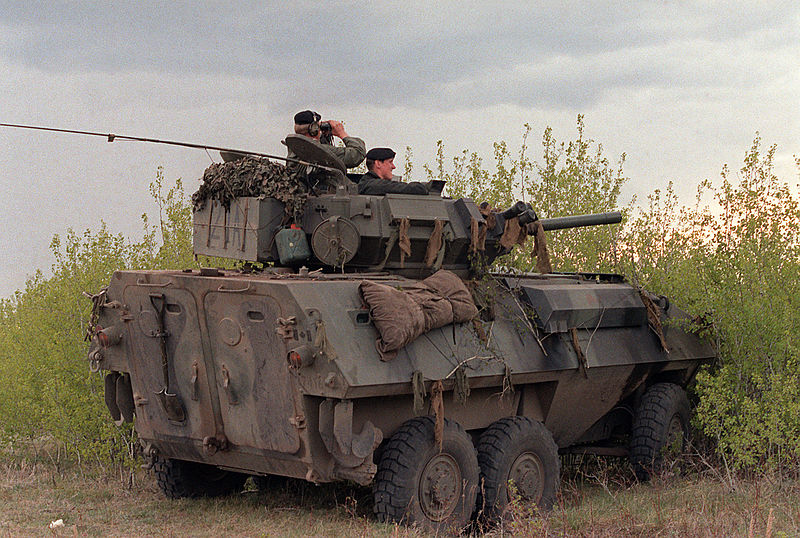
A right rear view of a Canadian army Cougar wheeled fire support vehicle being used as an observation post by soldiers standing watch during the combined U.S./Canadian NATO Exercise Rendezvous ’83. Location: Camp Wainright, AB
I was commenting on this before president Trump was elected; and shortly after his 2016 election victory I said that
“Prime Minister Trudeau and most European presidents and prime ministers will have to face a newly elected US president who wants them to pay for a bigger and bigger slice of their own defence. Real leaders would do well to recognize that the Americans have a valid point … some, probably many of them, including Prime Minister Justin Trudeau, may try to pretend that it doesn’t matter; they will be wrong.”
I was impressed, then, with how deeply many, many Americans felt about Donald Trump’s campaign message which said that allies were “freeloading,” and taking unfair advantage of America’s innate generosity … I was very, very conscious of the fact that, when I was a young man, a junior officer in Canada’s tough, superbly disciplined, well trained, trained, nuclear armed “vest pocket army” (as more than one allied general called us) brigade group in Germany, Canada used to pay its full and fair share … but we stopped, in the late summer of 1969, when Pierre Trudeau tried to totally withdraw from NATO and, indeed, from the world.
I wonder when President Trump will send someone like Timothy Betts, the Deputy Assistant Secretary and Senior Advisor for Security negotiations and Armaments in the US State Department, to Ottawa to demand that Canada should pay up after a half century of “freeloading” on the US taxpayers’ goodwill. That will come as a nasty shock to Team Trudeau and, indeed, to a majority of Canadians who have gotten used to the notion that the Americans will defend us out of the kindness of their hearts. I’m not sure that Canada is next in line, but I suspect we’re on his short list.
Comments Off on When Trump gets serious with Canada about defence spending
Project Lightening Episode 02: 100 Yard Test
C&Rsenal
Published on 14 Feb 2019Project Lightening is the first collaborative project between C&Rsenal and Forgotten Weapons. It features SEVEN World War One light machine guns put head to head to see which is the best!
We’re releasing two episode a week but you can get them all at once over at C&Rsenal AND support both shows at the same time!
Comments Off on Project Lightening Episode 02: 100 Yard Test
Tank Chats #42 Elefant | The Tank Museum
The Tank Museum
Published on 18 Aug 2017Originally known as the Ferdinand, then later renamed Elefant, 90 of this heavily armed and armoured vehicle were built, seeing service in the Soviet Union, Italy and Germany.
Although deployed as a tank destroyer, the Elefant had its origins in Ferdinand Porsche’s attempt to build what became the Tiger tank.
This particular Elefant is part of The Tiger Collection at The Tank Museum, Bovington, on loan from the US Army Ordnance Training and Heritage Center, VA.
Support the work of The Tank Museum on Patreon: ► https://www.patreon.com/tankmuseum
Or donate http://tankmuseum.org/support-us/donateTwitter: ► https://twitter.com/TankMuseum
Tiger Tank Blog: ► http://blog.tiger-tank.com/
Tank 100 First World War Centenary Blog: ► http://tank100.com/ #tankmuseum #tanks #tigertank tiger tanks tank chat
Comments Off on Tank Chats #42 Elefant | The Tank Museum


