
Extra Credits
Published on 16 May 2019This series is brought to you by Total War: THREE KINGDOMS, a brand new strategy game set during this time period. https://store.steampowered.com/app/77…
Yuan Shao’s forces cross the Yellow River, assaulting Cao’s fortifications. Yuan has 110,000 soldiers — including the runaway warlord Liu Bei — while Cao Cao has only twenty thousand. But things are about to go in a very unexpected, brutal twist for the next eight years…
Three kings ruled in China. Three kings, each dreaming of ruling all under heaven. Three kings who rallied their armies for battle. The empire, long divided, must unite; long united, must divide.
Thanks to Jordan Martin for the guest art! https://www.jordanwmartin.com/
Join us on Patreon! http://bit.ly/EHPatreon
May 17, 2019
The Three Kingdoms – The Battle of Guandu – Extra History – #2
The Red Baron – The Great War – Sabaton History 015
Sabaton History
Published on 16 May 2019The Red Baron is one of the, if not THE MOST iconic heroes of The Great War. He simultaneously embodies the mechanisation of modern war and a romanticised version of war with his individual skill and heroism. Indy goes beyond the legend to tell the history of Manfred von Richthofen, a.k.a The Red Baron, the latter of which also is the name of a Sabaton song that will feature on their upcoming album The Great War.
You can find the eight points of the Dicta Boelcke in the pinned comment.
Support Sabaton History on Patreon (and possibly get a History Channel special edition): https://www.patreon.com/sabatonhistory
Pre-order The Great War here: https://www.sabaton.net/pre-order-of-…
Check out the trailer for Sabaton’s new album ‘The Great War’ right here: https://www.youtube.com/watch?v=HCZP1…
Watch more videos on the Sabaton YouTube channel: https://www.youtube.com/user/Sabaton?…
Listen to Sabaton on Spotify: http://smarturl.it/SabatonSpotify
Official Sabaton Merchandise Shop: http://bit.ly/SabatonOfficialShopHosted by: Indy Neidell
Written by: Markus Linke and Indy Neidell
Directed by: Astrid Deinhard and Wieke Kapteijns
Produced by: Pär Sundström, Astrid Deinhard and Spartacus Olsson
Creative Producer: Joram Appel
Executive Producers: Pär Sundström, Joakim Broden, Tomas Sunmo, Indy Neidell, Astrid Deinhard, and Spartacus Olsson
Maps by: Eastory
Edited by: Iryna Dulka
Sound Editing by: Marek KaminskiEastory YouTube Channel: https://www.youtube.com/channel/UCEly…
Archive by: Reuters/Screenocean https://www.screenocean.com
Music by Sabaton.Sources:
– © IWM: Q 66959, Q 105717, Q 73533, Q 67598, Q 50329, Q 50328, Q 42284, Q 111872, Q 54397, Q 63148, Q 63122, Q 3140, Q 57513 Q 58028, Q 52781, Q 63822, Q 50673, Q 72919, Q 12044, IWM 187, EPH 9001, Q 67832, IWM 1004, Q 63162, Q 67780, Q 58034, Q 63137, Q 63160
– © IWM Art: IWM ART 517, 1488, 517, 3071, 2659, 2660, 3199, 2754, 654
– Bendigo Soldiers Memorial Institute Military Museum: 2075P
– Klimbim Colorization
– James Miller ColorizationAn OnLion Entertainment GmbH and Raging Beaver Publishing AB co-Production.
© Raging Beaver Publishing AB, 2019 – all rights reserved.
From the comments:
Sabaton History
This is the second episode of Sabaton History about one of the songs of the upcoming Sabaton album The Great War. By supporting us on Patreon, you can help us continue making these YouTube videos. You will also get some exclusive content – like a full version of Indy and Joakim talking about The Red Baron, which is live on our Patreon site right here: https://www.patreon.com/posts/full-length-red-26854763Indy mentions the Dicta Boelcke in the video. These are the eight points that Boelcke and von Richthofen used in the skies (source: Werner, Johannes von, 1932):
1. Try to secure advantages before attacking. If possible, keep the sun behind you.
2. Always carry through an attack when you have started it.
3. Fire only at close range, and only when your opponent is properly in your sights.
4. Always keep your eye on your opponent, and never let yourself be deceived by ruses.
5. In any form of attack it is essential to assail your enemy from behind.
6. If your opponent dives on you, do not try to evade his onslaught, but fly to meet it.
7. When over the enemy’s lines never forget your own line of retreat.
8. For the Staffel (squadron): Attack on principle in groups of four or six. When the fight breaks up into a series of single combats, take care that several do not go for the same opponent.
Convincing Children That Airfix Is Still Fun | James May’s Toy Stories | Spark
Spark
Published on 6 Apr 2019James May subjects traditional toys to spectacular, supersize challenges. Children have taken their attention by video games and mobile phones since they became heavily accesible, can they be convinced that outdated Airfix’s models are still fun?
Subscribe to Spark for more amazing science, tech and engineering videos – https://goo.gl/LIrlur
Content licensed from Plum Pictures to Little Dot Studios. Any queries, please contact us at: owned-enquiries@littledotstudios.com
#toys #Airfix #JamesMay #spark #sparkdocumentary #sciencedocumentary
May 16, 2019
Remembering Monte Cassino … and Wojtek the Bear, a Polish war hero
At the Daily Chrenk, Arthur Chrenkoff remembers the Polish soldiers who finally took Monte Cassino from the Germans in 1944, after earlier allied attempts by soldiers of many other nations (including Canada) had failed:
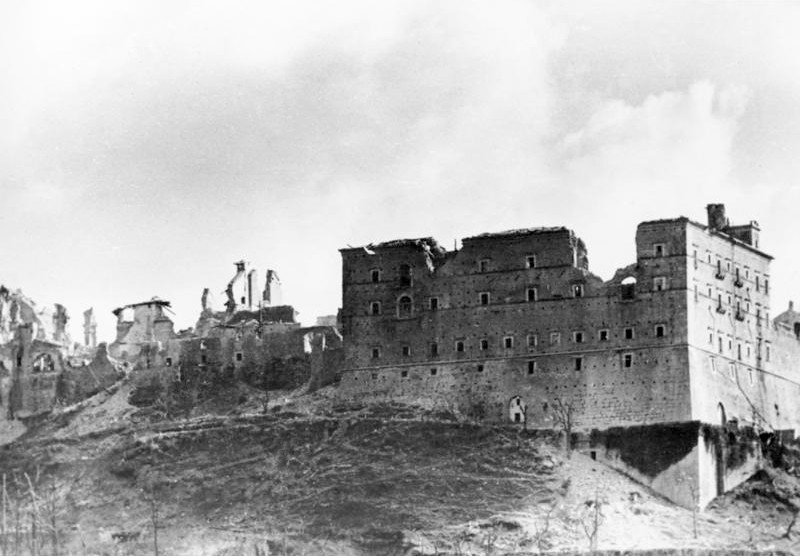
The ruins of the abbey at Monte Cassino after the 1944 battle.
Photograph credited to “Wittke” in the German Federal Archive (Bundesarchiv) via Wikimedia Commons.
On May 18, the day Australia goes to the polls, on the other side of the world we will be commemorating the 75th anniversary of the end of the bloodiest and hardest fought battle of the Italian campaign if not the whole of the Western front of WW2. On that day, a patrol from the 12th Podolian Cavalry Regiment raised the Polish flag above the ruins of the Benedictine monastery on top of Monte Cassino, bringing to an end four months and four Allied offensives against the heavily fortified Gustav (or Winter) Line, manned by crack German divisions across the entire width of the Italian boot about 100 miles south of Rome. Some of the German troops, veterans of the Eastern front, thought the fighting was worse than at Stalingrad. Others, on the Allied side, compared the conditions to Verdun. Unlike Russian cities or French fields, most of the fighting around Monte Cassino took place over an unimaginably difficult terrain of steep mountain slopes, deep valleys, wild rivers and landscape stripped bare by the artillery. It was a truly world battle in a world war: pitted against the Wehrmacht were the units from Great Britain, including British India and Rhodesia, the United States, France and its north African colonies like Morocco, Canada, Australia, New Zealand, including Maori troops, South Africa, Italy and Poland. Since the start of the Allied offensive in January 1944, waves after waves of troops of the 5th US and the 8th British armies smashed themselves against the rocks, unable to dislodge the well dug-in Germans. Finally, the fourth battle code-named Operation Diadem, which commenced with a massive bombardment on May 16, threw the British 13th Army Corp and the 2nd Polish Corp against the very linchpin of the Gustav Line at Monte Cassino and its monastery. Two days later it was over.
[…]
Churchill, right from the time of the Gallipoli disaster, remained obsessed about the vulnerability of the continental powers – primarily Germany – through what he called “the soft underbelly of Europe”. The war records are full of his harebrained schemes to attack the Axis through Italy, the Balkans or Greece and knock them out of the fight by a sharp thrust into the Central Europe. This was to be a masterstroke in place of the Normandy invasion, which Churchill strenuously opposed, and later in addition to it, to draw some of the German troops away from the northern France and indeed to get to Austria and southern Germany before the Red Army.
The problem with the soft underbelly of Europe is that it’s anything but. In fact it’s the hardest part of Europe; all rock, no roll. It’s mountains and deep valleys, fast rivers and vast forests, rudimentary roads and virtually no useful infrastructure. Unlike the northern European plains, this is the defender’s country where the Allies lost all the advantage of their numbers, their maneuverability and their armour. The two years of arduous slogfest from the southern Sicily to the Emilia-Romagna in the north might have indeed drawn valuable German troops from the other theaters of war but it was a bloody dead end. Poles were still stuck taking Bologna in April 1945, while only days later the patrols from Patton’s 3rd US Army were reaching the outskirts of Prague.
And Wojtek?
Monte Cassino is on my mind today, because entirely coincidentally I’m reading a delightful war book (that’s an oxymoron if there is one) titled Wojtek the Bear: Polish War Hero. It tells the surreal but entirely true story of a bear cub adopted by the Polish troops in northern Iran in 1942, towards the start of their anabasis from Stalin’s Siberia all the way to Italy and eventually Scotland. Accompanying the Poles through all their service in the Middle East and then southern Europe, Wojtek grew up to be a 6-foot, 500-pound ursine, who always thought he was a human. Quintessentially Polish (if only by adoption), he loved beer and cigarettes (he also ate them, but only if lit), taking showers with the troops and riding shotgun in army trucks. Some of his war-time exploits included capturing an Arab spy in Iraq and stealing underwear from a female support unit. But Wojtek truly became a legend during the battle of Monte Cassino, when to his comrades’ amazement he volunteered to carry ammunition in his paws. He was eventually made a Private in the Polish Army, and lived until 1963, continuing to win hearts in Scotland, where the Polish troops were repatriated after the war.
Boys Anti-Tank Rifle: Mk I and Mk I* Improvements
Forgotten Weapons
Published on 11 Apr 2019These rifles are lots #1087 and #1088 at Morphy’s April 2019 auction:
https://www.forgottenweapons.com/boys…The Boys Anti-Tank Rifle was adopted by the British military in 1937, and remained in production until 1943 when it was replaced by the PIAT. During that time more than 114,000 were made, both in the UK and in Canada. Canadian engineers at the John Inglis company devised a number of improvements to the rifle in 1942, which were adopted as the Mk I* pattern that year. Today we are looking at these improvements with examples of each type side by side. They are a new style of muzzle brake, simplified rear sight, and improved bipod design.
http://www.patreon.com/ForgottenWeapons
Cool Forgotten Weapons merch! http://shop.bbtv.com/collections/forg…
Contact:
Forgotten Weapons
PO Box 87647
Tucson, AZ 85754
May 15, 2019
Mussolini and D’Annunzio On The Rise – Allies in Crisis Over Italy I THE GREAT WAR April 1919
The Great War
Published on 14 May 2019» SUPPORT THE CHANNEL
Patreon: https://www.patreon.com/thegreatwar
Merchandise: https://shop.spreadshirt.de/thegreatwar/Italy joined World War 1 in 1915 after it had been promised territorial gains in the Treaty of London. Now that the Central Powers had been defeated, the Italian government and the Italians themselves expected that their contribution would be honored at the Paris Peace Conference. But France, Great Britain and the US had other plans and so the Italian government was caught between the new realities at Paris and the nationalists at home.
» SOURCES
Gerwarth, Robert. The Vanquished. Why the First World War Failed to End, 1917-1923 (Penguin, 2017).Leonhard, Jörn. Der überforderte Frieden. Versailles und die Welt 1918-1923 (CH Beck, 2018)
Macmillan, Margaret. The Peacemakers: Six Months that Changed the World (London: John Murray, 2001).
Report: Disorders Inquiry Committee 1919-1920 (Calcutta: Superintendent of Government Printing, India: 1920)
Sullivan, “Vittoria Mutilata” in 1914-1918 online. International Encyclopedia of the First World War https://encyclopedia.1914-1918-online…
Thompson, Mark. The White War: Life and Death on the Italian Front 1915-1919 (London: Faber, 2008).
» SOCIAL MEDIA
Twitter: https://twitter.com/WW1_Series
Reddit: https://reddit.com/r/TheGreatWarChannel»CREDITS
Presented by: Jesse Alexander
Written by: Jesse Alexander
Director: Toni Steller & Florian Wittig
Director of Photography: Toni Steller
Sound: Toni Steller
Editing: Toni Steller
Mixing, Mastering & Sound Design: http://above-zero.com
Motion Design: Christian Graef – GRAEFX
Maps: Daniel Kogosov (https://www.patreon.com/Zalezsky)
Research by: Jesse Alexander
Fact checking: Florian WittigChannel Design: Alexander Clark
Original Logo: David van StepholdA Mediakraft Networks Original Channel
Contains licensed material by getty images
All rights reserved – Real Time History GmbH 2019
May 14, 2019
The Broad Fourteens – Royal Navy Motor Torpedo Boats In WWII
PeriscopeFilm
Published on 20 Sep 2017Support Our Channel : https://www.patreon.com/PeriscopeFilm
Made in 1945, THE BROAD FOURTEENS is one of the excellent, dramatized accounts of WWII made by the Ministry of Information for morale purposes. The film shows the first posting, and eventual first action, of a newly-trained motor torpedo boat (MTB) crew. (‘The Broad Fourteens’ is the name given to a patrol area of the North Sea off the Dutch coast.) The film joins the boat and crew at the end of their training (probably HMS Bee, the Coastal Force working up base at Weymouth). The boats featured include 70’ Vosper 1942 class boats, 70’ British Power Boat motor gunboats and MTB 210 — a J Samuel White-built 70’ Vosper which later joined the 13th MTB Flotilla at Dover. The fictional MTB 181 is probably MTB 352, commanded by Lieutenant John M Moore RNVR which joined the 11th MTB Flotilla at Felixstowe after completing her work up. Also featured is MTB 354, commanded by Lieutenant Roland Plugge RN which was the SO’s boat, 5th MTB Flotilla, at Dover. The German flak trawler is in fact an RN Isles Class trawler standing in.
(0:48) Introduces the viewer to how the “broad fourteens” came to exist. Navy training is depicted (2:15). At the training commander’s office (2:25) the film shows the commander and the captain conversing about torpedo and battle experiences and strategies. [Note that they emphasize that Lieutenant Howard is Canadian, although clearly serving in the Royal Navy, as he doesn’t have a “Canada” patch on the shoulder of his uniform.] The crew is shown going through their regular activities. They discuss the previous battles as they are called together. The commander and the captain (5:10) discuss the boat’s impending departure. 5:40 shows the operational base as crews and the commander busily arrive the base. (6:48) operation room as a crew brings a report to the commander. The captain talks about his crew alongside another (7:28). At mark 8:00 the film shows the crew’s residential life. The crew are shown prepping for the first operation as their boats head offshore (9:15) and into the deep sea. The captain is shown calculating the boat’s navigation on his map (10:20). A communication link is established (11:18) and the captain discusses how much longer it is till they get to the operation site. Back at the base (12:20) the crews left converse. The crews are seen at the starmouth arms (14:30), they enjoyed listening to their music at (15:00). The crew takes care of their ship (16:05).
The commander converses with the captain (16:45). The crew are shown in their rooms (17:18). (17:27) is the Starmouth Arms where the crew talk among themselves. The Starmouth Arms manager receives a call which got all crews back to their base (18:40). The commander gives a report (19:20) on the mission and key targets. The meeting closes (20:00) as all crew member are set as they start their engine and move on (21:15). On the deep sea is the navigation map (21:50). At mark 22:20, the crews stops for awhile and takes a break. They move on (22:53). The key target is seen (23:10) and the troops get ready for firing. All crew on set as they wait on the captain to give the go ahead to shoot (23:50). The captain makes the key calculations as the crew stands by for the torpedo release. He gives the go (24:47) and the torpedo is launched out. The torpedo engages the target (25:06). Reports about the operation are documented (25:30) as they proceed to rendezvous point. Two German gun boats are sighted (25:47) as they appear and fire at the crew (26:03). Firing continues till 26:45. There is alarm about fire at the cargo base as a crew is injured (27:00). The fire is attended to as firing continues (27:50). The report about the casualty and the op is documented (28:30). Explosives are launched across the sea towards the enemy gun boats (29:15) as they cool down the heat on them.
Meanwhile back at the base, the film shows the commander (30:00) receiving a visit from his superior, who asks about the mission report as he looks towards the map (30:40). At the battle front, the captain asks about news on the gun boats (31:11) as his underlings all wait in anxiety. The gun boats are sighted (31:38) as they closes on fast towards the crew. At mark 31:53, they opened fire against the boat. A crew is hit (32:15). A gun boat comes in their rescue (33:00) and defeats the enemy boat. Gregory and Johnny are shown wounded. The gun boat (34:00) makes reports and request the course as they depart for home port.
This film is part of the Periscope Film LLC archive, one of the largest historic military, transportation, and aviation stock footage collections in the USA. Entirely film backed, this material is available for licensing in 24p HD, 2k and 4k. For more information visit http://www.PeriscopeFilm.com
Hotchkiss Revolving Cannon from San Juan Hill
Forgotten Weapons
Published on 9 Apr 2019This Hotchkiss cannon and its accessories are lot #1116 in the upcoming April 2019 Morphy auction:
https://www.forgottenweapons.com/hotc…
Benjamin Hotchkiss was an American artillery designer who moved to Paris in 1867 in hopes of building a business for his improvements in artillery shells. He experienced the Franco-Prussian War in 1870, and understood the failure of the French Mitrailleuse multi-barrel volley guns. In his opinion, an effective rapid-fire weapon needed to fire explosive projectiles to have a real effect at extended range (unlike the Mitrailleuse which fired simple rifle bullets). So being the inventive sort, he went ahead and designed just such a gun. His revolving cannon was sized for 1-pound (450g) 37mm explosive shells (although he would also produce armor-piercing and canister ammunition). The gun looks like a Gatling gun at first glance, but its mechanical operation is quite different.
The Hotchkiss cannon would become quite popular, with major purchases by the French and American navies as well as many other nations. They would serve into World War One, including some use repurposed as antiaircraft weapons. This particular example was captured by American forces in Cuba during the Spanish-American War, most likely from San Juan Hill. It is a magnificent example of the type, and with a fantastic historical provenance to match.
http://www.patreon.com/ForgottenWeapons
Cool Forgotten Weapons merch! http://shop.bbtv.com/collections/forg…
Contact:
Forgotten Weapons
PO Box 87647
Tucson, AZ 85754
May 13, 2019
U.S. Civil War – Surprising Soldiers – Extra History
Extra Credits
Published on 11 May 2019Historians have been learning that the US Civil War armies were a lot more diverse than previously accounted for — partly because many soldiers who hailed from other countries and nations used adopted names. Chinese, Hawaiian, Hispanic, and Cherokee soldiers all participated on both sides of the US civil war — suffering even more conflict in some cases.
Researchers are beginning to learn that the makeup of the Union and Confederate armies in the US Civil War was a lot more nuanced and diverse than we had previously known. Here is an episode on the accounts of some of those surprising soldiers!
Join us on Patreon! http://bit.ly/EHPatreon
The political persecution of Vice-Admiral Norman
Conrad Black on the recently stayed prosecution of the former Vice-Chief of the Defence Staff, Vice-Admiral Mark Norman:

The RCMP, the same Palooka force that brought us the ghastly fiasco of the trial and resounding acquittal of Senator Mike Duffy, alleged that Vice Adm. Norman was the source of press leaks, and searched his house with a warrant in January 2017, a fact that was also mysteriously leaked to the press. He was suspended with full pay, and finally, in March of 2018, he was charged with a criminal breach of trust. The government barred him from the benefit of the loan of money for legal fees to accused government employees pending judgment, a capricious attempt to starve him into surrender.
Neither the media, usually pretty quick to jump on the back of any defendant, nor any other serious observers, believed the defendant, who started in the navy as a diesel mechanic and rose for 33 years to commander of the fleet and then serve as vice-chief of the defence staff, would do such a thing, or that the RCMP had any real evidence. It didn’t, inciting the suspicion that the Mounties, if they can’t raise their game, should stick to musical rides and selling ginger ale, and reinforcing the view that the Armed Forces should be funded properly, and not just in phony announcements every few years of naval construction and army and air force procurement programs that don’t happen. And It is, in any case unacceptable that police corporals get warrants to search the home of the second highest military officer in the country on grounds that are eventually shown to be unfounded.
It appears to be clear that exculpatory evidence was withheld by the prosecutors, deliberately or otherwise. Outgoing Liberal MP and parliamentary secretary Lt. Gen. (Rt.) Andrew Leslie (a grandson of two former defence ministers, Gen. Andrew McNaughton and Brooke Claxton), had announced he would testify on behalf of Vice Adm. Norman. The prime minister ducked out of question period for two days as this contemptible abuse of prosecution collapsed. Instead, he should, if conscientiously possible, have blamed it on the former attorney general, Jody Wilson-Raybould. That would have been believable, given some of her other antics in that office.
If he can’t do that, then this rotten egg falls on him and could be a politically mortal blow. The SNC-Lavalin affair was an attempt to save jobs in Canada and avoid over-penalization of a successful international company where there is a legal right for the justice department to choose between a fine and criminal prosecution. It was bungled, a ludicrous amateur hour that brought down senior civil servants and led to expulsions of ex-cabinet ministers as Liberal MPs, but it was not a show-stopper unless the prime minister lied to Parliament.
This appears to be a malicious and illegal prosecution of a blameless senior serving officer, who fought his corner as a brave man must. If that is what it is, heads should roll, not of scapegoats, token juniors, or fall-guys, but of those responsible for this outrage.
May 12, 2019
Hitler Strikes in the West – WW2 – 037 – May 11 1940
World War Two
Published on 11 May 2019As the Allied troops in central Norway are evacuated and the Norwegian troops there surrender to the Germans, the Allied position around Narvik is still quite strong. With the addition of roughly 5000 Polish soldiers, the French, British and Norwegian force will prove to be a formidable foe for the Germans up North. This week however, the war drastically changes as not three but four Neutral countries are invaded. The Phoney War is ultimately over.
Join us on Patreon: https://www.patreon.com/TimeGhostHistory
Or join The TimeGhost Army directly at: https://timeghost.tvFollow WW2 day by day on Instagram @World_war_two_realtime https://www.instagram.com/world_war_t…
Join our Discord Server: https://discord.gg/D6D2aYN.
Between 2 Wars: https://www.youtube.com/playlist?list…
Source list: http://bit.ly/WW2sourcesWritten and Hosted by: Indy Neidell
Produced and Directed by: Spartacus Olsson and Astrid Deinhard
Executive Producers: Bodo Rittenauer, Astrid Deinhard, Indy Neidell, Spartacus Olsson
Creative Producer: Joram Appel
Research by: Indy Neidell
Edited by: Ben Ollerenshaw and Wieke Kapteijns
Map animations: EastoryColorisations by Norman Stewart and Julius Jääskeläinen https://www.facebook.com/JJcolorization/
Sources: IWM (A 7644), IWM (A 7637), IWM HU 55505, Bundesarchiv, Photos from the Jonatan Myhre Barlien photo collection.
Eastory’s channel: https://www.youtube.com/channel/UCEly…
Archive by Screenocean/Reuters https://www.screenocean.com.A TimeGhost chronological documentary produced by OnLion Entertainment GmbH.
From the comments:
World War Two
The Phoney War is over. This is the week that many have been anxiously waiting for (how did they know something big was going to happen). We have some great episodes coming up, which are like this one only as great as they are because of the amazing effort that our team puts in creating them. As is very apparent in this episode, Eastory’s maps take these videos to the next level. Every week we’re stunned by his level of detail and the amazing value that is added by these maps. As the war enters a new phase, so do we. Next week will see the first of our roadtrip to France specials going live as well as the longest weekly episode we have written up until now.Cheers,
Joram
QotD: The British Army between the wars
In the nineteenth century the British common soldier was usually a farm labourer or slum proletarian who had been driven into the army by brute starvation. He enlisted for a period of at least seven years – sometimes as much as twenty-one years – and he was inured to a barrack life of endless drilling, rigid and stupid discipline, and degrading physical punishments. It was virtually impossible for him to marry, and even after the extension of the franchise he lacked the right to vote. In Indian garrison towns he could kick the “niggers” with impunity, but at home he was hated or looked down upon by the ordinary population, except in wartime, when for brief periods he was discovered to be a hero. Obviously such a man had severed his links with his own class. He was essentially a mercenary, and his self-respect depended on his conception of himself not as a worker or a citizen but simply as a fighting animal.
Since the war the conditions of army life have improved and the conception of discipline has grown more intelligent, but the British army has retained its special characteristics – small size, voluntary enlistment, long service and emphasis on regimental loyalty. Every regiment has its own name (not merely a number, as in most armies), its history and relics, its special customs, traditions, etc., etc., thanks to which the whole army is honey-combed with snobberies which are almost unbelievable unless one has seen them at close quarters. Between the officers of a “smart” regiment and those of an ordinary infantry regiment, or still more a regiment of the Indian Army, there is a degree of jealousy almost amounting to a class difference. And there is no question that the long-term private soldier often identifies with his own regiment almost as closely as the officer does. The effect is to make the narrow “non-political” outlook of the mercenary come more easily to him. In addition, the fact that the British Army is rather heavily officered probably diminishes class friction and thus makes the lower ranks less accessible to “subversive” ideas.
But the thing which above all else forces a reactionary view-point on the common soldier is his service in overseas garrisons. An infantry regiment is usually quartered abroad for eighteen years consecutively, moving from place to place every four or five years, so that many soldiers serve their entire time in India, Africa, China, etc. They are only there to hold down a hostile population and the fact is brought home to them in unmistakeable ways. Relations with the “natives” are almost invariably bad, and the soldiers – not so much the officers as the men – are the obvious targets for anti-British feeling. Naturally they retaliate, and as a rule they develop an attitude towards the “niggers” which is far more brutal than that of the officials or business men. In Burma I was constantly struck by the fact that the common soldiers were the best-hated section of the white community, and, judged simply by their behaviour, they certainly deserved to be. Even as near home as Gibraltar they walk the streets with a swaggering air which is directed at the Spanish “natives.” And in practice some such attitude is absolutely necessary; you could not hold down a subject empire with troops infected by notions of class-solidarity. Most of the dirty work of the French empire, for instance, is done not by French conscripts but by illiterate Negroes and by the Foreign Legion, a corps of pure mercenaries.
To sum up: in spite of the technical advances which do not allow the professional officer to be quite such an idiot as he used to be, and in spite of the fact that the common soldier is now treated a little more like a human being, the British army remains essentially the same machine as it was fifty years ago.
George Orwell, “Democracy in the British Army”, Left, 1939-09.
May 11, 2019
The Three Kingdoms – Yellow Turban Rebellion – Extra History – #1
Extra Credits
Published on 9 May 2019This series is brought to you by Total War: THREE KINGDOMS, a brand new strategy game set during this time period. https://store.steampowered.com/app/77…
Fierce duels. Great armies. Love, brotherhood and betrayal. These are the images conjured when we speak of the Three Kingdoms.
Liu Bei, Zhang Fei, Guan Yu — these were the men who would define the Three Kingdoms period. Even though the actual history of this period is often conflated with the events of the historical novel, Romance of the Three Kingdoms, there was still a lot of compelling drama and intrigue we can explore — let’s delve in to the Yellow Turban Rebellion, which really did happen!
Thanks to Jordan Martin for the guest art! https://www.jordanwmartin.com/
Join us on Patreon! http://bit.ly/EHPatreon
Balkans, Bazookas, and Bunkers – WW2 – OOTF 002
World War Two
Published on 9 May 2019Out of the Foxholes is back to answer your questions about the war. In this episode, we take a look at anti-tank weaponry for infantry, the German defensive lines of the Westwall, the never-finished German aircraft-carrier Graf Zeppelin and the Balkans. The Chieftain, who has his own YouTube channel about tanks and armored vehicles, joins us to answer some of your technical questions. Do you have any questions of your own? You can submit them here: https://community.timeghost.tv/c/Out-…
Join us on Patreon: https://www.patreon.com/TimeGhostHistory
Or join The TimeGhost Army directly at: https://timeghost.tvCheck out The Chieftain on Youtube: https://www.youtube.com/user/TheChief…
Follow WW2 day by day on Instagram @World_war_two_realtime https://www.instagram.com/world_war_t…
Join our Discord Server: https://discord.gg/D6D2aYN.
Between 2 Wars: https://www.youtube.com/playlist?list…
Source list: http://bit.ly/WW2sourcesWritten and Hosted by: Indy Neidell
Produced and Directed by: Spartacus Olsson and Astrid Deinhard
Executive Producers: Bodo Rittenauer, Astrid Deinhard, Indy Neidell, Spartacus Olsson
Creative Producer: Joram Appel
Research by: Joram Appel
Edited by: Wieke Kapteijns and Spartacus OlssonArchive by Screenocean/Reuters https://www.screenocean.com.
A TimeGhost chronological documentary produced by OnLion Entertainment GmbH.
From the comments:
World War Two
Out of the Foxholes is back! While we can’t make this into a regular thing yet, releasing one on set days and stuff, we love doing them and will publish one whenever we find some time to make them. In this edition, The Chieftain joins us to tackle some of the technical questions we have received. Did you know that the Chieftain has made several special episodes about tanks and tactics leading up to World War Two on his own channel? You can find that right here: https://www.youtube.com/user/TheChieftainWoT
If you want to submit a question of your own, you can do that right here: https://community.timeghost.tv/c/Out-of-the-Foxholes-QsPlease consider supporting us on Patreon, as this project is almost fully driven by the financial support we receive on there. You can find our Patreon page right here: https://www.patreon.com/TimeGhostHistory
Cheers,
Joram
Inside the Chieftain’s Hatch. M151 Series
The_Chieftain
Published on 6 Apr 2019A fun, and rather dangerous, little softskin which will easily fit in your garage.


