Quotulatiousness

May 9, 2019

MV Asterix delivers for the Royal Canadian Navy and breach of trust charge is dropped

Filed under: Cancon, Law, Military, Politics — Tags: , , , , , — Nicholas @ 03:00

Amid rumours that the Trudeau government is contemplating dropping the charge against Admiral Mark Norman, Matthew Fisher retweeted a link to his article from last year, praising the ship and suggesting that it should be renamed in honour of the man who did everything he could to get the RCN’s only current replenishment ship to sea:

MV Asterix
Photo via Canadian Defence Review

Aboard MV Asterix and HMCS Charlottetown – The Trudeau government would have fits, but the Royal Canadian Navy should consider renaming the MV Asterix the HMCS Admiral Mark Norman.

The controversial new replenishment ship, which entered service on time and on budget this past January, has been performing brilliantly for the navy during sea trials. That was the unanimous opinion of sailors on HMCS Charlottetown and on MV Asterix after a series of refuelling exercises with the Canadian frigate and American destroyers during a hunt for three U.S. nuclear subs that I witnessed recently in the Caribbean.

The only hiccup during the five-day war game was on the American side. The crew on one of the destroyers was unable to establish a good seal on the fuel probe Asterix sent over as the vessels sailed at 15 knots in a two-metre sea with about 30 metres of water between them. However, it only took about 10 minutes to fix the problem.

Vice-Admiral Mark Norman, who ran the RCN before becoming the military’s second-in-command, strongly supported leasing or buying Asterix. The admiral was suspended early last year and subsequently charged with breach of trust for allegedly violating cabinet confidences. He is accused of passing on information pertaining to doubts that the Trudeau government was believed to have had about leasing the vessel. Although there were strong signals that it wanted out of the deal, the government eventually decided to honour a contract that Davie had with the Harper government to lease Asterix for five years at will be a cost of $677 million,according to the Globe and Mail.

“I think the Asterix is fantastic,” said Chief Petty Officer 2nd Class Mark Parsons, the Charlottetown’s chief bosun’s mate, who oversaw two approximately hour-long, problem-free fuel transfers from the tanker to his warship. “We have missed that capability since (HMCS) Preserver was retired in 2014” because of electrical problems and corrosion.

Parsons’ opposite number on Asterix, CPO2 Steve Turgeon, served on the 48-year old Preserver until 2013. Since January he has been training four deck crews of 11 navy sailors each to handle refuellings. This has allowed Canada to once again be an independent blue-water navy after several years in which it depended on NATO allies and leased Chilean and Spanish navy tankers for fuel at sea. A fresh group of navy sailors has just begun training on the Asterix, which is participating with two Canadian frigates in the vast U.S.-led, 25-nation Rim of the Pacific naval exercise off Hawaii this month.

And on the legal front:

Later in the day, the news was finally made official: the government has dropped the charge and Vice-Admiral Mark Norman wants his job back:

The newly exonerated Vice-Admiral Mark Norman says he was alarmed by the persistent belief among senior government officials that he was guilty, and that their false assumptions took a significant financial and emotional toll on him and on his family.

On Wednesday, prosecutors stayed the single criminal charge of breach of trust laid against Norman, a major victory for the senior naval officer who has always maintained his innocence in the face of allegations he leaked confidential information about a project to procure a supply ship for the Royal Canadian Navy. In announcing the decision, Crown prosecutor Barbara Mercier told the court it was necessary in part due to new evidence the defence produced in March.

“This new information definitely provided greater context to the conduct of Vice-Admiral Norman, and it revealed a number of complexities in the process that we were not aware of,” Mercier said. “Based on the new information, we have come to the conclusion that given the particular situation involving Vice-Admiral Mark Norman, there is no reasonable prospect of conviction in this case.”

She did not provide any details on what exactly that information was.

The announcement ends the two-year legal battle against the officer and heads off what would have been a politically explosive trial for the Liberal government in the middle of a federal election campaign.

A fascinating little detail is also reported:

[Admiral Norman only] learned from a reporter’s question that Defence Minister Harjit Sajjan had announced the government would pay for his legal fees. “Wow,” was all he could muster in response. In 2017, the Department of National Defence had denied Norman’s request for financial assistance, concluding he was likely guilty.

So even though they’re finally making the right gestures, they still manage to be as ungracious as humanly possible while doing so. It’s not the kind of reputation you’d want to encourage.

May 7, 2019

The Suez Crisis reconsidered

Filed under: Books, Britain, France, History, Military, USA — Tags: , , , , , — Nicholas @ 05:00

Jordan Chandler Hirsch reviews a new book on what is now a somewhat forgotten international crisis that shook the Atlantic alliance, Philip Zelikow’s Suez Deconstructed:

Zelikow encourages readers to assess Suez by examining three kinds of judgments made by the statesmen during the crisis: value judgments (“What do we care about?”), reality judgments (“What is really going on?”), and action judgments (“What can we do about it?”). Asking these questions, Zelikow argues, is the best means of evaluating the protagonists. Through this structure, Suez Deconstructed hopes to provide “a personal sense, even a checklist, of matters to consider” when confronting questions of statecraft.

The book begins this task by describing the world of 1956. The Cold War’s impermeable borders had not yet solidified, and the superpowers sought the favor of the so-called Third World. Among non-aligned nations, Cold War ideology mattered less than anti-colonialism. In the Middle East, its champion was Egyptian President Gamal Abdel Nasser, who wielded influence by exploiting several festering regional disputes. He rhetorically — and, the French suspected, materially — supported the Algerian revolt against French rule. He competed with Iraq, Egypt’s pro-British and anti-communist rival. He threatened to destroy the State of Israel. And through Egypt ran the Suez Canal, which Europe depended on for oil.

Egypt’s conflict with Israel precipitated the Suez crisis. In September 1955, Nasser struck a stunning and mammoth arms deal with the Soviet Union. The infusion of weaponry threatened Israel’s strategic superiority, undermined Iraq, and vaulted the Soviet Union into the Middle East. From that point forward, Zelikow argues, the question for all the countries in the crisis (aside from Egypt, of course) became “What to do next about Nasser?”

Israel responded with dread, while, Britain, France, and the United States alternated between confrontation and conciliation. Eventually, the United States abandoned Nasser, but he doubled down by nationalizing the Suez Canal. This was too much for France. Hoping to unseat Nasser to halt Egyptian aid to Algeria, it concocted a plan with Israel and, eventually, Britain for Israel to invade Egypt and for British and French troops to seize the Canal Zone on the pretense of separating Israeli and Egyptian forces. The attack began just before the upcoming U.S. presidential election and alongside a revolution in Hungary that triggered a Soviet invasion. The book highlights the Eisenhower administration’s anger at the tripartite plot. Despite having turned on Nasser, Eisenhower seethed at not having been told about the assault, bitterly opposed it, and threatened to ruin the British and French economies by withholding oil shipments.

Throughout, Suez Deconstructed disorients. As the story crisscrosses from terror raids into Israel to covert summits in French villas, from Turtle Bay to the Suez Canal, names and places, thoughts and actions blur. Venerable policymakers scramble to comprehend the latest maneuvers as they struggle with the weight of history: Was Suez another Munich? Could Britain and France still project power abroad? Would a young Israel survive?

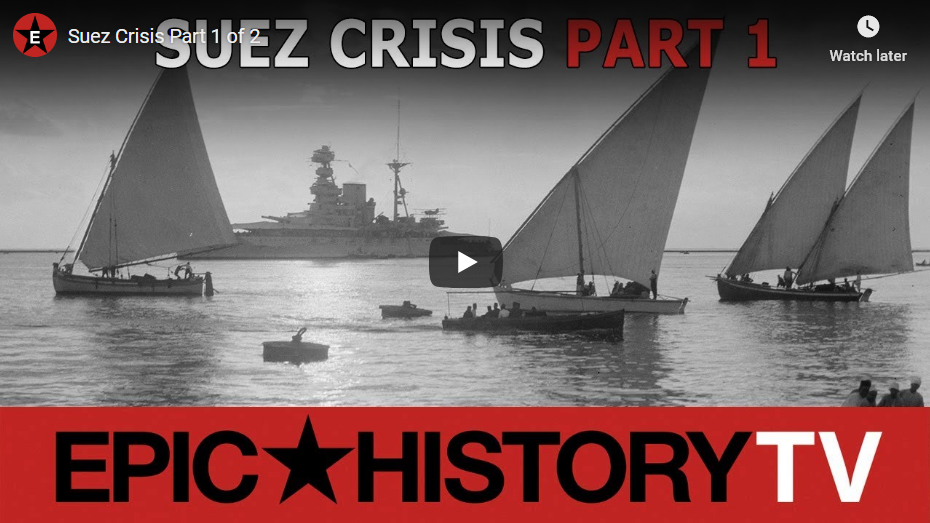
If you’re not familiar with the Suez Crisis and want more than just the Wikipedia article for background, here’s the coverage of the military side of things from the British perspective (Operation Musketeer) from Naval History Homepage.

A detailed map of Port Said in 1936 (American Geographical Society Library). Changes by 1956 are not known.
Map via Naval History Homepage.

May 6, 2019

Queen Nzinga – The Double Queen – Extra History – #2

Filed under: Africa, History, Military, Religion — Tags: , , , — Nicholas @ 06:00

Extra Credits
Published on 4 May 2019

Nzinga was briefly, temporarily supplanted by Ngola Hari who had been installed by the Portuguese, but she was determined to let nothing get in the way of keeping West Africa safe from colonial powers. To achieve this end, she would go on to form — and break, as she pleased — alliances with the Dutch, the Imbangala, and even the Catholic Church!

Thanks again to Cassandra Khaw for guest-writing this mini-series!

Join us on Patreon! http://bit.ly/EHPatreon

From the comments:

Extra Credits
Queen Nzinga is a woman who, despite being one of the best-documented rulers in early modern Africa, still presents a puzzle. Her record, from ambitious noble, to guerrilla fighter, to consummate diplomat and religious reformer is still haunted by myths conjured up by her enemies — and a few constructed by Nzinga herself.

Catch our Lies episode next week for behind-the-scenes on our research for the Siege of Vienna and Queen Nzinga series!

Mers El Kebir: When The British Blew Up the French Fleet

Filed under: Britain, France, History, Military, WW2 — Tags: , , , , — Nicholas @ 04:00

Historigraph
Published on 4 May 2019

Join us in #WarThunder for free using this link and get a premium tank or aircraft and three days of premium time as a bonus: https://gjn.link/Historigraph/190504

If you enjoyed this video and want to see more made, consider supporting my efforts on Patreon: https://www.patreon.com/historigraph

To chat history, join my discord: https://discord.gg/vAFTK2D

#WarThunder #MersElKebir #Historigraph

► Twitter: https://twitter.com/historigraph
►Patreon: https://www.patreon.com/historigraph
►Discord: https://discord.gg/vAFTK2D

Sources:

Colin Smith, England’s Last War Against France: Fighting Vichy 1940-42

Stephen Roskill, Churchill and the Admirals

Correli Barnett, Engage the enemy more closely

http://avalon.law.yale.edu/wwii/frgea…

Music:

Rynos Theme, Incompetech https://incompetech.com

Malicious, Incompetech https://incompetech.com

Crypto, Incompetech https://incompetech.com

Arctic Warfare Magnum: Accuracy International L115A3

Filed under: Britain, Military, Technology, Weapons — Tags: , , — Nicholas @ 02:00

Forgotten Weapons
Published on 29 Mar 2019

http://www.patreon.com/ForgottenWeapons

Cool Forgotten Weapons merch! http://shop.bbtv.com/collections/forg…

In 2007, the British Army placed an order for 582 AI Arctic Warfare Super Magnum rifles chambered for the .338 Lapua Magnum cartridge, formally adopting the model as the L115A3 sniper rifle. This followed special forces use of the .338 Accuracy International rifles in Afghanistan, where the A1 (fixed stock) and A2 (folding stock) models had both been given designations. With the adoption of the L115, the British retired all of their remaining L96A1 rifles, and moved to the .338 cartridge for all of their sniping equipment. At the same time, the SSIP (Sniper System Improvement Program) was improving and updating all the ancillary gear used with the guns – scopes, bipods, ballistic calculators and training programs, spotting scopes, and more. These remain the current British sniper weapon today, and they are quite formidable kit in properly trained hands.

Thanks to Steve Houghton for providing me access to this rifle! If you are interested in learning more, I highly recommend checking out Steve’s newly released book, “The British Sniper: A Century of Evolution”. It can be found at:

https://www.swiftandboldpublishing.co…

Contact:
Forgotten Weapons
PO Box 87647
Tucson, AZ 85754

Update: Apparently the video plays better if you actually remember to include the embed code before saving the post. Who knew?

May 5, 2019

Retreat in the North, Preparations in the West – WW2 – 036 – May 4 1940

Filed under: China, Europe, History, Japan, Military, WW2 — Tags: , , , , , — Nicholas @ 04:00

World War Two
Published on 4 May 2019

Allied plans to take Trondheim in Norway to allow for larger reinforcements and even bigger aerial support to come in are disbanded as the troops approaching Trondheim are pulled back from Norway. While the Allied efforts in Norway lose force there, the Allied forces in Western Europe are prepared for a German invasion through the Benelux countries. The Japanese too are determined to continue their campaign in China, and send thousands more young men into the battlefields.

Join us on Patreon: https://www.patreon.com/TimeGhostHistory
Or join The TimeGhost Army directly at: https://timeghost.tv

Follow WW2 day by day on Instagram @World_war_two_realtime https://www.instagram.com/world_war_t…
Join our Discord Server: https://discord.gg/D6D2aYN.
Between 2 Wars: https://www.youtube.com/playlist?list…
Source list: http://bit.ly/WW2sources

Written and Hosted by: Indy Neidell
Produced and Directed by: Spartacus Olsson and Astrid Deinhard
Executive Producers: Bodo Rittenauer, Astrid Deinhard, Indy Neidell, Spartacus Olsson
Creative Producer: Joram Appel
Research by: Indy Neidell
Edited by: Iryna Dulka
Map animations: Eastory

Colorisations by Norman Stewart and Julius Jääskeläinen https://www.facebook.com/JJcolorization/
Some photos depicting Norway are from the Jonatan Myhre Barlien’s photo collection.

Eastory’s channel: https://www.youtube.com/channel/UCEly…
Archive by Screenocean/Reuters https://www.screenocean.com

A TimeGhost chronological documentary produced by OnLion Entertainment GmbH.

From the comments:

World War Two
The situation in Norway looks grim for the Allied forces, and the Norwegians are steadily losing faith in the Allied capability to turn things around. And even though all is still quiet on the Western Front, the Allies have a plan ready to counter a German invasion of France and the Benelux countries. This episode is, again, very heavily filled with top notch maps and animations. These are all made by Eastory, who has a YouTube channel on his own as well! Check out and subscribe to his channel here: https://www.youtube.com/channel/UCElybFZ60Hk1NSjgCf7I2sg

Cheers,
Joram

May 3, 2019

“The Lost Battalion” – The Meuse-Argonne Offensive – Sabaton History 013

Filed under: France, Germany, History, Media, Military, USA, WW1 — Tags: , , — Nicholas @ 04:00

Sabaton History
Published on 2 May 2019

In the last months of the Great War, the Americans join the fighting on the Western Front in an effort to break through the German Lines for once and for all. The Americans launch their Meuse-Argonne Offensive in the fall of 1918. As part of the offensive, nine companies of the United States 77th Division under command of Major Charles White Whittlesey pushes through the German lines with remarkable ease. Little did they know that the German lines were not abandoned, but that they simply found a hole. The Lost Battalion was surrounded and the men had to fight for days, awaiting their rescue.

Support Sabaton History on Patreon (and possibly get a special edition of The Great War): https://www.patreon.com/sabatonhistory

Watch the Official Lyric Video of “The Lost Battalion” here: https://www.youtube.com/watch?v=oSZtV…

Check out the trailer for Sabaton’s new album The Great War right here: https://www.youtube.com/watch?v=HCZP1…

Listen to Sabaton on Spotify: http://smarturl.it/SabatonSpotify
Official Sabaton Merchandise Shop: http://bit.ly/SabatonOfficialShop

Hosted by: Indy Neidell
Written by: Markus Linke and Indy Neidell
Directed by: Astrid Deinhard and Wieke Kapteijns
Produced by: Pär Sundström, Astrid Deinhard and Spartacus Olsson
Creative Producer: Joram Appel
Executive Producers: Pär Sundström, Joakim Broden, Tomas Sunmo, Indy Neidell, Astrid Deinhard, and Spartacus Olsson
Maps by: Eastory
Edited by: Iryna Dulka
Sound Editing by: Marek Kaminski

Eastory YouTube Channel: https://www.youtube.com/channel/UCEly…
Archive by: Reuters/Screenocean https://www.screenocean.com
Music by Sabaton.

Sources:
© IWM (Q 8986), IWM (Q 10317), IWM (Q 8842), IWM (Q 9080), IWM (Q 87923), IWM (Q 61038), IWM (Q 53524), © IWM (Q 45553), IWM (Q 81616), IWM (Q 9078), IWM (Q 9079), IWM (Q 8844), IWM (Q 56607), IWM (Q 55559), IWM (Q 55558), IWM (Q 87940), IWM (Q 85383), IWM (Q 23719), IWM (Q 23709), IWM (Q 42057), IWM (Q 115198), IWM (Q 8161), IWM (Q 10316), IWM (Q 7928) IWM (Q 61481), IWM (Q 57695), IWM (Q 9088), IWM (Q 9083), IWM (Q 47997), IWM (Q 79595)
USMC Archives through Flickr: https://www.flickr.com/photos/6086806…

An OnLion Entertainment GmbH and Raging Beaver Publishing AB co-Production.

© Raging Beaver Publishing AB, 2019 – all rights reserved.

From the comments:

Sabaton History
1 day ago
We met up with Indy in the Argonne to film Sabaton History’s episode for “The Lost Battalion”. As it happens, our new album is about the First World War as well. We have published a video earlier today presenting the “History Channel Edition” for the upcoming Sabaton Album The Great War. This is a special edition of the new album that is an exclusive reward for people who generously support us on Patreon as a Hussar or higher. If you want to check out the video in which Joakim and Indy explain the contents of the special edition, click here: https://youtu.be/Nk-VN_PjZyg If you want to support this channel on Patreon, go here: https://www.patreon.com/sabatonhistory

Thanks for your time and cheers! 🤘

May 2, 2019

The French Char B Tank – WORLD WAR TWO Special

Filed under: France, History, Military, WW2 — Tags: , , — Nicholas @ 04:00

World War Two
Published on 30 Apr 2019

After the Great War was over, the French reconsidered their army’s function and the role that tanks would play in future warfare. On the brink of World War Two, the Char B tank is deeply embedded in the structure of the French armoured defences. David Willey from the Tank Museum in Bovington (UK) tells how French politics influenced how the Char B will be used if the Germans attack. To learn more about the technical details of the Char B, check out the Tank Chat that David Fletcher from the Tank Museum has done about the Char B-1 Bis: https://www.youtube.com/watch?v=tz8L1…

Check out the Tank Museum YouTube Channel right here: https://www.youtube.com/user/TheTankM…

Join us on Patreon: https://www.patreon.com/TimeGhostHistory
Or join The TimeGhost Army directly at: https://timeghost.tv

Follow WW2 day by day on Instagram @World_war_two_realtime https://www.instagram.com/world_war_t…
Source list: http://bit.ly/WW2sources

Written and Hosted by: David Willey and Indy Neidell
Produced and Directed by: Astrid Deinhard
Executive Producers: Bodo Rittenauer, Astrid Deinhard, Indy Neidell, Spartacus Olsson
Creative Producer: Joram Appel
Post Production Director: Wieke Kapteijns
Research by: David Willey
Edited by: Wieke Kapteijns

Archive by Screenocean/Reuters https://www.screenocean.com.

A TimeGhost chronological documentary produced by OnLion Entertainment GmbH.

From the comments:

World War Two
44 minutes ago (edited)
David Willey from the Tank Museum in Bovington (UK) explains brilliantly what impact French politics in the 1920s and 1930s had on the development and use of French tanks leading up to World War Two. On their own channel, the Tank Museums own David Flecher dives into the technical ins and outs of the Char B-1 tank. You can find that right here: https://www.youtube.com/watch?v=tz8L1FU74Rs Make sure to subscribe to their YouTube channel too, as it perfectly compliments the content that we show here. Cheers!

QotD: The Global Pottersville

Filed under: France, History, Media, Military, Quotations, USA — Tags: , — Nicholas @ 01:00

Director Frank Capra’s It’s a Wonderful Life, set during the Depression, was a divine counterfactual thought experiment designed to remind a suicidal George Bailey (Jimmy Stewart) that his hometown, Bedford Falls, would have turned out to be a pretty miserable place called Pottersville without his seemingly ordinary presence.

Consider the Obama administration’s first six years as a prolonged counterfactual take on what the world might have been like for the last 70 years without a traditionally engaged American president dedicating our country to preserving the postwar Western-inspired global order.

The what-if dream seems to be working to show the vast alterations in a world that Westerners once took for granted. France, a perennial critic of America, is suddenly an unlikely international activist. For seven decades, the French harped about American hyperpuissance – on the implied assurance that such triangulating would be ignored by an easily caricatured, aw-shucks American George Bailey trying his best to keep things in the global community from falling apart.

But now the Johnny-on-the-spot American everyman is gone, and lots of things have filled the vacuum. An overwhelmed France nevertheless intervened in Mali to staunch Islamic extremism. It bombed Libya, and then discovered that the United States’ new policy of “lead from behind” meant that America was no more likely to clean up the ensuing post-Qaddafi mess than was France — especially given that the new Mogadishu-on-the-Mediterranean was not far from Marseilles, but an Atlantic Ocean away from New York and Washington.

[…]

The aim of Capra’s fable was to remind us that the easily ridiculed, so-so status quo often hides Herculean efforts by those whom we take for granted, and who, working in the shadows, guarantee civilization instead of chaos. In the movie, the guardian angel Clarence can make the dream go away and cure George Bailey of his suicidal melancholy, as normalcy returns with the old Bedford Falls. In our version, we will learn soon after November 2016 whether we awake from the temporary alternative universe of a new Pottersville or whether it proves to be a depressing and continuing reality.

Victor Davis Hanson, “The Global Pottersville”, National Review, 2015-06-02.

May 1, 2019

Bavarian Soviet Republic – 1919 Economy and Reconstruction I BEYOND THE GREAT WAR

Filed under: France, Germany, History, Military — Tags: , , , , , — Nicholas @ 06:00

The Great War
Published on 30 Apr 2019

» SUPPORT THE CHANNEL
Patreon: https://www.patreon.com/thegreatwar
Merchandise: https://shop.spreadshirt.de/thegreatwar/

Jesse Alexander takes a look at the short lived but historically important Bavarian Soviet Republic that existed for 3 weeks in April 1919. He also takes a look at the post armistice economy and reconstruction in the west.

» SOURCES
Deperchin, Annie. “Des destructions aux reconstructions,” in Stéphane Audoin-Rouzeau and Jean-Jacques Becker, eds. Encyclopédie de la Grande guerre 1914-1918 (Paris : Bayard, 2013): 1063-1074.

Gerwarth, Robert. The Vanquished. Why the First World War Failed to End, 1917-1923 (Penguin, 2017).

Jones, Mark. Am Anfang war Gewalt. Die Deutsche Revolution 1918/19 und der Beginn der Weimarer Republik (Berlin: Propyläen, 2017). English edition: Founding Weimar. Violence and the German Revolution of 1918-19 (Cambridge University Press, 2016).

» SOCIAL MEDIA
Twitter: https://twitter.com/WW1_Series
Reddit: https://reddit.com/r/TheGreatWarChannel

»CREDITS
Presented by: Jesse Alexander
Written by: Jesse Alexander
Director: Toni Steller & Florian Wittig
Director of Photography: Toni Steller
Sound: Toni Steller
Editing: Toni Steller
Mixing, Mastering & Sound Design: http://above-zero.com
Motion Design: Christian Graef – GRAEFX
Maps: Daniel Kogosov (https://www.patreon.com/Zalezsky)
Research by: Jesse Alexander
Fact checking: Florian Wittig
Channel Design: Alexander Clark
Original Logo: David van Stephold

A Mediakraft Networks Original Channel Contains licensed material by getty images

All rights reserved – Real Time History GmbH 2019

From the comments:

The Great War
28 minutes ago
As a small production announcement: This was the last episode in the classical format where we answer questions directly. From May onward, every video we publish every other week will have one main topic: an important event from exactly 100 years ago. This will make it much easier to follow the channel and it will be more in line with our mission statement to cover the war in real time 100 years later. Of course, you can still ask questions. We will answer some of the directly in our Patreon podcast and we will use them as inspiration for our episodes. As an example: A lot of fans asked if we will cover the American “Polar Bear Expedition” and so that will be exactly what we will cover in our episode in late May. On top of that, we will do a small “time jump” and starting with our episode in June we will have a synchronized timeline again meaning: The episodes coming out in June 2019 will cover June 1919 and so forth.

Feds impose media ban on companies taking part in “the largest single outlay of tax dollars in Canadian history”

Filed under: Business, Cancon, Government, Media, Military — Tags: , , — Nicholas @ 05:00

Ted Campbell understands that governments need to keep some information secret (like the capability of weapon systems or details of naval radar implementations), but that our current federal government is going far beyond any reasonable definition of secrecy:

Type 26 Global Combat Ship — selected as the Canadian Surface Combatant program’s design winner.
(BAE Systems, via Flickr)

But, that sort of really SECRET stuff aside, we, citizens, do have a right to know how the government is spending our money and that, in my opinion, includes understanding “details about the industrial benefits and jobs supposedly to be created by the surface combatant project.” After all, it was our government, the Harper Conservative government to be clear, that selected, in that case, Irving Shipbuilding (Halifax) to be the supplier of new destroyer-frigate type warships, and they did so after what was described in a 2010 press release by then Public Works and Government Services Minister Rona Ambrose as developing a

    Strategy [that] promotes the regional distribution of work and opportunities to shipyards across the country. Shipyards that are selected to build the combat and non-combat packages will have to subcontract vast amounts of work to the broader marine industry and suppliers of this industry. Subcontracting in any of the three streams encompassed by the Strategy will be of notable benefit small and medium enterprises … [and] … The Government of Canada is committed to getting the best value for Canadian taxpayers. Under the Strategy, shipbuilding projects that are similar in nature will be grouped together to reduce production costs. This type of strategic sourcing will create the conditions for the effective and efficient delivery and support of the federal fleet over the long term.

That’s all pretty good stuff and I’m pretty sure that most Liberal ministers are still toeing that same line today. They promised industrial benefits and jobs; we, taxpayers, have a right to know if they are delivering.

But, in an article in the National Post, defence correspondent David Pugliese tells us that

    The Liberal government has brought in yet another media ban, this time affecting companies seeking work on a warship project that involves the largest single outlay of tax dollars in Canadian history … [in this case] … In a new directive, firms interested in maintenance work on the $60 billion Canadian Surface Combatant program have been told they can’t talk to journalists and instead must refer all inquiries to Public Services and Procurement Canada … [and] … At the same time, a public interest researcher who is seeking details about the industrial benefits and jobs supposedly to be created by the surface combatant project has been informed by government it will take at least three and a half years to get any such documents under the Access to Information law.

Mr Pugliese says, and these are two very worrying points, that:

  • The media ban imposed by Procurement Canada on firms interested in maintenance work on that fleet is the fifth such order in the last year involving the purchase of military equipment or ships, according to documents compiled by Postmedia; and
  • Industry representatives have sent the news organization the documents, warning about the growing secrecy at Procurement Canada. The records include a ban on firms talking to journalists about the Canadian Surface Combatants, the purchase of next generation fighter jets, a light icebreaker, a Defence department satellite, as well as a military pilot training contract. Industry executives point out the secrecy is not based on security concerns but on worries the news media will be able to use the information to keep close tabs on the problem-plagued military procurement system.

The Trudeau regime seems obsessed with secrecy and wants to bend all factual information to suit its narrative that it is spending our money as we might wish … which is, of course exactly what the Trudeau campaign said about Prime Minister Stephen Harper

April 29, 2019

Queen Nzinga – Rise of a Legend – Extra History – #1

Filed under: Africa, Europe, History, Military — Tags: , , , — Nicholas @ 06:00

Extra Credits
Published on 27 Apr 2019

Nzinga didn’t start out as a queen — but when she saw how incompetently her brother was running affairs in Ndongo (what would become Angola), she took advantage of his decision to send her to negotiate with the Portuguese — much to his grief later. Nzinga established herself against colonial forces and did not budge.

Queen Nzinga of the Ndongo and Matamba Kingdoms, a scion of the Mbundu people, will spend forty years standing between the Portuguese and their ambitions, using everything at her command — her cunning, her ruthless intellect, her military acumen, even the bodies of her people — whatever it takes to succeed.

Thanks again to Cassandra Khaw for guest-writing this mini-series!

Join us on Patreon! http://bit.ly/EHPatreon

April 28, 2019

Norway is Burning – WW2 – 035 – April 27 1940

Filed under: Britain, Europe, Germany, History, Military, WW2 — Tags: , , , , — Nicholas @ 04:00

World War Two
Published on 27 Apr 2019

The invasion and subsequent Battle of Norway has only just begun when the British decide to pull back. Poor planning and misfortune after misfortune harms the British campaign, which becomes very apparent this week while the fighting continues. Almost everywhere, except for in the far north, the Allied troops pull back under heavy German pressure.

Join us on Patreon: https://www.patreon.com/TimeGhostHistory
Or join The TimeGhost Army directly at: https://timeghost.tv

Follow WW2 day by day on Instagram @World_war_two_realtime https://www.instagram.com/world_war_t…
Join our Discord Server: https://discord.gg/D6D2aYN.
Between 2 Wars: https://www.youtube.com/playlist?list…
Source list: http://bit.ly/WW2sources

Written and Hosted by: Indy Neidell
Produced and Directed by: Spartacus Olsson and Astrid Deinhard
Executive Producers: Bodo Rittenauer, Astrid Deinhard, Indy Neidell, Spartacus Olsson
Creative Producer: Joram Appel
Research by: Indy Neidell
Edited by: Iryna Dulka
Map animations: Eastory

Colorisations by Norman Stewart and Julius Jääskeläinen https://www.facebook.com/JJcolorization/

Eastory’s channel: https://www.youtube.com/channel/UCEly…
Archive by Screenocean/Reuters https://www.screenocean.com

Sources:
© IWM (HU 74922)
© IWM (HU 104678)
© IWM (A 22641)
© IWM (TR 209)
© IWM (N 97)
© IWM (A 1873)
© IWM (N 102)
© IWM (HU 104688)
© IWM (Q 88619)
© IWM (N 107)
© IWM (Q 92253)
© IWM (HU 91803)

National Army Museum (NAM), 1984-10-79-.

A TimeGhost chronological documentary produced by OnLion Entertainment GmbH.

The Battle of Lützen – 1632 – The 30 Years War (in Swedish, with English sub-titles)

Gripen
Published on 3 Dec 2015

One of the bloodiest battles of the Thirty Years War. Sweden vs. the Holy Roman Empire. A mass grave has been found, with the victims from the battle. Are they Swedish/Finnish soldiers or German mercenaries?

(This Swedish documentary has English subtitles).

From the comments:

Blah b
2 years ago
This documentary is often painful to watch, the way inexperienced modern people with no sense of empathy project their values onto those times. They weren’t “defenseless men standing still”. Armies had learned the hard way that massed musket fire won battles. If everybody is looking for cover and looking out for themselves, you can never operate such rigid units.

So the individual soldier was harshly drilled to indeed stand still even with cannonballs tearing through his unit, or another unit standing 30-80 meters away. Because if individuals acted as individuals, the battle would be lost and the army would be destroyed.

But when that machine operated, it would win battles. The system invented by Maurice of the Netherlands ensured that if you were attacking a group of musketeers, every 20-25 seconds, they could deliver a crushing volley that can kill or injure 10-25% of a another unit, that means they only needed 2-3 salvos to achieve a local victory. Untrained units would literally never touch a musketeer, as his unit would’ve routed the attackers before they got within touching range.

Also there were no standing armies, there was no national identity as such. Mercenaries were totally acceptable. Mercenaries could become very loyal and reliable if paid on time [and] consistently, and would easily crush national armies that usually lacked the routine of professional soldiers. Loyalty and your identity was constructed differently. It would’ve been perfectly normal for me to utterly hate and maybe kill my neighbours if they were of a different religion. Otherwise, a Swedish protestant from far away was an ally with the right ideas. I wouldn’t have been able to understand him and everything would be alien about him, but I’d consider him a friend, and Catholics from the next village where I’d lived all my life would be enemies.

Unless the king comes around and says the Catholics are friends. Because the king is appointed by God who runs the world on a day to day [basis], and you obey without question. If the king says it’s so, that means God himself agrees and says it’s so, and you don’t question God. Loyalty until death is about the least you owed your king in those days.

People who can’t understand how such things worked historically, really should not be making documentaries…

April 27, 2019

Israeli Light-Barrel FAL (from DS Arms)

Filed under: History, Middle East, Military, Technology, Weapons — Tags: , , , , — Nicholas @ 02:00

Forgotten Weapons
Published on 23 Mar 2019

http://www.patreon.com/ForgottenWeapons

Cool Forgotten Weapons merch! http://shop.bbtv.com/collections/forg…

Israel was one of the very First Nations to adopt the FN FAL rifle – after Canada but before many actual other NATO nations. Israel made its first purchases of the rifles in 1955, and delayed them almost immediately in the 1956 Suez Crisis. The first rifles were wholly made by FN in Belgium, but over time IMI in Israel would produce almost all parts except receivers (they had a good working relationship with FN, which had licensed production of the Uzi submachine gun from IMI). These first rifles are good examples of many early FN design elements, which are not seen on later major NATO contracts, as the design details evolved over time. Israel would use the FAL through the Yom Kippur War in 1973 before transitioning to the 5.56mm Galil rifles.

In addition to the light-barrel infantry rifle, Israel also adopted a heavy barreled version of the FAL as a light machine gun or automatic rifle. These were fitted with stout bipods, but used the same 20-round magazines as the standard rifles.

A very small number of Israel semiauto FAL rifles were imported in the late 1980s, and they are very scarce in the United States today – or they were, until DS Arms acquired a supply of Israeli light-barrel parts kits and began assembling them into complete rifles to sell. They are particularly nice builds as the DSA markings and serial number are on the inside of the magazine well, allowing the external surface to be engraved with a very nice recreation of the original Israeli receiver markings with their distinctive Hebrew text and IDF insignia.

Stay tuned for an upcoming 2-Gun Action Challenge Match on InRangeTV using this rifle!

Contact:
Forgotten Weapons
PO Box 87647
Tucson, AZ 85754

« Newer PostsOlder Posts »

Powered by WordPress