
World War Two
Published 8 Dec 2022Japanese planes bomb Calcutta when it is still being crushed by the weight of the Bengali famine. Adolf Hitler and Albert Speer are obsessively trying to increase war production so Germany can begin launching its vengeance weapon against Britain. The wars of resistance continue across the Balkans with continued brutality and a new resistance force emerges in Italy.
(more…)
December 9, 2022
V-1: Hitler’s Deluded Revenge Plan – War Against Humanity 090
Comments Off on V-1: Hitler’s Deluded Revenge Plan – War Against Humanity 090
Rod Bayonet Springfield 1903 (w/ Royalties and Heat Treat)
Forgotten Weapons
Published 20 Nov 2016(Note: I misspoke regarding Roosevelt’s letter; he was President at the time and writing to the Secretary of War)
The US military adopted the Model 1903 Springfield rifle in 1903, replacing the short-lived Krag-Jorgenson rifle. However, the 1903 would undergo some pretty substantial changes in 1905 and 1906 before becoming the rifle we recognize today. The piece in today’s video is an original Springfield produced in 1904, before any of these changes took place.
The most notable difference is the use of the rod bayonet. When the 1903 was in development, the Ordnance Department opined that the bayonet was largely obsolete, and that it was unnecessary to encumber soldiers with a long blade hanging from the belt. Instead, the new rifle would have a retractable spike bayonet that could double as cleaning rod and would be stored in the rifle stock, unobtrusive to the soldier. This ended in 1905 with a critical letter from Theodore Roosevelt (who was Secretary of War at the time). As the rod bayonet was replaced with a traditional blade bayonet, the cartridge would also be improved to a new style spitzer projectile at higher velocity, and the rifles’ stocks, hand guards, and sights were redesigned.
In this video I also discuss two often misunderstood elements of the Springfield’s history: heat treating and patent royalties. Are low serial number 1903 Springfields safe to shoot, and why or why not? And did the US government actually pay royalties to Germany for copying Mauser elements in the 1903?
(more…)
Comments Off on Rod Bayonet Springfield 1903 (w/ Royalties and Heat Treat)
December 8, 2022
Is the Luftwaffe Defeated in 1943? – WW2 Documentary Special
World War Two
Published 7 Dec 2022Outnumbered and outproduced, the once mighty Luftwaffe is battling to hold its own across three fronts. Every month brings new pain for the force. But the Luftwaffe still has a few tricks up its sleeves and can make the Allies bleed heavily. If only Hitler and the Nazi leadership weren’t sabotaging its chances …
(more…)
Comments Off on Is the Luftwaffe Defeated in 1943? – WW2 Documentary Special
December 7, 2022
Pearl Harbor: Before and After December 7th
Geographics
Published 20 Sep 2022
(more…)
Comments Off on Pearl Harbor: Before and After December 7th
December 6, 2022
The coming of the Korean War
In Quillette, Niranjan Shankar outlines the world situation that led to the outbreak of the Korean War in 1950:
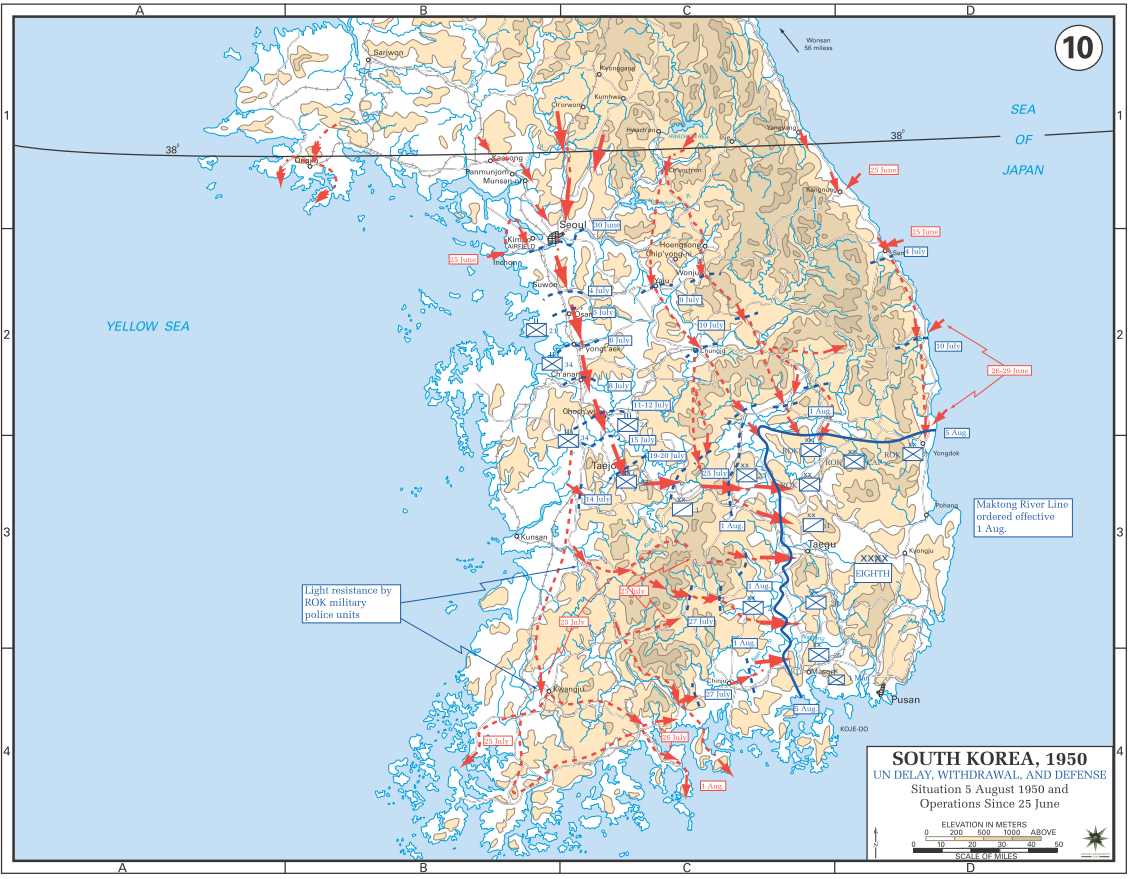
Initial phase of the Korean War, 25 June through 5 August, 1950.
Map from the West Point Military Atlas — https://www.westpoint.edu/academics/academic-departments/history/korean-war
The Korean War was among the deadliest of the Cold War’s battlegrounds. Yet despite yielding millions of civilian deaths, over 40,000 US casualties, and destruction that left scars which persist on the peninsula today, the conflict has never received the attention (aside from being featured in the sitcom M*A*S*H) devoted to World War II, Vietnam, and other 20th-century clashes.
But like other neglected Cold War front-lines, the “Forgotten War” has fallen victim to several politicized and one-sided “anti-imperialist” narratives that focus almost exclusively on the atrocities of the United States and its allies. The most recent example of this tendency was a Jacobin column by James Greig, who omits the brutal conduct of North Korean and Chinese forces, misrepresents the underlying cause of the war, justifies North Korea’s belligerence as an “anti-colonial” enterprise, and even praises the regime’s “revolutionary” initiatives. Greig’s article was preceded by several others, which also framed the war as an instance of US imperialism and North Korea’s anti-Americanism as a rational response to Washington’s prosecution of the war. Left-wing foreign-policy thinker Daniel Bessner also alluded to the Korean War as one of many “American-led fiascos” in his essay for Harper’s magazine earlier this summer. Even (somewhat) more balanced assessments of the war, such as those by Owen Miller, tend to overemphasize American and South Korean transgressions, and don’t do justice to the long-term consequences of Washington’s decision to send troops to the peninsula in the summer of 1950. By giving short shrift to — or simply failing to mention — the communist powers’ leading role in instigating the conflict, and the violence and suffering they unleashed throughout it, these depictions of the Korean tragedy distort its legacy and do a disservice to the millions who suffered, and continue to suffer, under the North Korean regime.
Determining “who started” a military confrontation, especially an “internal” conflict that became entangled in great-power politics, can be a herculean task. Nevertheless, post-revisionist scholarship (such as John Lewis Gaddis’s The Cold War: A New History) that draws upon Soviet archives declassified in 1991 has made it clear that the communist leaders, principally Joseph Stalin and North Korean leader Kim Il-Sung, were primarily to blame for the outbreak of the war.
After Korea, a Japanese imperial holding, was jointly occupied by the United States and the Soviet Union in 1945, Washington and Moscow agreed to divide the peninsula at the 38th parallel. In the North, the Soviets worked with the Korean communist and former Red Army officer Kim Il-Sung to form a provisional “People’s Committee”, while the Americans turned to the well-known Korean nationalist and independence activist Syngman Rhee to establish a military government in the South. Neither the US nor the USSR intended the division to be permanent, and until 1947, both experimented with proposals for a united Korean government under an international trusteeship. But Kim and Rhee’s mutual rejection of any plan that didn’t leave the entire peninsula under their control hindered these efforts. When Rhee declared the Republic of Korea (ROK) in 1948, and Kim declared the Democratic People’s Republic of Korea (DPRK) later that year, the division was cemented. Each nation threatened to invade the other and began preparing to do so.
What initially prevented a full-scale attack by either side was Washington’s and Moscow’s refusal to provide their respective partners with support for the military reunification of the peninsula. Both superpowers had withdrawn their troops by 1949 to avoid being dragged into an unnecessary war, and the Americans deliberately withheld weapons from the ROK that could be used to launch an invasion.
However, Stalin began to have other ideas. Emboldened by Mao Zedong’s victory in the Chinese Civil War and frustrated by strategic setbacks in Europe, the Soviet premier saw an opportunity to open a “second-front” for communist expansion in East Asia with Beijing’s help. Convinced that Washington was unlikely to respond, Stalin gave Kim Il-Sung his long-sought “green-light” to reunify the Korean peninsula under communist rule in April 1950, provided that Mao agreed to support the operation. After Mao convinced his advisers (despite some initial difficulty) of the need to back their Korean counterparts, Red Army military advisers began working extensively with the Korean People’s Army (KPA) to prepare for an attack on the South. When Kim’s forces invaded on June 25th, 1950, the US and the international community were caught completely off-guard.
Commentators like Greig, who contest the communists’ culpability in starting the war, often rely on the work of revisionist historian Bruce Cumings, who highlights the perpetual state of conflict between the two Korean states before 1950. It is certainly true that there were several border skirmishes over the 38th parallel after the Soviet and American occupation governments were established in 1945. But this in no way absolves Kim and his foreign patrons for their role in unleashing an all-out assault on the South. Firstly, despite Rhee’s threats and aggressive posturing, the North clearly had the upper hand militarily, and was much better positioned than the South to launch an invasion. Whereas Washington stripped Rhee’s forces of much of their offensive capabilities, Moscow was more than happy to arm its Korean partners with heavy tanks, artillery, and aircraft. Many KPA soldiers also had prior military experience from fighting alongside the Chinese communists during the Chinese Civil War.
Moreover, as scholar William Stueck eloquently maintains, the “civil” aspect of the Korean War fails to obviate the conflict’s underlying international dimensions. Of course, Rhee’s and Kim’s stubborn desire to see the country fully “liberated” thwarted numerous efforts to establish a unified Korean government, and played a role in prolonging the war after it started. It is unlikely that Stalin would have agreed to support Pyongyang’s campaign to reunify Korea had it not been for Kim’s persistent requests and repeated assurances that the war would be won quickly. Nevertheless, the extensive economic and military assistance provided to the North Koreans by the Soviets and Chinese (the latter of which later entered the war directly), the subsequent expansion of Sino-Soviet cooperation, the Stalinist nature of the regime in Pyongyang, Kim’s role in both the CCP and the Red Army, and the close relationship between the Chinese and Korean communists all strongly suggest that without the blessing of his ideological inspirators and military supporters, Kim could not have embarked on his crusade to “liberate” the South.
Likewise, Rhee’s education in the US and desire to emulate the American capitalist model in Korea were important international components of the conflict. More to the point, all the participants saw the war as a confrontation between communism and its opponents worldwide, which led to the intensification of the Cold War in other theaters as well. The broader, global context of the buildup to the war, along with the UN’s authorization for military action, legitimized America’s intervention as a struggle against international communist expansionism, rather than an unwelcome intrusion into a civil dispute among Koreans.
Comments Off on The coming of the Korean War
Tank Chat #160 | M18 Hellcat | The Tank Museum
The Tank Museum
Published 5 Aug 2022Hello Tank Nuts! M18 Hellcat perfectly fit the American Army’s Tank Destroyer doctrine during WW2. This particular M18 saw service during WW2 and conflict in former Yugoslavia. It is part of the Phelps private collection and recently took part in the celebrations for the 75th Anniversary of the liberation of the city of Mons, Belgium. Discover more on Hellcat and watch the latest Tank Chat with David Willey.
(more…)
Comments Off on Tank Chat #160 | M18 Hellcat | The Tank Museum
QotD: Mao Zedong’s theory of “Protracted War”
The foundation for most modern thinking about this topic begins with Mao Zedong’s theorizing about what he called “protracted people’s war” in a work entitled – conveniently enough – On Protracted War (1938), though while the Chinese Communist Party would tend to subsequently represent the ideas there are a singular work of Mao’s genius, in practice he was hardly the sole thinker involved. The reason we start with Mao is that his subsequent success in China (though complicated by other factors) contributed to subsequent movements fighting “wars of national liberation” consciously modeled their efforts off of this theoretical foundation.
The situation for the Chinese Communists in 1938 was a difficult one. The Chinese Red Army has set up a base of power in the early 1930s in Jiangxi province in South-Eastern China, but in 1934 had been forced by Kuomintang Nationalist forces under Chiang Kai-shek to retreat, eventually rebasing over 5,000 miles away (they’re not able to straight-line the march) in Shaanxi in China’s mountainous north in what became known as The Long March. Consequently, no one could be under any illusions of the relative power of the Chiang’s nationalist forces and the Chinese Red Army. And then, to make things worse, in 1937, Japan had invaded China (the Second Sino-Japanese War, which was a major part of WWII), beating back the Nationalist armies which had already shown themselves to be stronger than the Communists. So now Mao has to beat two armies, both of which have shown themselves to be much stronger than he is (though in the immediate term, Mao and Chiang formed a “United Front” against Japan, though tensions remained high and both sides expected to resume hostilities the moment the Japanese threat was gone). Moreover, Mao’s side lacks not only the tools of war, but the industrial capacity to build the tools of war – and the previous century of Chinese history had shown in stark terms how difficult a situation a non-industrial force faced in squaring off against industrial firepower.
That’s the context for the theory.
What Mao observed was that a “war of quick decision” would be one that the Red Army would simply lose. Because he was weaker, there was no way to win fast, so trying to fight a “fast” war would just mean losing. Consequently, a slow war – a protracted war – was necessary. But that imposes problems – in a “war of quick decision” the route to victory was fairly clear: destroy enemy armed forces and seize territory to deny them the resources to raise new forces. Classic Clausewitzian (drink!) stuff. But of course the Red Army couldn’t do that in 1938 (they’d just lose), so they needed to plan another potential route to victory to coordinate their actions. That is, they need a strategic framework – remember that strategy is the level of military analysis where we think about what our end goals should be and what methods we can employ to actually reach those goals (so that we are not just blindly lashing out but in fact making concrete progress towards a desired end-state).
Mao understands this route as consisting of three distinct phases, which he imagines will happen in order as a progression and also consisting of three types of warfare, all of which happen in different degrees and for different purposes in each phase. We can deal with the types of warfare first:
- Positional Warfare is traditional conventional warfare, attempting to take and hold territory. This is going to be done generally by the regular forces of the Red Army.
- Mobile Warfare consists of fast-moving attacks, “hit-and-run”, performed by the regular forces of the Red Army, typically on the flanks of advancing enemy forces.
- Guerrilla Warfare consists of operations of sabotage, assassination and raids on poorly defended targets, performed by irregular forces (that is, not the Red Army), organized in the area of enemy “control”.
The first phase of this strategy is the enemy strategic offensive (or the “strategic defensive” from the perspective of Mao). Because the enemy is stronger and pursuing a conventional victory through territorial control, they will attack, advancing through territory. In this first phase, trying to match the enemy in positional warfare is foolish – again, you just lose. Instead, the Red Army trades space for time, falling back to buy time for the enemy offensive to weaken rather than meeting it at its strongest, a concept you may recall from our discussions of defense in depth. The focus in this phase is on mobile warfare, striking at the enemy’s flanks but falling back before their main advances. Positional warfare is only used in defense of the mountain bases (where terrain is favorable) and only after the difficulties of long advances (and stretched logistics) have weakened the attacker. Mobile warfare is supplemented by guerrilla operations in rear areas in this phase, but falling back is also a key opportunity to leave behind organizers for guerrillas in the occupied zones that, in theory at least, support the retreating Red Army (we’ll come back to this).
Eventually, due to friction (drink!) any attack is going to run out of steam and bog down; the mobile warfare of the first phase is meant to accelerate this, of course. That creates a second phase, “strategic stalemate” where the enemy, having taken a lot of territory, is trying to secure their control of it and build new forces for new offensives, but is also stretched thin trying to hold and control all of that newly seized territory. Guerrilla attacks in this phase take much greater importance, preventing the enemy from securing their rear areas and gradually weakening them, while at the same time sustaining support by testifying to the continued existence of the Red Army. Crucially, even as the enemy gets weaker, one of the things Mao imagines for this phase is that guerrilla operations create opportunities to steal military materiel from the enemy so that the factories of the industrialized foe serve to supply the Red Army – safely secure in its mountain bases – so that it becomes stronger. At the same time (we’ll come back to this), in this phase capable recruits are also be filtered out of the occupied areas to join the Red Army, growing its strength.
Finally in the third stage, the counter-offensive, when the process of weakening the enemy through guerrilla attacks and strengthening the Red Army through stolen supplies, new recruits and international support (Mao imagines the last element to be crucial and in the event it very much was), the Red Army can shift to positional warfare again, pushing forward to recapture lost territory in conventional campaigns.
Through all of this, Mao stresses the importance of the political struggle as well. For the guerrillas to succeed, they must “live among the people as fish in the sea”. That is, the population – and in the China of this era that meant generally the rural population – becomes the covering terrain that allows the guerrillas to operate in enemy controlled areas. In order for that to work, popular support – or at least popular acquiescence (a village that doesn’t report you because it supports you works the same way as a village that doesn’t report you because it hates Chiang or a village that doesn’t report you because it knows that it will face violence reprisals if it does; the key is that you aren’t reported) – is required. As a result both retreating Red Army forces in Phase I need to prepare lost areas politically as they retreat and then once they are gone the guerrilla forces need to engage in political action. Because Mao is working with a technological base in which regular people have relatively little access to radio or television, a lot of the agitation here is imagined to be pretty face-to-face, or based on print technology (leaflets, etc), so the guerrillas need to be in the communities in order to do the political work.
Guerrilla actions in the second phase also serve a crucial political purpose: they testify to the continued existence and effectiveness of the Red Army. After all, it is very important, during the period when the main body of Communist forces are essentially avoiding direct contact with the enemy that they not give the impression that they are defeated or have given up in order to sustain will and give everyone the hope of eventual victory. Everyone there of course also includes the main body of the army holed up in its mountain bases – they too need to know that the cause is still active and that there is a route to eventual victory.
Fundamentally, the goal here is to make the war about mobilizing people rather than about mobilizing industry, thus transforming a war focused on firepower (which you lose) into a war about will – in the Clausewitzian (drink! – folks, I hope you all brought more than one drink for this …) sense – which can be won, albeit only slowly, as the slow trickle of casualties and defeats in Phase II steadily degrades enemy will, leading to their weakness and eventual collapse in Phase III.
I should note that Mao is very open that this protracted way of war would be likely to inflict a lot of damage on the country and a lot of suffering on the people. Casualties, especially among the guerrillas, are likely to be high and the guerrillas own activities would be likely to produce repressive policies from the occupiers (not that either Chiang’s Nationalists of the Imperial Japanese Army – or Mao’s Communists – needed much inducement to engage in brutal repression). Mao acknowledges those costs but is largely unconcerned by them, as indeed he would later as the ruler of a unified China be unconcerned about his man-made famine and repression killing millions. But it is important to note that this is a strategic framework which is forced to accept, by virtue of accepting a long war, that there will be a lot of collateral damage.
Now there is a historical irony here: in the event, Mao’s Red Army ended up not doing a whole lot of this. The great majority of the fighting against Japan in China was positional warfare by Chiang’s Nationalists; Mao’s Red Army achieved very little (except preparing the ground for their eventual resumption of war against Chiang) and in the event, Japan was defeated not in China but by the United States. Japanese forces in China, even at the end of the war, were still in a relatively strong position compared to Chinese forces (Nationalist or Communist) despite the substantial degradation of the Japanese war economy under the pressure of American bombing and submarine warfare. But the war with Japan left Chiang’s Nationalists fatally weakened and demoralized, so when Mao and Chiang resumed hostilities, the former with Soviet support, Mao was able to shift almost immediately to Phase III, skipping much of the theory and still win.
Nevertheless, Mao’s apparent tremendous success gave his theory of protracted war incredible cachet, leading it to be adapted with modifications (and variations in success) to all sorts of similar wars, particularly but not exclusively by communist-aligned groups.
Bret Devereaux, “Collections: How the Weak Can Win – A Primer on Protracted War”, A Collection of Unmitigated Pedantry, 2022-03-03.
Comments Off on QotD: Mao Zedong’s theory of “Protracted War”
December 5, 2022
The sinking of HMS Courageous, 17 September, 1939
The Northern Historian
Published 5 Feb 202117th September 1939, just two weeks after Britain had declared war on Germany, aircraft carrier HMS Courageous was on patrol off the west coast of Ireland. Unbeknown to her, she was being stalked by a hidden predator. Within 20 minutes of being attacked she had slipped beneath the Atlantic surface, taking with her the lives of over 500 men. She became the first British naval casualty of World War Two.
She began her life as a light cruiser during World War One as part of the Courageous class of cruisers. They were a trio of ships comprising HMS Courageous, HMS Glorious, and HMS Furious. These ships were designed and built to support Admiral Lord Fisher’s Baltic project.
Following heavy losses at The Battle of Jutland, HMS Courageous became the flagship of the 1st Cruiser Squadron and took part in the 2nd Battle of Heligoland.
Following World War 1 and due to the Washington Naval Treaty of 1922, limiting new ship constructions, HMS Courageous along with her sisters HMS Glorious and HMS Furious were converted into aircraft carriers and became the Courageous class of aircraft carriers for the Royal Navy.
(more…)
Comments Off on The sinking of HMS Courageous, 17 September, 1939
December 4, 2022
Operation Overlord Confirmed at Teheran – WW2 – 223 – December 3, 1943
World War Two
Published 3 Dec 2022The Teheran Conference is in full swing and the Allied leadership and plan for a cross channel invasion of Europe is agreed upon by Stalin, Churchill, and Roosevelt. There are new Allied attacks across Italy, but at Bari a German air raid releases deadly poison gas.
(more…)
Comments Off on Operation Overlord Confirmed at Teheran – WW2 – 223 – December 3, 1943
L39A1: British Service Target Rifle Before the L42A1
Forgotten Weapons
Published 5 Aug 2022The story of the conversion of the Lee Enfield to 7.62mm NATO would not be complete without the L39A1. This is essentially the civilian competition version of what would become the L42A1. It was actually in British service as a target rifle — not intended for combat. It followed the L8 (the first British military attempts at a 7.62mm precision version of the Enfield) and the L42A1. It was basically a copy of the conversions done by civilian competition shooters in the British NRA.
Sights were made by several different companies, as the rifles were not issued with sights — they were obtained by the unit they went to, whatever particular model that unit preferred. This example has Parker Hale diopter sights. The L39A1 also used a .303 caliber magazine, as they were intended for slow-fire, single-loaded competition but the magazine was used as a loading tray. The .303 magazine will not reliably hold 7.62mm cartridges, but 7.62mm conversion magazines can be put in the L39A1 and will then work just fine. They also sometimes are fitted with .303 extractors. The stock here has a semi-pistol grip a bit less substantial than the L8 .22 rifle, although most had standard No4 stocks.
The original sights were removed, and remarked as L39A1. They were made in 1969, 1970, and 1972, with a single serial number range used for the L39A1, the pretrial trials examples of the L39, and the “7.62 Conv” rifles. A total of 1,213 L39A1 rifles were made, with the other types accounting for about 28 additional rifles.
(more…)
Comments Off on L39A1: British Service Target Rifle Before the L42A1
December 3, 2022
“The Valley of Death” – The Battles of Doiran – Sabaton History 115
Sabaton History
Published 1 Dec 2022The Bulgarian defenses in the Lake Doiran region were pretty much the best defenses any country had anywhere in the Great War, which the Entente forces discovered as they tried time and again and failed time and again — to break the front.
(more…)
Comments Off on “The Valley of Death” – The Battles of Doiran – Sabaton History 115
This Is What A British Sailor Ate In Nelson’s Royal Navy!
History Hit
Published 23 Oct 2021‘This Is What A British Sailor Ate In Nelson’s Royal Navy!’
200 years ago, Britain’s Royal Navy was the most technologically advanced and supremely efficient force in the history of naval warfare.
But what was it like to live and work on board these ships? What did the men eat? How did the ships sail? What were the weapons they used?
In our latest documentary on History Hit TV, to commemorate the Battle of Trafalgar, Dan Snow explores what life would have been like for those whose served in the Nelson’s Navy.
(more…)
Comments Off on This Is What A British Sailor Ate In Nelson’s Royal Navy!
QotD: Mantetsu and the Kwantung Army
Thus the South Manchuria Railway Corporation, originally contracted to develop a defunct line in a disputed territory, soon developed into a full-spectrum enterprise. Pretty much all heavy industry in the Japanese areas of Manchuria were divisions of Mantetsu. But since all the heavy industry depended on mines, and transportation, and food and housing for workers, and banks, and schools for the workers’ children, etc., pretty soon Mantetsu ran all of that, too. By the late 1920s, you could argue that Mantetsu was almost its own country.
It even had its own army, and that’s where things get really interesting.
The Kwantung Army was the security force assigned to the South Manchuria Railway Zone. The Japanese weren’t stupid; they knew the perils of independent commands far from home, and they rotated units through with some regularity. Nonetheless, the command staff remained fairly stable over the years … and so did Mantetsu’s.
The Japanese weren’t stupid, but they were people, and people being people, soon enough the lines between the Kwantung Army and Mantetsu began to blur. And since the lines between Mantetsu, the Imperial Army, and the government were already pretty blurry, pretty soon the concerns of one became the concern of all. (Nor was the Navy left out, though I’m not discussing them in order to keep it simple. They were up to their eyeballs in Mantetsu, too, because warships need lots of steel and steel comes from Manchuria).
A small but highly committed and totally ideologized faction developed inside the Kwantung Army. Several, in fact, and one of them (the Imperial Way faction) attempted an actual coup d’etat in 1936. It was put down, and the Imperial Way faction dissolved (in theory), but the problem of an intensely ideologized officer corps remained. Long story short, you had a small group of highly ideologized officers garrisoning a remote province pulling the entire Empire into big, unwinnable wars.
One could make the case that World War II in the Pacific was ultimately caused by about fifteen or twenty guys in the Kwantung Army.
That’s overly reductionist, but it highlights the huge problem with organizations slipping the leash. In theory, there was a clear chain of command, and even the head of the Kwantung Army was a down it a ways — he was subordinate to the Army Council, which was subordinate to the War Minister, who was subordinate to the Parliament, who were subordinate to the Emperor. In theory, lots of people could’ve sacked Gen. Araki, or his mini-me Ishiwara Kanji (a lieutenant colonel through most of it). Equally in theory, Mantetsu had no say in any of it — the Kwantung Army was a formation of the Imperial Japanese Army, not Mantetsu’s private security force.
But in reality, Mantetsu was so wired in to the Japanese government that in a lot of cases, it was the government. But not always, because the same could be said about the Army, and the Navy, both of which were also wired into Mantetsu up to the very top (or vice versa, your choice). And Mantetsu had their Media arm, of course, as did the Army and Navy …
What all this boiled down to, then, was a power vacuum. I know, that seems weird, but a skilled bureaucratic infighter like Ishiwara never lacked for groups to play against each other. The Army and Navy would oppose on principle any move that seemed to aggrandize the other, neither could go against Mantetsu (and neither could control it), and all had to pay at least lip service to the civilian government. Because of this, real power fell to whomever had the balls to grab it …
… which was the officer corps of the Kwantung Army. They assassinated at least two Manchurian warlords, staged a number of false flag attacks on their own positions, and generally got up to however you say “standard issue Juggalo fuckery” in Japanese, up to and including a full-scale war with China.
Severian, “Slipping the Leash”, Founding Questions, 2022-08-27.
Comments Off on QotD: Mantetsu and the Kwantung Army
December 2, 2022
Bombing Berlin with Ed Murrow of CBS – War Against Humanity 089
World War Two
Published 1 Dec 2022Ed Murrow accompanies the RAF on a bombing raid on Berlin, and files one of his most iconic broadcasts with CBS. In Teheran, Winston Churchill walks out on a dinner with Joseph Stalin, after the USSR Premiere suggests mass murdering German officers.
(more…)
Comments Off on Bombing Berlin with Ed Murrow of CBS – War Against Humanity 089
QotD: Rome’s legions settle down to permanent fortresses
What absolutely does begin happening during the reign of Augustus and subsequently is that the Roman legions, which had spent the previous three centuries on the move outside of Italy, begin to settle down more permanently on Rome’s new frontiers, particularly along the Rhine/Danube frontier facing Central and Eastern Europe and the Syrian frontier facing the Parthian Empire. That in turn meant that Roman legions (and their supporting auxiliary cohorts) now settled into permanent forts.
The forts themselves, at least in the first two centuries, provide a fairly remarkably example of institutional inertia. While legionary forts of this early period typically replaced the earthwork-and-stakes wall (the agger and vallum) with stone walls and towers and the tents of the camp with permanent barracks, the basic form of the fort: its playing-card shape, encircling defensive ditches (now very often two or three ditches in sequence) remain. Of particular note, these early imperial legionary forts generally still feature towers which do not project outward from the wall, a stone version of the observation towers of the old Roman marching camp. Precisely because these fortifications are in stone they are often very archaeologically visible and so we have a fairly good sense of Roman forts in this period. In short then, put in permanent positions, Roman armies first constructed permanent versions of their temporary marching camps.
And that broadly seems to fit with how the Romans expected to fight their wars on these frontiers. The general superiority of Roman arms in pitched battle (the fancy term here is “escalation dominance” – that escalating to large scale warfare favored the heavier Roman armies) meant that the Romans typically planned to meet enemy armies in battle, not sit back to withstand sieges (this was less true on Rome’s eastern frontier since the Parthians were peer competitors who could rumble with the Romans on more-or-less even terms; it is striking that the major centers in the East like Jerusalem or Antioch did not get rid of their city walls, whereas by contrast the breakdown of Roman order in the third century AD and subsequently leads to a flurry of wall-building in the west where it is clear many cities had neglected their defensive walls for quite a long time). Consequently, the legionary forts are more bases than fortresses and so their fortifications are still designed to resist sudden raids, not large-scale sieges.
They were also now designed to support much larger fortification systems, which now gives us a chance to talk about a different kind of fortification network: border walls. The most famous of these Roman walls of course is Hadrian’s Wall, a mostly (but not entirely) stone wall which cuts across northern England, built starting in 122. Hadrian’s Wall is unusual in being substantially made out of stone, but it was of-a-piece with various Roman frontier fortification systems. Crucially, the purpose of this wall (and this is a trait it shares with China’s Great Wall) was never to actually prevent movement over the border or to block large-scale assaults. Taking Hadrian’s wall, it was generally manned by something around three legions (notionally; often at least one of the legions in Britain was deployed further south); even with auxiliary troops nowhere near enough to actually manage a thick defense along the entire wall. Instead, the wall’s purpose is slowing down hostile groups and channeling non-hostile groups (merchants, migrants, traders, travelers) towards controlled points of entry (valuable especially because import/export taxes were a key source of state revenue), while also allowing the soldiers on the wall good observation positions to see these moving groups. You can tell the defense here wasn’t prohibitive in part because the main legionary fortresses aren’t generally on the wall, but rather further south, often substantially further south, which makes a lot of sense if the plan is to have enemies slowed (but not stopped) by the wall, while news of their approach outraces them to those legionary forts so that the legions can form up and meet those incursions in an open battle after they have breached the wall itself. Remember: the Romans expect (and get) a very, very high success rate in open battles, so it makes sense to try to force that kind of confrontation.
This emphasis on controlling and channeling, rather than prohibiting, entry is even more visible in the Roman frontier defenses in North Africa and on the Rhine/Danube frontier. In North Africa, the frontier defense system was structured around watch-posts and the fossatum Africae, a network of ditches (fossa) separating the province of Africa (mostly modern day Tunisia) from non-Roman territory to its south. It isn’t a single ditch, but rather a system of at least four major segments (and possibly more), with watch-towers and smaller forts in a line-of-sight network (so they can communicate); the ditch itself varies in width and depth but typically not much more than 6m wide and 3m deep. Such an obstruction is obviously not an prohibitive defense but the difficulty of crossing is going to tend to channel travelers and raids to the intentional crossings or alternately slow them down as they have to navigate the trench (a real problem here where raiders are likely to be mounted and so need to get their horses and/or camels across).
On the Rhine and the Danube, the defense of the limes, the Roman frontier, included a border wall (earthwork and wood, rather than stone like Hadrian’s wall), similarly supported by legions stationed to the rear, with road networks positioned; once again, the focus is on observing threats, slowing them down and channeling them so that the legions can engage them in the field. This is a system based around observe-channel-respond, rather than an effort to block advances completely.
Bret Devereaux, “Collections: Fortification, Part II: Romans Playing Cards”, A Collection of Unmitigated Pedantry, 2021-11-12.
Comments Off on QotD: Rome’s legions settle down to permanent fortresses


