
Anyway, I should be delighted by the news that the comic’s titular “Archie” is, at last, deceased. Shot to death, even.
But while I hasten to add that I was nowhere near Riverdale when that happened, my relief is tempered.
You see, in last Wednesday’s number of the Life with Archie series, the redheaded, eternally youthful hero took a bullet for a gay politician.
Of course he did.
This scenario represents progress of a sort, in that the homosexual character isn’t the one who dies this time. The gay counterpoint to the “magical negro” is what you might call the “tragical homo,” a pop culture trope exhaustively catalogued in Vito Russo’s 1981 classic The Celluloid Closet. But we’re well into a new century, and gays have milked that Harvey dry, I guess. Time to switch it up, and make the straight guy the “lovable but doomed best friend” instead.
“The way in which Archie dies is everything that you would expect of Archie,” beams Archie’s head honcho, Jon Goldwater. “He dies heroically. He dies selflessly. He dies in the manner that epitomizes not only the best of Riverdale but the best of all of us. It’s what Archie has come to represent over the past almost 75 years.”
Which is … what, exactly? Butt sex? Political assassination? Naked, shameless pandering?
Oh, wait, I know: “Eat your spinach or else” liberal propaganda! Dummy me.
Maybe there’s a comic book industry bar bet the rest of us aren’t in on. This week alone, Captain America became a black guy and Thor got a sex change.
Kathy Shaidle, “Comic Con Job”, Taki’s Magazine, 2014-07-22.
July 23, 2014
QotD: The comic book business and “being relevant”
July 20, 2014
July 19, 2014
The moment the Chris Kluwe saga went surreal
 For the few of you who care, the Minnesota Vikings released a summary of the full report on Mike Priefer’s homophobic comments yesterday (you can read the PDF here). The conclusion is pretty anodyne:
In sum, our review of RKMC’s investigative materials you provided fails to establish that Kluwe’s activism in support of marriage equality and other equal rights motivated his release from the team in May of 2013. We also did not find sufficient evidence to establish that members of the Vikings organization attempted to discourage Kluwe from engaging in marriage equality or equal rights activism or that the Vikings harbored a homophobic hostile work environment. The record does, however, support the conclusion that the distractions caused by the level, but not the nature, of Kluwe’s activism did create some discomfort in the organization during the 2012 season in which Kluwe’s punting performance was unsatisfactory to the team. The investigation materials support that the Vikings released Kluwe for football performance reasons and not his views on marriage equality.
The report includes comments that are not complimentary to Kluwe himself:
The record does not support the claim that the Vikings released Kluwe because of his activism on behalf of marriage equality, but instead because of his declining punting performance in 2012 and potentially because of the distraction caused by Kluwe’s activism, as opposed to the substance of such.
Throughout the independent investigation, interviewees characterized Kluwe in similar ways: someone who is highly intelligent, reads a lot, a prankster or jokester, comfortable with the media and seems to enjoy attention. Walsh stated that Kluwe spent much of his free time in the locker room doing interviews. Walsh also said that Kluwe “loves the attention,” “was focused on everything but football,” and wanted to be in the spotlight.
Kluwe’s locker room behavior stood out to some interviewees and included stories about Kluwe dropping his pants in front of 20-25 business people as they were being escorted through the locker room on a tour. Interviewees also recalled Kluwe making fun of the coaches’ speeches on the white board in the locker room and leaving it there even when the press came in. Kluwe also made fun of the Vikings’ then Head Strength and Conditioning Coach Tom Kanavy, an alumnus of ‒ and former coach at ‒ Penn State University, concerning the Jerry Sandusky/Penn State situation. In his interview, Kanavy explained that Kluwe cut the seat out of his pants and then put them on to imitate a victim of the Penn State child-abuse scandal. According to Kanavy, Kluwe said that he was a “Penn State victim” and to “stay away” from him while his buttocks were exposed.
There is consistent and weighty evidence from the record, mostly from Kluwe himself, that he viewed his performance as a member of the Vikings in an inflated manner. For instance, Kluwe, in at least one article, described himself as a very good punter. In another he stated that his performance in 2012 was consistent with his previous years’ performance with the Vikings. He also stated that he believed he had a good year in 2012.
It should be no surprise to anyone that Kluwe was not satisfied with the results, and set off to rally the troops on Twitter:
Never let it be said that I didn't try. Apparently the Vikings want to do this the hard way.
— Chris Kluwe (@ChrisWarcraft) July 18, 2014
And yes, shit is about to get real. Unfortunate that it has to come to this.
— Chris Kluwe (@ChrisWarcraft) July 18, 2014
And yeah, if the Vikings want to play dirty, we can talk about ALL sorts of stuff.
— Chris Kluwe (@ChrisWarcraft) July 19, 2014
Sure I gave my strength coach a hard time. Once. I made a joke about the Sandusky case, because he was a big Penn State guy.
— Chris Kluwe (@ChrisWarcraft) July 19, 2014
Over half the team did it for over a month, including asking him if he "raped any little boys lately," repeatedly, in front of coaches.
— Chris Kluwe (@ChrisWarcraft) July 19, 2014
That's in the report, by the way, but you wouldn't know it from the Vikings' version. Wonder what else they might be covering?
— Chris Kluwe (@ChrisWarcraft) July 19, 2014
Oooh, shall we talk about the time two very well known Vikings players were caught in a compromising situation with an underage girl?
— Chris Kluwe (@ChrisWarcraft) July 19, 2014
And that’s the point where I stopped thinking Chris Kluwe was just trying to ensure that justice was done. If he himself knew of a sex crime and didn’t report it, it rather pales in importance to the situation he found himself in, yet he doesn’t seem to recognize it. Perhaps it really all is about him after all.
The team has suspended special teams coach Mike Priefer for three games and is requiring that he take additional sensitivity training. Priefer has apologized for his remarks, while Kluwe said he will be filing his suit as soon as possible. Priefer’s statement:
“I owe an apology to many people — the Wilf family, the Minnesota Vikings organization and fans, my family, the LGBT community, Chris Kluwe and anyone else that I offended with my insensitive remark,” he said. “I regret what has occurred and what I said. I am extremely sorry but I will learn from this situation and will work on educating others to create more tolerance and respect.”
July 18, 2014
Russia’s foreign policy just went over the ledge
Tom Nichols discusses what the destruction of Malaysian Airlines flight 17 means for Russia:
Here’s what the shootdown of Malaysian Airlines Flight 17 means: Russia, with Vladimir Putin at the wheel, just drove off the edge of a cliff.
Now, by this I don’t mean that the United States and the European Union are going to charge in with a new round of sanctions, provide lethal aid to Ukraine, patrol the skies of Ukraine, or anything of that nature. The West didn’t react in time, or with enough resolve, to the initial invasion and partition of Ukraine last spring, and there’s no reason to think our reaction will be any more effective or resolute this time. It would be reassuring to think America and Europe will now fully engage on the problem of Russian aggression, but it’s unlikely.
As far as Russia’s future is concerned, however, it doesn’t matter. The moment Flight 17 exploded was the moment that Putin’s foreign policy officially went over the ledge, and with it his dreams of restored Russian greatness.
Until now, Moscow claimed it was protecting the interests of Russian-speakers in eastern Ukraine. That was nonsense right from the start, but it was nonsense the Americans and Europeans decided they could live with, as galling as it was. (Who, after all, protects the rights of Russians in Russia? Certainly not Putin.) The West looked away as Putin seized Crimea, as we conveniently convinced ourselves that this was some odd ethnic quarrel in which we had no say. Now that a civilian airliner has been blown out of the sky by a Russian missile, however, there can be no further denial that Russia is actively pursuing a major proxy war against its neighbor in the center of Europe, and with a brutality that would make the now-departed marshals of the old Soviet high command smile with approval. This is no longer a war on Ukraine, but a war on the entire post-Cold War international order.
The Israeli-Palestinian situation is difficult to solve, but not complex
David Harsanyi responds to a silly post at Vox by Max Fisher:
This is the one thing that both Hamas and Israel seem to share: a willingness to adopt military tactics that will put Palestinian civilians at direct risk and that contribute, however unintentionally, to the deaths of Palestinian civilians. Partisans in the Israel-Palestine conflict want to make that an argument over which “side” has greater moral culpability in the continued killings of Palestinian civilians. And there is validity to asking whether Hamas should so ensconce itself among civilians in a way that will invite attacks, just as there is validity to asking why Israel seems to show so little restraint in dropping bombs over Gaza neighborhoods. But even that argument over moral superiority ultimately treats those dying Palestinian families as pawns in the conflict, tokens to be counted for or against, their humanity and suffering so easily disregarded.
A “partisan” writing about a conflict as if he we an honest broker is distracting, but read it again. You might note that one of the institutions he’s talking about is the governing authority of the Palestinian people in Gaza, which, applying even the most basic standards of decency, should task itself with safeguarding the lives of civilians. Instead, it makes martyrs out of children and relies on the compassion of Israelis to protect its weapons. This is a tragedy, of course, but Israel does have to bomb caches of rockets hidden by “militants” in Mosques, schools, and hospitals. Since Hamas’ terrorist complex is deeply embedded in Gaza’s civilian infrastructure there is really no other way. And that only tells us that one of the two organizations mentioned by Fisher has purposely decided to use Palestinian as pawns and put civilians in harm’s way.
It is also preposterous to claim that Israel is showing “little restraint in dropping bombs over Gaza neighborhoods.” Actually, Israel is far more concerned with the wellbeing of Palestinians civilians than Hamas. This week, 13 Hamas fighters used a tunnel into Israel and attempted to murder 150 civilians in Kibbutz Sufa, with Kalashnikovs and anti-tank weapons. On the same day, Israel issued early warnings before attacking Hamas targets – as it often has throughout this conflict in an effort to avoid needless civilian deaths Hamas is hoping for. It was Israel that agreed to a five-hour cease-fire so that UN aid could flow into Gaza last week. It is Israel that sends hundreds of thousands of tons of food to Gaza every year, millions of articles of clothing and medical aid. That’s more than restraint.
[…]
I often hear people claim that the Israel-Palestinian situation is complex. It isn’t. It’s difficult to solve, indeed, but it’s not complex. One side refuses to engage in any serious efforts to make peace with modernity and with Jews. So, for those like Andrew Sullivan and some of the folks at The American Conservative, who argue that Israel is the one drifting from Western ideals, I think Douglas Murray has the best retort:
A gap may well be emerging. But not because Israel has drifted away from the West. Rather because today in much of the West, as we bask in the afterglow of our achievements — eager to enjoy our rights, but unwilling to defend them — it is the West that is, slowly but surely, drifting away from itself.
Update: Charles Krauthammer says this is a rare moment of moral clarity.
Israel accepts an Egyptian-proposed Gaza ceasefire; Hamas keeps firing. Hamas deliberately aims rockets at civilians; Israel painstakingly tries to avoid them, actually telephoning civilians in the area and dropping warning charges, so-called roof knocking.
“Here’s the difference between us,” explains the Israeli prime minister. “We’re using missile defense to protect our civilians and they’re using their civilians to protect their missiles.”
Rarely does international politics present a moment of such moral clarity. Yet we routinely hear this Israel–Gaza fighting described as a morally equivalent “cycle of violence.” This is absurd. What possible interest can Israel have in cross-border fighting? Everyone knows Hamas set off this mini-war. And everyone knows Hamas’s proudly self-declared raison d’être: the eradication of Israel and its Jews.
[…]
Why? The rockets can’t even inflict serious damage, being almost uniformly intercepted by Israel’s Iron Dome anti-missile system. Even West Bank leader Mahmoud Abbas has asked: “What are you trying to achieve by sending rockets?”
It makes no sense. Unless you understand, as a Washington Post editorial explained, that the whole point is to draw Israeli counterfire.
This produces dead Palestinians for international television. Which is why Hamas perversely urges its own people not to seek safety when Israel drops leaflets warning of an imminent attack.
To deliberately wage war so that your own people can be telegenically killed is indeed moral and tactical insanity. But it rests on a very rational premise: Given the Orwellian state of the world’s treatment of Israel (see: the U.N.’s grotesque Human Rights Council), fueled by a mix of classic anti-Semitism, near-total historical ignorance, and reflexive sympathy for the ostensible Third World underdog, these eruptions featuring Palestinian casualties ultimately undermine support for Israel’s legitimacy and right to self-defense.
QotD: The duty of the soldier
Every young American today is subject to military service; most of them, as shown by the Mayer Report, et al., are not prepared for it, either emotionally or by formal schooling…
He doesn’t see why he should expose himself to death; nothing in his experience justifies it. The whole thing is wildly implausible and quite unfair — like going to sleep in your own bed and waking up in a locked ward of an insane asylum. It strikes him as rank injustice.
And it is … [sic] the rankest sort of injustice.
My basic purpose, then, was to promote in that prototype youth-in-a-foxhole a better understanding of the nature, purpose and function of the ridiculous and dangerous predicament he found himself in.
There were various ancillary purposes but this was the main one … I was forced to limit my scope to: “Why in hell should a young man in good health be willing to fight and perhaps die for his country?” …
I do not expect you to like the book, nor to speak approvingly of it, since you quite clearly do not like it and do not approve of it. But, in fairness, I ask that you, in published criticism of it, (a) read more carefully what I did say and not impute to it things which I did not say, and (b) judge it within its obvious limitations as a short first-person commercial novel and not expect it to unscrew the inscrutable with respect to every possible facet of an extremely complex philosophical question (i.e., don’t expect of me more than you require of yourself).
Robert A. Heinlein, letter to Theodore Cogswell 1959-12-04, quoted in William H. Patterson Jr., Robert A. Heinlein, In Dialogue with His Century Volume 2: The Man Who Learned Better, 2014).
July 17, 2014
Brilliant Salon parody shut down for being too accurate
One of the funniest parody accounts on Twitter disappeared yesterday:
At approximately 5:50 P.M. EST, it became known that Twitter had shut down @Salondotcom, a hilarious parody of Salon run by The Daily Caller‘s opinion editor, Jordan Bloom, and his roommate, Rob Mariani. @Salondotcom constantly tweeted fake headlines that perfectly aped Salon‘s everyone-is-racist-and-Republicans-are-worse-than-Hitler shtick.
If anything, @Salondotcom was too good: more than once I mistook their parody tweet for the real thing. And I was far from alone in that.
It’s not clear exactly why Twitter shut down @Salondotcom, although the social media service has been known to suspend parody accounts. Still, it’s a shame.
The Twitterverse is currently standing in solidarity with @Salondotcom by using #FreeSalondotcom instead.
Update, 18 July: Tim Cavanaugh has more on the disappointing-but-legit shutdown.
The Twitter parody account @salondotcom got the Royal of the Boot Wednesday evening due to an alleged violation of the microblogging giant’s terms of service. The co-creator of the parody account tells National Review Online that Twitter, which requires such accounts to be clearly marked as parodies in order to protect the stupid, shut the account down.
“Technically we’re in violation of their terms of service for not disclaiming that it is a parody account,” Jordan Bloom, who created @salondotcom with Rob Mariani in June, writes in an e-mail. “But where’s the fun in that? We’re stubborn enough that if it takes a quota of social justice snitches reporting us or whatever, by god we’ll make ’em do it. I suppose we’ll appeal and promise that if they give it back we’ll prominently display our jailhouse tattoos.”
(Disclosure: This reporter worked with Bloom at The Daily Caller, where he is the opinion editor, and I consider Bloom to be among the most redoubtable people in Washington. He is also indefatigable and dauntless.)
Heh. @Salondotcom shut down b/c it confused @Salon readers, who were unable to tell it was a parody. There's a moral in here somewhere.
— Political Math (@politicalmath) July 16, 2014
Peer review fraud – the tip of the iceberg?
Robert Tracinski points out that the recent discovery of a “peer review and citation ring” for mere monetary gain illustrates that when much is at stake, the temptation to pervert the system can become overwhelming:
The Journal of Vibration and Control — not as titillating as it sounds; it’s an engineering journal devoted to how to control dangerous vibrations in machines and structures — just retracted 60 published papers because “a ‘peer review and citation ring’ was apparently rigging the review process to get articles published.”
The motive here is ordinary corruption. Employment and prestige in academia is usually based on the number of papers a professor has published in peer-reviewed journals. It’s a very rough gauge of whether a scientist is doing important research, and it’s the kind of criterion that appeals to administrators who don’t want to stick their noses out by using their own judgment. But it is obviously open to manipulation. In this case, a scientist in Taiwan led a ring that created fake online reviewers to lend their approval to each others’ articles and pump up their career prospects.
But if this is what happens when the motive is individual corruption, imagine how much greater the incentive is when there is also a wider ideological motive. Imagine what happens when a group of academics are promoting a scientific theory that not only advances their individual careers in the universities, but which is also a source of billions of dollars in government funding, a key claim for an entire ideological world view, an entrenched dogma for one side of the national political debate, and a quasi-religious item of faith whose advocates believe they are literally saving the world?
Geddy Lee, wine fan
I don’t recall a lot of wine references in Rush songs, but perhaps I’m not listening hard enough: Geddy Lee is a huge wine fan and has a recent interview in Terroni Magazine (transcribed by Power Windows).
How long have you been collecting wine?
I was trying to think about that this morning actually, because I knew you’d ask me. I started collecting wine probably in the mid ’80s but not in a serious way. It wasn’t until the late ’80S that I got more serious about it.
I read that you built a modest cellar in your home but your collection quickly outgrew that one so you had to construct a second. Has your collection outgrown your cellar space or is it still hovering at around 5,000 bottles?
I don’t like to talk about how much wine I have [laughing] but I have surpassed that. I also spend a lot of time out of the country so I have wine in those places, too.
Was it love at first sip or was a taste for wine something that you acquired over time?
Well, what happened with me was when I was touring in the late ’70s, we were starting to get a little successful in America and promoters would always ask our manager, “What can I buy the guys and leave in their dressing room?” So Alex, my guitar player/partner, he was always into wine before I was so he would always say, “Great wine. Great Bordeaux.” So we would get these great bottles left for us. He would drink his and I would take all mine home because I wasn’t really fanatical About wine yet and I had a little wine fridge and I kept them safe and sound. At first I acquired a taste for Bordeaux but after many years of trying different wines, I discovered Burgundy and it changed my life, my palate and I completely crossed over to the other side-the pinot side.
[…]
I’ve read that you’re an avid traveler. Is sampling locally produced wine, if the country you’re in indeed produces it, import ant to you?
Yes it is. I’ll give you an example: last year my wife and I spent a month in New Zealand. And I’m not a big New World wine fan but seeing as we were going to be there for a month 1 thought, well you know, I should try. So every night I made it a project to try a different pinot noir. I came away from the country with about four or five New Zealand pinots that I absolutely love. It was good for me, helping to lose that French wine snobbishness that I happen to have. New Zealand makes, in my view, the best pinot noir outside of France.
Now bear with me here, but Louis Pasteur once said, “A bottle of wine contains more philosophy than all the books in the world.” And Rush lyrics are famously philosophical. Any chance that you imbibe in wine to help fuel the writing process?
Absolutely not! [Laughing] I imbibe in wine to forget the writing process! I drink coffee to inspire the writing.
July 16, 2014
Rolling Stone is your top source for reliable, informative gun news
The folks at Rolling Stone are concerned for your safety, so they’ve helpfully put together a primer on the five “most dangerous” guns in America. Because they love you, America:
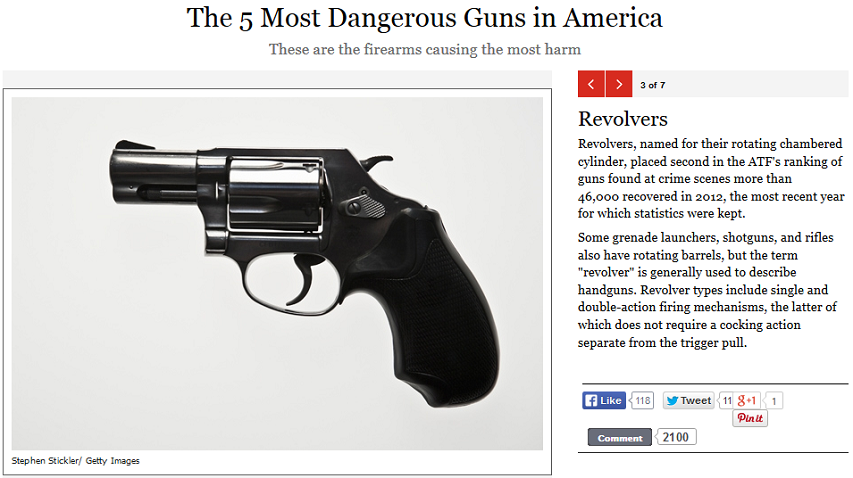
Yes, we’re apparently talking about grenade launchers here. I didn’t even know grenade launchers were available to civilians. Awesome!

Wait, “the explosive that creates the energy to fire the gun occurs in the fixed shell of a shotgun rather than the metallic cartridge of a rifle”. Why would I expect the charge that propels the shot out of a shotgun to be ignited in a rifle cartridge? Is this some sort of magic that allows you to fire a different weapon than the one you’re holding? No wonder Rolling Stone thinks this is such a dangerous weapon!
H/T to Charles C. W. Cooke for the link.
July 15, 2014
Investigation bingo, Minnesota style
The long-running investigation into whether Vikings special teams coach Mike Priefer made homophobic comments to former punter Chris Kluwe may come to some form of resolution today (but that’s not likely), as the Minnesota Vikings have received the report from the investigators. What’s not clear is the next step, as Chris Kluwe and his attorney are holding a press conference a bit later this morning to complain that the Vikings are not releasing the report as they had agreed (or, at least, have not shared the report with Kluwe). Until the team makes some sort of official announcement, we’re watching Chris Kluwe drive the media agenda. Eric Thompson has thoughtfully prepared a handy-dandy little bingo card we can all use when the press conference gets underway:
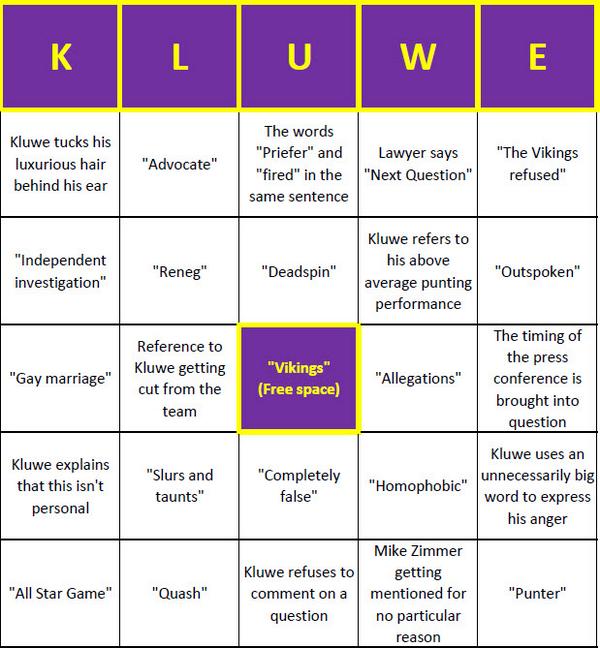
I’ll update this post after Chris Kluwe’s press conference and the expected official team announcement/response.
July 14, 2014
Lois McMaster Bujold interview
Published on 29 Apr 2013
In 2012 we had the unique opportunity to interview Lois McMaster Bujold about her writing. As one of the most highly awarded science fiction/fantasy writers, her insights and story about her writing life makes an excellent addition to our collection of master writers on The Authors Road.
July 13, 2014
July 11, 2014
DSM-5 turns “everyday anxiety, eccentricity, forgetting and bad eating habits into mental disorders”
Helene Guldberg reviews Saving Normal: An Insider’s Revolt Against Out-of-Control Psychiatric Diagnosis, DSM-5, Big Pharma, and the Medicalization of Ordinary Life by Allen Frances.
Frances’ arguments about the dangers of inflating psychiatric conditions and psychiatric diagnosis are persuasive — maybe more so because he honestly admits to his own role in developing such an inflation. He is keenly aware of the risks of diagnostic inflation ‘because of painful firsthand experience’, he writes. ‘Despite our efforts to tame excessive diagnostic exuberance, DSM-IV had since been misused to blow up the diagnostic bubble’. He is particularly concerned about the exponential increase in the diagnosis of psychiatric conditions in children, writing: ‘We failed to predict or prevent three new false epidemics of mental disorder in children — autism, attention deficit, and childhood bipolar disorder. And we did nothing to contain the rampant diagnostic inflation that was already expanding the boundary of psychiatry far beyond its competence.’
Take Attention Deficit Hyperactivity Disorder (ADHD), which is ‘spreading like wildfire’. This diagnosis is applied so promiscuously that ‘an amazing 10 per cent of kids now qualify’, Frances writes. He points out that in the US, boys born in January are 70 per cent more likely to be diagnosed with ADHD than boys born in December. The reason diagnosing ADHD is so problematic is that it essentially is a description of immaturity, including symptoms such as ‘lack of impulse control’, ‘hyperactivity’ or ‘inattention’. Boys born in January are the youngest in their school year group (in the US) and thus they are more likely to be immature; in the UK, the youngest children in a school classroom are born in August, and so here, August-born kids are more likely to be diagnosed with ADHD. We have medicalised immaturity.
[…]
Until 1980, the DSMs were ‘deservedly obscure little books that no one much cared about or read’. DSM-I (published in 1952) and DSM-II (published in 1968) were ‘unread, unloved and unused’. Now, says Frances, this ‘bible’ of psychiatry ‘determines all sorts of important things that have an enormous impact on people’s lives — like who is considered well and who sick; what treatment is offered; who pays for it; who gets disability benefit; who is eligible for mental health, school vocational and other services; who gets to be hired for a job, can adopt a child, or pilot a plane, or qualifies for life insurance; whether a murderer is a criminal or mental patient; what should be the damages awarded in lawsuits; and much, much more’.
Today, as a result of various trends, including the impact of the DSMs, many human behaviours, quirks, eccentricities and woes which in the past would have been seen as parts of the rich tapestry of life are now branded mental disorders.
July 9, 2014
Britain’s latest moral panic enters the “proposing bad law” stage
Iain Martin says it’s now gotten to the point “where it is permissible to mention George Orwell and his novel Nineteen Eighty-Four“:
Peter Wanless, the chief executive of the NSPCC, said earlier: “If someone consciously knows that there is a crime committed against a child, and does nothing about it because they put the reputation of the organisation above the safety of that child, that should be a criminal offence.”
“Consciously knows.” There’s an interesting phrase. It seems that the NSPCC sees this sanction applying only to people in positions of responsibility. But how can that be defined fairly in law? Will the new law only apply to the chief executive of a health trust, but not to the finance director or to the head of communications? It would be impossible to define such a law so narrowly. In time it would have to apply to anyone working in any organisation. And, surely it must also apply to anyone who comes into contact with said organisation and who might have heard that a crime has been committed? People often think they “consciously know” something when they have actually only heard it third-hand. If the idea is established that failure to pass on a wild rumour to the police is somehow illegal, it is not difficult to imagine what could go wrong.
[…]
If it is to become a crime to fail to report suspicions that child abuse is taking place, why should the new law not to be extended in time to all other areas of criminal activity? It could become illegal to fail to report to the police if you suspected that a fellow citizen had committed a crime, or might be about to. As someone wise on Twitter put it earlier: the historical precedents of states making it compulsory for citizens to report on their fellow citizens are not encouraging.


