Quotulatiousness

November 18, 2022

WOLLT IHR DEN TOTALEN TWEET?

Filed under: Germany, History, Humour, Media, Technology — Tags: , , , , , — Nicholas @ 05:00

When German public TV is willing to invoke literal Nazi imagery, you know the Twitter situation has gotten out of hand:

After Germany’s “first” public television network, ARD, compared Elon Musk reducing Twitter censorship to “letting rats out of their holes”, Germany’s “second” public television network, ZDF, has now compared Musk to Nazi Propaganda Minister Joseph Goebbels! (The network’s name Zweites Deutsches Fernsehen literally means “Second German Television”.)

Thus, last Friday, ZDF’s would-be comedy program, the “Heute Show”, posted the below tweet and photoshop.

The Tweet reads: “Thanks to Elon Musk, you’re allowed to say anything again on Twitter! Total freedom of speech! #heuteshow.” The caption, whose color scheme and font invoke Nazi-era propaganda, reads “Do you want total tweet?” It is an allusion to Goebbels’s 1943 speech at the Berlin Sportspalast, in which the Nazi Minister of Propaganda famously shouted, “Do you want total war?” – in response to which audience members leapt to their feet shouting “Yes!” and raising their arms in the Hitler-salute.

The background image appears to show a Nazi Party rally with the swastikas replaced by the Twitter bird logo. Two smaller swastikas are still visible in the lower left-hand corner of the full-size image.

Leaving aside the extreme mental contortionism required to associate freedom of speech with Nazi Germany, if ever there was a don’t-throw-stones-in-glass-houses moment, this was it. For, as so happens, during the Second World War, the founding director of ZDF, Karl Holzamer, himself served in one of the propaganda units that none other than Goebbels’s Ministry of Propaganda embedded with the different divisions of the Germany military.

Holzamer served in a propaganda unit of the Luftwaffe or German air force. As noted in a 2012 article titled “Goebbels’s Soldiers” in the German daily Die Frankfurter Rundschau, Holzamer was embedded with the Luftwaffe during its April 1941 bombing of Belgrade and was “the first” to report on the German subjugation of the Yugoslav capital.

QotD: Therapism

Filed under: Media, Quotations — Tags: , , — Nicholas @ 01:00

Therapism has caused a decline in the quality of our culture. People are now engaged in a kind of arms race, feeling obliged to express their emotions ever more extravagantly to prove to themselves and other just how much and how deeply they feel. This leads to the peculiar shrillness, shallowness, and lack of subtlety of so much of our culture.

Theodore Dalrymple, “Bad counsel”, The New Criterion, 2005-06-23.

November 17, 2022

TikTok (aka “Digital Fentanyl”)

Filed under: China, Media, Politics, USA — Tags: , , , , , — Nicholas @ 05:00

Geoffrey Cain at Common Sense on the malign influence of the massively popular Chinese social media platform on US politics and culture:

The midterm elections of 2022 were many things — a shocker for Republicans, the possible end of Donald Trump, a win for centrist Democrats. Overlooked is the fact that they were also a big turning point for TikTok, the Chinese social-media platform.

TikTok is not only the most trafficked news app for Americans under 30. It was also a major political force this year. Exhibit A: the Senate race in Pennsylvania, in which both Democrat John Fetterman and his Republican rival, Mehmet Oz, deployed TikTok, with Oz railing against the cost of vegetables in one video, and Fetterman slamming Oz for saying “crudité” in a highly effective response. Other candidates who took to TikTok this cycle include Tim Ryan, who ran for Senate in Ohio, and Val Demmings, who ran for Senate in Florida. (Both are Democrats.) The Democratic National Committee, early this year, launched its own TikTok channel.

Now, there are calls to shut it down. Just yesterday, FBI Director Christopher Wray said the bureau has “national-security concerns” about TikTok. Last Friday, the top Republican on the Federal Communications Commission, Brendan Carr, called TikTok “China’s digital fentanyl”. The day before, Senator Marco Rubio and Rep. Mike Gallagher, both Republicans, introduced legislation banning the social-media platform, noting that the data of millions of Americans is “effectively controlled” by the Chinese Communist Party. Earlier in the month, Carr also said the U.S. government should ban TikTok.

It’s about time.

Ever since TikTok began expanding into the United States, more than four years ago, we’ve known that it was a disaster waiting to happen. What’s shocking is that it’s taken this long to get serious political attention.

I know all about this. I used to be an investigative reporter in China. In December 2017, I first heard from friends on social media that a Chinese tech unicorn called ByteDance was planning on entering the American market with a new app. It was called TikTok.

Alongside its sibling app, Douyin, which operates only in China, TikTok was poised to sweep up the Gen Z audience in America, with its preference for video snippets of dancing celebrities, DIY projects, cooking demonstrations, skincare routines and other Gen Z’ers singing and dancing in their parents’ kitchens. As the fastest growing social media app ever, it rankled American competitors Facebook and YouTube, which were banned in China.

By October 2018, ByteDance was the world’s most valuable startup, with a valuation of $75 billion.

Four years later, ByteDance is worth $300 billion. TikTok is expected to reach 1.8 billion users globally by the end of the year. And a quarter of American adults under 30 get their news from the social-media app.

There’s a good reason for this success. TikTok has developed one of the most powerful machine-learning algorithms ever — one that is able to reveal people’s unknown desires to themselves.

Every day, every hour, every waking minute, TikTok is hoovering up seemingly infinite bits of information about its users — their tastes, hobbies, political views, sexual preferences, their facial structure, the sound of their voice. Ostensibly, all this is meant to provide a better product. It should also be noted that this information can be used for spying, influencing millions of users — even waging war. Every time we swipe for the next video, every time we post videos of our own, we are helping the world’s most sophisticated police state learn more about us.

The Pornstars of World War Two – Pin-Ups – On the Homefront 017

Filed under: Europe, History, Media, Military, USA, WW2 — Tags: , , , , , — Nicholas @ 04:00

World War Two
Published 16 Nov 2022

How do you motivate men to leave home and go fight in a foreign land? Send them packing with Betty Grable, Rita Hayworth, and Irene Manning, of course! It helps if you include an Esquire magazine and girlie cartoons from the infamous Alberto Vargas.
(more…)

November 16, 2022

“Angertainment is unlikely the sole cause of US political polarisation, but it certainly hasn’t helped”

Filed under: Media, Politics, USA — Tags: , , , , , — Nicholas @ 03:00

At Quillette, Claire Lehmann rounds up the rising distrust/disgust among the American public in their views of the legacy media:

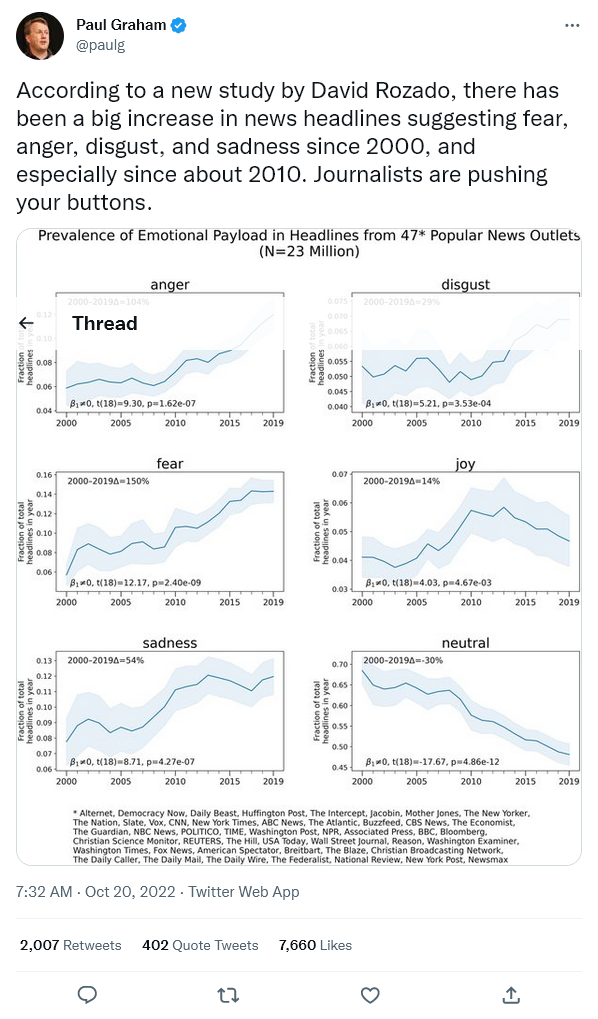
In October, a study published in PLOS One provided some fresh insight into how and why American media has become so dysfunctional. Over the past 20 years, the study reported, headlines that convey anger, fear, sadness, and disgust have been increasing, while headlines conveying neutrality or joy have been in decline. These trends have coincided with a massive drop in trust in news journalism, particularly in the US.

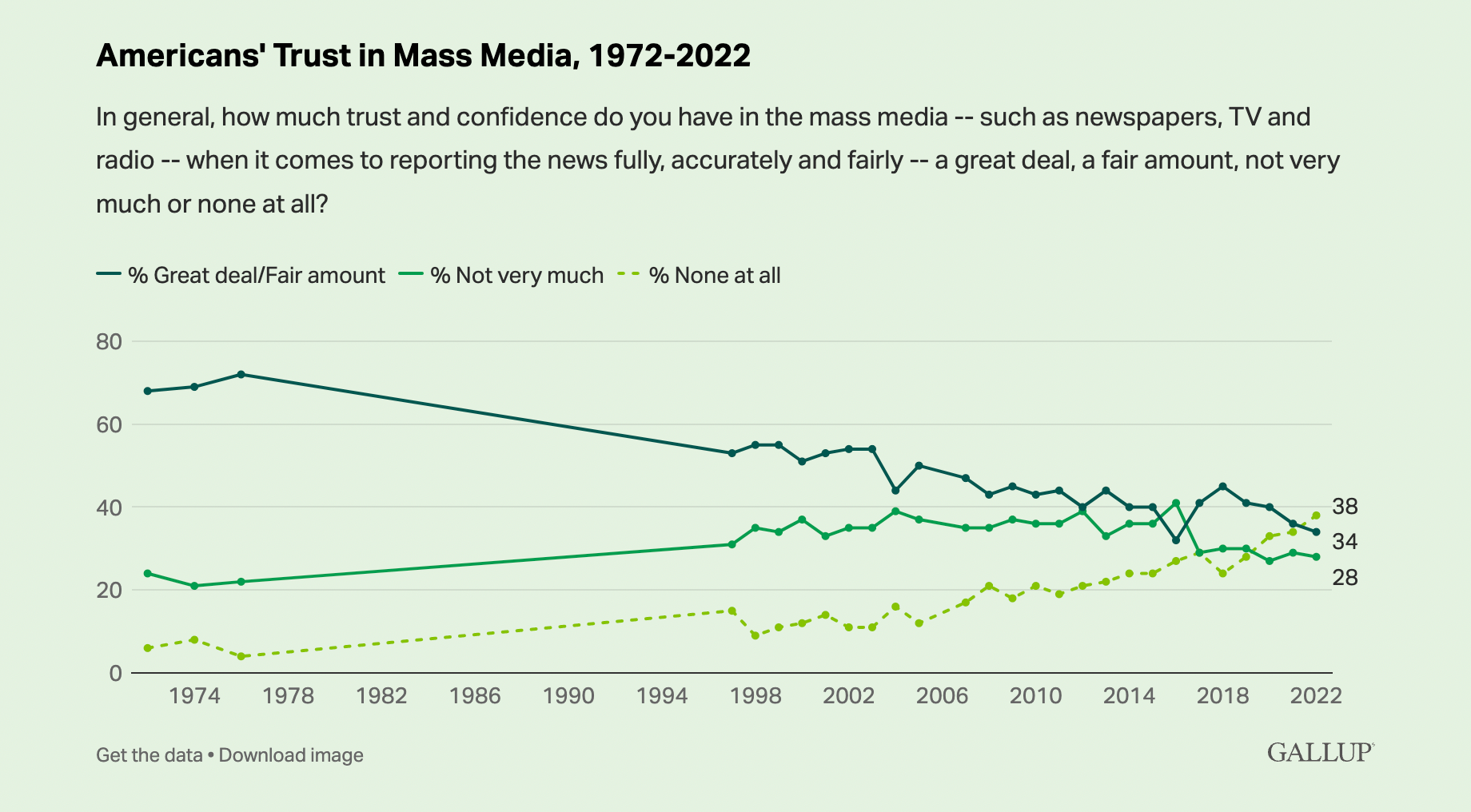
According to Gallop polling, seven percent of Americans say they have “a great deal” of trust in the media, while 38 percent say they have none at all. As angertainment has increased, trust has decreased. As one political tribe provides angertainment for its loyal readers and viewers, the other becomes increasingly alarmed and disgusted. Angertainment may be profitable for journalism in the short-term but over the long-term it trashes the integrity of the profession.

Angertainment is unlikely the sole cause of US political polarisation, but it certainly hasn’t helped. Just as mad cow disease was caused by feeding bovine-meal to cows, angertainment feeds on polarisation which in turn feeds on angertainment. It’s a cannibalistic cycle.

[…]

The incentives for journalism are broken. This is not always the fault of individual journalists, although some strive for truth and accuracy with more sincerity than others. Nor is it solely the fault of media companies, although many of them prioritise profit and engagement over rigour and fairness. It is not even the fault of “Big Tech”, even though social media companies have built the machine on which these broken incentives run.

It’s the fault of all of us. We are the ones who devour angertainment and get high on watching our enemies suffer. We are the ones who want to see various idiots eviscerated and dismembered by the bayonets of Twitter. We are the ones who clamour after content which makes us feel virtuous, complacent, and like we belong. The 20-year incline in headlines denoting fear, anger, disgust, and sadness in American media would not have occurred if audiences had not been rewarding it. In a competitive eco-system, media organisations must adapt to their audiences, feed them what they want, or die. But like the cows feeding on the meat-and-bone meal of other cows, this feedback loop creates the cultural equivalent of a neurodegenerative disease.

I have been just as guilty of this as any other publisher, consumer, or creator of media. But in recent months I’ve largely stepped back from social media, stood outside this machine, and have watched it whir and whizz from the sidelines. It is possible to disengage and reconsider the machine from a safe distance, starving it of fuel. And every day at Quillette I am reminded by my writers and readers and subscribers that it is possible to publish and create journalism that is appreciated for its analytical and aesthetic value, rather than for the artillery it provides in a never-ending culture war. It’s a war in which facts and reputations exist merely as cannon fodder, and where truth is less important than tribe. The media’s incentives may be broken, but we as individuals do not have to be.

November 15, 2022

New Zealand’s “splintered reality”

Filed under: Media, Politics — Tags: , , , — Nicholas @ 03:00

Earlier in 2022, when most of us were distracted by the Freedom Convoy in Ottawa, New Zealand was having its own populist protest moment, as Chris Bray recounts:

Back in February, protesters gathered outside New Zealand’s parliament began warning that police were using LRAD sound cannons to disrupt their protest. To the news media, it was evidence of how stupid and crazy the protesters had become, and still more proof of the obvious silliness of the anti-vaccine mandate protests in general.

Here are the first three paragraphs of that news story, laying it on thick with baseless claims and tinfoil hats:

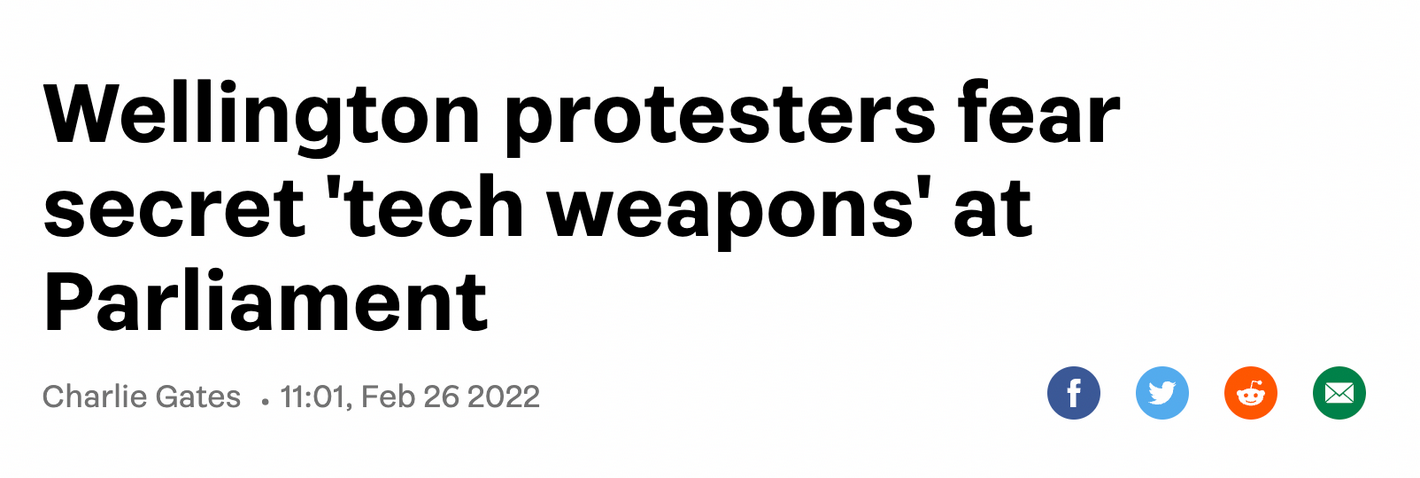
    Wellington anti-mandate protesters have been seen wearing tin foil hats, as some baselessly claim they are being targeted by “tech weapons” directed at them.

    A video posted on Facebook on Thursday under the name Carlene Louise has attracted attention on social media.

    In the video, the protester said people at the occupation site in Wellington are getting ill and claims without any evidence that the cause is “EMF machines”, “radiation machines” and “technological weapons” being directed at the occupation.

Four months later, police confirmed that they had used LRAD cannons against the protesters, though they claimed they didn’t use them until March. See, so it totally was a baseless conspiracy theory. Tinfoil hatted morons! Falsely claiming that the police did … what they … did. Hold on a second.

This nice bookending of claims and facts, and many other extraordinarily insightful juxtapositions, comes from a short documentary that, unfortunately, appears to only be available on YouTube:

In just half an hour, this is the whole thing, a perfect depiction of the “disinformation” project as it works everywhere. Note the moment when a news anchor and New Zealand’s bizarre prime minister are having an exchange about the viciousness and terrifying blood thirst of the far-right anti-government protesters, and the camera cuts away to show the protest, undercutting the description in real time. Note the moment when the disinformation expert tells an interviewer that she has determined that the protests are violent and dangerous, and then explains that people inside the protest believe that they’re engaged in a project of peace and love — a frightening example, she explains, of the splintered reality these people occupy inside their echo chamber. Note the moment when a member of parliament warns that anti-mandate protests are “fascist”.

And note, above all, how confused the news media figures are as they discuss the way their accurate and factual reporting from the perimeter of the protest, responsibly informed by experts and authorities, is being irresponsibly contradicted by livestreaming from inside the protest.

November 13, 2022

Carrying on about the Carry On movies

Filed under: Britain, History, Humour, Media — Tags: , , , , , — Nicholas @ 05:00

In The Critic, Alexander Larman looks back at one of the longest-running film series beginning with 1958’s Carry On Sergeant (not to be confused with the earlier — and reputedly terrible — interwar Canadian film of the same name) and continuing with many more until the filmic disaster of Carry On Emmanuelle in 1978 (there was also a 1992 attempt to revive the franchise, which failed):

In Alan Bennett’s The History Boys, it is decreed by the contrarian history master, Irwin, that “if George Orwell had lived, nothing is more certain than that he would have written an essay on the Carry On films”.

We are invited to take Irwin’s instructions that the Carry On films represent a valuable insight into British social history with suitable detachment. (The precise, suitably pompous quote is that “while they have no intrinsic merit, they acquire some of the permanence of art simply by persisting, and acquire an incremental significance if only as social history”.)

Yet Irwin (or Bennett) was almost certainly right that, had Orwell survived into the Sixties and Seventies, he would have found the Carry On film series both repellent and fascinating. It is literature’s, and history’s, loss that we do not have an account of Orwell’s thoughts on the antics of Charles Hawtrey, Kenneth Williams, Barbara Windsor et al.

In 1941, Orwell wrote of postcards by the cheerfully lowbrow artist Donald McGill that “your first impression is one of overpowering vulgarity” and that “what you are really looking at is something as traditional as Greek tragedy, a sort of sub-world of smacked bottoms and scrawny mothers-in-law which is a part of Western European consciousness”. He goes on to say that “jokes barely different from McGill’s could casually be uttered between the murders in Shakespeare’s tragedies”.

[…]

The joy of watching the Carry On films, then, is twofold. On the one hand, the hackneyed stories, two-dimensional characterisation and laboured puns and innuendo can be enjoyable, on a purely basic level, but hardly threaten to aspire to the levels of great art.

Yet on the other, the cheerfully Rabelaisian sentiments of the pictures — in which all men and women are defined purely in sexual and scatological terms — exist on a level of reductio ad absurdum.

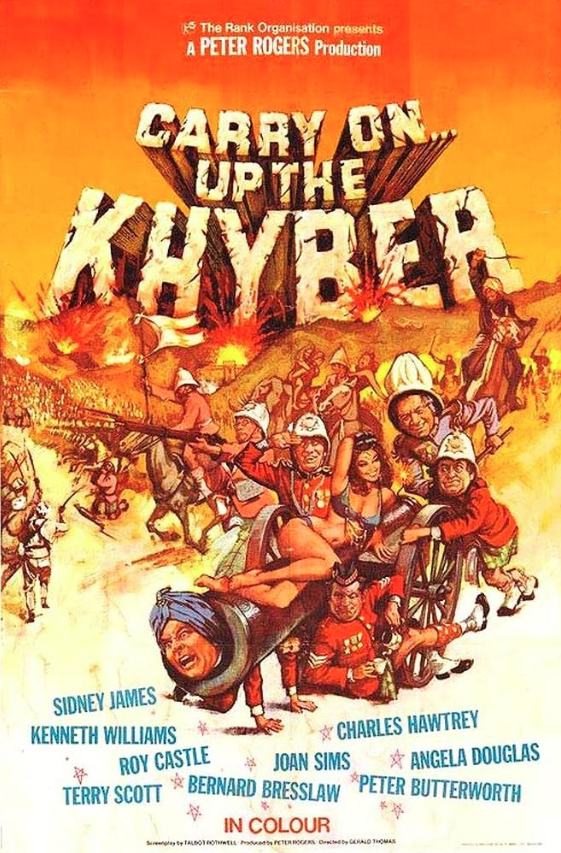
It is no coincidence that the best Carry On films contain a vein of social satire in their mocking of great British institutions, whether it be the NHS, MI5, the army or the Raj, and the final set piece of Carry On Up The Khyber — in which the stiff-upper-lip British occupiers ignore the Afghan invaders while taking formal dinner in black tie — rises to a level of surrealist genius that would have made Buñuel proud.

There is occasional talk of making another Carry On film, but with all the principal cast (save the ever-sprightly Dale) now dead and with the world a very different place, it is impossible to imagine that we will ever see, say, Carry On Tweeting or the like.

There is every possibility that a really top-notch cast could be assembled, if there was any serious intent behind it — I would love to see Andrew Scott, for instance, offer a more dynamic take on the kind of roles that Williams essayed, because he would do so brilliantly, and if the script could be written by the award-winning likes of Patrick Marber or Richard Bean, it could be a thing of innuendo-heavy beauty.

But then the Carry On series never was a thing of beauty. In its grim and hilarious way, it took every British national stereotype, pulled its trousers down, and gave it a hearty slap on its bare buttocks. Some might find this offensive; others might mourn its loss from public life.

In either case, we shall not look upon its like again. Dr Nookey, Francis Bigger, Professor Inigo Tinkle, Vic Flange: your services are no longer required. To which unkind cut we must solemnly say: “Ooh, matron.”

November 12, 2022

The Final Bloody Chapter of Operation Reinhard – War Against Humanity 085

World War Two
Published 9 Nov 2022

The genocide of the Jews of Eastern Europe concludes with Operation Harvest Festival — Aktion Erntefest when 42,000 are murdered in the Lublin district.
(more…)

SUPERCUT – Every Window Cameo in Batman (1966-1968)

Filed under: Humour, Media, USA — Tags: , , — Nicholas @ 02:00

Tommy Westphall’s Snowglobe
Published 14 Jan 2020

The dynamic duo’s show of the 60s was fond of celebrity cameos. Here is a Supercut of every single one of them.

In order of appearance:

1. Jerry Lewis
2. George Cisar (from the 1966 film)
3. Dick Clark
4. Van Williams and Bruce Lee as The Green Hornet and Kato from The Green Hornet
5. Sammy Davis Jr.
6. Bill Dana as José Jiménez
7. Howard Duff as of Sam Stone from Felony Squad
8. Werner Klemperer as Colonel Klink from Hogan’s Heroes
9. Ted Cassidy as Lurch from The Addams Family
10. Don Ho
11. Santa Claus
12. Art Linkletter
13. Edward G. Robinson
14. Suzy Knickerbocker
15. The Carpet King
(more…)

November 11, 2022

QotD: WW1 was the first war where the artillery was destructive enough to change the landscape

Filed under: History, Media, Military, Quotations, WW1 — Tags: , , , — Nicholas @ 01:00

So why is it always muddy? The real answer is high explosive shells (particularly, but not exclusively, penetrating high explosive shells). Heavy artillery shells in the First World War were made to penetrate into the ground and then explode, sending up a rain of loose dirt – the idea was to be able to destroy or at least bury trenches and deep bunkers. The explosions were so powerful that they uprooted trees and grass, leaving behind the “blasted moonscape” so common in pictures of the Western Front. All that remained were the deep craters which collected water and turned into often fatal mud-traps (Peter Jackson’s They Shall Not Grow Old (2018), includes a horrific description of one man, unable to assist, having to watch another man sucked under the mud to his death in such a crater).

This kind of terrain – with so much of the ground-cover blasted away – would turn into mud-soaked pits the moment it rained – particularly where water collected in the shell-holes.

That also explains why these post-battle scenes often lack any kind of local terrain features. Powerful explosive shells could annihilate terrain features like forests, roads, hedgerows, fences, fields – even hills and entire villages – with extended bombardments. And without any ground-cover left, almost any rain at all will then reduce the local terrain into a mud-soaked bog, especially if the local soil drains poorly (as it did so famously in Flanders).

The problem with depicting medieval, or even early modern battlefields this way is, of course, that these armies do not possess any weapons which can deliver this kind of destruction. Even as late as the American Civil War, field artillery – even massed field artillery – was simply not that powerful (although some heavy naval and siege guns were beginning to come close). Post-battle photography of Gettysburg – even in the approaches to Cemetery Ridge and around the Wheat Field – areas of fierce fighting – shows not only trees and ground-cover, but even fences and buildings largely intact.

Field artillery firing solid shot from 6 to 20lbs to is simply not strong enough to tear apart the terrain in the way that we often see in popular depictions of historical or fantasy battlefields; as pictured above, the guns doing that in WWI were often firing 1,000+ pound shells, 100 times the weight of shot of a normal ACW cannon (lighter artillery, like the famed French 75 (Matériel de 75mm Mle 1897) still fired lighter shells – the French 75 fired a c. 12lbs shell – but still had far more explosive power due to improvements in explosives; that said, the French 75, a capable field gun, was famously too light for ideal use in the trenches). Massed musketry won’t do it either and so massed arrow or crossbow fire, catapults or whatever else certainly won’t.

(This, as a side note, may go some distance to explaining why First World War commanders were so unprepared for the challenges the new terrain they were creating in turn inflicted on them. Doctrine said that the solution to well-entrenched infantry was to mass artillery against them – blast them out of position. It had never been the case before that such massed artillery would render the ground itself impassible, because the artillery had never before been powerful enough to do so.)

Bret Devereaux, “Collection: The Battlefield After the Battle”, A Collection of Unmitigated Pedantry, 2019-10-18.

November 10, 2022

Contemplating the end of brand franchises like Star Wars

Filed under: Business, History, Media — Tags: , , — Nicholas @ 05:00

Ted Gioia is wondering how Star Wars ends:

Original Stormtrooper Hero Helmet from Shepperton Design Studios + originalstormtrooper.com

Lately, I’ve been wondering how Star Wars ends.

Let me be clear, I’m not worried about how the story resolves, or what happens to the characters. I have zero interest in all that. Darth Vader can win the Nobel Peace Prize, for all I care.

I’m more concerned with how a powerful brand franchise loses its stranglehold on the culture. And it’s not just Star Wars, it’s all those other stories that never achieve closure. I’m talking about Batman and Indiana Jones and James Bond and the Marvel Cinematic Universe (or MCU, for short), and the rest of them.

They all die, sooner or later. But how?

Heroes in capes and colorful costumes seem invincible now, if only because these fictional flâneurs are bigger than anything else in commercial culture. If Spiderman and Batman were real people, they would boast higher incomes and net worth than any flesh-and-blood entertainer in the world. The Marvel Cinematic Universe, which Disney acquired back in 2009, must be worth ten or twenty times the $4 billion they spent back then — total revenues from Marvel brands since then are somewhere around the one trillion dollar mark.

No pop star in history has ever possessed that kind of earning power.

Can these franchises just go on forever? The management team at Disney certainly must hope so, judging by their never-ending slate of Star Wars, Marvel, and other brand extension offerings. No Time to Die isn’t just the name of the 25th James Bond movie, but a promise for the future — why not another 25 films in the series? Or 50 or 100?

But brand franchises do die, or become so tired that few people care anymore. Universal Studios made so much money from Ma and Pa Kettle films that these corny comedies allegedly saved it from bankruptcy in the 1940s, but by 1960 audiences had lost interest in the predictable formulas of the series.

The Carry On films were the most dependable audience draw in British comedy, but after 31 movies the franchise could carry on no longer. A final resuscitation attempt after 14 years not only failed at the box office but was voted the worst British film ever made.

Some franchises not only die, but become genuinely toxic as attitudes evolve — killing, for example, the Charlie Chan franchise, and making it unlikely that Tarzan or the Lone Ranger or many other once lucrative brands will ever enjoy another meaningful payday.

None of this should surprise us, because narratives and protagonists go in and out of fashion like anything else. A story that charmed your grandparents is unlikely to interest your grandchildren.

The headscratcher that was the American midterms outcome

Filed under: Media, Politics, USA — Tags: , , , , — Nicholas @ 03:00

As the voters went to the polls on Tuesday, it was easy to find doom-and-gloom-mongering among Democratic stalwarts and most of the mainstream media (BIRM), and chest-thumping triumphalism on the right. Both sides seemed to agree that the outcome was going to be somewhere between a red landslide and a red wipeout. So … how do we square the expectations of both sides with what actually happened? Chris Bray makes an attempt:

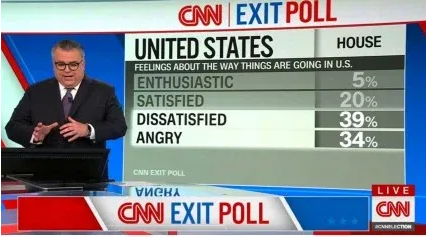
Eight percent uptake of the much-touted bivalent booster, 75% wrong track sentiment, pretty good night for the party in power. Multiple signs of a total loss of trust and respect for the existing order equals a decision to more or less stay the course.
Tribalism is the first explanation, sure. If you shat on a sidewalk and ran it for office with a D behind its name, Democrats would vote for it; if you shat on a sidewalk and ran it for office with an R behind its name, Republicans would vote for it. John Fetterman is headed for the United States Senate. Go ‘way, I’m ‘batin’.

And I agree with the argument that Republicans didn’t offer much of a plan or a vision, a premise you can check by reading Kevin McCarthy’s Commitment to America. More mush from the wimp.

But the other thing, and you can argue with me about this, is that the society of the spectacle madness of messaging without regard to reality actually achieves its purpose, no matter how absurd it is. We have to add $3 trillion in extra debt-funded spending to the economy to reduce inflation! If you vote Republican, they’ll kill our children!
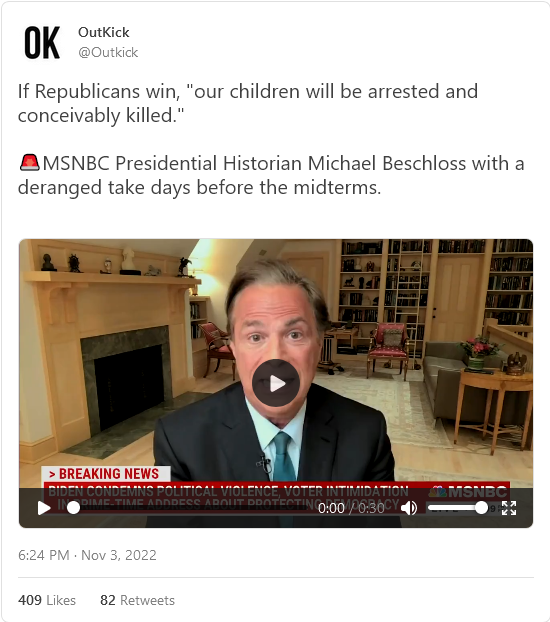
Amazingly, this turns out to work pretty well. The available evidence suggests that we have a sizable population that cannot assess fact claims. I propose that we test this with sample messages to voters: If you vote for bubblegum trees, the sky bees will give you a diamond-crusted ribeye! (Ohh, I have to vote for bubblegum trees!) If you’re out in public, look to your left; then look to your right. At least one of those people thinks Karine Jean-Pierre makes some pretty good points.

Sarah Hoyt strongly believes that the busy midnight vote-finders of 2020 were just as busy on Tuesday night:

As I write this late on the 8th, the tsunami is resolving itself into a wavelet.

Or rather, the tsunami has been overfrauded into a wavelet. And it might be frauded away to a Dem win before I wake tomorrow.
This shouldn’t be a surprise to any of us who were awake and remember this:
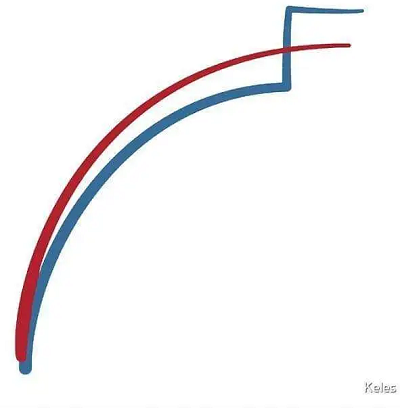
And we know damn well it was a Trump landslide before that.

So for the Republicans to have picked up any seat, this was the tsunami to end all tsunamis.

I know the usual idiots are out there, already saying “It was abortion: the Womyns came out in force to vote dem.”

Are there women who are single ticket abortion voters. Sure. Most are older than I and are determined to make sure their actions and choices are validated a posteriori. They’re an ever dwindling minority. Married women vote more and more for the right every time. Single women? Who knows? But I suspect there’s been a shift in that too after the last too years. And most of them don’t see that career path ahead they once did.

Then there’s the other bs which is of course “The people don’t want to be free.” That’s bs. The people, every time they can express their displeasure do so. But having the vote taken away from them via fraud means THEY each individual thinks he or she is alone.

Things like “Let’s go Brandon” sweep the nation, but there’s no major legal or financial movement to protest the fraud, because each person thinks “I guess all these idiots are so beaten down they like beaten down, and I’m the only one who is angry.”

Meanwhile the perpetrators know what the people think, and erect barricades in DC to protect themselves from the anger they sense but can’t seem to bring out into the open.

Yes, we’re getting the house, and probably not the senate. Which means a good five/six seats fraud. I’m in a group right now with people crunching numbers, and the fraud is evident. The races the democrats cared out got flipped by turning just those votes for the dems. That’s the flexibility of Dominion at work, and the way they can turn a vote into the other.

At Founding Questions, Severian is appropriately sanguine about the notion of “adjusted” or “fortified” ballot counts in disputed races:
So the “elections” were fun, eh? By far the best “news” from the Dissident perspective is that they did, in fact, pull out all the stops for S-s-s-Strokey. As I think it was Based 5.0 who quipped below, it looks like dual-passport-holding Muslim carny barkers aren’t going to be making America great again. Here’s hoping they’re stupid enough to fall for the “Dr. Jill” trap twice — now they’re stuck with Strokey the way they’re stuck with Tapioca Joe, because Giselle is Dr. Jill on steroids (perhaps literally). Eh, Dr. Jill had 40 years in [Washington, DC] to get a taste of the finer things; Giselle’s price is probably far lower. But until Strokey resigns for health reasons and is replaced […] the image of a tatted-out, brain-damaged hobo in a hoodie shuffling around the Senate floor is so on the nose, no novelist would dare use it.

[…]

I bet if we look back on it, we’ll see the state (lowercase s) Media freaking out first, dragging the Official State (capital S) Media with them. It makes sense, given the perverse incentive structure of the Media. Stick with me here:

Joe Schmoe (D) is running for Congress in Flyover State. Obviously The Media wants him to win, because (D). And they’re sure he’s going to, because his opponent is some “ultra-MAGA” yahoo. But Reality is what it is, and suddenly the yahoo is getting closer and closer …

At that point, The Media’s perverted incentive structure kicks in. The “reporters” at the biggest local rag in Flyover State, the Toad Suck Times-Picayune, only care about one thing: Getting the fuck out of Toad Suck, trading the Times-Picayune for a slot somewhere higher up the chain. Now, there are only two ways to do that: Be a hard-hitting, straight-shooting newshoun …

HAHAHAHAHAHAHAHAHAHAHAHA!! Oh Jesus, I’m sorry, I thought I could type that with a straight face, but I can’t. Give me a minute …

… ok, there’s only one way to move up in The Media, and that’s by proving yourself a more zealous cultist than the next guy. So our Heroic Journalist starts doing what he thinks the Inner Party wants, which is of course “propping up Joe Schmoe for all he’s worth”. But here’s the rub: He’s not privy to what the Inner Party actually wants. Of course he’s not; after all, he’s riding a desk at the Toad Suck Times-Picayune. And of course everybody in a similar position, nationwide, is doing the same thing …

… but they’re all at least kinda sorta privy to the real polls that come down from the big organizations (recall that there are maybe three companies that control all the newspapers in the US), and so he knows things are looking grim for Joe Schmoe. More importantly, he sees that Tapioca Joe himself is out stumping for Democrats, and not in battleground states — they’re putting Brandon out there in supposedly safe Democratic districts.

So our man at the Toad Suck Times-Picayune consults his own personal political tea leaves, and he concludes: We’re gonna lose. The “red wave” is real. So again, he starts doing what he thinks his masters want, the thing he thinks will get him noticed at the higher levels: He admits the truth, or as much as he personally can stomach, and starts laying in the groundwork for #TheResistance, same as in 2020. Oh, Kari Lake is ahead 8% over Abortion Mouse there in AZ (give Ace of Normies this, he coins a good nickname), well obviously that’s because of bigotry MAGA yadda yadda and don’t forget the Russian hacking!

But here’s the problem with that: It does get him noticed by the Big League club, but in the exact opposite way. So long as everyone stays on point, you can brazen it out through the inevitable “fortification”. Had everyone stayed on point, a “worryingly tight race” — they’ll admit that much, for verisimilitude — can easily be turned into one of those 3am miracles the Dems are famous for. Hey, whaddaya know, all the mail in ballots were for Joe Schmoe. What a surprise.

But now that the Toad Suck Times-Picayune is running stories about the challenger being ahead, the Big League clubs have to at least acknowledge it, the school of fish effect takes over, and pretty soon you’ve got the entire Media in panic mode. Which has the further effect of making the freelance riggers even crazier, so that the regularly scheduled 3am ballot drop is being disrupted by mysterious “hiccups” at key locations — you know, “cyberattacks” and whatnot (why the fuck is a voting machine connected to the internet in the first place?), and so on, plus all the mailmen and so forth dumping a whole bunch of ballots from red districts into the nearest streams, culverts, and landfills. Jimmy Hoffa is probably up to his eye sockets in Republican ballots out there in the foundations of Giants’ Stadium…

And so the weird shit we see above, and the odd “had a Narrative all ready” vs. “are clearly scrambling” coverage of different contests.

I can’t think of a better way to really shore up the idea that ALL elections are rigged than that. Wait a minute, the “red wave” was on last week. You guys admitted it. Early Tuesday afternoon, every talking head on tv looked like he was weaving a noose under the “news” desk; you’d expect “journalists” hanging from the rafters by 7pm.

But … ooops! Short of actually being caught on camera throwing Republican ballots in a bonfire, or openly xeroxing Democrat ones — and it’s only mid-morning of the day after, give it time — I can’t think of a clearer way of announcing that it’s ALL rigged than that.


QotD: Sarah’s rules of art

Filed under: Humour, Media, Quotations, USA — Tags: , , — Nicholas @ 01:00

… the botanic gardens were holding a sculpture exhibit, called “human nature” with statues from various times and places.

And why was this a bad idea, Sarah?

Mostly because I’m married to a mathematician. There is a certain … ah … compulsiveness that comes with it. If there’s something that’s numbered and has a route, we OF COURSE have to follow the route and see every single statue, even if that’s not what we set out to do.

This made things very interesting, since the wedding parties were blocking some of the statues, and others we could see from a distance were the sort of modern art that your kids could do with a backyard forge, meaning the actual level of artistry was about the level of a kindergartner, only they used metal instead of playdough.

This leads us to Sarah’s first rule of art: if people viewing it have trouble telling it from accidental formations, it’s probably not art.

The second corollary of this is: if you need an elaborate card pointing out to you that it’s art, it’s probably not art.

The third would be that if you need a placard explaining to you how daring and courageous this art is, and how it defied some tyrannical regime at great peril to the artist’s life, it’s not only not art, you’re in the presence of a self-aggrandizing conman.

Sarah Hoyt, “Art and Revolution”, According to Hoyt, 2019-05-31.

November 9, 2022

The Big Mac’s “peacekeeping magic” is gone

Filed under: Books, China, Europe, History, Media, Russia, USA — Tags: , , — Nicholas @ 05:00

In The Critic, Christopher McCallion illustrates the irrational optimism that countries having McDonald’s restaurants wouldn’t go to war with one another:

“Toledo, McDonald’s, 1967” by DBduo Photography is licensed under CC BY-SA 2.0 .

In 1910, Norman Angell wrote his famous book The Great Illusion, which argued that it would be irrational for the European great powers to go to war with one another when their prosperity was so interconnected by mutual trade and investment. The subsequent outbreak of WWI confirmed for many observers that competition for relative power and security trumped the pacific pursuit of reciprocal gains in wealth.

Following the Cold War, however, the sheer scope and intensity of globalization convinced many that a new era of capitalist peace had arrived. Thomas Friedman famously proposed a “Golden Arches Theory of Conflict Prevention”, which claimed that no two countries with a McDonalds had ever gone to war. There were many propitious augurs for a new era of peace: the lines stretched for blocks when McDonalds first opened in Moscow, and even still-nominally Communist China proclaimed, “to get rich is glorious.”

Simply put, the “capitalist peace theory” says that mutual gains from trade reduce incentives for conflict between economically engaged states, making the prosperity of each dependent on the other and producing high opportunity costs for war.

Realists have long countered this theory by claiming that states prioritize relative gains over absolute gains. State X and State Y may both be made wealthier in absolute terms by trading with one another, but if Y’s wealth grows at a faster pace than X, X may fear that Y’s rapidly growing wealth could be translated into a surplus of military power putting X’s security at risk. Realists contend that states will ultimately prioritize security over all other goals for the simple reason that without security, no other goals can be assured, including the pursuit of prosperity. Realists tend to reverse the logic of interdependence, claiming that low barriers to the cross-border flow of goods and capital are effects, rather than causes, of peace.

It appears that the realists are being proven right. On the eve of the unveiling of the Nordstream-2 pipeline between Russia and Europe, Moscow decided to invade Ukraine, which (literally) blew up the multi-billion-dollar project and all its future returns. Even McDonald’s, the golden harbinger of perpetual peace, shuttered its operations in Russia.

An even more important example is provided in East Asia. The US and China, the two largest economies in the world, are engaged in a rapidly escalating economic, technological, and military rivalry. Not only did the US initiate a trade war against China, it has also launched an increasingly severe series of export restrictions on advanced technology to China, clearly designed to halt China’s economic growth and limit its growing military power. America’s attempts to cut China off at the knees are reminiscent of the measures taken early in the Cold War to contain the Soviet Union and isolate it from the other industrial centers of the world.

Liberal political fortunes ride “especially women in the suburbs of the Greater Toronto Area” … and those women are angry right now

Filed under: Cancon, Economics, Health, Media, Politics — Tags: , , , , , , — Nicholas @ 03:00

In The Line, Ashley Csanady has some advice for Justin Trudeau in the lead-up to the next federal election that he really needs to pay attention to:

Poll after poll has told us the Liberals lost white male voters a long time ago, and their electoral fortunes, especially in Quebec and suburban Ontario, rely on women, especially women in the suburbs of the Greater Toronto Area. This isn’t to say dads and other caregivers aren’t angry. Families take many shapes and anyone with small people at home has faced the same indignities over the past nearly three years. However, politically and demographically, it’s the Ontario moms who are going to make or break the next election. And when folks are angry, it doesn’t matter who the incumbent is, they are wont to vote them out.

Nor is it not just about the children’s pain meds.

It’s about the fact we can’t find antibiotic eye drops over-the-counter either (a shortage one pharmacist told me is even worse than the one for pain and fever meds for the wee ones). Another shortage that means we must then turn to an already over-burdened health-care system to get a prescription for a medicine that may or may not be in stock.

Oh, and if that respiratory virus going around turns nasty, we aren’t even certain there will be a hospital bed for our babies when they need it most.

Then there is the infuriatingly slow roll-out of affordable childcare in this province. Parents once again caught between the feds and the province in a battle that may drag out the process so long that many expecting relief will see their kids off to junior kindergarten before it arrives.

Grocery bills are skyrocketing, and while I admit I’m privileged enough to absorb the eye-popping increases, so many families simply cannot. Imagine telling a picky toddler they can’t have their favourite snack because you can’t afford the crackers.

Now, Ontario moms had to deal with yet another disruption to their kids’ schooling, which threw their work lives into chaos once again. More disruptions are possible should bargaining fail again. This just after many women who left the workforce or took a step back from their careers during the pandemic were just getting back into the swing of things.

I made this point — that Ontario moms are angry and much of that anger is directed at political leaders, but I don’t expect it to fall on Ontario Doug Ford — on Twitter a couple weeks back. For this, I was “reminded” — more like chided — that many of these challenges are Mr. Ford’s fault. Or global challenges no logical person could blame the prime minister for. The partisans in my mentions were right on both counts. But here’s what they got wrong:

It doesn’t matter if I’m being “unfair” to Mr. Trudeau, because politics is unfair.

And as for Mr. Ford’s share of the blame, voters punish who’s up next at the ballot box, especially in a crisis. They had a chance to take out their rage on the PCs in June. They didn’t. So who does that leave up next?

« Newer PostsOlder Posts »

Powered by WordPress