
Sabaton History
Published 3 Jan 2023Where did the war to end all wars begin? The assassination in Sarajevo may have only killed two, but the repercussions killed millions, destroyed empires, and changed the course of history.
(more…)
January 4, 2023
“Sarajevo” – Assassination of Archduke Franz Ferdinand – Sabaton History 116
Comments Off on “Sarajevo” – Assassination of Archduke Franz Ferdinand – Sabaton History 116
January 2, 2023
How much of the media coverage of the Bosnian War was fake news?
Kate at Small Dead Animals linked to this rather disturbing collection of intelligence cables from the Canadian peacekeeping force in Bosnia to NDHQ in Ottawa during the conflict, which contradicts the media narrative of the time:

Map of deployment of National Battalions in UN Forces in Croatia and Bosnia and Herzegovina – Early 1993 (Balkan Battlegrounds Map I)
Balkan Battlegrounds: A Military History of the Yugoslav Conflict, 1990-1995 author credit: Central Intelligence Agency.
A trove of intelligence files sent by Canadian peacekeepers expose CIA black ops, illegal weapon shipments, imported jihadist fighters, potential false flags, and stage-managed atrocities.
The established mythos of the Bosnian War is that Serb separatists, encouraged and directed by Slobodan Milošević and his acolytes in Belgrade, sought to forcibly seize Croat and Bosniak territory in service of creating an irredentist “Greater Serbia”. Every step of the way, they purged indigenous Muslims in a concerted, deliberate genocide, while refusing to engage in constructive peace talks.
This narrative was aggressively perpetuated by the mainstream media at the time, and further legitimized by the UN-created International Criminal Tribunal for the former Yugoslavia (ICTY) once the conflict ended. It has become axiomatic and unquestionable in Western consciousness ever since, enforcing the sense that negotiation invariably amounts to appeasement, a mentality that has enabled NATO war hawks to justify multiple military interventions over subsequent years.
However, a vast trove of intelligence cables sent by Canadian peacekeeping troops in Bosnia to Ottawa’s National Defence Headquarters, first published by Canada Declassified at the start of 2022, exposes this narrative as cynical farce.
The documents offer an unparalleled, first-hand, real-time view of the war as it developed, with the prospect of peace rapidly degrading into grinding bloodshed that ultimately caused the painful death of the multi-faith, multi-ethnic Yugoslavia.
The Canadian soldiers were part of a wider UN Protection Force (UNPROFOR) dispatched to former Yugoslavia in 1992, in the vain hope tensions wouldn’t escalate to all-out-war, and an amicable settlement could be reached by all sides. They stayed until the bitter end, long past the point their mission was reduced to miserable, life-threatening failure.
The peacekeepers’ increasingly bleak analysis of the reality on the ground provides a candid perspective of the war’s history that has been largely concealed from the public. It is a story of CIA black ops, literally explosive provocations, illegal weapon shipments, imported jihadist fighters, potential false flags, and stage-managed atrocities.
Read the complete Canadian UNPROFOR cables here.
See key excerpts of the files referred to in this article here.
Comments Off on How much of the media coverage of the Bosnian War was fake news?
January 1, 2023
Public Domain Day for 2023
Duke University School of Law’s Center for the Study of the Public Domain highlights just some of the creative works that have entered into the public domain (in the United States: other countries’ laws may vary substantially) today:
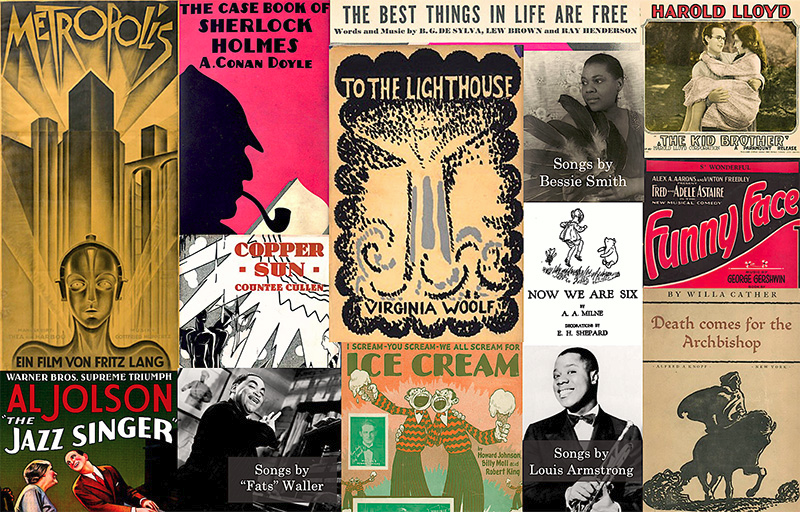
Here are just a few of the works that will be in the US public domain in 2023. They were supposed to go into the public domain in 2003, after being copyrighted for 75 years. But before this could happen, Congress hit a 20-year pause button and extended their copyright term to 95 years. Now the wait is over. (To find more material from 1927, you can visit the Catalogue of Copyright Entries.)
Books:
- Virginia Woolf, To the Lighthouse
- Arthur Conan Doyle, The Case-Book of Sherlock Holmes
- Willa Cather, Death Comes for the Archbishop
- Countee Cullen, Copper Sun
- A. A. Milne, Now We Are Six, illustrated by E. H. Shepard
- Thornton Wilder, The Bridge of San Luis Rey
- Ernest Hemingway, Men Without Women (collection of short stories)
- William Faulkner, Mosquitoes
- Agatha Christie, The Big Four
- Edith Wharton, Twilight Sleep
- Herbert Asbury, The Gangs of New York (the original 1927 publication)
- Franklin W. Dixon (pseudonym), The Tower Treasure (the first Hardy Boys book)
- Hermann Hesse, Der Steppenwolf (in the original German)
- Franz Kafka, Amerika (in the original German)
- Marcel Proust, Le Temps retrouvé (the final installment of In Search of Lost Time, in the original French)
[…]
Movies Entering the Public Domain
- Metropolis (directed by Fritz Lang)
- The Jazz Singer (the first feature-length film with synchronized dialogue; directed by Alan Crosland)
- Wings (winner of the first Academy Award for outstanding picture; directed by William A. Wellman)
- Sunrise (directed by F.W. Murnau)
- The Lodger: A Story of the London Fog (Alfred Hitchcock’s first thriller)
- The King of Kings (directed by Cecil B. DeMille)
- London After Midnight (now a lost film; directed by Tod Browning)
- The Way of All Flesh (now a lost film; directed by Victor Fleming)
- 7th Heaven (inspired the ending of the 2016 film La La Land; directed by Frank Borzage)
- The Kid Brother (starring Harold Lloyd; directed by Ted Wilde)
- The Battle of the Century (starring the comedy duo Laurel and Hardy; directed by Clyde Bruckman)
- Upstream (directed by John Ford)
1927 marked the beginning of the end of the silent film era, with the release of the first full-length feature with synchronized dialogue and sound. Here are the first words spoken in a feature film from The Jazz Singer: “Wait a minute, wait a minute, you ain’t heard nothing yet.” Read about the transition from the silent film to the “talkie” era, and the quest to preserve some of the remarkable silent films on this list, here. Please note that while the original footage from these films will be in the public domain, newly added material such as musical accompaniment might still be copyrighted. If a film has been restored or reconstructed, only original and creative additions are eligible for copyright; if a restoration faithfully mimics the preexisting film, it does not contain newly copyrightable material. (Putting skill, labor, and money into a project is not enough to qualify it for copyright. The Supreme Court has made clear that “the sine qua non of copyright is originality.”) In the list above, while some of the titles were not registered for copyright until 1928 or 1929, the original version of the film was published with a 1927 copyright notice, so the copyright expires over that version in 2023.
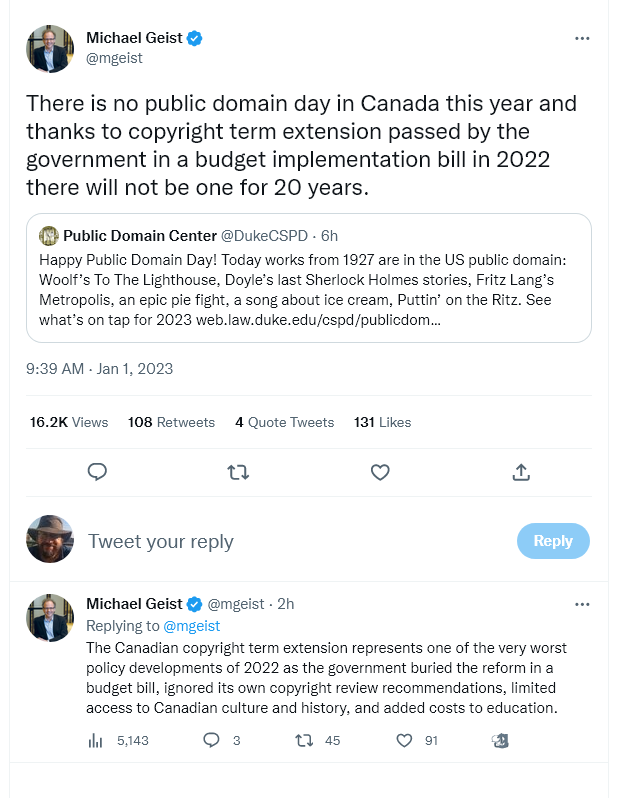
Update: Michael Geist explains why there’s no equivalent Public Domain day for Canada:
Comments Off on Public Domain Day for 2023
December 31, 2022
The Twitter Files – “Let’s at least try to stop lying for a while, see what happens. How bad can it be?”
Matt Taibbi on the continuing revelations about Twitter’s deep entanglements with agencies of the US (and probably many other) government:
In the coming days you’ll find a new thread on Twitter, along with a two-part article here at TK explaining the latest #TwitterFiles findings. Even as someone in the middle of it, naturally jazzed by everything I’m reading, I feel the necessity of explaining why it’s important to keep hammering at this.
Any lawyer who’s ever sifted though a large discovery file will report the task is like archaeology. You dig a little, find a bit of a claw, dust some more and find a tooth, then hours later it’s the outline of a pelvis bone, and so on. After a while you think you’re looking at something that was alive once, but what?
Who knows? At the moment, all we can do is show a few pieces of what we think might be a larger story. I believe the broader picture will eventually describe a company that was directly or indirectly blamed for allowing Donald Trump to get elected, and whose subjugation and takeover by a furious combination of politicians, enforcement officials, and media then became a priority as soon as Trump took office.
These next few pieces are the result of looking at two discrete data sets, one ranging from mid-2017 to early 2018, and the other spanning from roughly March 2020 through the present. In the first piece focused on that late 2017 period, you see how Washington politicians learned that Twitter could be trained quickly to cooperate and cede control over its moderation process through a combination of threatened legislation and bad press.
In the second, you see how the cycle of threats and bad media that first emerged in 2017 became institutionalized, to the point where a long list of government enforcement agencies essentially got to operate Twitter as an involuntary contractor, heading into the 2020 election. Requests for moderation were funneled mainly through the FBI, the self-described “belly button” of the federal government (not a joke, an agent really calls it that).
The company leadership knew as far back as 2017 that giving in to even one request to suspend this or that set of accused “hostile foreign accounts” would lead to an endless cycle of such demands. “Will work to contain that”, offered one comms official, without much enthusiasm, after the company caved for the first time that year. By 2020, Twitter was living the hell its leaders created for themselves.
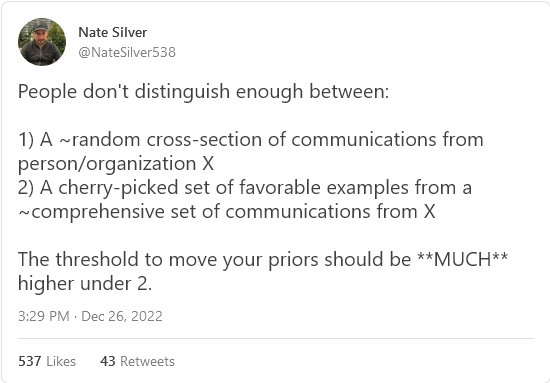
What does it all mean? I haven’t really had time to think it over. Surely, though, it means something. I’ve been amused by the accusation that these stories are “cherry-picked”. As opposed to what, the perfectly representative sample of the human experience you normally read in news? Former baseball analytics whiz Nate Silver chimed in on this front:
Comments Off on The Twitter Files – “Let’s at least try to stop lying for a while, see what happens. How bad can it be?”
December 29, 2022
Selection bias in polling
At Astral Codex Ten, Scott Alexander points out that it’s impossible to do any kind of poll without some selection bias, so you can’t automatically dismiss any given poll on that basis. The kind of selection bias, however, may indicate whether the results will have any relationship to reality:
The real studies by professional scientists usually use Psych 101 students at the professional scientists’ university. Or sometimes they will put up a flyer on a bulletin board in town, saying “Earn $10 By Participating In A Study!” in which case their population will be selected for people who want $10 (poor people, bored people, etc). Sometimes the scientists will get really into cross-cultural research, and retest their hypothesis on various primitive tribes — in which case their population will be selected for the primitive tribes that don’t murder scientists who try to study them. As far as I know, nobody in history has ever done a psychology study on a truly representative sample of the world population.
This is fine. Why?
Selection bias is disastrous if you’re trying to do something like a poll or census. That is, if you want to know “What percent of Americans own smartphones?” then any selection at all limits your result. The percent of Psych 101 undergrads who own smartphones is different from the percent of poor people who want $10 who own smartphones, and both are different from the percent of Americans who own smartphones. The same is potentially true about “how many people oppose abortion?” or “what percent of people are color blind?” or anything else trying to find out how common something is in the population. The only good ways to do this are a) use a giant government dataset that literally includes everyone, b) hire a polling company like Gallup which has tried really hard to get a panel that includes the exact right number of Hispanic people and elderly people and homeless people and every other demographic, c) do a lot of statistical adjustments and pray.
Selection bias is fine-ish if you’re trying to do something like test a correlation. Does eating bananas make people smarter because something something potassium? Get a bunch of Psych 101 undergrads, test their IQs, and ask them how many bananas they eat per day (obviously there are many other problems with this study, like establishing causation — let’s ignore those for now). If you find that people who eat more bananas have higher IQ, then fine, that’s a finding. If you’re right about the mechanism (something something potassium), then probably it should generalize to groups other than Psych 101 undergrads. It might not! But it’s okay to publish a paper saying “Study Finds Eating Bananas Raises IQ” with a little asterisk at the bottom saying “like every study ever done, we only tested this in a specific population rather than everyone in the world, and for all we know maybe it isn’t true in other populations, whatever.” If there’s some reason why Psych 101 undergrads are a particularly bad population to test this in, and any other population is better, then you should use a different population. Otherwise, choose your poison.
Comments Off on Selection bias in polling
QotD: That foolish optimism of the early days of the internet
Thirty years ago, at the dawn of what we think of as the internet, no one imagined that this amazing new frontier in human interaction would become a tool of oppression wielded by massive corporations. In fact, it was assumed that the internet would break the grip of corporations, special interests, and even governments. People would be free of the gatekeepers who controlled public discourse.
Those we call the left were sure that the internet would help democratize American society by opening the floor to marginalized voices. The people we call the right were sure this new medium would follow the pattern of talk radio. Free of progressive control, normal people could challenge the opinions of the liberal media. The internet was going to be an open debating society that worked on democratic principles.
Thirty years on and people old enough to remember the before times think that maybe the internet was a mistake. Giving a platform to millions of talking meat sticks, banging away at their phones, has just made life noisy. Worse yet, the range of allowable opinion has become much narrower. We now live in an age of censorship that was unimaginable before the internet.
The Z Man, “Coercion and Consensus”, Taki’s Magazine, 2022-09-25.
Comments Off on QotD: That foolish optimism of the early days of the internet
December 28, 2022
The Twitter Files – “How does anyone run a business under these conditions?”
Chris Bray on the sheer magnitude of government(s) meddling in Twitter’s business (even though, yes, Twitter’s management was totally on-board politically with most or all of this meddling):
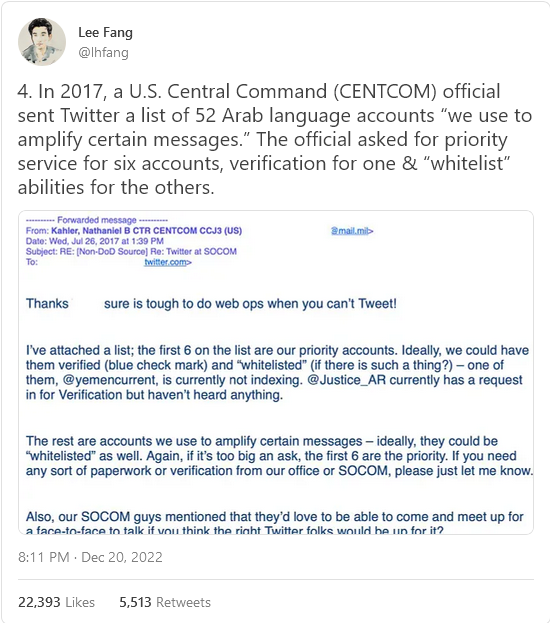
[…] Twitter has been constantly flooded with requests from at least dozens of separate federal entities, all of them needy and pushy and consuming the company’s time and energy: CENTCOM wants a meeting this week and CDC wants a meeting this week and NIH wants a meeting this week and the FBI wants a meeting this week and the White House wants a meeting this week and DHS wants a meeting this week and DOD wants a meeting this week even though CENTCOM already has one, and several members of Congress have some concerns they want the senior team to address this week, and …
Now: Twitter is a global platform. I would bet a kidney that there’s a Twitter Files equivalent for the Ottawa Police Department during the Freedom Convoy, and an RCMP file, and a Trudeau government file, and that Chrystia Freeland had some thoughts to share about some tweets she didn’t like. I would bet the other kidney that Twitter has equivalent files, in dozens of languages, from multiple government agencies in Iran and New Zealand and Australia and the Netherlands and the UK and Brazil and on and on an on.
As for my third kidney — just go with it, and we’ll clean up the biological metaphors later — state and local governments also expect Twitter to act on their content concerns and complaints about disinformation, which means fifty governors and attorneys general and state directors of public health and state police commanders picking up the phone, and 3,243 sheriffs and district attorneys and public health directors expecting to be able to reach out to their partners at Twitter, and close to 20,000 mayors and police chiefs, and thousands of state legislators and tens of thousands of city councilmembers, and on and on and on. “You tell this Jack Dorsey that I’m the damn mayor pro tem here in Glendale, and I want my concerns to be dealt with.”
And so, if we accept the premise that governments have special rights to demand content moderation, if the staff director of a legislative committee in the Arkansas state legislature and a sheriff in Maryland and the flag officers at all the MACOMS and Jen Psaki’s deputy assistant and a member of a county board of supervisors in Oregon and the chief of staff to the governor of Rhode Island, being Very Important People, all expect to by God get a direct meeting with Twitter executives because @buttchug623 is saying some things that they do not like at all, and oh by the way the prime minister of the Democratic Republic of the Congo is holding on line 6 and he’s pissed and when can you pencil in a half-hour with Turkmenistan’s finance minister, then how much does it cost to manage all of those relationships?
The regulatory affairs staffing buries the business — you can’t pay for that much face time with that many self-important officials. We need to schedule the senior management team for a meeting with the White House this week, ’cause they don’t like Alex Berenson. How does anyone run a business under these conditions? “Before you cook that cheeseburger for order number seven, the deputy assistant secretary for sustainable agriculture would like to share some thoughts on the environmental trajectory of industrial protein cultivation. And about that milkshake …”
In addition to the free speech problem and the pathologies of gleichschaltung, the Twitter files are about the way government without boundaries consumes resources from every entity it touches.
Twitter’s path to bankruptcy runs through the premise that every government official who doesn’t like a tweet deserves a meeting.
Comments Off on The Twitter Files – “How does anyone run a business under these conditions?”
December 25, 2022
Repost – “Fairytale of New York”
Time:
“Fairytale of New York” by The Pogues featuring Kirsty MacColl
This song came into being after Elvis Costello bet The Pogues’ lead singer Shane MacGowan that he couldn’t write a decent Christmas duet. The outcome: a call-and-response between a bickering couple that’s just as sweet as it is salty.
Comments Off on Repost – “Fairytale of New York”
December 24, 2022
Repost – The Monkees – “Riu Chiu”
Uploaded on 15 Dec 2015
The Monkees perform “Riu Chiu” from Episode 47, “The Monkees’ Christmas Show”.
H/T to the late Kathy Shaidle for the link.
Comments Off on Repost – The Monkees – “Riu Chiu”
December 23, 2022
Never, ever be the first to stop clapping
Chris Bray on the echoes of Soviet-era mandatory celebrations expected of US elected politicians during a speech by Comrade Stalin to the Politburo state visit by the President of Ukraine:
I hesitate to say any of this, because it’s December 22 and none of us should be thinking about the grotesqueries of the political and media classes, but it’s been a busy week for them. I started writing here a little more than a year ago, and have argued since the beginning that our notional leadership classes have developed a set of ritual behaviors that are entirely severed from any form of reality you’ll ever see in your own daily life. (Dana Loesch: “You can’t run a country you’ve never been to.”)
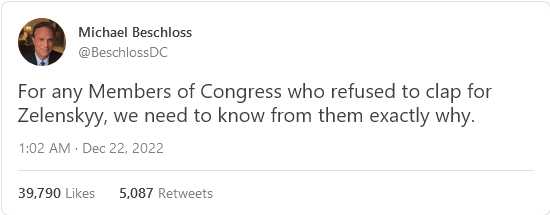
And so here’s one of the least subtle court eunuchs with a message about ritual obedience:
I wish I could replicate the awkward burst of nervous laughter that came out of me at the moment that I saw this message. The policing of performative applause in a formal political setting is so obviously a theme of totalitarian societies that … well, that Chief Eunuch Michael Beschloss can be counted on to not notice what he’s just done. I didn’t get a harumph outta that guy, he said, from deep inside a cloud of obtuse self-regard.
“They insist on inflicting on us such bloated theater & they seem not to know how false it all appears.” The Ukrainian president made it all the way to the Capitol in his combat fatigues, doncha know, and was greeted with a rapturous standing ovation by members of Congress, seen here in this actual footage:
Are there any normal human beings who don’t taste bile when they see this performance? And, Thomas Massie and Rand Paul aside, are there any normal human beings left inside the Beltway?
“Squee! Squee! Squee!” they explained, shaking their pom poms in a dignified ritual of state.


Comments Off on Never, ever be the first to stop clapping
Remember when ending “Net Neutrality” was going to be the death of the internet?
Peter Jacobsen answers a reader question about the now almost forgotten doomsday scenario for the internet that was the ending of “Net Neutrality” in 2017:
To answer this question, we have to wind back the clock to 2017. Then-chair of the Federal Communications Commission (FCC) Ajit Pai successfully led an effort to repeal a set of 2015 regulations on Internet Service Provider (ISP) companies originally put into place by the Obama Administration.
The simplest summary of net neutrality regulations is that they required ISPs to enable access to content on the internet at equal speeds and for equal costs. For example, your ISP charging you to get faster speeds on YouTube or blocking High Definition access on Netflix would be examples of violations of net neutrality.
The idea of paying your ISP extra to have access to certain websites is a scary one, but it appears the worst fears associated with the end of net neutrality were overstated. To some extent proponents of net neutrality are the victim of their own apocalyptic marketing.
The Rumors of the Internet’s Death Were Greatly Exaggerated
If you spent any time on the internet during the death of net neutrality, it was hard to miss it. On July 12, 2017 websites across the internet coordinated their messages for the “battle for the net.”
Websites including Amazon, Netflix, YouTube, and Reddit called their users to fight for “a free and open internet”.
On Twitter, #SaveTheInternet thrived, seemingly implying the internet itself was facing an existential threat.
The repeal of #NetNeutrality officially goes into effect today, but the fight is far from over.
The people saying we can’t pass the resolution to #SaveTheInternet in the House are the same people who were saying we couldn’t do it in the Senate.
Ignore them. Just keep fighting.
— Ed Markey (@SenMarkey) June 11, 2018
After the decision by the FCC, CNN briefly declared it was “the end of the internet as we know it”.
Unfortunately for all kinds of doomsday prophets, extreme rhetoric always looks silly in hindsight when it fails to pan out.
Obviously we aren’t seeing ISPs charge users different amounts to use different websites in any systematic way. There’s no “pay your ISP to access Hulu” package yet. So already it’s clear some of the doom and gloom was over-hyped.
Fears of ISPs offering “fast lanes” to make users pay more for better service don’t seem to have materialized either. The only example of this sort of thing I could find was a Cox Communications trial of an “Elite Gamer” service. But this service was unlike the “fast lanes” hyped up by net neutrality proponents in that it never offered a less throttled experience and would have been permissible under the old net neutrality rules.
One of the biggest concerns about the repeal of these regulations was that it would lead ISPs to favor their own services. For example, AT&T owns Time Warner and HBO Max. In theory, AT&T could silently throttle speed to competing streaming platforms like YouTube and Netflix, thereby destroying competition.
Comments Off on Remember when ending “Net Neutrality” was going to be the death of the internet?
QotD: Wokeness as a lifestyle
For Gen X, think of my personal candidate for “everything that’s wrong with the 90s, all in one place,” the 1994 movie Reality Bites. Don’t rent it unless you’re current on your blood pressure meds. It’s four of the 1990s’ most insufferable people (Winona Ryder, Ethan Hawke, Ben Stiller, Janeane Garofalo) quipping about being slackers. Well, except Stiller (also the director), who plays the grasping, uptight, sold-his-soul-to-The-Man yuppie foil to the other three. Stiller is the Gen Xer who chose to compete in the oversaturated career arena; he’s cartoonishly evil. The rest of them hang out in coffee houses, polishing their image. They’re lifestyle competitors.
For Millennials, and whatever we’re calling the upcoming generation (“The Lobotomized Snowflake Posse” is my suggestion, brevity be damned), well, just look at social media. Even lounging-around-Starbucks lifestyle competition is out of reach for people who went $100K in the hole for a Gender Studies degree. The only currency they’ve got is effort — hey, didn’t Karl Marx say something about that? — so Twitter becomes their full time job. Xzhe with the most followers wins.
Severian, “Why So #Woke?”, Rotten Chestnuts, 2020-01-07.
Comments Off on QotD: Wokeness as a lifestyle
December 22, 2022
The Emulsified High-Fat Offal Tube | Yes, Minister: 1984 Christmas Special | BBC Comedy Greats
BBC Comedy Greats
Published 26 Jul 2021Bernard (Derek Fowlds) walks Jim Hacker (Paul Eddington) through the red-tape of signing his Christmas cards, but Jim Hacker is more concerned with worrying plans from Brussels to rename the British sausage.
(more…)
Comments Off on The Emulsified High-Fat Offal Tube | Yes, Minister: 1984 Christmas Special | BBC Comedy Greats
December 21, 2022
The rise of David Bowie
In Quillette, David Cohen outlines the career of David Bowie:
With impeccable timing, the thin white stork had dropped David Robert Jones out of London’s skies nearly three-score-and-ten years earlier. The suburban Bromley Boomer fell to Earth on January 8th, 1947, and landed smack in the middle of the bulge years, a wonderfully fertile period for anyone looking to forge a career in recorded music. His first instrument was the saxophone, which he was blowing on by the age of 14. Within a few years, the transistor radio would be ubiquitous, young people would be awash with disposable cash to buy records, and the mass adoption of international air travel would open up new vistas for fans and artists alike. Could any moment have been better suited to a rock-star-in-waiting?
But he also came of age as the youngest child in a doomy household. Three of his maternal aunts suffered from acute mental health issues — one of whom was eventually lobotomized — and the family was riven with more dark secrets than the Tolstoy home. His schizophrenic step-brother, Terry, would spend much of his adult life in psychiatric care. His beloved father dropped dead when Bowie was just 22, while his mother — a children’s home publicist with whom he was emphatically not close — lived on. “Everyone says, ‘Oh yes, my family is quite mad,'” Bowie later recalled. “Mine really is.”
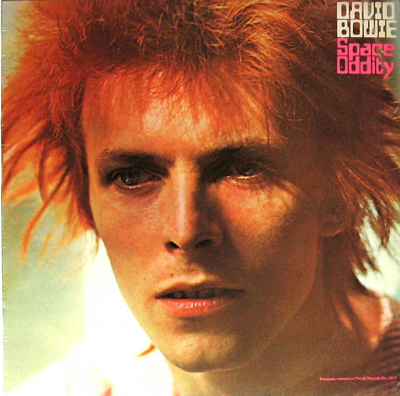
The greatest dream of the era in which Bowie grew up — the promise of putting Man on the Moon — became one of his first signature artistic nightmares. Space Oddity, the most famous track from his eponymous second album, conjured one such scenario, and provided him with his first real hit after the false start of his debut. The earlier album had its moments, but it left unresolved the question of whether the singer wanted to be a fey-voiced Anthony Newley or a strange young man called Dylan.
By the time he recorded his second album — and, especially, his third — Bowie had decided he would be a bit of both. The cover art for 1970’s The Man Who Sold the World presented him elegantly reclining on a chaise longue in a dress. He smoked copious amounts of hash and assembled a crack band for 10 days of whirling Moog synthesizers and hard rock guitars. The experience was so enjoyable and creatively rewarding that bassist Trevor Bolder, guitarist Mick Ronson, and drummer Mick Woodmansey stayed on. The tracks were laid down at a London residence called Haddon Hall, in Beckenham, and it is here that he would write and rehearse the material for his next three albums that would send his career stratospheric.
Commercially, the sex, drugs, and frock ‘n’ roll of The Man Who Sold the World didn’t find much of an audience. It was too heavy, perhaps, for the folk followers he had accrued with its acoustic predecessor. And too gay for rock fans certainly, the singer’s voracious heterosexuality notwithstanding. He followed it a year later with Hunky Dory, which is generally thought to be the record on which the Bowie alchemy first cohered into something truly new. It was also the curtain-raiser for what’s generally regarded as his classic period, and it provided him with his first American hit, “Changes”. More critically, it saw him discard the claustrophobic sound of The Man Who Sold the World for textured melodies, creamy arrangements, seat-of-the-pants lyrics, and further cameos from extraterrestrials.
On Hunky Dory, Bowie also turned in tribute tracks about Lou Reed, Andy Warhol, and Bob Dylan. Warhol hated the song Bowie had written about him. Reed would eventually smack Bowie about the head during an altercation at a London restaurant in April 1979. And when Bowie finally met Dylan, he later told Playboy, they “didn’t have a lot to talk about. We’re not great friends. Actually, I think he hates me.” Small wonder that he preferred the company of spacemen. The razzle-dazzle of “Oh! You Pretty Things” conjures hordes of them. As does “Life on Mars?” which features a chord progression nicked from Frank Sinatra’s “My Way”. The album closes with “The Bewlay Brothers”, in which the 24-year-old singer paid a tribute of sorts to his own step-brother, Terry.
But it was the release of The Rise and Fall of Ziggy Stardust and the Spiders from Mars in 1972 that made David Bowie a superstar. Picking the space songs out of that record is difficult because, by that point, almost everything Bowie was writing seemed to have an explicitly alien streak. During his appearance on Top of the Pops, he draped an arm across Ronson’s shoulders, and glowered out at a world that was about to repay the attention. In the wake of the album’s release, he returned to the United States a sensation (although the stormy flight en route only confirmed his fear of flying).
A generation on, Ziggy Stardust still routinely appears at or near the top of critics’ lists of the all-time greatest rock albums. It is strange to recall then, that in 1972, while it picked up its share of warm reviews, the album was by no means universally well received (the work of a “competent plagiarist”, sniffed Sounds). Some critics never got it. “I always thought all that Ziggy Stardust homo-from-Aldebaran business was a crock of shit,” wrote Lester Bangs in Creem four years later, “especially coming from a guy who wouldn’t even get in a goddam airplane.”
Comments Off on The rise of David Bowie
December 20, 2022
QotD: Myrna Loy
She goes on to provide a short list: John Barrymore (“just because he felt like a little redhead now and then didn’t incline me to join the club …”), Clark Gable (she shoved him off her back porch one night after he made a pass “and, boy, did he punish me for that!”), Spencer Tracy (“he chased me for years, then sulked adorably when I married someone else …”) and Leslie Howard (despite both of them being married he “wanted to whisk me off to the South Seas, and, believe me, that was tempting …”).
“These days you’re made to feel dull and defensive if you weren’t the Whore of Babylon,” Loy writes. “Well, succumbing isn’t the only interesting aspect of a relationship.”
It’s no surprise that a woman who understands this much was such a natural in screwball comedies, where succumbing is usually held at bay until the last shot, the better to draw out the difficulties, obstacles and improbabilities set up like an obstacle course along the way.
Of the over 120 films she made, most of the first half of her career – largely bit parts, vamps and “exotics” – is forgotten, her reputation based on the fourteen she made with William Powell (six of which were Thin Man pictures), along with titles like The Best Years of Our Lives, The Bachelor and the Bobby Soxer, Mr. Blandings Builds His Dream House and Cheaper by the Dozen.
If she had a type onscreen – and Loy tried hard to avoid becoming a type – she would become Nora Charles, the paragon of wives: supportive but not obsequious, the equal of any spouse, ready with a wisecrack and a bit of fun, and always beautifully turned out. Quite a stretch, she’d admit, for a woman divorced four times, childless and openly dismissive of her domestic skills.
Rick McGinnis, “Do You Take This Woman? Myrna Loy and Third Finger, Left Hand“, Steyn Online, 2022-09-17.
Comments Off on QotD: Myrna Loy


