
But what this whole developing scandal really reminded us of was, ironically, another scientific paper that was published in the midst of the pandemic. This one in the Journal of Experimental Social Psychology was released in September 2021 and titled: “Misplaced trust: When trust in science fosters belief in pseudoscience and the benefits of critical evaluation”.
The paper consisted of the results of four pre-registered experiments of decent sample size, albeit administered online. They introduced false claims about a fictional virus created as a bioweapon, and about the carcinogenic nature of GMO foods.
The results were so, so very telling.
“Participants who trust science are more likely to believe and disseminate false claims that contain scientific references than false claims that do not,” and “We conclude that trust in science, although desirable in many ways, makes people vulnerable to pseudoscience.”
Let that sink in. The people who #BelieveScience are more vulnerable to falling for pseudoscientific claims, especially when those claims are presented with the comforting ephemera of science — the lab coats, the credentials, the technical studies filled with jargon. That’s because “Believing Science” isn’t the same thing as actually doing science. “Believing Science” is a statement of tribal affiliation. All this claim demonstrates is that a person wants to be seen as the sort of individual who believes experts and takes advice from trusted and credentialed officials. For the most part, this is a good instinct! But if those experts and trusted officials are wrong, malicious, or simply full of shit, the “Believe Science” crowd will reliably fall in line. Because of its ideological affiliation, this crowd is, ironically, far less capable of spotting bad science.
Actually doing science as opposed to merely believing in it requires that we all evaluate claims critically regardless of their origins; we look for inconsistencies, we examine the quality of the evidence presented, and we question the credibility of the people making the claims.
“Dispatch from the Front Line: Comms aren’t the government’s problem”, The Line, 2023-07-23.
October 27, 2023
October 25, 2023
Progressive support for Hamas, despite (or even because of) the atrocities
In The Line, Jen Gerson outlines the dilemma many on the left find themselves in, as the Hamas atrocities in Israel attract loud cheering from other sections of the left:

The shockingly broad support for Hamas is a full mask-off moment for a big chunk of the modern North American left, and I think most ordinary people are recoiling from what the self-styled progressive movement has revealed itself to be.
I do wish to be fair. I believe a lot of lefties were caught up in the latest Hamas incursion, and expressed support for it before we had a full view of how brutal and, yes, barbaric it was. I also assume that a lot of lefties are well-meaning, and struggle to acknowledge the significant overlap between a noble Palestinian cause in abstract, and the violent resistance movement that seeks to support its ends. I suspect very few have read Hamas’ charter, which is explicitly and openly genocidal. This is not a militancy that is engaging in violence with the ultimate goal of a peaceful, two-state solution. Hamas — the political entity running Gaza, whether we like that fact or not — wants to run the Jews into the sea, and to establish a theocratic Islamic state in its stead.
There is nothing more bizarre than seeing pictures of soft-headed proggies holding signs like “Queers for Palestine,” seemingly oblivious to the fact that a Palestine run by Hamas is one in which the Queers would be pushed from the top floors of whatever is left of Gaza’s multi-story buildings once Israel is done bombing them. One can be deeply sympathetic to the plight of Palestinians as a people while noting that there is nothing liberal, humane or progressive about Hamas’ actual, stated goals, let alone its recent actions.
The fact that this terrorist organization has garnered so much public support from the likes of unions, professors and groups like Black Lives Matter, is darkly ironic.
Let’s look at a few examples; CUPE was, perhaps, the most infamous supporter of Palestinian “resistance” in the hours after it had been revealed that Hamas militants had killed more than 1,000 Jewish civilians, and taken hostage hundreds more. Fred Hahn, Ontario’s CUPE president, reveled in the news last Sunday, noting that he was thankful for “the power of resistance around the globe.” And: “From the river to the sea, Palestine will be free” — presumably (?) unaware that this is a phrase that is commonly associated with the destruction of Israel.
Hahn did apologize. Sorta. “My social media posts became a giant lightning rod for both legitimate anger, and also for bad faith actors with a divisive agenda.” Sure, Fred. Timing and those with a divisive agenda. That’s what got ya.
This week, we had a student group at Toronto Metropolitan University issue a public statement insisting “Israel not a country, but rather the brand of a settler colony” and supporting “all forms of Palestinian resistance and efforts toward liberation”. Credit is due for not mincing words. There is no mealy equivocation between Hamas and the innocent people of Palestine, here.
“All” “resistance” is legitimate.
[…]
I could go on, but I trust you get the point. None if it is compatible with cheering on atrocities — literal violence of the the most base and brutal kind. Justifying rape and baby beheading is irreconcilable with a version of the “left” that presents itself as secular, humane, compassionate, and committed to social justice.
Ordinary people see this, and the dissonance is jarring.
So how do we reconcile it? Well, try this on: Support for Palestinian resistance reveals this lefty jargon for the straightforward power play that it always was.
The activist left doesn’t actually believe that “words are literal violence”, and never did. The weaponization of compassion, the cancelling, the de-platforming — these are tactics. It’s never been about creating a more harmonious and tolerant world, nor protecting innocent students from harmful opinions; it’s about winning. Re-setting the Overton window by bullying dissenters. Dismantling the old power hierarchies — and replacing them with new ones. These politics exist to ensure that anybody who disagreed with the new order and its values was too intimidated to speak up for fear of being labelled a bigot, a racist, a transphobe, whatever, whatever
Violence, harassment, and threats have always been acceptable tactics to this crowd, provided these measures were applied to the right people for the right causes.
There is a reason why this ideology found such fertile soil in universities, and particularly in elite universities. (And it’s no coincidence that the most expensive institutions of education also happen to be clearinghouses for Palestinian support.) At the risk of stating the obvious, universities don’t just exist to educate students, they exist to instruct society’s future scions in the language, manners, and political views that signal acceptance in the ruling class. That’s what elite schools to do. It’s why major corporations and most media institutions have likewise followed suit. It’s power all the way down. .
October 23, 2023
QotD: The real meaning of “Watergate”
[…]
Recently, reading Mark Levin’s Unfreedom of the Press, I was reminded that, before reporters went on their great crusade against Richard Nixon, they had overlooked a whole lot of corruption in the Democrat presidents who preceded him.
Levin tells how John F. Kennedy, with the knowledge of his brother and Attorney General Robert, nudged the IRS into auditing conservative groups. With Kennedy’s approval, the FBI was also employed to investigate those the administration disliked, including Martin Luther King Jr. Lyndon Baines Johnson would later increase the politically motivated auditing and spying. None of this was uncovered until later on.
Ben Bradlee — the editor of the Washington Post, where Woodward and Bernstein broke the Watergate story — was well aware of his pal Kennedy’s misuse of the tax and investigative agencies. Not only did he not report it, he allowed himself and his paper to be manipulated by information JFK had wrongly obtained.
This totally changes the Watergate narrative. Nixon’s dirty tricks and enemy lists may have been creepy and wrong, but the press exposure of these misdemeanors came after years of ignoring similar and worse malfeasance by Democrat administrations.
That changes what Watergate means. That transforms it from a heroic crusade into a political hit job, Democrat hackery masquerading as nobility. The press turned a blind eye to the corruption of JFK and LBJ, then raced to overturn the election of a man they despised — despised in part because he battled the Communism many of them had espoused.
Andrew Klavan, “‘Watergate’ Doesn’t Mean What the Press Thinks It Means: The press turned a blind eye to the corruption of JFK and LBJ, then raced to overturn the election of a man they despised”, The Daily Wire, 2019-08-31.
October 21, 2023
“… we’re not a business publication. One of them can point out that corporate governance is a joke in Canada”
In the latest SHuSH newsletter, Ken Whyte reviews a recent BNN Bloomberg interview with Heather Reisman former-and-now-current-again CEO of Canada’s only big box book retailer, Indigo:

“Indigo Books and Music” by Open Grid Scheduler / Grid Engine is licensed under CC0 1.0

Heather Reisman gave an interview to Amanda Lang of BNN Bloomberg last week, her first effort to explain a summer of screwball management at Canada’s only bricks-and-mortar book chain.
[…]
How did Heather explain the zany sequence of events that started with her reporting Indigo’s fourth massive annual loss in five years in May; saw her booted in June from her role as executive chairman of Indigo, the company she founded, by her husband and controlling shareholder, Gerry Schwartz, along with every member of the board of directors who wasn’t personally beholden to Gerry; saw her spin her exit as a personal life-stages choice (“deciding when it is time to move on is one of the toughest decisions a founder must make”); saw her hand-picked successor and CEO, long-time British clothing retailer Peter Ruis, grab a seven-figure payout and make his own exit in September; saw the company announce that it would “act swiftly to find the right leader to move the company forward following Peter’s resignation”; saw Heather reinstated at the head of the chain two weeks later?
She didn’t. How could anyone explain that?
Heather bullshitted her way through the interview. It was all Ruis’s fault, she told Amanda. Indigo “took a journey off brand” under Ruis. She’d put him in charge of a book chain and “suddenly I was hearing that we were getting famous for selling $550 barbecues,” she said. “Somehow vibrators turned up in our stores and I remember saying ‘no, that’s not who we are.'” Ruis had “lost sight of … what our commitment is to customers.” He was “taking the business in the wrong direction” and it was showing up in the financials.
Heather claimed she’d been powerless to stop Ruis: “I was gone formally for over a year and informally for two and a half years in the sense that I was pulling back and not able to influence things.”
I scarcely know where to start. We could talk about the breathtaking ease with which Heather presented herself as a victim of Ruis while running him over with a forklift. How she hired a career fashion retailer to run what most Canadians still understand as a book chain and complained that he took the business off brand. How his barbecues and dildo merchandising was a logical extension of the cheeseboards and blankets merchandising she’d been doing for a decade.
If we were a serious business publication, we’d have to talk about her supposed powerlessness to do anything about the dildo-happy Ruis. The people who run public companies have duties to their shareholders, one of which is to keep them informed—promptly, honestly, transparently—about the management of the business. If Heather was gone “formally for over a year” and “informally for two and a half years,” investors should have known, right?
Let’s start with “formally for over a year.” Heather is referring to the most recent period of September 2022 to August 2023 during which Barbecue Boy was CEO of the company. Was Heather gone?
She was no longer CEO, a title she’d held for a quarter century, but according to corporate records she remained executive chairman of Indigo during that time, drawing an annual salary of almost a million. Titles matter in public companies. The difference between an executive chairman and a run-of-the-mill chairman is that the former is recognized as having an active role in the operations of the business, hence the executive-level salary. Executive chairman is higher on the org chart than CEO. If the company was moving off brand, betraying its customers, she was the one person with the formal role and the moral authority, as founder, to send the “four hours of fun” Firefighter Vibrator from Smile Makers ($75.00) back to the warehouse. Either Heather misspoke to Amanda last week about being “gone” or she spent her last year at Indigo misrepresenting herself to her shareholders and drawing a salary under false pretenses.
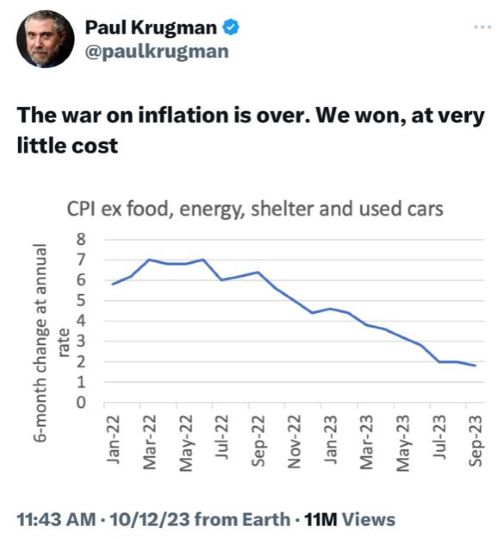
Paul Krugman lives in a fantasy world where “The war on inflation is over. We won, at very little cost”
Inflation continues to roar, despite calming words from government officials and legacy media pundits, as anyone who buys groceries could tell you. We long ago gave up going out for dinner, and now we’re very much living week-to-week and hoping the money lasts the whole month. Until my wife’s pension comes in late in the month, we’re utterly skint and trying to avoid spending any money at all. At Ace of Spades H.Q., Buck Throckmorton refutes the pro-government propaganda of, among others, Paul Krugman:

Monty used to use this image at Ace of Spades H.Q., and I certainly think it’s appropriate to include it here.
My household’s monthly grocery bill continues to steadily increase, despite the grocery list containing a pretty consistent basket of goods. We are spending more but not bringing home any more groceries. I am blessed that inflation has not forced us to cut back what we buy, but that hardly seems like an “expectation smashing” spending spree.
This article points out that several categories of retailers are not seeing any revenue growth at all, including clothing stores, electronics and appliance retailers, and sporting goods stores. In other words, these dry goods retailers are seeing declining unit sales as consumers are forced to redirect their decreasing purchasing power toward food, housing, and utilities.
Sales excluding auto and gas increased 0.6%, above estimates for a 0.1% increase compiled by Bloomberg.
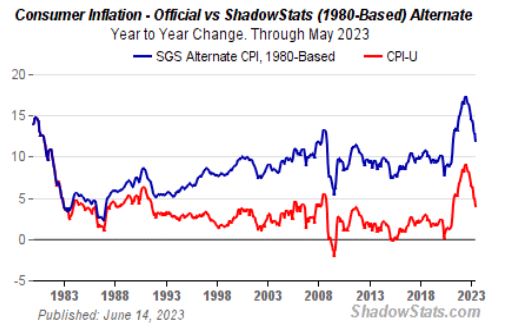
That 0.6% monthly increase in spending annualizes to a 7.2% increase in spending over one year. As we’ve discussed often, the government’s published inflation figures are completely fraudulent, with the Bureau of Labor Statistics reporting that as of September the annual inflation rate is just 3.7%, down from 4.0% in May 2023.
John Williams’ website (shadowstats.com) tracks inflation using the same measurements used in the Carter era. The chart below is updated through May 2023, showing the official 4% inflation as reported by the US government (red line) versus inflation if calculated the same way it was calculated in 1980 (blue line.) Actual inflation is more than 12%, which is 3 times the official bogus government figure.
Therefore, the “expectation smashing” consumer spending that the media is reporting is not even keeping up with actual inflation, which means that consumers are bringing home less in the way of retail goods, despite the increased dollar amount they are spending.
This tweet below is not a parody. Nobel Prize winning
propagandisteconomist Paul Krugman actually stated that excluding food, energy and shelter, “The war on inflation is over. We won, at very little cost.”
Thanks, Mr. Krugman, that’s very helpful. While inflation may be out of control on food, energy, and shelter, those are unnecessary discretionary expenditures. If people will just forego extravagances such as feeding their families and putting a roof over their children’s heads, they’ll do just fine in Biden’s economy.
October 20, 2023
Orwell on “Boys’ Weeklies” (aka “penny dreadfuls”)
David Friedman is enjoying re-reading some of George Orwell’s collected essays and has some comments on one that I’m quite fond of as well — Orwell’s survey of “Boy’s weeklies” first published in Horizon March of 1940:

The Weeklies, of which Orwell identifies ten, produced by two different publishers and including two older series somewhat different from the others, were very popular reading, targeted at boys up to about fourteen or fifteen. All of the stories in the two older ones and many in the others were set in British public schools; Orwell suggests, plausibly enough, that much of the inspiration for the setting was Kipling’s Stalky and Company.
Orwell focuses mostly on the two older ones, each of which had a stock cast of characters and a setting that showed no sign of changing for the thirty years over which they had been coming out and recognizably stylized plots and dialog. He comments that although each claims to be written by a single named author — “Frank Richards” for one series and “Martin Clifford” for the other — it is obvious that a single author could not have done thirty years of weekly stories and that the stylized writing is in part a way of maintaining the illusion of a single author.
The essay is interesting both for the detailed, and to some extent sympathetic, description of the weeklies
In the Gem and Magnet there is a model for very nearly everybody. There is the normal athletic, high-spirited boy (Tom Merry, Jack Blake, Frank Nugent), a slightly rowdier version of this type (Bob Cherry), a more aristocratic version (Talbot, Manners), a quieter, more serious version (Harry Wharton), and a stolid, “bulldog” version (Johnny Bull). Then there is the reckless, dare-devil type of boy (Vernon-Smith), the definitely “clever”, studious boy (Mark Linley, Dick Penfold), and the eccentric boy who is not good at games but possesses some special talent (Skinner Wibley). And there is the scholarship-boy (Tom Redwing), an important figure in this class of story because he makes it possible for boys from very poor homes to project themselves into the public-school atmosphere. In addition there are Australian, Irish, Welsh, Manx, Yorkshire and Lancashire boys to play upon local patriotism. But the subtlety of characterization goes deeper than this. If one studies the correspondence columns one sees that there is probably no character in the Gem and Magnet whom some or other reader does not identify with, except the out-and-out comics, Coker, Billy Bunter, Fisher T. Fish (the money-grabbing American boy) and, of course, the masters.
and for Orwell’s analysis of their political implications. He thinks they are designed, probably deliberately by the owners of the firms that publish them, to indoctrinate boys with conservative views — respectful towards the upper classes, ignorantly patriotic, contemptuous of foreigners, blind to the real problems of British society.
Here is the stuff that is read somewhere between the ages of twelve and eighteen by a very large proportion, perhaps an actual majority, of English boys, including many who will never read anything else except newspapers; and along with it they are absorbing a set of beliefs which would be regarded as hopelessly out of date in the Central Office of the Conservative Party. All the better because it is done indirectly, there is being pumped into them the conviction that the major problems of our time do not exist, that there is nothing wrong with laissez-faire capitalism, that foreigners are un-important comics and that the British Empire is a sort of charity-concern which will last for ever. Considering who owns these papers, it is difficult to believe that this is un-intentional. Of the twelve papers I have been discussing (i.e. twelve including the Thriller and Detective Weekly) seven are the property of the Amalgamated Press, which is one of the biggest press-combines in the world and controls more than a hundred different papers. The Gem and Magnet, therefore, are closely linked up with the Daily Telegraph and the Financial Times. This in itself would be enough to rouse certain suspicions, even if it were not obvious that the stories in the boys’ weeklies are politically vetted. So it appears that if you feel the need of a fantasy-life in which you travel to Mars and fight lions bare-handed (and what boy doesn’t?), you can only have it by delivering yourself over, mentally, to people like Lord Camrose.
The essay ends with a somewhat tentative suggestion that someone ought to produce a left-wing equivalent and a discussion of some problems in doing so.
It is an interesting essay on its own merits. Still more interesting is the response, an article by Frank Richards rebutting Orwell and defending his own work. It turns out that, contrary to Orwell’s confident claim, most of thirty years of weekly stories by “Frank Richards” were produced by the same person, with occasional stories by other authors when he was for some reason not available. Further, as Orwell comments in a later footnote to his essay, Frank Richards was also Martin Clifford, so the same person produced, for thirty years, most of the contents of two different weekly magazines for boys.
His response shows him to be an intelligent and articulate writer. His views are conservative in a general sense; he makes it clear that the setting of the stories is an unchanging 1910 England because he does not think much of the changes since. But he also makes it clear that the reason his stories do not include strikes, unemployment, labor unions, and a variety of other features of the real world is that he believes that providing boys an imaginative foundation in a secure world helps equip them to face future difficulties in a world much less secure.
Of strikes, slumps, unemployment, etc., complains Mr Orwell, there is no mention. But are these really subjects for young people to meditate upon ? It is true that we live in an insecure world: but why should not youth feel as secure as possible? It is true that burglars break into houses: but what parent in his senses would tell a child that a masked face may look in at the nursery window ! A boy of fifteen or sixteen is on the threshold of life: and life is a tough proposition; but will he be better prepared for it by telling him how tough it may possibly be? I am sure that the reverse is the case. Gray — another obsolete poet, Mr Orwell! — tells us that sorrows never come too late, and happiness too swiftly flies. Let youth be happy, or as happy as possible. Happiness is the best preparation for misery, if misery must come. At least, the poor kid will have had something! He may, at twenty, be hunting for a job and not finding it — why should his fifteenth year be clouded by worrying about that in advance? He may, at thirty, get the sack — why tell him so at twelve? He may, at forty, be a wreck on Labour’s scrap-heap — but how will it benefit him to know that at fourteen? Even if making miserable children would make happy adults, it would not be justifiable. But the truth is that the adult will be all the more miserable if he was miserable as a child. Every day of happiness, illusory or otherwise — and most happiness is illusory — is so much to the good. It will help to give the boy confidence and hope. Frank Richards tells him that there are some splendid fellows in a world that is, after all, a decent sort of place. He likes to think himself like one of these fellows, and is happy in his daydreams. Mr Orwell would have him told that he is a shabby little blighter, his father an ill-used serf, his world a dirty, muddled, rotten sort of show. I don’t think it would be fair play to take his twopence for telling him that!
As a child in England in the early 1960s, I didn’t encounter any of the stories by Frank Richards (at least, I strongly doubt it), but many of the storylines and tropes of his work were still echoed by later authors, especially in the British comics (Lion, Tiger, Valiant, Rover, and The Hotspur among the many offerings). Alongside the heroic adventure stories, the war stories, science fiction, and the (omnipresent) football stories, there were still some that might well have been comic versions of Mr. Richards’ originals.
I missed them after we emigrated, but I was delighted find that the W.H. Smith bookshop at Sherway Gardens carried a few of them (at a significant mark-up, of course) so I was still getting my occasional comic fix until about 1974.
QotD: The Gen-X-Files
I wasn’t in any way political back then. If forced to pick a side, I’d have been reflexively liberal, like all college kids are. I didn’t know the first thing about what was going on out in the world, let alone in the corridors of power in Washington, but even I found that pretty farfetched.
More importantly, the zeitgeist I saw was rapidly changing. X Files creator Chris Carter was born in 1956 and grew up in sunny SoCal (his wiki entry makes sure to give us his favorite surfing stance), so he more than most probably wrestled with the dilemma of how to bring Flower Power into Ronald Reagan’s 1980s. Hence the weird disconnect of the early 1990s, when Bill Clinton got his groovy, greasy, chicken-fried hippie self into the White House: The same people who, in their own college days, had nothing but hatred for the CIA and their domestic Mini-Me, the FBI, were all of a sudden kinda sorta coming around on the idea that The Feds are our friends — since, you know, the Feds are now us. It’s probably not a coincidence that Agent Mulder, FBI, was the star of The X-Files.
Explains a lot about “Gen X”, don’t it? When every single authority figure in your life, from the President on down, tells you to Fight the Power, the only way out of the clown show is to be, you know, like, whateverrr about everything — learned helplessness, 1994 version.
But smoked-out, flannel-clad, and apathetic is no way to go through life, and so we turned into a generation of suck-ups and toadies. Oh, the lunatic Marxists in the Teachers’ Unions want to encourage kids to “transition” in elementary school. Dude … you know, like, whateverrr. The college kids of 1994 are the middle managers, the Deep Staters, the lever-pullers of 2021. It’s working out about as well as you might’ve expected. You don’t need Agent Mulder to solve this mystery.
Severian, “1994”, Rotten Chestnuts, 2021-04-15.
October 18, 2023
The greatest sin of Twit-, er, I mean “X” is that it allowed us hoi polloi to peek behind the curtains of governments, universities, and major corporations
The latest book review at Mr. and Mrs. Psmith’s Bookshelf begins with a brilliant explanation for the coming fall of western civilization at the hands of Twit-, er, I mean “X”:

The greatest gift bestowed by admittance to elite institutions is that you stop being overawed by them. For instance, there was a time when upon hearing “so-and-so is a Rhodes Scholar”, I would have assumed that so-and-so was a very impressive person indeed. Nowadays I know quite a lot of former Rhodes Scholars, and have seen firsthand that some of them are extremely mediocre individuals, so meeting a new one doesn’t phase me much. My own cursus honorum through America’s centers of prestige has been slow and circuitous, which means I’ve gotten to enjoy progressive disenchantment with the centers of power. Trust me, you folks aren’t missing much.
I have a theory that this is why Twitter has been so destabilizing to so many societies, and why it may yet be the end of ours. Twitter offers a peek behind the curtain — not just to a lucky few,1 but to everybody. We’re used to elected officials acting like buffoons, but on Twitter you can see our real rulers humiliating themselves. Tech moguls, four-star generals, cultural tastemakers, foundation trustees, former heads of spy agencies, all of them behaving like insane idiots, posting their most vapid thoughts, and getting in petty fights with “VapeGroyper420.” There’s a reason most monarchies have made lèse-majesté a crime, there’s a level at which no regime can survive unless everybody pretends that the rulers are demigods. To have the kings be revealed as mere men who bleed, panic, and have tawdry love affairs is to rock the monarchic regime at its foundations. But Twitter is worse than that, it’s like a hidden camera in the king’s bedroom, but they do it to themselves. Moreover it seems likely that regimes like ours which legitimate themselves with a meritocratic justification are especially fragile to this form of disenchantment.
This is also why the COVID pandemic was so damaging to our government’s legitimacy. I’ve been inside elite institutions of many different sorts, and discovered the horrible truth that most of the people in them are just ordinary people making it up as they go along, but one place I hadn’t quite made it yet was the top of our disease control agencies.2 So in a bit of naïveté analogous to Gell-Mann amnesia, I just assumed that there was some secret wing of the Centers for Disease Control which housed men-in-black who would rappel out of helicopters and summarily execute everybody in Wuhan who had ever touched a bat. And I was genuinely a little bit surprised and disappointed when instead they were caught with their pants down, and a bunch of weirdos on the internet turned out to be the real experts (the silver lining to this is that now we all get to be amateur scientists).
So much for public health. But if there’s one institution which still manages to shroud itself in mystery while secretly pulling all the strings, surely it’s the Federal Reserve. You can tell people take it seriously because of all the conspiracy theories that surround it (conspiracy theories are the highest form of flattery). And there’s a lot to get conspiratorial about — the Fed manages to combine two things that rarely go together but which both impress people: technocratic mastery and arcane ritual. The Fed employs a research staff of thousands which meticulously gather and analyze data about every aspect of the economy, and they have an Open Market Committee whose meeting minutes are laden with nuanced double-meanings that would make a Ming dynasty courtier blush, and which are accordingly parsed with an attention to detail once reserved for Politburo speeches.
And they also control all of our money! Is it any wonder that people go a little bit crazy whenever they think about the Fed? I can’t think of a more natural target for the recurring cycles of ineffectual populist ire that characterize American politics. So it is with great regret that I’m here to report that they, too, are making it all up as they go along.
1. And that lucky few have much to gain by maintaining the charade. A stable ruling class is one that has much to offer potential class traitors, so they don’t get any ideas. It’s when the goodies dry up, whether due to elite overproduction or to a real reduction in the spoils available, that things fall apart.
2. That’s not quite true: I did once attend an invite-only conference at the United States Army Medical Research Institute of Infectious Diseases. The food was awful, and I wasn’t even able to find the lab where they created crack cocaine, HIV, and Lyme disease.
October 17, 2023
Those problematic “AI girlfriends” – men suck and women suffer because of it
Janice Fiamengo discusses a recent CNN program that woman-splained why young men paying for “AI girlfriends” are yet another way that misogynistic men are harming women:
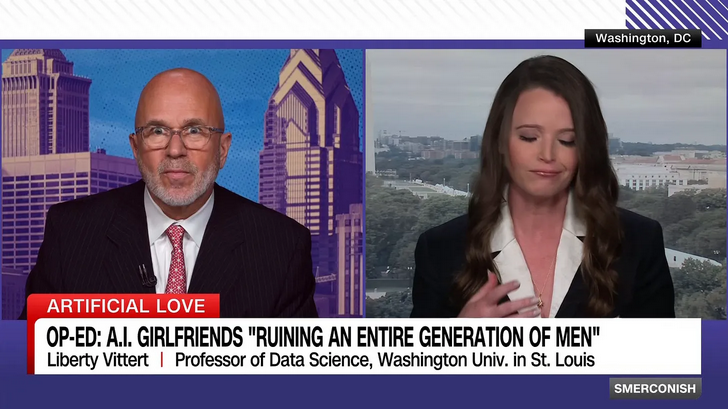
Last week, CNN aired a must-watch episode with the somber headline, “AI girlfriends are here and they’re posing a threat to a generation of men”. If that sounds as if the show might possibly express some compassion for young men and for the “epidemic of loneliness” referred to in the show, it was not to be. Even an expert, Scott Galloway, profiled briefly on how society is “failing men”, felt the need to express contempt for their alleged conspiracy theories, online misogyny, and even (gasp!) climate change denial. With friends like these …
The segment is fascinating, however, for its revelation of some pundits’ uneasy awareness of male discontent.
[…] The expert is Liberty Vittert, a statistician and professor of data science at Washington University’s Olin Business School. But she might as well be an AI feminist, so predictable was her analysis of the male entitlement allegedly driving the turn to AI girlfriends. Though a statistician, Vittert gave no data about the numbers of men who are paying to access AI content. While the CNN host, Michael Smerconish, seemed open to the possibility of exploring men’s points of view, the expert could only emphasize male failure.
She condemned young men for “choosing AI girlfriends over real women”. The choice means, according to Vittert, that “they don’t have relationships with real women, don’t marry them and then don’t have and raise babies with them”.
But wait, aren’t marrying and raising babies a patriarchal imposition on women — part of the “comfortable concentration camp” that Betty Friedan so memorably indicted?
Professor Vittert says nothing about the decreasing number of young women willing to marry and procreate. Her (botoxed) mouth turns down in disapproval as she explains that the increasing realism of AI is “enabling this entire generation of young men to continue in this loneliness epidemic”. It seems that men prefer sterile self-pleasuring and facile scopophilia to the “hard work” of relationships with real women. Like Joaquin Phoenix’s hapless character, these men, she says, are so fixated on perfection that they “are not able to deal with ups and downs, not only in a relationship, but in life in general”. The glibness of the condemnation is remarkable, though far from unusual.
It’s not clear if Professor Vittert has ever talked to actual men about why some of them (not “an entire generation”) might choose an AI relationship. Does she know any young men who have tried for years without success to find a marriageable girlfriend? Many discover that such prizes are remarkably thin on the ground, many of them unsuitable to be considered as future mothers. Even worse, perhaps, does Vittert know anything about what can happen to an inexperienced young man who pursues the wrong woman or women (there are a couple of heartbreaking examples in Sons of Feminism)? How many times does a young man who has failed repeatedly need to hear that no woman owes him love or sex before he starts thinking that giving up on them might not be a bad idea? Meanwhile, women laugh at his loneliness and drink “I bathe in male tears” mugs.
To give him credit, CNN’s Smerconish asks a few questions about the male point of view: “What’s going on with the women?” Has the power dynamic shifted in their favor? Are they less approachable than formerly? These only scratch the surface, but he’s chosen the wrong expert for such a conversation.
Vittert freely admits that there are now many more women than men at university (thanks, affirmative action!) and that far more women than formerly are choosing career over homemaking (thanks, feminist propaganda!). But those are good things, and young men simply need to adapt. Calling any of this debacle women’s fault, she declares, would not be “the right way to go”.


QotD: Representations of sex work in SF
Maybe it’s a relic from when SF was just another facet of Men’s Adventure magazines, or maybe it’s capitalizing on the stereotypical basement-dwelling Geek’s desire to have high quality women to command at the wave of a few credits or gold pieces. Or, more cynically, it’s the desire of Hollywood producers who actually DO have high quality women at their mercy, career-wise, to further normalize the idea that “Sex work is real work” to help smooth away the resistance to their hamfisted efforts on the casting couch.
TV Tropes has a number of entries about this, from “Unproblematic Prostitution” to “High Class Call Girl”. Writers like to call up the imagery of the Geisha, and make their Space Hookers come across as brilliant sexual artists, with additional talents that help the protagonists, such as advanced degrees or connections to corporate executives and high ranking government officials. (Funny how they are not corporate movers and shakers or government officials themselves …). They forget, of course, that Geisha were not actually prostitutes, and only rarely took lovers. There were still actual brothels in Japan for that sort of thing.
Science Fiction has gotten a lot more difficult to write as the frontiers of reality have pushed back against the flights of fantasy. We have had to accept that you can’t get to the moon inside a Victorian upholstered artillery shell, or set foot on the Jungles of Venus. And maybe that’s why a lot of SF in recent decades has turned towards the softer sciences where theories are more prominent than scientific facts, making it simpler to speculate.
However, even in our understanding of society, there are some realities that can’t be ignored. A few of them are listed in the aforementioned “Unproblematic Prostitution” entry. The primary social reality that undermines all of the tropes is that when you commodify sex, you are putting women on sale. Maybe it’s just fractionally, for a few hours out of her lifetime, but when your fantasy/SF hero comes along and waves a few C-notes to get a woman to do what he wants, it’s not the “Combination of Sex and Capitalism” (“… which are you against?” the excuse goes) but the sublimation of Sex TO Capitalism.
“Sex work is real work,” they like to say, but when you turn sex INTO work, it strips it of all of its better qualities. “Do what you love and you’ll never work another day in your life,” is another lie. I’ve known too many artists who go from having a fun hobby to chasing unsatisfying commissions, eventually burning out from endless requests by cretins for illustrations of their vilest fantasies. So the idea that our happy Space Hookers are having fun and getting paid, and what’s wrong with that, turns into burnout in pretty short order, because the kind of guys who go out looking for “That kind of girl” are not interested in the parts of sex that make it as enjoyable as it is for a compatible couple. They don’t have girlfriends for a reason. So the trope that Prostitution is just Sexy Fun Time falls by the wayside in the face of human nature.
SF also likes to postulate that science will make sex consequence free with perfect contraception and cures for all diseases. Writers and Producers fail to see the actual social costs and secondary effects, some of which we are finally running afoul of today, as women are aging out of their “Hookup culture” days and finding themselves alone and with few prospects for a lasting relationship, while at the same time human reproduction is falling below the replacement rate worldwide. And of course, nature being what it is, there will always be new diseases from new planets or new alien races or who knows WHAT our horny young space cadets have been sticking their dicks into. Human biology has less security in its OS than a Commodore 64.
Dr. Mauser, “Space Hookers Must Die!”, Shoplifting in the Marketplace of Ideas, 2023-07-16.
October 16, 2023
After the attacks, Hamas proudly shared photos and videos of the victims
In UnHerd, David Patrikarakos describes what he calls “the week Hamas reinvented horror”:

Israel and Gaza are a Pathé newsreel of violence. Atrocity mounts upon atrocity. Blood smeared on gristle. Festivals mottled with corpses. Women dragged off to be raped and killed. And, now, perhaps the ultimate taboo. “This is the most difficult image we’ve posted”, ran the Daily Telegraph’s front page, reprinting a tweet from the State of Israel’s official account. “As we are writing this we are shaking. We went back and forth about posting this. But we need each and everyone of you to know. This happened.”
The images were of the charred and blackened corpses of babies. Dead bodies are a fixture of my professional life, and I have never seen anything like it. I have never felt that level of nausea. Nothing is beyond the sadism of Hamas. Nothing, now, might be beyond the response — comes the reply from Israel.
Clearly, nothing now is beyond being live-streamed, uploaded, posted, tweeted or shared. Amid the horror and disgust, one thing has struck me above all: the footage has overwhelmingly come from the perpetrators. Yes, there is video shot by terrified and fleeing victims, but scroll through Twitter, Telegram and Instagram and what do you see? Hamas filming themselves barking at cowering Israeli families on the ground; parents covering their children’s eyes, desperate to banish reality; Hamas yanking soldiers off tanks and throwing them into the dirt; Hamas grinning as they parade an elderly woman around in a golf cart.
This conflict has lasted for almost a century, yet what we have seen this week has never been seen before. It is a nasty and brutal war fought over land where ideology and the interminable cycle of reprisals has made its resolution impossible. But it is something else, too. It is perhaps the world’s longest running geopolitical media spectacle. Nothing, not Kashmir nor the Balkans nor any of the other enduring conflicts largely created by empire, has received anywhere near this level of coverage. The depths plumbed by Hamas are unprecedentedly low.
Several factors explain the brutality. First is a perennial of human nature: old-fashioned rage and bloodlust. No one, least of all it seems Hamas, expected the attacks to be so successful. Coming upon hundreds of unarmed Israelis was obviously too much of a temptation for many of these incontinent fanatics.
Then there is the desire to provoke. To get Israel to overreact, but also its neighbours. Broadcast images of dead Palestinian babies onto those feeds and then maybe your Arab allies will start to wonder about the wisdom of their various normalisation agreements with Israel. History is turning away from Hamas. The warming of relations between Israel and Saudi Arabia threatens to destroy them forever. If the “Custodian of the Two Holy Places” decides the “Zionist Entity” is actually ok, then it’s only the politically impotent and half-witted Bashar al-Assad beside you, and the Iranians, who are formidable but largely alone.
It’s a basic strategy but a generally successful one. Don’t forget that one of the reasons bin Laden struck the World Trade Center was to get the Leviathan to lash out, which it did. Hamas has limited options. This is perhaps the one card it can play with any real efficacy.
October 15, 2023
“… officials gesture and perform with a constant focus on the optics. The act of governing becomes the act of calculated sloganeering”
Chris Bray explains how politicians and government officials have so damaged their own credibility that significant portions of the population greet each and every news story as pre-calculated propaganda to advance this or that cause. Thanks to their breathtaking cynicism, the swivel-eyed conspiracy theorist of old has more credibility than a high-ranking government official:
The moral and intellectual sickness of the global governing class is infecting us all. They’ve poisoned the public sphere.
In the society of the spectacle, authority has become a display; officials gesture and perform with a constant focus on the optics. The act of governing becomes the act of calculated sloganeering: This vaccine is safe and effective. The use of evidence is a conspiracy theory; disagreement is disinformation. What we learned from the discovery process in Missouri v. Biden is that, yes, the government has manipulated what you’ve been allowed to read and to know. Everyone who gets vaccinated against COVID-19 becomes a dead end for the virus, and don’t you dare say otherwise.
The British journalist Laura Dodsworth told us, with considerable evidence, that governments were using nudge units of social scientists to deliberately crank up public terror over the pandemic, embracing mask mandates as a way of planting a symbol of fear on our faces. We wake up every morning knowing that governments lied for the purpose of manipulating our behavior.
And now we see the devastating cost. I wrote on Substack this week about video of the Hamas attacks on Israel and quickly began seeing the themes of a low-trust society in the comment thread, comments that were echoed all over social media: Why do the authorities want us to see this footage? What’s their game? How did they pull off this psyop? What’s causing them to launch this false flag attack at this exact moment?
The repeated message was about the importance of being skeptical: The war machine is trying to propagandize us into another stupid war!
But what I began seeing — what we all began seeing — wasn’t skepticism, the diligent search for clear evidence, but a wholesale refusal at the political margins to believe anything at all.
The certainty that all images are lies is the psychological mirror of the reflex to believe the news, identically displaying the refusal to parse evidence and make choices. It’s all one thing or the other: Oh, right, Hamas attacked Israel, moron! I GUESS THE SHEEPLE JUST BELIEVE WHATEVER THEY’RE TOLD!
It’s scorched-earth nihilism, the blanket rejection of inconvenient reality. And I understand it. People who’ve been lied to assume that they’re being lied to.

Training and educating for unseriousness
Theophilus Chilton on the many ways our education and entertainment industries inculcate trivial and easily distracted habits in both children and young adults:

Any thinking American has surely observed that our culture and society are growing more and more immature, childish, and unthinking with each passing year. In previous articles, I’ve noted this immaturity, as well as the tendency (neither coincidental, nor accidental) to make Americans more and more dependent upon the Regime for even the most basic needs of life. There are several interrelated cultural and political agendas at work which have systematically worked to create this state of affairs among the American people – and these are largely the work of social and political “progressivism”, the handiwork of the Left. Let’s face it – it is to the benefit of left-wingers to cause as many people as they possibly can to be dumb, distracted, and therefore destitute of the ability to think for themselves or to successfully reason their way into informed opinions about complex social and economic issues.
One of the major ways in which the Left dumbs down the American population is through the public education system. What people need to understand is that progressives are not genuinely interested in our children receiving a thorough and useful education, no matter how much they may squawk about “funding” and whatnot. For the Left, publik skoolz are merely a means by which to propagandize children to a progressive worldview while simultaneously rendering them unable to question the unreality they have been taught. At the same time, additional funding “for schools” is basically just a way for personnel in the managerial superstructure to divide the spoils. The Left has absolutely no desire for children to grow up into college students, and then into full-fledged adults, who can think for themselves, using logic and reason to assess what they see and hear and to come to their own conclusions.
Along these lines, I was reminded of Pascal-Emmanuel Gobry’s article from 2014 in Forbes magazine about the need to put the liberal arts back into the centre of American educational curricula. By this, he means the restoration of the great books of Western civilization, the accumulated wisdom in the sciences and humanities that our culture has built, and the ideological underpinnings upon which Western notions of citizenship, responsibility, and the rule of law are based. In other words, all of the things that the cultural Marxists have spent the last five decades systematically expunging from the American educational system, from top to bottom. Things like Cicero, Plato, the Church Fathers, Shakespeare, Herodotus, Montesquieu, the Founding Fathers, and so much more that I could not possibly list in full. No – these have been purged, replaced by Heather Has Two Mommies and Why Are the Ice Caps Melting?: The Dangers of Global Warming. Progressives want young people (who will then grow up to be old people) who are in the dark about the whats, hows, and whys of our cultural underpinnings and what they all mean for our heritage and traditions. They want your kids to be more interested in emasculating themselves with hormones than they are in reading dusty old books about their own history and heritage. This explains why progressives are so irate about the proposals such as those which remove diversity and LGBT propaganda from classrooms, just to give a couple of examples.
However, I don’t believe we can place the blame solely on the educational system. It surely has not escaped the attention of intelligent Americans that most of what constitutes our entertainment and media establishment is, shall we say, less than cerebral. In fact, much of what is on television, in the movies, and on the radio waves is downright stupid and distracting. It is literally distracting. The content of these media, as well as the advertising regimen by which television viewers are presented with five minutes of show, then three minutes of ads, then another five minutes of show, then another three minutes of ads … it is all designed to train people toward short attention spans that are easily distracted by shiny baubles and other mindlessness. A person who has their brain trained by modern television programming is going to be someone who will not have the patience to sit down with a book and read it. They’ll literally be uneducable beyond simple repetition and mindless obedience.
The state of American journalism is no better. This is illustrated by Gobry’s article above, in which he addressed the attacks upon Republican congressman (nominee at the time it was written) Dave Brat of Virginia, an economics professor who overturned Eric Cantor in the 2014 GOP primary, and who is a genuine constitutionally-minded intellectual who stands on the fundamental principles of our society and constitutional system (meaning, of course, that he’s still a turbonormie but at least his heart’s in the right place). In the course of some statements he made, Brat remarked that government has “a monopoly on the use of force”. For this, he was attacked by nimrods in the news media as some kind of crazy, wacko extremist. There’s just one problem, as Gobry points out,
What’s wrong with this picture, America, is that the concept of the state having “a monopoly on the [legitimate] use of force” is a quotation from the highly reputed and important German sociologist Max Weber, and is a concept that is absolutely basic to our modern understanding of the State. Anyone who has taken polisci 101 or sociology 101 or political philosophy 101 or history of ideas 101 ought to have encountered the phrase. It is about as offensive as saying that donuts have holes …
In other words, journalists – who are supposed to be educated, and who, if they are dealing with the political circuit, should have at least some sort of basic education in political science to go with their typewriting skills – had no clue what Brat was talking about. They didn’t recognize Weber’s (very commonly quoted) dictum; most of them probably don’t even know who Max Weber was. All they saw was what they thought was an opportunity to play the “Tea Party wacko extremist” card because somebody used the words “force” and “government” in the same sentence.
The sad part is that it probably worked with a lot of the low-information voters out there.
A paper in the Journal of Pediatrics by Peter Gray, David F. Lancy, and David F. Bjorklund points to the ever-declining ability of children and teens to engage in independent activity away from direct adult supervision from a very early age:
It is no secret that rates of anxiety and depression among school-aged children and teens in the US are at an alltime high. Recognizing this, the American Academy of Pediatrics, American Academy of Child and Adolescent Psychiatry, and Children’s Hospital Association issued, in 2021, a joint statement to the Biden administration that child and adolescent mental health be declared a “national emergency.”
Although most current discussions of the decline in youth mental health emphasize that which has occurred over the past 10-15 years, research indicates that the decline has been continuous over at least the last 5 or 6 decades. Although a variety of causes of this decline have been proposed by researchers and practitioners (some discussed near the end of this Commentary), our focus herein is on a possible cause that we believe has been insufficiently researched, discussed, and taken into account by health practitioners and policy makers.
Our thesis is that a primary cause of the rise in mental disorders is a decline over decades in opportunities for children and teens to play, roam, and engage in other activities independent of direct oversight and control by adults. Such independent activities may promote mental well-being through both immediate effects, as a direct source of satisfaction, and long-term effects, by building mental characteristics that provide a foundation for dealing effectively with the stresses of life.
With few, if any, opportunities to explore and engage with the world away from parental supervision, it isn’t a surprise that young adults today suffer much higher rates of mental illness, especially anxiety-related afflictions.
QotD: The two eras of Jazz
Dylan Jones, “The 100 best jazz albums you need in your collection”, GQ, 2019-08-25.
October 14, 2023
Ray Manzarek – “Riders On The Storm”
EliasIak2011
Published 30 Nov 2012“The Doors: Mr. Mojo Risin’ — The Story of LA Woman“


