
Johnny Carson
Published 27 Jun 2023Original Airdate: May 26, 1983
(more…)
November 8, 2023
Mel Blanc on How He Created His Iconic Voices | Carson Tonight Show
Comments Off on Mel Blanc on How He Created His Iconic Voices | Carson Tonight Show
November 7, 2023
The “slopes of Lyle”, and why they matter
In The Line, Matt Gurney explains what Paul Wells christened the “slopes of Lyle” and why Canadian political discourse is so hypocritical so often:

A screenshot from a YouTube video showing the (pick your team’s preferred term) [protest | insurrection] in front of Parliament in Ottawa on 30 January, 2022.
Photo via Wikimedia Commons.
It was a bit over a year ago when Paul Wells, in one of the best pieces of his I’ve ever read, created the concept of the “slopes of Lyle”. The “Lyle” refers to some polling published by Greg Lyle, of Innovative Research Group. I won’t spend a ton of time recapping the polling or what Paul drew from it, beyond the necessary: Lyle found and could graph what amounts, in effect, to political hypocrisy. Using the example of whether governments should meet with protesters, even if those protesters have broken the law, Lyle found that one’s opinion on the matter hinged less on any overall value-neutral philosophical belief and more on the specifics of the protesters. Left-leaning Canadians (NDP and Liberal voters, in Lyle’s poll) were a lot more sympathetic to a government that would meet with Indigenous Canadians (and supporters) protesting a new pipeline than they were with the Ottawa convoy protesters. CPC-supporting Canadians — and who’da thunk it?! — felt the reverse. Graphing out these positions resulted in those slopes Paul noticed — left-wing and right-wing support for governments meeting with protesters tanked when you changed who the protesters were.
The slopes of Lyle.
It’s been basically a month since the appalling assault by Hamas into southern Israel. Israel’s war against Hamas grinds on, and is producing the kind of horrible collateral damage we all feared. People across the West, including very much here at home in North America, are devastated by what they’re seeing, hearing and reading, and of course they are. It’s awful, every bit of it. There have been large rallies and protests and from them, we’re starting to see some of those Lyle-ian slopes emerge. It’s predictable, but it’s still bad, and it’s worth noting. Because we can do better, and it’s not hard to try.
Consider one issue: whether or not a protest is defined by the worst elements within it. Personally, I say no. Any large group of people necessarily becomes impossible for any organizer to control, and if terrible people show up to wave terrible signs, chant terrible slogans and do terrible things, I don’t think that reflects badly on everyone who showed up. That’s my overall philosophical view on such matters. I felt that way about the convoy in Ottawa, as some of you may remember — I tried really hard in my pieces from the capital to hammer home how the crowd there was a blend of the nasty and the harmlessly well-meaning. At the time, many were portraying the entire event as harmless — just a bunch of bouncy castle fans, folks! Others were portraying every last one of them as Confederate Nazis. Neither was accurate, and I said so then, and I’ve said so since.
Ditto with the protests we’re seeing in Canadian cities of late. I have no problem agreeing that many, probably even most, of the people showing up are good people, motivated by genuine concern over the plight of the Palestinian people, both in the broader sense of their aspirations for a better future but also over their current endangered state, as the war grinds on around them. I’m also not blind to the fact that some of what we’ve seen — some of the flags, some of the chants and slogans, some of the signs being waved, and some of the behaviour — has been wildly inappropriate, perhaps even illegal, and has absolutely gone well beyond simple criticism of Israel into outright antisemitism. There’s just no way to deny that we’ve had antisemites marching through our streets, saying and doing antisemitic things. Loud and proud, out in the open.
And yet I’ve noticed some, ahem, difficulty in admitting this or acknowledging this. And that’s interesting, because some of the very same people who will go to their deathbed believing the convoy was a Nazi uprising get very upset at the suggestion that there’s much to be worried about in the anti-Israel protests or that we should read much into people who want Jews killed for the mere fact of their Judaism.
So that’s a conundrum, eh? I don’t care what side you take. I really don’t. I just want you to be consistent. So I’ll just ask the question: does the presence of a radical group with a larger protest invalidate the protest and even tarnish the cause, or nah? Again, I don’t care which way you vote. But kindly put yourself on the record.
Comments Off on The “slopes of Lyle”, and why they matter
November 6, 2023
Justin Trudeau’s (latest) very bad week
Paul Wells wonders if Justin Trudeau would even want to stay on as Liberal Party leader for the next election after the more recent awful week he’s had:
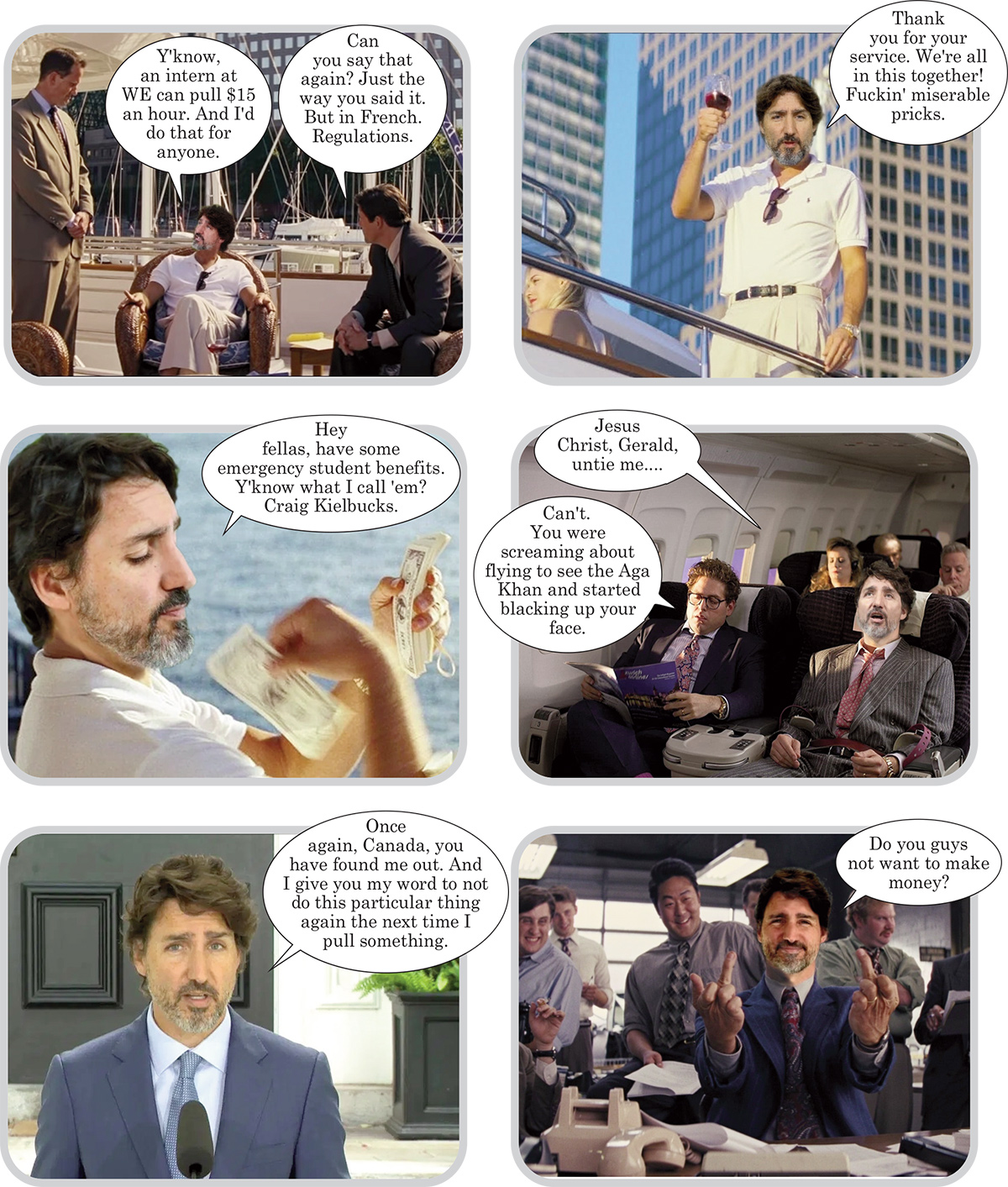
That was fun of Justin Trudeau to act out the message that somebody who spends his days in the Senate is a nobody. Of course, the kind of year he’s having, his bit of theatre came two days after he appointed five new senators. Welcome to the upper chamber, suckers. If you’re really lucky, a flailing prime minister might use you for a punchline.
This felt like the week that Trudeau’s hold on his leadership became precarious. I’ve had people asking me all week whether Trudeau will run again. Of course I don’t know. I guess the only thing that’s new is that if he does stay until the next election, and lead the Liberals into it, I’ll wonder — more keenly than before — why he bothered.
The decision still feels like his alone. The headline-making assaults on his power this week fell well short of what it would take to remove him if he doesn’t want removing. I find Percy Downe a serious and likable man, but he is not gregarious, he doesn’t have networks of people ready to do his bidding, and the truth is that the Senate isn’t a base for getting anything done within the Liberal Party. Hasn’t been for a decade.
As a good Liberal who was working hard long before “hard work” became a Trudeauite slogan, Downe has never forgiven Trudeau for kicking senators out of the Liberal caucus. As a good Prince Edward Islander, he has never forgiven Trudeau for maintaining tolls on the Confederation Bridge between the Island and the mainland while removing tolls on the Champlain Bridge into Montreal. This was a straightforward transfer of wealth from PEI to Central Canada, and turned out to be foreshadowing for last week’s fuel-oil transfer in the other direction. So Downe has a grudge or two to motivate him, and no army to deliver his desired outcome. His preference for Trudeau’s political future is widely shared in the country but he lacks a mechanism for delivering it in real life.
At least Downe has been expressing a clear preference in coherent language. In this he contrasts nicely with Mark Carney. Carney was a successful central-bank governor in two countries, a feat without obvious precedent. But politics is a different line of work. Reading Carney’s interview with the Globe was like watching somebody shake a Ziploc bag full of fridge magnets. In fact I’m pretty sure that when he started talking, he wasn’t planning to deliver any message about party politics.
He’ll “lean in where I can”. He has a list of things he hasn’t ruled out: becoming the next Liberal leader; running for Parliament. Running for Parliament is also on his list of things he hasn’t ruled in. Not ruling things out is, notoriously, not how you actually get into Parliament. I haven’t ruled out becoming a backup dancer for Taylor Swift, and yet I’m not in the new concert film. I checked.
Comments Off on Justin Trudeau’s (latest) very bad week
November 5, 2023
Hugo Chávez
The most recent entry in the Dictator Book Club at Astral Codex Ten looks at former Venezuelan President Hugo Chávez:

Former Venezuelan President Hugo Chávez.
Photo by Roberto stuckert Filho/PR via Wikimedia Commons.
All dictators get their start by discovering some loophole in the democratic process. Xi realized that control of corruption investigations let him imprison anyone he wanted. Erdogan realized that EU accession talks provided the perfect cover to retool Turkish institutions in his own image.
Hugo Chavez realized that there’s no technical limit on how often you can invoke the emergency broadcast system. You can do it every day! The “emergency” can be that you had a cool new thought about the true meaning of socialism. Or that you’re opening a new hospital and it makes a good photo op. Or that opposition media is saying something mean about you, and you’d like to prevent anyone from watching that particular channel (which is conveniently bound by law to air emergency broadcasts whenever they occur).
This might not be the only reason or even the main reason Hugo Chavez ended up as dictator. But it’s a very representative reason. If Putin is basically a spook and Modi is basically an ascetic, Hugo Chavez was basically a showman. He could keep everyone’s attention on him all the time (the emergency broadcast system didn’t hurt). And once their attention was on him, he could delight them, enrage them, or at least keep them engaged. And he never stopped. Hugo Chavez was the marathon runner of dictators.
He was on television almost every day for hours at a time, invariably live, with no script or teleprompter, mulling, musing, deciding, ordering. His word was de facto law, and he specialised in unpredictable announcements: nationalisations, referenda, troop mobilizations, cabinet shuffles. You watched not just for news value. The man was a consummate performer. He would sing, dance, rap; ride a horse, a tank, a bicycle; aim a rifle, cradle a child, scowl, blow kisses; act the fool, the statesman, the patriarch. There was a freewheeling, improvised air to it all. Suspense came from not knowing what would happen.
There would be no warning. Soap operas, films, and baseball games would dissolve and be replaced by the familiar face seated behind a desk or maybe the wheel of a tractor … it could [last] minutes or hours. Sometimes Chavez wouldn’t be talking, merely attending a ceremony … One time Chavez decided to personally operate a machine on the Caracas-to-Charallave rail tunnel. A television and radio announcer improvised commentary for the first few minutes, but gradually ran out of things to say as the president continued drilling, drilling, drilling. Radio listeners, blind to Chavez pounding away, were baffled and then alarmed by the mechanical roar monopolizing the airwaves. Some thought it signaled a coup.
In 2012, while he was dying of cancer, Chavez gave “a state of the nation address lasting nine and a half hours. A record. No break, no pause.” Put a TV camera in front of him, and the man was a machine.
If he had been an ordinary celebrity, he would be remembered as a legend. But he went too far. He became his TV show. He optimized national policy for ratings. The book goes into detail on one broadcast in particular, where he was filmed walking down Venezuela’s central square, talking to friends. He remarked on how the square needed more monuments to glorious heroes. But where could he put them? The camera shifted to a mall selling luxury goods. A lightbulb went on over the dictator’s head: they could expropriate the property of the rich capitalist elites who owned the mall, and build the monument there. Make it so! Had this been planned, or was it really a momentary whim? Nobody knew.
Then he would move on to some other topic. An ordinary citizen would call in and describe a problem. Chavez would be outraged, and immediately declare a law which solved that problem in the most extreme possible way. Was this staged? Was it a law he had been considering anyway? Again, hard to tell.
Sometimes everyone in government would ignore his decisions to see if he forgot about them. Sometimes he did. Other times he didn’t, and would demand they be implemented immediately. Nobody ever had a followup plan. They expropriated the mall, but Chavez’s train of thought had already moved on, and nobody had budgeted for the glorious monuments he had promised. The mall sat empty; it became a dilapidated eyesore. Laws declared on the spur of the moment to sound maximally sympathetic to one person’s specific problem do not, when combined into a legal system, form a great basis for governing a country.
But Chavez TV was also a game show. The contestants were government ministers. The prize was not getting fired. Offenses included speaking out against Chavez:
Chavez clashed with and fired all his ministers at one time or another but forgave and reinstated his favorites. Nine finance ministers fell in succession … it was palace custom not to give reasons for axing. Chavez, or his private secretary, would phone the marked one to say thank you but your services are no longer required. Good-bye. The victim was left guessing. Did someone whisper to the comandante? Who? Richard Canan, a young, rising commerce minister, was fired after telling an internal party meeting that the government was not building enough houses. Ramon Carrizales was fired as vice president after privately complaining about Cuban influence. Whatever the cause, once the axe fell, expulsion was immediate. The shock was disorienting. Ministers who used to bark commands and barge through doors seemed to physically shrink after being ousted … they haunted former colleagues at their homes, seeking advice and solace, petitioning for a way back to the palace. “Amigo, can you have a word with the chief?” One minister, one of Chavez’s favorites, laughed when he recounted this pitiful lobbying. “They know it as well as I do. In [this government] there are no amigos.”
… or taking any independent action:
[A minister] was not supposed to suggest an initiative, solve a problem, announce good news, theorise about the revolution, or express an original opinion. These were tasks for the comandante. His fickleness encouraged ministers to defer implementation until they were certain of his wishes. In any case they spent so much time on stages applauding — it was unwise to skip protocol events — that there was little opportunity for initiative. Thus the oil minister Rafael Ramirez would lurk, barely visible, while the comandante signed a lucrative deal with Chevron […]
But upon command, the stone would transform into a whirling dervish … the comandante‘s impulsiveness demanded instant, urgent responses. He would become consumed by a theme. Rice! Increase rice production! The order would ricochet through [the government]. The agriculture, planning, transport, commerce, finance, and infrastructure ministers would work around the clock devising a scheme or credits, loans, cooperatives, mills and trucks to have it ready, at least on paper, for the comandante to unveil on his Sunday show. Thus was born the Mixed Company for Socialist Rice. Then, the next week, chicken! Cheaper chicken! The same ministers would forget about rice while they rushed to squeeze farmers, truckers, and supermarkets so that the comandante could say, on his next show, that chicken was cheaper.
… or, worst of all, not enjoying Chavez’s TV shows enough:
[Ministers had to] arrange their features into appropriate expressions when on camera or in the comandante‘s sight line. This was tricky when the comandante did something foolish or bizarre because the required response could contradict instinct … Missing a cue could be fatal. During a show the comandante‘s laser-beam gaze swung from face to face, spotlighting expressions, seeking telltale tics. Immediately after a broadcast, Chavez reviewed the footage, casting a professional eye over the staging, lighting, camera angles — and audience reaction.
The comandante‘s occasional lapses into ridiculous were inevitable. He spoke up to nine hours at a time live on television, without a script … Being capricious and clownish also sustained interest in the show and underlined his authority. No other government figure, after all, dared show humour in public. But on occasion this dissolved into absurdity. Who tells a king he is being a fool?
Ministers faced another test of the mask in September 2007, when the comandante announced clocks would go back half an hour. The aim was to let children and workers wake up in daylight, he said. “I don’t care if they call me crazy, the new time will go ahead, let them call me whatever they want. I’m not to blame. I received a recommendation and said I liked the idea.” Chavez wanted it implemented within a week — causing needless chaos — and bungled the explanation, saying clocks should go forward rather than back. If ministers realized the mistake, they said nothing, only smiled and clapped […]
On rare occasions the correct response was not obvious, sowing panic. In a speech to mark World Water Day in 2011, the comandante said capitalism may have killed life on Mars. “I have always said, heard, that it would not be strange that there had been civilisation on Mars, but maybe capitalism arrived there, imperialism arrived and finished off the planet.” Some in the audience tittered, assuming it was a joke, then froze when they saw neighbors turned to stone. To these audience veterans it was unclear if it was a joke, so they adopted poker faces, pending clarification. It never came; the comandante moved on to other topics.
How did a once-great nation reach this point? I read Rory Carroll’s Comandante to find out.
Comments Off on Hugo Chávez
Military “institutional racism” and the Expert Infantry Badge
Chris Bray on a recent article in which a USAF Colonel lectures other “white colonels” about institutional racism in America’s military services:
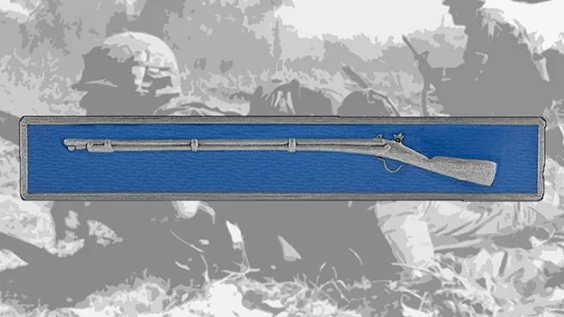
US Army Expert Infantry Badge
Image from armyfacts.com
Thoughts about the Air Force colonel who delivers sanctimonious lectures about institutional racism to his fellow “white colonels”.
In you’re an infantry soldier in the US Army, you can distinguish yourself by earning an Expert Infantry Badge. To do that, you have to qualify as an expert with the rifle, then complete a series of skills tests like “set headspace and timing on a caliber .50 machine gun” and “operate as a station in a radio net with SINCGARS radio single channel”. Then, finally, you have to complete a 12-mile road march. You can read the standards for that event here: carry a rifle and magazines, wear a helmet at all times, carry a rucksack weighing at least 35 pounds, and so on. When the person with the stopwatch says that three hours have elapsed, you’re either standing behind the finish line or in front of it; you either earn the EIB or you don’t.
The test isn’t subjective — the judges don’t award you style points. If you crawl across the finish line in a pool of blood and urine, sobbing for mommy, but you do it in less than three hours, and you still have your rucksack and your rifle and everything else at the end, you get the EIB.
Nor is it weighted. If you’re a fourth-generation VMI graduate with a fine old family name that can be found on the rolls of the Mayflower Society, you get the EIB if you cross the finish line on time. If you’re an E-2 who grew up in a trailer park and barely made it out of high school and doesn’t remember the names of all your so-called stepdads, you get the EIB if you cross the finish line on time. Officers and enlisted work to exactly the same standard. The credential comes from the task, full stop. This fact is the core of every credential you can earn in the military: If you’re authorized to wear the Parachutist Badge, you went to Fort Benning, or whatever they call it now, and jumped out of the plane five times without missing the ground. You did the thing. Doing the thing is who you are, in a growing list of things.
As a set of organizations built on task competence, for plainly measurable tasks that can’t be faked or fudged, the armed forces have been America’s first meritocracy. The first black West Point graduate was commissioned in 1877; the first black Medal of Honor recipient was born into slavery. Even in the segregated military, credentials obtained through task competence bore weight, as the court-martial of Jackie Robinson suggests with its outcome: In 1944, in Texas, a black officer was correct to harshly demand respect from a white enlisted soldier.
If you’ve served in the military, you’ve seen this. In my first posting as an infantryman, my company commander, first sergeant, platoon sergeant, and squad leader were black, a fact that I never heard anyone even mention. Rank, profession, and authority come from doing, without socioeconomic or racial chutes or ladders: If you can fly the plane, you’re a pilot. Up to the boundaries of the flag ranks, politics and identity don’t matter. (Regarding those flag ranks, see the late David Hackworth’s discussion of “perfumed princes”.)
And so the descent of the American military into the performative politics of DEI and equity and Robin DiAngelo books just blindly shits on the core value of the American military, which is that you get the rank and the status for what you do, full stop.
November 2, 2023
The carbon tax has been murdered, by Justin Trudeau, in the House, with a blatant self-interest
Rex Murphy believes the much-hated carbon tax — the Laurentian Elite’s revenge on working Canadians — has been dealt its mortal blow by the least likely suspect:
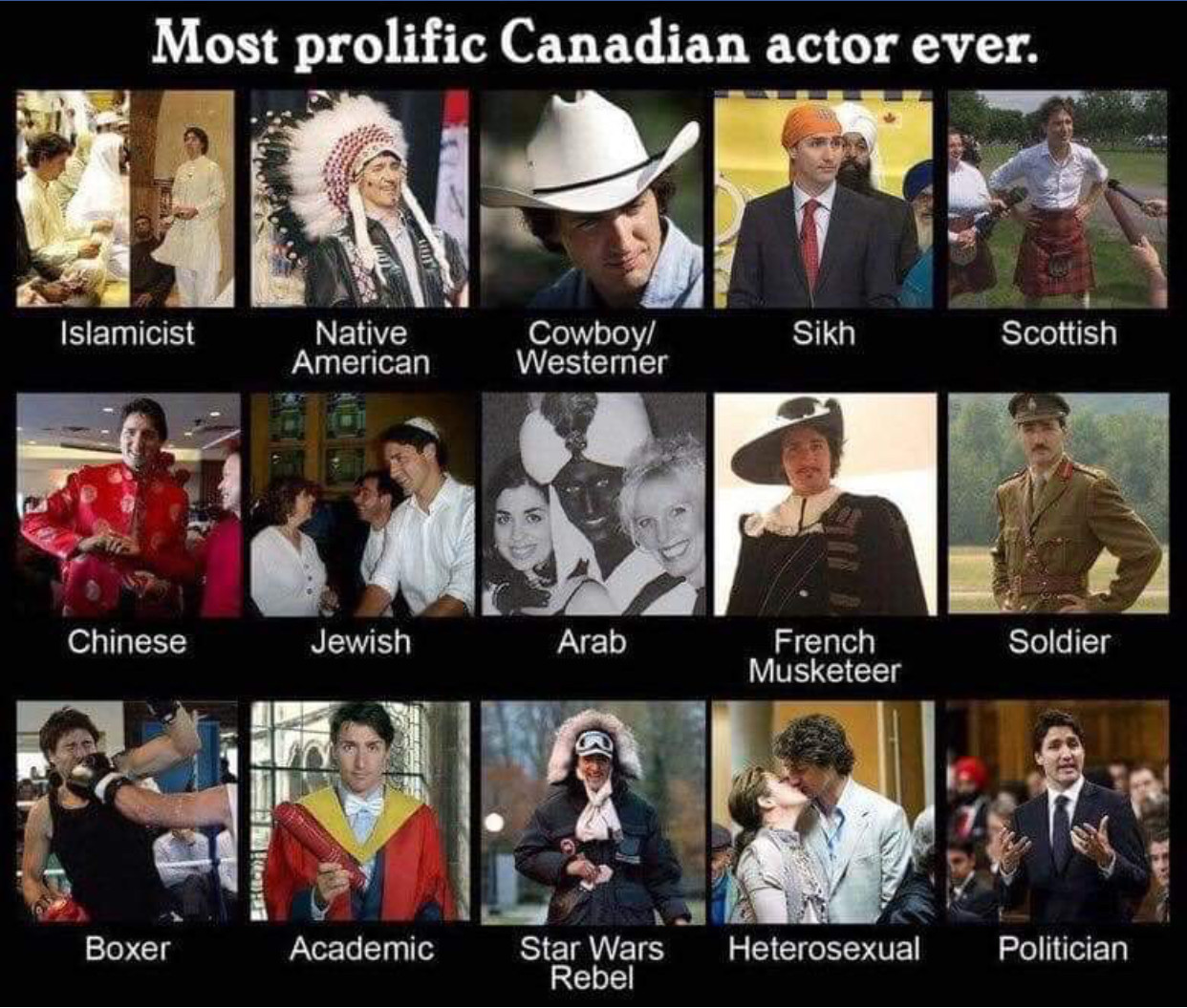
Justin Trudeau came into office on the spume of Canadian-level celebrity, built on a persona of ostentatious, idle gestures and token cheer (selfies, socks, costumes), the endless vocalization of woke crackerjack-box slogans and a smile cemented in place that had all the warmth of well-gelled cement. Just style. Style, understood as the adoption of surface mannerisms in place of deeply settled convictions, convictions built on a real attempt to understand Canada, to relate to all its regions, and an appreciation (which does not mean agreement) of the ideas, lifestyles and situations of mainstream Canadians: style adopted as a campaign dynamic.
It’s worth reminding that from the moment of its first swearing-in, the Liberal government has been an administration of show and tactics: tactics have been its policy, tactics have been its governing lifeblood. Policies — in so far as it can be said to have had policies — have been merely (temporary) scaffolding or window displays meant to shore up the tactics. They have not been, as with an honourable government, needful measures for Canadian well-being, shored up not by tactics but by their obvious benefit and their consonance with what Canadians made clear were their concerns.
Canada’s predominant commitment these past eight painful years, the “one ring to rule them all”, the only government commitment held with deepest conviction we have been told, has been combatting global warming. It is different. It is real policy. It is the core principle. It is immutable because its cause is existential. It has been Canada’s passport to an admiring progressive world. Above all it has absolutely glowed with virtue-signalling and superior progressive sensibility. It has been as good as a wristband was at a rock concert years back.
For all of his eight years Trudeau has incessantly promoted and promulgated his single cause. At home he has out-Suzukied David Suzuki, out-Mayed Elizabeth May, and there have been moments when he “out-dared” Greta. Abroad, he has been climate alarmism’s smiling Galahad.
Global warming has been his religion, and what he calls the carbon tax both eucharist and passport to net-zero paradise. To an increasingly skeptical Canadian public, anxious and distrustful of a government regularly racked by scandal and heroic mismanagement, he said (I paraphrase): “I know I’m taxing a necessity — heat for homes in northerly Canada — and I know it must hit the poor first and worst. But it’s to save the world! Saving the world keeps me up at night. And I want Canada to lead the way in saving it. And for that, there must be a tax on energy, on gas and oil, on heating. It must be done. It’s a sacrifice poets will write in praise of in the lower-temperature world we will be key to making happen.”
The tax on carbon dioxide — the great comedians of the Liberal party called it a “tax on pollution” — had to be imposed, even as inflation ravaged the country and further immiserated the already sufficiently immiserate, because Trudeau had a whole world to save. It was the signature element of the signature policy of Trudeau’s showcase government. It was the indispensable girder in building a post-oil-and-gas future for a post-nationalist Canada, the indestructible bridge to a golden net-zero tomorrow for our country. And, incidentally, a great shiny glittering Last Spike to doom Conservative Alberta’s economy and government, and no little whack for Saskatchewan.
This was principle as policy, and policy as principle. For seven plus years.
And now. A few fingers snapped somewhere and suddenly, Mr. Trudeau … cancels the carbon tax. Cancel for one and you must cancel for all.
Comments Off on The carbon tax has been murdered, by Justin Trudeau, in the House, with a blatant self-interest
With progressive allies like these …
In The Free Press, Suzy Weiss and Francesca Block record the reactions of progressive Jews who are waking up to discover that their “allies” hate them and want them dead:
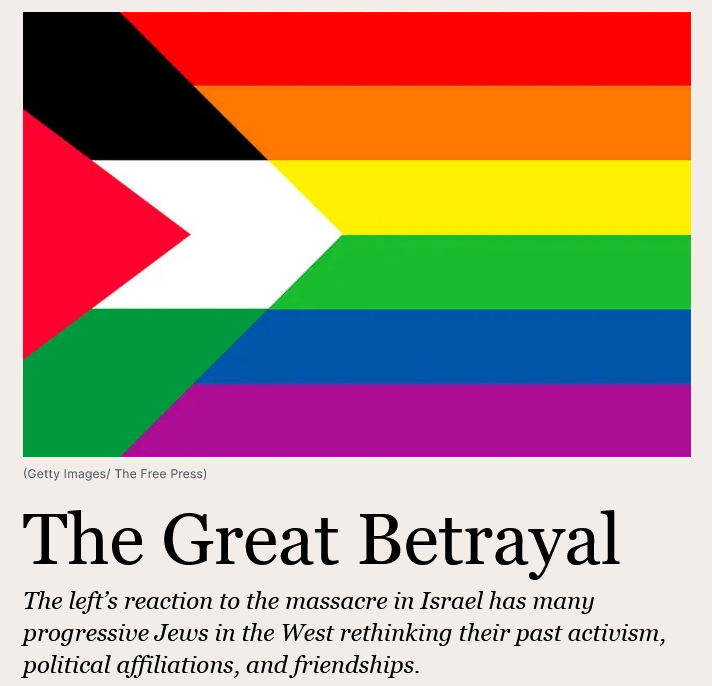
After Donald Trump was elected, Emily Rose, 51, flew to New York with her daughters to walk in the Women’s March. She demonstrated on the streets of Minneapolis, where she lives, in the days after George Floyd’s murder. She donated money to small, black-led movements and social justice organizations that she believed in. She unlearned and then re-educated herself, as white Americans were instructed to, and read the teachings of anti-racist scholars like Ta-Nehisi Coates.
But then, after the massacre in Israel on October 7, when some 1,400 Jews were brutally murdered, not to mention the rapes, beheadings, and instances of torture, Rose began to notice something odd from the cohort of fellow progressives she admired: they were cheering for the other side.
“I started to see these intelligent, educated people, whose mission is to make our system better for people of color, suddenly posting all this anti-Israel, pro-Palestinian stuff,” Rose said. “I’m not changing my values, but screw the allyship. I will not stop fighting, because I believe in the causes themselves. But as for going out of my way to support, to post, to give money? I’m done.”
While professional politicos, like DSA founder Maurice Isserman, are publicly stepping down from their parties and denouncing organizations that justify, or even cheer, the events of October 7, and wealthy Jewish donors claw back their millions from elite universities that they say helped foment antisemitism on their campuses, there’s a quieter, more personal reckoning happening among progressive Jews. Like Rose, they feel betrayed by a left that they thought would have their backs.
Dov, 30, a Canadian musician who didn’t want to share her last name for privacy reasons, is transgender and a self-proclaimed “political progressive”. Since October 7, she says, “Every time I open Instagram I’m just like, blocking or deleting people that I thought I knew.” She calls anti-Zionism “cloaked antisemitism”.
Josh Gilman, 37, who lives in Arizona and prides himself on having friends across the political spectrum, says he has been muting even close friends who espouse anti-Zionist views. “I don’t need the emotional distress,” he told The Free Press. “If there’s someone who is truly my friend, it makes me feel that they very much don’t understand who I am as a person.” He’s cut out people he had invited to dinner at his home, and who he had trusted around his family and children.
“There’s a line in the sand, which is Israel,” he said.
Nate Clark, 34, lives in Virginia. He’s marched for gay rights, and in 2020, for the removal of statues of Confederate soldiers in his home state. He said his choice to stand up for others is rooted in his Jewish identity.
“As a Jew, I feel like it would be weird if I went to Germany and took a right turn down Hitler Avenue or saw a statue of Eichmann, and then hear people claim ‘Oh, it’s our history. We’re just proud of our history’?” he told me.
Since October 7, he’s found himself “politically homeless”.
Comments Off on With progressive allies like these …
November 1, 2023
They don’t actually offer post-grad studies in anti-semitism … formally, anyway
Glenn Reynolds on the somehow surprising-to-academics discovery that western universities are hotbeds of antisemitism:
UC Berkeley Law School Dean Erwin Chemerinsky is shocked, shocked at the amount of antisemitism present throughout elite academia.
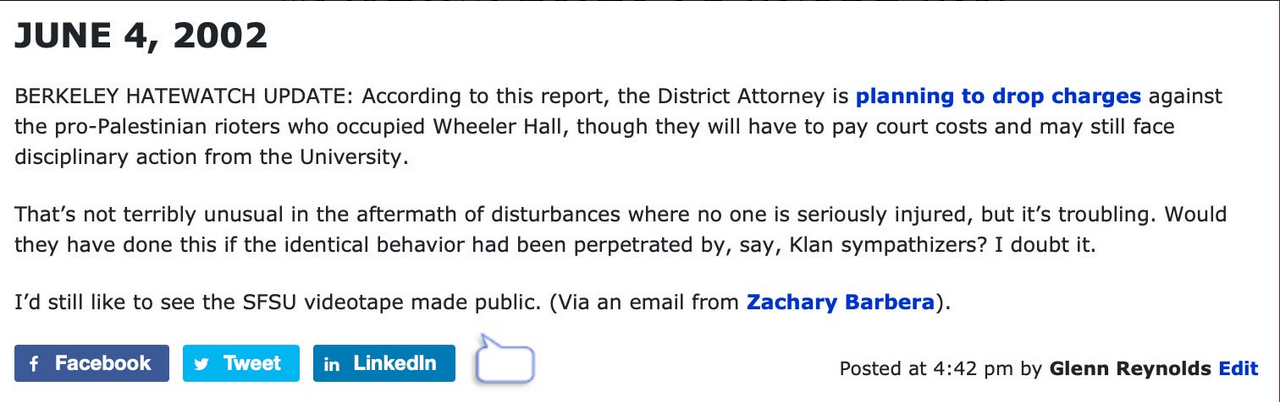
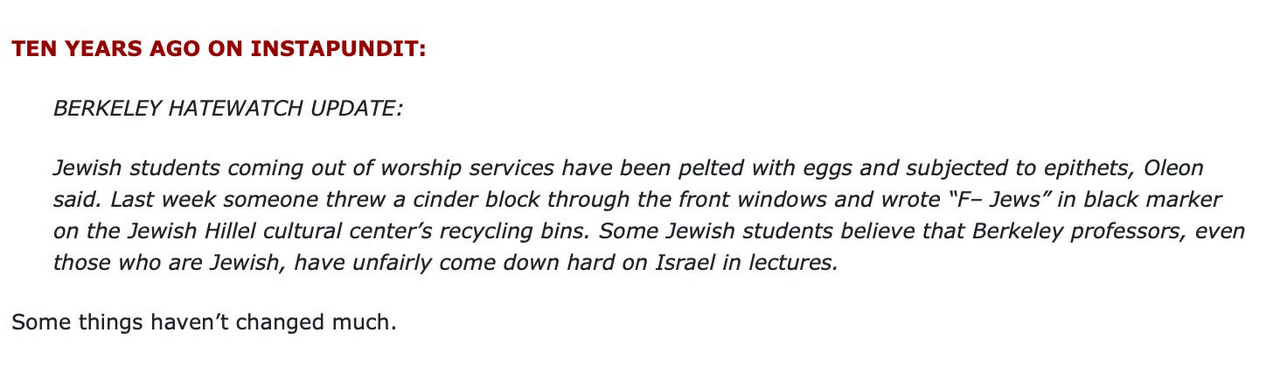
Obviously, he hasn’t been reading my blog. Over 20 years ago I was running a series of posts tagged “Berkeley Hatewatch Update”, tracking hateful and antisemitic behavior at UC Berkeley.
Like this one:
Or this one:
To be fair, Erwin wasn’t Dean at Berkeley Law back then, when it was still called Boalt Hall.
[…]
So even in Chemerinsky’s own backyard, the signs have been there continuously for basically the entire 21st Century to date. If Chemerinsky read my blog, he’d have known about happenings there, and elsewhere throughout the higher education world, that apparently are news to him.
Well, to be fair, deans have more important things to do than read blogs. On the other hand, well, welcome to the party, pal. Pointing out the flourishing, toleration, and even encouragement of antisemitism in the higher education sector has largely been the function of “right wing” outlets. Mainstream and left-wing media (but I repeat myself) have had little desire to air the dirty laundry in public. And, anyway, they’re increasingly staffed with recent graduates from elite schools, steeped in Critical Race Theory, “decolonization” talk, and the like, who see this antisemitism (along with prejudice against Asians and “whiteness”) as natural and laudable, instead of as what it is, which is evil and un-American. The truth is that support for antisemitism and mass murder isn’t an aberration for the far left that dominates American campuses now. As Ilya Somin notes, it’s baked in: “It’s rooted in a long history of defending horrific mass murder and other atrocities”.
Comments Off on They don’t actually offer post-grad studies in anti-semitism … formally, anyway
October 30, 2023
The rapidly fading market for “song investing”
Ted Gioia called it over two years ago, and now it’s coming true:
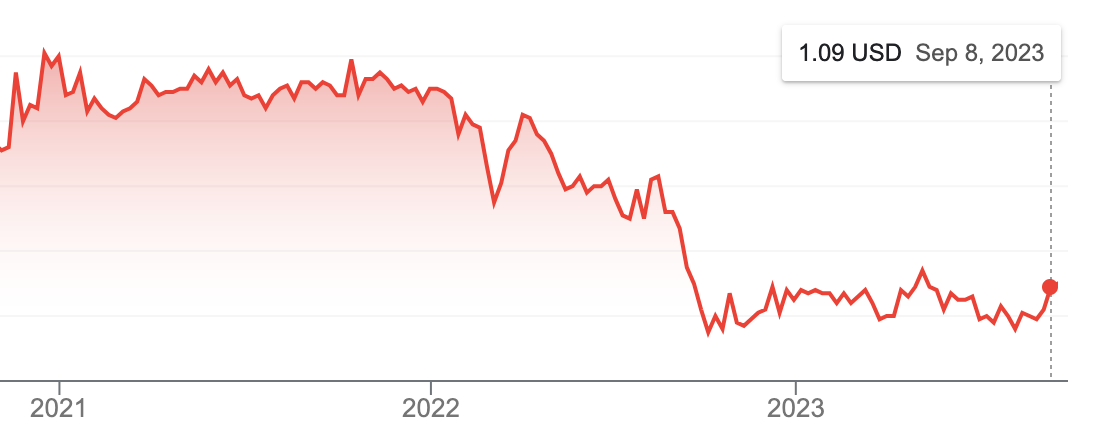
The collapse finally came.
When I analyzed the song buyout mania, led by the Hipgnosis fund, back in June 2021, I predicted that this ultra-hot investment trend would “come to an unhappy end”. And now the collapse has arrived.
We’ve reached the endgame. The song fund’s share price has dropped 50% since I made that assessment — and now shareholders have voted to dissolve or reorganize the investment trust.
But where do we go from here? What are old songs really worth? And who will end up owning all these old rock and pop tunes?
Below I offer 12 predictions.
Much of what I have to say is harsh. That’s unfortunate — if I were a real judge, I’d err on the side of leniency. It’s never fun issuing such hardass verdicts. But if I claim to be the Honest Broker, I really have to stick with truths, even when (as in this case) they’re painful truths.
(1) Many musicians still want to sell their songs, but it will be hard to find generous buyers.
Bob Dylan got out at the top, but the times are now a-changin’. Musicians won’t get the big payouts available back in 2021. A telltale sign will be more deals with “undisclosed terms” — because nobody will want to brag about these lowball transactions.(2) Professional financiers have finally learned their lesson.
The two big finance outfits promoting song investing, Hipgnosis and Round Hill, have faltered and will now sell the songs they bought. Sophisticated investors no longer believe the hype. So don’t expect to see the launch of new song investment funds any time soon. The remaining buyers will be bottom fishers and the terminally naive (described in more detail below).[…]
(5) Look out for these vultures in all sectors of the music business.
When private equity firms knock on your door, it’s a sign that you’re already half dead. These folks actually enjoy picking on carcasses — which is easier work than hunting for live prey. I tend to avoid name-calling, but there’s a reason why some folks refer to them as vulture capitalists. That’s their specialty and their economic model is built on bottom-feeding. This is why private equity firms bought up lots of failing local newspaper, struggling local radio stations, etc. Guess what’s next on their list? Expect to see these tough hombres play a bigger role in all aspects of the music business over the next decade.[…]
(7) This whole situation is a case study in misallocated investment capital.
There’s a general lesson here too. I realized, early on in my consulting work, that the single biggest mistake large corporations make is investing too much to keep their old business units alive — when they would be wiser putting that cash to work in new opportunities. The major record labels in the current moment are poster children for exactly this mistaken sense of priorities. They will support the “old songs” business model at all costs — it’s a core part of their self image — but return on investment will be dismal.
Comments Off on The rapidly fading market for “song investing”
The funny side of reviewing woodworking tools
Christopher Schwarz used to be the editor of one of the big US woodworking magazines and part of the job included being inundated with free tools from manufacturers eager to get a review in an upcoming issue of the magazine. Some — and not just the marginal producers — had the misfortune of shipping tools that failed to work properly (or at all) when tested:

“Woodworking Tools on the wooden table” by wuestenigel is licensed under CC BY 2.0 
 .
.
… it should come as no surprise that toolmakers also make mistakes. Most readers probably think that the tools that came into our shop had been carefully tested and tuned by the manufacturers to make sure they were perfect. Based on how many goofed-up tools I saw, I doubt that’s the case.
And in fact, I took it as a mark of the toolmakers’ honesty when they sent us one right off the warehouse floor.
Here’s a small sample of some of the stuff I’ve seen:
DeWalt: The company makes good tools, but we had a jigsaw come into the shop where the blade clamping mechanism failed. It went click, click, then the blade dropped out like a rotten tooth. When DeWalt introduced its first hybrid table saw, the first rip fence we got was twisted. So was the second. The third replacement was fine.
Delta: When Delta introduced its C-arm drum sander, we were all excited in the shop. We set it up, plugged it in and cranked the puppy up. It spun up and then spun down forever. The motor burned out after three seconds.
Harbor Freight: It might sound too easy to pick on this discount seller. But they sell tools and people buy them. So here goes: When we tested the company’s plunge router, the collet failed. The bit slipped out and flew out. That was one of the days that I wished we had some Depends in the first-aid kit.
Black & Decker: Here’s every tool marketer’s worst nightmare. Black & Decker sent us its new cordless tape measure. Now let’s ignore for a moment the possibility that you do not need an electric tape measure. So Senior Editor David Thiel took it out of the box in front of the entire staff and demonstrated how it works. The tape extended about a foot and then died forever.
Metabo: Cordless drills aren’t supposed to shoot flames out the back are they?
Lobo: When we tested its edge sander the sheet metal base flexed like tin foil. You would turn the machine on, and the thing would do the twist like Chubby Checker.
Powermatic: Yes, even Powermatic. An early version of its benchtop mortiser had a flaw in the piece of metal that joined the motor to the arm mechanism. The gears on the interior stripped out. So when you pulled the arm, the motor never moved.
Tools for Working Wood: The Ray Iles mortising chisels are great, but one of my students at the Marc Adams School of Woodworking snapped the tip off one when working in poplar. I heard it from across the room. It turned out that a few of the tools had been made from A2 instead of D2. It did make for an amusing day as everyone crowded around the chisel like the victim of a car accident.
Lie-Nielsen Toolworks: I had a narrow iron shoulder plane that was an early production run. The bronze grip wouldn’t stay in place when you retracted the iron. When I turned the screw, the plane disassembled itself in my hands.
Veritas: An early version of the Veritas cabinet scraper (an adaptation of the No. 80) would clog after a few passes like Crystal Gayle’s shower’s drain. The company has since fixed that problem and the tool works great.
Stanley Tools: During a test of jack planes, we had a tool that simply would not function. It was like it was haunted. If you snugged up the frog screw to where you thought it should be, you couldn’t adjust the iron. If you loosened the frog screw so you could adjust the iron, the thing would chatter and shake like a Vega going 56 mph. We never figured that one out.
Wenzloff & Sons: While teaching a sawing class at Kelly Mehler’s School of Woodworking, one student’s carcase saw was misbehaving. It was tearing out the shoulders of his tenons something fierce. At first I thought it was user error. Turns out the saw was filed for rip when it was supposed to be crosscut.
Let me conclude by saying that mistakes slip out the door for every toolmaker (and magazine editor and book publisher). We’ve never heard of any toolmaker with zero returns. The real test of a toolmaker (and editor) is how you deal with the mistakes when they occur.
Comments Off on The funny side of reviewing woodworking tools
October 29, 2023
“Citizens of the World, Unite! You have nothing to lose but your illusions!”
Sarah Hoyt addresses the people who think of themselves not as Americans, Canadians, Brits, or Germans, but as “Citizens of the world”:

One of the funniest conceit of our age has to be the idea that the sophisticated and “bien pensant” are “citizens of the world”.
I was profoundly amused that Alvin Toffler fell for his in his last book I read sometime in the 90s. Keep in mind that, despite everything else, I believe his Future Shock is brilliant and explains a lot of life in the US in the last fifty years. (Note in the US. I’m not sure about the rest of the world. And I could explain why, but it would sidetrack us a lot more than this.) However the book about how the most powerful were the ones who had the most information (arguable) also pushed the “citizens of the world, not a country” thing as being the one for most powerful people.
I was amused because, though I agree this is the CONCEIT of most self-styled international elites, it is also in practicality, a load of stinking Hooey. (Or as we call it around here, #2 son’s pre-school teacher. Yes, that really was her last name.)
Part of the reason the “elites” believe themselves multinational or “citizens of the world” is oikophobia. They believe themselves to have risen above their co-citizens in their lands of origin, who are … well, in their minds, stupid and uneducated, which is a way to say “less rich” than the “elites”.
Therefore, in the same way that the nobility of old had more in common with other nobility from other lands than with their own country, they think they are a caste set aside and by reason of existing or having money inherently superior to all those who are loyal in and interested in their homelands.
Part of it is the belief that “nationalism” is bad and it led to WWI and WWII. Having been taught that (at this point it, drank it with mother’s milk) the richest and “best” (Most expensively) educated want to get as far away from that as possible, and be at a level when they’re free from that irrational passion, since it’s their conceit that they can rule “impartially” and from above for the good of all.
The problem with it is that not only is none of it true, but they are in fact both more provincial and less well educated than their countrymen. And also that what they aspire to is not only impossible, but really easy to manipulate.
So, the long war of the 20th century was not because of nationalism. In fact, the only explanation I have found for its being assumed to be so is that the international socialists who dominated intellectual discourse for the rest of the century despised the fact that, against their theory, workers of the world didn’t unite, but rather rallied to defend their homeland.
However, if you do a deep dive into the reasons for the first war, ignoring the opinions of those writing about it — which I did, because I was profoundly unsatisfied with the reasons given and none of it made sense — the war’s causation was attempts at internationalism. yes, the internationalism wasn’t of the “supra-national, pseudo worldwide” type (Actually the mask worn by Russian national imperialism) but of the “extended noble family trying to grab the entire world” type. But it was still internationalism, with all the problems of internationalism. (More on that later.)
And the current elites are not “better educated” and don’t rise above much of anything. In fact the world-renowned establishments most of them attend take so many “legacy” and “endowed an entire specialty” students, not to mention “admitted because diversity of skin color or origin” that their meritocratic requirements (I.E. knows or gives a damn about the subject), might be lower than your average state university. Also, once admitted, these people are guaranteed to graduate. Or at least will, barring some particularly egregious violation of code of “everybody knows”.
[…]
But more importantly, these “Citizens of the world” have no clue how their country is constituted, nor how many miles of miles and miles with the occasional house there are in this country. Or that each state has a different culture. Or –
In fact, these people who by and large don’t mix with local populations have a vague idea that the country has a lot more cities/apartments than it does, and that people act more compliant than they do. Because like Europeans, what they know about America is what they see in movies, not realizing movies are made by people like them and are feeding their assumptions back to them.
They also have a vague idea most of the country is easily led, because of course the only reason to disagree with them is that we’re being lied to by extremely persuasive evil people. (That it never occurs to them this might be happening to them, is a measure of [their] lack of self awareness.) Hence their reason to try to get Trump. Because without his evil persuasion, we’d be fully on board with their crazy-cakes insanity.
As for the European elites, I don’t know. I used to hobnob with them, in the sense that I tended to hobnob with the over-educated which were, definitionally, better off than I, but it’s been a minute. However, judging from that and what I see now, my belief is they’re not really “citizens of the world” so much as citizens of their homeland which they secretly believe should rule all nations due to the “nationality” — race/breed being obviously superior.
What I do know is that there is no such a thing as a citizen of the world, no matter the level of self delusion that induces people to believe they are such.
We are all members of our culture. While we can believe everything about our culture is bad and evil, we still project it on everything else we see. Therefore, you know, well to do Americans keep believing criminals and terrorists don’t really exist, and must be decent people driven to extremes by need or oppression. (The results of these beliefs would be hilarious, if they didn’t more or less break everything.) Heck, they keep believing the LAZY or lacking ambition don’t exist, and if people aren’t working hard to succeed it must be because of a terrible condition. (Look up “Bee sting” theory of poverty sometime.)
When the various international elites meet abroad, they each read in the other what they themselves would do, but don’t actually understand each other beyond vague fashion sense, and spending money like water.Ultimately their entire attempt to be “international” seems to consist of an idea that if they just become the people of the song “Imagine” and don’t believe in or care about anything, they can lead people better.
They are wrong because it’s not only impossible to divest yourself of all passion and interest (well, without offing yourself or doing a lot of drugs) but also because it’s impossible to totally divest yourself of your basic culture. (You can acculturate, but that involves a lot of work, and ACQUIRING another culture, which defeats their purpose. The “citizen of the world” culture doesn’t exist, beyond some shibboleths like “humans are killing the Earth” and “The proles are really stupid, eh?”). MORE IMPORTANTLY, even if they managed it, that wouldn’t make them impartial or able to lead anyone to utopia. What it would make them is very, very people-stupid and unable to realize why certain people do certain things, and others don’t. Or why certain countries are the way they are.
In fact, to the extent they’ve managed to shed their culture and replace it with Marxism, all they’ve done is become an unreasoning cult, unable to realize the population isn’t in fact exploding — because people lie in census, and so do nations — but also that there is not only no necessity but no benefit in “eating bugs”.
Comments Off on “Citizens of the World, Unite! You have nothing to lose but your illusions!”
QotD: Leni Riefenstahl’s Triumph of the Will
Eighty-five years ago today, the National Socialist Party was midway through its hugely successful rally at Nuremberg — the Reichsparteitag des Willens, or Rally of the Will. Unlike previous get-togethers, the 1934 rally would produce a hit movie, one that cinéastes still watch with appalled fascination to this day. Its creator was a brilliant cinematographer and editor who could compose and edit anything — except, in the end, her own life. If only she’d been able to snip one problematic decade out of her 101 years, we’d know Leni Riefenstahl as a game old gal who in her sixties went off to live with an African tribe, in her seventies learned to scuba dive, and at the age of 98 survived a plane crash in the Sudan. There was a documentary made about her a few years back in which she’s seen getting off the boat at the end of a day’s diving. The captain and her friend Horst walk up the pier ahead of her, lost in conversation. She follows behind, carrying her scuba gear and oxygen tank. She’s 92, and it never occurs to either man to give her a hand. They don’t think of her as a woman or as a nonagenarian.
Ah, if only it weren’t for that awkward patch …
In the 1930s, Fräulein Riefenstahl put her formidable film-making talents to the cause of the Third Reich, and, after attending the Reichsparteitag des Willens in 1934, produced one of the most remarkable films ever made: Triumph Of The Will.
Go back to that scuba-diving disembarkation scene in Ray Müller’s The Wonderful Horrible Life Of Leni Riefenstahl. In theory, it could all be a setup, and the participants chewed over how best to do it beforehand and did fifteen takes: anyone who’s worked in documentaries knows how phony the whole business is. But the point is it seems careless — as if it happened, and the camera happened to be there to record it.
There’s no sense of that in any frame of Triumph Of The Will. Granted that audiences were a lot less media savvy in 1934, and granted that a people dumb enough to fall for National Socialism will fall for anything, it’s still hard to believe that even in its day anyone accepted what remained Fräulein Riefenstahl’s official explanation to the end — that this was just a “documentary record” of the 1934 annual party convention. Early on, we see the Führer‘s motorcade driving through Nuremberg, with what seems like the entire citizenry jammed on to the streets to greet him. Riefenstahl’s camera shoots Hitler (if you’ll forgive the expression) from directly behind him, a sequence which for some reason always reminds me of Gore Vidal’s boast that only very famous people such as himself know what the back of their heads look like. There’s a fabulous moment when the great man — Adolf, not Gore — is responding to the Hitler salutes offered up by the crowds with his campy little elbow-bend and wrist-flip and, as his Mercedes moves forward, the sun catches his fingers and fills the palm, first bathing it in glory and then making it appear as if the Führer‘s hand is the very source of the sunlight itself. Did the director just get lucky? Did the sun just happen to hit? Seconds later, we cut to a long shot of Hitler in the Mercedes continuing down the street. There’s no camera in the car, although the scene we’ve just witnessed could only have been filmed by someone in the back seat. Another minute goes by, and we’re back to the close-up of the Führer‘s neck.
Did she stop the car, get out and film the long shot, and then get back in? Did Leni get Adolf to do re-takes? Or maybe she made the entire population of Nuremberg re-take the scene; maybe they staged the procession twice. If Hitler was unusually agreeable about taking direction, it was because this was never a filmed record of an event so much as an event created for the film. Whatever Triumph Of The Will is, it’s not a documentary. Its language is that of feature films — not Warner Brothers gangster movies or John Ford westerns, but rather the supersized genres, the epics and musicals where huge columns of the great unwieldy messy mass of humanity get tidied and organized — and, if that isn’t the essence of totalitarianism, what is? Riefenstahl has the same superb command of the crowd as Busby Berkeley, the same flair for human geometry (though Berkeley would have drawn the line at giving the gentlemen of the chorus as swishy a parade step as Hitler’s personal SS bodyguard do).
Mark Steyn, “Triumph of the Will”, SteynOnline, 2019-09-07.
Comments Off on QotD: Leni Riefenstahl’s Triumph of the Will
October 28, 2023
Israel’s Zugzwang
Not being a huge chess nerd, I’d never encountered the term “zugzwang” before, but as Niall Ferguson and Jay Mens explain here, it’s an appropriate way to characterize the situation Israel finds itself in at the moment:
Zugzwang is one of the ultimate challenges for a chess player. In zugzwang, a player is in a situation where any move can only weaken one’s position and carries the risk of checkmate — but not moving isn’t an option. Beyond the intrinsic horror of Hamas’s October 7 massacre, it is now obvious that the attack was designed to provoke Israel into reacting. The extent of the zugzwang is increasingly clear, and Israel has few good options. Nor does the United States.
No one should have been surprised by the attacks on Israel by Hamas and Palestinian Islamic Jihad (PIJ). Over the last year, there have been more than a dozen public meetings between Iranian officials and the leaders of Hamas, Hezbollah, and PIJ. Enormous quantities of men and matériel have moved from Iraq into Syria, with other matériel arriving by land and air to Lebanon. Hezbollah and the Iranian Revolutionary Guards Corps (IRGC), the common thread of the region’s so-called “Axis of Resistance”, have worked to build and consolidate enormous bunkers and fortifications across Syria along with Hezbollah. Some anticipated another Lebanon War, others expected another Gaza War, and others expected a Third Intifada. The only thing few — if any — expected was a design to drag Israel into all these battles and several more at once.
The Imperative to Act
In the aftermath of October 7, Israel must strike back. Propelled by nationwide rage, a new government of national unity in Jerusalem has vowed to destroy Hamas. If that is the true goal, a ground operation in Gaza is necessary. Such an operation began in Israel on Friday night. The very nature of urban warfare means that it will have an enormous human cost and an uncertain duration. And this is not just urban warfare: there are two Gazas — the aboveground and the underground network of tunnels where Hamas’s men and weapons are stored.
And time is not on Israel’s side. International support is already waning, and nowhere more than in the Arab world. Egypt and Jordan, Israel’s most important security partners in the region, have already accused Israel of planning the ethnic cleansing of Gaza. Worse still, the operation will tie down a significant portion of Israel’s manpower and assets. Israel will, as a result, be especially vulnerable to the risk of overextension.
Gaza isn’t the only problem. There is also the West Bank, where unrest is already growing and where the Palestinian Authority is at risk of collapse. Then, to the north, Hezbollah has its vast arsenal of rockets, drones, men, and missiles in Lebanon, while on the Syrian border tens of thousands of Iraqi militants have amassed with the goal of “liberating” the Golan. Thousands more Iranian-made drones and ballistic missiles are spread out across dozens of bases in Iraq, Syria, and Yemen. For that reason, Israel now relies on American support. Jerusalem is likely waiting for the last of American reinforcements — including another carrier strike group — to arrive in the region prior to launching its attack. But is there an alternative?
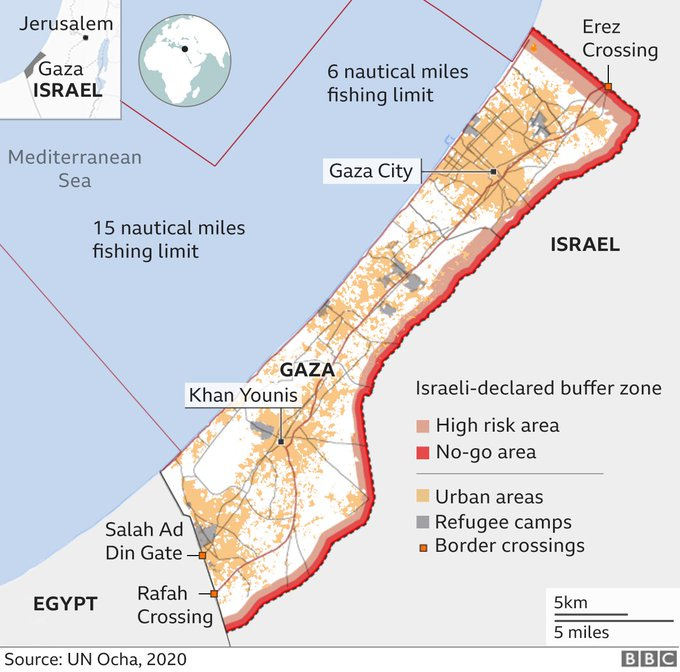
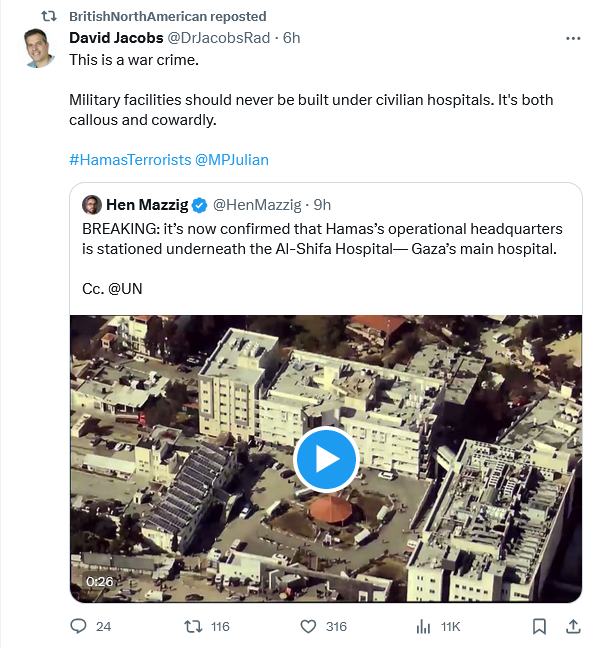
Of course, it’s widely believed that Hamas deliberately positions its facilities to make Israeli attacks less likely due to the elevated risk of unacceptable levels of collateral damage … like this:
Comments Off on Israel’s Zugzwang
October 27, 2023
Scientific Wokemerican
In Spiked, James Esses on the formerly respected magazine Scientific American (I’ve been calling it JunkScientific American since they published a story on the “Racist Roots of Fighting Obesity”):
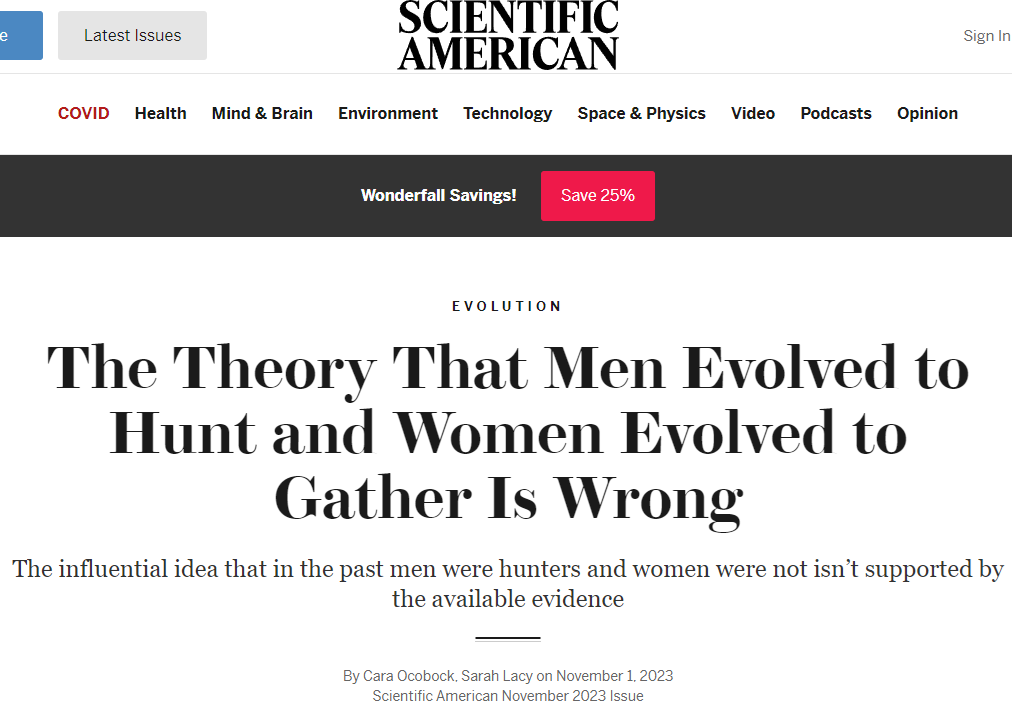
When you come across the longstanding magazine, Scientific American, you could be forgiven for assuming that scientific truth would play a pivotal role in its output.
But not any more, it seems. Scientific American, founded in 1845, is the oldest continuously published magazine in the United States. It has previously featured work by Albert Einstein, among others. However, in recent years, it appears to have been taken over by contributors who consider themselves activists first and scientists second. The magazine’s ethos now includes the express aim of “sharing trustworthy knowledge, enhancing our understanding of the world, and advancing social justice” (my emphasis). It has also started to intervene in electoral politics, too. In 2020, Scientific American broke with a 175-year history of non-partisanship to endorse Joe Biden in the US presidential election.
Worst of all, when its articles touch on questions of gender and biological sex, Scientific American seems to have abandoned objective facts entirely, in favour of trans-activist pseudoscience.
In 2019, an article by Simón(e) D Sun, who identifies as a “transgender nonbinary woman”, tells us to “Stop using phoney science to justify transphobia”. The piece is, as you might expect, filled with ideologically driven language and easily disprovable claims. For instance, it asserts that sex is “assigned” at birth when it is not – it is observed and recorded. It also suggests that “scientific endeavour is quantifiably better when it is more inclusive”. But what if “being inclusive” requires us to deny the reality of biological sex? That would surely put inclusivity at odds with science.
A patronising, finger-wagging tone runs throughout, too. At one point, readers are told to “hold onto your parts, whatever they may be. It’s time for ‘the talk'”.
Ironically, the article undermines its own premise within the first few paragraphs, as it walks readers through the clear biological differences between males and females, ranging from chromosomes to sexual characteristics to brain development. And at the end of the article, having done nothing to challenge the status quo of human biology, we are told: “The science is clear and conclusive: sex is not binary, transgender people are real”.
Of course, nobody has ever claimed “transgender people” are a figment of our imaginations. What gender-critical feminists have argued, however, is that sex is both binary and immutable – and that feeling uneasy about one’s sex is a symptom of mental distress, rather than proof of an innate gender identity that is at odds with one’s body.
And now, for its upcoming November issue, Scientific American has published another piece denying biological reality. Again, this article is peppered with ideological claims that purport to be scientific facts.
Comments Off on Scientific Wokemerican
Two wild-eyed optimists claim that things aren’t as bad as you think
Who lets these dangerous lunatics talk to the press? If anyone listens to them, they may get unwarranted optimistic notions that go against the narrative:
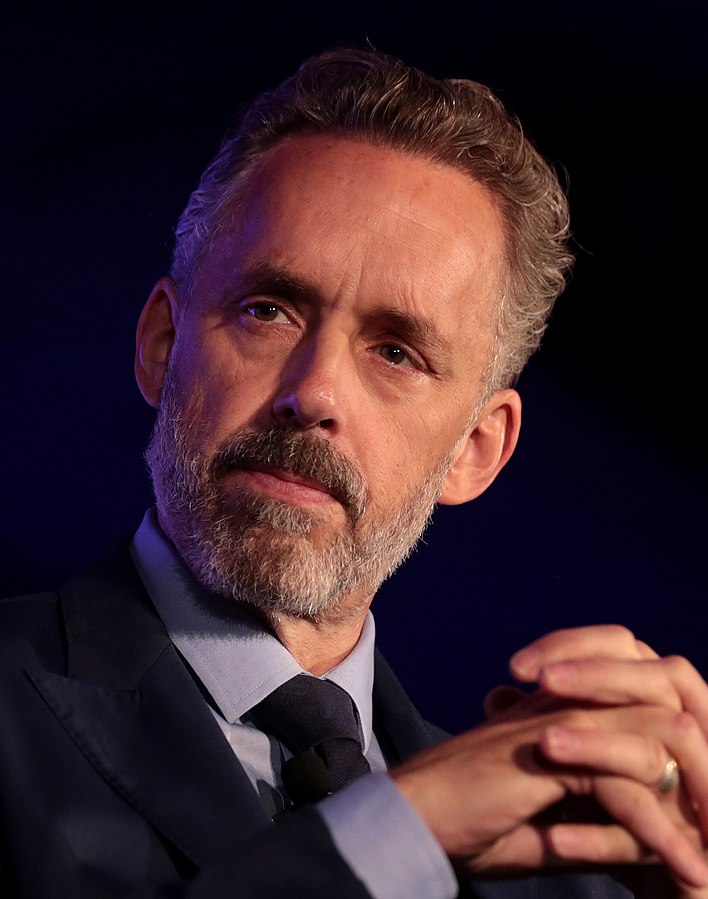
Jordan Peterson speaking at an event in Dallas, Texas on 15 June, 2018.
Detail of a photo by Gage Skidmore via Wikimedia Commons.
War is endlessly and eternally horrific. It is understandable and even necessary that the media spotlights today’s conflicts. But this can make us believe that we’re living through unprecedented violence. Russia’s war indeed meant that battle deaths in 2022 reached a high for this century, but they are still very low by historical standards. Last year, 3.5 in 100,000 people died as a consequence of war, below even the 1980s and far below the 20th-century average of 30 per 100,000. The world has in fact become much more peaceful.
This is of course little consolation to those living in conflict zones. But the data speaks to the problem with the constant barrage of contextless catastrophe and doom. Analysis of media content across 130 countries from 1970 to 2010 indicates that the emotional tone has dramatically and consistently become more negative. Negativity sells, but it informs badly.
The same pattern characterizes climate change reporting. A pervasive and false apocalyptic narrative draws together every negative event — ignoring the bigger picture almost entirely. Last summer, for example, forest fires made headlines, but coverage largely failed to mention that the annual burned global area has been declining for decades, reaching the lowest level ever last year. Likewise, deaths from droughts and floods make fill the front pages, but we don’t hear that deaths from such climate-related disasters have declined 50-fold over the past century.
The data show what we all fundamentally know: the world has improved dramatically. Life expectancy has more than doubled since 1900. Two centuries ago, almost everyone was illiterate. Now, almost everyone can read. In 1820, nearly 90 per cent of people lived in extreme poverty. Now it’s less than 10 per cent. Indoor air pollution has declined dramatically, and its outdoor equivalent has also done so in rich countries. If we could choose when to be born, having all the facts at hand, few would choose any time before today.
This incontrovertible progress has been driven by ethical and responsible conduct, trust, well-functioning markets, the rule of law, scientific innovation and political stability. We have to recognize, appreciate and proclaim the value, and comparative rarity, of each of these.
The constant barrage of negative stories may lead us to imagine that our forward progress is about to end. However, the evidence at hand does not support this conclusion. The latest Intergovernmental Panel on Climate Change scenarios indicate that, if not for climate change, the average person would be 4.5-times richer by the end of the century than they are today.
Comments Off on Two wild-eyed optimists claim that things aren’t as bad as you think


