Quotulatiousness

November 6, 2014

Souhan – Peterson should be suspended for the remainder of the NFL season

Filed under: Football, Humour, Law — Tags: , , — Nicholas @ 10:01

The Star-Tribune‘s Jim Souhan takes a strong stance against leniency for Vikings running back Adrian Peterson after he pleaded no contest to a misdemeanour in Texas:

Roger Goodell has treated player discipline with the consistency of that annoying person you get stuck behind in line at Starbucks every morning.

One day, they want a Venti triple-foam frappé low-fat caramel macchiato topped with handmade artisanal whipped cream drained by pacifists from the udders of a cow that has attended global warming symposiums.

The next day, they order a black coffee. Small.

When he became NFL commissioner, Goodell wanted to impose discipline on every minor player infraction. He was going to make his name by cleaning up a league filled with violent young men.

Goodell proudly wore the badge he fished out of a box of Cracker Jack until Ray Rice punched his fiancée in an elevator, and Goodell’s friends with the Baltimore Ravens told him to proceed cautiously, and Goodell blinkered himself like a skittish horse.

Goodell went overboard with player discipline, then effectively disappeared when he could have taken a dramatic stance against players performing violent acts, and particularly violent acts toward women. He went from Mr. Venti-Everything to, suddenly, Mr. Small Black Coffee.

This week, Adrian Peterson, who has admitted to the severe and cowardly beating of his son, got the Texas treatment in court. He was allowed to agree to a generous plea deal that allows him to resume his life and career. It’s a wonder he wasn’t presented with a gold star for upholding the tenets of traditional parenting.

This time around, Goodell can get it right. He can establish that he has higher standards than the anachronistic Texas courts, that he holds players, and especially players who have gotten rich because of the NFL’s remarkable wealth, to a higher standard than the average citizen.

Goodell can and should suspend Peterson for the rest of the season. Doing so would improve Goodell’s reputation, and save the Vikings and the league a lot of grief.v

November 4, 2014

Vizzini and the Man in Black – different kinds of planners

Filed under: Books, Humour, Media — Tags: — Nicholas @ 00:02

Sarah Skwire on the two different types of planners featured in William Goldman’s novel The Princess Bride:

… in the response that has spawned an M.O.U.T. (meme of unusual tenacity), Inigo replies, “You keep using that word! … I don’t think it means what you think it does.”

When my friend Sam Wilson, a frequent blogger at both Euvoluntary Exchange and Sweet Talk, posted a brief Facebook comment on that famous line, a glorious debate erupted. Sam recorded a bit of that over at Sweet Talk, but since that same discussion got me thinking about The Princess Bride in light of questions of political economy, I thought it was worth bringing over here.

Throughout the novel, Vizzini stands as an example of the expert, the intellectual, and the man of system. Thoroughly persuaded that he is capable of controlling the innumerable variables that are involved in every step of his extraordinarily complicated plans, he is constantly failing. While his initial snatch-and-grab of Buttercup goes well enough, everything after that begins to collapse — and always because he has failed to anticipate some kind of human action.

[…]

After a few rounds of intellectual pyrotechnics designed to determine the location of the poison, Vizzini fails. And he dies. And the reason Vizzini fails is that, once more, he has not anticipated a human action. The Man in Black has poisoned both cups. The Man in Black has conditioned himself to be immune to this poison, on the off chance that an occasion like this should arise. Once again, Vizzini’s ideal plan has been beaten by unpredictable humans.

I can hear Sam objecting that our hero, the Man in Black, is also something of a planner. I point out, in response, that his plans — particularly the plan to storm the wedding and rescue Buttercup — are always flexible, updated on the fly, and tagged with a warning label reading, “Hear me now; there may be problems once we’re inside.” He is a planner, yes, but certainly not one who believes his plans are ideal and immune to failure. It seems likely that the Man in Black has read Hayek’s “Use of Knowledge in Society,” which emphasizes the importance and viability of this kind of “knowledge of people, of local conditions, and of special circumstances” that allow an individual to plan his own actions and respond speedily when circumstances change.

By contrast, Vizzini might have done well to read Hayek’s “The Intellectuals and Socialism,” which could have cautioned him about the dangers of viewing the world only through one theoretical lens and ignoring the advice of practical types like Inigo. He certainly would have profited from Adam Smith’s famous warnings about the man of system, who treats other human beings as if they are merely chess pieces, with no motivations of their own. It is those motivations that thwart Vizzini at every turn. His human design is beaten, every time, by the unpredicted and unpredictable human actions of others.

As Hayek and Smith and a host of other thinkers remind us, any other outcome is simply inconceivable.

November 2, 2014

QotD: The town of Reading

Filed under: Britain, History, Humour, Quotations — Tags: , , , — Nicholas @ 00:01

We came in sight of Reading about eleven. The river is dirty and dismal here. One does not linger in the neighbourhood of Reading. The town itself is a famous old place, dating from the dim days of King Ethelred, when the Danes anchored their warships in the Kennet, and started from Reading to ravage all the land of Wessex; and here Ethelred and his brother Alfred fought and defeated them, Ethelred doing the praying and Alfred the fighting.

In later years, Reading seems to have been regarded as a handy place to run down to, when matters were becoming unpleasant in London. Parliament generally rushed off to Reading whenever there was a plague on at Westminster; and, in 1625, the Law followed suit, and all the courts were held at Reading. It must have been worth while having a mere ordinary plague now and then in London to get rid of both the lawyers and the Parliament.

Jerome K. Jerome, Three Men in a Boat (to say nothing of the dog), 1889.

October 31, 2014

Placebo effect so powerful that it can influence the climate

Filed under: Britain, Environment, Humour — Tags: , , , — Nicholas @ 07:34

JoNova on the newly discovered Global Placebo Effect:

Matt Ridley was questioning Baroness Sandip Verma at the House of Lords this week. He pointed out to the peers that even the IPCC admits there is “hiatus” that modelers can’t explain. Verma responded: “‘It [global warming] may have slowed down, but that is a good thing. It could well be that some of the measures we are taking today is helping that to occur.’” [Source — Dailymail]

Verma raises the intriguing possibility that windmills and solar panels that were built after 2005 have managed to keep global temperatures constant starting from ten years before they were constructed.

What’s even more remarkable is that none of these projects or activities have reduced global CO2 levels. It follows then, that the mere thought of building windmills is enough to change the weather.

Furthermore, it’s well known that more expensive placebo’s are more effective. Hence the final-final copy of the latest IPCC report — issued on Friday after the leak, the draft, and the redraft — will explain that they are 95% certain that if we spend $2 billion dollars a day on renewable energy (instead of just $1 billion) there will be no more category five storms, seas will stop rising, and goats will stop shrinking.

October 30, 2014

Sir Harry Flashman goes to Westeros

Filed under: Books, Humour, Media — Tags: , , — Nicholas @ 07:20

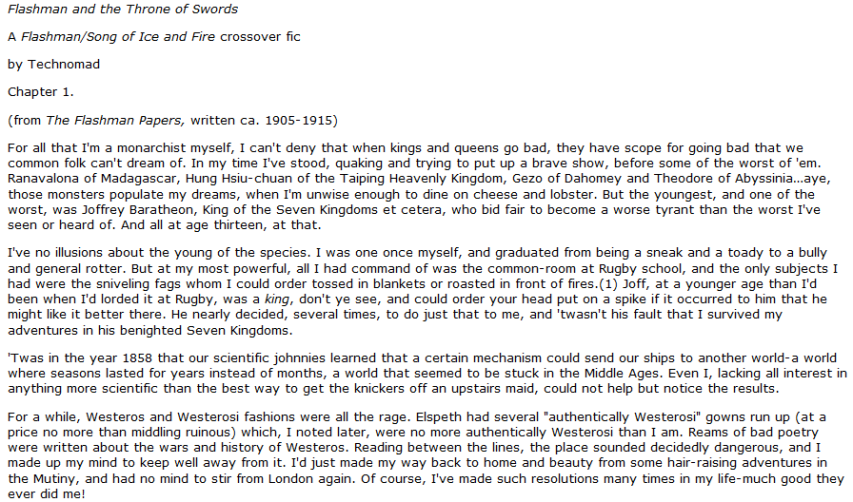
I’m not much of a fan fiction reader, but I was quite amused at this crossover between George MacDonald Fraser’s Flashman series and George R.R. Martin’s Game of Thrones:

Flashman and the Throne of Swords

October 27, 2014

Beware the stoner sheep!

Filed under: Britain, Food, Humour, Law — Tags: , — Nicholas @ 07:21

In The Register, news you can use!

A flock of sheep that are about to meet their maker at the abattoir got high on cannabis plants worth £4,000, after the drugs were ditched in a Surrey field.

“My sheep weren’t quite on their backs with legs in the air but they probably had the munchies,” farm shop manager Nellie Budd told local rag the Surrey Mirror.

“They haven’t had any other side effects but I’ll tell you about the meat next week.”

The stash of marijuana plants, which were each roughly three foot tall, were dumped at the edge of Fanny’s Farm in Markedge Lane, the paper reported. Budd’s shop was just 200 yards from where the drugs were fly-tipped, apparently.

Police told Budd that the cannabis had a street value of about £4,000.

October 26, 2014

QotD: Rowing

Filed under: Humour, Quotations — Tags: , — Nicholas @ 00:01

George never went near the water until he was sixteen. Then he and eight other gentlemen of about the same age went down in a body to Kew one Saturday, with the idea of hiring a boat there, and pulling to Richmond and back; one of their number, a shock-headed youth, named Joskins, who had once or twice taken out a boat on the Serpentine, told them it was jolly fun, boating!

The tide was running out pretty rapidly when they reached the landing-stage, and there was a stiff breeze blowing across the river, but this did not trouble them at all, and they proceeded to select their boat.

There was an eight-oared racing outrigger drawn up on the stage; that was the one that took their fancy. They said they’d have that one, please. The boatman was away, and only his boy was in charge. The boy tried to damp their ardour for the outrigger, and showed them two or three very comfortable-looking boats of the family-party build, but those would not do at all; the outrigger was the boat they thought they would look best in.

So the boy launched it, and they took off their coats and prepared to take their seats. The boy suggested that George, who, even in those days, was always the heavy man of any party, should be number four. George said he should be happy to be number four, and promptly stepped into bow’s place, and sat down with his back to the stern. They got him into his proper position at last, and then the others followed.

A particularly nervous boy was appointed cox, and the steering principle explained to him by Joskins. Joskins himself took stroke. He told the others that it was simple enough; all they had to do was to follow him.

They said they were ready, and the boy on the landing stage took a boat-hook and shoved him off.

What then followed George is unable to describe in detail. He has a confused recollection of having, immediately on starting, received a violent blow in the small of the back from the butt-end of number five’s scull, at the same time that his own seat seemed to disappear from under him by magic, and leave him sitting on the boards. He also noticed, as a curious circumstance, that number two was at the same instant lying on his back at the bottom of the boat, with his legs in the air, apparently in a fit.

They passed under Kew Bridge, broadside, at the rate of eight miles an hour. Joskins being the only one who was rowing. George, on recovering his seat, tried to help him, but, on dipping his oar into the water, it immediately, to his intense surprise, disappeared under the boat, and nearly took him with it.

And then “cox” threw both rudder lines over-board, and burst into tears.

How they got back George never knew, but it took them just forty minutes. A dense crowd watched the entertainment from Kew Bridge with much interest, and everybody shouted out to them different directions. Three times they managed to get the boat back through the arch, and three times they were carried under it again, and every time “cox” looked up and saw the bridge above him he broke out into renewed sobs.

George said he little thought that afternoon that he should ever come to really like boating.

Jerome K. Jerome, Three Men in a Boat (to say nothing of the dog), 1889.

October 25, 2014

They don’t like to brag…

Filed under: Cancon, Humour, Military — Tags: , — Nicholas @ 09:56

John Turner sent me this link. I found it quite amusing:

JTF2 brag sheet from imgur

QotD: Hugging

Filed under: Humour, Personal, Quotations — Tags: , — Nicholas @ 00:01

Part of the problem with hugging is that it has become a social convention, rather than what it once was, which was an expression of genuine emotion.

There are some times when a hug is appropriate. Those times are when there’s a marriage proposal in the air or a body in the ground.

Hugging is for celebration, or comforting someone who’s had a setback. Hugging is not for noting that two people have both managed to meet at Chili’s after work. Being at Chili’s is not a cause for celebration, and nor is it quite dire enough to require comforting.

An even more important rule is Men don’t hug. The only time men should hug is when male family members are observing a major life milestone, such as a major promotion, the safe return from overseas deployment, or noting a witty observation in the commentary audio track of Die Hard.

The only exception to these guidelines if a man tells another man, “Boy, I could sure use a hug.” But he won’t say that, because he’s a man, so just stop with the male-on-male hugging.

To be serious, if I could: There are rules of physical distance, and there are meanings to breaches of those rules.

People of course do occasionally touch each other. But those touches have important communicative purposes precisely because of the general rule that we don’t touch each other.

[…]

There’s something a little child-like about hugging, too. It’s an innocent gesture — it’s intended to be so.

But it sort of ignores the adult-world meaning of intimate touching.

So I wonder if it’s somehow connected to a growing preference for Child World rules, and an increasing rejection of Adult World rules.

Ace, “Arms Are Not Made For Hugging”, Ace of Spades H.Q., 2014-10-10.

October 22, 2014

QotD: Ancient history

Filed under: Greece, History, Humour, Quotations — Tags: , — Nicholas @ 00:01

New interests and different locations are provided by an iPad app that gathers pages relevant to my interests, and lets me indulge particular subjects, like “Ancient History.” This gives me the impression I am learning something, and perhaps I am, but when you finish an article about Xobar the Cruel who ruled during the Middle Period of the Crinchothian Empire (140 square miles in modern-day Herzo-Slavbonia) you think “well, there’s something of which I was previously unaware, and let’s preen for a second about being the sort of person who cares about ancient history,” and then it’s all forgotten. It’s all the history of rulers, which means the history of cruelty, and the remnants of settlements, which means the history of floors and walls and tombs. I fault myself for not having a better grasp on the shadowy beginnings of civilization; it doesn’t snap into focus until the Greeks, and then you’re surprised because they have shoes and religion and government and traditions and the rest of the recognizable pillars that hold up the ceiling mankind builds to put some space between himself and the raging caprices of the gods above. Except for Egypt, where they were doing stuff for a long time, but it was weird.

James Lileks, The Bleat, 2014-04-01

October 21, 2014

QotD: Hipster economics

Filed under: Economics, Humour, Quotations — Tags: , , — Nicholas @ 00:01

Hipster economics are standard economics because hipsters are everything the US economy has ever wished for in one convenient package. It’s a group consisting largely of young, upper-middle class people with very little conviction, who will spend large amounts of money to maintain their own comfort and the appearance of diversity and rebellion. They are activists as long as it’s easy, poor as long as it doesn’t involve dirt or hunger, and selfless as long as they don’t stand to lose anything. They represent the sanitizing of national issues so that they can be discussed without being addressed. And all you have to do to control them is use some reverse psychology. They’re not rebels, they’re not even malicious, because they’re not anything except a bunch of kids playing pretend. They’ll eventually grow up and become bankers, lawyers and politicians, just like their parents…

“Robert” commenting on “The peril of hipster economics: When urban decay becomes a set piece to be remodelled or romanticised“, by Sarah Kendzior, 2014-05-28.

October 19, 2014

QotD: The countryside, at night

Filed under: Humour, Quotations — Tags: , — Nicholas @ 00:01

We are creatures of the sun, we men and women. We love light and life. That is why we crowd into the towns and cities, and the country grows more and more deserted every year. In the sunlight — in the daytime, when Nature is alive and busy all around us, we like the open hill-sides and the deep woods well enough: but in the night, when our Mother Earth has gone to sleep, and left us waking, oh! the world seems so lonesome, and we get frightened, like children in a silent house. Then we sit and sob, and long for the gas-lit streets, and the sound of human voices, and the answering throb of human life. We feel so helpless and so little in the great stillness, when the dark trees rustle in the night-wind. There are so many ghosts about, and their silent sighs make us feel so sad. Let us gather together in the great cities, and light huge bonfires of a million gas-jets, and shout and sing together, and feel brave.

Jerome K. Jerome, Three Men in a Boat (to say nothing of the dog), 1889.

October 16, 2014

QotD: The art of writing

Filed under: Humour, Quotations — Tags: , , — Nicholas @ 00:01

I’d like to say it’s great to be back from vacation, but frankly it’s not. A lot of people think the biggest problem with being a pundit is all the blood sacrifice and unlicensed steel-cage shovel fighting. That’s true. But there’s obviously nothing to be done about that. Another problem is that when you usually write several thousand words a week — at least — you build up muscle memory. It’s like exercise — I’m told. When you train yourself to run every day, taking a week off doesn’t make running easier, but harder. Since I’ve been back, I haven’t been able to find my groove (this isn’t it). I had to delete the first 700 words of this “news”letter because it turned into a lengthy poem in Esperanto about chinchillas. Frankly, I nailed the iambic pentameter. Maybe someday I will publish “Kiam la Chinchilla vekas el sia dormado en la pantalono de mia koro” (Loosely: “When the chinchilla awakes from his slumber in the trousers of my heart”), but today is not that day.

Jonah Goldberg, “The Goldberg File”, 2014-04-04

October 14, 2014

QotD: “Teaching” kids to be more creative

Filed under: Education, Humour, Quotations — Tags: — Nicholas @ 00:01

We don’t send our children to public school, but we hear all about what goes on there. They’re always maundering on in the local papers about their bright new ideas — generally already discredited since the 1960s — about “teaching children to be more creative.” See, there’s your problem right there.

I don’t know exactly how dull you have to be to be a public school administrator, but school is supposed to try to put some sort of lid on a child’s creativity, and get them to add single digits without using a sundial as a stopwatch, and put apostrophes where they belong once in a while, for five goddamn minutes a day, at least. Children only have one problem, and that’s creativity. The reason you’re all still sitting at the dinner table after an hour and fifteen minutes has come and gone is because your seven-year-old is still building stonehenge with his french fries. That’s creativity, isn’t it? The reason your bathroom smells like a cattle stall is all the creative ways that little Magellan you’re raising has figured out to circumnavigate the bowl. This video is like shooting fish in a barrel, which incidentally produces a very similar kind and amount of splashback.

If your kid doesn’t compose at least one insane opera a day that lasts from sunup to sundown, he’s not normal. A kid with that little imagination is luckily not common, but when he or she grows up, they’re likely to cause trouble, likely by becoming a public school administrator or a state senator. Claiming you’re going to teach children to be creative is like claiming you’re going to teach Mike Tyson to be aggressive. And your Common Core plan for teaching creativity? Well, as Mike once said, everyone’s got a plan until they get punched in the mouth.

Sippican Cottage, “Still Better Dialog Than Anything George Lucas Ever Wrote”, Sippican Cottage, 2014-03-26

October 13, 2014

QotD: Remember your days in the educational-industrial complex?

Filed under: Bureaucracy, Education, Humour, Quotations — Tags: , — Nicholas @ 00:01

They started him out on basic blocks and why he shouldn’t nail somebody who took his cookie. Those are hard lessons. How to stack something up so it doesn’t collapse in a heap at the first shudder in the earth. How to “share” your very limited and very personal resources. Why you don’t just whack anyone who irritates you with the nearest blunt object.

These are basic lessons, and we forget how hard they are. Some of us don’t learn them at all. Those people are either in prison, assembling bombs, or CEO of a Fortune 500 company.

Still, that’s your entry level position in the educational-industrial complex at age 3. It’s all downhill from there.

For years you get up at an ungodly hour and don’t even get a chance to read the paper. Plus, no coffee at all. Not. A. Drop.

You are then pushed out of your home and either driven to your “office-complex” by a cranky chauffeur with complete control over you, or you get to ride with a few dozen of your more-or-less peers with different ideas of hygiene and levels of intelligence in a shaking tin box with no seatbelts, driven by some of the least intelligent members of your community. I’d be a nervous wreck by the time I got to the office, I’ll tell you.

Once you do get to the office, your time to just goof off is extremely limited. No leisurely stints by the water cooler for you. No coffee cart with tasty pastries coming by after only an hour. Bladder issue? Raise your hand and get a note. Other than that you are never alone.

You get one break out in the dirt, with, I might add, no coffee. A couple of hours later you get a quick hit of really bad food that is the same this Wednesday as it was last Wednesday. After that, it’s back to your office where they don’t even have a little cube for you, but slam you together with 15 to 30 other slaves to the clock in a room fit only for 10.

In some huge gesture to your youth, they let you out of this joint at 3 in the afternoon. They tell you it’s a “school day,” but if you’ve been up since 7 and out at three, that’s a full eight hours in my book.

Oh, and no chatting with your friends. Yes, you, pipe down. If not it’s off to the CEO’s antechamber for a quick and humiliating performance review. Daily if you don’t snap out of it. If you really don’t snap out of it, we’re calling your father AND your mother to come here from work right now.

Gerard Vanderleun, “Back to School”, American Digest, 2014-09-09.

« Newer PostsOlder Posts »

Powered by WordPress