
Published on 24 Aug 2015
Check out C&Rsenal for more background information on historic firearms: http://bit.ly/HistoricGuns
In the very first edition of our livestream with Othais from C&Rsenal, he introduced us to the French guns of World War 1, such as the Berthier carbine or the Lebel rifle. This is the first summary of our session surrounding the rifles that the French took into battle and their design. If you are curious to find out more about these, check out Othais’ videos where he goes into even more detail about the individual firearms. In the second summary we will talk about French pistols.
The next live session will be on September 3 and we will talk about German rifles and pistols. You can ask questions for that episode using the hashtag #OthaisGermanGuns
August 25, 2015
The French Rifles of World War 1 featuring Othais from C&RSENAL I THE GREAT WAR – Special
Byzantine Empire: Justinian and Theodora – V: Impossible Burden of Fate – Extra History
Published on 18 Jul 2015
The conquest of Carthage and the North African provinces was just the beginning for Justinian’s ambition. He must have Rome. But like Carthage, he must find a reason to attack the Ostrogoths who now hold it. And like Carthage, this reason is given to him when the Ostrogothic Queen Amalsuntha, his ally, is murdered. But unlike Carthage, Belisarius now has only 7500 men, barely half of what he had for North Africa. He sails out anyway, making his first stop at the island of Sicily. All the cities except Panormus surrender to him, and Panormus he takes quickly by seizing their harbor with his ships. Meanwhile, Justinian has bribed the Franks to invade Italy from the north while another his generals marches from the east. But just when the Ostrogothic king is on the verge of surrender, disaster strikes. The other Byzantine general dies, and Belisarius is forced to return to Carthage to quell a revolt. The conquest loses its momentum and the Ostrogothic king imprisons the Roman ambassador. Justinian will not be stopped, and orders Belisarius to return to Italy once North Africa is secure. Alone, Belisarius marches up the coast of Italy until he meets resistance at Neapolis. With his forces too thinned to mount a siege, he engineers a sneak attack by invading through the pipe of a dried, broken aqueduct. Neapolis falls and the way now lies open to Rome.
August 24, 2015
Comparative Advantage
Published on 25 Feb 2015
What is comparative advantage? And why is it important to trade? This video guides us through a specific example surrounding Tasmania — an island off the coast of Australia that experienced the miracle of growth in reverse. Through this example we show what can happen when a civilization is deprived of trade, and show why trade is essential to economic growth.
In an economy with a greater number of participants trading goods and services, there are more ways to find a comparative advantage and earn more by creating the most value for others. Let’s dive right in with an example from our new friends, Bob and Ann.
August 23, 2015
The Falklands War – The Untold Story
Published on 19 Aug 2013
Falklands Crisis was a 1982 war between Argentina and the United Kingdom. The conflict resulted from the long-standing dispute over the sovereignty of the Falkland Islands and South Georgia and the South Sandwich Islands, which lie in the South Atlantic, east of Argentina.
H/T to Ghost of a Flea for the link.
QotD: The real reason for the popularity of the English language in Europe
But all this is apart from the moral I wished to draw from the incident. The true inwardness of the situation lay in the indignation of this Britisher at finding a German railway porter unable to comprehend English. The moment we spoke to him he expressed this indignation in no measured terms.
“Thank you very much indeed,” he said; “it’s simple enough. I want to go to Donaueschingen myself by train; from Donaueschingen I am going to walk to Geisengen; from Geisengen I am going to take the train to Engen, and from Engen I am going to bicycle to Constance. But I don’t want to take my bag with me; I want to find it at Constance when I get there. I have been trying to explain the thing to this fool for the last ten minutes; but I can’t get it into him.”
“It is very disgraceful,” I agreed. “Some of these German workmen know hardly any other language than their own.”
“I have gone over it with him,” continued the man, “on the time table, and explained it by pantomime. Even then I could not knock it into him.”
“I can hardly believe you,” I again remarked; “you would think the thing explained itself.”
Harris was angry with the man; he wished to reprove him for his folly in journeying through the outlying portions of a foreign clime, and seeking in such to accomplish complicated railway tricks without knowing a word of the language of the country. But I checked the impulsiveness of Harris, and pointed out to him the great and good work at which the man was unconsciously assisting.
Shakespeare and Milton may have done their little best to spread acquaintance with the English tongue among the less favoured inhabitants of Europe. Newton and Darwin may have rendered their language a necessity among educated and thoughtful foreigners. Dickens and Ouida (for your folk who imagine that the literary world is bounded by the prejudices of New Grub Street, would be surprised and grieved at the position occupied abroad by this at-home-sneered-at lady) may have helped still further to popularise it. But the man who has spread the knowledge of English from Cape St. Vincent to the Ural Mountains is the Englishman who, unable or unwilling to learn a single word of any language but his own, travels purse in hand into every corner of the Continent. One may be shocked at his ignorance, annoyed at his stupidity, angry at his presumption. But the practical fact remains; he it is that is anglicising Europe. For him the Swiss peasant tramps through the snow on winter evenings to attend the English class open in every village. For him the coachman and the guard, the chambermaid and the laundress, pore over their English grammars and colloquial phrase books. For him the foreign shopkeeper and merchant send their sons and daughters in their thousands to study in every English town. For him it is that every foreign hotel- and restaurant-keeper adds to his advertisement: “Only those with fair knowledge of English need apply.”
Did the English-speaking races make it their rule to speak anything else than English, the marvellous progress of the English tongue throughout the world would stop. The English-speaking man stands amid the strangers and jingles his gold.
“Here,” cries, “is payment for all such as can speak English.”
He it is who is the great educator. Theoretically we may scold him; practically we should take our hats off to him. He is the missionary of the English tongue.
Jerome K. Jerome, Three Men on the Bummel, 1914.
August 21, 2015
Escalation At Sea and Russia Up Against the Wall I THE GREAT WAR – Week 56
Published on 20 Aug 2015
The Entente was in desperate need of American supplies and so the German submarine campaign in the Atlantic was a real problem. The British started to run false flag operations with so called Q-Ships to hunt down U-Boats which lead to the so called Baralong Incident this week. In the meantime, Russia was standing up against the wall as the fortresses of Kovno and Novogeorgievsk were falling to the Germans leading to a catastrophic loss in men, equipment and supplies.
Allocating the blame for “Operation Jubilee”
In a BBC post from a few years back, Julian Thompson looks at the Dieppe raid:
On 19 August 1942, a disastrous seaborne raid was launched by Allied forces on the German-occupied French port of Dieppe. Why was such a raid ever undertaken? Because, with Germany operating deep in the Soviet Union, the Russians were urging the Allies to relieve the pressure on them by opening a second front in north-west Europe.
At the same time the British Chief of Combined Operations, Rear Admiral Louis Mountbatten, was agitating for a practical trial beach landing, against real opposition, for his troops. In the face of this pressure, Churchill decided that Operation Rutter, a ‘hit and run’ raid on Dieppe, should go ahead.
[…]
Churchill and the Chiefs of Staff — the heads of the Navy, Army and Air Force, who met daily to discuss strategy and advise Churchill — were responsible for this disastrous misjudgement. But, because no written record exists of the Chiefs of Staff approving the raid in its final form, it has sometimes been suggested that it was really Mountbatten who remounted it without authorisation. This is almost certainly nonsense.
The Chiefs of Staff disliked Mountbatten, regarding him as an upstart foisted on them by Churchill, so any unauthorised action on his part would have given them the ammunition to recommend his removal. Since Mountbatten was not removed, and the Chief of the Imperial General Staff, General Sir Alan Brooke, in his frank and detailed diary, makes no mention of his having exceeded his authority, it seems unlikely that Mountbatten can be accused of mounting the raid without authority.
General Brooke was in the Middle East from 1 August 1942, returning on the 24th, after the event. This was unfortunate, for, as the most forceful and intelligent of the Chiefs of Staff, had he been in Britain in the days preceding the raid, he might have persuaded Churchill to call it off.
Much has been said since about the fact that the Dieppe raid was a necessary precursor to the great amphibious operations that were to follow, in terms of the lessons learned and experience gained. Mountbatten pursued that line all his life. But as Chief of Combined Operations, he did bear some of the responsibility for mounting the operation, so one can only comment, ‘he would say that, wouldn’t he?’
The disaster did point up the need for much heavier firepower in future raids. It was recognised that this should include aerial bombardment, special arrangements to be made for land armour, and intimate fire support right up to the moment when troops crossed the waterline (the most dangerous place on the beach) and closed with their objectives.
However, it did not need a debacle like Dieppe to learn these lessons. As judged by General Sir Leslie Hollis — secretary to the Chiefs of Staff Committee and deputy head of the Military Wing of the War Cabinet with direct access to Churchill — the operation was a complete failure, and the many lives that were sacrificed in attempting it were lost with no tangible result.
August 20, 2015
Frédéric Bastiat
Lawrence W. Reed makes the case for Frédéric Bastiat to be awarded a Nobel Prize … if they awarded them posthumously, anyway:
If a posthumous Nobel Prize was awarded for crystal-clear writing and masterful storytelling in economics, no one would be more deserving of it than Frédéric Bastiat (June 30, 1801–December 24, 1850). He set the standard over a century and a half ago.
This remarkable Frenchman was an economist in more than the traditional sense. He understood the way the economic world works, and he knew better than anybody how to explain it with an economy of words. He employed everyday language and a conversational tone, an innate clarity that flowed from his logical and orderly presentation. Nothing he wrote was stilted, artificial, or pompous. He was concise and devastatingly to the point. To this day, nobody can read Bastiat and wonder, “Now what was that all about?”
Economic writing these days can be dull and lifeless, larded with verbosity and presumptuous mathematics. Bastiat proved that economics doesn’t have to be that way: the core truths of the science can be made lively and unforgettable. In literature, we think of good storytelling as an art and stories as powerful tools for understanding. Bastiat could tell a story that stabbed you with its brilliance. If your misconceptions were his target, his stories could leave you utterly, embarrassingly disarmed.
If you aspire to be an economist or a policy maker or a teacher or just an influential communicator, take time to study at the feet of this 19th-century master.
August 18, 2015
Capturing the Horrors – The Art of World War 1 I THE GREAT WAR Special
Published on 17 Aug 2015
The beginning of the 20th century saw rapid changes to the understanding of the fine arts and the First World War was a big catalyst for all the new art movements of Modernity like Cubism, Expressionism or Impressionism. Countless painters like Otto Dix or Max Beckmann used their paintings to process the horrors they had lived through. Before this war, paintings used to glorify soldiers and generals, but the new schools of art couldn’t be further from that and so it is no wonder that the Nazis displayed a lot of World War 1 paintings in their exhibition of degenerate art (“Entartete Kunst“) before World War 2.
Byzantine Empire: Justinian and Theodora – IV: Vanquishing the Vandals – Extra History
Published on 11 Jul 2015
Thirty-nine days after the disastrous Nika Riots ended with the slaughter of 30,000 civilians, Justinian directed the city to rebuild the Hagia Sophia. Together, they built an even greater cathedral — but Justinian was not satisfied. He was called a Roman emperor, but he did not rule Rome itself. He resolved to reconquer the west, starting with Carthage in Africa, which had been conquered by Vandal tribes and turned into the seat of their budding empire. When the cousin of the Vandal king overthrew him for being pro-Roman and a follower of Rome’s orthodox Christianity, Justinian had his excuse for war. He stirred up rebellion in the Vandal colonies, creating a distraction while he sent his general Belisarius to Carthage with a small army of men. Belisarius landed successfully and moved on Carthage, winning the support of the local people on his way. Gelimer teamed up with his brothers in two separate attempts to crush Belisarius and drive him out of Carthage, but after both of his brothers died, Gelimer lost his will to fight. He broke, and the Vandal resistance broke with him. Justinian awarded Belisarius a triumph, the greatest honor a Roman general could receive, but it would turn out to be the last formal triumph Rome would ever see.
August 17, 2015
August 16, 2015
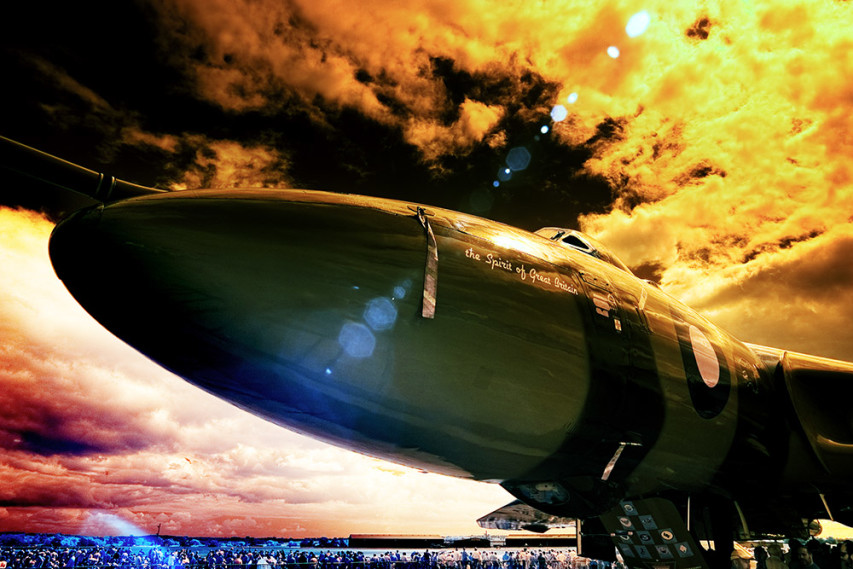
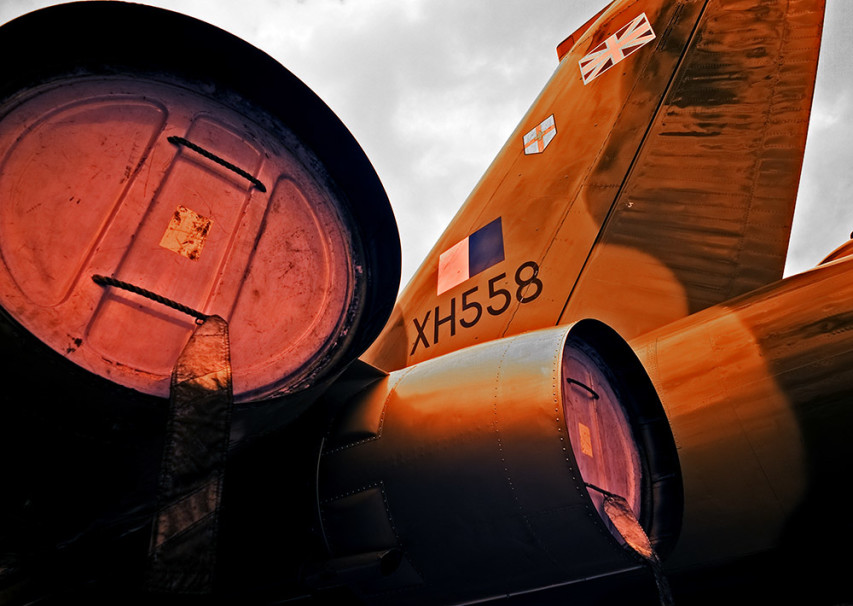
Farewell to the Vulcan … in infra-red
Ashley Pomeroy attended the Yeovilton Air Day event, one of the last flying events for the last of the Vulcans. She took along her camera to capture some rather interesting images:
Off to the Yeovilton Air Day, with an infrared camera and a bottle of pop. This year the Avro Vulcan retires for the third and final time. Like Lazarus, it was raised from the dead; and like Lazarus it is fated to die again, this time forever.
I used an infrared camera – there is no shortage of Vulcan photographs taken with visible light – in part because the results are dramatic but also because I was curious to see what would happen.
The Vulcan entered service in the 1950s. Its original mission was to incinerate Russians – tens of thousands of them – with our nuclear bombs. In practice this never came to pass, and the only people incinerated by Vulcans were Argentine ground crew, six of them, during the Falklands War of 1982. The Vulcan was retired from service almost immediately afterwards. It remained in flight as a display aircraft until 1993, at which point the expense of keeping a jet bomber in the air became too great.
In this shot, for example, you can see that some of the panels were made of a different material from the rest of the airframe, or perhaps they used a fundamentally different paint.
[…]
What’s it like to see a Vulcan dancing in the sky? In an airshow context the experience is somewhat muted, because regulations prevent it from flying overhead. The pilot can only make long passes parallel with the crowd line plus some wingovers. The Vulcan’s low wing loading gave it superb high-altitude performance – I imagine that the likes of the F-86 or MiG-15 would have found it an incredibly hard gun target – but this doesn’t help at an airshow. Nonetheless, when the pilot gunned the engines it was like being punched in the chest, and I could feel a collective grin from the crowd, although I was too far from the car park to hear the car alarms going off.

An interesting era in Portuguese history
Sarah Hoyt on the time when the throne of the Kingdom of Portugal was occupied by the Kings of Spain:
When I was little, one of my favorite times in history class every year was when we studied the Spanish occupation.
From 1560 to 1640 and due to some truly gifted stupid actions of Portuguese kings, the throne of Portugal was occupied by the Philips. The first Philip was the famous Philip of the Armada.
Now the throne of Portugal was acquired as legitimately as any other succession at the time and more legitimately than most. Technically Philip was the late King Sebastian’s nephew. (And possibly first cousin, uncle and grandfather. There is no word on whether the royal lines of Portugal and Spain could play the banjo really well, but if they didn’t it was only because they didn’t have banjos.)
However by the time I studied the occupation or “usurpation” EVERY year of elementary school, great indignation was built towards the Philips. One of the reasons I really liked that lesson is that our prim and elderly school marm would instruct us to bring out our crayons and deface our pictures of Philip of Portugal and Spain. (And for those cringing about destruction of school property, in Portugal you buy your school books. You can sometimes buy them used or inherit them from a sibling — not me, my brother was much older than I and books had changed — but in general everyone from the richest to the poorest bought the school books. I rather suspect, now I think about it, that this keeps the Portuguese publishing system working.)
The reason they were hated, the reason we were instructed to deface the pictures was that while occupying the Portuguese throne, perhaps because they were sure it wouldn’t last, or perhaps because they wanted to reduce the proud and independent spirit of the Portuguese (from their perspective the last of the small kingdoms in the peninsula to be swallowed by the Spanish leviathan) the Philips seemed to go out of their way to destroy all Portuguese interests, possessions and wealth, as well as the Portuguese standing with their allies and the world.
It’s been a long time, and mostly I spent my time studying how to deface a picture, but I remember the Spaniards broke the Portuguese alliance with the English which had lasted almost since before there was England, and save for that interruption has lasted to present day. This meant Portuguese ships could fall prey to the British privateers. They also failed to adequately defend Portuguese colonies and gave some of them away as dowry to Spanish Princesses or perhaps party favors.
There were other things, and the rule must have been felt even at the time as disastrous because particularly in the North a cult of the “King who will return” (in this case King Sebastian, young and possibly nuts or at least a really good banjo player, since his mother was the upteenth Spanish princess the Portuguese kings had married in a row.) He died in a futile attack on the North of Africa (there’s taking the fight to the enemy and then there’s nuts) which left the kingdom without a king. Save the Spaniards.
For years, and then centuries, adding an element of fantasy, the legend grew that he had not died and would return “one foggy morning.”
I must have had a fantastical or romantic bend from early on, because one of my favorite songs was by a group called 1111 (Ah ah) which sang about King Sebastian and how they’d found his horse and pieces of his doublet, his sword and his heart, notwithstanding which he’d come back in a foggy morning to lead the half mad seers and witches of the foggy Northern lands. (Represent, I say, represent.)
However, no matter how bad the Spanish occupation was, in that morality tale it became the inflection point at which Portugal stopped being amazing and became beaten down and down and out. At that moment (even though colonies and empire remained) Portugal was broken in the eyes of the world and in its own eyes.
QotD: German coachmen
Another peculiarity of the German coachman is that he never attempts to pull in or to pull up. He regulates his rate of speed, not by the pace of the horse, but by manipulation of the brake. For eight miles an hour he puts it on slightly, so that it only scrapes the wheel, producing a continuous sound as of the sharpening of a saw; for four miles an hour he screws it down harder, and you travel to an accompaniment of groans and shrieks, suggestive of a symphony of dying pigs. When he desires to come to a full stop, he puts it on to its full. If his brake be a good one, he calculates he can stop his carriage, unless the horse be an extra powerful animal, in less than twice its own length. Neither the German driver nor the German horse knows, apparently, that you can stop a carriage by any other method. The German horse continues to pull with his full strength until he finds it impossible to move the vehicle another inch; then he rests. Horses of other countries are quite willing to stop when the idea is suggested to them. I have known horses content to go even quite slowly. But your German horse, seemingly, is built for one particular speed, and is unable to depart from it. I am stating nothing but the literal, unadorned truth, when I say I have seen a German coachman, with the reins lying loose over the splash-board, working his brake with both hands, in terror lest he would not be in time to avoid a collision.
Jerome K. Jerome, Three Men on the Bummel, 1914.
August 14, 2015
The Ruse at Gallipoli and the Siege of Kovno I THE GREAT WAR – Week 55
Published on 13 Aug 2015
Another 20.000 soldiers fresh from the barracks are supposed to turn the tide at Gallipoli. But Mustafa Kemal is an Ottoman commander to be reckoned with. With a tactical ruse and the right timing, he surprises the inexperienced ANZAC recruits with a bayonet charge. As the sand of Chunuk Bair turns red, one thing is clear, Gallipoli is still not taken. On the Eastern Front the Germans lay siege on Kovno and are about to encircle the Russian troops near Brest-Litovsk. The German offensive on the Western Front is not nearly as successful though.


