
Published on 13 Aug 2015
Another 20.000 soldiers fresh from the barracks are supposed to turn the tide at Gallipoli. But Mustafa Kemal is an Ottoman commander to be reckoned with. With a tactical ruse and the right timing, he surprises the inexperienced ANZAC recruits with a bayonet charge. As the sand of Chunuk Bair turns red, one thing is clear, Gallipoli is still not taken. On the Eastern Front the Germans lay siege on Kovno and are about to encircle the Russian troops near Brest-Litovsk. The German offensive on the Western Front is not nearly as successful though.
August 14, 2015
The Ruse at Gallipoli and the Siege of Kovno I THE GREAT WAR – Week 55
Comments Off on The Ruse at Gallipoli and the Siege of Kovno I THE GREAT WAR – Week 55
August 13, 2015
The Hockey Stick of Human Prosperity (Everyday Economics 1/7)
Published on 24 Jun 2014
In this series, Professor Don Boudreaux explores the question economists have been asking since the era of Adam Smith — what creates wealth? On a timeline of human history, the recent rise in standards of living resembles a hockey stick — flatlining for all of human history and then skyrocketing in just the last few centuries. Without specialization and trade, our ancient ancestors only consumed what they could make themselves. How can specialization and trade help explain the astonishing growth of productivity and output in such a short amount of time — after millennia of famine, low life expectancy, and incurable disease?
Comments Off on The Hockey Stick of Human Prosperity (Everyday Economics 1/7)
August 11, 2015
The Forgotten War Heroine – Milunka Savic I WHO DID WHAT IN WW1?
Published on 10 Aug 2015
Even though Milunka Savic was one of the highest decorated soldiers of the entire Great War, she was forgotten soon after it ended. Her great deeds for the Serbian Army and even the impossible fact that she was serving as a female soldier became lost and were only recently discovered. Find out all about the forgotten Serbian fighter which is now considered a war heroine with Indy.
Comments Off on The Forgotten War Heroine – Milunka Savic I WHO DID WHAT IN WW1?
Byzantine Empire: Justinian and Theodora – III: Purple is the Noblest Shroud – Extra History
Published on 4 Jul 2015
A group of monks declared sanctuary for two hooligans from the demes (Constantinople’s fanatical chariot racing factions) who had miraculously survived a hanging. The public wanted them pardoned for their crimes, so when Justinian made his public appearance at the next chariot race, they begged him to have mercy. When Justinian refused, the crowd turned on him and became a rioting mob that tore through the streets of Constantinople. During the Nika Riots, they burned down neighborhoods and even the Hagia Sophia cathedral, rampaging until Justinian agreed to pardon the two men from the demes. Now, however, the mob would not accept that. They demanded that he fire his advisors. Then they decided to appoint their own emperor, a man named Hypatius who was related to the previous emperor Anastasius. Assaulted on all sides, Justinian made plans to flee, only to be confronted by Theodora. She gave a now famous speech asking whether he would rather live a failure or die an emperor, announcing that she would choose the latter. Justinian followed her lead and made new plans to retake his city. He called Belisarius and Mundus, his best generals, to marshal a force. He also sent the eunuch Narses to bribe one faction of the demes and begin dismantling their leadership. Then he ordered his forces to invade the Hippodrome, where they cut down some thirty thousand civilians and executed the false emperor Hypatius. Justinian’s reign was once again secure.
Comments Off on Byzantine Empire: Justinian and Theodora – III: Purple is the Noblest Shroud – Extra History
August 10, 2015
Price Controls and Communism
Published on 25 Feb 2015
What happens when the prices of all goods are controlled? Under communism, or a command economy, this is exactly what occurs. As a result, all of the effects of price controls become amplified: there are even more shortages or surpluses of goods, lower product quality, longer lines and more search costs, more losses in gains from trade, and more misallocation of resources. As we have seen, universal price controls destroy market coordination and create a system of planned chaos in which it becomes more difficult for consumers to get the goods and services they want and need.
Comments Off on Price Controls and Communism
August 9, 2015
Robert Conquest’s historical vindication
David Warren on the late Robert Conquest:
[Robert Conquest’s] grand works of historical investigation — The Great Terror (1968), documenting the incredible extent of Stalin’s purges; and, The Harvest of Sorrow (1986), surveying the catastrophic effects of his collectivization — were books of remarkable ambition; of bold conception and real consequence. Other writers had (often at the cost of their careers) reported upon Soviet failings. But they had done so in ways modest enough to be ignored, or dismissed by the fashionable Left as “biased.” The broad, massive, systematic nature of Conquest’s researches was something new. It cracked even the faith of many diehard Communists. The history he told fit together; it was all meticulously sourced; it was overwhelming. There was, as it rose on the horizon, too much to deny.
Yet others could still simply block it out. For people believe what they want to believe, and may resolutely look away from what they do not want to see, or even chute the cocksure laugh, in the face of the mounting tsunami of evidence that finally washes them away.
Conquest was also a light or minor poet, and verse translator, of skill, talent, and integrity. He moved, privately, more in literary than in political circles. His closest friends were such as Kingsley Amis and Philip Larkin; another was Alexander Solzhenitsyn.
He was no ideologue, and judging by the way he burned through wives, not a moralist either. Outwardly, in the tiny glimpse I had of him, he was not passionate or irascible. Inwardly, he was surely “driven.” But I would count him as a detached artist, working in a rather unusual modern genre: the author of elaborately proven epics of debunkment.
It was not Conquest, incidentally, but Amis who proposed that the revision of The Great Terror, published after the Berlin Wall fell, should be re-entitled, I Told You So, You Fucking Fools. But Conquest was content with, A Reassessment. He presented his facts emotionlessly. This magnified his impact, as historian. When he had a provocation to offer, that he was entirely unable to resist, he would put it safely into verse form, so that it wouldn’t be noticed.
Comments Off on Robert Conquest’s historical vindication
Toronto-area supermarkets of the past
At BlogTO, Chris Bateman digs up some old photos of some Toronto-area supermarket chains that have faded from the scene over the years:
Today, a trip to the supermarket in Toronto more than likely means shopping at a brand belonging to one of a small number of corporations. Loblaws owns No Frills, Valu-mart, and T&T; Metro owns Food Basics, while FreshCo, Sobeys, Price Chopper are part of the Canadian conglomerate Empire Company Limited.
In the mid 20th century, before the first of several major acquisitions and mergers, shoppers had more of a say where their grocery dollars ended up. In those days, independent chains like Power, Dominion, and Steinberg wowed customers with gleaming self-serve supermarkets, ample parking, and space age foods.
Here’s a look back at five supermarket chains that have vanished from Toronto.
My family moved to the Toronto area in 1968, but I didn’t know about some of the chains (but I recognized the distinctive architecture of this one):
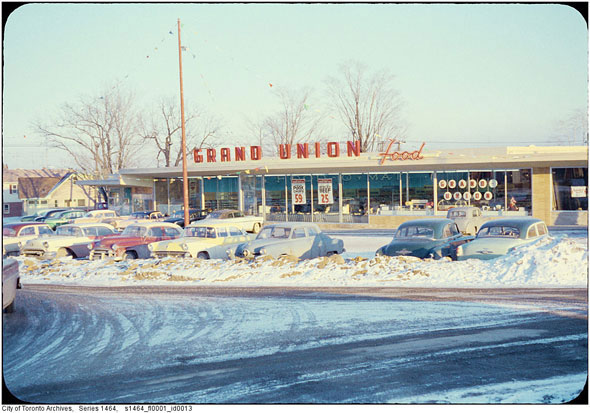
Grand Union
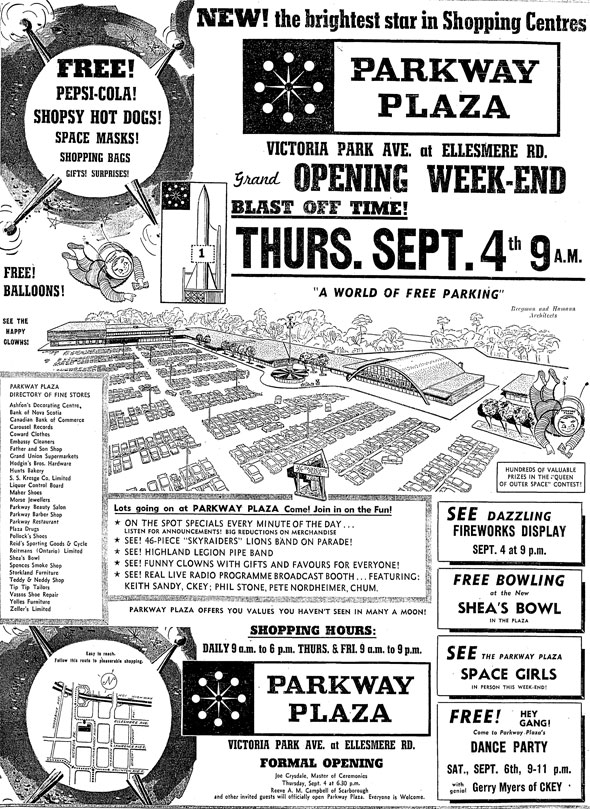
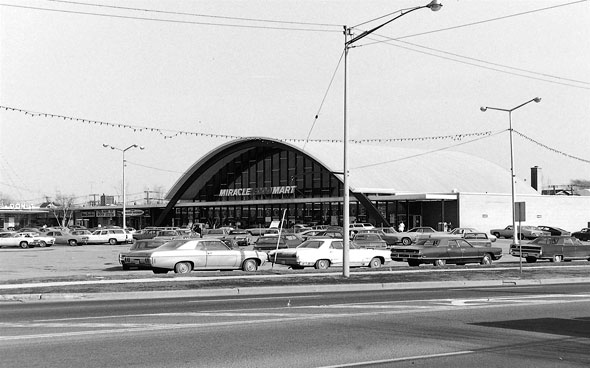
Grand Union’s most famous Toronto store was at the Parkway Mall at Victoria Park and Ellesmere in Scarborough.
The U.S.-based company built the store with its distinctive arched roof in 1958, just five years after entering the Canadian market with the purchase of Carroll’s, a grocery chain based out of Hamilton.
Just months after opening its flagship Scarborough location, Quebec-based Steinberg’s […] bought the company’s Canadian stores and rebranded the Parkway Mall location. It was later a Miracle Food Mart and a Dominion. Today, it’s a Metro. In 2009, the store became the first supermarket to be listed on the City of Toronto’s Inventory of Heritage Properties.
Comments Off on Toronto-area supermarkets of the past
QotD: The distinctive scent of the Black Forest
There was one night when, tired out and far from town or village, we slept in a Black Forest farmhouse. The great charm about the Black Forest house is its sociability. The cows are in the next room, the horses are upstairs, the geese and ducks are in the kitchen, while the pigs, the children, and the chickens live all over the place.
You are dressing, when you hear a grunt behind you.
“Good-morning! Don’t happen to have any potato peelings in here? No, I see you haven’t; good-bye.”
Next there is a cackle, and you see the neck of an old hen stretched round the corner.
“Fine morning, isn’t it? You don’t mind my bringing this worm of mine in here, do you? It is so difficult in this house to find a room where one can enjoy one’s food with any quietness. From a chicken I have always been a slow eater, and when a dozen — there, I thought they wouldn’t leave me alone. Now they’ll all want a bit. You don’t mind my getting on the bed, do you? Perhaps here they won’t notice me.”
While you are dressing various shock heads peer in at the door; they evidently regard the room as a temporary menagerie. You cannot tell whether the heads belong to boys or girls; you can only hope they are all male. It is of no use shutting the door, because there is nothing to fasten it by, and the moment you are gone they push it open again. You breakfast as the Prodigal Son is generally represented feeding: a pig or two drop in to keep you company; a party of elderly geese criticise you from the door; you gather from their whispers, added to their shocked expression, that they are talking scandal about you. Maybe a cow will condescend to give a glance in.
This Noah’s Ark arrangement it is, I suppose, that gives to the Black Forest home its distinctive scent. It is not a scent you can liken to any one thing. It is as if you took roses and Limburger cheese and hair oil, some heather and onions, peaches and soapsuds, together with a dash of sea air and a corpse, and mixed them up together. You cannot define any particular odour, but you feel they are all there — all the odours that the world has yet discovered. People who live in these houses are fond of this mixture. They do not open the window and lose any of it; they keep it carefully bottled up. If you want any other scent, you can go outside and smell the wood violets and the pines; inside there is the house; and after a while, I am told, you get used to it, so that you miss it, and are unable to go to sleep in any other atmosphere.
Jerome K. Jerome, Three Men on the Bummel, 1914.
Comments Off on QotD: The distinctive scent of the Black Forest
August 8, 2015
Top 11 Stupid Moves of Early World War 1 I THE GREAT WAR – Ranking
Published on 5 Aug 2015
As a last birthday surprise, we tried something new and present Indy’s ranking of the 11 most stupid moves of early World War 1. What do you think of our list and who would make it to the top of yours? Tell us in the comments below.
Comments Off on Top 11 Stupid Moves of Early World War 1 I THE GREAT WAR – Ranking
August 7, 2015
Warsaw Falls – The Fokker Scourge Begins I THE GREAT WAR Week 54
Published on 6 Aug 2015
After the Russian defeats on the Eastern Front, Warsaw falls. The first time in over 100 years a foreign power occupies the city. The German onslaught in the East seems to be unstoppable. Also on the Western Front the Germans are causing havoc with the new Fokker-Eindecker planes which start the so called Fokker Scourge. The British pilots even start to call their airplanes Fokker-Fodder. At the same time, the battle in Gallipoli continues with ever more troops landing while neither the Ottomans nor the ANZAC troops can gain any advantage.
Comments Off on Warsaw Falls – The Fokker Scourge Begins I THE GREAT WAR Week 54
August 4, 2015
Boy Scouts during WW1 And The Lusitania Sinking Myths I OUT OF THE TRENCHES
Published on 3 Aug 2015
It’s time for the chair of wisdom again. This time Indy answers to particular questions – which took us a bit to research – about the Boy Scouts during World War 1 and the many theories about the sinking of the Lusitania and wether it was carrying ammunitions or not.
Comments Off on Boy Scouts during WW1 And The Lusitania Sinking Myths I OUT OF THE TRENCHES
Byzantine Empire: Justinian and Theodora – II: The Reforms of Justinian – Extra History
Published on 27 Jun 2015
Justinian wanted to restore the glory of Rome, but many obstacles stood in his way. He brought on talented advisors to help him reform the tax system, the law code, and the military might of the empire. With them he made great strides, but these advisors had very human flaws. His tax collector, John the Cappadocian, centralized tax collection and crushed corruption in his agents, greatly increasing the revenue to the empire – but he also skimmed money off the top to feed his private corruption. Meanwhile, a lawyer named Tribonian took centuries of confusing and even conflicting legal precedents and resolved them into a single code, the Corpus Juris Civilis, which remains the foundation of modern law today. He even made a textbook for students to learn from. But he was also a practicing pagan during an era when Justinian was trying to crack down on pagan rituals. And last, Justinian’s chief military commander Belisarius helped the Empire recover its military glory. He defeated the Sassanid Persians in the Battle of Dara, crushing a force of 50,000 men with only 25,000 of his own through clever strategy: he dug a trench to halt their infantry’s advance, then baited the Persian cavalry into overextending and sprang a surprise attack on them with Hun mercenaries. Although Belisarius seems to have been an upstanding person, his personal historian Procopius tainted even his clean record. Procopius wrote glowing official histories of the reign of Justinian, but his long lost secret history depicted Justinian as a literal headless demon and Theodora as a debauched monster.
Comments Off on Byzantine Empire: Justinian and Theodora – II: The Reforms of Justinian – Extra History
August 1, 2015
July 31, 2015
Russian Roulette – Germany Helps The Bolsheviks I THE GREAT WAR Week 53
Published on 30 Jul 2015
After Russia’s Great Retreat and the defeat on the Eastern Front, the Russian Army is demoralized and even revolution is in the air. Germany is fanning the revolutionary flames by sending Bolshevik prisoners of war back to Russia – equipped with money to support the Bolshevik cause. Meanwhile, the the war is continuing on the Western Front. Even small skirmishes are turning into atrocious battles with little gain for either side. A great offensive is not in sight.
Comments Off on Russian Roulette – Germany Helps The Bolsheviks I THE GREAT WAR Week 53
July 30, 2015
It’s our Birthday! – One year on THE GREAT WAR
Published on 28 Jul 2015
We can’t believe it’s already been a year working on the great war!
Thank you so much for your great support. We hope you enjoy our little special, and if you’re up for even more History check out our sister-channel IT’S HISTORY: http://bit.ly/ITSHISTORYSHOW
Comments Off on It’s our Birthday! – One year on THE GREAT WAR


