
Published on 1 Apr 2017
Ned Kelly has never shot a man. Until now.
Support Extra History on Patreon! https://www.patreon.com/ExtraCredits/
April 25, 2017
Ned Kelly 3 – Extra History
Comments Off on Ned Kelly 3 – Extra History
April 24, 2017
April 22, 2017
Flamethrower Units – Handling of Prisoners – Artillery Fuses I OUT OF THE TRENCHES
Published on 22 Apr 2017
In this week’s episode, Indy talks about flamethrower units, the handling of war prisoners and different types of artillery fuses.
Comments Off on Flamethrower Units – Handling of Prisoners – Artillery Fuses I OUT OF THE TRENCHES
Movie on the Armenian Genocide attracts massive number of Turkish trolls
One of the worst aspects of the First World War was the attempt by Ottoman forces to eliminate the Armenian “threat” by launching an organized campaign of murder and deportation that killed an estimated 1.5 million Armenians. A new movie which is set in this time has been drawing trollish attention from Turkish detractors:
The Promise, the grandest big-screen portrayal ever made about the mass killings of Armenians during World War I, has been rated by more than 111,300 people on IMDb — a remarkable total considering it doesn’t open in theaters until Friday and has thus far been screened only a handful of times publicly.
The passionate reaction is because The Promise, a $100-million movie starring Oscar Isaac and Christian Bale, has provoked those who deny that 1.5 million Armenians were massacred between 1915 and 1923 by the Ottoman Empire or that the deaths of Armenians were the result of a policy of genocide. Thousands, many of them in Turkey, have flocked to IMDb to rate the film poorly, sight unseen. Though many countries and most historians call the mass killings genocide, Turkey has aggressively refused that label.
Yet that wasn’t the most audacious sabotage of The Promise, a passion project of the late billionaire investor and former MGM owner Kirk Kerkorian.
In March, just a few weeks before The Promise was to open, a curiously similar-looking film called The Ottoman Lieutenant appeared. Another sweeping romance set during the same era and with a few stars of its own, including Ben Kingsley and Josh Hartnett, The Ottoman Lieutenant seemed designed to be confused with The Promise. But it was made by Turkish producers and instead broadcast Turkey’s version of the events — that the Armenians were merely collateral damage in World War I. It was the Turkish knockoff version of The Promise, minus the genocide.
“It was like a reverse mirror image of us,” said Terry George, director and co-writer of The Promise. George, the Irish filmmaker, has some experience in navigating the sensitivities around genocide having previously written and directed 2004’s Hotel Rwanda, about the early ’90s Rwandan genocide.
George bought a ticket to see it. “Basically the argument is the Turkish government’s argument, that there was an uprising and it was bad and we had to move these people out of the war zone — which, if applied to the Nazis in Poland would be: ‘Oh, there was an uprising in the Warsaw Ghetto and we need to move these Jews out of the war zone,’” says George. “The film is remarkably similar in terms of structure and look, even.”
The movie itself, however, didn’t win over A.V. Club critic Ignatiy Vishnevetsky:
Among the many virtues of James Gray’s The Lost City Of Z is its sense of proportion, which turns a decades-spanning historical epic into a pas de deux between vision and madness. Unfortunately, most recent historical epics have been more on the order of Terry George’s The Promise: messes of soap and cheese. Here at last is a film that tackles the Armenian genocide by way of a flimsy love triangle and an international cast (it really captures the diversity of the Armenian people), straining so hard to show its good intentions that it doesn’t bother to be directed. What does a movie that can’t even mount a competent horse chase — despite repeated attempts — have to say about the murder of 1.5 million people? At least George can rest easy knowing that his film is less bungled than Bitter Harvest, the February release that turned the Holodomor into the stuff of schmaltz. Up next, presumably, is Nicholas Sparks’ Auschwitz.
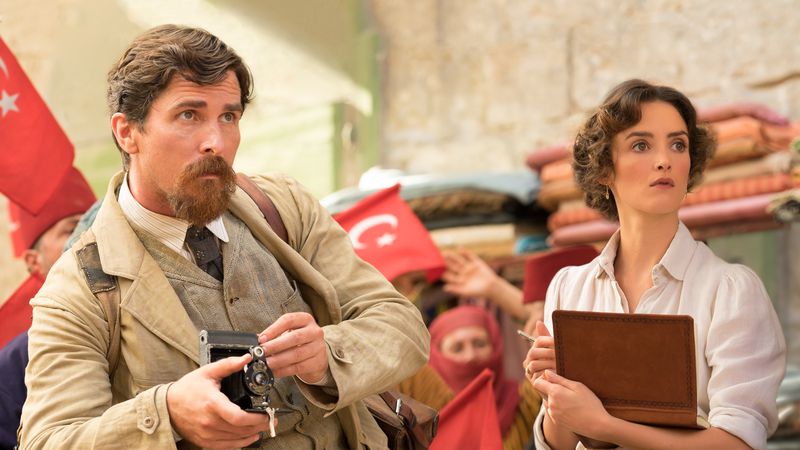
Doing his best impression of Omar Sharif, Oscar Isaac stars as Mikael Boghosian, a village apothecary who agrees to marry doe-eyed local girl Maral (Angela Sarafyan) in order to use her dowry to finance his dream of becoming a doctor. (Pity poor Maral, as no two members of the cast seem to agree on how to pronounce her name.) Arriving in Constantinople, the capital of the Ottoman Empire, Mikael moves in with his wealthy uncle and enrolls in medical school, but soon develops a crush on Ana (Charlotte Le Bon), the modern young woman who tutors his uncle’s children. But it’s 1914, and the Ottoman Empire is about to enter World War I as an ally of Germany and Austria-Hungary and within months will begin a strategic elimination of its large Armenian minority. As if to make matters worse, Ana has an American boyfriend, Chris Myers (Christian Bale), the Associated Press’ bureau chief of Armenian genocide exposition.
Still from The Promise, by Open Road Films.
Comments Off on Movie on the Armenian Genocide attracts massive number of Turkish trolls
Tank Chats #7 British Mark II
Published on 2 Jul 2015
The seventh in a series of short films about some of the vehicles in our collection presented by The Tank Museum’s historian David Fletcher MBE.
Only fifty tanks each of Marks II and III were produced. They were unarmoured, in the sense that the steel from which they were built was not heat treated to make it bullet proof. The reason being that these tanks were only intended for use as training machines.
The chief external differences from Mark I lay in the tail wheels, which were not used on Marks II and III and later heavy tanks, the narrower driver’s cab and the ‘trapezoid’ hatch cover on the roof.
Comments Off on Tank Chats #7 British Mark II
April 21, 2017
The Nivelle Offensive – Carnage At The Chemin Des Dames I THE GREAT WAR Week 143
Published on 20 Apr 2017
French Commander Robert Nivelle was sure that his offensive would bring the final victory against Germany. He scaled up his successful plan from Verdun which had worked so well and even when other generals questioned the very idea of the offensive, he would refuse to alter it or call it off. The Germans knew that the French were coming and were well prepared. And so the disaster at the Chemin Des Dames unfolded.
Comments Off on The Nivelle Offensive – Carnage At The Chemin Des Dames I THE GREAT WAR Week 143
How do spacesuits work? | James May Q&A | Head Squeeze
Published on 8 Nov 2013
You’ve seen the videos of those astronauts on the International Space Station getting suited and booted in a spacesuit before a spacewalk, but how exactly does the space suit work?
A spacesuit has to protect you from the glaring radiation from the sun as well as keeping you warm from the extreme cold of outer space. As well as that is has to make sure you have enough oxygen and enough movement so you can actually do your job.
It also has to be pressurised to about 4.7PSI. Otherwise the empty vacuum of outer space will make your organs increase to twice their normal size and you will meet a very unpleasant untimely death.
Don’t fancy building your own spacesuit, why not build an elevator into space? http://www.youtube.com/watch?v=annVRxRjj4c&feature=c4-overview-vl&list=PLMrtJn-MOYmeNkbYzXsEluioufGDxuqtO
Martin Archer has all the information you need on when humans will be able to go to Mars http://www.youtube.com/watch?v=fYthxj-bO0I&list=PLMrtJn-MOYme6klSjJXoZfWmNZ6ZthOSA&index=12
Comments Off on How do spacesuits work? | James May Q&A | Head Squeeze
April 20, 2017
STEEL MILL RAILROAD RELICS Still found in Pittsburgh, Pa
Published on 27 Nov 2016
Although it is 2016, and most mills closed in the 80’s, there are still many items still preserved in and around the Pittsburgh area. Here is just a small sampling.
Comments Off on STEEL MILL RAILROAD RELICS Still found in Pittsburgh, Pa
April 19, 2017
QotD: Hubris and Nemesis, or pride goeth before the fall
Few things are more likely to precede defeat than the conviction that you are on the verge of victory. One hundred years ago, in the spring of 1917, Germany had every reason to believe that it would triumph over its enemies in the First World War. France had been bled white in repeated attacks on the German army’s fortified lines, England was suffering from shortages of both munitions and military manpower, and Russia was descending into a revolution that would, within a year, enable Germany and its Austro-Hungarian allies to shift enormous numbers of troops and guns to the Western Front. Yet the entry of the United States into the war on April 6, 1917, proved to be the counterweight that shifted the balance. By the autumn of 1918, the fond hope of Germany victory had been exposed as a delusion. The ultimate result of the Kaiser’s war was the destruction of the Kaiser’s empire, and of much else besides.
What is true in war is true also in politics. Hubris is nearly always the precedent to unexpected defeat. In 1964, Lyndon Johnson won a landslide victory; less than four years later, LBJ could not even win his own party’s nomination for re-election. In 1972, Richard Nixon was re-elected in a landslide; less than two years later, he was forced to resign from office. More recently, after George W. Bush’s 2004 re-election, some imagined that this victory was the harbinger of a “permanent Republican majority” — a GOP electoral hegemony based on a so-called “center-right” realignment — but two years later, Democrats captured control of Congress and in 2008 Barack Obama was elected president. Obama’s success in turn led Democrats to become overconfident, and Hillary Clinton’s supporters believed they were “on the right side of history,” as rock singer Bruce Springsteen told a rally in Philadelphia on the eve of the 2016 election. Unfortunately for Democrats, history disagreed.
Robert Stacy McCain, “Why Is the ‘Right Side of History’ Losing?”, The American Spectator, 2017-04-05.
Comments Off on QotD: Hubris and Nemesis, or pride goeth before the fall
April 18, 2017
Western Front Artillery At The Outbreak of World War 1 I THE GREAT WAR Special
Published on 17 Apr 2017
World War 1 was a war of artillery, 75% of casualties are attributed to artillery fire. And since the late 19th century the development of field canons, howitzers and mortars had made rapid progress. We are taking a look at the standard artillery pieces of the German, French and British Army at the outbreak of the war in this first part of a new series.
Comments Off on Western Front Artillery At The Outbreak of World War 1 I THE GREAT WAR Special
In WW1, the United States “was not fighting for survival. It was fighting for an ideal.”
Reason‘s Glenn Garvin reviews two new documentaries, including one called American Experience: The Great War (no relation to the YouTube channel I regularly reblog).
World War I, as American Experience: The Great War paraphrases a conclusion already reached by the cast of Friends many years ago, is probably the biggest event in U.S. history of which Americans know next to nothing. In some ways, that will still be true even if they watch The Great War, which views the events strictly through the lens of how Americans were affected. The welter of royal bloodlines and backdoor treaties that turned a seemingly isolated event — the assassination of an Austrian nobleman by a Serbian teenager — into a worldwide conflagration involving Russia, France, England, Italy, Germany, the Austro-Hungarian Empire, the Ottoman Empire, Bulgaria, Japan, and the United States is barely explored [*]. Nor are many of the war’s geopolitical shockwaves. Even the implosion of Russia’s czarist government, which would eventually result in a Cold War that for nearly five decades threatened to turn apocalyptically hot, only gets a minute or two.
What The Great War does do, in truly spectacular fashion, is limn the voracious expansion of the American government midwifed by World War I. When Woodrow Wilson’s uncertain attempts at neutrality floundered and he called for a declaration of war in 1917 because “the world must be made safe for democracy,” it made the United States unique among the combatants, notes a historian in The Great War: “It was not fighting for survival. It was fighting for an ideal.”
But as The Great War documents in horrifying detail, that ideal was the creation of a Leviathan state with unprecedented power: to draft young men and send them to a foreign war. To set price controls on food and impose dietary restrictions. To arrest and even deport political dissidents. To create a powerful government propaganda organ aimed not at enemy nations but the American people. (It expanded from one employee to about 100,000 in a couple of months.) To send goon squads known as Liberty Loan Committees roaming neighborhoods offering deals on war bonds that couldn’t be refused.
Wilson’s actions did not go without dissent (signs at a protest march in New York City: MR. PRESIDENT, WHY NOT MAKE AMERICA SAFE FOR DEMOCRACY?) and dissent did not go without punishment. Wilson demanded, and got, a new Espionage Act that made it a crime to collect, record and disseminate information “harmful to the war effort,” and he wielded it like an axe against the anti-war movement. By the fall of 1917, the federal government opened prison camps in Utah, Georgia, and North Carolina to house all the “security threats” Wilson’s Justice Department had detected.
Wilson’s security mania spread out into the population, too, where it unleashed what The Great War calls the “wholesale destruction of German culture in the United States. There were moves to ban German music, plays, and even the spoken language. Some of the xenophobic spasms, like beer-stein-smashing contests, were loony enough to be funny; others, like the slaughter of German dog breeds in Ohio, were almost too ugly for words. Though Wilson’s supporters managed to utter some. When an Illinois coal miner of German heritage was lynched by coworkers who thought he might be a spy, the Washington Post labeled it a nothing more than a slightly over-exuberant sign of “a healthful and wholesome awakening in the interior part of the country.”
* Should you want to know more about the non-American aspects of how World War 1 began, you could read my Origins of WW1 series of posts, starting here (there are 12 posts in the series, and even so, I could be accused of omitting a lot of detail).
Comments Off on In WW1, the United States “was not fighting for survival. It was fighting for an ideal.”
Ned Kelly – II: Under Suspicion – Extra History
Published on 25 Mar 2017
Ned’s second venture as a bushranger brought him to the attention of the local police. He did time in prison, then tried to clean up his act, but became frustrated by the suspicion that continued to dog him.
Comments Off on Ned Kelly – II: Under Suspicion – Extra History
April 16, 2017
The tale of unsalted butter in French cuisine
At his new blog, Splendid Isolation, Kim du Toit explains the historical roots of a French culinary oddity:
One of the quirks of French cuisine is that most often the butter is unsalted, and at a French dinner table you will usually find a tiny cruet of salt with a microscopic spoon inside, so that you can salt your butter (or not) according to taste. To someone like myself, accustomed only to salted butter, this seemed like an affectation, but it wasn’t that at all: it was the result of taxation, and this is one of the things changed forever by Napoleon’s administrative reforms.
One of the best parts of our U.S. Constitution is the “interstate commerce” clause, which forbids states from levying taxes on goods and services passing from one state to another, and through another in transit. This was not the case in pre-Napoleonic France. Goods manufactured in, say, Gascony or Provence would pass through a series of customs posts en route to Paris, and at each point the various localities would levy excise taxes on the goods, driving up the final price at its eventual destination.
Which brings us to salt. French salt, you see, was produced mainly on the Atlantic coastline, and was a major “export” of Brittany to the rest of France. Butter, of course, was produced universally — in and outside Paris and ditto for every major city — but the salt for the butter came almost exclusively from Brittany, and having been taxed multiple times by the time it reached points east like Paris or Lyons, it was expensive. So the cuisine and eating habits in those parts developed without the use of salt — or, if salt was requested, at an added cost. It’s why, to this day, many French recipes use unsalted butter as an ingredient. (In contrast, butter for local consumption in western France was [and still is] almost always salted, because salt was dirt cheap there.)
Napoleon’s reforms did away with all that; he saw to it that the douane locale checkpoints and toll booths along the main roads were abolished (causing salt prices in eastern France to plummet and become a mainstay of French cuisine at last). And when the towns and villages protested about the loss of tax revenue, Napoleon made up the shortfall with “federal” funds out of the national treasury.
Of course, the French treasury had in the meantime been emptied out by, amongst other things, the statist welfare policies of the Revolutionary government (stop me if this is starting to sound familiar). Which is why, to raise money, Napoleon invaded wealthy northern Italy and western Germany (as it is now), pillaged their rich cities’ treasuries and garnered revenue from the wealthy aristocracy, who paid bribes to avoid having their palaces sacked and their wealth confiscated.
Comments Off on The tale of unsalted butter in French cuisine
Smoke Screens – Fortress Location – Recruitment Age I OUT OF THE TRENCHES
Published on 15 Apr 2017
Start your free Great Courses Plus trial today: http://ow.ly/z4VI30acl50
It’s time for Out Of The Trenches again where Indy answers your questions about World War 1, this week we talk about the recruitment age, smoke grenades and fortress locations.
Comments Off on Smoke Screens – Fortress Location – Recruitment Age I OUT OF THE TRENCHES
Damnatio memoriae
The Latin in the title is a modern construction, but it describes a fairly common way that Romans would (to borrow from Orwell) push memories down the memory hole, including even former Emperors:
In the Soviet Union, Josef Stalin didn’t just defeat his political enemies – he purged their memories from existence. Photographs were altered and history texts changed to eliminate any trace of those who stood against him, a practice that inspired George Orwell to write 1984. But Stalin was far from the first leader to erase his enemies. The ancient Romans, too, tried to erase people from history – even Emperors.
A new show on now at the British Museum explores the use of memory sanctions against Roman emperors and their families in antiquity. It also evaluates the physical treatment of objects deemed “pagan” or heretical in the Christianized empire of Late Antiquity.
But what was the point of “damnatio memoriae“? And can you ever fully expunge someone from the historical record?
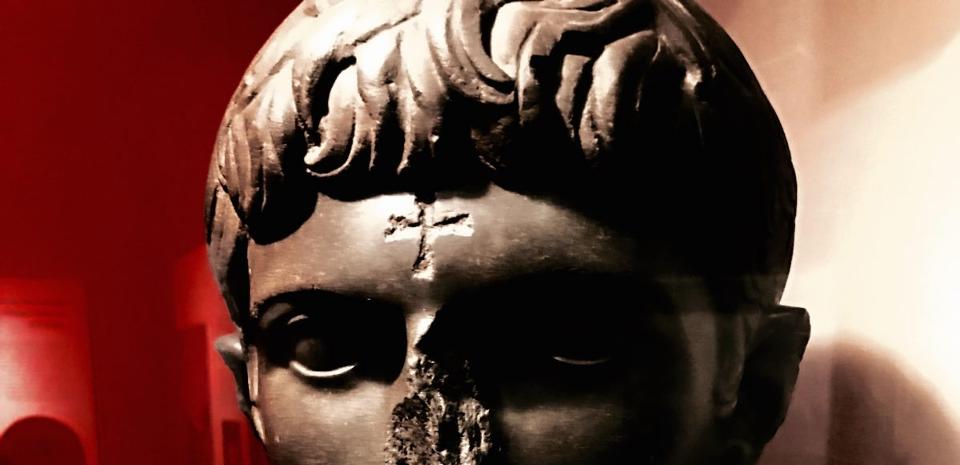
A Basanite bust of Germanicus that has a series of cuts around his ear, a shorn nose, his right ear chipped away and a cross etched on his forehead. The bust is on display now at the British Museum. (Photo by Sarah E. Bond)
The British Museum is currently displaying an exhibit on ancient memory sanctions called: “Defacing the Past: Damnation and desecration in imperial Rome.” It is a fascinating look into the ways in which we interact with objects as a proxy for the actual person. It is also a look into what ancient historian Harriet Flower has called the “art of forgetting.” Although such sanctions are often called “damnatio memoriae,” this is a modern Latin phrase and thus a construct that did not in fact exist in antiquity. Use of the term suggests a monolithic way in which Romans could legally damn the memory of a disgraced or unpopular Roman emperor, when in fact there was no one term for such sanctions or even a fully systematized procedure for it. What we have today is instead the material remnants of various senatorial, imperial, and ecclesiastical decrees — as well as a number of personal choices.
Sanctions against the commemoration of a person could take many forms in ancient Rome and can be traced back to the Republican period. The dictator Sulla had the statues of his rival, Marius, pulled down. He also banned the display of wax imagines carried in funeral processions. We are told by Plutarch (Caes. 5) that the nephew of Marius, Julius Caesar, displayed these wax casts of Marius’ face for the first time in the funeral for his aunt Julia in 69 BCE. Julia had been Marius’ wife and was Caesar’s aunt. The disgraced general and his consorts were earlier declared hostes (enemies) of the Roman state, but their memory was clearly not forgotten. The absence of the imagines under Sulla had in fact always been conspicuous, rather than a tactic that led to the erasure of their deeds or memory.
Comments Off on Damnatio memoriae


