
Epicurus had reacted against the Platonic concepts of Reason with a capital R, the Good, the Beautiful, Duty, and other absolute concepts existing in themselves in some supernatural world. For Epicurus, what is moral is what brings pleasures to individuals in a context where there is no social strife. The Epicurean wise man will keep the covenant and not harm others not because he wishes to comply with some moral injunction being imposed from above, but simply because that’s the best way to pursue his happiness and keep his tranquility of mind.
Martin Masse, “The Epicurean roots of some classical liberal and Misesian concepts“, speaking at the Austrian Scholars Conference, Auburn Alabama, 2005-03-18.
July 21, 2018
QotD: Epicurus and Plato
Comments Off on QotD: Epicurus and Plato
July 20, 2018
2nd Battle Of The Marne – Turning Point On The Western Front I THE GREAT WAR Week 208
The Great War
Published on 19 Jul 2018The German Army launches an diversionary attack from the Rheims-Soisson salient and increases the pressure on Paris. But the Allies knew about the attack and for the first time, they effectively counter the German Stormtrooper tactics and even counter-attack along the line.
Comments Off on 2nd Battle Of The Marne – Turning Point On The Western Front I THE GREAT WAR Week 208
Tank Chats #33 Panzer III | The Tank Museum
The Tank Museum
Published on 11 Mar 2017The thirty-third Tank Chat, this time presented by Curator David Willey. Including a fascinating insight into pre-Second World War German tank production and how the Panzer III worked alongside its fellow Panzers.
To find out more, buy the new Haynes Panzer III tank manual. https://www.myonlinebooking.co.uk/tan…
The Panzer III was conceived in 1934 as the principle combat tank of the Panzer divisions. The Museum’s Panzer III went into action in the North African theatre of war and is believed to have been captured at the Battle of Alam Halfa.
Support the work of The Tank Museum on Patreon: ► https://www.patreon.com/tankmuseum
Or donate http://tankmuseum.org/support-us/donate
Comments Off on Tank Chats #33 Panzer III | The Tank Museum
July 19, 2018
Mucking around with Stonehenge
Many people are still under the impression that Stonehenge was built by the Druids (debunked in this video by Siobhan Thompson). At least as many people think that the modern day stone circle is an undisturbed historical relic, and that the stones are standing today as and where they have for thousands of years. All the way back in 2001, Emma Young did a quick debunking of that theory in New Scientist:
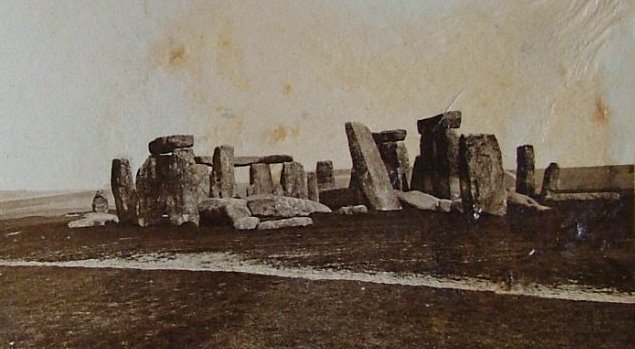
An early photograph of Stonehenge taken in July 1877 by Philip Rupert Acott
Via Wikimedia Commons
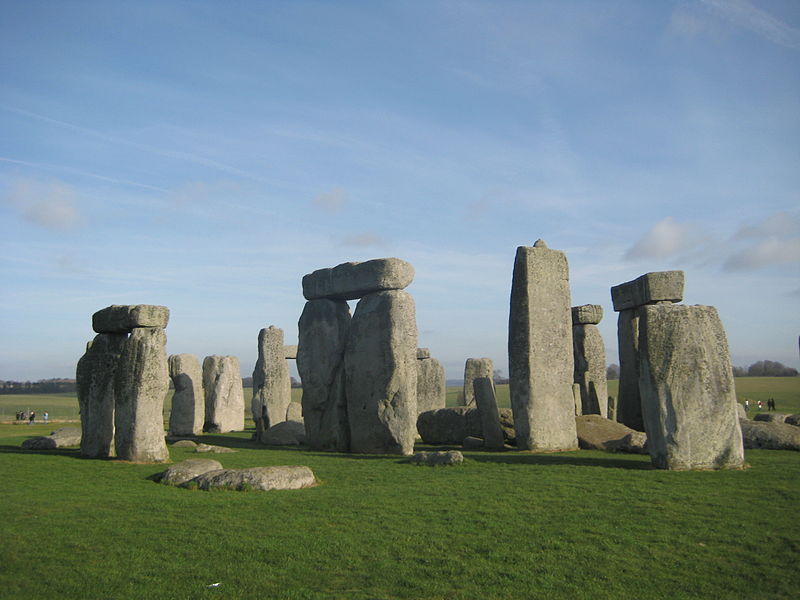
Photo from a similar angle in 2008 showing the extent of reconstruction.
Via Wikimedia Commons
Most of the one million visitors who visit Stonehenge on Salisbury Plain every year believe they are looking at untouched 4,000-year-old remains. But virtually every stone was re-erected, straightened or embedded in concrete between 1901 and 1964, says a British doctoral student.
“What we have been looking at is a 20th-century landscape, reminiscent of what Stonehenge might have looked like thousands of years ago,” says Brian Edwards, a student at the University of the West of England in Bristol.
Stonehenge isn’t the only ancient site to have been transformed in recent years, he says. “Even many of the local people in Avebury weren’t aware that a lot of the stones were put up in the 1930s,” he told New Scientist.
[…]
English Heritage says it is now considering covering the Stonehenge alteration programme in detail in the next edition of its official guidebook to the site. A decision not to include the work in official guides was taken in the 1960s, says Dave Batchelor, English Heritage’s senior archaeologist.
The first restoration project took place in 1901. A leaning stone was straightened and set in concrete, to prevent it falling.
More drastic renovations were carried out in the 1920s. Under the direction of Colonel William Hawley, a member of the Stonehenge Society, six stones were moved and re-erected.
Cranes were used to reposition three more stones in 1958. One giant fallen lintel, or cross stone, was replaced. Then in 1964, four stones were repositioned to prevent them falling.
The 1920s ‘restoration’ was the most “vigorous”, says Christopher Chippindale of the Cambridge University Museum of Archaeology and Anthropology. “The work in the 1920s under Colonel William Crawley is a sad story,” he says.
As I commented on a post back in 2010:
I imagine, given how many times Stonehenge has been mucked about with by earlier enthusiasts, there must be much misleading data has to be sifted and re-sifted before any definite discoveries can be announced. Stonehenge has been fascinating people for centuries and there are probably lots of amateur investigations that may well have made the situation more confusing (think of a sixteenth century equivalent of Indiana Jones or Lara Croft with a nose for treasure).
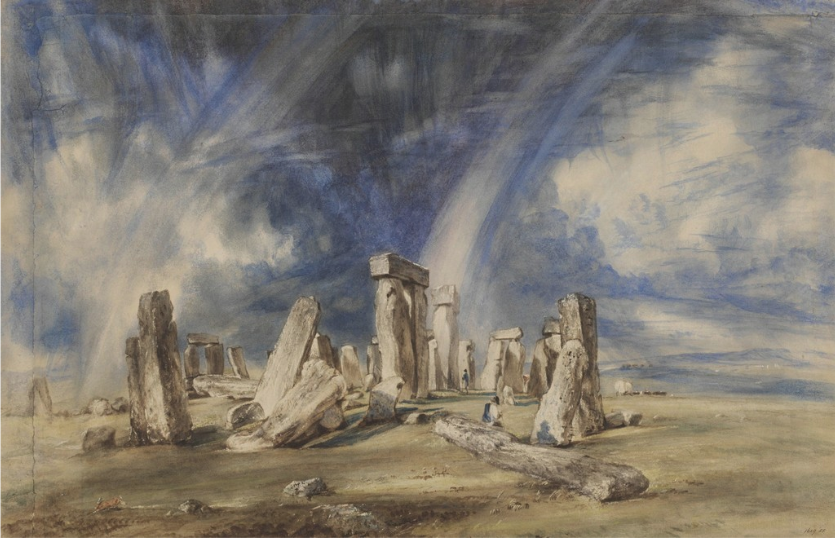
Atlas Obscura recently had a set of photos of Stonehenge taken in 1867 likely featuring the family of Colonel Sir Henry James, of the Ordnance Survey. There’s also a watercolour by John Constable from around 1835 showing a very different, more ruin-y monument:
Comments Off on Mucking around with Stonehenge
July 18, 2018
Isaac Asimov – Master of Science – Extra Sci Fi – #1
Extra Credits
Published on 17 Jul 2018Isaac Asimov didn’t have a birthday. Nobody knew the exact date of his birth, so he picked one for himself at a young age — and that choice, quite possibly, was what gave us one of his best creative periods.
Comments Off on Isaac Asimov – Master of Science – Extra Sci Fi – #1
An Israeli milestone is reached
Barbara Kay in the National Post:
The announcement was not unexpected.
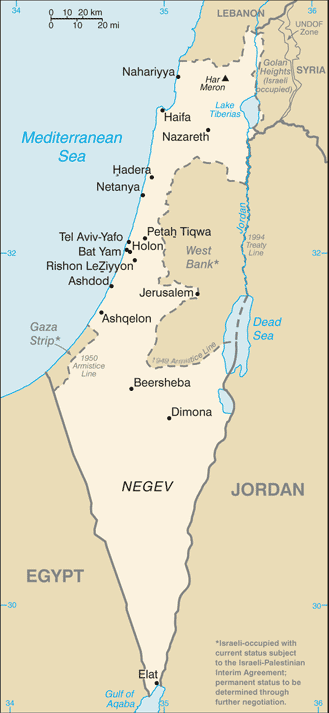
On the contrary, for those who follow the subject, it was long anticipated. But the words themselves, spoken by Israel’s Immigration Minister, Sofa Landver, still carried emotional force: “Israeli Jews now constitute the largest Jewish community in the world.”
Until now, the U.S., with its many millions of Jews, has been the most Jewish country in the world. For context, in 1948, when Israel achieved official nationhood, only 600,000 of the world’s 11.5 million Jews lived there (5.2 per cent of world Jewry). By 1967, Israel’s Jewish population was 2.4 million (almost 20 per cent), and in 2012, 5.9 million (43 per cent).
The exact numbers are disputed according to methodology and definition of Jewishness. Landver puts the Israeli number at 6.6 million, the U.S. figure at 5.7 million, while Pew has the U.S. number at 7.7 million Jews identifying as Jewish at some level, which includes 2.4 million people with “Jewish background,” but no affiliation or practice.
However one calculates who is or is not Jewish for census purposes, everyone agrees the trend is to a diminishing Jewish presence in America (secularization, intermarriage, low birthrate) and an escalating Jewish presence in Israel. So whether it’s this week or next year, the population dies are cast, and will, according to Hebrew University’s Sergio DellaPergolo, an expert on Jewish demographics, reflect a demographic reality not experienced by the Jewish people since 586 BCE.
In the age-old question: is this good or bad for the Jews?
It’s good in the sense that, since Israel is the Jewish homeland with Jews the only extant indigenous people who consider it sacred space, this is a return to an original norm. Twenty years ago, it was estimated that 98 per cent of Jews no longer reside in the place in which at least one grandparent was born. Perhaps it is a few percentage points fewer today. Still, such numbers speak to a rather lachrymose history of dispersion and insecurity, in which the dream of Zion restored has been both a comfort in adversity and motivation for endurance.
Once the dream came true (at a cost of two-thirds of European Jews’ deaths, numbers still not made up), it makes sense that Jews should gather in the one place where they know they will be unconditionally welcome. A steady stream of European Jews — notably from France, where the state has proved unequal to the task of quelling or reliably containing Muslim anti-Semitism — will continue to swell the ranks of highly cultured and well-educated Jews who can fairly seamlessly and productively integrate into Israeli society.
Comments Off on An Israeli milestone is reached
Why use clips when you can use magazines?
Lindybeige
Published on 27 Jun 2018Why did soldiers in World War Two get issued with clips of ammunition instead of magazines? The reasons are quite practical. Support me on Patreon: https://www.patreon.com/Lindybeige
My thanks to Bloke on the Range for the use of his rifles and costume.
Lindybeige: a channel of archaeology, ancient and medieval warfare, rants, swing dance, travelogues, evolution, and whatever else occurs to me to make.
▼ Follow me…
Twitter: https://twitter.com/Lindybeige I may have some drivel to contribute to the Twittersphere, plus you get notice of uploads.
website: http://www.LloydianAspects.co.uk
Comments Off on Why use clips when you can use magazines?
July 17, 2018
Australian General John Monash I WHO DID WHAT IN WW1
The Great War
Published on 16 Jul 2018John Monash was one of the most capable commanders of World War 1 but his rise to fame didn’t come unopposed.
Comments Off on Australian General John Monash I WHO DID WHAT IN WW1
July 16, 2018
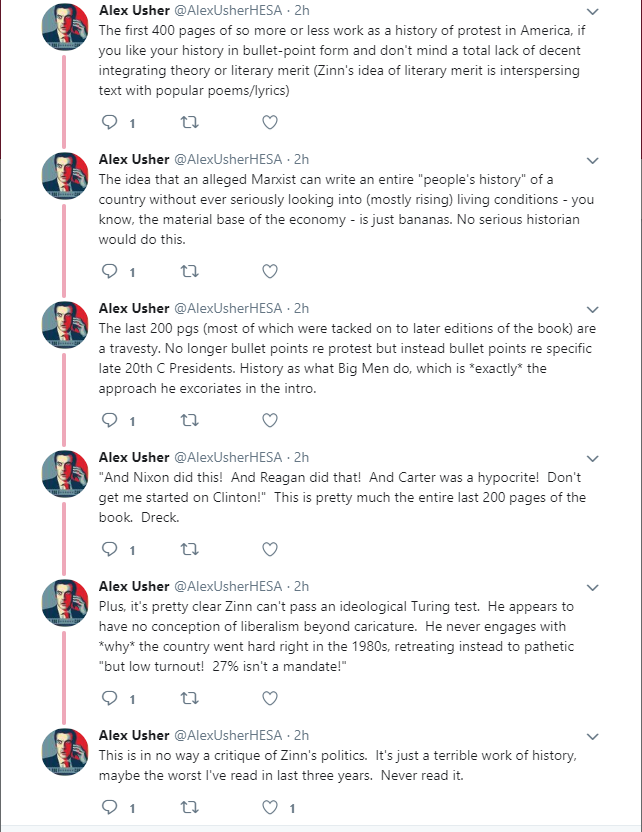
Deconstructing Zinn’s People’s History of the United States
Alex Usher took to the Twitters to explain why you shouldn’t bother reading Howard Zinn’s ?popular? history book:
Finished Howard Zinn's "People's History of the United States". I do not understand how this came to be thought of as a classic because it's a terrible work of history.
— Alex Usher (@AlexUsherHESA) July 14, 2018
Rather than slowing down your page loading speed, here’s the rest of that Twitter thread as a screen grab:
Comments Off on Deconstructing Zinn’s People’s History of the United States
Monty Python RAF Banter
bakerco502
Published on 30 Apr 2007secretly why I put a RAF impression together hahah
I’ve also disabled comments because people were starting to turn it into a pissing contest over who did what during the war.
Comments Off on Monty Python RAF Banter
QotD: The Great Enrichment
Look at the astonishing improvements in China since 1978 and in India since 1991. Between them, the countries are home to about four out of every 10 humans. Even in the United States, real wages have continued to grow — if slowly — in recent decades, contrary to what you might have heard. Donald Boudreaux, an economist at George Mason University, and others who have looked beyond the superficial have shown that real wages are continuing to rise, thanks largely to major improvements in the quality of goods and services, and to nonwage benefits. Real purchasing power is double what it was in the fondly remembered 1950s — when many American children went to bed hungry.
What, then, caused this Great Enrichment?
Not exploitation of the poor, not investment, not existing institutions, but a mere idea, which the philosopher and economist Adam Smith called “the liberal plan of equality, liberty and justice.” In a word, it was liberalism, in the free-market European sense. Give masses of ordinary people equality before the law and equality of social dignity, and leave them alone, and it turns out that they become extraordinarily creative and energetic.
The liberal idea was spawned by some happy accidents in northwestern Europe from 1517 to 1789 — namely, the four R’s: the Reformation, the Dutch Revolt, the revolutions of England and France, and the proliferation of reading. The four R’s liberated ordinary people, among them the venturing bourgeoisie. The Bourgeois Deal is, briefly, this: In the first act, let me try this or that improvement. I’ll keep the profit, thank you very much, though in the second act those pesky competitors will erode it by entering and disrupting (as Uber has done to the taxi industry). By the third act, after my betterments have spread, they will make you rich.
And they did.
Dierdre N. McCloskey, “The Formula for a Richer World? Equality, Liberty, Justice”, New York Times, 2016-09-02.
Comments Off on QotD: The Great Enrichment
July 15, 2018
1918 Flu Pandemic – Trench Fever – Extra History – #2
Extra Credits
Published on 14 Jul 2018The flu arrived in France. It found a pleasant home in the crowded wartime trenches, much to the dismay of the Allies who tried to keep the flu a secret. When it made its way to Madrid, not subject to wartime censorship, it picked up the nickname “Spanish flu.”
Comments Off on 1918 Flu Pandemic – Trench Fever – Extra History – #2
Alcibiades, the Athenian Byron
Not for poetry, but for the Byronian swathe he cut through a large portion of Classical Greece:
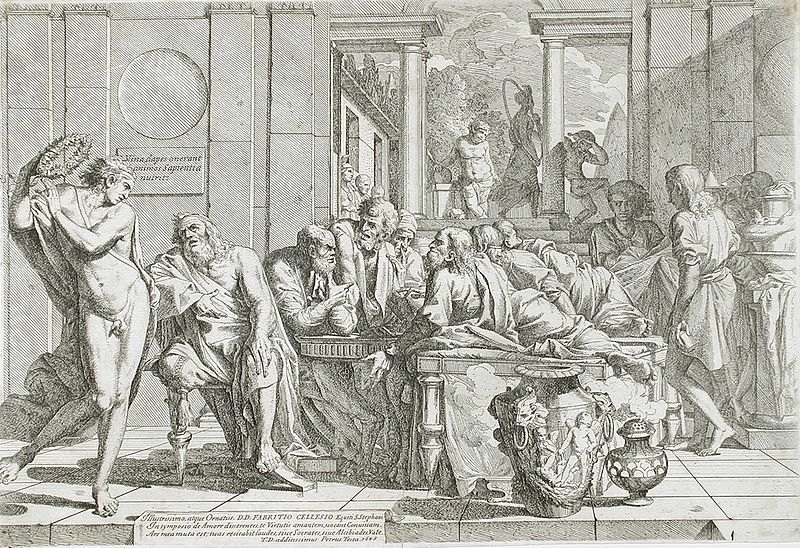
“Drunken Alcibiades interrupting the Symposium”, an engraving from 1648 by Pietro Testa (1611-1650)
Via Wikimedia Commons.
Of all personality traits, charisma is the hardest to appreciate at second hand. We read Cicero’s letters and can instantly tell that he was vain, insecure and ferociously clever; we read scraps of Samuel Johnson’s conversation in Boswell’s biography and know at once that he was magnificent, lovable and desperately unhappy. But as to what it was like to have Lord Byron turn the full force of his attention onto you – well, we have no conceivable way of knowing. We just have to trust his contemporaries that it felt like ‘the opening of the gate of heaven’.
This causes problems for a biographer of Alcibiades. On the face of it, the man was utterly insufferable. Born in around 450 BC into one of the oldest and richest families of ancient Athens, Alcibiades was the only Old Etonian (as it were) to play a leading role in the late-fifth-century radical democracy. The account of his childhood in Plutarch’s Life of Alcibiades suggests a bad case of antisocial personality disorder: biting during wrestling, mutilating dogs, punching his future father-in-law in the face for a dare. His later political career makes Boris Johnson seem like a man of firm and unbending principle. Exiled from Athens in 415 BC over some particularly odious Bullingdon Club antics, Alcibiades promptly sold his services to Sparta (where he seduced the king’s wife) before double-crossing both sides and wheedling his way into the court of a Persian satrap.
But Alcibiades, like Byron, clearly had that indefinable something. One catches a glimpse of it in the unforgettable last scene of Plato’s Symposium, when he crashes into the room, blind drunk, flirting with everything on legs, shouting about his love for Socrates. Thucydides captures it in his report of Alcibiades’s speech whipping up the Athenian assembly to vote for the disastrous Sicilian expedition of 415 BC – an extraordinary stew of egotistic bragging (about how successful his racehorses are), mendacious demagoguery and brilliantly acute strategic thinking. The unwashed Athenian masses, not usually prone to atavistic toff-grovelling, absolutely adored him: when Alcibiades finally returned to Athens in 407 BC after eight years of exile, sailing coolly into Piraeus on a ship with purple sails, they welcomed him back with paroxysms of joy.
Behind the Peloponnese-sized ego, Alcibiades was a general of spectacular genius – when he could be bothered. In 410 BC, shortly after his controversial reinstatement as admiral of the Athenian navy (on the back of a bogus promise of Persian support), he wiped out the entire Spartan fleet at the Battle of Cyzicus; two years later, through sheer chutzpah, he captured the city of Selymbria near Byzantium with only fifty soldiers, and without striking a blow. When things went wrong – as in 406 BC, after a disastrous campaigning season in the eastern Aegean – he showed an infuriating ability to wriggle out of trouble. His final years (406–404 BC) were spent once again in exile from Athens, holed up in a private castle on the Gallipoli peninsula. The circumstances of his death are still shrouded in mystery. One story tells that he died in the remote mountains of central Turkey at the hands of the brothers of a Phrygian noblewoman whom he had decided to seduce. This is, I fear, all too believable.
This is the introduction to a review by Peter Thonemann of a new biography of Alcibiades by David Stuttard in the Literary Review for July, 2018. H/T to Never Yet Melted for the link.
Comments Off on Alcibiades, the Athenian Byron
More Info About Alsace-Lorraine in WW1 I OUT OF THE ETHER
The Great War
Published on 14 Jul 2018Markus and Indy give you some background on our recent special episode.
Comments Off on More Info About Alsace-Lorraine in WW1 I OUT OF THE ETHER
Soviet Gear – Why it Didn’t Die | Feature Fittings
Feature History
Published on 23 Jun 2018———————————————————————————————————–
Patreon
https://www.patreon.com/FeatureHistory
https://twitter.com/Feature_History
———————————————————————————————————–
I do the research, writing, narration, art, and animation. Yes, it is very lonelyIntro Song
Ross Bugden – ChosenMusic by Epidemic Sound: http://epidemicsound.com
Comments Off on Soviet Gear – Why it Didn’t Die | Feature Fittings


