
Obamacare will not collapse imminently — or maybe not even ever. But that is not because it is “working” as a public policy. Countries around the world have carried the husk of their far more socialized health-care systems for generations. Rent control, the minimum wage, and countless other economically ridiculous policies endure because they satisfy the political needs of politicians, bureaucrats, and a whole phylum of remora-like rent-seekers. That’s why Milton Friedman said, “Nothing is so permanent as a temporary government program.” He should know, given how it was basically his idea to implement tax-withholding from paychecks as a wartime measure.
You might say that these programs also help real people too. And that is true. But wealth distribution efforts always help someone. And those someones become vested interests who demand perpetuation of the status quo. If the federal government implemented a program to give every left-handed person in the country $20,000 a year free and clear (no doubt to compensate for the fact that such people are witches), you can be sure the Left Handed Association of America would work assiduously to protect their entitlement.
Jonah Goldberg, “The Consequences of Overpromising on Obamacare”, National Review, 2016-10-08.
July 15, 2018
QotD: “Temporary” government programs
July 13, 2018
The Gardeners Of Salonica Prepare A New Offensive I THE GREAT WAR Week 207
The Great War
Published on 12 Jul 2018The Macedonian Front has been quite since the recapture of Monastir except for some minor battles like at Skra. But the five nation Army of the Orient wants to change that and is readying a new offensive.
July 12, 2018
“And that is how the Flat Century dies. Upstairs, downstairs isn’t just our past, it’s our future”
ESR looks in his crystal ball and finds a much less egalitarian future lurking just ahead of us:
I think we all better hope we get germ-line genetic engineering and really effective nootropics real soon now. Because I think I have seen what the future looks like without these technologies, and it sucks.
A hundred years ago, 1918, marked the approximate end of the period when even middle-class families in the U.S. and Great Britain routinely had servants. During the inter-war years availability of domestic servants became an acute problem further and further up the SES scale, nearly highlighted by the National Council on Household Employment’s 1928 report on the problem. The institution of the servant class was in collapse; would-be masters were priced out of the market by rising wages for factory jobs and wider working opportunities for women (notably as typists).
But there was a supply-side factor as well; potential hires were unwilling to be servants and have masters – increasingly reluctant to be in service even when such jobs were still the best return they could get on their labor. The economic collapse of personal service coincided with an increasing rejection of the social stratification that had gone with it. Society as a whole became flatter and much more meritocratic.
There are unwelcome but powerful reasons to expect that this trend has already begun to reverse.
[…]
But now it’s 2018. Poverty cultures are reaching down to unprecedented levels of self-degradation; indicators of this are out-of-wedlock births, rates of drug abuse, and levels of interpersonal violence and suicide. Even as American society as a whole is getting steadily richer, more peaceful and less crime-ridden, its lowest SES tiers are going to hell in a handbasket. And not just the usual urban minority suspects, either, but poor whites as well; this is the burden of books like Charles Murray’s Coming Apart. J. D. Vance’s Hillbilly Elegy, and the opioid-abuse statistics.
It’s hard not to look at this and not see the prophecies of The Bell Curve, a quarter century ago, coming hideously true. We have assorted ourselves into increasing cognitive inequality by class. and the poor are paying an ever heavier price for this. Furthermore, the natural outcome of the process is average IQ and other class differentiating abilities abilities are on their way to becoming genetically locked in.
The last jaw of the trap is the implosion of jobs for unskilled and semi-skilled labor. Retail, a traditional entry ramp into the workforce, has been badly hit by e-commerce, and that’s going to get worse. Fast-food chains are automating as fast as political morons pass “living wage” laws; that’s going to have an especially hard impact on minorities.
But we ain’t seen nothing yet; there’s a huge disruption coming when driverless cars and trucks wipe out an entire tier of the economy related to commercial transport. That’s 1 in 15 workers in the U.S., overwhelmingly from lower SES tiers. What are they going to do in the brave new world? What are their increasingly genetically disadvantaged children going to do?
Here’s where we jump into science fiction, because the only answer I can see is: become servants. And that is how the Flat Century dies. Upstairs, downstairs isn’t just our past, it’s our future. Because in a world where production of goods and routinized service is increasingly dominated by robots and AI, the social role of servant as a person who takes orders will increasingly be the only thing that an unskilled person has left to offer above the economic level of digging ditches or picking fruit.
Sometimes, the worst reporter is an eyewitness
In criminal cases — especially those dramatized for movies and TV — the strongest evidence against an accused is often an eyewitness to the crime. But as Dave Freer points out, what the person-on-the-spot saw isn’t always congruent with what objectively happened, especially when filtered through news reporting:
Back in the dark ages – 1980’s in South Africa the BBC Radio News reported on a labor dispute/picket protest led by the ANC aligned organizers in a fishing town up the West Coast of the Cape. The picket line had been savagely broken up by the police with dogs (the BBC reporter of the time was a passionate promoter of the anti-apartheid cause, and as his media was not within the country could report whatever he liked without any form of censorship.) The local Afrikaans press reported on the incident too. There wasn’t a lot to report on from one horse towns on the West Coast, and the Cape Town Riot squad dispersing a protest with dogs was news, if not big news. The one set of media carried it from their point of view as a bad thing, and the other as a good thing.
Now, as it happens I was – quite inadvertently – there, along with my pregnant wife. I wasn’t protesting, or with the police. I was just at the tail end of a long sampling trip, collecting shark vertebrae and gut contents –as well as measurements of said sharks – at various fish processing plants up the west coast. I was a very broke research scientist, and paying dog-sitters or putting our two hounds (a sloppy bull-terrier x keeshond cross and a dim-witted but loveable Old English Sheepdog) in kennels was just an expense that couldn’t be met. So they traveled with us, sleeping in the back of the truck. They loved the trips. My wife used to record for me – as it was a bloody, slimy, smelly dirty job, making writing difficult while you were doing it. Now, typically – as we were taking nothing of value, fish processors were quite obliging about us sampling the catch – as long as we didn’t get in the way. In this particular fishing town, that meant starting really early on the previous night’s landings, before work started. The track to the shark plant was a narrow alley next to and around the corner from the main only large employer in the town – they dealt with pilchards and anchovies.
We got there in the dark and had worked hard for several hours, and, tired, smelly, bloody and laden with sample buckets of vertebrae sections, (for age and grown studies) were glad to be heading for a coffee and giving the dogs a run before heading home. The dogs of course knew the pattern and were hyper with ‘walk-delight’, as always.
So: Barbara driving we headed around the corner and into the midst of a whole bunch of people. My dogs – confined to the back canopy — were barking. They were already excited for their walk and liked to tell the world… My wife, being herself, hooted and drove slowly towards the protestors –all we wanted was out of there… And, to be honest, we couldn’t actually turn around – and the sea was behind us.
Now, whether the protestors got freaked the idea that cops were somehow behind them, or just the noise of the two dogs was enough – people scattered in all directions running and screaming. We drove out, past the couple of local cops, having no idea what the hell we’d done, and wondering if we were in trouble.
A friend later told me the Cape Town Riot squad (we were about 2 hours away from the city) showed up about an hour and half after this, and were somewhat peeved at being called out for nothing.
The news media reported the event from their point of view. The essential facts were in a way true. A protest had been broken up by dogs. The riot squad had come up from Cape Town. The rest was the story that they wanted to tell their audience. They, or their sources, may have actually believed their version of events. Who knows? But I gave up on believing their reportage was overly accurate after that.
Great Blunders of WWII: Japan’s Mistakes at Midway
Anthony Coleman
Published on 3 Nov 2016From the History Channel DVD series “Great Blunders of WWII”
July 11, 2018
The Golden Age of Science Fiction – Modernity Begins – Extra Sci Fi
Extra Credits
Published on 10 Jul 2018The golden age of science fiction represents a very flawed but fascinating American view of the future; authors Arthur C. Clarke, Isaac Asimov, and Robert Heinlein were all influential to this time period.
Men of Harlech
Mark Mains
Published on 16 Apr 2011This stirring music first appeared as “March of the Men of Harlech” in Musical and Poetical Relics of the Welsh Bards (Edward Jones, London 1784). The song was also used in the movie Zulu (1964). To learn more visit: http://www.rorkesdriftvc.com/myths/my… http://en.wikipedia.org/wiki/Men_of_H…
July 10, 2018
Mountain Combat In The Vosges – The Battle For Alsace-Lorraine I THE GREAT WAR Special
The Great War
Published on 9 Jul 2018The Battle for Alsace-Lorraine in the Vosges was unforgiving and brutal. Both the French and the German troops were fighting in extreme conditions for a extremely symbolic stretch of land.
Operation Husky with the “D-Day Dodgers”
On this day in 1943, the Allies invaded Sicily as their first step toward knocking Italy out of the war. It was the first major allied operation (other than the abortive Operation Jubilee in 1942) in which a major formation of the Canadian Army took part. The 1st Canadian Infantry Division under the command of Major General Guy Simonds was part of General Montgomery‘s Eighth Army, which landed on the southeast coast of the island.
The Canada History Project describes the Canadian participation in Operation Husky:
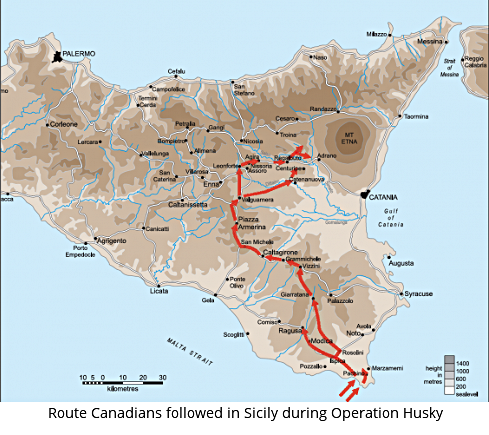
The men were young, of course, many just 18 to 24 years old. The roads were narrow dirt tracks switchbacking over steep, volcanic mountains. Temperatures hovered around 37 degrees, turning water bottles into hot water bottles, as one soldier put it. Three dry and dusty weeks into the campaign, there was a five-hour downpour, and all the troops relished the chance to shower off the dirt caked to their skin. By this time they were well into the middle of the island where their enemy was the fierce Hermann Goering division of the German army.
For six weeks, from July 10th to August 17th 1943, the Canadians, fighting as an independent unit for the first time, slogged through the interior of Sicily as part of Operation Husky, the first stage of taking back Europe from the Nazis after four years of war. Meanwhile, the Americans skirted the more level western coastline of the island and the British came up the east side, each competing with the other for glory.
American General Patton wrote in a letter, “This is a horse race in which the prestige of the US Army is at stake…we must take Messina before the British.”
That may be the way the generals saw it. For the soldiers, pushing through, village by village, mountaintop by mountaintop, it was no game.
Sicily, a rural mountainous island known for its orange groves and almond orchards, olives and the Mafia, sits strategically in the Mediterranean off the foot of Italy. The Canadian contingent was 25,000 strong. All men and materials were brought in by sea, making it the largest amphibious operation yet, though D-Day, a year later, would be bigger still.
In the first few days the Canadians passed through an area that is now a Unesco World Heritage site. Today tourists come to this southeast corner of Sicily to see the restored baroque architecture. But the young Canadian lads were eyeing the pillboxes, watching for snipers and lookouts. In the early days many Italian soldiers surrendered without too much resistance and the local people gave them grapes and oranges to quench their thirst in the scorching heat.
[…]
Operation Husky did succeed in gaining back the first European soil for the Allies. In the midst of it, Mussolini resigned and soon after Italy surrendered, another goal of the campaign. It started a second front forcing Hitler to back off his aggressive attack on our ally, Russia. And it provided a rehearsal for the larger amphibious landing on the beaches of Normandy, France in June of 1944. As well, it was the first time Canadians had fought as an independent unit. Their young commander was Guy Simonds. 1200 Canadians were wounded in Sicily and 562 died there. 490 of them are buried in the Canadian cemetery at Agira.
For their efforts, the soldiers fighting in Sicily and Italy became known as the “D-Day Dodgers”, a careless epithet supposedly delivered by Lady Astor, but embraced by the soldiers themselves who, with some sarcastic humour, turned it into the song, “We are the D-Day Dodgers, in sunny Italy…”
The Canadian part of the campaign from canadiansoldiers.com:
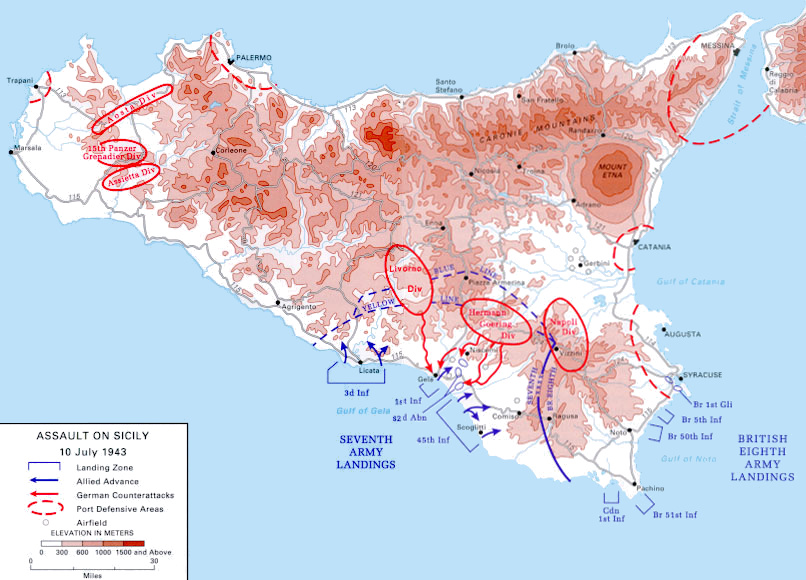
Sailing secretly at the end of June, the Division took its place on the left flank of General Bernard Montgomery’s famed Eighth Army for the Sicilian landings. The amphibious attack against Pachino peninsula was an unqualified success. The defenders were surprised and overrun with very few Allied casualties, and so began a controversial 38-day campaign. General Simonds’ troops advanced inland under difficulties:
The weather was extremely hot, the roads extremely dusty, and there was little transport; the troops were fresh from a temperate climate and a long voyage in crowded ships; and even though for a time there was scarcely any opposition, mere marching was a very exhausting experience under these conditions.
Continuing over the rocky terrain, they had their first fight with the Germans at Grammichele on 15 July. Three days later they captured Valguarnera. Both were rear-guard actions by a withdrawing enemy, and the first real tests came on the July 20 at Assoro and Leonforte. At the former, the 1st Brigade launched a surprise attack at night against an ancient Norman stronghold on the summit of a lofty peak. They seized and held their place in the face of fierce counter attacks, the records for the 15th Panzer Grenadier Division afterwards revealing generous tributes to the fieldcraft (Indianerkrieg) of the Canadians. Leonforte, an equally difficult situation, was captured by the 2nd Brigade after a bitter fight. These three days cost the Division about 275 casualties.
The advance then turned the east towards Adrano, at the base of Mount Etna. In their path stood Agira, “one of the most imposing of Sicily’s innumerable hill-towns,” and in the neighbouring hills the enemy put up a stubborn resistance. Both the 1st and 2nd Brigades were heavily engaged during the last week of July. The operations were, however, effectively supported by Canadian tanks and by the divisional artillery, reinforced by units of the Royal Artillery. General Simonds also had temporarily under his command the 231st British Infantry Brigade (the Malta Brigade), which threatened German communications from the south. After a bitter struggle Agira was captured on the 28th. Between Agira and Adrano the Hermann Goering Division made a stand at Regalbuto, using tanks as pillboxes in the debris of the town. While part of the 1st Division loosened the enemy’s grip on this town, the 3rd Brigade, temporarily under the command of the British 78th Infantry Division, assisted that formation in the Dittaino Valley.
American encircling operations in the western and northern districts of the island, combined with steady British pressure north of the Catania Plain, forced the enemy out of the defences based on Etna, and the campaign ended when the Allies entered Messina on 16-17 Aug. The 1st Division had performed all of its allotted tasks and had acquired valuable battle experience at a total cost of 2,155 casualties. The measure of the achievement was contained in General Montgomery’s statement: “I now consider you one of my veteran Divisions.”
The Division passed from XXX Corps to XIII Corps on 10 Aug, and moved to a concentration area in the rear on 11-13 Aug, relieved of operational responsibilities. Divisional headquarters moved to Francofonte. During the battle of Sicily they had travelled 120 miles, over largely rough and mountainous terrain.
QotD: Epicurean philosophy
Epicurus was born in 341 B.C., only six years after Plato’s death. He was 18 when Alexander the Great died. This event conventionally separates the classical Greece of independent city-states from the Hellenistic period, when Alexander’s generals and their dynasties ruled vast kingdoms in the former Persian Empire. He set up his school in a Garden in the outskirt of Athens. There is very little that survived from his many books. But fortunately, the work of his Roman disciple Lucretius, who lived in the first century B.C., De Rerum Natura, or On the Nature of Things, was rediscovered in the 15th century.
Through this work, Epicureanism had a major influence on the development of science in the following centuries. Epicurus had borrowed and refined the atomic hypothesis of earlier philosophers, and De Rerum Natura was studied and discussed by most scientists and philosophers of the West. The physics of Epicureanism, which explains that worlds spontaneously emerge from the interaction of millions of tiny particles, still looks amazingly modern. It is the only scientific view coming out of the Ancient World that one can still read today and find relevant.
Those influenced by Epicureanism include Hobbes, Mandeville, Hume, Locke, Smith, and many of the British moralists up to the 19th century. They not only discussed the Atomic theory, but Epicurean ethics, his views on the origin of society, on religion, his evolutionary account of life, and other aspects of his philosophy.
To me, Epicureanism is the closest thing to a libertarian philosophy that you can find in Antiquity. Plato, Aristotle, the Stoics, were all statists to various degrees, glorified political involvement, and devised political programs for their audiences of rich and well-connected aristocrats. Epicurus focused on the individual search for happiness, counselled not to get involved in politics because of the personal trouble it brings, and thought that politics was irrelevant. His school included women and slaves. He had no political program to offer and one can find no concept of collective virtues or order or justice in his teachings. On the contrary, the search for happiness implied that individuals should be as free as possible to plan their lives. To him, as one of his sayings goes “natural justice is a pledge guaranteeing mutual advantage, to prevent one from harming others and to keep oneself from being harmed.”
Martin Masse, “The Epicurean roots of some classical liberal and Misesian concepts“, speaking at the Austrian Scholars Conference, Auburn Alabama, 2005-03-18.
July 9, 2018
1918 Flu Pandemic – Emergence – Extra History – #1
Extra Credits
Published on 7 Jul 2018Between 3 and 6 percent of the world’s population died in 18 months when the flu first tried to take over the world. In today’s episode we explore the flu outbreak’s origins from military camps across the United States and Canada.
The flu was the first modern plague — turning our interconnected world against us by spreading through shipping lanes, rail lines and the arteries of industrialized war. Yet it was also the first pandemic of the scientific age, where doctors could to some extent understand what was happening and stand against the infection, though they lacked the tools to stop it. Also, say hello to the voice of “professor” Matt!
We used to joke about the “Pre-Fab Four”, but now every major artist is pre-fab
Not only pre-fabricated, but with a global audience that has been trained to like their music in advance. You could go so far as to say they’ve been brainwashed into liking it. ESR commented on this and shared the following video.
Not just a get-off-my-lawn rant, very exact information on how modern production techniques and producers’ economic incentives squeeze the life and variety out of popular music.
I actually didn’t know how bad it had gotten out there, I never hear any of this chart-topping crap because I select my music from niche genres without lyrics – instrumental prog metal, jazz fusion, space ambient. I thought that was just me, but maybe such strict selectivity is what one has to do to avoid being inundated in garbage these days.
July 8, 2018
Postal Service – Trench Deployment – US Air Force I OUT OF THE TRENCHES
The Great War
Published on 7 Jul 2018Chair of Wisdom Time!
Western Approaches – the bunker from which they won the war
Lindybeige
Published on 17 Jun 2018The command bunker ‘Western Approaches’ is now a museum in Liverpool. I was invited to take a look before it re-opened.
Support me on Patreon: https://www.patreon.com/LindybeigeThe Museum’s website: http://www.liverpoolwarmuseum.co.uk
Many thanks to Richard MacDonald for inviting me and showing me around (you saw him plugging the big fuse in).
Lindybeige: a channel of archaeology, ancient and medieval warfare, rants, swing dance, travelogues, evolution, and whatever else occurs to me to make.
QotD: Marx on how to run a true communist state
What really clinched this for me was the discussion of Marx’s (lack of) description of how to run a communist state. I’d always heard that Marx was long on condemnations of capitalism and short on blueprints for communism, and the couple of Marx’s works I read in college confirmed he really didn’t talk about that very much. It seemed like a pretty big gap.
[…]
I figured that Marx had just fallen into a similar trap. He’d probably made a few vague plans, like “Oh, decisions will be made by a committee of workers,” and “Property will be held in common and consensus democracy will choose who gets what,” and felt like the rest was just details. That’s the sort of error I could at least sympathize with, despite its horrendous consequences.
But in fact Marx was philosophically opposed, as a matter of principle, to any planning about the structure of communist governments or economies. He would come out and say “It is irresponsible to talk about how communist governments and economies will work.” He believed it was a scientific law, analogous to the laws of physics, that once capitalism was removed, a perfect communist government would form of its own accord. There might be some very light planning, a couple of discussions, but these would just be epiphenomena of the governing historical laws working themselves out. Just as, a dam having been removed, a river will eventually reach the sea somehow, so capitalism having been removed society will eventually reach a perfect state of freedom and cooperation.
Singer blames Hegel. Hegel viewed all human history as the World-Spirit trying to recognize and incarnate itself. As it overcomes its various confusions and false dichotomies, it advances into forms that more completely incarnate the World-Spirit and then moves onto the next problem. Finally, it ends with the World-Spirit completely incarnated – possibly in the form of early 19th century Prussia – and everything is great forever.
Marx famously exports Hegel’s mysticism into a materialistic version where the World-Spirit operates upon class relations rather than the interconnectedness of all things, and where you don’t come out and call it the World-Spirit – but he basically keeps the system intact. So once the World-Spirit resolves the dichotomy between Capitalist and Proletariat, then it can more completely incarnate itself and move on to the next problem. Except that this is the final problem (the proof of this is trivial and is left as exercise for the reader) so the World-Spirit becomes fully incarnate and everything is great forever. And you want to plan for how that should happen? Are you saying you know better than the World-Spirit, Comrade?
I am starting to think I was previously a little too charitable toward Marx. My objections were of the sort “You didn’t really consider the idea of welfare capitalism with a social safety net” or “communist society is very difficult to implement in principle,” whereas they should have looked more like “You are basically just telling us to destroy all of the institutions that sustain human civilization and trust that what is baaaasically a giant planet-sized ghost will make sure everything works out.”
Scott Alexander, “Book Review: Singer on Marx”, Slate Star Codex, 2014-09-13.


