
History Buffs
Published on 19 Feb 2018
July 7, 2018
History Buffs: Gettysburg
Comments Off on History Buffs: Gettysburg
Zimbabwe and Hyperinflation: Who Wants to Be a Trillionaire?
Marginal Revolution University
Published on 3 Jan 2017How would you like to pay $417.00 per sheet of toilet paper?
Sound crazy? It’s not as crazy as you may think. Here’s a story of how this happened in Zimbabwe.
Around 2000, Robert Mugabe, the President of Zimbabwe, was in need of cash to bribe his enemies and reward his allies. He had to be clever in his approach, given that Zimbabwe’s economy was doing lousy and his people were starving. Sow what did he do? He tapped the country’s printing presses and printed more money.
Clever, right?
Not so fast. The increase in money supply didn’t equate to an increase in productivity in the Zimbabwean economy, and there was little new investment to create new goods. So, in effect, you had more money chasing the same goods. In other words, you needed more dollars to buy the same stuff as before. Prices began to rise — drastically.
As prices rose, the government printed more money to buy the same goods as before. And the cycle continued. In fact, it got so out of hand that by 2006, prices were rising by over 1,000% per year!
Zimbabweans became millionaires, but a million dollars may have only been enough to buy you one chicken during the hyperinflation crisis.
It all came crashing down in 2008 when — given that the Zimbabwean dollar basically ceased to exist — Mugabe was forced to legalize transactions in foreign currencies.
Hyperinflation isn’t unique to Zimbabwe. It has occurred in other countries such as Yugoslavia, China, and Germany throughout history. In future videos, we’ll take a closer look at inflation and what causes it.
Comments Off on Zimbabwe and Hyperinflation: Who Wants to Be a Trillionaire?
July 6, 2018
The First Modern Battle – The Battle of Hamel I THE GREAT WAR Week 206
The Great War
Published on 5 Jul 2018Meet us at the Tank Museum: http://bit.ly/TankMuseumFanMeeting
The Battle of Hamel is considered as the first modern battle. Masterminded by Australian general John Monash, it included meticulous planning and integrated tanks, artillery, airplanes and infantry into one cohesive strategy.
Comments Off on The First Modern Battle – The Battle of Hamel I THE GREAT WAR Week 206
July 5, 2018
World of Warships – HMCS Haida
The Mighty Jingles
Published on 3 Jul 2018Oh Canada! Your ship finally made it into World of Warships even if your flag didn’t. I could just tell you what I think of her right now but that would spoil the video, so go on, watch it!
Little White Mouse Haida Review: https://forum.worldofwarships.com/top…
All music licensed from www.epidemicsound.com and www.machinimasound.com Really, I’m not kidding. Stop trying to claim license-free music you record company scumbags!
Comments Off on World of Warships – HMCS Haida
Tales of Cromwell tanks
Lindybeige
Published on 6 Apr 2016War memoirs are filled with amazing anecdotes. Here I relate two, and ramble a bit about British WW2 tank units.
Support me on Patreon: https://www.patreon.com/LindybeigeI am likely to return to this topic – anecdotes from war memoirs. It is a rich vein of stories. These come from Troop Leader by Bill Bellamy, which describes the author’s time commanding a trio of fast Cromwell tanks in World War Two, when fighting the Germans in Holland.
Lindybeige: a channel of archaeology, ancient and medieval warfare, rants, swing dance, travelogues, evolution, and whatever else occurs to me to make.
Comments Off on Tales of Cromwell tanks
July 4, 2018
The War of 1812 on the frontier
Danny Sjursen on what he calls the “Forgotten and Peculiar War of 1812”, specifically the odd situation on the US/Canadian border:
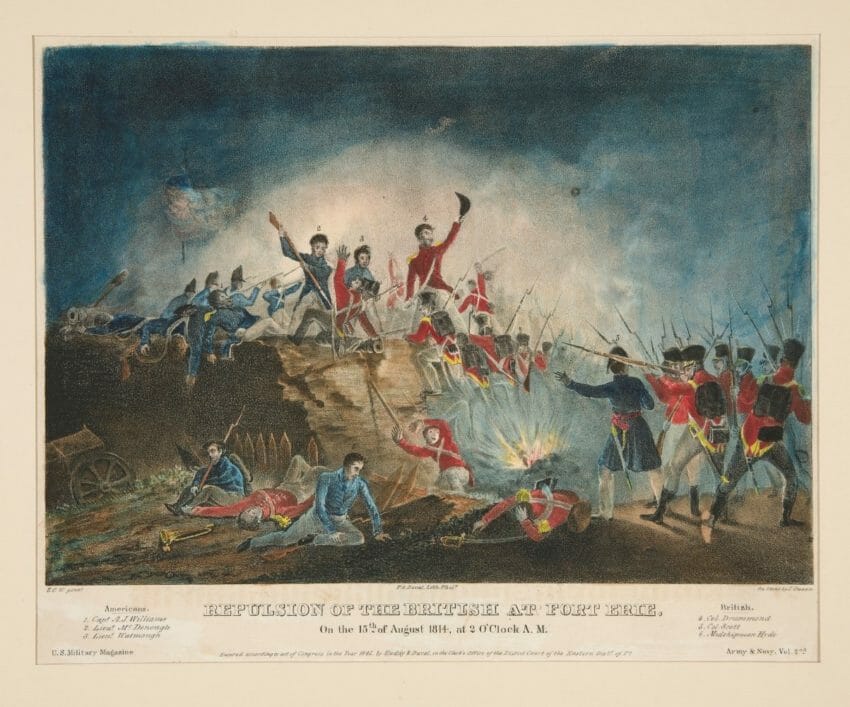
A lithograph based on an E.C. Watmough painting titled “Repulsion of the British at Fort Erie, 15 August 1814.” It depicts an attack that occurred at the U.S.-Canadian border during the War of 1812.
Image via AntiWar.com
“The acquisition of Canada, this year, as far as the neighborhood of Quebec, will be a mere matter of marching.” —Thomas Jefferson (1812)
“People speaking the same language, having the same laws, manners and religion, and in all the connections of social intercourse, can never be depended upon as enemies.” —Baron Frederick de Gaugreben, British officer, in 1815
No one seems to know this (or care), but the United States had long coveted Canada. In two sequential wars, the U.S. Army invaded its northern neighbor and intrigued for Canada’s incorporation into the republic deep into the 19th century. Here, on the Canadian front, the conflict most resembled a civil war.
Canada was primarily (though sparsely) populated by two types of people: French Canadians and former American loyalists — refugees from the late Revolutionary War. Some, the “true” loyalists, fled north just after the end of the war for independence. The majority, however, the “late” loyalists, had more recently settled in Upper Canada between 1790 and 1812. Most came because land was cheaper and taxes lower north of the border. Far from being the despotic kingdom of American fantasies, Canada offered a life rather similar to that within the republic. Indeed, this was a war between two of the freest societies on earth. So much for modern political scientists’ notions of a “Democratic Peace Theory” — the belief that two democracies will never engage in war. Britain had a king, certainly, but also had a mixed constitution and one of the world’s more representative political institutions.
In many cases families were divided by the porous American-Canadian border. Loyalties were fluid, and citizens on both sides spoke a common language, practiced a common religion and shared a common culture. Still, if and when an American invasion came, the small body of British regular troops would count on these recent Americans — these “late” loyalists — to rally to the defense of mother Canada.
And came the invasion did. Right at the outset of the war in fact. Though the justification for war was maritime and naval, the conflict opened with a three-pronged American land invasion of Canada. The Americans, for their part, expected the inverse of the British hopes — the “late” loyalists, it was thought, would flock to the American standard and support the invasion. It never happened. Remarkably, a solid base of Canadians fought as militiamen for the British and against the southern invaders. Most, of course, took no side and sought only to be let alone.
It turned out the invading Americans found few friends in Canada and often alienated the locals with their propensity for plundering and military blunder. Though the war raged along the border — primarily near Niagara Falls and Detroit — for nearly three years the American campaign for Canada proved to be an embarrassing fiasco. Defeats piled up, and Canada would emerge from the war firmly in British hands. In the civil war along the border, the Americans were, more often than not, the aggressors and the losers.
[…]
The Treaty of Ghent, which ended the war, changed nothing. There was no change of borders, and the British said nothing about impressment — the purported casus belli! So just what had those thousands died for?
Certainly it was no American victory that forced the British to the peace table. By 1814 the war had become a debacle. Two consecutive American invasions of Canada had been stymied. Napoleon was defeated in April 1814, and the British finally began sending thousands of regular troops across the Atlantic to teach the impetuous Americans a lesson — even burning Washington, D.C., to the ground! (Though in fairness it should be noted that the Americans had earlier done the same to the Canadian capital at York.) The U.S. coastline was blockaded from Long Island to the Gulf of Mexico; despite a few early single ship victories in 1812, the U.S. Navy was all but finished by 1814; the U.S. Treasury was broke and defaulted (for the first time in the nation’s history) on its loans and debt; and 12 percent of U.S. troops had deserted during the war.
The Americans held few victorious cards by the end of 1814, but Britain was exhausted after two decades of war. Besides, they had never meant to reconquer the U.S. in the first place. A status quo treaty that made no concessions to the Americans and preserved the independence of Canada suited London just fine.
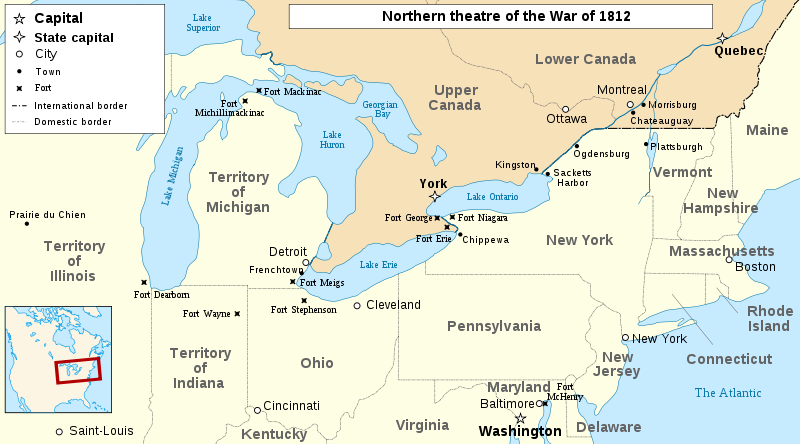
Northern theatre of the War of 1812 (note that Ottawa was not founded until 1826 and shouldn’t appear in this view, and the Niagara River is shown at least 45 degrees off its actual course)
Image via Wikimedia Commons
Comments Off on The War of 1812 on the frontier
Tank Chats #32 Cromwell | The Tank Museum
The Tank Museum
Published on 24 Feb 2017The thirty second in a series of short films about some of the vehicles in our collection, presented by The Tank Museum’s historian David Fletcher MBE. The Second World War, British, Cromwell tank was one of the fastest tanks of the war.
Comments Off on Tank Chats #32 Cromwell | The Tank Museum
QotD: “The world is rich and will become still richer. Quit worrying”
Not all of us are rich yet, of course. A billion or so people on the planet drag along on the equivalent of $3 a day or less. But as recently as 1800, almost everybody did.
The Great Enrichment began in 17th-century Holland. By the 18th century, it had moved to England, Scotland and the American colonies, and now it has spread to much of the rest of the world.
Economists and historians agree on its startling magnitude: By 2010, the average daily income in a wide range of countries, including Japan, the United States, Botswana and Brazil, had soared 1,000 to 3,000 percent over the levels of 1800. People moved from tents and mud huts to split-levels and city condominiums, from waterborne diseases to 80-year life spans, from ignorance to literacy.
You might think the rich have become richer and the poor even poorer. But by the standard of basic comfort in essentials, the poorest people on the planet have gained the most. In places like Ireland, Singapore, Finland and Italy, even people who are relatively poor have adequate food, education, lodging and medical care — none of which their ancestors had. Not remotely.
Inequality of financial wealth goes up and down, but over the long term it has been reduced. Financial inequality was greater in 1800 and 1900 than it is now, as even the French economist Thomas Piketty has acknowledged. By the more important standard of basic comfort in consumption, inequality within and between countries has fallen nearly continuously.
Dierdre N. McCloskey, “The Formula for a Richer World? Equality, Liberty, Justice”, New York Times, 2016-09-02.
Comments Off on QotD: “The world is rich and will become still richer. Quit worrying”
July 3, 2018
French North Africa in World War 1 I THE GREAT WAR Special
The Great War
Published on 2 Jul 2018Algeria, Tunisia and Morocco were all part of French North Africa before and during World War 1. They all contributed in material and men to the war effort and the French colonial soldiers were praised for their bravery.
Comments Off on French North Africa in World War 1 I THE GREAT WAR Special
July 2, 2018
Mark Steyn on 49th Parallel
His annual Canada Day post this year featured a World War 2 British film about Canada intended for Americans:
The film stars, in order of billing, Leslie Howard, Laurence Olivier, Raymond Massey, Anton Walbrook, Eric Portman “and the music of Ralph Vaughan Williams”, which gets an above-the-title credit – as well it should. Vaughan Williams’ score is an integral part of the picture and, if not especially Canadian (save for a very short evocation of Calixa Lavallée’s “O Canada” right at the beginning), accompanies the country’s physical landscape beautifully, particularly in the opening travelogue, mostly shot by Freddie Young leaning out of a plane with a hand-held camera and edited back in England by David Lean. (Lean and Young, of course, subsequently worked together on Lawrence of Arabia, Doctor Zhivago and Ryan’s Daughter.) And, if you’re thinking that (with one exception) none of these participants seems terribly Canuck, well, if it’s any consolation, the English also get to play all the Nazis, too. The Canadians are largely relegated to small roles and extras – like the real seamen who play the survivors of the Canadian ship torpedoed in the Gulf of St Lawrence at the opening of the picture. “So,” pronounces the German U-boat commander, “the curtain rises on Canada.”
U-37 decides to flee to Hudson’s Bay to evade the RCAF and RCN patrols looking for it. Six Germans are put ashore to scout for supplies. But, even as they set foot on land, they hear the swoop of planes and look back to see Canadian bombers destroying their submarine. In order to lend verisimilitude to the scene, Michael Powell destroyed a real – or real-ish – sub, built for him in Halifax, Nova Scotia. The RCAF gave him two thousand-pound bombs to make it look good, and he put them on “U-37” and was cunning enough to neglect to tell the actors, lest it made them nervous. The sub was then towed to the Strait of Belle Isle between Labrador and Newfoundland to be blown sky high. That was Powell’s only mistake. Notwithstanding that he named the film after Canada’s southern border, the director’s grip on the country’s eastern border was a little hazier. He had forgotten that Newfoundland was not (yet) in Canada but was a British possession in its own right. So HM Customs impounded “U-37” and Powell had to go directly to the Governor to get it back.
Other than that, he and Pressburger didn’t put a foot wrong. The location footage was impressive in its day, and still striking in ours; Pressburger’s script is subtle and humane; and the episodic structure allows for plenty of variety. Following the loss of U-37, the six Germans are now beached in northern Canada and have to figure out a way to get to safe, neutral America. They make their way to a Hudson’s Bay trading post, where the factor (played by the great Scots actor Finlay Currie) is welcoming back an old friend who’s spent the last eleven months hunting in the wilds and so has no idea Canada is at war. Johnny is a French-Canadian trapper played by – who else? – Laurence Olivier. We first meet him in the bath tub singing “Alouette”, and, as often with Olivier, the attention to detail on the accent is so good that it becomes oddly intrusive: “Diss is one big country, but verra few pipple. Ever-wan know ever-body. You can’t make goosestep trew it widdout da police fine out,” he tells the senior German officer (Eric Portman).
The window shot Michael Powell uses to get the Nazis into the factor’s small cabin is cool and clinical and all the more chilling for it. The six Germans enter and announce that they’re now in control. When you’ve just come in off the tundra after eleven months and you want to have a soak in the tub and unwind, the Master Race showing up is a bit of a downer. “Okay, you are German. Why yell about it? I am Canadian,” says the Frenchie. “He is Canadian” – he points to the Scots factor – “and he is Canadian” – and to the smiling eskimo lad: French, English and Inuit all with the same unhyphenated label “Canadian”. That’s a lot simpler than the fractious diversity at Parliament Hill earlier today.
The Nazi lieutenant attempts to beguile his captives with a copy of Mein Kampf, but Trapper Johnny isn’t interested. “What’s the matter with Negroes?” he asks.
“They’re semi-apes,” explains the German. “One step above the Jews.” This is something of a remote concern at a Hudson’s Bay trading post. The Nazis seems as enraged by their prisoners’ geniality as by anything else. As they depart, one tears a portrait of the King and Queen off the wall and carves a swastika into the space.
Pressburger’s plot follows as you’d expect: There are six Germans, and soon there will be five, and then four, three, two… From Hudson’s Bay, they commandeer a seaplane that crashes near a Hutterite community in Manitoba, where a young pre-Mary Poppins Glynis Johns is sweetly trusting of them. They make their way to Indian Day in Banff National Park, for a rather Hitchcockian scene, and thence to a camp in the Rockies, where an arty pacifist (Leslie Howard) is discoursing on Thomas Mann. The tone is set by Olivier’s Frenchie coming in from the bush: He may not be interested in war, and nor is Glynis Johns or Leslie Howard. But war is interested in them. This was the purpose of the film, as the British Ministry of Information saw it: That’s why they wanted it set in Canada, rather than in, say, England, across the Channel from Occupied Europe. These trappers, Hutterites, and pacifists didn’t come looking for trouble. But, even five thousand miles from the fighting, trouble came looking for them – in big, empty, peaceable Canada. And the implicit message to America was: In the end, it will come for you, too. There is no 49th Parallel. Whichever side of it you’re on, it’s the same side.
Comments Off on Mark Steyn on 49th Parallel
History of Non-Euclidean Geometry – Lies – Extra History – #6
Extra Credits
Published on 30 Jun 2018You gently corrected out our math mistakes and artistic slip-ups, and we’re here to tell you it was all part of Bismarck’s plans—er, it’s Euclid’s fault. Time for another episode of Lies!
Comments Off on History of Non-Euclidean Geometry – Lies – Extra History – #6
The holy book of Marx and the religion of progress
In the latest Libertarian Enterprise, Sarah Hoyt discusses the religious nature of progressive thought in the western world:
While the left not only filled every nook and cranny of twentieth century “narrative industries” to the point the only way a conservative could work in one of those was under deep, deep cover, the engineers made the internet.
The left didn’t even know it really had any serious opposition left. You can’t blame them too much. Even those of us who were very opposed and very disgusted kept it polite in public and treated them as retarded children who couldn’t take opposition.
Would it have made any difference if we’d talked back, say 30 years ago?
I doubt it.
You see, leftism is as much as anything else a religion. The crazy Marx with his vision of the future created an entire narrative from paradise (pre-capitalism, i.e. it never existed, guys, not even as apes. Apes, as we now know, trade) through fall into capitalism to eventual paradise again, where the New Man (what used to be called the Soviet Man) will be so altruistic and communally oriented that a government isn’t needed. (Like the peace of Islam, there’s only one way to obtain that, and no. Just no. Worldwide species extinction is as fantastical as the idea of that primordial paradise. Humans are humans, and someone will survive. I’m just not interested in letting them send us back ten thousand years.)
You hear it in the talk of the left — particularly the rather intellectually inbred fourth generation, who ate the pap the older people fed them and never had an original thought in their lives — stuff like calling us “reactionaries” (when they’re the ones in power, and have been for a long time, and the ones knee-jerk reacting) and talking about “the future” as belonging utterly to them, and the arrow of history, as though history were the chart in their book, with an arrow beneath.
Their faith doesn’t align particularly well with reality. For instance there’s the whole thing of them talking about us — always — as though we were the ones in power, when they have all the gatekeeping positions and all the contacts.
This dissonance has required them to make up invisible monsters that give us all the power: Patriarchy (a laughable idiocy in America and weak everywhere in the west. While they refuse to see it in the Middle East and Latin America where it actually exists in spades.) Micro aggressions. White privilege (which is so strong that it gives an edge to concentration camp survivors.)
All the while they refuse to admit the real privilege: Leftist privilege. The fastest way to rise in the narrative fields is to be lefter-than-thou. Because they’re in charge and that’s how the system is setup, so they can stay in charge.
Unfortunately this has created their isolation. You see, every song, every movie, ever history book, every fictional book, assures them they’ll win. They know that “the people united shall never be defeated.” They also know that though held back by patriarchy, racism, sexism and all the micro aggressions, the people really are with them. HAVE TO BE, because they’re ideology of the future, and history’s arrow points to their paradise. Every book, movie, etc. says so either subtly or openly. So they KNOW. Everybody knows.
Comments Off on The holy book of Marx and the religion of progress
July 1, 2018
Mapping medieval trade routes
Open Culture linked to a fascinating new map by a Swedish grad student, showing trade routes during the Medieval period:
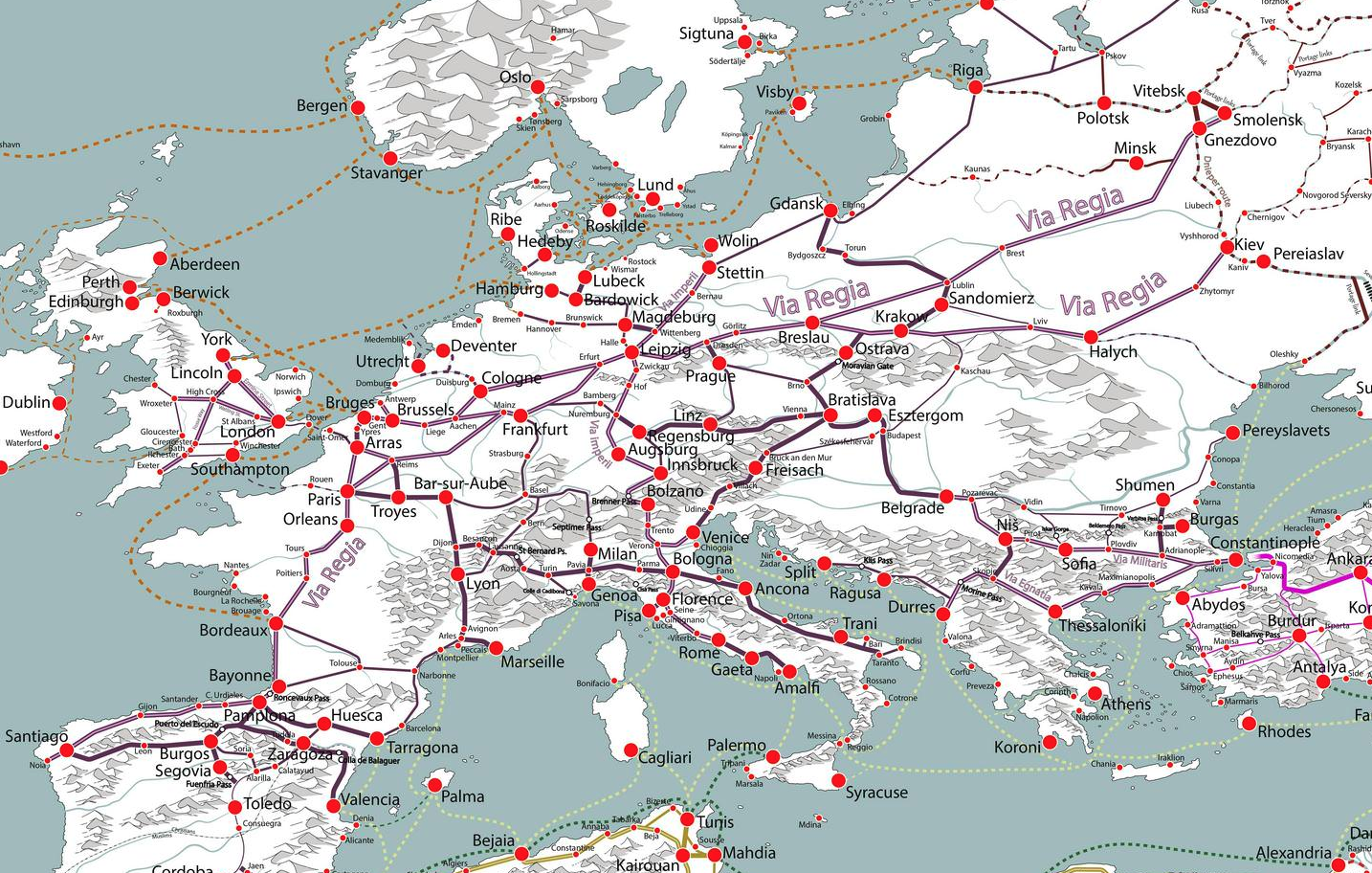
A small portion of Martin Jan Månsson’s trade map of the Middle Ages.
“I think trade routes and topography explains world history in the most concise way,” Månsson explains in the very small print at the map’s lower right corner. “By simply studying the map, one can understand why some areas were especially important–and remained successful even up to modern times.”
The map covers 200 years, spanning both the 11th and 12th centuries, and “depicts the main trading arteries of the high Middle Ages, just after the decline of the Vikings and before the rise of the Mongols, the Hansa and well before the Portuguese rounded the Cape of Good Hope.”
It also shows the complex routes already available to Africa and Asia, and the areas where Muslim and Christian traders would meet. The open-to-trade Song Dynasty ruled China, and the competitive kingdoms in the Indonesia region provided both Muslims and Europeans with spice.
Looking like a railway map, Månsson’s work shows how interconnected we really were back in the Middle Ages, from Greenland in the west to Kikai and Kagoshima in the East, from Arkhangelsk in the frozen north to Sofala in modern-day Mozambique.
The full-sized, high-resolution map can be downloaded here.
Update: Tim Worstall was kind enough to link to this post and uses Månsson’s map to help explain the gravity model of trade:
A standard observation is that places which are closer together trade with each other more than places which are further apart. Add to that the thought that larger economies will trade more with other larger economies – well, you know, more economic activity means more economic activity – and you get the gravity model of trade. So, therefore Britain’s trade future lies with those places nearby, in the EU, than with places further away like the Commonwealth or the US.
This is, sadly, actually the level of debate over Brexit at times. We should trade with France because it’s 26 miles away, so there. The point being that while the gravity model is true – among the best empirically supported of all economic observations – that’s not actually what it says. Rather, that those places which are closer by trade distance trade more with each other. Trade distance being a more complex point than mere geographical location.
[…]
The point here being that by showing the trade routes it is showing us this trade, or perhaps economic, distance which is what the gravity model is about. Valencia and Palma were very much closer – and trade very much more – than Valencia and Toledo, despite roughly equal distances crowfly wise.
Naval Legends: HMCS Haida | World of Warships
World of Warships Official Channel
Published on 28 Jun 2018“The most fightingest ship of the Royal Canadian Navy”, and the last survivor of the Tribal-class! Find out more in the new Naval Legends episode!
Naval Legends is a series about the construction, service, and daring deeds of legendary 20th-century ships. Very few vessels survived World War I and II — most were decommissioned and scrapped. The Naval Legends production crew travels all across the globe to visit almost every active museum ship and chronicle her story.
Each episode has our own footage, military chronicles, and data from archives. The story of each ship is narrated by military historians, museum staff, and navy veterans for maximum historical accuracy. Computer graphics based on archival blueprints illustrate critical engineering elements and components, along with the ship’s armament, so you can observe these colossal war machines from your armchair!
Comments Off on Naval Legends: HMCS Haida | World of Warships
A point about historical advisors in films
Lindybeige
Published on 24 Mar 2011In which I relate an anecdote which is fairly depressingly illuminating when it comes to how much Hollywood really cares about historical authenticitude.
Comments Off on A point about historical advisors in films


