
The Great War
Published on 30 Jun 2018Chair of Wisdom Time!
June 30, 2018
Crown Prince Wilhelm – Front Line Visits – Trench Entertainment I OUT OF THE TRENCHES
Comments Off on Crown Prince Wilhelm – Front Line Visits – Trench Entertainment I OUT OF THE TRENCHES
June 29, 2018
The Run For The Baku Oil Fields I THE GREAT WAR Week 205
The Great War
Published on 28 Jun 2018While the Ottoman Army of Islam is marching on Baku and the Caspian Sea, multiple other players are trying to stake their claim of the Baku oil fields.
Comments Off on The Run For The Baku Oil Fields I THE GREAT WAR Week 205
Honduran refugees and the hellhole they’re fleeing
Justin Raimondo on the plight of Honduras, and how it got to be the hellhole it is:

Honduras, Guatemala and El Salvador
Image via Google Maps.
As tens of thousands gather at our southern border, roiling US politics, the question arises: why are so many of the asylum-seekers and migrants crossing the border illegally from three Central American countries in particular: El Salvador, Honduras, and Guatemala?
To begin with, it’s no coincidence that these are the three “most invaded” countries south of the Rio Grande – that is, invaded by the United States and its proxies.
[…]
So what are these “refugees” fleeing? Is it so bad that parents are justified in paying smugglers to guide their underage children – traveling alone! – across the US-Mexican border?
Unlike the rest of the media, which has routinely ignored most of what goes on in Latin America since the end of the cold war, I’ve been covering the region regularly. […] As I wrote last year:
“Honduras has always been an American plaything, to be toyed with for the benefit of United Fruit (rebranded Chiquita) and the native landowning aristocracy, and disciplined when necessary: Washington sent in the Marines a total of seven times between 1903 and 1925. The Honduran peasants didn’t like their lands being confiscated by the government and turned over to foreign-owned producers, who were granted monopolistic franchises by corrupt public officials. Periodic rural revolts started spreading to the cities, despite harsh repression, and the country – ruled directly by the military since 1955 – returned to a civilian regime in 1981.”
That column was about the Hillary Clinton-endorsed coup against the democratically elected President, Manuel Zelaya. The popular conservative-turned-reformer had pushed through a number of measures designed to alleviate the peasantry’s hopeless poverty and shift power from the military to the presidency, which angered the Honduran elite. They were triggered, however, when Zelaya joined the ALBA alliance of Latin American countries allied with Hugo Chavez’s Venezuela. While ALBA never really amounted to much, either economically or militarily, the symbolism of this move was too much for the Honduran military, which was trained in the US and generously subsidized by Washington. The generals soon had Zelaya on a plane out of the country – while still in his pajamas. Washington issued a perfunctory scolding, but Hillary’s State Department had approved the coup in advance. It’s always been done that way, and this time was no exception.
[…]
So is the Honduran hegira to the Rio Grande a direct result of US foreign policy: is it “blowback,” to utilize CIA parlance for the unpleasant consequences of US actions abroad? It would be easy to say this is yet another example of how our foreign policy of global intervention comes back to haunt us, because that is partially true. Yet the old familiar story of the Ugly Americans backing the even uglier Local Despot doesn’t quite fit the most current facts: there has been an amazing drop in US military aid to Honduras. In 2017 it was over $19 million. This year it’s a mere $750,000!
The history of Honduras before the rise of American hegemony has done more to shape the country than any other single factor: the vital question of land ownership is the central issue here and in the entire South. Feudalism was never really abolished, and the feudalist remnants that persist to this day in the region delayed economic and technological development and kept the vast majority in penury. US foreign policy helped to sustain the life of this systemic repression: it didn’t create it. Whatever the “root causes,” the blowback from all this history has created something very close to a failed state.
This is why tens of thousands are making the long trek to the US-Mexican border: the social and institutional basis of human civilization is breaking down, not only in Honduras but throughout Latin America. Yet this is neither new nor is it primarily attributable to the actions of the US. Yes, our “war on drugs” has created a criminal class that is rivaling the power of the local governments to keep order, but hard drugs are illegal everywhere, not just in North America.
Comments Off on Honduran refugees and the hellhole they’re fleeing
June 28, 2018
Mary Seacole – II: Mother Seacole in the Crimea – Extra History
Extra Credits
Published on 16 Jan 2016Unable to find any official sponsors, Mary Seacole decided to send herself to the Crimea. She recruited her husband’s cousin, a fellow business person, and the two of them set off for the war zone. Unlike London, where she’d met a chilly reception, Mary’s help was welcomed by the overworked doctors and suffering soldiers. She built a new version of her British Hotel and invited officers to dine or shop there, using their money to buy medical supplies and creature comforts for the poorer soldiers. She had set herself up next to the army camp, and during battles she helped provide emergency care. But when at last the city of Sevastopol fell, Mary’s medical services were no longer in much demand. She enjoyed a few months of prosperity as the soldiers celebrated their newfound time off, but in March of 1856, a treaty was signed and troops began returning home. Many of them left unpaid debts, and Mary could no longer sell her supplies, so she and her business partner were forced to return home to London and declare bankruptcy. When that news got out, the soldiers she’d cared for rallied to her aid, donating money to help pay her debts. Although Mary tried to continue serving soldiers in warzones, the government never recognized her and in the end, only her homeland of Jamaica remembered her contributions after her death. In the 2000s, her story came back to light in the United Kingdom and she was recognized in 2004 as the Greatest Black Briton.
Comments Off on Mary Seacole – II: Mother Seacole in the Crimea – Extra History
QotD: Some positive aspects of the Great Depression
… one fascinating thread about the Depression era in American food is the hunger, the poverty, the disruption to American households. But even at the height of the Depression, when a quarter of the workforce was unemployed, most people were not on relief, and most were not suffering malnutrition. Those people were, however, seeing some pretty remarkable transformation in how they produced, purchased and consumed food.
- The tractor. Between 1930 and 1940, despite the fact that credit had dried up and farms were failing left and right, tractors became the majority of the horsepower available on American farms. Tractor technology itself improved during the decade, but the most remarkable advance was simply the number of draft animals who were replaced. This had far-reaching effects on American farms: It meant that more land could be put into cash crops or pasturage for food animals (because an enormous amount of available land had previously been needed simply to grow food to feed the draft animals). It increased the amount that a farmer could produce. It also meant that farmers were more exposed to market forces; you cannot grow diesel fuel on a spare field, and two amorous tractors do not make a new tractor every spring. And the capital required to buy a tractor favored larger farms, one of the first steps along the road to modern agribusiness.
- The supermarket. The grocery store as we now know it — with open shelves where the customers gather their own goods — is a relatively recent innovation. A&P, generally regarded as the first modern grocery chain, entered the 1930s well-positioned to benefit from the Depression, because it had financed expansion out of retained earnings rather than debt. Its ability to offer low prices through bulk purchasing, low labor costs and good logistics helped it to grow even as other stores were failing. Naturally this triggered a backlash, culminating in some rather exciting legislative battles in Congress, and a law, the Robinson-Patman Act, that is still on the books today.
- Commodity markets. Like stock exchanges, commodity markets — where things got a little hairy when farm prices collapsed — got a big new regulatory bill in the mid-1930s, the Commodity Futures Act. Even if you don’t care about commodity exchanges — and you should! — it’s worth knowing that there’s always something crazy going on when people are trading commodities.
- Farm policy. The New Deal programs designed to deal with the crisis in American agriculture had vast and enduring effects on the nation’s food supply, changing how people farmed, what they grew and how they got paid for it.
- Frozen food. Don’t sniff. Yes, frozen vegetables are not as good as vegetables picked at the peak of freshness and taken straight to your table from the garden or farmer’s market. This is the wrong comparison. What frozen vegetables and fish replaced was the usually inferior alternatives like canning, drying or salt-preserving, because most people could not afford to get fresh produce from a hothouse or a farm thousands of miles away. When General Foods debuted the Birds Eye line, it became possible for people to have tasty vegetables out of season or out of region at a reasonable price.
- The refrigerator. There were other technologies that made inroads during the decade thanks to falling prices, improving design and rural electrification. The waffle iron and the toaster, among others, probably deserve at least a glancing mention, as does the electric range. But indisputable pride of place goes to the refrigerator, which had penetrated 20 percent of American homes by 1932, and 50 percent by 1938. That bears a second look: In the depths of the Great Depression, people are purchasing a major expensive appliance, which suggests just how great refrigerators are. The early models were primitive, but still represented an order-of-magnitude improvement over the icebox, which couldn’t maintain an even temperature, couldn’t freeze anything, and had to have its drain periodically scrubbed with a wire brush to get rid of the disgusting accumulation of green slime. The refrigerator was complementary to other developments, like the supermarket and the frozen food case, allowing less frequent marketing and a wider variety of temperature-sensitive foods.
- Nutrition science. This almost always gets attention in histories of the era; most of that attention is not very nice. Yes, the concoctions that home economists came up with look awful to the modern eye. (I, for one, never want to find out what “cornstarch pudding” tastes like.) Yes, they got a bunch of stuff wrong. Yes, they were a little overintoxicated with idea of scientifically managing every aspect of human life, leaving no room for small matters such as, erm, flavor. But they were also coming out of an era when people frequently died of food-borne illness, or were permanently debilitated by vitamin deficiencies. And modern writers give far too little credit to the constraints that home economists were working under. Until the 1960s, just making sure you had enough calories on the table was a major part of the American household budget. Limited food supply chains did not offer the rich array of exotic ingredients we now take for granted, and cooking was something that every woman had to do a lot of, even if she had no interest or skill for the task. Providing calories with limited means (and limited cooks) took precedence over learning how to concoct the perfect pot-au-feu. The innovators who tackled these challenges did some harm, but they also did a fair amount of good, and they deserve better than the amused condescension they usually get.
- Convenience foods. Obviously, the development of convenience foods was not limited to the 1930s. We got powdered gelatin, which is to my mind the first major convenience food, in the late 19th century; cake mixes, invented in the 1930s, properly belong to the 1940s as a mass phenomenon. But the 1930s had some notable contributions: Jiffy Biscuit Mix and Bisquick, refrigerator rolls, dry soup mix, and of course, that notorious old standby, Campbell’s cream of mushroom soup. For good or for ill, these things transformed American cookery.
We often think of these developments narrowly: A tractor can plow a few more furrows, a refrigerator lets you keep food a little longer, a biscuit mix lets you have bread on the table 30 percent faster. But these sorts of changes are not just shifts in degree, but changes in kind. The tractor changed not just how fast a farmer could work, but the kinds of work he could do; the supermarket and the frozen pea and the refrigerator worked in concert to revolutionize what a housewife could do, how she could do it, and therefore, what other things she could do with the time and energy she had freed up.
And all of these things, working in concert, made radical alterations to the kind and amount of food that we put into our mouths. The Great Depression left a lot of lasting legacies on the American landscape. But the most ubiquitous, and perhaps least noticed, is the way we eat.
Megan McArdle, “The Depression Was Great for the American Kitchen”, Bloomberg View, 2016-09-23.
Comments Off on QotD: Some positive aspects of the Great Depression
June 27, 2018
Calico prohibition
In the current issue of Reason, Virginia Postrel outlines an eighteenth-century French government attempt to prohibit calico cloth:
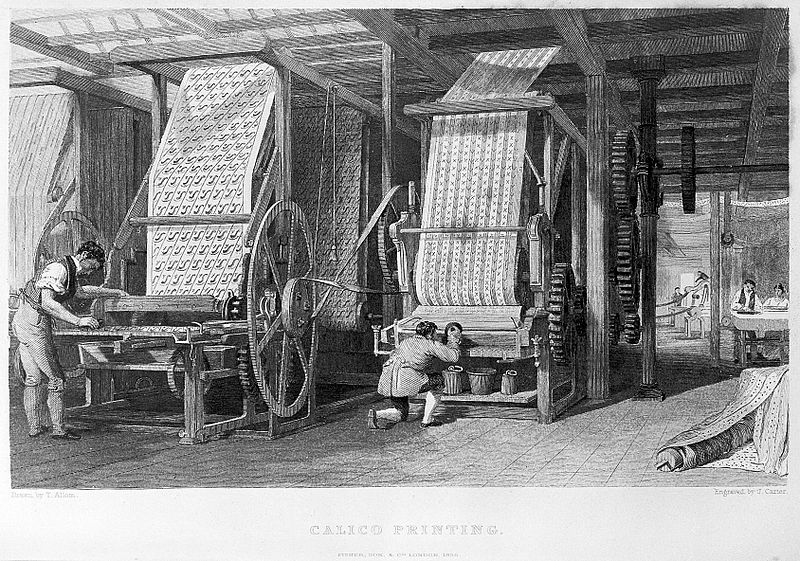
Calico printing, an image from Wellcome Images, via Wikimedia Commons
On a shopping trip to the butcher’s, young Miss la Genne wore her new, form-fitting jacket, a stylish cotton print with large brown flowers and red stripes on a white background. It got her arrested.
Another young woman stood in the door of her boss’ wine shop sporting a similar jacket with red flowers. She too was arrested. So were Madame de Ville, the lady Coulange, and Madame Boite. Through the windows of their homes, law enforcement authorities spotted these unlucky women in clothing with red flowers printed on white. They were busted for possession.
It was Paris in 1730, and the printed cotton fabrics known as toiles peintes or indiennes — in English, calicoes, chintzes, or muslins — had been illegal since 1686. It was an extreme version of trade protectionism, designed to shelter French textile producers from Indian cottons. Every few years the authorities would tweak the law, but the fashion refused to die.
Frustrated by rampant smuggling and ubiquitous scofflaws, in 1726 the government increased penalties for traffickers and anyone helping them. Offenders could be sentenced to years in galleys, with violent smugglers put to death. Local authorities were given the power to detain without trial anyone who merely wore the forbidden fabrics or upholstered furniture with them.
“The exasperation of the lawmakers, after forty years of successive edicts and ordinances which had been largely ignored, flouted or circumvented on a wholesale basis, can be sensed in this law,” writes the fashion historian Gillian Crosby in a 2015 dissertation on the ban. Her archival research shows a spike in arrests for simple possession. “Impotent at stopping the cross-border trade, printing or the peddling of goods,” she writes, “government officials concentrated on making an example of individual wearers, in an attempt to halt the fashion.”
They failed.
In the annals of prohibition, the French war on printed fabrics is one of the strangest, most futile, and most extreme chapters. It’s also one of the most intellectually consequential, producing many of the earliest arguments for economic liberalism. “Long before the more famous debates about the liberalisation of the grain trade, about taxation, or even about the monopoly of the French Indies Company, philosophes and Enlightenment political economists saw the calico debate as their first important battleground,” writes the historian Felicia Gottmann in Global Trade, Smuggling, and the Making of Economic Liberalism (Palgrave Macmillan).
Comments Off on Calico prohibition
Mary Seacole – I: A Bold Front to Fortune – Extra History
Extra Credits
Published on 9 Jan 2016Mary Seacole treated soldiers during the Crimean War – but she took a long path to get there. She grew up in Jamaica, the daughter of a local hotel owner and a Scottish soldier. She admired her doctress mother and wanted to be like her, but she also yearned to travel and see the world. In 1821 she accepted a relative’s invitation to visit London, and turned herself from a tourist to a businesswoman by importing Jamaican food preserves. She traveled with her business for several years before returning home to Jamaica, where she married a white man named Edwin Seacole and started a general store. Their venture failed, and disaster struck: fire destroyed most of Kingstown, and both Mary’s husband and her mother died in 1843. Mary survived and rebuilt the hotel, but she set out to start a new life in Panama and was immediately greeted by a cholera epidemic. She helped contain it, and earned a reputation that helped her start her own business across the street from her half-brother’s. When word reached her that the Crimean War back in Europe needed nurses, she left her business behind and went to sign up. Both the War Office and Florence Nightingale’s expedition rejected her, but Mary determined to find her own way there.
Comments Off on Mary Seacole – I: A Bold Front to Fortune – Extra History
QotD: Male homosexuality in ancient and modern times
Most educated people in the U.S. and Europe have a default model or construction of homosexual behavior which I will call “romantic homosexuality”. Romantic homosexuality is homoeroticism between equals; men or women of roughly the same age and social position, with the relationship having affective elements similar to the emotional range in heterosexual relationships (from one-night stand through lifetime marriage).
[…]
Over and over again, the pattern of male homosexual behavior in pre-modern sources is overwhelmingly one of pederasty and domination sex. And not just in pre-modern sources but in most of the present-day world as well. […] We may further note that there are, broadly speaking, two contending models of “normal” — acceptable or semi-acceptable male homosexual behavior — observable in human cultures. In one model, that of the modern West, romantic homosexuality is relatively tolerated, while pederasty and domination sex are considered far more deviant. I’ll call this the homophilic construction. It’s what most of my readers accept as normal.
But in the other, older model, pederasty and domination sex are considered more “normal” than romantic homosexuality. In cultures with this model, the “top” in an episode of pederasty or domination sex is not necessarily considered homosexual or deviant at all; any stigma attaches to the passive partner. Romantic homosexuality is considered far more perverse, because it feminizes both partners. I think of this as the “classical” construction of homosexuality, as it describes the attitudes of ancient Rome – but it persists in cultures as near to our own as South America and the Mediterranean littoral.
It’s the classical construction that is the rule in human cultures. The homophilic one is the exception; in fact, I am not able to identify any culture which held to it until after the Industrial Revolution in Europe. And not all of Europe has acquired it yet. Even in the English-speaking countries, where the homophilic construction is most entrenched, the connotations of sexual insults and threats in our language still reflect the older model.
To put it another way, the male homosexuals of the last two centuries in our culture have engaged in a massive reinvention of homosexuality that is still underway. Specifically the male homosexuals; lesbians began the game with romantic homosexuality as their dominant mode. I have not identified any culture in which it was considered more normal for lesbians to have sex with prepubescent girls or with dominated inferiors.
[…]
This analysis raises two interesting questions. The first one is about the past: what changed? That is, how did the homophilic construction replace the classical one, where it did? I’m only speculating here, but I think the proximate cause may have been the sentimentalization of family life around the turn of the 19th century in Europe, which in turn was enabled by a sharp fall in infant mortality rates. Both processes started earlier and moved faster in England and the Anglosphere than they did elsewhere.
The other interesting question is whether this reinvention is sustainable in the longer term. If my analysis is correct, modern homosexuals are bucking a pretty strong biological headwind. How strong can be judged by a chilling little statistic I picked up years ago from a how-to manual written by homosexual SM practitioners for newbies, er, learning the ropes; it noted that, adjusted for population size, male homosexuals murder each other at a rate 26 times that of the general population.
That suggests to me that a tendency for male homosexuals to drift into the darker corners of domination sex is still wired in beneath the modern homophilic construction. It might take actual genetic engineering, of a kind we don’t yet have, to fix that wiring. Until then, I wish them luck. Because (and here I make the first and only value claim in this essay) whatever one’s opinion of homophilic homosexuals might be, the behaviors associated with the pederastic/dominating classical style are entangled with abuse and degradation in a way that can only be described as evil. Modern homosexuals deserve praise for their attempt to get shut of them.
Eric S. Raymond, “Reinventing Homosexuality”, Armed and Dangerous, 2009-06-17.
Comments Off on QotD: Male homosexuality in ancient and modern times
June 26, 2018
Henry Johnson And The Harlem Hellfighters I WHO DID WHAT IN WW1?
The Great War
Published on 25 Jun 2018The 369th Infantry Regiment from Harlem, New York was an all-black unit that served on the Western Front. But not under American command, but loaned tot he French Army.
Comments Off on Henry Johnson And The Harlem Hellfighters I WHO DID WHAT IN WW1?
Saragarhi – The Last Stand – Extra History
Extra Credits
Published on 5 Aug 2017A humble signal station manned by only twenty one Sikh soldiers of the British Empire finds itself beset by 10,000 attackers. There is no hope for relief, but even knowing it will come at the cost of their lives, the Sikhs refuse to stand down.
Twenty one men in the 36th Sikh Regiment stand against thousands of attackers, prepared to make their final stand.
Comments Off on Saragarhi – The Last Stand – Extra History
June 25, 2018
The oddly variable careers of Royal Navy ships named HMS Lion
Every now and again, a random question leads me to odd results … in this case I wondered about the Royal Navy ships named HMS Lion, which I remembered as being used for a First World War battlecruiser (Vice-Admiral Beatty’s flagship through the actions at Heligoland Bight and Jutland) and a Cold War light cruiser (whose sister ships were converted into hybrid light cruiser/amphibious assault ships). Earlier ships of that name had even more interesting careers (from the Wikipedia disambiguation page):
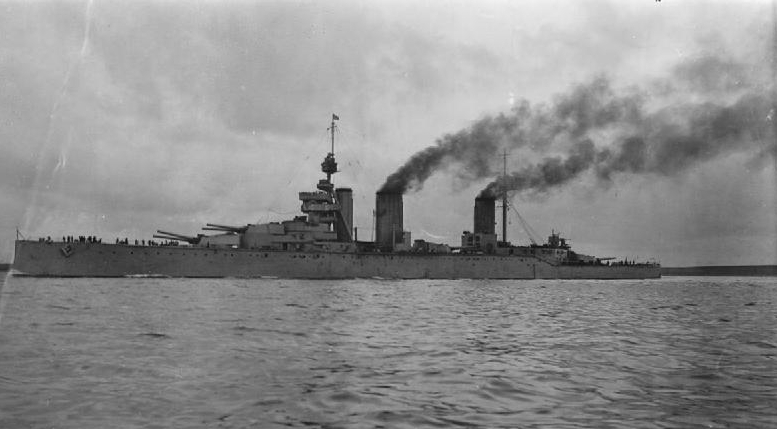
HMS Lion, lead ship of the Lion-class of Royal Navy battlecruisers.
Photo from the Imperial War Museum, via Wikimedia Commons.
- English ship Lion (1511) was a 36-gun ship of the Royal Scottish Navy captured in 1511 and sold in 1513.
- English ship Lion (1536) was a 50-gun ship built in 1536 and on the navy list until 1559.
- English ship Lion (1547) was a Scottish ship captured in 1547 and later lost off Harwich.
- English ship Lion (1557) was a 40-gun ship, also known as Golden Lion. She was rebuilt four times, in 1582, 1609, 1640 and 1658. After her 1609 rebuild she was renamed Red Lion, but this was reverted to Lion after the 1640 rebuild. She was sold in 1698.
Modern naval ships are considered long-in-the-tooth after 25-30 years of service. HMS Lion (the HMS was not consistently applied to royal ships until the eighteenth century, but let’s just let that slide here) of 1557 was only undergoing her first rebuild/life extension at the point a modern ship would already be under consideration for dismantling. She was still in royal service for three more rebuildings, and was sold (not scrapped) after 141 years of active service. But the Royal Navy was far from done with using this name:
- HMS Lion (1665) was a 6-gun ketch, also known as Young Lion. She was captured from the Dutch in 1665, sold in 1667, repurchased in 1668 and sunk as a foundation at Sheerness in 1673.
- HMS Lion (1683) was a fifth rate captured from the Algerians in 1683 and sold the same year.
- HMS Lion (1702) was a 4-gun stores hoy of 99 tons burthen purchased in 1702. A French privateer captured her off Beachy Head in 1708, but she was recaptured in 1709.[1]
- HMS Lion (1709 hoy) was a 4-gun hoy launched in 1709. She was wrecked in 1752.[2]
- HMS Lion (1709) was a 60-gun third rate launched in 1709, rebuilt in 1738 and sold in 1765.
Another longer-service veteran than the vast majority of modern naval ships.
- HMS Lion (1753) was a transport launched in 1753, hulked in 1775, and sold in 1786.
- HMS Lion (1763) was a cutter purchased in 1763 and sold in 1771.
- HMS Lion (1774) was a discovery vessel in service from 1774 to 1785.
- HMS Lion (1777) was a 64-gun third rate launched in 1777. She was used as a sheer hulk from 1816 and was sold for breaking up in 1837.
One assumes the name was changed before 1781, even though the hull was still in use for long after other ships named HMS Lion were respectively in commission and then out of service with the Royal Navy:
- HMS Lion (1781) was a schooner purchased around 1781 and sold in 1785.
- HMS Lion (1794) was a 4-gun vessel, originally a Dutch hoy. She was purchased in 1794 and sold in 1795.
- HMS Lion (1823) was a schooner in service from 1823 and sold in 1826.
- HMS Lion (1847) was an 80-gun second rate launched in 1847. She was converted to screw propulsion in 1859 and became a training ship after 1871. She was sold for breaking up in 1905.
- HMS Lion (1910) was a Lion-class battlecruiser launched in 1910 and sold in 1924.
- HMS Lion (1939) was to have been a Lion-class battleship. She was laid down in 1939, but work was suspended later that year, and again in 1942. The order was finally cancelled in 1945 and she was broken up on the slipway.
- HMS Lion (C34) was a Tiger-class cruiser launched in 1944 as the Minotaur-class HMS Defence. She was finally completed to a revised design in 1960. She was placed in reserve in 1964 and was scrapped in 1975.
Comments Off on The oddly variable careers of Royal Navy ships named HMS Lion
The History of Non-Euclidian Geometry – The World We Know – Extra History – #5
Extra Credits
Published on 23 Jun 2018Up until the 20th century, people assumed light behaved like a wave, passing through the “aether wind” — a fluid with incomprehensible properties. When the Michelson-Morley experiment disproved the aether’s existence, Einstein put out the theory of relativity — that space and time were part of the same package.
It’s 1887. Physics is almost complete. We almost know enough to see the clockwork of the universe. Only one last great question remains: how does light travel?
Comments Off on The History of Non-Euclidian Geometry – The World We Know – Extra History – #5
QotD: Gandhi and the British army
The film, moreover, does not give the slightest hint as to Gandhi’s attitude toward blacks, and the viewers of Gandhi would naturally suppose that, since the future Great Soul opposed South African discrimination against Indians, he would also oppose South African discrimination against black people. But this is not so. While Gandhi, in South Africa, fought furiously to have Indians recognized as loyal subjects of the British empire, and to have them enjoy the full rights of Englishmen, he had no concern for blacks whatever. In fact, during one of the “Kaffir Wars” he volunteered to organize a brigade of Indians to put down a Zulu rising, and was decorated himself for valor under fire.
For, yes, Gandhi (Sergeant-Major Gandhi) was awarded Victoria’s coveted War Medal. Throughout most of his life Gandhi had the most inordinate admiration for British soldiers, their sense of duty, their discipline and stoicism in defeat (a trait he emulated himself). He marveled that they retreated with heads high, like victors. There was even a time in his life when Gandhi, hardly to be distinguished from Kipling’s Gunga Din, wanted nothing so much as to be a Soldier of the Queen. Since this is not in keeping with the “spirit” of Gandhi, as decided by Pandit Nehru and Indira Gandhi, it is naturally omitted from the movie.
Richard Grenier, “The Gandhi Nobody Knows”, Commentary, 1983-03-01.
Comments Off on QotD: Gandhi and the British army
June 24, 2018
Life In The Tomb – WW1 Author Stratis Myrivilis I WHO DID WHAT IN WW1?
The Great War
Published on 23 Jun 2018Get Life In The Tomb: https://amzn.to/2MF8TMZ [Affiliate Link]
Stratis Myrivilis was a Greek Author, but he was also a soldier that fought in the Balkan Wars, World War 1 and the Greco-Turkish War. His experience in the First World War, was the basis for his most famous novel Life In The Tomb.
Comments Off on Life In The Tomb – WW1 Author Stratis Myrivilis I WHO DID WHAT IN WW1?
QotD: Ludwig von Mises and Epicureanism
On page 147 of Human Action, Ludwig von Mises writes:
The historical role of the theory of the division of labor as elaborated by British political economy from Hume to Ricardo consisted in the complete demolition of all metaphysical doctrines concerning the origin and the operation of social cooperation. It consummated the spiritual, moral and intellectual emancipation of mankind inaugurated by the philosophy of Epicureanism.
This is a rather strong statement. Epicureanism, says Mises, inaugurated the spiritual, moral and intellectual emancipation of mankind. There are several other passages in his books where he mentions this philosophy in a very favourable light, but without ever explaining in details why. And although a lot of attention has been devoted to the influence of Aristotle, Aquinas, the Scholastics, the French liberals and others on Austrian ideas, as far as I know, nobody has ever paid attention to Epicurus.
Now, why would Mises make such a claim in relation to a philosophy that has been so reviled for 2000 years? Stacks of new books devoted to Plato, Aristotle and other philosophers of Antiquity appear every year. But if you go to a university library, you will usually find a shelf or two containing books on Epicureanism, and that’s for all those that were published in the past hundred years.
Epicureanism has been largely forgotten. And when it is mentioned, it is usually the distorted view that has been propagated since Antiquity that is being repeated. Epicureanism is said to be the philosophy of “Eat, drink and be merry because tomorrow you die.” An “Epicure” is a depraved and irresponsible individual only concerned with bodily pleasures. In Austrian terms, we would say he has very high time preference.
I even read in an article posted on LewRockwell.com that the unbridled hedonism of the Epicureans played an important role in the transformation of ancient Rome from a republic to an empire. There is not a shred of historical evidence that they had that kind of influence, and Epicureans were not a licentious lot anyway. On the contrary, their goal was tranquility of mind. For them, it is true, all pleasures were good, including those of the body. But they tried to attain happiness by planning their lives in the long term in the most rational way possible.
Epicurus’ ethics can be summed up by this sentence from his Letter to Menoeceus: “For it is not drinking bouts and continuous partying and enjoying boys and women, or consuming fish and the other dainties of an extravagant table, which produce the pleasant life, but sober calculation which searches out the reasons for every choice and avoidance and drives out the opinions which are the source of the greatest turmoil for men’s souls.”
Martin Masse, “The Epicurean roots of some classical liberal and Misesian concepts“, speaking at the Austrian Scholars Conference, Auburn Alabama, 2005-03-18.
Comments Off on QotD: Ludwig von Mises and Epicureanism


