Quotulatiousness

April 8, 2021

Fallen Flag — the Duluth, Missabe & Iron Range Railway

Filed under: Business, History, Railways, USA — Tags: , , , , — Nicholas @ 03:00

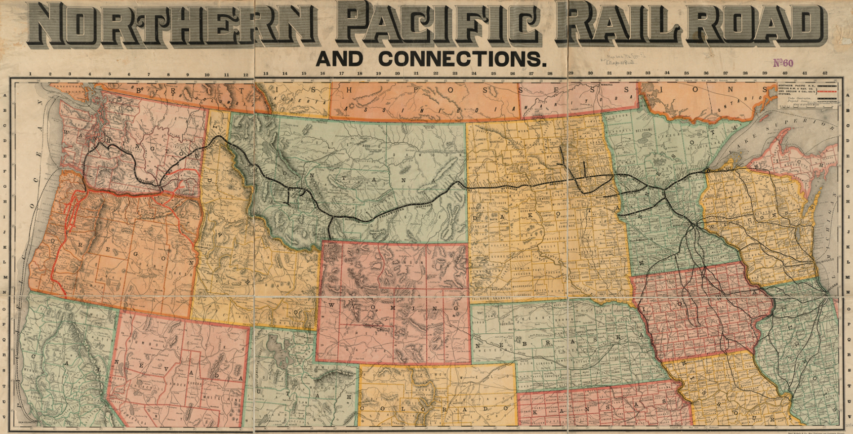
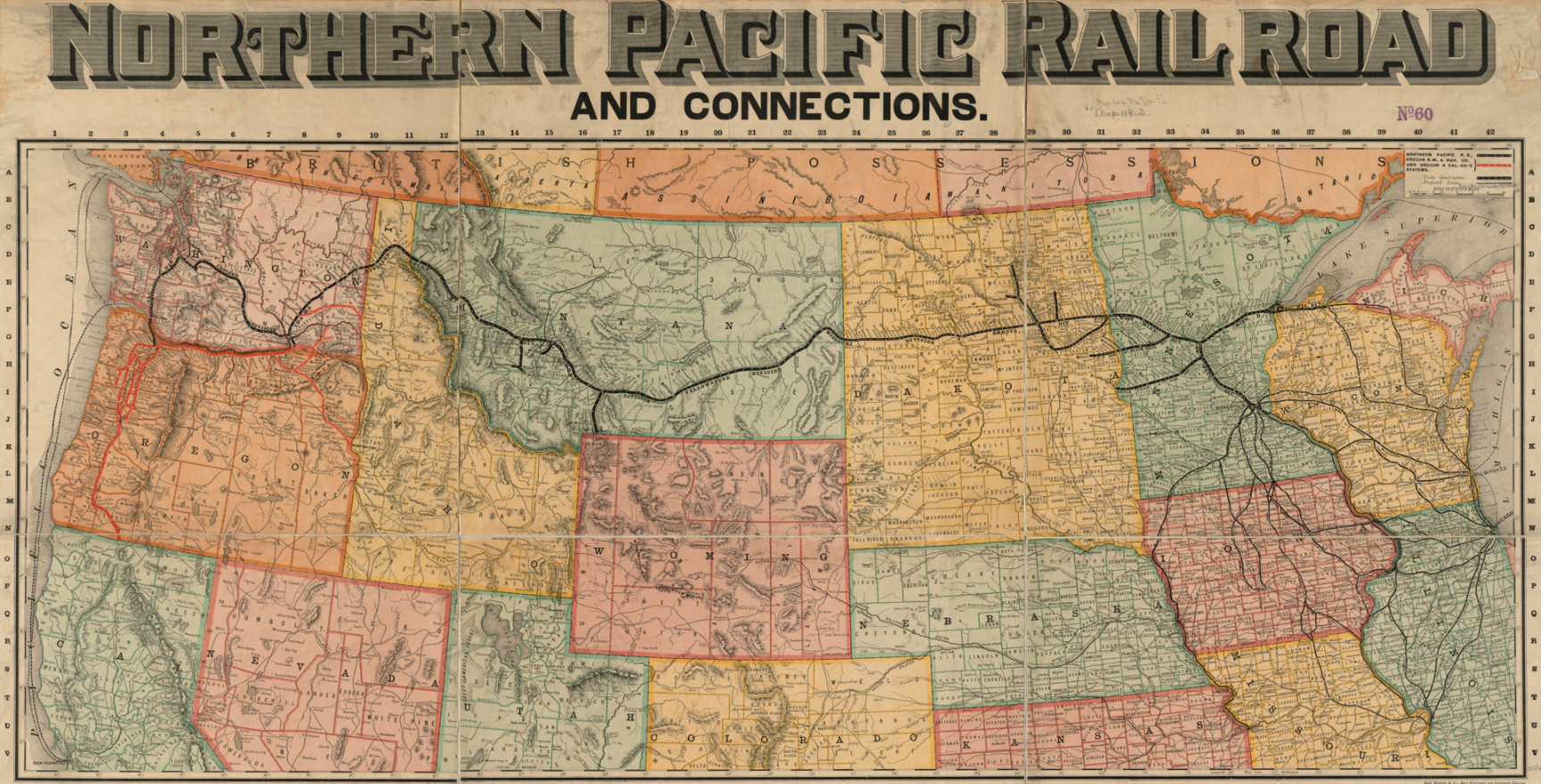
This month’s Classic Trains fallen flag feature is the Duluth, Missabe & Iron Range Railway (DM&IR) by Steve Glischinski. The DM&IR was formed by the 1937 merger between the Duluth, Missabe and Northern Railway (DMN) and the Spirit Lake Transfer Railway and the 1938 further merger of the combined operation with the Duluth and Iron Range Road (D&IR) and the Interstate Transfer Railway. The D&IR had been founded in 1874 to transport iron ore from Tower, MN to Two Harbors, MN, eventually coming under the ownership of United States Steel Corporation in 1901.

The Merritt family of Minnesota (known as the “Seven Iron Brothers“) discovered a large iron ore deposit in the Mesabi Range and created the largest iron ore mine in the world (as of the 1890s) and tried to persuade the DMN to build a 70-mile rail connection to get their ore to harbour and out to the iron and steel foundries around the Great Lakes. The DMN was unwilling to commit, so the Merritt family borrowed money to build the line from, among other financiers, John D. Rockefeller. The line — called the Duluth, Missabe and Northern — got built and began operations in 1892, but the Merritts expanded too quickly at the wrong moment — the financial panic of 1893 — losing financial control and leaving ownership of both the mine and the railway in Rockefeller’s hands by 1894.

Charlemagne Tower sold the Duluth & Iron Range to Illinois Steel in 1887, which was succeeded by Federal Steel, then U.S. Steel. By 1901, both the D&IR and DM&N were under U.S. Steel control. USS upgraded both railroads with heavy rail and double track, ordered bigger locomotives and larger cars, and built sizeable shops and roundhouses at Proctor and Two Harbors.

In 1915 DM&N leased the Spirit Lake Transfer Railway, a link between DM&N at Adolph, near Proctor, and the Interstate Transfer Railway at Oliver, Wis., across from Steelton, Minn. The Interstate Transfer ran from Oliver to Itasca, in eastern Superior, giving the DM&N connections with large railroads including Northern Pacific, Chicago & North Western’s “Omaha Road”, and three members of the Canadian Pacific family: Minneapolis, St. Paul & Sault Ste. Marie (“Soo Line”); Wisconsin Central; and Duluth, South Shore & Atlantic.

DM&N and D&IR remained separate until January 1, 1930, when the DM&N leased the D&IR and consolidated operations. Then on July 1, 1937, the DM&N merged with the Spirit Lake Transfer to form the Duluth, Missabe & Iron Range Railway. DM&IR then acquired ownership of D&IR and Interstate Transfer, and they became part of the new corporation on March 22, 1938. Reminders of the two big predecessors remained in the DM&IR’s two operating divisions, named Iron Range and Missabe, made up primarily of the predecessors’ tracks.

The Great Depression drastically reduced ore traffic. In 1932, not a single all-ore train was run — the small amount of ore that had to be shipped was carried in mixed freights. World War II reversed the road’s fortunes, of course, and the postwar boom resulted in an even higher demand for ore, with an all-time tonnage record being set in 1953.

Missabe had minimal passenger service. Into the 1950s, handsome Pacifics pulled heavyweight steel RPOs and coaches, two with solarium observation sections. At the end of World War II, the Missabe still provided service between Duluth and Ely (Winton), and Duluth and Hibbing, with the Hibbing train connecting with one from Iron Junction to Virginia.

Duluth, Missabe & Iron Range M-3 locomotive no. 227.
Photo by “GavinTheGazelle” via Wikimedia Commons.

U.S. Steel spun off the DM&IR and its other ore railroads and shipping companies to subsidiary Transtar in 1988, selling majority control to the Blackstone Group. In 2001, DM&IR and other holdings were moved from Transtar to Great Lakes Transportation, fully owned by Blackstone, so for the first time in a century, DM&IR was no longer associated with U.S. Steel. On October 20, 2003, Canadian National announced it would buy Great Lakes Transportation, which also owned Bessemer & Lake Erie, Pittsburgh & Conneaut Dock Co. in Ohio, and Great Lakes Fleet, Inc. The purchase was finalized on May 10, 2004, and the independent Missabe Road vanished.

CN retired all but 10 of the SD40-3s, most of the SD38s, and all the rebuilt SD9s and 18s. Major locomotive work shifted from Proctor to other shops, and train dispatchers moved to Wisconsin, then Illinois. CN invested in new ore cars for the Missabe, gradually replacing those that dated to when steam still ruled the railroad. DM&IR existed on paper until December 31, 2011, when CN merged subsidiaries DM&IR and Duluth, Winnipeg & Pacific into Wisconsin Central.

QotD: Thomas Hobbes and his “state of nature”

Filed under: History, Liberty, Quotations — Tags: , , , — Nicholas @ 01:00

One reason I had such a hard time teaching this stuff to undergraduates back in my ivory tower days was that, ironically, we can imagine a much more “realistic” State of Nature than Hobbes could. We even had a TV show about it: Lost (in which, I’m told, one of the characters was actually named “John Locke”). A large group of strangers, unrelated by blood or affinity, would never be shipwrecked on a deserted island in Hobbes’s day, but we Postmoderns have no problem imagining a large international flight going down. Assume everyone survives the crash, and there’s your State of Nature – a much better one than Hobbes’s.

Under those very specific conditions, something like what Hobbes says might come to pass. In reality, of course, we seem to be much likelier to pull together in a disaster than to immediately go full retard, but let’s envision the most apocalyptic scenario, in which every guy who can bench press his body weight (assuming such still exist on international flights) immediately tries to lord it over everyone else on the island. There, and only there, the stuff Hobbes says about equality is true – the strong guy can beat up the weak guy, and enslave him, but the strong guy has to sleep sometime …

… so pretty soon there are no more strong guys, only various flavors of weak, clever guys, and now they have to band together, because you need three or four of them to accomplish the physical labor that one strong guy could’ve before they murdered him in his bed. And so on, you get the point, eventually everyone grudgingly lays down his arms and starts working together for mutual survival.

At this point, I need to point out something fundamental about Thomas Hobbes, that y’all probably don’t know. Hobbes always considered himself first and foremost a mathematician. But he wasn’t a very good mathematician. He’d thought he’d discovered a way to “square the circle,” for instance, and that’s not a metaphor – that was really a thing back then, and Hobbes’s attempt got ripped to shreds by real mathematicians, who thought they were thereby discrediting his metaphysics and, by implication, his political philosophy …

… fun stuff, but irrelevant, the point is, Hobbes was a bad mathematician. So bad, in fact, that even I, a former History professor who needs to pull off a sock every time I have to count past ten, can see the glaring flaw in his “geometrical” political theory: IF it’s based on “the State of Nature,” and we legitimize the Leviathan because that’s what gets us out of the State of Nature, then once we are free of the State of Nature, what’s the point of the Leviathan?

Hobbes didn’t see it that way, of course. He thought that we really did revert to “the war of all against all” the minute the social contract was broken, and in his context – the English Civil Wars, recall – that’s not unreasonable. But what about all the periods of “normal” government? You know, those periods of peace we created the Leviathan specifically to secure? If we get those – and there’s no point to the exercise otherwise – then we seem to have created an all-powerful government that, while it CAN do everything, really shouldn’t do anything.

Severian, “Hobbes (II)”, Founding Questions, 2020-12-11.

April 7, 2021

Hitler and Stalin’s Child Soldiers: The Hitler Youth and KOMSOMOL – WW2 – On the Homefront 008

Filed under: Germany, History, Italy, Military, Russia, WW2 — Tags: , , , , — Nicholas @ 04:00

World War Two
Published 6 Apr 2021

Patriotism and war enthusiasm sweeps through the totalitarian countries in the run-up to the Second World War. This doesn’t leave out children either, who are supposed to become the prime soldiers of the future.

Join us on Patreon: https://www.patreon.com/TimeGhostHistory
Or join The TimeGhost Army directly at: https://timeghost.tv

Follow WW2 day by day on Instagram @ww2_day_by_day – https://www.instagram.com/ww2_day_by_day
Between 2 Wars: https://www.youtube.com/playlist?list…
Source list: http://bit.ly/WW2sources

Hosted by: Anna Deinhard
Written by: Fiona Rachel & Spartacus Olsson
Director: Astrid Deinhard
Producers: Astrid Deinhard and Spartacus Olsson
Executive Producers: Astrid Deinhard, Indy Neidell, Spartacus Olsson, Bodo Rittenauer
Creative Producer: Maria Kyhle
Post-Production Director: Wieke Kapteijns
Research by: Fiona Rachel
Edited by: Karolina Dołega
Sound design: Marek Kamiński

Colorizations by:
– Mikołaj Uchman
– Daniel Weiss

Sources:
– Bundesarchiv
– Library of Congress
– RIAN NOVOSTI: 25358
– Narodowe Archiwum Cyfrowe NAC
– Yad Vashem: 6884/13, 6884/14, 6884/5
– National Archives NARA
– Picture of Boy Scouts at a Campsite courtesy of Springfield College, Archives and Special Collections
– English children at school in 1920s courtesy of pellethepoet from Flickr – https://tinyurl.com/yerg47hn​
– Fortepan: 5660, 1371, 32045, 55755,
– Picture of the League of German Girls with children courtesy of Facing History and Ourselves & Hoover Institution Archives – https://tinyurl.com/yzrfozas

Soundtracks from Epidemic Sounds:
– “The Inspector 4” – Johannes Bornlöf|
– “Weapon of Choice” – Fabien Tell
– “Remembrance” – Fabien Tell
– “Moving to Disturbia” – Experia
– “Break Free” – Fabien Tell

Archive by Screenocean/Reuters https://www.screenocean.com​.

A TimeGhost chronological documentary produced by OnLion Entertainment GmbH.

From the comments:

World War Two
3 hours ago (edited)
When thinking of people who have been affected by the horrors of war, children are not usually the first group to pop into one’s mind. Of course, fathers away at the front and wartime propaganda bring the war closer to children’s homes, but with state-controlled youth organizations in totalitarian countries, we have yet another topic at our hands, how the war crept into children’s lives. Even though with the end of the war this dark chapter of youth movements in Europe mostly got to an end, clubs and associations are still an important part of youth culture to network and emancipate oneself. Have you been part of a club or other youth organizations in your childhood? Please let us know in the comments.

Cheers, Fiona

Bring back the … guillotine?

Filed under: France, History, Law, USA — Tags: — Nicholas @ 03:00

I’d always generally assumed that Colby Cosh was a libertarian-leaning chap, but here he is banging on the table for executing criminals with that revolutionary French device, the guillotine:

A double guillotine
Musée de la Révolution française via Wikimedia Commons.

The history of the death penalty in the English-speaking world looks extremely bizarre from any vantage point in the year 2021. The electric chair, now abolished throughout the United States, has always been a stupid, barbarous idea: it sprouted from a time when electricity was a fashionable new technology, and then just kind of stuck around for a century. Gas chamber arrangements came and went.

Hanging, which is still employed in Japan, has centuries of technique behind it, but is recognizably a holdover from a period when the risk of prolonged death was considered a feature, not a bug. Now the U.S. depends on lethal injection methods, some of them antiquated or illogical, that are very capable of being screwed up.

And in the meantime, the guillotine had its foolproof two-century run in France. The famous Dr. Joseph-Ignace Guillotin was a revolutionary opponent of capital punishment who advocated for the device as being more humane than existing methods. Can this be argued against even now? Measurement of the suffering involved with various methods of execution (or euthanasia) involves more uncertainty than anyone likes to admit, but patients receiving lethal injection, whether at their own request or the law’s, do receive sedation before actually being administered a fatal substance. The maximum duration of suffering in a beheading is a matter of seconds, not minutes; and if you believe in capital punishment without cruelty, there is no reason a person with a guillotine appointment should not be permitted to load up in advance on drugs of their own choosing.

The guillotine’s last use in France, and anywhere else in the world, took place on Sept. 10, 1977. It is associated in Anglo-Saxon minds with everything from French revolutionary terror to the Gestapo and the Stasi. There are good reasons to be reluctant to introduce mechanization of any kind into the process of executing murderers. Perhaps it makes the fatal step toward killing mere political enemies a little easier.

But, again, Americans used the electric chair without noticeable shame for more than 100 years: it came into use on a wave of passion for modernity before anyone even knew exactly how electricity kills you. Beheading’s principal problem, assuming one is willing to contemplate the taking of a human life by the state, is janitorial.

Britain’s First Standard Trainer: the No 2 Mk IV*

Filed under: Britain, History, Military, Weapons — Tags: , , , — Nicholas @ 02:00

Forgotten Weapons
Published 6 Jun 2018

http://www.forgottenweapons.com/brita…

http://www.patreon.com/ForgottenWeapons

Cool Forgotten Weapons merch! http://shop.bbtv.com/collections/forg…

The British military started using training rifles in 1883, with the .297/.230 Morris cartridge in adapted Martini rifles. This would give way to the .22 rimfire cartridge for training shortly after the Boer War, and a substantial variety of rifles converted to .22 rimfire. Standardization would take until 1921, when the “Rifle, short, .22 inch, RF, Mk IV” was formally adopted – a conversion of the No1 MkIII SMLE to a single shot .22 rimfire weapon. This was modified to Mk IV* in 1925, when an empty magazine body was added to the rifle, to act as a brass catcher.

Just to make things more confusing, the nomenclature system was retroactively changed in 1926, and the designation became Rifle, No2 Mk IV*. This rifle is a very simple conversion. It used a standard bolt body, with the striker and bolt head modified for a rimfire type firing pin and .22 caliber extractor. The sight was not even changed; instead a conversion chart was issued with the rifles to specify the proper sight settings for .22 rimfire shooting (ie, set sight to 300yd for shooting at 25yd). These rifles would be used into the 1950s, particularly by India and Australia, who did not produce No4 rifles and thus did not produce No4 trainer conversions either.

If you enjoy Forgotten Weapons, check out its sister channel, InRangeTV! http://www.youtube.com/InRangeTVShow

Contact:
Forgotten Weapons
6281 N Oracle #36270
Tucson, AZ 85704

April 6, 2021

Tank Chats #102 | Crossley Armoured Car | The Tank Museum

Filed under: Britain, History, Military, Weapons — Tags: , , , — Nicholas @ 02:00

The Tank Museum
Published 8 May 2020

David Fletcher looks at the Crossley Armoured Car, an inter-war vehicle. Only five were built and sent to Egypt, where they were unable to cope with the sand.

Support the work of The Tank Museum on Patreon: ► https://www.patreon.com/tankmuseum
Visit The Tank Museum SHOP & become a Friend: ► tankmuseumshop.org

Twitter: ► https://twitter.com/TankMuseum
Instagram: ► https://www.instagram.com/tankmuseum/
Tiger Tank Blog: ► http://blog.tiger-tank.com/
Tank 100 First World War Centenary Blog: ► http://tank100.com/
#tankmuseum #tanks

April 5, 2021

Did the Trojan War Really Happen?

Kings and Generals
Published 13 Aug 2020

Kings and Generals’ historical animated documentary series continues with a video on the Trojan War, as we talk about the historicity of the conflict between Trojans and the Greeks depicted in the immortal Iliad of Homer. We also cover the Mycenaean and Hittite civilizations. How did this story come to be? Is it just a myth or is there historical proof that it happened? What does archeology tell us about the conflict at the end of the Bronze age? Were Hector, Achilles, Helen and Paris even real?

Support us on Patreon: http://www.patreon.com/KingsandGenerals​ or Paypal: http://paypal.me/kingsandgenerals​​ We are grateful to our patrons and sponsors, who made this video possible: https://docs.google.com/document/d/1o…​

Art and animation: Oğuz Tunç http://bit.ly/2H6oRjw​
Script: Leo Stone
Narration: Officially Devin (https://www.youtube.com/user/OfficiallyDevin​)

✔ Merch store ► teespring.com/stores/kingsandgenerals​
✔ Podcast ► Google Play: http://bit.ly/2QDF7y0​ iTunes: https://apple.co/2QTuMNG​
✔ Twitter ► https://twitter.com/KingsGenerals
✔ Instagram ► http://www.instagram.com/Kings_Generals​

Production Music courtesy of Epidemic Sound: http://www.epidemicsound.com

#Documentary​ #Troy​ #Greece

The 1919 Red Scare – the craziest year in American history

The Cynical Historian
Published 19 May 2016

Many people have heard of the first Red Scare, but we should look at the year of 1919 more thoroughly. It’s probably the craziest one in American history.

Ann Hagedorn, Savage Peace: Hope and Fear in America, 1919 (New York: Simon & Schuster Paperbacks, 2007). https://amzn.to/2NHIcaT
————————————————————
contribute to my Patreon:
https://www.patreon.com/CynicalHistorian

LET’S CONNECT:
https://twitter.com/Cynical_History
————————————————————
wiki:
The First Red Scare was a period during the early 20th-century history of the United States marked by a widespread fear of Bolshevism and anarchism, due to real and imagined events; real events included those such as the Russian Revolution. At its height in 1919–1920, concerns over the effects of radical political agitation in American society and the alleged spread of communism and anarchism in the American labor movement fueled a general sense of paranoia.

The Scare had its origins in the hyper-nationalism of World War I as well as the Russian Revolution. At the war’s end, following the October Revolution, American authorities saw the threat of Communist revolution in the actions of organized labor, including such disparate cases as the Seattle General Strike and the Boston Police Strike and then in the bombing campaign directed by anarchist groups at political and business leaders. Fueled by labor unrest and the anarchist bombings, and then spurred on by United States Attorney General A. Mitchell Palmer’s attempt to suppress radical organizations, it was characterized by exaggerated rhetoric, illegal search and seizures, unwarranted arrests and detentions, and the deportation of several hundred suspected radicals and anarchists. In addition, the growing anti-immigration nativism movement among Americans viewed increasing immigration from Southern Europe and Eastern Europe as a threat to American political and social stability.

Bolshevism and the threat of a Communist-inspired revolution in the U.S. became the overriding explanation for challenges to the social order, even such largely unrelated events as incidents of interracial violence. Fear of radicalism was used to explain the suppression of freedom of expression in form of display of certain flags and banners. The First Red Scare effectively ended in mid-1920, after Attorney General Palmer forecast a massive radical uprising on May Day and the day passed without incident.
————————————————————
Hashtags: #History #1919 #RedScare #SpanishFlu #Bolshevism #BlackSox #strikes #WoodrowWilson #LeagueOfNations #prohibition #suffrage

[Note: this was filmed in 2016 … I think 2020 has now taken the mantle of “craziest year”. Unless 2021 doubles down all the weirdness of 2020.]

April 4, 2021

The Carpet Bombing of Germany begins – WW2 – 136 – April 3, 1942

World War Two
Published 3 Apr 2021

Britain’s campaign to firebomb the old towns of Germany where civilians reside begins in earnest this week. The British also destroy the port at St. Nazaire in commando action. In the Indian Ocean, however, they are avoiding contact with the Japanese, even while on land the Japanese advance in both Burma and New Guinea.

Check out Indy’s Tie Barn to get your own tie right here: https://www.youtube.com/c/IndysTieBar…

Join us on Patreon: https://www.patreon.com/TimeGhostHistory
Or join The TimeGhost Army directly at: https://timeghost.tv

Follow WW2 day by day on Instagram @ww2_day_by_day – https://www.instagram.com/ww2_day_by_day
Between 2 Wars: https://www.youtube.com/playlist?list…
Source list: http://bit.ly/WW2sources

Written and Hosted by: Indy Neidell
Director: Astrid Deinhard
Producers: Astrid Deinhard and Spartacus Olsson
Executive Producers: Astrid Deinhard, Indy Neidell, Spartacus Olsson, Bodo Rittenauer
Creative Producer: Maria Kyhle
Post-Production Director: Wieke Kapteijns
Research by: Indy Neidell
Edited by: Iryna Dulka
Sound design: Marek Kamiński
Map animations: Eastory (https://www.youtube.com/c/eastory​)

Colorizations by:
– Daniel Weiss
– Carlos Ortega Pereira, BlauColorizations – https://www.instagram.com/blaucolorizations
– Election1960 from Wiki Commons

Sources:
– Bundesarchiv – 101II-MW-3722-03
– IWM C 2351, A 11787, H_018753_1, R 1827

Soundtracks from the Epidemic Sound:
– Rannar Sillard – “Easy Target”
– Edward Karl Hanson – “Spellbound”
– Phoenix Tail – “At the Front”
– Jo Wandrini – “Dragon King”
– Phoenix Tail – “Last Minute Reaction”
– Craft Case – “Secret Cargo”
– Fabien Tell – “Last Point of Safe Return”
– Howard Harper-Barnes – “Underlying Truth”
– Flouw – “A Far Cry”
– Fabien Tell – “Break Free”
– Wendel Scherer – “Time to Face Them”

Archive by Screenocean/Reuters https://www.screenocean.com​.

A TimeGhost chronological documentary produced by OnLion Entertainment GmbH.

German railway logistical problems after Operation Barbarossa began

Filed under: Europe, Germany, History, Military, Railways, Russia, WW2 — Tags: , , — Nicholas @ 03:00

I was involved in a discussion on the TimeGhost Army forum on the reasons the Wehrmacht didn’t get as much use out of the existing Soviet railway system to support their forces. I ended up writing enough that I thought it’d be worth pulling together into a blog post. The original question was why didn’t the Germans build new rail lines in Poland to the Russian gauge — which was different enough from the standard 4′ 8 1/2″ gauge used in most of the rest of Europe to help supply their armies.

Example of the damage to Soviet railway lines conducted during the Soviet retreat in 1941.
This photo originally from Wydawnictwo Prasowe Kraków-Warszawa via Wikimedia Commons.

In Christian Wolmar’s Engines of War: How Wars Were Won and Lost on the Railways, he outlines the troubles the Germans faced after launching Operation Barbarossa with regard to logistics on the railway network. Each of the main Germany axes of advance had only one Soviet rail line to provide the bulk of the transport, but the Soviets had successfully withdrawn or destroyed the majority of the locomotives and rolling stock. German industry could have been assigned the task of producing new locomotives to fit the Russian gauge, but re-gauging the existing track was significantly faster.

This meant a significant labour requirement to unload incoming German trains at the furthest point of conversion and re-loading onto the few Russian trains that were able to be put back into service. This was a major task for the German army even before Partisan activity began in earnest. The available coal to fuel the engines in Russia was of inferior thermal quality to the coal the German locomotives were designed to use, so in addition to all the military supplies that had to be carried, the Germans also had to supplement the Russian coal with significant amounts of better coal from elsewhere in Europe.

The next problem didn’t show up until late in 1941, but it was the same problem the fighting troops had to contend with: the Russian winter. Russian railway locomotives were engineered to operate throughout the year, but German locomotives almost never faced the low temperatures that happen in Russia, so any German locomotive allowed to freeze was almost certainly lost to permanent mechanical failure (the locomotive’s entire boiler would need to be replaced, which was not a repair that could be made in the field).

Compounding the problems for the Germany railway troops was that the military planners failed to give the railway troops any priority for supplies and reinforcements, which meant that the higher priority troops (the front-line soldiers) often had to wait longer and/or receive less because the railways weren’t able to repair damaged track or rolling stock or increase the speed of re-gauging the Russian railways.

Somone agreed that these were significant problems for the Wehrmacht, but weren’t they at least somewhat taken into consideration in the planning process:

You’re quite correct that the military planners must have been aware of these issues and a rational army staff would have taken them fully into account in their war plans. It’s possible that they expected to capture a much larger proportion of the Russian locomotives and rolling stock in the initial attacks, but they should have made contingency plans that didn’t absolutely depend on all of them falling into German hands … which is what appears to have been their “plan”.

I agree that it would have been a sensible thing to take into consideration that even if everything went off perfectly – and it never does in wartime – large parts of the German military were going to be staying in Russia for a very long time. Russian winter is, thanks to the historical experiences of Charles XII and Napoleon, proverbial. Hitler’s interventions in the planning process can only account for so much of the irrational optimism: the rest is clearly staff failure at many different levels.

Historical changes of gauge in peacetime have been achieved in amazingly short periods of time … but that was with the advantage of advance planning and having vast numbers of workers available on a tight timetable to get it done. My personal sense (not derived from Christian Wolmar’s book) is that the German military as a whole put too much emphasis on the “teeth” and no where near enough on the “tail” for anything other than a “short, victorious war”.

Railways in North America had certainly tried to adopt as many mechanical aids to track maintenance as they could afford, but I’m not sure if that was equally true of European railways at that time. I recall watching a late 1940s promotional film by one of the “Big Four” British railways showing the innovative way they were now doing track work, and even with some quite modern mechanical aids, there were still dozens of workers clustered around the work (in that time period, not wearing any of what we’d now consider essential safety gear), because labour was still relatively cheap and plentiful.

[…]

There’s a hoary old saying about amateurs plan strategy, but professionals plan logistics. Despite having the benefit of basically inventing the modern military staff system, German plans in WW2 appear in hindsight to be very amateurish once you get to the strategic scale. […] Given the constraints, I think the Germans did far better than they should have done to get as close to Moscow as they did. […] Human psychology plays a large part in explaining both the Germans’ incredible over-confidence (what the Japanese termed “Victory disease”) and Stalin’s willing self-delusion that the Germans wouldn’t attack him while his forces weren’t ready.

The Good Idea Fairy Strikes: American Trowel Bayonets

Filed under: History, Military, USA, Weapons — Tags: , , , , — Nicholas @ 02:00

Forgotten Weapons
Published 13 Nov 2017

The United States first experimented with a combination trowel and bayonet in 1868, producing 200 experimental examples made from standard socket bayonets. This was immediately followed by an additional 500 Model 1869 trowel bayonets made new. These were distributed to a few companies of the infantry to test in the field. Remarkably, the trials reports were overwhelmingly positive.

The US infantryman at that time did not carry any sort of entrenching tool, and so even an awkward combination tool was an improvement over a canteen cup or other ad hoc tool for digging. The bayonet was seen by some officers as becoming obsolete with the introduction of breechloading rifles, so the reduced effectiveness of the new item as a bayonet was not a substantial concern. The intended use of these tools was not to dig elaborate trenches, but rather to hastily construct a shallow ditch and embankment which would provide just enough cover to shelter a prone soldier.

With the trials reports in, the government purchased 10,000 of the improved 1873 pattern trowel bayonet, which featured a stronger blade and a much more comfortable handle for digging. These were issued and used in the field (and in several combat engagements), but the developmental direction turned towards combination knife trowels instead of bayonets, and there would be no further development or issue of these tools after the 1870s.

See the full trials report here: https://books.google.com/books?id=qUE…

http://www.patreon.com/ForgottenWeapons

Cool Forgotten Weapons merch! http://shop.bbtv.com/collections/forg…

If you enjoy Forgotten Weapons, check out its sister channel, InRangeTV! http://www.youtube.com/InRangeTVShow

QotD: Revolution and civil war

Filed under: Europe, History, Military, Quotations, USA — Tags: , , , , , , — Nicholas @ 01:00

I was a crew chief on Blackhawks, in an air assault company. Our job was to fly the infantry troops around and put them where they needed to be. A lot of the time, we would fly through the hills north of [Camp] Bondsteel. When we went that way, we usually flew over a mass grave. One morning, Serb gunmen showed up in a little Albanian village in the hills. They drove everyone out of their homes, forced them to dig their own graves, and then murdered them. Men, women and children. Fathers, mothers, sons, daughters, grandparents.

There was a little memorial with flowers.

Whenever someone starts talking about maybe voting is useless and perhaps other means are necessary to take back our country, I think of Kosovo. That EXACT rhetoric was part and parcel with the disintegration of the Balkans. The rhetoric I see people casually bandying about, we need to confront them everywhere and they deserve no peace, this is the rhetoric and the justification the Serbs used on their way to killing a quarter of a million people in the Balkans. Their former neighbors; often literally.

It’s worth considering whether all those who killed people in Kosovo started with killing in mind, or were they merely trying to right the wrongs that the other side had perpetrated against them? Civilization is a millimeters thin veneer on top an ocean of violence a billion years of evolution deep. If you think it’s acceptable to use violence for political gain, or if you fantasize for revolution, you’re a monster.

Revolution is not what you think it is. Revolution is civil war. Civil war is driving your neighbors from their homes and forcing them to dig their own graves. It is leaving your grandmother behind because she cannot move fast enough to escape the gunmen; and they won’t stop. Yes, there are monsters in places of power, but you are not absolved of your obligations to humanity because of it. That others have foresworn theirs is no excuse. You fetishize misery you cannot fathom. You are in good company, we are all monsters in civilized clothes; do not be insulted or ashamed.

Endeavor to be more.

Again.

Please.

John Chmelir (@JohnChmelir), Twitter (part of a 20-tweet thread), 2018-10-20.

April 2, 2021

Victory at any Cost? – Allied Censorship – WW2 Special

Filed under: Britain, History, Military, USA, WW2 — Tags: , , — Nicholas @ 04:00

World War Two
Published 1 Apr 2021

Censorship was not just a practice in totalitarian regimes. During World War Two, democratic liberties in Allied countries often clashed with propaganda and restrictions of the press.

Join us on Patreon: https://www.patreon.com/TimeGhostHistory
Or join The TimeGhost Army directly at: https://timeghost.tv

Follow WW2 day by day on Instagram @ww2_day_by_day – https://www.instagram.com/ww2_day_by_day
Between 2 Wars: https://www.youtube.com/playlist?list…
Source list: http://bit.ly/WW2sources

Hosted by: Spartacus Olsson
Written by: Joram Appel
Director: Astrid Deinhard
Producers: Astrid Deinhard and Spartacus Olsson
Executive Producers: Astrid Deinhard, Indy Neidell, Spartacus Olsson, Bodo Rittenauer
Creative Producer: Maria Kyhle
Post-Production Director: Wieke Kapteijns
Research by: Joram Appel
Edited by: Miki Cackowski
Sound design: Marek Kamiński
Map animations: Eastory (https://www.youtube.com/c/eastory​)

Colorizations by:
Adrien Fillon – https://www.instagram.com/adrien.colo…​

Sources:
Dutch National Archives
IWM D 20472
Bundesarchiv
from the Noun Project: Map by BaristaIcon, strategy by Fran Couto, weather by Yoyon Pujiyono, building by Made, Government by lathiif studio, documents by Geovani Almeid, Pen by Caesar Rizky Kurniawan
The True Cost of Petrol, courtesy of www.mirrorpix.com

Soundtracks from the Epidemic Sound:
Johannes Bornlof – “The Inspector 4”
Fabien Tell – “Last Point of Safe Return”
Johan Hynynen – “Dark Beginning”
Reynard Seidel – “Deflection”
Phoenix Tail – “At the Front”
Johannes Bornlof – “Deviation In Time”
Max Anson – “Maze Heist”
Wendel Scherer – “Out the Window”

Archive by Screenocean/Reuters https://www.screenocean.com​.

A TimeGhost chronological documentary produced by OnLion Entertainment GmbH.

From the comments:

World War Two
2 days ago
Censorship is a phenomenon of all ages. Those in power sometimes don’t want certain voices to be heard for a variety of reasons. While this episode is about political and military censorship, we ourselves are still dealing with another kind of censorship today. Economic, political and PR reasons to demonetize or age-restrict our videos are being conflated with “safety” and “harm” of “certain audiences”. We adamantly object to the restriction of fact-based history for the sake of business and public image. This is why it’s so important that we’re able to remain independent. We have full editorial control of our content, and we won’t surrender our mission to publish factual, unbiased and unsanitized documentaries. Our TimeGhost Army is the main reason why we have been able to remain independent and unwavering. Join the TGA at www.patreon.com/timeghosthistory or https://timeghost.tv

Cheers,
Joram

The science must bow to the political narrative yet again

Filed under: Americas, Cancon, History, Science — Tags: , , , , , — Nicholas @ 03:00

In Quillette, Bruce Bourque outlines some fascinating archaeological discoveries on Canada’s east coast and how the scientific findings are being actively blocked to avoid offending First Nations people for undermining or even contradicting their beliefs:

One of the major North American archaeological discoveries of the 20th century was made in 1967 by a bulldozer crew preparing a site for a movie theater in the small fishing village of Port au Choix (PAC), on Newfoundland’s Northern Peninsula. It was a vast, 4,000-year-old cemetery created by a complex maritime culture known among researchers as the Maritime Archaic. The graves contained beautifully preserved skeletons covered in a brilliant red powder called red ocher (powdered specular hematite). Buried with the skeletons were many finely crafted artifacts. A few similar ones had previously turned up in earlier field surveys on the island, but no archaeologist had suspected that such a large and magnificent ceremonial site existed in the North American subarctic.

Had the discovery been made only a few years earlier, it is likely that no trained archaeologist would have taken over from the bulldozer crew. But fortunately, Memorial University in St. Johns had just added archaeologist James (“Jim”) Tuck (1940–2019) to its faculty. The American-born scholar set out to explore the cemetery, eventually excavating more than 150 graves spread over three clusters (which he referred to as loci).

[…]

In regard to the Red Paint People, Reich’s lab at Harvard Medical School analyzed material from the Nevin site in Blue Hill, Maine — the only known Red Paint cemetery that is likely ever to produce well-preserved human remains. Reich’s analysis was not confined to mDNA (which, unlike nuclear DNA, is transmitted through the maternal line, and so cannot address paternal ancestry), and focused instead on autosomal DNA (aDNA) found in cell nuclei, thereby adding information on the paternal line. (This addition can be critically important because, as Reich’s lab had demonstrated, a population can be founded by males and females with very different origins.) The Reich team has yet to publish comprehensive results of its Nevin site analysis. But from what I have heard, their work will confirm the existence of genetic discontinuities between the Red Paint People and later populations in the region, much as with Duggan’s work in regard to the Maritime Archaic.

But this is where events took a strange turn: It was when Duggan’s group announced that they’d gained the capacity to analyze aDNA, and made known their plans to apply this technology to the male genome of their Labrador/Newfoundland skeletal sample, that a sense of apprehension seemed to spread through some quarters of the paleogenetic community.

During the summer of 2020, amid the COVID-19 pandemic and Black Lives Matter protests, Duggan’s project went noticeably quiet. I inquired among team members with whom I regularly communicated, but received oblique and evasive responses about the pace of research and publication. Suspecting that this might be related to sensitivities surrounding Indigenous populations (a topic that has consumed Canadian academia in recent years), I contacted Duggan directly, expressing concern that her valuable work might not be published.

[…]

When the Maritime Archaic tradition vanished, it was replaced, as noted earlier, by unrelated Paleoeskimos, an Arctic people who had then recently derived from Siberia. Following their own disappearance, more recently arrived inhabitants migrated from Labrador, these probably being ancestors of the historic Beothuk, who still lived in the region when Europeans arrived. The last surviving Beothuk, a woman named Shanawdithit, died of tuberculosis in 1829. And since that time, there has been no descendant Beothuk community with whom Duggan, or anyone else, could engage in the “discussions and agreements” she’d described to me.

And even if there were, moreover, Duggan’s own research has demonstrated that the Beothuk were not descended from the Maritime Archaic people of Port au Choix. The only community Duggan might be referring to is the (genealogically unrelated) Newfoundland Mi’kmaq community, whose ancestors arrived on Newfoundland from Nova Scotia in the 18th century, several hundred years after the arrival of Europeans.

March 31, 2021

British Commandos – Men of the Hunter Class – WW2 Special

Filed under: Britain, History, Military, WW2 — Tags: , — Nicholas @ 04:00

World War Two
Published 30 Mar 2021

After the German take over continental Europe, the British invent the commando, a new soldier type to raid and harass German installations in occupied Europe.

Join us on Patreon: https://www.patreon.com/TimeGhostHistory
Or join The TimeGhost Army directly at: https://timeghost.tv

Follow WW2 day by day on Instagram @ww2_day_by_day – https://www.instagram.com/ww2_day_by_day
Between 2 Wars: https://www.youtube.com/playlist?list…
Source list: http://bit.ly/WW2sources

Hosted by: Indy Neidell
Written by: Joram Appel
Director: Astrid Deinhard
Producers: Astrid Deinhard and Spartacus Olsson
Executive Producers: Astrid Deinhard, Indy Neidell, Spartacus Olsson, Bodo Rittenauer
Creative Producer: Maria Kyhle
Post-Production Director: Wieke Kapteijns
Research by: Joram Appel
Edited by: Karolina Dołęga
Sound design: Marek Kamiński
Map animations: Eastory (https://www.youtube.com/c/eastory​)

Colorizations by:
– Daniel Weiss

Sources:
– Imperial War Museums: N 3, HU41240, A 26238, H17472, B 5203, H 19272, CH 10705, H 17489, D 8893, H 39031, A 17763, H 17502, TR1425, E 6390,E 6404, H 31439, TR1230, ADM 5072, H39029, H 17485, H 17347, H 022592, H 17511,H 22588, H 019284, H19269, NA 12466, N 530, NA12469, H18957, H 22604, A 27469, NA 379 A,N397 1941, C2352,H 17364, 023574,H 039033
– Bundesarchiv
– National Archives NARA
– National Military Museum
– Icons from the Noun Project: barge by Seb Chmiel, soldier by Wonmo Kang,
– Crickets sound courtesy of damonmensch
– Slide projector courtesy of hpebley3

Soundtracks from the EpidemicSound:
– “London” – Howard Harper-Barnes
– “March Of The Brave 10” – Rannar Sillard
– “Rememberance” – Fabien Tell
– “The Inspector 4” – Johannes Bornlöf

Archive by Screenocean/Reuters https://www.screenocean.com​.

A TimeGhost chronological documentary produced by OnLion Entertainment GmbH.

« Newer PostsOlder Posts »

Powered by WordPress