Quotulatiousness

March 25, 2022

QotD: Herodotus as Spartan propagandist

Filed under: Europe, Greece, History, Military, Quotations — Tags: , , , , , , — Nicholas @ 01:00

The greatest military asset the Spartans had was not actual military excellence – although, again, Spartan capabilities seem to have been somewhat better than average – but the perception of military excellence.

Herodotus seems to be at the start of it, at least in our sources – he relates a story where, after an embarrassing failure in an effort to reduce tiny Tegea to helotage (the Tegeans kicked the Spartans’ asses) in the mid-sixth century, the Spartans supposedly stole the bones of the hero Orestes. Consequently, Herodotus notes, the Spartans were from that point on able to always beat Tegea and subdued the Peloponnese (Hdt. 1.68), resulting in the creation of the Spartan-led Peloponnesian League. The unbeatable Spartans thus appear. It’s possible the Spartan reputation predated this, but – as we’ll see – Herodotus will be the one who codifies that reputation and cements it.

Except, hold on a minute – how hard was it to subdue the Peloponnese? It seems to have been done with a fairly adept mix of diplomacy and military force (champion one side in a local dispute, beat the other, force both into your alliance, repeat, see Kennell (2010), 51-3 for details). But it is little surprise that Sparta would be dominant in the Peloponnese. Messenia and Laconia together was around 2,600 square miles or so. This is – if you’ll pardon the expression – flippin’ massive by the standards of Greek poleis. More than twice as large as the next largest polis in all of Greece (Athens). Sparta is fully one-third of the Peloponnese (the peninsula Sparta is located on). The remaining two-thirds is home to many other poleis – Corinth, Argos, Elis, Tegea, Mantinea, Troezen, Sicyon, Lepreum, Aigeira and on and on. Needless to say, Sparta was several times larger than all of them – only Corinth and Argos came even remotely close in size. The population differences seem to have roughly followed land area. Sparta was just much, MUCH larger and more powerful than any nearby state by the start of the fifth century.

Sparta thus spends the back half of the 500s as the teenager beating up all of the little kids in the sandbox and making himself leader. When you are upwards of three times larger (and in some cases, upwards of ten times larger) than your rivals, a reputation for victory should not be hard to achieve. And, in the event, it turns out it wasn’t.

Which brings us back to Herodotus […] because he isn’t just observing the Spartan reputation, Herodotus is manufacturing the Spartan reputation. Herodotus is our main source for early Greek history (read: pre-480) and for the two Persian invasions of Greece. Herodotus’ Histories cover a range of places and topics – Persia, Greece, Scythia, Egypt – and contain a mixture of history, ethnography, mythology and straight up falsehoods. But – as François Hartog famously pointed out in his The Mirror of Herodotus (originally in French as Le Miroir d’Hérodote), Herodotus is writing about Greece, even when he is writing about Persia – those other cultures and places exist to provide contrasts to the things that Herodotus thinks bind all of the fractious and fiercely independent Greek poleis. And he is perfectly willing to manufacture the past to make it fit that vision.

Sparta has a role to play in that narrative: the well-governed polis, a bastion of freedom, ever opposed to tyranny, be it Greek or Persian. We’ll come back to Sparta’s … let’s say relationship … with Persian “tyranny” next week. But for Herodotus, Sparta is the expression of an ideal form of “Greekness” and in Herodotus’ logic, being well-governed (eunomia is the Greek term) results primarily in military excellence. For the story Herodotus is telling to work, Sparta – as one of the leading states resisting Persia – must be well governed and it must be militarily excellent. That’s what will make a good story – and Herodotus never lets the facts get in the way of a good story.

(Sidenote: Athens – at least post-Cleisthenic Athens – gets this treatment too. Athens ends up embodying a different set of “Greek” virtues and where Sparta shows its prowess on land, the Athenians do so at sea.)

And so, Herodotus – the myth-maker – talks up the Spartiates at Thermopylae (you know, the brave 300) and quietly leaves out the other Laconians (who, if you scrutinize his numbers, he knows must be there, to the tune of c. 900 men), downplaying the other Greeks. Spartan leadership is lionized, even when it makes stupid mistakes (Thermopylae, to be clear, was a military disaster and Spartan intransigence nearly loses the battle of Plataea, but Herodotus represents this as boldness in the face of the enemy; even more fantastically inept was the initial Spartan plan to hold on the Isthmus of Corinth as if no one had ever seen a boat before).

Bret Devereaux, “Collections: This. Isn’t. Sparta. Part VI: Spartan Battle”, A Collection of Unmitigated Pedantry, 2019-09-20.

March 24, 2022

What a bunch of hosers! Take off, eh?

Filed under: Cancon, History, Humour, Media — Tags: , , , , , , — Nicholas @ 03:00

In The Line (which is operating on skeleton staff due to March break), Laura Mitchell considers the existential question of Canadian nationhood: what if we’re just a bunch of hosers?

Bob and Doug MacKenzie’s “Great White North” on SCTV.
Screencapture from YouTube.

Remember Bob and Doug MacKenzie? I’m old enough to have owned a bag featuring this pair, Canada’s quintessential Hosers. But for those of you who might not remember, Bob and Doug were a pair of TV characters played by Canadian comedians Rick Moranis and Dave Thomas, who played up Canada’s silly, self-deprecating sense of humour on SCTV.

[…]

Now, The Canadian Encyclopedia has a definition and an entry to define this particular personality subtype, and it’s not terribly flattering:

    Hoser: is a slang word for a Canadian of limited intelligence and little education.

I profoundly disagree. Hoser is all of us and we are all hosers.

Hidden in the silliness of baby bottle beer chugging and yodelling, there is subtle genius to the premise behind these characters (beyond the genius of the entire concept, of course — Bob and Doug sketches were cheekily and overtly mocking “CanCon” rules by providing government regulators content that was wildly over the top in its stereotypical portrayal of an average Canadian). In this particular sketch, we see just two normal dudes concerned about local matters and asking basic questions. They don’t try to be anything more than they are and they don’t apologize.

In the entry above in the Canadian Encyclopedia, there is much hand wringing over the idea that a hoser has to be white. This obviously stems from the fact Rick Moranis and Dave Thomas are white and the skits are set in rural Ontario in the early ’80s, when Canada was noticeably less diverse. But focusing on race misses the point of the whole thing. Hoserdom isn’t racial, it is a state of mind. To be a Hoser is to accept your place in the world and to be at peace with it.

[…]

The Canada of the 21st century is suffering from an identity crisis — somewhere along the line we stopped feeling inferior and began to fancy ourselves superior. Whether it be our health-care system, immigration policies, perceived influence on global affairs or success of some of our celebrities (looking at you, Celine Dion), we took on a feeling of grandiose majesty we simply don’t deserve. Our current prime minister is the personification of this collective delusion — pretty on the outside but hollow and fake beneath. Canada is alarmingly little more than a two-bit Instagram influencer with a closet full of free designer clothes but no ability to pay the gas bill.

The French MAS-38 Submachine Gun

Filed under: France, History, Military, Weapons, WW2 — Tags: , , , , — Nicholas @ 02:00

Forgotten Weapons
Published 4 May 2017

The MAS-38 was France’s first officially adopted submachine gun, rushed into service in 1940. It was basically too late to help with the defense of France, with less than a thousand delivered by June 1940. The Germans kept the gun in production, making 20-30 thousand under the designation MP722(f). French production picked up immediately after the war, and 203,000 were made by the end of 1951. The gun would see service mostly in Indochina.

Mechanically, the MAS 38 is a simple blowback SMG, although it has a few unusual features. One is the approximately 6 degree angle between the barrel and receiver, which was done in order to drop the stock and allow a sight picture with shorter iron sights. As a result, the bolt face is also cut at about a 6 degree angle off perpendicular. The safety is the trigger itself, which folds up and forward to engage, locking the bolt in place. The weapon is chambered for the 7.65 French Long cartridge, which was also used in the 1935A and 1935S pistols. It is lighter than most other military submachine gun rounds, roughly on par with 9x18mm Makarov. That reduced ballistic peer does make for a very comfortable and controllable weapon, however.

http://www.patreon.com/ForgottenWeapons

Cool Forgotten Weapons merch! http://shop.bbtv.com/collections/forg…

If you enjoy Forgotten Weapons, check out its sister channel, InRangeTV! http://www.youtube.com/InRangeTVShow

QotD: Tolkien’s wartime experiences and The Lord of the Rings

Filed under: Books, Britain, History, Military, Quotations, WW1, WW2 — Tags: , , , , — Nicholas @ 01:00

… there’s more to Tolkien than nostalgic medievalism. The Lord of the Rings is a war book, stamped with an experience of suffering that his modern-day critics can scarcely imagine. In his splendid book Tolkien and the Great War, John Garth opens with a rugby match between the Old Edwardians and the school’s first fifteen, played in December 1913. Tolkien captained the old boys’ team that day. Within five years, four of his teammates had been killed and four more badly wounded. The sense of loss haunted him for the rest of his life. “To be caught in youth by 1914 was no less hideous an experience than to be involved in 1939 and the following years,” he wrote in the second edition of The Lord of the Rings. “By 1918, all but one of my close friends were dead.”

Tolkien arrived on the Western Front in June 1916 as a signals officer in the 11th Lancashire Fusiliers, and experienced the agony of the Somme at first hand. In just three and a half months, his battalion lost 600 men. Yet it was now, amid the horror of the trenches, that he began work on his great cycle of Middle-earth stories. As he later told his son Christopher, his first stories were written “in grimy canteens, at lectures in cold fogs, in huts full of blasphemy and smut, or by candlelight in bell-tents, even some down in dugouts under shell fire”.

But he never saw his work as pure escapism. Quite the opposite. He had begun writing, he explained, “to express [my] feeling about good, evil, fair, foul in some way: to rationalise it, and prevent it just festering”. More than ever, he believed that myth and fantasy offered the only salvation from the corruption of industrial society. And far from shaking his faith, the slaughter on the Somme only strengthened his belief that to make sense of this broken, bleeding world, he must look back to the great legends of the North.

Yet The Lord of the Rings is not just a war book. There’s yet another layer, because it’s also very clearly an anti-modern, anti-industrial book, shaped by Tolkien’s memories of Edwardian Birmingham, with its forges, factories and chimneys. As a disciple of the Victorian medievalists, he was always bound to loathe modern industry, since opposition to the machine age came as part of the package. But his antipathy to all things mechanical was all the more intense because he identified them — understandably enough — with killing.

And although Tolkien objected when reviewers drew parallels between the events of The Lord of the Rings and the course of the Second World War, he often did the same himself. Again and again he told his son Christopher that by embracing industrialised warfare, the Allies had chosen the path of evil. “We are attempting to conquer Sauron with the Ring,” he wrote in May 1944. “But the penalty is, as you will know, to breed new Saurons, and slowly turn Men and Elves into Orcs.” Even as the end of the war approached, Tolkien’s mood remained bleak. This, he wrote sadly, had been, “the first War of the Machines … leaving, alas, everyone the poorer, many bereaved or maimed and millions dead, and only one thing triumphant: the Machines”.

“Trivial”, then? Clearly not. Tolkien was at once a war writer and an ecological writer; a product of High Victorianism and also a distant relative of the modernist writers who, like him, were trying to make sense of the shattered world of the Twenties and Thirties. But he wasn’t just a man of his time; he remains a guide for our own.

Dominic Sandbrook, “This is Tolkien’s world”, UnHerd, 2021-12-09.

March 23, 2022

In The Highest Tradition — Episode 6

Filed under: Britain, History, Military — Tags: , , , , — Nicholas @ 04:00

British Army Documentaries
Published 9 Nov 2021

This is the final part of the six-part series which delves into the world of the British Army’s regimental traditions and the stories behind them. This is a world where a Napoleonic Drum Major’s staff remains prized booty, a dog wears campaign medals awarded at Queen Victoria’s command, and snuff is served from a ram called George.

© 1989

This production is for viewing purposes only and should not be reproduced without prior consent.

This film is part of a comprehensive collection of contemporary Military Training programmes and supporting documentation including scripts, storyboards and cue sheets.

All material is stored and archived. World War II and post-war material along with all original film material are held by the Imperial War Museum Film and Video Archive.

What did Genghis Khan eat?

Filed under: Asia, China, Food, History — Tags: , , , , — Nicholas @ 02:00

Tasting History with Max Miller
Published 30 Nov 2021

Support the Channel with Patreon ► https://www.patreon.com/tastinghistory
Merch ► crowdmade.com/collections/tastinghistory
Instagram ► https://www.instagram.com/tastinghist…
Twitter ► https://twitter.com/TastingHistory1
Tiktok ► TastingHistory
Reddit ► r/TastingHistory
Discord ► https://discord.gg/d7nbEpy
Amazon Wish List ► https://amzn.to/3i0mwGt

Send mail to:
Tasting History
PO Box 766
Burbank, CA 91503

LINKS TO INGREDIENTS & EQUIPMENT**
Sony Alpha 7C Camera: https://amzn.to/2MQbNTK
Sigma 24-70mm f/2.8 Lens: https://amzn.to/35tjyoW
Asafoetida: https://amzn.to/3DKCH4P
Long Pepper: https://amzn.to/2ZgFRhY

LINKS TO SOURCES**
Soup for the Qan: https://amzn.to/3oXOpDk
Description of the World by Marco Polo: https://amzn.to/3xf5093
Genghis Khan and the Making of the Modern World: https://amzn.to/32fDmxm

**Some of the links and other products that appear on this video are from companies which Tasting History will earn an affiliate commission or referral bonus. Each purchase made from these links will help to support this channel with no additional cost to you. The content in this video is accurate as of the posting date. Some of the offers mentioned may no longer be available.

Subtitles: Jose Mendoza | IG @ worldagainstjose

PHOTO CREDITS
Stones pressing curd: Taylor Weidman / The Vanishing Cultures Project

#tastinghistory #genghiskhan

QotD: Fansplaining that feudalism is bad

Filed under: Books, History, Humour, Quotations — Tags: , , , , — Nicholas @ 01:00

One that continues to baffle me is the indefatigable enthusiasm of some fans for explaining to others that Barrayaran neo-feudalism is a terrible system of government, as if their fellow readers couldn’t figure that out for themselves. It seems to rest on an a-historical understanding, or simply a lack of understanding, of feudalism, a system that died out in our world five hundred years ago, to be replaced by geographically based national states. (Well, four hundred years ago, in Japan.) From the passion these readers bring to the table, one would gather they imagine insidious card-carrying Feudalists are dire threat to the lifeblood of our nation. I’m not sure I should tell them about the SCA.

Portrayal is not promulgation, people.

That said, I’ve spent thirty years learning that no writer, be they ever so clear and plain, can control how readers read, or misread, their texts. Reading is a dance, not a march. If some readers step on one’s feet, well, it’s still better than sitting by the wall … Usually.

Lois McMaster Bujold, “Lois McMaster Bujold on Fanzines, Cover Art, and the Best Vorkosigan Planet”, Tor.com, 2017-11-02.

March 22, 2022

The LAST Tribal-Class Destroyer — HMCS Haida

Filed under: Cancon, History, Military, WW2 — Tags: , , , , , , — Nicholas @ 06:00

Royal Canadian Navy / Marine Royale Canadienne
Published 21 Mar 2022

HMCS Haida has a long and distinguished naval career of service during the Second World War, the Korean Conflict and the Cold War, that’s why Canada’s “fightingest ship” is today a National Historic Site and the ceremonial flagship of the Royal Canadian Navy.

BUT … have you heard the rest of the story?

The incredible journey of saving Haida after being decommissioned in 1963 is told as you’ve never heard it before directly from the last survivor of HAIDA Inc., the group responsible for rescuing the aging Tribal-class destroyer from the scrap heap.

Russia’s historical expansionism

Filed under: Europe, History, Russia — Tags: , , , — Nicholas @ 05:00

Arthur Chrenkoff notes some plot points from his second novel, written in 2010, and the headlines from Ukraine over the last few weeks:

Russian expansion in Eurasia between 1533 and 1896.
Map originally from the Marxist Internet Archive via Wikimedia Commons.

Twelve years ago I wrote my second novel. The action took place in an Eastern European magic kingdom, superimposed in another dimension over what is, in this world, western Ukraine, south-east Poland, eastern Slovakia, and reaching down perhaps as far as the north-eastern corner of Hungary and the northern border of Romania. I named the kingdom after two historical regions, partly overlapping, by which this borderland of ethnicities and states had once been known. Last together as part of the Austro-Hungarian Empire, five independent nations now share the tectonic fault zone between Russia and the Orthodox Slavdom in the east and the Catholic Central Europe to the west.

One of the plots of the novel – titled Ruthenia & Galicia – revolved around the attempts by Russia to blackmail sections of the kingdom’s political establishment and destroy the country if unsuccessful.

If the plot sounds vaguely familiar today, I hasten to add I’m not claiming any prophetic abilities. While in 2010 Ukraine was largely at peace, two years prior Vladimir Putin briefly invaded Georgia in order to detach from it two separatist regions. In any case, the main point is that over the past five centuries, ever since overthrowing the Tartar yoke and consolidating under Ivan the Terrible, Russia has been an imperialist and expansionist power, which has repeatedly and consistently invaded, absorbed and dominated its many neighbours. Sadly, there is not much that is unusual about the current conflict in Ukraine; mid-17th century Poles, Ukrainians (to the extent there existed then any ethnic consciousness among the region’s peasantry), Cossacks and Muscovites would have been intimately familiar with the issues at stake.

Forget for a moment the Bidens, “globalists”, NATO, the “decadent West” and all other attempts to blame one’s own side first for, in effect, “provoking” Russia, and ask yourself why all of Russia’s regional neighbours, from Finland, through the Baltic states, Poland, Czechia, Slovakia, Rumania and beyond (Hungry and Serbia being two exceptions, the former contemporary political, the latter historical) are so fiercely opposed to Russia’s military actions and so supportive of Ukraine’s resistance against Putin’s aggression. Most of the historical Poland (which prior to WW2 included western Belarus and western Ukraine) had been, with small breaks, dominated, occupied and colonised by Russia (either as the centre of the empire or of the Soviet Union) for well over three centuries. Ditto for the Baltic states. Finland used to be a Russian vassal before WW1, fought Russia twice (in 1939-40 and 1941-44) and after the war had lent its very name to the concept of forced pro-Russian neutrality. Other parts of Central, Eastern and Southern Europe had only experienced Russian domination post-1945, as member states of the Warsaw Pact. Hungary and Czechoslovakia were at the receiving end of military interventions directed by Moscow; Poland almost was. Foreign policy realists like John Mearsheimer might argue for the unchanging reality of power politics in human history – from which point of view, a great power like Russia needs and will get a friendly or neutral buffer zone – but the states, which have the geographical and historical misfortune to exist within such buffer zone are by now well and truly over having to live in perpetual shadow and/or under the jackboot of an imperial power with delusions about its civilisational mission.

From that point of view, the challenge is not “de-Nazification” of Ukraine, whatever that means apart from being another example of Russia’s historical tendency, now also assumed by the Western left, of smearing everyone and everything it doesn’t like as Nazi (the Azov Battalion, whose heritage harks back to the Ukrainian collaboration with Hitler against Stalin, is a real problem – in an ideal world the Azov men and the pro-Russian Chechens would all kill each other – but as propagandictically exaggerated as attempts to portray the American right as a whole as white supremacists, bigots, extremists and terrorists). The true challenge is de-imperialising Russia.

This is perhaps a Sisyphean task. Former imperialist powers like Germany and Japan are now normal countries, liberal democracies, successful and prosperous economies and generally good international citizens. Arguably the reason for that can be traced to their unequivocal military defeat in WW2, large scale devastation and subsequent occupation, which forced a traumatic psychological reset. After “year zero”, the past was consigned to history and new society were born.

This has not happened in Russia. In fact, Russia today is much more reminiscent of Germany in the 1930s than Germany in the 1960s. Like the Imperial Wilhelmine Germany, Russia had lost the war – the cold one – without suffering a crushing military defeat or the indignity of foreign occupation. What the Versailles Peace was for the inter-war Germany, the dissolution of the Soviet Union has been for Russia – a disadvantageous and humiliating settlement, which resulted in imperial dissolution and has left millions of Russian speakers scattered beyond the borders of the Fatherland/Motherland. The newly independent states are illegitimate – both the Nazi Germany and the Soviet Union considered Poland a “bastard creation of Versailles”, just as Russian nationalists nowadays see the former Soviet republics and satellites as artificial entities that are rightfully Russia’s. If there are temperamental similarities between the Weimer Germany and Yeltsin’s Russia, Putin himself resembles Hitler circa 1938. Let us hope and pray he never graduates to 1939 and beyond (though some would argue that the invasion of Ukraine is worryingly analogous to the invasion of Poland at the start of WW2). For the international community, Russia of the past two and a bit decades represents the worst of all worlds: humiliated enough to be resentful but undefeated enough to remain unrepentant. Hence Putin can claim the fall of the Soviet Union to be the greatest tragedy of the 20th century (as opposed to both world wars or communism) and agitate for the de facto recreation of the Russian, if not the Soviet, empire.

Imperial Germany’s crushing military defeat (from the “Black Day of the German Army” through the Hundred Days to the Armistice) at the hands of the British, French, American, Canadian, and Australian forces on the western front … but stopped near the German border. The provisional government after the fall of the monarchy signed the armistice because the German army had been decisively defeated and was dissolving in the face of Allied pressure. Because the fighting didn’t penetrate into Germany proper — as it did in 1944-45 — this significantly helped solidify the myth that the Germany army had been “stabbed in the back” by the civilian government, which was so helpful to the Nazis during their rise to power.

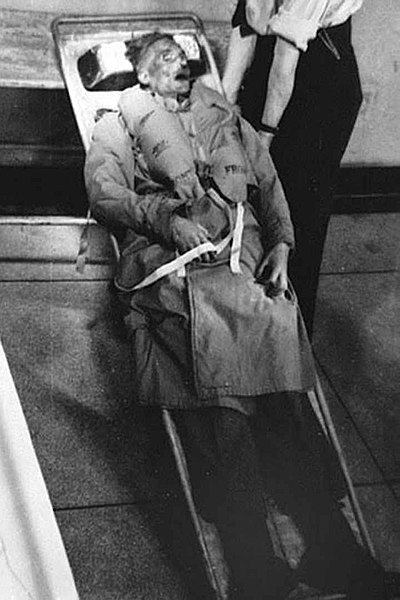
“The Unkillable Soldier” – Adrian Carton de Wiart – Sabaton History 109 [Official]

Filed under: Africa, Britain, History, Media, Military, WW1 — Tags: , , , , , , — Nicholas @ 04:00

Sabaton History
Published 21 Mar 2022

Adrian Carton de Wiart fought in a variety of wars over more than forty years, and he was wounded … again and again and again, and yet he always came back for more. This episode is his sometimes ridiculous but always interesting and incredible story.

Support Sabaton History on Patreon: https://www.patreon.com/sabatonhistory

Listen to “The Unkillable Soldier” on the album The War To End All Wars: https://music.sabaton.net/TheWarToEnd…

Watch the Official Music Video of “The Unkillable Soldier” here: https://www.youtube.com/watch?v=b4vj_…

Watch more videos on the Sabaton YouTube channel: https://www.youtube.com/user/Sabaton
Listen to Sabaton on Spotify: https://sabat.one/Spotify
Official Sabaton Merchandise Shop: http://bit.ly/SabatonOfficialShop

Hosted by: Indy Neidell
Written by: Markus Linke and Indy Neidell
Directed by: Astrid Deinhard and Wieke Kapteijns
Produced by: Pär Sundström, Astrid Deinhard and Spartacus Olsson
Creative Producer: Maria Kyhle
Executive Producers: Pär Sundström, Joakim Brodén, Tomas Sunmo, Indy Neidell, Astrid Deinhard, and Spartacus Olsson
Community Manager: Maria Kyhle
Post-Production Director: Marek Kaminski
Editor: Iryna Dulka
Sound Editor: Marek Kaminski
Archive: Reuters/Screenocean – https://www.screenocean.com
Colorization:
– Julius Jääskeläinen – https://www.facebook.com/JJcolorization/

Sources:
National Army Museum, London
IWM HU 94459, Q 4511, Q 7105, Q 3140, IWM 32, IWM 162, IWM Q 68300, IWM 130-09+10
National Library of Scotland
All music by: Sabaton

An OnLion Entertainment GmbH and Raging Beaver Publishing AB co-Production.

© Raging Beaver Publishing AB, 2019 – all rights reserved.

West Germany’s Wirtschaftwunder — the staggering economic postwar recovery

Christian Monson debunks the common tale taught in western schools of reason for the amazing recovery of West Germany’s economy after World War Two:

Occupation zone borders in Germany, 1947. The territories east of the Oder-Neisse line, under Polish and Soviet administration/annexation, are shown as cream as is the likewise detached Saar protectorate. Berlin is the multinational area within the Soviet zone.

Image based on map data of the IEG-Maps project (Andreas Kunz, B. Johnen, and Joachim Robert Moeschl of the University of Mainz) — www.ieg-maps.uni-mainz.de, via Wikimedia Commons.

This “economic miracle” is commonly referred to as die Wirtschaftswunder. But how did Germany go from rubble to riches in just a decade while neutral countries like Spain merely treaded economic water? If you ask your average American history student, they will say the Marshall Plan, of course!

Unfortunately, the ubiquity of the myth that the Marshall Plan rebuilt Germany is proof that state-controlled education favors propaganda over economic literacy. Despite the fact that most modern historians don’t give the Marshall Plan much credit at all for rebuilding Germany and attribute to it less than 5 percent of Germany’s national income during its implementation, standard history textbooks still place it at the forefront of the discussion about post-war reconstruction.

Consider this section from McDougal Littell’s World History (p. 968), the textbook I was given in high school:

    This assistance program, called the Marshall Plan, would provide food, machinery, and other materials to rebuild Western Europe. As Congress debated the $12.5 billion program in 1948, the Communists seized power in Czechoslovakia. Congress immediately voted approval. The plan was a spectacular success.

Of course, the textbook makes no mention of the actual cause of the Wirtschaftwunder: sound economic policy. That’s because, for the state, the Marshall Plan makes great statist mythology.

Not only is it frequently brought up to justify the United States getting involved in foreign conflicts, but it simply gives support for central planning. Just look at the economic miracle the government was able to create with easy credit, they say.

And of course, admitting that the billions of dollars pumped into Germany after WWII accomplished next to nothing, especially when compared to something as simple as sound money, would be tantamount to admitting that the government spends most of its time making itself needed when it isn’t and thereby doing little besides getting in the way.

Credit for the turnaround should be accorded to Ludwig Erhard, according to Alasdair Macleod at the Cobden Centre:

Anyone who favours regulation needs to explain away Germany’s post-war success. Her economy had been destroyed, firstly by the Nazi war machine, and then by Allied bombing. We easily forget the state of ruin the country was in, with people in the towns and cities actually starving in the post-war aftermath. The joint British and American military solution was to extend and intensify war-time rationing and throw Marshall aid at the problem.

Then a man called Ludwig Erhard was appointed director of economics by the Bizonal Economic Council, in effect he became finance minister. He decided, against British and American misgivings, as well as opposition from the newly-recreated Social Democrats, to do away with price controls and rationing, which he did in 1948. These moves followed his currency reform that June, which contracted the money supply by about 90%. He also slashed income tax from 85% to 18% on annual incomes over Dm2,500 (US$595 equivalent).

Economists of the Austrian school would comprehend and recommend this strategy, but it goes wholly against the bureaucratic grain. General Lucius Clay, who was the military governor of the US Zone, and to whom Erhard reported, is said to have asked him, “Herr Erhard, my advisers tell me what you have done is a terrible mistake. What do you say to that?”

Erhard replied, “Herr General, pay no attention to them! My advisers tell me the same thing.”

About the same time, a US Colonel confronted Erhard: “How dare you relax our rationing system, when there is a widespread food shortage?”

Erhard replied, “I have not relaxed rationing, I have abolished it. Henceforth the only rationing ticket the people will need will be the deutschemarks. And they will work hard to get those deutschemarks, just wait and see.”

The US Colonel did not have to wait long. According to contemporary accounts, within days of Erhard’s currency reform, shops filled with goods as people realised the money they sold them for would retain its value. People no longer needed to forage for the basics in life, so absenteeism from work halved, and industrial output rose more than 50% in the second half of 1948 alone.

Tank Chats #141 | AEC Armoured Car | The Tank Museum

Filed under: Britain, History, Military, Weapons, WW2 — Tags: , , — Nicholas @ 02:00

The Tank Museum
Published 3 Dec 2021

Tune in to our weekly YouTube content today with David Fletcher as he details the AEC Armoured Car!

00:00 – Intro
00:25 – History of the AEC
04:46 – Key Features
(more…)

QotD: Epitaph for Yugoslavia

Filed under: Europe, History, Quotations — Tags: , — Nicholas @ 01:00

Born as a monarchy, died as a failed socialist state. Succumbed after a life-long illness at the age of 73. Survived by seven ungrateful and prodigal children, nation-states. Preceded in death by other fellow-socialist countries of Europe. Donations (still) welcomed to the impoverished, orphaned Yugonostalgic peoples of the region.

Maria Vivod, “A Late Obituary for a Country: Yugoslavia (1918-1991)”, Quillette, 2021-12-12.

March 21, 2022

Republic to Empire: Sulla A Failed Reaction

seangabb
Published 10 Feb 2021

In 120 BC, Rome was a republic with touches of democracy. A century later, it was a divine right military dictatorship. Between January and March 2021, Sean Gabb explored this transformation with his students. Here is one of his lectures. All student contributions have been removed.
(more…)

M44 Submachine Gun: Finland Copies the Soviet PPS-43

Forgotten Weapons
Published 17 Nov 2021

http://www.patreon.com/ForgottenWeapons

https://www.floatplane.com/channel/Fo…

Cool Forgotten Weapons merch! http://shop.forgottenweapons.com

The kp/31 Suomi submachine gun in Finnish service was an outstanding weapon, but it was slow and expensive to manufacture. When Finnish forces began capturing Soviet PPS-42 and PPS-43 submachine guns from the Soviets in the Continuation War, it was very quickly decided that Finland should copy the design. This was a far simpler, far cheaper stamped sheet-metal design that was not as refined as the Suomi, but much more efficient to make.

The Sudayev design was changed only minimally; primarily to fit the Finnish cartridge (9x19mm Parabellum) and magazines. The guns were originally designed to use the 50-round quad-stack boxes and 71/72 round drums of the Suomi, but also used the Swedish Carl Gustaf m/45 magazine that was adopted by Finland after WW2.

Two companies were approached to produce the M44; Tikkakoski and Ammus Oy. Ammus was unable to source raw materials for the project, and only Tikka put the guns into production. Marshal Mannerheim initially wanted 50,000, but the order was reduced to 20,000 — of which only 10,000 were actually made, due to limited material availability before the end of the war led to production ending. Another 400 were assembled from remaining parts after the war.

In the 1950s, a plan was begun to resume M44 production in order to completely replace the Suomi in Finnish inventory. However, this plan was interrupted when Sam Cummings of InterArms made a deal to trade Finland about 75,000 surplus Sten guns for Finland’s supply of 7.35mm Carcano rifle (received as aid from Italy during the war) along with a melange of old machine guns. This was a sufficient quantity of Stens to handle the duties of the Suomi, and so the Sten went into Finnish service and M44 production was never resumed.

Those Carcano rifles were in turn imported into the United States, and this is why the majority of 7.35mm Carcano here bear Finnish “SA” property stamps. The same is true for the significant number of Chauchat automatic rifles in the US with Finnish property marks, which were also part of the deal.

Contact:
Forgotten Weapons
6281 N. Oracle 36270
Tucson, AZ 85740

« Newer PostsOlder Posts »

Powered by WordPress